Wednesday, December 21, 2022

Q&A with John Van Stry

From my Q&A with John Van Stry, author of Summer's End:
How much work does your title do to take readers into the story?

Honestly, I don't think it does all that much - I mean I hope that it does pique their interest enough to get them to look at the blurb because for a lot of us I think the idea of the end of Summer makes us think of coming changes.

As for how I came up with the name? I honestly don't remember. Most of the time I have trouble coming up with a title and a lot of working titles often go through a change before the final title. This one never changed. What's funny is that my publisher and editor didn't like the title when they first saw it. But after they read the book they never suggested changing it again. So I think the book does capture the title, once you've read it.

What's in a name?

I picked Dave's name because...[read on]
Visit John Van Stry's website.

Q&A with John Van Stry.

--Marshal Zeringue

Pg. 99: A. David Redish's "Changing How We Choose"

Featured at the Page 99 Test: Changing How We Choose: The New Science of Morality by A. David Redish.

About the book, from the publisher:
The “new science of morality” that will change how we see each other, how we build our communities, and how we live our lives.

In Changing How We Choose, David Redish makes a bold claim: Science has “cracked” the problem of morality. Redish argues that moral questions have a scientific basis and that morality is best viewed as a technology—a set of social and institutional forces that create communities and drive cooperation. This means that some moral structures really are better than others and that the moral technologies we use have real consequences on whether we make our societies better or worse places for the people living within them. Drawing on this new scientific definition of morality and real-world applications, Changing How We Choose is an engaging read with major implications for how we see each other, how we build our communities, and how we live our lives.

Many people think of human interactions in terms of conflicts between individual freedom and group cooperation, where it is better for the group if everyone cooperates but better for the individual to cheat. Redish shows that moral codes are technologies that change the game so that cooperating is good for the community and for the individual. Redish, an authority on neuroeconomics and decision-making, points out that the key to moral codes is how they interact with the human decision-making process. Drawing on new insights from behavioral economics, sociology, and neuroscience, he shows that there really is a “new science of morality” and that this new science has implications—not only for how we understand ourselves but also for how we should construct those new moral technologies.
Visit A. David Redish's website.

The Page 99 Test: Changing How We Choose.

--Marshal Zeringue

Five top modern LA noir books by women writers

Alex Kenna is a lawyer, writer, and amateur painter based in Los Angeles.

Before law school, Kenna studied painting and art history at Penn. She also worked as a freelance art critic and culture writer. Originally from Washington DC, Kenna lives in Los Angeles with her husband, son, and giant schnauzer, Zelda. When she’s not writing Kenna can be found nerding out in art museums, exploring flea markets, and playing string instruments badly.

Her debut novel is What Meets the Eye.

[Q&A with Alex Kenna; My Book, The Movie: What Meets the Eye]

At CrimeReads Kenna shared "a short list of modern LA noir books by women writers sure to keep you flipping pages well after the lights should be out." One title on the list:
These Women by Ivy Pochoda

These Women is told in the voices of a several women affected by a vicious killer who targeted sex workers years ago. We hear from the mother of a murdered teen, a police officer, the sole surviving victim, and a young erotic dancer just discovering her keen eye for photography. When more women are killed after a long break in the carnage, all of the protagonists are affected in profound and sometimes deadly ways. The story is loosely inspired by the Grim Sleeper, a murderer who killed and tortured women in the 1980s, took an extended hiatus, and attacked again in 2002.

Far from archetypes, Pochoda’s characters are multifaceted and distinct. She masterfully switches between these very different women, giving us a glimpse of their inner worlds. Among the most compelling is Julianna, the dancer who has an artistic epiphany and discovers that she’s a talented photographer in her own right – albeit one the LA art world has no interest in discovering. Julianna’s chapters capture the ecstasy of being young and creatively gifted. Seeing her come into her own only heightens our fear for her, as she continues dancing to put food on the table while a killer wanders the streets.

These Women paints a vivid picture of LA as a dangerous, violent place, where just trying to make a living can be a deadly undertaking. The story is gut-wrenching, but the book is un-put-downable.
Read about another entry on the list.

These Women is among Meg Gardiner's six favorite crime fiction books, Eliza Jane Brazier's ten top thrilling stories of Los Angeles, Stephen Miller's favorite crime titles of 2020 and Smith Henderson and Jon Marc Smith's ten American masterpieces that are actually crime fiction.

The Page 69 Test: These Women.

--Marshal Zeringue

Tuesday, December 20, 2022

Pg. 69: Shirley Russak Wachtel's "A Castle in Brooklyn"

Featured at the Page 69 Test: A Castle in Brooklyn: A Novel by Shirley Russak Wachtel.

About the book, from the publisher:
Spanning decades, an unforgettable novel about reckoning with the past, the true nature of friendship, and the dream of finding home.

1944, Poland. Jacob Stein and Zalman Mendelson meet as boys under terrifying circumstances. They survive by miraculously escaping, but their shared past haunts and shapes their lives forever.

Years later, Zalman plows a future on a Minnesota farm. In Brooklyn, Jacob has a new life with his wife, Esther. When Zalman travels to New York City to reconnect, Jacob’s hopes for the future are becoming a reality. With Zalman’s help, they build a house for Jacob’s family and for Zalman, who decides to stay. Modest and light filled, inviting and warm with acceptance―for all of them, it’s a castle to call home.

Then an unforeseeable tragedy―and the grief, betrayals, and revelations in its wake―threatens to destroy what was once an unbreakable bond, and Esther finds herself at a crossroads. A Castle in Brooklyn is a moving and heartfelt immigration story about finding love and building a home and family while being haunted by a traumatic past.
Visit Shirley Wachtel's website and Twitter perch.

The Page 69 Test: A Castle in Brooklyn.

--Marshal Zeringue

Pg. 99: Barbara Leckie's "Climate Change, Interrupted"

Featured at the Page 99 Test: Climate Change, Interrupted: Representation and the Remaking of Time by Barbara Leckie.

About the book, from the publisher:
In this moment of climate precarity, Victorian studies scholar Barbara Leckie considers the climate crisis as a problem of time. Spanning the long nineteenth century through our current moment, her interdisciplinary treatment of climate change at once rethinks time and illustrates that the time for climate action is now.

Climate Change, Interrupted argues that linear, progress-inflected temporalities are not adequate to a crisis that defies their terms. Instead, this book advances a theory and practice of interruption to rethink prevailing temporal frameworks. At the same time, it models the anachronistic, time-blending, and time-layering temporality it advances. In a series of experimental chapters informed by the unlikely trio of Walter Benjamin, Donna Haraway, and Virginia Woolf, Leckie reinflects and cowrites the traditions and knowledges of the long nineteenth century and the current period in the spirit of climate action collaboration.

The current moment demands as many approaches as possible, invites us to take risks, and asks scholars and activists adept at storytelling to participate in the conversation. Climate Change, Interrupted, accordingly, invests in interruption to tell a different story of the climate crisis.
Visit Barbara Leckie's website and learn more about Climate Change, Interrupted at the Stanford University Press website.

The Page 99 Test: Climate Change, Interrupted.

--Marshal Zeringue

Five top humans turned weapons of science fiction

Karen Osborne is the author of Architects of Memory and Engines of Oblivion from Tor Books. Her short fiction appears in Uncanny, Clarkesworld, Fireside, Escape Pod, Robot Dinosaurs, and Beneath Ceaseless Skies. She is a member of the DC/MD-based Homespun Ceilidh Band, emcees the Charm City Spec reading series, and once won a major event filmmaking award for taping a Klingon wedding.

Osborne lives in Baltimore, MD, with two violins, an autoharp, five cameras, two cats and a family.

At the Tor/Forge Blog she tagged five favorite science fiction humans turned weapons, including:
General Shuos Jedao — Ninefox Gambit by Yoon Ha Lee

What immortal dictator doesn’t want a tractable pocket tactician? The leaders of the spacebound hexarchate have one in the form of Shuos Jedao, one of the most gifted military minds of his generation. There’s just one problem: he’s insane.

During his life, Jedao never lost a battle—until he turned heretical traitor and burned an entire fleet under his command. Jedao’s disembodied mind was stored away until the hexarchate needed a win, then forced to win battles for the hexarchate as punishment.

In his revenant form, he isn’t allowed to sleep, nor does he have control of the body into which he’s installed. This time, that body belongs to Kel Cheris, a math genius and dedicated soldier skating on the edge of heresy herself. He’s nothing more than an intelligent weapon meant to help Cheris win the next big fight.

But there’s a problem with hosting a pocket tactician who’s smarter than you. If the hexarchate can’t see what that is, not even immortality will be able to help them.
Read about another entry on the list.

Yoon Ha Lee’s Machineries of Empire series is among Ada Hoffmann's five best science fiction books by autistic authors, Jenn Lyons's five villains who see themselves as heroes, Jeff Somers's fifty greatest debut sci-fi and fantasy novels ever written, and T.W. O'Brien's five recent books that explore the secret lives of robots.

My Book, The Movie: Ninefox Gambit.

--Marshal Zeringue

Monday, December 19, 2022

What is Christiane M. Andrews reading?

Featured at Writers Read: Christiane M. Andrews, author of Wolfish.

Her entry begins:
This question finds me just finishing several wildly different works (which I suppose is fairly typical for me):

I most recently read Grey Bees by Andrey Kurkov (translated by Boris Dralyuk), which offers a stunning portrait of the protracted conflict in eastern Ukraine and the burden of violence its people have had to endure. Written before the 2022 invasion, Grey Bees mourns what was then already lost in Donbas—homes, land, security, everyday simple pleasures—and examines how even fear may turn to apathy in the habitualization of war. Kurkov’s main character, pensioner beekeeper Sergey Sergeyich, struggles to keep his hives safe; what normalcy—including simple human decency—he and others manage to preserve comes to seem heroic. The prose is admirably direct, unflinching and...[read on]
About Wolfish, from the publisher:
The Inquisitor’s Tale meets The Book of Boy in this adventurous fantasy inspired by the myth of Romulus and Remus.

Twelve-year-old Rae is content as the adopted daughter of shepherds, helping with the flock and reveling in the beauty of her family’s hillside farm. But after a frightening encounter with a wolf—to whom she feels a sudden, peculiar connection—Rae realizes there is much more to her past, and her future, than she could have imagined.

Meanwhile, a young girl named Alba goes about her days as an oracle’s apprentice, a duty that confines her to a distant, watery cave. But when she bestows a troubling prophecy on the rising boy-king, her words unintentionally begin a reign of terror, and send Alba on a desperate mission alongside Rae and the wolf.

Inspired by Roman mythology, this mysterious and uniquely magical adventure explores the intricate roles of nature and fate in our lives, the power of language to shape our world, and the boundless importance of love and kindness.
Visit Christiane M. Andrews's website.

My Book, The Movie: Spindlefish and Stars.

The Page 69 Test: Spindlefish and Stars.

Q&A with Christiane M. Andrews.

The Page 69 Test: Wolfish.

Writers Read: Christiane M. Andrews.

--Marshal Zeringue

Seven top New Orleans crime novels

T. G. Herren is the pen name of an award winning author who has published over thirty-six books and over fifty short stories under various names. Herren is a long time resident of New Orleans, where every day is Anything Can Happen Day. Herren has also worked as sports/fitness journalist, an editor, and spent far too many years working in the airline industry.

His new novel is A Streetcar Named Murder.

At CrimeReads Herren tagged seven top New Orleans crime novels, including:
The Devil’s Muse by Bill Loehfelm

Choosing one book to recommend in Bill Loehfelm’s Maureen Coughlin series is difficult—all five books are superb—but decided to go with the Mardi Gras volume. A cocktail waitress on Staten Island in her debut, Maureen has since relocated to New Orleans and become a cop. Working the parade route as a rookie, Maureen is dealing with a half-naked man who throws himself on the hood of a car in the parade when she hears gunshots—and a twisty, fascinating story begins to unfold. Maureen is an engaging heroine—flawed sure, but likable—and Loehfelm’s wild and crazy Carnival season is one of the best in fiction.
Read about other entry on the list.

--Marshal Zeringue

Pg. 99: Erica Hannickel's "Orchid Muse"

Featured at the Page 99 Test: Orchid Muse: A History of Obsession in Fifteen Flowers by Erica Hannickel.

About the book, from the publisher:
A kaleidoscopic journey into the world of nature’s most tantalizing flower, and the lives it has inspired.

The epitome of floral beauty, orchids have long fostered works of art, tales of adventure, and scientific discovery. Tenacious plant hunters have traversed continents to collect rare specimens; naturalists and shoguns have marveled at orchids’ seductive architecture; royalty and the smart set have adorned themselves with their allure. In Orchid Muse, historian and home grower Erica Hannickel gathers these bold tales of the orchid-smitten throughout history, while providing tips on cultivating the extraordinary flowers she features.

Consider Empress Eugenie and Queen Victoria, the two most powerful women in nineteenth-century Europe, who shared a passion for Coelogyne cristata, with its cascading, fragrant white blooms. John Roebling, builder of the Brooklyn Bridge, cultivated thousands of orchids and introduced captivating hybrids. Edmond Albius, an enslaved youth on an island off the coast of Madagascar, was the first person to hand-pollinate Vanilla planifolia, leading to vanilla’s global boom. Artist Frida Kahlo was drawn to the lavender petals of Cattleya gigas and immortalized the flower’s wilting form in a harrowing self-portrait, while more recently Margaret Mee painted the orchids she discovered in the Amazon to advocate for their conservation.

The story of orchidomania is one that spans the globe, transporting readers from the glories of the palace gardens of Chinese Empress Cixi to a seedy dime museum in Gilded Age New York’s Tenderloin, from hazardous jungles to the greenhouses and bookshelves of Victorian collectors. Lush and inviting, with radiant full-color illustrations throughout, Orchid Muse is the ultimate celebration of our enduring fascination with these beguiling flowers.
Visit Erica Hannickel's website.

The Page 99 Test: Orchid Muse.

--Marshal Zeringue

Denise Crittendon's "Where it Rains in Color," the movie

Featured at My Book, The Movie: Where it Rains in Color by Denise Crittendon.

The entry begins:
After writing Where It Rains In Color, I couldn’t help but daydream about certain scenes and images appearing on the big screen.

The novel is picturesque and takes place on an idyllic world that’s actually bathed in fluttering, neon vapors. Tourists from across the galaxy flock to this vacation spot to get drenched in its brilliant mists, marvel at its high-tech underground city and gawk at Lileala who’s the Rare Indigo and considered the most beautiful woman in the galaxy.

That is until a surprise challenge shakes up Lileala’s life and transforms the entire planet.

Throughout it all, the colorful scenes and African culture put me in mind of an enchanting movie where the actors and actresses are dressed in elaborate garments by award-winning costume designer Ruth Carter (best known for the striking regalia in Black Panther and Coming 2 America).

Since the characters are descendants of Africa, if the book were adapted into a film, I’d love to see Lileala portrayed by an ebony actress like Lupita Nyongo or…[read on]
Visit Denise Crittendon's website.

Q&A with Denise Crittendon.

The Page 69 Test: Where it Rains in Color.

My Book, The Movie: Where it Rains in Color.

--Marshal Zeringue

Sunday, December 18, 2022

Five top SFF novels about unrest & rebellion

At Tor.com James Davis Nicoll tagged five top SFF novels about unrest & rebellion, including:
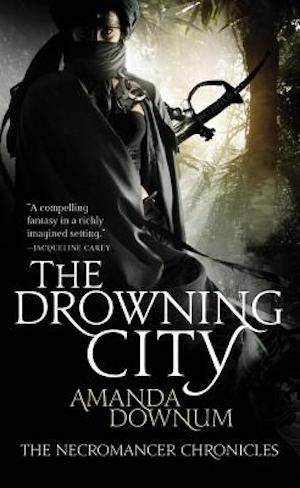
The Drowning City by Amanda Downum (2009)

The rulers of Selafai have a simple dream. They will dispatch spy/necromancer Isyllt Iskaldur to distant Symir, where Isyllt will exacerbate tensions between Symir and their Assari Empire overlords and provoke an uprising that will distract the empire from its predatory intentions for Selafai. The consequences for Symir will no doubt be horrific, but that is a price Selafai is willing that Symir should pay.

Alas for poor Isyllt, while Symir is known as the Drowning City, it could also be called the city of a thousand contending factions. Compared to veteran Symir schemers, Selafai is a land of naïve children. Symir has no time for foreign plots, because it has far too many of its own. Isyllt will do well to survive the learning experience currently bearing down on the visiting necromancer.

The abject failure of the Selafai plot to launch is pretty hilarious, although the violent events that transpire in place of the failed plot are not at all funny. I guess the lesson here is that if you are setting out to manipulate a distant community, pick victims who are not far more politically sophisticated than you are.
Read about another entry on the list.

--Marshal Zeringue

Pg. 99: Musab Younis's "On the Scale of the World"

Featured at the Page 99 Test: On the Scale of the World: The Formation of Black Anticolonial Thought by Musab Younis.

About the book, from the publisher:
This expansive history of Black political thought shows us the origins—and the echoes—of anticolonial liberation on a global scale.

On the Scale of the World examines the reverberations of anticolonial ideas that spread across the Atlantic between the two world wars. From the 1920s to the 1940s, Black intellectuals in Europe, Africa, and the Caribbean established theories of colonialism and racism as structures that must be understood, and resisted, on a global scale. In this richly textured book, Musab Younis gathers the work of writers and poets, journalists and editors, historians and political theorists whose insights speak urgently to contemporary movements for liberation.

Bringing together literary and political texts from Nigeria, Ghana, Sierra Leone, France, the United States, and elsewhere, Younis excavates a vibrant and understudied tradition of international political thought. From the British and French colonial occupations of West Africa to the struggles of African Americans, the hypocrisy of French promises of 'assimilation,' and the many-sided attacks on the sovereignties of Haiti, Liberia, and Ethiopia, On the Scale of the World shows how racialized imperialism provoked critical responses across the interwar Black Atlantic. By transcending the boundaries of any single imperial system, these counternarratives of global order enabled new ways of thinking about race, nation, and empire.
Learn more about On the Scale of the World at the University of California Press website.

The Page 99 Test: On the Scale of the World.

--Marshal Zeringue

Third reading: D.W. Buffa on "The House of Mirth" and "The Writing of Fiction"

D.W. Buffa's recent novel is The Privilege, the ninth legal thriller involving the defense attorney Joseph Antonelli. The tenth, Lunatic Carnival, will be published soon. He has also just published Neumann's Last Concert, the fourth novel in a series that attempts to trace the movement of western thought from ancient Athens, in Helen; the end of the Roman Empire, in Julian's Laughter; the Renaissance, in The Autobiography of Niccolo Machiavelli; and, finally,  America in the twentieth century, in Neumann's Last Concert.

Buffa writes a monthly review for the Campaign for the American Reader that we're calling "Third Reading." Buffa explains. "I was reading something and realized that it was probably the third time that I knew it well enough to write something about it. The first is when I read it when I was in college or in my twenties, the second, however many years later, when I wanted to see if it was as good as I remembered, and the third when I knew I was going to have to write about it."

Buffa's "Third Reading" of The House of Mirth and The Writing of Fiction by Edith Wharton begins:
If you had, like a medieval scholar, spent years in the intensive study of the works of Aristotle, you would remember, if you remembered nothing else, the line with which the great philosopher opened so many of the tightly-reasoned things he wrote: “The beginning is more than half.” If you had not studied Aristotle you might still have a sense of how important, how essential, the beginning is if you had read Edith Wharton’s The House of Mirth. Published in 1905, it was her ninth novel and the first to become a great popular success, with 140,000 copies in print within the three first months it became available. The first paragraph reads:

“Seldon paused in surprise. In the afternoon rush of the Grand Central Station his eyes had been refreshed by the sight of Miss Lily Bart.” Then, a few lines later: “There was nothing new about Lily Bart, yet he could never see her without a faint movement of interest: it was characteristic of her that she always roused speculation, that her simplest acts seemed the result of far-reaching intentions.”

Toward the end of the page, the first page of the novel, Edith Wharton adds that Seldon had rarely seen Miss Bart more “radiant,” that she had, “against the dull tints of the crowd…regained the girlish smoothness, the purity of tint, that she was beginning to lose after eleven years of late hours and indefatigable dancing. Was it really eleven years, Seldon found himself wondering, and had she indeed reached the nine-and-twentieth birthday with which her rivals credited her?”

When Edith Wharton was a very young child...[read on]
About Buffa's recent novel Neumann’s Last Concert, from the publisher:
Neumann’s Last Concert is a story about music and war and the search for what led to the greatest evil in modern history. It is the story of an American boy, Wilfred Malone, who lost his father in the early days of the Second World War and a German refugee, Isaac Neumann, the greatest concert pianist of his age when he lived in Berlin, but who now lives, anonymous and alone, in a single rented room in a small town a few miles from San Francisco.

Wilfred has a genius for the piano, “a keen curiosity not yet corrupted by vanity” and “a memory that forgot nothing essential.” Neumann, alone in his room, is constantly writing, an endless labyrinth of questions and answers, driving him farther and farther back into the past, searching for the causes, searching for the meaning, of what happened in Germany, trying to understand what had led him, a German Jew, to stay in Germany when he could have left but instead continued to perform right up to the night that during his last concert they took his wife away.

Neumann’s Last Concert is a novel about the great catastrophe of the 20th century and the way in which music, great music, preserves both the hope of human decency amidst the carnage of human insanity and the possibility of what human beings might still accomplish.
Visit D.W. Buffa's website.

Third reading: The Great Gatsby. 

Third reading: Brave New World.

Third reading: Lord Jim.

Third reading: Death in the Afternoon.

Third Reading: Parade's End.

Third Reading: The Idiot.

Third Reading: The Decline and Fall of the Roman Empire.

Third Reading: The Scarlet Letter.

Third Reading: Justine.

Third Reading: Patriotic Gore.

Third reading: Anna Karenina.

Third reading: The Charterhouse of Parma.

Third Reading: Emile.

Third Reading: War and Peace.

Third Reading: The Sorrows of Young Werther.

Third Reading: Bread and Wine.

Third Reading: “The Crisis of the Mind” and A Man Without Qualities.

Third reading: Eugene Onegin.

Third Reading: The Collected Works of Thomas Babington Macaulay.

Third Reading: The Europeans.

Third Reading: The House of Mirth and The Writing of Fiction.

--Marshal Zeringue

Saturday, December 17, 2022

Ten of the best novels about Asian American politics

Ryan Lee Wong was born and raised in Los Angeles, lived for two years at Ancestral Heart Zen Temple, and currently lives in Brooklyn, where he is the administrative director of Brooklyn Zen Center. Previously, he served as program director for the Asian American Writers’ Workshop and managing director of Kundiman. He has organized exhibitions and written extensively on the Asian American movements of the 1970s. He holds an MFA in fiction from Rutgers University–Newark.

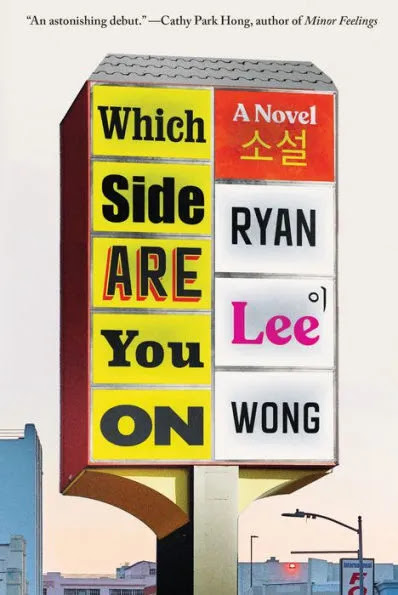
Which Side Are You On is his first book.

At Publishers Weekly he tagged ten must-read novels about Asian American politics, including:
The Reluctant Fundamentalist by Mohsin Hamid

The narrator of this novel talks to you, but the “you” of it is an ambiguous American who is in Lahore, Pakistan, for unknown reasons—to befriend the narrator, to kill him, or both. Like the confessor in Camus’s The Fall, we get a frank and revealing series of tales, but instead of the existential angst of the judge we have the racial existentialism of the man trying to belong in a world that won’t have him. It’s a reminder that often fundamentalists scorn the very systems in which they once came close to belonging.
Read about another entry on the list.

The Reluctant Fundamentalist is among Maris Kreizman's top twenty-three short books, Colleen Kinder's ten books about chance encounters with strangers, Maris Kreizman's nineteen top short books and stories, Ian MacKenzie's ten top books about Americans abroad, Emily Temple's ten top contemporary novels by and about Muslims, Laila Lalami's eight top books about Muslim life for a nation that knows little about Islam, Porochista Khakpour's top ten novels about 9/11, Jimmy So's five best 9/11 novels, and Ahmede Hussain's five top books in recent South Asian literature.

The Page 69 Test: The Reluctant Fundamentalist.

--Marshal Zeringue

Pg. 99: Uther Charlton-Stevens's "Anglo-India and the End of Empire"

Featured at the Page 99 Test: Anglo-India and the End of Empire by Uther Charlton-Stevens.

About the book, from the publisher:
The standard image of the Raj is of an aloof, pampered and prejudiced British elite lording it over an oppressed and hostile Indian subject population. Like most caricatures, this obscures as much truth as it reveals. The British had not always been so aloof. The earlier, more cosmopolitan period of East India Company rule saw abundant 'interracial' sex and occasional marriage, alongside greater cultural openness and exchange. The result was a large and growing 'mixed-race' community, known by the early twentieth century as Anglo-Indians.

Notwithstanding its faults, Empire could never have been maintained without the active, sometimes enthusiastic, support of many colonial subjects. These included Indian elites, professionals, civil servants, businesspeople and minority groups of all kinds, who flourished under the patronage of the imperial state, and could be used in a 'divide and rule' strategy to prolong colonial rule. Independence was profoundly unsettling to those destined to become minorities in the new nation, and the Anglo-Indians were no exception.

This refreshing account looks at the dramatic end of British rule in India through Anglo-Indian eyes, a perspective that is neither colonial apologia nor nationalist polemic. Its history resonates strikingly with the complex identity debates of the twenty-first century.
Follow Uther Charlton-Stevens on Twitter.

The Page 99 Test: Anglo-India and the End of Empire.

--Marshal Zeringue
Pg. 69: Julie E. Czerneda's "To Each This World"

Featured at the Page 69 Test: To Each This World by Julie E. Czerneda.

About the book, from the publisher:
From an Aurora Award-winning author, a new sci-fi novel follows three intrepid humans caught up in a conflict that stretches across time and space.

Biologist Julie E. Czerneda’s new standalone science fiction novel, To Each This World follows a desperate mission to reconnect with long lost sleeper ships, sent centuries earlier from Earth to settle distant worlds.

A trio of Humans must work with their mysterious alien allies to rescue any descendants they can find on those worlds. Something is out there, determined to claim the cosmos for itself, and only on Earth will Humans be safe.

Or will they?

The challenge isn’t just to communicate with your own kind after generations have passed. It’s to understand what isn’t your kind at all.

And how far will trust take you, when the truth depends on what you are?
Visit Julie E. Czerneda's website.

The Page 69 Test: To Guard Against the Dark.

The Page 69 Test: The Gossamer Mage.

The Page 69 Test: Mirage.

Q&A with Julie E. Czerneda.

The Page 69 Test: To Each This World.

--Marshal Zeringue

Friday, December 16, 2022

Eight top books that capture a life in motion

Tree Abraham is an Ottawa-born, Brooklyn-based writer, art director, and book designer. Her authorship experiments with fragmented essay and mixed media visuals.

Cyclettes is her first book.

At Electric Lit she tagged eight of her "favorite books that keenly track on the page the experience of a mind in motion." One title on the list:
What I Talk About When I Talk About Running by Haruki Murakami

Prolific Japanese writer Murakami’s memoir feels almost like dispatches from the road, a light stream of consciousness that comes while he is running in Hawaii, Japan, and New England in preparation for the New York City marathon. His history as a runner and long distance racer has spanned the length of his writing career. What Murakami talks about when he talks about running is running, but also writing, and also the distillation of self. His self is one of great solitude, whose persistent focus at a writing desk parallels his fixed gaze on a horizon during a long run. He revisits past successes and failures in both writing and racing, which are really competitions between his younger and older self, stamina sharpened by a mind that remains present one word or step at a time. Murakami calls himself a physical more than an intellectual person who needs to physically strain his muscles to near an understanding of anything. The secret to succeeding in one’s pursuits is maintaining a pace, he says. Reading the book is like slipping into Murakami’s shoes and lapping in time with him.
Read about another entry on the list.

What I Talk About When I Talk About Running is among Ben Wilkinson's seven top books about running, Karen Campbell's ten top books about freedom, and Lauren Passell's top seven books that belong on every runner’s bookshelf.

--Marshal Zeringue

Pg. 99: Joshua Kurlantzick's "Beijing's Global Media Offensive"

Featured at the Page 99 Test: Beijing's Global Media Offensive: China's Uneven Campaign to Influence Asia and the World by Joshua Kurlantzick.

About the book, from the publisher:
A major analysis of how China is attempting to become a media and information superpower around the world, seeking to shape the politics, local media, and information environments of both East Asia and the World.

Since China's ascendancy toward major-power status began in the 1990s, many observers have focused on its economic growth and expanding military. China's ability was limited in projecting power over information and media and the infrastructure through which information flows. That has begun to change. Beijing's state-backed media, which once seemed incapable having a significant effect globally, has been overhauled and expanded. At a time when many democracies' media outlets are consolidating due to financial pressures, China's biggest state media outlets, like the newswire Xinhua, are modernizing, professionalizing, and expanding in attempt to reach an international audience. Overseas, Beijing also attempts to impact local media, civil society, and politics by having Chinese firms or individuals with close links buy up local media outlets, by signing content-sharing deals with local media, by expanding China's social media giants, and by controlling the wireless and wired technology through which information now flows, among other efforts.

In Beijing's Global Media Offensive--a major analysis of how China is attempting to build a media and information superpower around the world, and how this media power integrates with other forms of Chinese influence--Joshua Kurlantzick focuses on how all of this is playing out in both China's immediate neighborhood--Southeast Asia, Taiwan, Australia, and New Zealand--and also in the United States and many other parts of the world. He traces the ways in which China is trying to build an information and influence superpower, but also critically examines the new conventional wisdom that Beijing has enjoyed great success with these efforts. While China has worked hard to build a global media and information superpower, it often has failed to reap gains from its efforts, and has undermined itself with overly assertive, alienating diplomacy. Still, Kurlantzick contends, China's media, information and political influence campaigns will continue to expand and adapt, helping Beijing exports its political model and protect the ruling Party, and potentially damaging press freedoms, human rights, and democracy abroad. An authoritative account of how this sophisticated and multi-pronged campaign is unfolding, Beijing's Global Media Offensive provides a new window into China's attempts to make itself an information superpower.
Learn more about Beijing's Global Media Offensive and follow Joshua Kurlantzick on Twitter.

The Page 69 Test: Charm Offensive.

The Page 99 Test: A Great Place to Have a War.

The Page 99 Test: Beijing's Global Media Offensive.

--Marshal Zeringue

Q&A with Henriette Lazaridis

photo credit: Sharona Jacobs
From my Q&A with Henriette Lazaridis, author of Terra Nova: A Novel:
How much work does your title do to take readers into the story?

I had a hard time settling on a title for Terra Nova that could signal not only the narrative of my two Antarctic explorers James Watts and Edward Heywoud, but also the story of Viola Heywoud, the woman who loves them both and who remains in London. My placeholder title was Had We Lived, a striking phrase I drew from one of Robert Scott’s final messages from his race to the South Pole. His race against Amundsen had inspired my novel, but that title didn’t capture Viola’s story, and, powerful though the phrase is, it didn’t really capture the ideas of exploration and ambition that I wanted for the book. Finally, after trying After Images (too soft) and An Undiscovered Light (didn’t sound good read aloud), I settled on Terra Nova. It’s a reference to Scott’s Antarctic expedition by that name, but it also stands for all the new territory that each of the three characters in my novel is striving for, including Viola in...[read on]
Visit Henriette Lazaridis's website.

Writers Read: Henriette Lazaridis Power (May 2013).

The Page 69 Test: The Clover House.

Coffee with a Canine: Henriette Lazaridis Power & Finn.

Q&A with Henriette Lazaridis.

--Marshal Zeringue

Thursday, December 15, 2022

Top ten books about freedom

Adam Wagner is a human rights barrister at Doughty Street Chambers. He is the founder and Chair of RightsInfo.

His new book is Emergency State: How We Lost Our Freedoms in the Pandemic and Why it Matters.

Jonathan Freedland, author of The Escape Artist, on Emergency State: "Clear-eyed, forensic and compelling, Wagner sets out what happened during the Covid-19 pandemic - and the lessons we need to learn."

At the Guardian Wagner tagged ten "books that show us what freedom is and others that tell more frightening stories of freedom being taken away." One title on the list:
Maus by Art Spiegelman

Nothing better illustrates the importance of freedom than the story of it being gradually but inexorably ripped away. Spiegelman’s two-part masterpiece literally
illustrates the story of his father’s experience in the Holocaust, from his beginnings in a comfortable and assimilated Polish Jewish family through the Auschwitz murder camp and ultimately to the US, where he lives a broken existence haunted by the suicide of his wife, Art’s mother. The book uses the metaphor of Jews as mice, Nazis as cats. It is audacious and compelling, but never simplistic or melodramatic. To appreciate freedom, we must understand that no society is immune. They were just like us.
Read about another entry on the list.

Art Spiegelman's Maus appears on Tom de Freston's top ten list of books about suffering artists, Paul Gravett's list of ten graphic novels everyone should read, Nicole Hill's list of five graphic novels for readers unfamiliar with the genre yet willing to give it a try, Ben Frederick's list of ten influential authors who came to the US as immigrants, Mary talbot's top ten list of graphic memoirs, Lev Grossman's top ten list of graphic novels, Danny Fingeroth's top 10 list of graphic novels, Meg Rosoff's top 10 list of adult books for teenagers, and Malorie Blackman's top ten list of graphic novels for teenagers.

--Marshal Zeringue