Saturday, November 21, 2020

Five top books about women fighting their way out

James S. Murray is a writer, executive producer, and actor, best known as "Murr" on the hit television show Impractical Jokers on truTV. He is also one of the stars of the TV show The Misery Index on TBS along with his comedy troupe, The Tenderloins.

His new novel, with Darren Wearmouth, is Don't Move.

At CrimeReads, Murray tagged "five books dedicated to women fighting their way out." One title on the list:
Home Before Dark by Riley Sager

Maggie Holt never really had a chance at freedom. Thanks to a tell-all book published by her father, Maggie’s childhood was sold as a freakshow. Chronicling the time she and her family lived in Baneberry Hall, a seemingly haunted estate filled with unusual paranormal activity, the book marked Maggie’s life with a twinge of notoriety she’s never been able to shake. That is, until years later, when as an adult, Maggie inherits the allegedly haunted property and prepares the estate for sale to rid her life of it forever. But before she knows it, the ghosts of the house and the living ghosts of her town come back to haunt her. Pulling from classics like The Amityville Horror and Jackson’s The Haunting of Hill House, Home Before Dark leaves its mark as a downright terrifying novel in a sea of overrated haunting stories. Alongside Maggie, it’s up to the reader to decipher the mysteries of Baneberry Hall and more importantly, to live to tell the tale.
Read about another entry on the list.

Home Before Dark is among Karen Dionne's eight top thrillers that turn home into a place of mortal danger.

The Page 69 Test: Home Before Dark.

--Marshal Zeringue

Q&A with Kristin Fields

From my Q&A with Kristin Fields, author of A Frenzy of Sparks:
How much work does your title do to take readers into the story?

I always know the title of my novels before I start writing. In many ways, the title becomes the question I work backwards to answer. There are many ways that A Frenzy of Sparks connects to the themes of the novel: coming of age, addiction, the civil, political, and societal demands for change (not unlike those of today). In both of my novels, A Lily in the Light and A Frenzy of Sparks, the title has also been a line in the story. 

What's in a name? 

My family is Italian American. Writing this novel was really a way to...[read on]
Visit Kristin Fields's website.

The Page 69 Test: A Lily in the Light.

Writers Read: Kristin Fields (May 2019).

My Book, The Movie: A Frenzy of Sparks.

The Page 69 Test: A Frenzy of Sparks.

Q&A with Kristin Fields.

--Marshal Zeringue

Andrea Portes's "This Is Not a Ghost Story," the movie

Featured at My Book, The Movie: This Is Not a Ghost Story by Andrea Portes.

The entry begins:
This is a fun exercise and one I’ve actually had to do, and continue having to do, if real life. My first novel, Hick, was made into a film starring ChloĆ« Grace Moretz, Eddie Redmayne, Blake Lively and Alec Baldwin. My second novel, Bury This, is currently in development and we are just now in this exact stage… of imagining who would be an inspired choice.

For This is Not a Ghost Story, I have no idea who would play Daffodil. I know, simply, that it should be directed by someone who knows how to create a kind of quiet, eerie tension. Perhaps the director of...[read on]
Visit Andrea Portes's website.

My Book, The Movie: This Is Not a Ghost Story.

--Marshal Zeringue

Friday, November 20, 2020

Eight books to read instead of "Hillbilly Elegy"

At the Los Angeles Times, Lorraine Berry tagged eight books that offer a more honest approach to America's working class than Hillbilly Elegy, including:
Ramp Hollow by Steven Stoll

Stoll examines the causes of poverty in the Appalachian region, drawing from a documented history of violence and exploitative capitalism to lay out a convincing argument the real culprits are public policy and corporate greed. Along the way, he shows how economic measures of self-reliance have failed to account for communities in which barter often takes the place of cash.
Read about another entry on the list.

--Marshal Zeringue

Pg. 99: Libra R. Hilde's "Slavery, Fatherhood, and Paternal Duty"

Featured at the Page 99 Test: Slavery, Fatherhood, and Paternal Duty in African American Communities over the Long Nineteenth Century by Libra R. Hilde.

About the book, from the publisher:
Analyzing published and archival oral histories of formerly enslaved African Americans, Libra R. Hilde explores the meanings of manhood and fatherhood during and after the era of slavery, demonstrating that black men and women articulated a surprisingly broad and consistent vision of paternal duty across more than a century. Complicating the tendency among historians to conflate masculinity within slavery with heroic resistance, Hilde emphasizes that, while some enslaved men openly rebelled, many chose subtle forms of resistance in the context of family and local community. She explains how a significant number of enslaved men served as caretakers to their children and shaped their lives and identities. From the standpoint of enslavers, this was particularly threatening--a man who fed his children built up the master’s property, but a man who fed them notions of autonomy put cracks in the edifice of slavery.

Fatherhood highlighted the agonizing contradictions of the condition of enslavement, and to be an involved father was to face intractable dilemmas, yet many men tried. By telling the story of the often quietly heroic efforts that enslaved men undertook to be fathers, Hilde reveals how formerly enslaved African Americans evaluated their fathers (including white fathers) and envisioned an honorable manhood.
Learn more about Slavery, Fatherhood, and Paternal Duty at the University of North Carolina Press website.

The Page 99 Test: Slavery, Fatherhood, and Paternal Duty.

--Marshal Zeringue

Pg. 69: Josh Swiller's "Bright Shining World"

Featured at the Page 69 Test: Bright Shining World by Josh Swiller.

About the book, from the publisher:
A darkly funny thriller about one boy’s attempt to unravel the mysterious phenomenon affecting students in his new town, as he finds a way to resist sinister forces and pursue hope for them all.

Wallace Cole is perpetually moving against his will. His father has some deeply important job with an energy company that he refuses to explain to Wallace who is, shall we say, suspicious. Not that his father ever listens to him. Just as Wallace is getting settled into a comfortable life in Kentucky, his father lets him know they need to immediately depart for a new job in a small town in Upstate New York which has recently been struck by an outbreak of inexplicable hysterics–an outbreak which is centered at the high school Wallace will attend.

In the new town, go from disturbing to worse: trees appear to be talking to people; a school bully, the principal, and the town police force take an instant dislike to Wallace; and the student body president is either falling for him or slipping into the enveloping darkness. Bright Shining World is a novel of resistance, of young people finding hope and courage and community in a collapsing world.
Visit Josh Swiller's website.

The Page 69 Test: Bright Shining World.

--Marshal Zeringue

Thursday, November 19, 2020

Top ten books about great thinkers

Peter Salmon was born in Australia but now lives in the UK. His first novel The Coffee Story was a New Statesman Book of the Year. He has written for the Guardian, the Sydney Review of Books, the New Humanist, as well as Australian TV and radio. He has received the Writer's Awards from the Arts Council of England and the Arts Council of Victoria, Australia.

Salmon's new book is An Event, Perhaps: A Biography of Jacques Derrida.

At the Guardian, he tagged ten of the best books about great thinkers, including:
At the Existentialist Cafe by Sarah Bakewell

Along with Stuart Jeffries’ Grand Hotel Abyss, this has become the ne plus ultra of group biographies, to the point where any pitch for a book in this area these days has to say: “It’s like At Existentialist Cafe meets The Rest Is Noise.” There’s a reason for this. Bakewell’s ability to connect a thinker’s ideas to their life and personality is impressive. I particularly love her slow, minutely reasoned, takedown of Heidegger the man: displaying Paul Celan’s books in the window of his local bookshop is, she writes, “the single documented example I can find of him actually doing something nice”.
Read about another entry on the list.

--Marshal Zeringue

Q&A with Susan Lewis

From my Q&A with Susan Lewis, author of My Lies, Your Lies:
How much work does your title do to take readers into the story?

I sometimes feel that getting the right title can be almost as difficult as deciding what the book is going to be about. I think titles can matter a lot, especially for less well-known authors as their names won’t be strong enough on their own to pull readers in. In the case of My Lies, Your Lies I knew I had to come up with something fast, as my publisher was keen to go with a title I simply didn’t feel was right. Their suggestion was Forgive Me which didn’t cover it at all. (It is now the title for my next book.) Luckily, everyone went for My Lies, Your Lies as it does go some way towards telling you what the book is about.

What's in a name?

Names are always important to me. It helps me to see the character, to understand something of their personality and to portray the right image of them to a reader. In My Lies, Your Lies I chose the name Joely for the lead protagonist because of its gentleness, elegance and relevance to age (early forties). There is also, I feel, a determination and intelligence to it. As for Freda, the other main character, I chose that because...[read on]
Visit Susan Lewis's website.

My Book, The Movie: My Lies, Your Lies.

Q&A with Susan Lewis.

--Marshal Zeringue

Pg. 99: Geoffrey F. Gresh's "To Rule Eurasia’s Waves"

Featured at the Page 99 Test: To Rule Eurasia’s Waves: The New Great Power Competition at Sea by Geoffrey F. Gresh.

About the book, from the publisher:
The first book to weave Eurasia together through the perspective of the oceans and seas

Eurasia’s emerging powers—India, China, and Russia—have increasingly embraced their maritime geographies as they have expanded and strengthened their economies, military capabilities, and global influence. Maritime Eurasia, a region that facilitates international commerce and contains some of the world’s most strategic maritime chokepoints, has already caused a shift in the global political economy and challenged the dominance of the Atlantic world and the United States. Climate change is set to further affect global politics.

With meticulous and comprehensive field research, Geoffrey Gresh considers how the melting of the Arctic ice cap will create new shipping lanes and exacerbate a contest for the control of Arctic natural resources. He explores as well the strategic maritime shifts under way from Europe to the Indian Ocean and Pacific Asia. The race for great power status and the earth’s changing landscape, Gresh shows, are rapidly transforming Eurasia and thus creating a new world order.
Learn more about To Rule Eurasia’s Waves at the Yale University Press website.

The Page 99 Test: To Rule Eurasia’s Waves.

--Marshal Zeringue

Pg. 69: Thilde Kold Holdt's "Northern Wrath"

Featured at the Page 69 Test: Northern Wrath: The Hanged God Trilogy by Thilde Kold Holdt.

About the book, from the publisher:
A dead man, walking between the worlds, foresees the end of the gods. A survivor searching for a weapon releases a demon from fiery Muspelheim. A village is slaughtered by Christians, and revenge must be taken.

The bonds between the gods and Midgard are weakening. It is up to Hilda, Ragnar, their tribesmen Einer and Finn, the chief's wife Siv and Tyra, her adopted daughter, to fight to save the old ways from dying out, and to save their gods in the process.

Following in the steps of Neil Gaiman & Joanne Harris, the author expertly weaves Norse myths and compelling characters into this fierce, magical epic fantasy.
Visit Thilde Kold Holdt's website.

Q&A with Thilde Kold Holdt.

The Page 69 Test: Northern Wrath.

--Marshal Zeringue

Wednesday, November 18, 2020

Q&A with Ruth Gilligan

From my Q&A with Ruth Gilligan, author of The Butchers' Blessing:
How much work does your title do to take readers into the story?

I would have said that the title of my novel was key – the thing that came almost before the story itself; the one aspect of my work-in-progress that I was happy to talk about.

‘What are you writing at the moment?’ people would ask.

‘A novel called The Butchers.’

‘Ooh – great title!’

And this was still the case when the book came out in the UK and Ireland – a book about the clash of tradition and modernity in late 90s Ireland; a book about a group of eight men, known as the Butchers, who travel the country slaughtering cattle according to a set of ancient folkloric customs; a book about the women they leave behind.

But then the book was bought by an American publisher and the first thing they said was: ‘We love the novel, but we need to change the name.’

They said it was too violent; too savage; that although the Butchers were a key feature of the plot, there was so much else going on too – there were stories of family and loss; of folklore and feminism; stories of individuals – and the country around them – finally coming of age. The Butchers, as a title, was too specific; too harsh.

In the end, we compromised on The Butchers’ Blessing. It meant there was a continuity between the UK and US editions, but it was also a little softer; a little less gory; a little more suggestive of the focus on faith and tradition and superstition. I will never know for certain how the different titles...[read on]
Visit Ruth Gilligan's website.

Q&A with Ruth Gilligan.

--Marshal Zeringue

Five great psychological thrillers set in isolated places

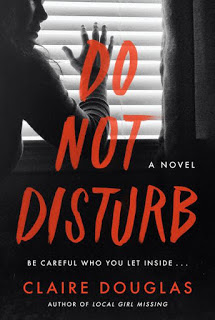
Claire Douglas has worked as a journalist for fifteen years writing features for women’s magazines and national newspapers, but she’s dreamed of being a novelist since the age of seven. She finally got her wish after winning the Marie Claire Debut Novel Award, with her first novel, The Sisters. She lives in Bath with her husband and two children.

Douglas's new novel is Do Not Disturb.

At CrimeReads she tagged "five of [her] favorite psychological thrillers that use isolated locations to create that sense of menace and fear." One title on the list:
In A Dark Dark Wood by Ruth Ware

In this Agatha Christie-esque debut novel by the brilliant Ruth Ware, the main character, Nora, is invited to a hen party with a small group of friends, to a house in the middle of the woods during winter. So far so chilling, but when the snow storm cuts them off from the rest of the world, the sense of isolation ramps up several notches and with it the tension. Especially when strange things start to happen; unexplained footprints in the snow, no reception on their phones. And then somebody is killed. This is a claustrophobic and scary psychological thriller where you don’t know who, out of all the friends, including the main character, to trust.
Read about another entry on the list.

In A Dark Dark Wood is among Jody Gehrman's top seven novels that use weather to enhance the suspense.

--Marshal Zeringue

Pg. 99: Toby Musgrave's "The Multifarious Mr. Banks"

Featured at the Page 99 Test: The Multifarious Mr. Banks: From Botany Bay to Kew, The Natural Historian Who Shaped the World by Toby Musgrave.

About the book, from the publisher:
A fascinating life of Sir Joseph Banks which restores him to his proper place in history as a leading scientific figure of the English Enlightenment

As official botanist on James Cook's first circumnavigation, the longest-serving president of the Royal Society, advisor to King George III, the "father of Australia," and the man who established Kew as the world's leading botanical garden, Sir Joseph Banks was integral to the English Enlightenment. Yet he has not received the recognition that his multifarious achievements deserve.

In this engaging account, Toby Musgrave reveals the true extent of Banks’s contributions to science and Britain. From an early age Banks pursued his passion for natural history through study and extensive travel, most famously on the HMS Endeavour. He went on to become a pivotal figure in the advancement of British scientific, economic, and colonial interests. With his enquiring, enterprising mind and extensive network of correspondents, Banks’s reputation and influence were global. Drawing widely on Banks's writings, Musgrave sheds light on Banks’s profound impact on British science and empire in an age of rapid advancement.
Visit Toby Musgrave's website.

The Page 99 Test: The Multifarious Mr. Banks.

--Marshal Zeringue

Wayne Santos's "The Chimera Code," the movie

Featured at My Book, The Movie: The Chimera Code by Wayne Santos.

The entry begins:
The Chimera Code is a cyberpunk science fiction adventure that takes place in a 22nd century Earth where magic returned to an already high tech world, and then was gradually integrated into that environment. By the time Cloke, the main character has her adventure the world has already had several decades of uneasy coexistence with both magic and technology, and that use and abuse of those forces has created a very different world and government structure. 

My dream casting would involve a pretty diverse cast, since the characters themselves come from many different countries and lifestyles. For Cloke, the half-Filipino, half-Irish combat mage, I think someone like fellow Canuck and actual Filipino/Irish mx Shay Mitchell would make a fine Cloke. 

For the other main character, Zee is a nonbinary hacker that’s been genetically engineered to some very particular “specs,” one of them being the almost sculpted perfection of their features. I think...[read on]
Visit Wayne Santos's website.

The Page 69 Test: The Chimera Code.

My Book, The Movie: The Chimera Code.

--Marshal Zeringue

Tuesday, November 17, 2020

Pg. 69: Kristin Fields's "A Frenzy of Sparks"

Featured at the Page 69 Test: A Frenzy of Sparks: A Novel by Kristin Fields.

About the book, from the publisher:
From the author of A Lily in the Light comes a poignant story of innocence lost and what it means to grow up too fast.

It’s 1965, and thirteen-year-old Gia, along with her older brother and cousins, are desperate to escape their sleepy, tree-lined neighborhood where nothing ever happens. The only thing Gia would miss is the surrounding marsh, where she feels at home among sea birds and salt water.

But when one of Gia’s cousins brings drugs into their neighborhood, it sets off a chain of events that quickly turn dangerous. Everyone will be caught in the ripples, and some may be swept away entirely. Gia is determined to keep herself and her family afloat while the world is turned upside down around her. Can she find a way to hold on to the life she was so eager to leave behind, or will she have to watch it all disappear beneath the marsh forever?

At turns heart-wrenching and hopeful, A Frenzy of Sparks explores a world where survival is the attempt to move forward while leaving pieces of your heart behind.
Visit Kristin Fields's website.

The Page 69 Test: A Lily in the Light.

Writers Read: Kristin Fields (May 2019).

My Book, The Movie: A Frenzy of Sparks.

The Page 69 Test: A Frenzy of Sparks.

--Marshal Zeringue

Eight top serial killer thrillers

Aurora Lydia Dominguez is a high school teacher, professor, journalist, writer and moderator as well as a cosplayer based in sunny Hollywood, Florida.

At Book Riot she tagged eight books about serial killers that will chill you to the bone, including:
Final Girls by Riley Sager 

Ten years ago, college student Quincy Carpenter went on vacation with five friends and came back alone, the only survivor of a horror movie–scale massacre by someone who was targeting them. Then, she became a member of a club no one would want to belong to, a group of similar survivors known in the press as the Final Girls. There’s Lisa, who lost nine sorority sisters; Sam, who went up against the killer during her shift at the Nightlight Inn; and now Quincy, who ran bleeding through the woods to escape Pine Cottage and the man behind the knife. The three girls are all attempting to put their nightmares behind them, but at what cost? This thriller, full of murder, intrigue, and plenty of twists and turns, will keep you tossing and turning until you figure out its outcome.
Read about another entry on the list.

--Marshal Zeringue

Q&A with Glen Erik Hamilton

From my Q&A with Glen Erik Hamilton, author of A Dangerous Breed:
How much work does your title do to take readers into the story?

Titles are key. They need to immediately draw a prospective reader's interest. For genre fiction they have to say "thriller" without sounding generic. And ideally a title will give a hint as to the theme of the novel. It's rare that I have a title before I've written the first or even the second draft of a new book. 

A Dangerous Breed was an exception. Since I knew the story would be about Van Shaw investigating his parentage, and his worries that violence and crime were inherited traits, I had similar titles floating in my head from the start. Consequently, the motif of dogs--fearsome and otherwise--and the question of nature vs. nurture worked their way into the writing without...[read on]
Visit Glen Erik Hamilton's website.

The Page 69 Test: A Dangerous Breed.

Q&A with Glen Erik Hamilton.

--Marshal Zeringue

Pg. 99: Erica De Bruin's "How to Prevent Coups d'Ɖtat"

Featured at the Page 99 Test: How to Prevent Coups d'Ɖtat: Counterbalancing and Regime Survival by Erica De Bruin.

About the book, from the publisher:
In this lively and provocative book, Erica De Bruin looks at the threats that rulers face from their own armed forces. Can they make their regimes impervious to coups?

How to Prevent Coups d'Ɖtat shows that how leaders organize their coercive institutions has a profound effect on the survival of their regimes. When rulers use presidential guards, militarized police, and militia to counterbalance the regular military, efforts to oust them from power via coups d'Ć©tat are less likely to succeed. Even as counterbalancing helps to prevent successful interventions, however, the resentment that it generates within the regular military can provoke new coup attempts. And because counterbalancing changes how soldiers and police perceive the costs and benefits of a successful overthrow, it can create incentives for protracted fighting that result in the escalation of a coup into full-blown civil war.

Drawing on an original dataset of state security forces in 110 countries over a span of fifty years, as well as case studies of coup attempts in Asia, Africa, Latin America, and the Middle East, De Bruin sheds light on how counterbalancing affects regime survival. Understanding the dynamics of counterbalancing, she shows, can help analysts predict when coups will occur, whether they will succeed, and how violent they are likely to be. The arguments and evidence in this book suggest that while counterbalancing may prevent successful coups, it is a risky strategy to pursue—and one that may weaken regimes in the long term.
Visit Erica De Bruin's website.

The Page 99 Test: How to Prevent Coups d'Ɖtat.

--Marshal Zeringue

Monday, November 16, 2020

Q&A with Thilde Kold Holdt

From my Q&A with Thilde Kold Holdt, author of Northern Wrath: The Hanged God Trilogy:
What non-literary inspirations have influenced your writing?

The biggest inspiration is undoubtedly the time I’ve spent sailing aboard a Viking warship. By the time I began to sail with the ship I was already halfway through Northern Wrath, but my experience aboard changed my perception of the Vikings and their communities and one can even say that it shaped the novel.

Northern Wrath is about a village’s final battle to protect their way of life. It was only after sailing with the longship that I realised that in reality, the story is not about a village but about a family’s struggle to survive and protect each other. They don’t really need to be blood-related to be family. They’re all from Ash-hill and that is a bond that is as strong as...[read on]
Visit Thilde Kold Holdt's website.

Q&A with Thilde Kold Holdt.

--Marshal Zeringue

Pg. 69: Wayne Santos's "The Chimera Code"

Featured at the Page 69 Test: The Chimera Code by Wayne Santos.

About the book, from the publisher:
Everything's for hire - even magic. 

If you need something done, Cloke's one of the best; a mercenary with some unusual talents and an attitude to match. But when she's hired by a virtual construct to destroy the other copies of himself, and the down payment is a new magical skill, she knows this job is going to be a league harder than anything she's ever done. 

An action-packed techno-thriller with a side of magical realism from a bold new voice in genre fiction.
Visit Wayne Santos's website.

The Page 69 Test: The Chimera Code.

--Marshal Zeringue

Nine books about mistaken identity

Christopher Louis Romaguera is an intern at Electric Literature. He has a monthly column at The Ploughshares Blog.

At Electric Lit he tagged nine titles about mistaken identity, including:
An American Marriage by Tayari Jones

An American Marriage by Tayari Jones is a story about how the carceral system in the United States is more about punishment than correction. Roy and Celestial are newlyweds, living as close to an American Dream in their American Marriage that is afforded to them, when through a case of mistaken identity, Roy is arrested. Despite their bond, and their individual strengths, Celestial and Roy’s marriage, love, and lives are pushed to the brink. This story shows that no matter how well individual people know each other, the system’s imprecision can ruin people.
Read about the another entry on the list.

An American Marriage is among Scarlett Harris's eight classic and contemporary novels, written by women, that offer insight into damaged male psyches, Tochi Onyebuchi's seven books about surviving political & environmental disasters, Ruth Reichl's six novels she enjoyed listening to while cooking, Brad Parks's top eight books set in prisons, Sara Shepard's six top stories of deception,and Julia Dahl's ten top books about miscarriages of justice.

--Marshal Zeringue

Sunday, November 15, 2020

Kristin Fields's "A Frenzy of Sparks," the movie

Featured at My Book, The Movie: A Frenzy of Sparks: A Novel by Kristin Fields.

The entry begins:
A Frenzy of Sparks is a coming of age story set in 1965, Queens, just as drugs enter a tight-knit community. Gia is thirteen years old. She loves nature and the bay near her house. If she could, she would spend all day in her boat and doesn’t understand why she isn’t allowed to take it out alone like her slightly older brother can. She is beginning to understand that the world has a different set of rules for men than it does for women, and isn’t particularly excited about becoming a young lady.

I am the absolute worst when it comes to remembering the names of actors/actresses and usually describe them to other people as “that guy who was in that show we watched on Netflix (maybe?) when we lived in Brooklyn and used to order pizza from the place on the corner on Wednesday nights,” which wouldn’t serve us very well here.

Since I would be terrible at casting and directing this, here’s the dream team who can:

Forrest Gump’s director, Robert Zemeckis, because he did a beautiful job portraying the historical events of the 60s and 70s in Forrest Gump, many of which also feature in A Frenzy of Sparks.

He also directed Cast Away, which was on my list of movies that I’d want A Frenzy of Sparks to take after, because they both have suspenseful scenes set in nature, where the main character has to...[read on]
Visit Kristin Fields's website.

The Page 69 Test: A Lily in the Light.

Writers Read: Kristin Fields (May 2019).

My Book, The Movie: A Frenzy of Sparks.

--Marshal Zeringue

Fifty of the greatest apocalypse novels

Emily Temple holds a BA from Middlebury College and an MFA in fiction from the University of Virginia, where she was a Henry Hoyns fellow and the recipient of a Henfield Prize.

Temple's new novel, her first, is The Lightness.

At Lit Hub she tagged fifty great apocalypse and post-apocalypse novels. One title on the list:
Sarah Pinsker, A Song for a New Day (2019)

Oh, weird, a novel in which a string of terrorist attacks, mass shootings, bombings, and then a pandemic, has resulted in widespread fear, consolidation of corporate power, and the end of all public gatherings. So unrealistic, amirite? Instead of Zoom, though, Luce and her band-mates have to contend with StageHolo, basically a holographic pay-per-view for concerts, and their talent scout Rosemary, who never really knew the world Before. Like all the best apocalyptic fiction, this is actually a book about human connection—the fact that it’s also a cool, queer rock and roll novel is just a bonus.
Read about another entry on the list.

A Song for a New Day is among Publishers Weekly's thirteen essential pandemic novels and Mike Chen's five top novels about finding hope at the end of the world.

The Page 69 Test: A Song for a New Day.

--Marshal Zeringue

Pg. 99: Emily J. H. Contois's "Diners, Dudes, and Diets"

Featured at the Page 99 Test: Diners, Dudes, and Diets: How Gender and Power Collide in Food Media and Culture by Emily J. H. Contois.

About the book, from the publisher:
The phrase "dude food" likely brings to mind a range of images: burgers stacked impossibly high with an assortment of toppings that were themselves once considered a meal; crazed sports fans demolishing plates of radioactively hot wings; barbecued or bacon-wrapped ... anything. But there is much more to the phenomenon of dude food than what’s on the plate. Emily J. H. Contois’s provocative book begins with the dude himself—a man who retains a degree of masculine privilege but doesn’t meet traditional standards of economic and social success or manly self-control. In the Great Recession’s aftermath, dude masculinity collided with food producers and marketers desperate to find new customers. The result was a wave of new diet sodas and yogurts marketed with dude-friendly stereotypes, a transformation of food media, and weight loss programs just for guys.

In a work brimming with fresh insights about contemporary American food media and culture, Contois shows how the gendered world of food production and consumption has influenced the way we eat and how food itself is central to the contest over our identities.
Visit Emily Contois's website

The Page 99 Test: Diners, Dudes, and Diets.

--Marshal Zeringue

Q&A with Martyn Ford

From my Q&A with Martyn Ford, author of Every Missing Thing:
How much work does your title do to take readers into the story?

It sets the tone and subject matter. The story is broadly about two missing characters and the effect their absence has on everyone else. Our focus is on what’s not there and what we don’t see, even when we’re watching closely.

There are also subtler themes around honesty and similar virtues lacking from some of the main characters. And how corrosive, and ultimately catastrophic, such shortfalls can be on a long enough timeline.

Plus, it…[read on]
Visit Martyn Ford's website.

Q&A with Martyn Ford.

--Marshal Zeringue

Saturday, November 14, 2020

Six books on America's swinging ideology

Robert D. Putnam is the Malkin Research Professor of Public Policy at Harvard University, having retired from active teaching in May 2018. Raised in a small town in Ohio, he was educated at Swarthmore, Oxford, and Yale. He is a member of the National Academy of Sciences, a Fellow of the British Academy, and past president of the American Political Science Association. In 2006 Putnam received the Skytte Prize, the world’s highest accolade for a political scientist, in 2013 President Barack Obama awarded him the National Humanities Medal, the nation’s highest honor for contributions to the humanities, for “deepening our understanding of community in America,” and in 2018 the International Political Science Association awarded him the Karl Deutsch Award for cross-disciplinary research. He has received sixteen honorary degrees from eight countries, including in 2018, the University of Oxford.

Putnam's books include Bowling Alone and, with Shaylyn Romney Garrett, The Upswing: How America Came Together a Century Ago and How We Can Do It Again.

At The Week magazine. he tagged six books on America's swinging ideology, including:
The Warmth of Other Suns by Isabel Wilkerson (2010).

This masterful chronicle of the Great Migration tells how millions of black Americans, their hopes dashed after Reconstruction, left the South for what looked like a brighter future in the North. It's an inspiring story of black Americans' persistent faith in the promise of the American "we," and their willingness to stand up and claim their place in it — essentially against all odds.
Read about another entry on the list.

--Marshal Zeringue

Pg. 69: A. J. Sass's "Ana on the Edge"

Featured at the Page 69 Test: Ana on the Edge by A. J. Sass.

About the book, from th epublisher:
Twelve-year-old Ana-Marie Jin, the reigning US Juvenile figure skating champion, is not a frilly dress kind of kid. So, when Ana learns that next season’s program will be princess themed, doubt forms fast. Still, Ana tries to focus on training and putting together a stellar routine worthy of national success.

Once Ana meets Hayden, a transgender boy new to the rink, thoughts about the princess program and gender identity begin to take center stage. And when Hayden mistakes Ana for a boy, Ana doesn’t correct him and finds comfort in this boyish identity when he’s around. As their friendship develops, Ana realizes that it’s tricky juggling two different identities on one slippery sheet of ice. And with a major competition approaching, Ana must decide whether telling everyone the truth is worth risking years of hard work and sacrifice.
Visit A. J. Sass's website.

The Page 69 Test: Ana on the Edge.

--Marshal Zeringue

Soledad Maura's "Madrid Again," the movie

Featured at My Book, The Movie: Madrid Again: A Novel by Soledad Maura.

The entry begins:
If my novel were to be turned into a film, my dream screenwriter and director would be Joanna Hogg. Her films resonate deeply. Her most recent, Souvenir, explores the life of a young woman in a poignant, subtle, stylish and haunting way. She is the perfect director for a mother-daughter story, and for people living in liminal spaces.

I would like Spanish actress Adriana Gil to play the mother, Odilia, and...[read on]
Visit Soledad Maura's website.

My Book, The Movie: Madrid Again.

--Marshal Zeringue

Friday, November 13, 2020

Q&A with Corey Sobel

From my Q&A with Corey Sobel, author of The Redshirt:
How much work does your title do to take readers into the story? 

That depends on a reader’s familiarity with college football. 

If you know even a little bit about the game, you will know that a “redshirt” is a term used for freshmen who don’t play their first season and thus retain a year of NCAA eligibility. My hope is that this reader—let’s call them Reader A—has their interest piqued because a redshirt freshman, being the lowest of the low of players on scholarship, isn’t an intuitive focus for a novel. We won’t see this player play in games or impact their team’s season in any real way, which is usually the status quo for the heroes of what few literary novels exist about sports. So what will be the focus? Why will this player’s experience warrant an entire book? Maybe this is a long way of saying that, for the football-savvy, the title will signal that this isn’t your usual sports story—which it isn’t. 

My experience so far, though, is that very few of the book’s readers know a single lonesome thing about college football—and that I haven’t heard reports of people setting The Redshirt on fire or using it as a doorstop suggests that this hasn’t been an obstacle to them enjoying it. For this reader—Reader B—the title will be a bit mysterious. Why is it “redshirt,” one word, instead of “red shirt”? Less literally, I would hope that readers’ minds wander to books that contain something similar to a red shirt; what I’ve heard most often is that they are reminded of Nathanael Hawthorne’s The Scarlet Letter. I am over the moon when people tell me this, because that association is very much intended. Hawthorne is one of my favorite writers, and I had his masterpiece in mind when settling on this title. Just as is the case with The Scarlet Letter, my book focuses on the customs of a deeply conservative society and on the stigma that’s affixed to anyone who dares to rebel against those mores. 

My ultimate hope is...[read on]
Visit Corey Sobel's website.

The Page 69 Test: The Redshirt.

Q&A with Corey Sobel.

--Marshal Zeringue

Pg. 99: Judith G. Coffin's "Sex, Love, and Letters"

Featured at the Page 99 Test: Sex, Love, and Letters: Writing Simone de Beauvoir by Judith G. Coffin.

About the book, from the publisher:
When Judith G. Coffin discovered a virtually unexplored treasure trove of letters to Simone de Beauvoir from Beauvoir's international readers, it inspired Coffin to explore the intimate bond between the famed author and her reading public. This correspondence, at the heart of Sex, Love, and Letters, immerses us in the tumultuous decades from the late 1940s to the 1970s—from the painful aftermath of World War II to the horror and shame of French colonial brutality in Algeria and through the dilemmas and exhilarations of the early gay liberation and feminist movements. The letters also provide a glimpse into the power of reading and the power of readers to seduce their favorite authors.

The relationship between Beauvoir and her audience proved especially long, intimate, and vexed. Coffin traces this relationship, from the publication of Beauvoir's acclaimed The Second Sex to the release of the last volume of her memoirs, offering an unfamiliar perspective on one of the most magnetic and polarizing philosophers of the twentieth century. Along the way, we meet many of the greatest writers of Beauvoir's generation—Hannah Arendt; Dominique Aury, author of The Story of O; FranƧois Mauriac, winner of the Nobel Prize and nemesis of Albert Camus; Betty Friedan; and, of course, Jean-Paul Sartre—bringing the electrically charged salon experience to life.

Sex, Love, and Letters lays bare the private lives and political emotions of the letter writers and of Beauvoir herself. Her readers did not simply pen fan letters but, as Coffin shows, engaged in a dialogue that revealed intellectual and literary life to be a joint and collaborative production. "This must happen to you often, doesn't it?" wrote one. "That people write to you and tell you about their lives?"
Follow Judith Coffin on Twitter, and learn more about Sex, Love, and Letters at the Cornell University Press website.

The Page 99 Test: Sex, Love, and Letters.

--Marshal Zeringue

Five of fiction’s greatest hacker-heroes

James Swallow is an author and scriptwriter with over fifteen years of experience in fiction, television, radio, journalism, new media, and video games. He is a three-time New York Times bestselling author of more than thirty-five novels with over 750,000 books currently in print in nine different worldwide territories. He was nominated by the BAFTA for his writing on the critically acclaimed Deus Ex: Human Revolution. Ghost is the latest novel in Swallow's Marc Dane thriller series.

At CrimeReads, the author tagged five fictional hackers who use their skills for good, including:
Henry Dorsett Case

Case is the wasted, down-at-heel anti-hero of William Gibson’s benchmark cyberpunk science fiction novel Neuromancer. A former “console cowboy” in a technologically enhanced future Japan, Case begins the novel as a drug-addicted burn-out, with his ability to cybernetically interface with the internet forcibly neutered as punishment for stealing from his employers. Offered the chance for a return to his old life, Case takes a job with a shady mercenary that unfolds into a series of escalating infiltrations, recruitments and attacks that take him across the world and eventually to a playground for the mega-rich in near Earth orbit—where a rogue artificial intelligence is planning to break its chains and seek freedom. Case’s story is a Chandler-esque adventure viewed through a Blade Runner lens, and Gibson’s novel captures a uniquely urban, uniquely 80’s view of the future that still retains a razor edge decades later.
Read about another entry on the list.

Neuromancer made Emily Temple's list of ten books that defined the 1980s, Jeff Somers's top ten list of books for non-geek parents of geeksSoman Chainani's top five list of SFF novels with perfect opening linesAbhimanyu Das and Gordon Jackson's list of eleven science fiction books regularly taught in college classesSteve Toutonghi's list of six top books that expand our mental horizonsAnn Leckie's top ten list of science fiction booksMadeleine Monson-Rosen's list of 15 books that take place in science fiction and fantasy versions of the most fascinating places on EarthBecky Ferreira's list of the six most memorable robots in literatureJoel Cunningham's top five list of books that predicted the internetSean Beaudoin's list of ten books that changed his life before he could driveChris Kluwe's list of six favorite booksInglis-Arkell's list of ten of the best bars in science fictionPopCrunch's list of the sixteen best dystopian books of all time and Annalee Newitz's lists of ten great American dystopias and thirteen books that will change the way you look at robots.

--Marshal Zeringue

Thursday, November 12, 2020

Pg. 69: Jennifer Gennari's "Muffled"

Featured at the Page 69 Test: Muffled by Jennifer Gennari.

About the book, from the publisher:
A young girl learns how to cope with her noise sensitivity and step outside of her comfort zone in this heartwarming middle grade novel that’s perfect for fans of If This Were a Story and El Deafo.

Ten-year-old Amelia does not like noise. From subway brakes to squeaky sneakers, she is sensitive to sound, just like her dad. Amelia has always worn noise-canceling headphones, but now that she’s going into fifth grade, her parents want her to stop wearing them. To make matters worse, she must learn to play an instrument! Or, as Amelia sees it, make noise on purpose.

To help Amelia cope, her father gives her a pair of earmuffs to wear instead. Even with her new earmuffs, Amelia struggles at school...until she gets partnered with Madge in music class. Madge is loud and bold and goofy—everything Amelia is not. And so Amelia is surprised when Madge wants to be friends.

Still, it’s not long though before Amelia’s quiet nature clashes with Madge’s loud personality. And when Madge disappears after an argument, Amelia fears Madge might be in trouble. If she’s going to help her friend, she will have to find a way to let in the noisy world she’s muffled for so long.
Visit Jennifer Gennari's website.

The Page 69 Test: Muffled.

--Marshal Zeringue

Q&A with Jessica Gross

From my Q&A with Jessica Gross, author of Hysteria:
What's in a name?

I kept the narrator of Hysteria nameless. The novel is told in what I hope is a very immersive first person; I wanted to embed the reader as deeply as possible in the narrator's psyche. I never think of myself in the third person, so it made most sense to me to lean into "I" and "me" rather than to ever have her think of herself by her name, which would suggest she has some perspective. (Hint: she doesn't! She's very myopic.)

How surprised would your teenage reader self be by your new novel?

Very. Hysteria features a highly sexual protagonist who becomes convinced that her bartender is Sigmund Freud. My teenage self...[read on]
Visit Jessica Gross's website.

The Page 69 Test: Hysteria.

Q&A with Jessica Gross.

--Marshal Zeringue

Pg. 99: Juan JosƩ Ponce-VƔzquez's "Islanders and Empire"

Featured at the Page 99 Test: Islanders and Empire: Smuggling and Political Defiance in Hispaniola, 1580-1690 by Juan JosƩ Ponce-VƔzquez.

About the book, from the publisher:
Islanders and Empire examines the role smuggling played in the cultural, economic, and socio-political transformation of Hispaniola from the late sixteenth to seventeenth centuries. With a rare focus on local peoples and communities, the book analyzes how residents of Hispaniola actively negotiated and transformed the meaning and reach of imperial bureaucracies and institutions for their own benefit. By co-opting the governing and judicial powers of local and imperial institutions on the island, residents could take advantage of, and even dominate, the contraband trade that reached the island's shores. In doing so, they altered the course of the European inter-imperial struggles in the Caribbean by limiting, redirecting, or suppressing the Spanish crown's policies, thus taking control of their destinies and that of their neighbors in Hispaniola, other Spanish Caribbean territories, and the Spanish empire in the region.
Learn more about Islanders and Empire at the Cambridge University Press website.

The Page 99 Test: Islanders and Empire.

--Marshal Zeringue

Top ten books about Lebanon

Born and raised in Beirut, Naji Bakhti graduated from the American University of Beirut (Lebanon, 2011). He recently obtained a PhD in Creative Writing from Lancaster University. Between Beirut and the Moon is his first book.

At the Guardian, Bakhti tagged ten "books about Lebanon which do not immediately concern themselves with the civil war, except when they do." One title on the list:
House of Stone by Anthony Shadid

Shadid’s subtle yet powerful memoir grapples with the meaning of bayt, the Arabic word for house. The American-Lebanese journalist embarks on a journey to rebuild his great-grandfather’s decrepit house in the ailing town of Marjayoun. It is a bittersweet tale about what it means to reconnect with one’s roots. Peopled with eccentric characters who produce such gems as “your family is the shittiest thing”, “Israel was dropping pamphlets from the sky and I was picking cucumbers” and the proud yet casual boast, “did I tell you our house in Marjayoun is older than America?” Tragically, Shadid lost his life on an assignment in Syria in 2012.
Read about another entry on the list.

House of Stone is among Tatjana Soli's six favorite books that conjure exotic locales.

--Marshal Zeringue

Wednesday, November 11, 2020

Susan Lewis's "My Lies, Your Lies," the movie

Featured at My Book, The Movie: My Lies, Your Lies: A Novel by Susan Lewis.

The entry begins:
The lead characters in My Lies, Your Lies are polar opposites. Freda is a manipulative, domineering and vengeful type in her early seventies. Although younger, I’ve always seen Tilda Swinton in the role. She’s a stunningly talented actor who brings such stark and yet layered sinisterness to performances that they’re utterly compelling. At the same time she can fill us with intrigue and sympathy, and lead us to places inside ourselves where we become shocked by our own responses. Definitely a perfect Freda.

Joely is early forties, mother of one hot-headed teenager, wife to a cheating husband and a successful ghostwriter. She has gentleness and beauty in her character, plenty of courage and humour mixed with a quick intelligence and perhaps too much trust. When confronted with Freda a real battle of wits begins and though frequently wrong-footed, Joely is up to the challenge. I can see..[read on]
Visit Susan Lewis's website.

My Book, The Movie: My Lies, Your Lies.

--Marshal Zeringue

Q&A with Louise Guy

From my Q&A with Louise Guy, author of A Life Worth Living:
How much work does your title do to take readers into the story?

The significance of the title, A Life Worth Living, becomes very clear in the novel’s opening pages when the reader is presented with identical twins who lead very different lives, but both desire something different – ideally what each other has. The question is raised by both as to what is worth living for and what they would change if they could. This question holds more meaning as the story progresses and one sister is forced to make a choice which will allow her to follow a different life path. A path that comes at a very high cost to her and...[read on]
Visit Louise Guy's website.

The Page 69 Test: A Life Worth Living.

My Book, The Movie: A Life Worth Living.

Q&A with Louise Guy.

--Marshal Zeringue

Pg. 99: Elizabeth L. Swann's "Taste and Knowledge in Early Modern England"

Featured at the Page 99 Test: Taste and Knowledge in Early Modern England by Elizabeth L. Swann.

About the book, from the publisher:
Elizabeth Swann investigates the relationship between the physical sense of taste and taste as a figurative term associated with knowledge and judgment in early modern literature and culture. She argues that - unlike aesthetic taste in the eighteenth century - discriminative taste was entwined with embodied experience in this period. Although taste was tarnished by its associations with Adam and Eve's fall from Eden, it also functioned positively, as a source of useful, and potentially redemptive, literary, spiritual, experimental, and intersubjective knowledge. Taste and Knowledge in Early Modern England juxtaposes canonical literary works by authors such as Shakespeare with a broad range of medical, polemical, theological, philosophical, didactic, and dietetic sources. In doing so, the book reveals the central importance of taste to the experience and articulation of key developments in the literate, religious, and social cultures of the sixteenth and seventeenth centuries.
Learn more about Taste and Knowledge in Early Modern England at the Cambridge University Press website.

The Page 99 Test: Taste and Knowledge in Early Modern England.

--Marshal Zeringue