Monday, January 09, 2023

Five of the best books about surviving war (or not)

Before becoming a full-time writer, Kevin McColley worked many jobs, including operating a nuclear reactor. He served in the U.S. Navy for six years, during which he traveled throughout the Caribbean pursuing drug runners. He also spent eight months in the Mediterranean recovering downed U.S. pilots, both dead and alive, and he patrolled Gaddafi’s “line of death.”

McColley is the author of several novels, including The Other Side: A Novel of the Civil War.

At Shepherd he tagged five of the best books about surviving war (or not), including:
Blood Meridian: Or the Evening Redness in the West by Cormac McCarthy

In my opinion, the best novel written in the last fifty years. The violence would be too much in the hands of a lesser writer and there is no greater living writer in English than McCarthy. McCarthy perfectly captures the nihilism of war, and how that nihilism later comes back to haunt war’s survivors.
Read about another entry on the list.

Blood Meridian is one authority's pick for the Great Texas novel; it is among Bruce McCandless III's top six books about crime & colonialism at the U.S.-Mexico border, Paul Howarth's top ten tales from the frontier, Craig DiLouie’s ten top fantasy books steeped in the Southern Gothic, Graham McTavish's six best books, ShortList's roundup of literature's forty greatest villains, Brian Boone's five great novels that will probably never be made into movies, Sarah Porter's five best books with unusual demons and devils, Chet Williamson's top ten novels about deranged killers, Callan Wink's ten best books set in the American West, Simon Sebag Montefiore's six favorite books, Richard Kadrey's five books about awful, awful people, Jason Sizemore's top five books that will entertain and drop you into the depths of despair, Robert Allison's top ten novels of desert war, Alexandra Silverman's top fourteen wrathful stories, James Franco's six favorite books, Philipp Meyer's five best books that explain America, Peter Murphy's top ten literary preachers, David Vann's six favorite books, Robert Olmstead's six favorite books, Michael Crummey's top ten literary feuds, Philip Connors's top ten wilderness books, six books that made a difference to Kazuo Ishiguro, Clive Sinclair's top 10 westerns, Maile Meloy's six best books, and David Foster Wallace's five direly underappreciated post-1960 U.S. novels. It appears on the New York Times list of the best American fiction of the last 25 years and among the top ten works of literature according to Stephen King.

--Marshal Zeringue

Pg. 99: Jacqueline Jones's "No Right to an Honest Living"

Featured at the Page 99 Test: No Right to an Honest Living: The Struggles of Boston’s Black Workers in the Civil War Era by Jacqueline Jones.

About the book, from the publisher:
From a Bancroft Prize winner, a harrowing portrait of Black workers and white hypocrisy in nineteenth-century Boston

Impassioned antislavery rhetoric made antebellum Boston famous as the nation’s hub of radical abolitionism. In fact, however, the city was far from a beacon of equality.

In No Right to an Honest Living, historian Jacqueline Jones reveals how Boston was the United States writ small: a place where the soaring rhetoric of egalitarianism was easy, but justice in the workplace was elusive. Before, during, and after the Civil War, white abolitionists and Republicans refused to secure equal employment opportunity for Black Bostonians, condemning most of them to poverty. Still, Jones finds, some Black entrepreneurs ingeniously created their own jobs and forged their own career paths.

Highlighting the everyday struggles of ordinary Black workers, this book shows how injustice in the workplace prevented Boston—and the United States—from securing true equality for all.
Learn more about No Right to an Honest Living at the Basic Books website.

My Book, The Movie: Goddess of Anarchy.

The Page 99 Test: No Right to an Honest Living.

--Marshal Zeringue

Pg. 69: Jean Louise's "Waking Fire"

Featured at the Page 69 Test: Waking Fire by Jean Louise.

About the book, from the publisher:
This incendiary YA fantasy debut follows a girl who will stop at nothing to save her village after it’s discovered by a dangerous warlord and his army of undead monsters.

Naira Khoum has only known life in Lagusa, a quiet village at the desert’s end. But to the rest of the world, Lagusa is a myth, its location shrouded in secrecy. While war rages to the north led by power-hungry Sothpike and his army of undead monsters called Dambi, Naira’s people live in peace.

Until the impossible happens—Lagusa is attacked by a Mistress sent to do Sothpike’s bidding with a hoard of Dambi under her control. The Mistress is looking for something, and she’s willing to let her Dambi destroy Lagusa to get it.

Desperate to protect her home, Naira convinces her twin brother Nez and handsome refugee Kal to join the newly formed resistance with her. Together, they’ll have to figure out what the Mistress wants—before there’s nothing left of Lagusa to save.
Visit Jean Louise's website.

The Page 69 Test: Waking Fire.

--Marshal Zeringue

Sunday, January 08, 2023

Nine top literary classics for the contemporary crime reader

Rebecca Kelley is an author and graphic designer whose first novel, Broken Homes and Gardens, was published in 2015.

Her second novel, No One Knows Us Here, is out this month from Lake Union Publishing.

"There is a point in my novel No One Knows Us Here when my heroine does a very, very bad thing, Kelley writes. "She doesn’t have to do the bad thing—it’s not one of those 'steal a loaf of bread to feed her starving family' situations. She has other options and chooses to go down the dark path anyway."

At CrimeReads Kelley tagged nine literary classics that "borrow elements from the crime writer’s toolkit: complex criminals, layered villains, criminal investigations, court cases, and even a few ghosts and violent psychopaths." One title on the list:
Their Eyes Were Watching God by Zora Neale Hurston (1937)

Now considered a classic of the Harlem Renaissance and taught in schools across the country, Their Eyes Were Watching God was not a huge success at publication, disparaged by other Harlem Renaissance authors such as Richard Wright and Ralph Ellison, who called it a “blight of calculated burlesque.” (RUDE!) In it, 40-something Janie Crawford recounts her life to her friend, taking her through her early sexual experiences and three tumultuous marriages. It’s with her last husband, Tea Cake, a drifter, that she finds the greatest happiness, though it ends in tragedy, with Janie on trial for his murder. After years in obscurity, Their Eyes Were Watching God was rediscovered in the 1970s, thanks in part to an essay Alice Walker wrote for Ms. Magazine called “Looking for Zora,” where she chided Hurston’s earlier critics for “throwing away a genius.”
Read about another entry on the list.

Their Eyes Were Watching God also appears among Henry Adam Svec's seven novels by or about folk musicians, Micheline Aharonian Marcom's eight epic quest stories, Michael Zapata's ten books that were almost lost to history, Yann Martel's five favorite books, and Benjamin Obler's top ten fictional coffee scenes in literature.

--Marshal Zeringue

Pg. 99: Cathal J. Nolan's "Mercy: Humanity in War"

Featured at the Page 99 Test: Mercy: Humanity in War by Cathal J. Nolan.

About the book, from the publisher:
War presents the most degraded moral environment humanity creates. It is an arena where individuality is subsumed in collective violence and humanity is obscured as a faceless, merciless enemy pitted against its reflection in an elemental struggle for survival.

A barbaric logic has guided the conduct of war throughout history. Yet as Cathal Nolan reveals in this gripping, poignant, and powerful book, even as war can obliterate hope and decency at the grand level it simultaneously produces conditions that permit astonishing exceptions of mercy and shared dignity. Pulling the trigger is usually both the expedient thing and required by war's grim and remorseless calculus. Yet somehow the trigger is not always pulled. A different choice is made. Restraint triumphs. Humanity is rediscovered and honored in a flash of recognition.

This book gathers and explores acts of singular mercy, giving them form and substance—across wars, causes, and opposing uniforms. These acts demand our attention not only for the moral uplift they supply but because they challenge assumptions about humanity itself. Rising above ordinary courage, they may ultimately transcend our understanding, entering the realm of the ineffable. Nevertheless, as Nolan shows, acts of mercy in war are not the provenance of saints but of ordinary men and women who perform them at great personal risk. As much or more than the normal war hero stories, we must recognize the extraordinary courage of the merciful in war.

Mercy is an exceptional book about exceptions, challenging myths and heroic fabrications, refuting claims to exclusive moral virtue. It reminds us that decency in warfare is also universal, offering a haunting and compellingly humane counternarrative to war's usual inhumane logic.
Learn more about Mercy: Humanity in War at the Oxford University Press website.

The Page 99 Test: The Allure of Battle.

The Page 99 Test: Mercy: Humanity in War.

--Marshal Zeringue

Mark Stevens's "The Fireballer," the movie

Featured at My Book, The Movie: The Fireballer by Mark Stevens.

The entry begins:
I know full well that very few books get made into movies. Precious few.

But my editor at Lake Union told me she bought The Fireballer because she’s a big fan of baseball movies. Not the sport, but movies about the sport. And she could see The Fireballer on film.

Me, too.

It didn’t hurt that New York Times best-selling author William Kent Krueger offered a blurb that included this comparison: “The characters are beautifully etched, and pitcher Frank Ryder may be the most likeable hero since Gary Cooper gave life to Lou Gehrig on the big screen.”

That movie was The Pride of the Yankees.

Krueger called Ryder “likeable” and I certainly hope he is. Likeable, but not perfect by any means. He’s been carrying a heavy heart since the age of 12. But he’s also getting to do what he loves to do (pitching in the major leagues, for the Baltimore Orioles) and he’s got far more money than he knows what to do with. He’s also inscrutable on the mound when he pitches.

I think Lucas Hedges (Manchester by the Sea, Three Billboards Outside Ebbing, Missouri) would be perfect for Frank. Hedges has got gravity and an earnest look. Whoever plays Frank needs a good pitchers’ stare on the mound and I think Hedges has got it.

Hedges is known for immersing himself in his roles and I think, as an actor, he would appreciate how much Frank Ryder drove himself to do one thing and do it better than anyone else has ever done it.

Plus, Hedges is...[read on]
Visit Mark Stevens's website.

The Page 69 Test: The Fireballer.

Q&A with Mark Stevens.

My Book, The Movie: The Fireballer.

--Marshal Zeringue

Saturday, January 07, 2023

Five top books on cults

A former magazine editor and award-winning journalist, Janice Hallett has written speeches and articles for, among others, the UK's Cabinet Office, Home Office and Department for International Development. In screenwriting, Hallett's first feature film Retreat was released by Sony Pictures (co-written and directed by Carl Tibbetts) which starred Cillian Murphy, Thandie Newton, and Jamie Bell.

Her novels are The Appeal, The Twyford Code, and The Mysterious Case of the Alperton Angels.

At the Waterstones blog Hallett tagged five favorite books that feature cults, including:
Educated by Tara Westover

The definition of a cult is not exclusive to religious and ideological organisations. Tara Westover grew up in a family of ‘survivalists’ whose existence was so isolated she didn’t set foot in a classroom until she was 17. On the surface her upbringing appeared idyllic, as she, her parents and seven siblings lived a hippyish lifestyle off-grid in rural, mountainous Idaho. They treated ailments with herbs and were always ready to ‘run to the hills’ and live off the land if the end of the world looked imminent. But this existence was the result of her father’s paranoia and untreated mental health problems. Her escape from his abusive tyranny is an extraordinary story, one of true survival. Westover’s account is particularly heart-breaking on the mixed feelings ‘escape’ can bring when it means leaving loved ones behind.
Read about another book on the list.

Educated is among Jae-Yeon Yoo's ten books about the merits & dangers of alternative schooling.

--Marshal Zeringue

Pg. 99: Rodney Hessinger's "Smitten"

Featured at the Page 99 Test: Smitten: Sex, Gender, and the Contest for Souls in the Second Great Awakening by Rodney Hessinger.

About the book, from the publisher:
In Smitten, Rodney Hessinger examines how the Second Great Awakening disrupted gender norms across a breadth of denominations. The displacement and internal migration of Americans created ripe conditions for religious competition in the North. Hessinger argues that during this time of religious ferment, religious seekers could, in turn, play the missionary or the convert. The dynamic of religious rivalry inexorably led toward sexual and gender disruption. Contending within an increasingly democratic religious marketplace, preachers had to court converts in order to flourish. They won followers through charismatic allure and making concessions to the desires of the people. Opening their own hearts to new religious impulses, some religious visionaries offered up radical dispensations—including new visions of how God wanted them to reorder sex and gender relations in society. A wide array of churches, including Methodists, Baptists, Mormons, Shakers, Catholics, and Perfectionists, joined the fray.

Religious contention and innovation ultimately produced backlash. Charges of seduction and gender trouble ignited fights within, among, and against churches. Religious opponents insisted that the newly converted were smitten with preachers, rather than choosing churches based on reason and scripture. Such criticisms coalesced into a broader pan-Protestant rejection of religious enthusiasm. Smitten reveals the sexual disruptions and subsequent domestication of religion during the Second Great Awakening.
Learn more about Smitten at the Cornell University Press website.

The Page 99 Test: Smitten.

--Marshal Zeringue
Pg. 69: Tracy Clark's "Hide"

Featured at the Page 69 Test: Hide (Detective Harriet Foster #1) by Tracy Clark.

About the book, from the publisher:
From acclaimed author Tracy Clark comes a page-turning mystery featuring hard-boiled Chicago detective Harriet Foster, who’s on the hunt for a serial killer with a deadly affinity for redheads.

When a young red-haired woman is found brutally murdered in downtown Chicago, one detail stands out: the red lipstick encircling her wrists and ankles.

Detective Harriet Foster is on the case, even though she’s still grieving the sudden death of her partner. As a Black woman in a male-dominated department, Foster anticipates a rocky road ahead acclimating to a new team―and building trust with her new partner isn’t coming easily.

After another victim turns up with the same lipstick markings, Foster suspects she’s looking for a serial killer. Through a tip from a psychiatrist, Foster learns about Bodie Morgan: a troubled man with a twisted past and a penchant for pretty young redheads with the bluest eyes. As Foster wades into Morgan’s sinister history, the killer continues their gruesome assault on Chicago’s streets.

In her desperate race to catch the murderer before they strike again, Foster will have to confront the darkest of secrets―including her own.
Visit Tracy Clark's website.

Q&A with Tracy Clark.

My Book, The Movie: What You Don’t See.

Writers Read: Tracy Clark (July 2021).

The Page 69 Test: Runner.

The Page 69 Test: Hide.

--Marshal Zeringue

Friday, January 06, 2023

Four of the best novels with nuanced portrayals of sex workers

Adele Parks is the #1 Sunday Times bestselling author of twenty novels, including Lies Lies Lies and Just My Luck, as well as I Invited Her. Just My Luck is currently in development to be made into a movie.

[The Page 69 Test: I Invited Her In; My Book, The Movie: I Invited Her In; Q&A with Adele Parks; The Page 69 Test: Lies, Lies, Lies; My Book, The Movie: Lies, Lies, Lies; My Book, The Movie: Just My Luck]

Parks's new novel is One Last Secret.

At CrimeReads Parks tagged "some of the best fictional portrayals of sex workers, and asks why the media so often relies on stereotype." One novel on her list:
These Women by Ivy Pochoda

A crime thriller about a serial killer targeting sex workers in a neighborhood in Los Angeles. Pochoda cleverly provides a sophisticated feminist analysis on the consequences of disregarding violence against sex workers.
Read about another novel Parks tagged at CrimeReads.

These Women is among Alex Kenna's five top modern LA noir books by women writers, Meg Gardiner's six favorite crime fiction books, Eliza Jane Brazier's ten top thrilling stories of Los Angeles, Stephen Miller's favorite crime titles of 2020 and Smith Henderson and Jon Marc Smith's ten American masterpieces that are actually crime fiction.

The Page 69 Test: These Women.

--Marshal Zeringue

Pg. 99: Noah Heringman's "Deep Time: A Literary History"

Featured at the Page 99 Test: Deep Time: A Literary History by Noah Heringman.

About the book, from the publisher:
In this interdisciplinary book, Noah Heringman argues that the concept of “deep time”—most often associated with geological epochs—began as a metaphorical language used by philosophers, poets, and naturalists of the eighteenth and nineteenth centuries to explore the origins of life beyond the written record. Their ideas about “the abyss of time” created a way to think about the prehistoric before it was possible to assign dates to the fossil record. Heringman, examining stories about the deep past by visionary thinkers ranging from William Blake to Charles Darwin, challenges the conventional wisdom that the idea of deep time came forth fully formed from the modern science of geology. Instead, he argues, it has a rich imaginative history.

Heringman considers Johann Reinhold Forster and Georg Forster, naturalists on James Cook’s second voyage around the world, who, inspired by encounters with Pacific islanders, connected the scale of geological time to human origins and cultural evolution; Georges-Louis Leclerc, Comte de Buffon, who drew on travel narrative, antiquarian works, and his own fieldwork to lay out the first modern geological timescale; Blake and Johann Gottfried Herder, who used the language of fossils and artifacts to promote ancient ballads and “prehistoric song”; and Darwin’s exploration of the reciprocal effects of geological and human time. Deep time, Heringman shows, has figural and imaginative dimensions beyond its geological meaning.
Learn more about Deep Time: A Literary History at the Princeton University Press website.

The Page 99 Test: Deep Time: A Literary History.

--Marshal Zeringue
Q&A with Shirley Russak Wachtel

From my Q&A with Shirley Russak Wachtel, author of A Castle in Brooklyn: A Novel:
How much work does your title do to take readers into the story?

I am so pleased with the title of my book, but it was not easy to settle on it. I originally called the book Jacob’s Castle since it is about Jacob, the central character, and his dream of building a home which he envisioned as a “castle.” However, upon collaborating with my agent and editor, we came up with a better title which quickly immerses the reader in the novel. Have you ever walked down a street in Brooklyn and noticed a castle? Hardly! The title, A Castle in Brooklyn, is ironic and piques the reader’s curiosity, yet it succinctly suggests the novel’s theme. After enduring a traumatic childhood during the Holocaust, Jacob dreams of building a home of his own in America, a land full of possibilities. For him, the home would be a castle. The reader will be curious as to how he...[read on]
Visit Shirley Wachtel's website and Twitter perch.

The Page 69 Test: A Castle in Brooklyn.

My Book, The Movie: A Castle in Brooklyn.

Q&A with Shirley Russak Wachtel.

--Marshal Zeringue

Thursday, January 05, 2023

Top ten novels and stories about prophets

Aidan Cottrell-Boyce was born in Liverpool in 1987. He completed his PhD at the Divinity Faculty of the University of Cambridge in 2018. During his doctoral studies he ran as a Parliamentary candidate for the Green Party. He is the author of two academic books: Jewish Christians in Puritan England (2020) and Israelism in Modern Britain (2021).

Cottrell-Boyce's debut novel is The End of Nightwork.

At the Guardian the author tagged ten favorite novels and stories about prophets, including:
Jane Eyre by Charlotte Brontë

Brontë uses prophecy to play with the form of the novel. On the one hand, the novel is told from the all-seeing vantage-point of future-Jane. At the same time, past-Jane is both plagued and sustained throughout the novel by the gift of prophecy, by “presentiments” which she experiences through her “spiritual eye”. The effect is electrifying: future-Jane and past-Jane reaching out towards one another across space and time. I like to think future-Jane is beaming these warnings back to past-Jane rather as Bill and Ted visit their past selves in Excellent Adventure.
Read about another entry on the list.

Jane Eyre also made Jane Shemilt's list of five books that trace the portrayal of mental disorders in literature, Lucy Ellmann's top ten list of gripes in literature, Elizabeth Brooks’s list of ten of the creepiest gothic novels, Kate Kellaway's list of the best romantic novels that aren’t riddled with cliches, Julia Spiro's list of seven titles told from the perspective of domestic workers, Jane Healey's list of five favorite gothic romances, Annaleese Jochems's list of the great third wheels of literature, Sara Collins's list of six of fiction's best bad women, Sophie Hannah's list of fifteen top books with a twist, E. Lockhart's list of five favorite stories about women labeled “difficult,” Sophie Hannah's top ten list of twists in fiction, Gail Honeyman's list of five of her favorite idiosyncratic characters, Kate Hamer's top ten list of books about adopted children, a list of four books that changed Vivian Gornick, Meredith Borders's list of ten of the scariest gothic romances, Esther Inglis-Arkell's top ten list of the most horribly mistreated first wives in Gothic fiction, Martine Bailey’s top six list of the best marriage plots in novels, Radhika Sanghani's top ten list of books to make sure you've read before graduating college, Lauren Passell's top five list of Gothic novels, Molly Schoemann-McCann's lists of ten fictional men who have ruined real live romance and five of the best--and more familiar--tropes in fiction, Becky Ferreira's lists of seven of the best fictional depictions of female friendship and the top six most momentous weddings in fiction, Julia Sawalha's six best books list, Honeysuckle Weeks's six best books list, Kathryn Harrison's list of six favorite books with parentless protagonists, Megan Abbott's top ten list of novels of teenage friendship, a list of Bettany Hughes's six best books, the Guardian's top 10 lists of "outsider books" and "romantic fiction;" it appears on Lorraine Kelly's six best books list, Esther Freud's top ten list of love stories, and Jessica Duchen's top ten list of literary Gypsies, and on John Mullan's lists of ten of the best governesses in literature, ten of the best men dressed as women, ten of the best weddings in literature, ten of the best locked rooms in literature, ten of the best pianos in literature, ten of the best breakfasts in literature, ten of the best smokes in fiction, and ten of the best cases of blindness in literature. It is one of Kate Kellaway's ten best love stories in fiction.

The Page 99 Test: Jane Eyre.

--Marshal Zeringue

Peter Blauner's "Picture in the Sand," the movie

Featured at My Book, The Movie: Picture in the Sand: A Novel by Peter Blauner.

The entry begins:
Picture in the Sand is a book about a movie within a book about relationship about a grandfather and his grandson. Don't worry - it's not that confusing when you read it. The premise is that a young man shocks his parents by abandoning their plans to see him off to an Ivy League college and instead goes overseas to fight in a "holy war." The only one who can reach him is his aged grandfather, Ali, who reveals a secret past. When he was a young man, in 1954, he went on a similar journey. After getting a job working for the legendary Hollywood director Cecil B. DeMille, he was drawn into a world of dangerous radicalism and paid a steep price. And so the book within the book is Ali sharing this cautionary tale to try to save his grandson's life - and soul.

Movies are very much part of the DNA of this story. So I have thought about casting from time to time. Unlike the era of the DeMille film, we actually live at a time when there are well-known, even bankable Egyptian-American stars for the international market. Rami Malek is a wonderful actor and could easily play Ali as a young man. I'm also a big fan of Ramy Youssef, the prodigiously talented comedian and writer, who created the most excellent television show Ramy. In fact, that show by itself could provide actors for a number of the key roles in the book's scenario.

The Westernized characters are big ones as well. Maybe the most interesting to cast would be Cecil B. DeMille. He had a larger-than-life persona that belongs to another era. For some reason, I think...[read on]
Visit Peter Blauner's website.

Writers Read: Peter Blauner (September 2018).

The Page 69 Test: Sunrise Highway.

Writers Read: Peter Blauner (December 2022).

The Page 69 Test: Picture in the Sand.

My Book, The Movie: Picture in the Sand.

--Marshal Zeringue

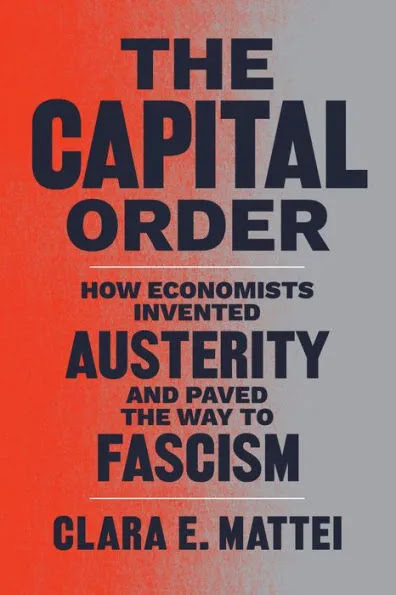
Pg. 99: Clara E. Mattei's "The Capital Order"

Featured at the Page 99 Test: The Capital Order: How Economists Invented Austerity and Paved the Way to Fascism by Clara E. Mattei.

About the book, from the publisher:
A groundbreaking examination of austerity’s dark intellectual origins.

For more than a century, governments facing financial crisis have resorted to the economic policies of austerity—cuts to wages, fiscal spending, and public benefits—as a path to solvency. While these policies have been successful in appeasing creditors, they’ve had devastating effects on social and economic welfare in countries all over the world. Today, as austerity remains a favored policy among troubled states, an important question remains: What if solvency was never really the goal?

In The Capital Order, political economist Clara E. Mattei explores the intellectual origins of austerity to uncover its originating motives: the protection of capital—and indeed capitalism—in times of social upheaval from below.

Mattei traces modern austerity to its origins in interwar Britain and Italy, revealing how the threat of working-class power in the years after World War I animated a set of top-down economic policies that elevated owners, smothered workers, and imposed a rigid economic hierarchy across their societies. Where these policies “succeeded,” relatively speaking, was in their enrichment of certain parties, including employers and foreign-trade interests, who accumulated power and capital at the expense of labor. Here, Mattei argues, is where the true value of austerity can be observed: its insulation of entrenched privilege and its elimination of all alternatives to capitalism.

Drawing on newly uncovered archival material from Britain and Italy, much of it translated for the first time, The Capital Order offers a damning and essential new account of the rise of austerity—and of modern economics—at the levers of contemporary political power.
Follow Clara E. Mattei on Twitter.

The Page 99 Test: The Capital Order.

--Marshal Zeringue

Pg. 69: Priyanka Taslim's "The Love Match"

Featured at the Page 69 Test: The Love Match by Priyanka Taslim.

About the book, from the publisher:
To All the Boys I’ve Loved Before meets Pride and Prejudice in this delightful and heartfelt rom-com about a Bangladeshi American teen whose meddling mother arranges a match to secure their family’s financial security—just as she’s falling in love with someone else.

Zahra Khan is basically Bangladeshi royalty, but being a princess doesn’t pay the bills in Paterson, New Jersey. While Zahra’s plans for financial security this summer involve working long hours at Chai Ho and saving up for college writing courses, Amma is convinced that all Zahra needs is a “good match,” Jane Austen style.

Enter Harun Emon, who’s wealthy, devastatingly handsome, and…aloof. As soon as Zahra meets him, she knows it’s a bad match. It’s nothing like the connection she has with Nayim Aktar, the new dishwasher at the tea shop, who just gets Zahra in a way no one has before. So, when Zahra finds out that Harun is just as uninterested in this match as she is, they decide to slowly sabotage their parents’ plans. And for once in Zahra’s life, she can have her rossomalai and eat it too: “dating” Harun and keeping Amma happy while catching real feelings for Nayim.

But life—and boys—can be more complicated than Zahra realizes. With her feelings all mixed up, Zahra discovers that sometimes being a good Bengali kid can be a royal pain.
Visit Priyanka Taslim's website.

My Book, The Movie: The Love Match.

Q&A with Priyanka Taslim.

The Page 69 Test: The Love Match.

--Marshal Zeringue

Wednesday, January 04, 2023

What is Joy Castro reading?

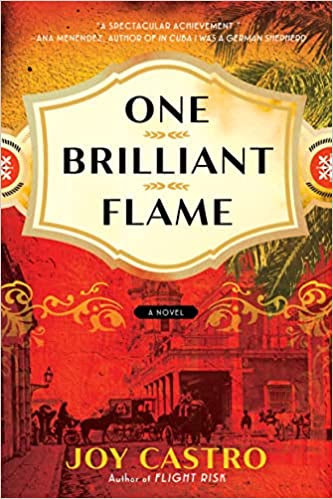
Featured at Writers Read: Joy Castro, author of One Brilliant Flame: A Novel.

Her entry begins:
I’m currently reading the novel Forbidden Notebook by Cuban Italian writer Alba de Céspedes, first published in Italy in 1952 and newly translated by Ann Goldstein (revered for her translations of Elena Ferrante’s work).

Forbidden Notebook is the story of a middle-aged petit bourgeois working housewife, Valeria Cossati, who secretly acquires a notebook. When she starts privately jotting down her honest observations, the livable fictions she’s constructed about her work, family, and social world all begin to crumble, and she has to decide what actions to take about...[read on]
About One Brilliant Flame, from the publisher:
A nineteenth-century utopia becomes a powder keg of political intrigue and betrayal in an enthralling historical novel―inspired by actual events―by the author of Flight Risk.

Key West, 1886. The booming cigar industry makes it the most prosperous city in Florida. As a rebel base for the anticolonial insurgency in Cuba, it’s also a tinderbox for six young friends with ambitious dreams.

They all brim with secrets: Zenaida, the daughter of an assassinated Havana journalist; power-hungry Sofia, who plots a fast track to success; Chaveta, Zenaida’s loyal comrade in arms who fearlessly flouts tradition; Feliciano, a charismatic Spanish anarchist; Líbano, the cafetero, silent and watchful; and Maceo, a daring guerrilla soldier who fights a brutal undertow. As lives intertwine, revolution smolders, and passions ignite, the bustling coral island is set to explode.

Against the backdrop of the Great Fire of Key West, One Brilliant Flame explores the luminous fates of consuming passion and encroaching peril in the face of insurrection, sacrifice, and inextinguishable hope.
Visit Joy Castro’s website and Twitter perch.

The Page 69 Test: Hell or High Water.

Writers Read: Joy Castro (July 2012).

Writers Read: Joy Castro (July 2013).

The Page 69 Test: Nearer Home.

Q&A with Joy Castro.

My Book, The Movie: Flight Risk.

The Page 69 Test: Flight Risk.

Writers Read: Joy Castro.

--Marshal Zeringue

Pg. 99: Benjamin Hudson's "Macbeth before Shakespeare"

Featured at the Page 99 Test: Macbeth before Shakespeare by Benjamin Hudson.

About the book, from the publisher:
Macbeth is arguably the world's most famous monarch. Both the historical king and the literary character have fascinated writers and audiences for centuries, beginning with the poets who recited their verses at the medieval monarch's court. Macbeth's legend began almost immediately after his death as medieval and Renaissance writers gradually replaced the king with a semi-literary character developed and embroidered to suit their own political and cultural agenda. The process of transformation culminated in playwright William Shakespeare's The Tragedie of Macbeth.

Investigating the man and the legend, Benjamin Hudson traces the eleventh-century prince's rise to prominence from local warlord to international ruler. Battling Vikings, English, and his fellow Scots, Macbeth was involved in a Dano-Norwegian conflict, made a pilgrimage to Rome, and gave refuge to Norman knights. He was more than a mere warlord. With his queen, Gruoch, the widow of a man who killed Macbeth's father, he was a benefactor of churches. The historical prince was an important innovator who used new fighting tactics, developed an international outlook to government, and encouraged intellectual pursuits. Hudson also tracks the ways in which popularizers developed the women behind the fictional Lady Macbeth and the weird sisters.

Drawing on centuries of Celtic and Scandinavian sources, popular entertainment, political theory, folklore, and art, Macbeth before Shakespeare recovers the genuine king from the historical record and shows how he was replaced by the legendary monster of ambition.
Learn more about Macbeth before Shakespeare at the Oxford University Press website.

The Page 99 Test: Macbeth before Shakespeare.

--Marshal Zeringue

Ten of the best 21st-century Chicago nonfiction books

Edward McClelland is a native of Lansing, Mich., which is also the birthplace of Burt Reynolds and the Oldsmobile.

McClelland’s most recent book, Midnight in Vehicle City: General Motors, Flint, and the Strike That Built the Middle Class, is a narrative account of the 1936-37 Flint Sit Down Strike, which led to the establishment of the United Auto Workers as the nation’s flagship labor union. His previous book, How to Speak Midwestern, is a guide to the speech and sayings of Middle America, which The New York Times called “a dictionary wrapped in some serious dialectology inside a gift book trailing a serious whiff of Relevance.”

At Chicago magazine McClelland tagged ten of Chicago’s best non-fiction books of the 21st Century, including:
The Devil in the White City: Murder, Magic, and Madness at the Fair That Changed America by Erik Larson (2003)

At 2.3 million copies, this may be the best selling book ever written about Chicago. Larson’s story runs on two tracks. It’s an account of the 1893 Columbian Exposition, Chicago’s debut as a world-class city. The fair was nicknamed the White City after the color of the buildings on the midway, whose construction was overseen by Daniel Burnham. Just a few miles away, serial killer H.H. Holmes was murdering and dismembering 27 victims in his Englewood hotel. Larson intertwined the biographies of Chicago’s greatest builder and its greatest destroyer.
Read about another entry on the list.

The Devil in the White City is among USA Today's twelve scariest books, Thomas Harding's eight favorite true crime books, Graham Moore's six favorite books about technology, Jeff Somers's eight top true crime books, Dell Villa's top five literary escapes to American cities, and Randy Dotinga's five favorite historical true-crime books from the last decade.

--Marshal Zeringue

Tuesday, January 03, 2023

Pg. 69: Peter Blauner's "Picture in the Sand"

Featured at the Page 69 Test: Picture in the Sand: A Novel by Peter Blauner.

About the book, from the publisher:
Peter Blauner's epic Picture in the Sand is a sweeping intergenerational saga told through a grandfather's passionate letters to his grandson, passing on the story of his political rebellion in 1950s Egypt in order to save his grandson's life in a post-9/11 world.

When Alex Hassan gets accepted to an Ivy League university, his middle-class Egyptian-American family is filled with pride and excitement. But that joy turns to shock when they discover that he’s run off to the Middle East to join a holy war instead. When he refuses to communicate with everyone else, his loving grandfather Ali emails him one last plea. If Alex will stay in touch, his grandfather will share with Alex – and only Alex – a manuscript containing the secret story of his own life that he’s kept hidden from his family, until now.

It's the tale of his romantic and heartbreaking past rooted in Hollywood and the post-revolutionary Egypt of the 1950s, when young Ali was a movie fanatic who attained a dream job working for the legendary director Cecil B. DeMille on the set of his epic film, The Ten Commandments. But Ali’s vision of a golden future as an American movie mogul gets upended when he is unwittingly caught up in a web of politics, espionage, and real-life events that change the course of history.

It's a narrative he’s told no one for more than a half-century. But now he’s forced to unearth the past to save a young man who’s about to make the same tragic mistakes he made so long ago.
Visit Peter Blauner's website.

Writers Read: Peter Blauner (September 2018).

The Page 69 Test: Sunrise Highway.

Writers Read: Peter Blauner (December 2022).

The Page 69 Test: Picture in the Sand.

--Marshal Zeringue

Nine books featuring female villains who lean into their wickedness

Rebecca Kelley is an author and graphic designer whose first novel, Broken Homes and Gardens, was published in 2015.

Her second novel, No One Knows Us Here, is out this month from Lake Union Publishing.

"There is a point in my novel No One Knows Us Here when my heroine does a very, very bad thing, Kelley writes. "She doesn’t have to do the bad thing—it’s not one of those 'steal a loaf of bread to feed her starving family' situations. She has other options and chooses to go down the dark path anyway."

At Electric Lit Kelley tagged nine "stories about bad women who chose to go down a dark and devious path," including:
Baby Teeth by Zoje Stage

Baby Teeth fits into the “Is your child a violent psychopath or am I just a horrible parent?” subgenre along with We Need to Talk about Kevin by Lionel Shriver and The Fifth Child by Doris Lessing. In this case, our villainess comes in the form of a little girl, Hanna. Sweet as candy to her adoring father, Hanna terrorizes her mother the minute he turns his back. “It was hard to pour endless love into someone who wouldn’t love you back,” observes the narrator. “No one could do it forever.”
Read about another entry on the list.

Baby Teeth is among Amber Garza's five titles featuring (possibly) murderous children, Christina Dalcher's seven crime books that challenge notions of inherent female goodness, May Cobb's five psychological thrillers featuring single-minded villains & anti-heroes, Jae-Yeon Yoo's top ten books about the promise & perils of alternative schooling, Pamela Crane's five top novels featuring parenting gone wild, Damien Angelica Walters's five titles about the horror of girlhood, and Sally Hepworth's eight messed up fictional families.

--Marshal Zeringue

Pg. 99: La Shonda Mims's "Drastic Dykes and Accidental Activists"

Featured at the Page 99 Test: Drastic Dykes and Accidental Activists: Queer Women in the Urban South by La Shonda Mims.

About the book, from the publisher:
After World War II, Atlanta and Charlotte emerged as leading urban centers in the South, redefining the region through their competing metropolitan identities. Both cities also served as home to queer communities who defined themselves in accordance with their urban surroundings and profited to varying degrees from the emphasis on economic growth. Uniting southern women's history with urban history, La Shonda Mims considers an imaginatively constructed archive including feminist newsletters and queer bar guides alongside sources revealing corporate boosterism and political rhetoric to explore the complex nature of lesbian life in the South.

Mims's work reveals significant differences between gay men's and lesbian women's lived experiences, with lesbians often missing out on the promises of prosperity that benefitted some members of gay communities. Money, class, and race were significant variables in shaping the divergent life experiences for the lesbian communities of Atlanta and Charlotte; whiteness especially bestowed certain privileges. In Atlanta, an inclusive corporate culture bolstered the city's queer community. In Charlotte, tenacious lesbian collectives persevered, as many queer Charlotteans leaned on Atlanta's enormous Pride celebrations for sanctuary when similar institutional community supports were lacking at home.
Follow La Shonda Mims on Twitter.

The Page 99 Test: Drastic Dykes and Accidental Activists.

--Marshal Zeringue

Monday, January 02, 2023

Q&A with Priyanka Taslim

From my Q&A with Priyanka Taslim, author of The Love Match:
How much work does your title do to take readers into the story?

For the longest time, early versions of The Love Match were called Rearranged, because it’s a book that explores and subverts the arranged marriage trope. I think that title might have been a bit on the nose, and since the book has a love triangle, might have felt a little flat? I’m actually not the best at coming up with titles, so my publishing team and I deliberated for a while about what to change it to, and ultimately settled on The Love Match.

A “love match” is a very common phrase in South Asian and Muslim culture. Anyone from those backgrounds who hears the term immediately knows that it refers to a couple who married because they met and fell in love, rather than having an arranged relationship. Love matches are more and more common these days, but what I love about the current title is that it requires a little more thinking. Hopefully, as readers delve into the story, they wonder who is truly Zahra’s love match and maybe...[read on]
Visit Priyanka Taslim's website.

My Book, The Movie: The Love Match.

Q&A with Priyanka Taslim.

--Marshal Zeringue

Five top novels featuring gods

Hannah Kaner is a Northumbrian writer living in Scotland. She works as a senior digital consultant in Edinburgh, delivering digital healthcare, tools, and services for the public sector. She has a first class degree in English from Pembroke College, Cambridge, and a Masters of Science with distinction from the University of Edinburgh. She is inspired by world mythologies, angry women, speculative fiction, and the stories we tell ourselves about being human.

Kaner's new novel is Godkiller.

At the Waterstones blog she tagged five favorite novels featuring gods, including:
The Poppy War by R.F. Kuang

The Poppy War begins The Burning Kingdoms trilogy, and creates a pantheon of gods and people who can wield their powers, at great cost.

Rin, the main character, has to negotiate the weight of her great power and the war that swallows her lands. Her choice between her god and her humanity, revenge and retreat, will stay with you for a long time.

The brutality and variety of the gods that form Kuang’s mythology is breathtaking, as well as the thrilling battle scenes and the grim reality of war.
Read about another entry on the list.

The Poppy War is among Sasha Peyton Smith's six magical schools you wish you could attend, Aigner Loren Wilson's five thrilling SFF books to motivate you while exercising, Megan Whalen Turner's eight SFF books featuring deities, Jennifer Giesbrecht's top five fantasy books steeped in history, and Ross Johnson's twenty-five epic fantasies for fans of Game of Thrones.

The Page 69 Test: The Poppy War.

--Marshal Zeringue

Pg. 99: Matthew Bentley & John Bloom's "The Imperial Gridiron"

Featured at the Page 99 Test: The Imperial Gridiron: Manhood, Civilization, and Football at the Carlisle Indian Industrial School by Matthew Bentley and John Bloom.

About the book, from the publisher:
The Imperial Gridiron examines the competing versions of manhood at the Carlisle Indian Industrial School between 1879 and 1918. Students often arrived at Carlisle already engrained with Indigenous ideals of masculinity. On many occasions these ideals would come into conflict with the models of manhood created by the school’s original superintendent, Richard Henry Pratt. Pratt believed that Native Americans required the “embrace of civilization,” and he emphasized the qualities of self-control, Christian ethics, and retaliatory masculinity. He encouraged sportsmanship and fair play over victory.

Pratt’s successors, however, adopted a different approach, and victory was enshrined as the main objective of Carlisle sports. As major stars like Jim Thorpe and Lewis Tewanima came to the fore, this change in approach created a conflict over manhood within the school: should the competitive athletic model be promoted, or should Carlisle focus on the more self-controlled, Christian ideal as promoted by the school’s Young Men’s Christian Association? The answer came from the 1914 congressional investigation of Carlisle. After this grueling investigation, Carlisle’s model of manhood starkly reverted to the form of the Pratt years, and by the time the school closed in 1918, the school’s standards of masculinity had come full circle.
Learn more about The Imperial Gridiron at the University of Nebraska Press website.

The Page 99 Test: The Imperial Gridiron.

--Marshal Zeringue

Sunday, January 01, 2023

The ten best fictional hangovers

For the Guardian Euan Ferguson named the ten best fictional hangovers in print, film and song. One title on the list:
One Day by David Nicholls

Awake at 9.30am, redolent with “dread and self-loathing combined with sexual frustration”, Dexter Mayhew, anti-hero of Nicholls’s bestselling novel – the film version is due next year – has a bad day ahead of him. He is just coming down from shedloads of both drugs and drink, and from having, for a job, to listen to Jamiroquai. The best aspect is the juxtaposition between his sudden morning lurch towards confidence – haven’t we all? – and the outcome. “He finds a bottle of vodka and pours an inch into his glass… as he hasn’t been to sleep yet, this is not the first drink of the day but the last drink of last night...”
Read about another entry on the list.

--Marshal Zeringue

Pg. 69: Elinor Lipman's "Ms. Demeanor"

Featured at the Page 69 Test: Ms. Demeanor: A Novel by Elinor Lipman.

About the book, from the publisher:
From one of America’s most beloved contemporary novelists, a delicious and witty story about love under house arrest

Jane Morgan is a valued member of her law firm—or was, until a prudish neighbor, binoculars poised, observes her having sex on the roof of her NYC apartment building. Police are summoned, and a punishing judge sentences her to six months of home confinement. With Jane now jobless and rootless, trapped at home, life looks bleak. Yes, her twin sister provides support and advice, but mostly of the unwelcome kind. When a doorman lets slip that Jane isn't the only resident wearing an ankle monitor, she strikes up a friendship with fellow white-collar felon Perry Salisbury. As she tries to adapt to life within her apartment walls, she discovers she hasn’t heard the end of that tattletale neighbor—whose past isn’t as decorous as her 9-1-1 snitching would suggest. Why are police knocking on Jane’s door again? Can her house arrest have a silver lining? Can two wrongs make a right? In the hands of "an inspired alchemist who converts serious subject into humor” (New York Times Book Review)—yes, delightfully.
Visit Elinor Lipman's website.

The Page 69 Test: The Family Man.

The Page 99 Test: I Can't Complain.

The Page 69 Test: Good Riddance.

Writers Read: Elinor Lipman (February 2019).

My Book, The Movie: Rachel to the Rescue.

The Page 69 Test: Ms. Demeanor.

--Marshal Zeringue

Priyanka Taslim's "The Love Match," the movie

Featured at My Book, The Movie: The Love Match by Priyanka Taslim.

The entry begins:
The Love Match begins with a prologue explaining tropes in Bengali natoks—the Bangla-language equivalent of Bollywood. Like a Bollywood movie or natok, this young adult romantic comedy is meant to feel cinematic, full of tropes, twists, turns—and even a musical number or two. The Love Match stars Zahra Khan, a Bangladeshi American teen who schemes to fake date the boy she’s set up with to keep both of their families happy, even as they sabotage the relationship from within. However, her real, growing feelings for a new coworker at the neighborhood tea shop where she waitresses might ruin all her plans.

Because I wrote The Love Match to feel like an American natok, I’ve pondered a potential cast to play the characters often. In an ideal world, there would not just be a large pool of South Asian diaspora actors to choose from, but specifically Bangladeshi actors, especially actors who can play teens, but since that’s not the case, I think Zahra would best be played by someone like Charithra Chandran, who became known after the second season of Bridgerton. Charithra has a Bambi-eyed, almost Disney-princess-ish disposition, but she seems spitfire beneath the surface as well, which is perfect for Zahra.

Nayim is the easiest answer for me because I always took inspiration from...[read on]
Visit Priyanka Taslim's website.

My Book, The Movie: The Love Match.

--Marshal Zeringue