Tuesday, July 19, 2016

What is John Gregory Brown reading?

Featured at Writers Read: John Gregory Brown, author of A Thousand Miles from Nowhere.

His entry begins:
I spent the last nine months teaching at the prep school Deerfield Academy, most famous in literary circles for distinguished alumnus John McPhee’s The Headmaster, a wonderful biography of Frank L. Boyden, the tiny man and towering presence who helmed the school from 1902 to 1968. Although I’d spent more than two decades in academia at the college level, this was my first experience as a high school teacher, a responsibility that seemed weighty indeed: What works would I choose for my juniors in their one year of American Lit? I was tormented by having to leave so many great authors off the syllabus, by all the great works these young men and women might never encounter on their own. We dipped into Whitman and Dickinson, of course; we compared August Wilson’s Fences to Arthur Miller’s Death of A Salesman; we gave Fitzgerald’s The Great Gatsby its full due. We tackled stories by Alice Munro and Amy Hempel, by Raymond Carver and Ron Rash. But the five works I truly loved teaching – and that the students thus loved back – were these:

Kate Chopin’s The Awakening

For better or worse, young people these days know their way around despair. They know well how it crouches in the shadows of lives that appear to be fulfilling. And they’ve got a clear notion of what it might mean to find oneself constrained by circumstances one apparently chose of one’s own volition. Thus they see Edna Pontellier’s crisis as a familiar one, arising not just out of a society that narrowly defines who women should be but also...[read on]
About A Thousand Miles from Nowhere, from the publisher:
A tragicomic tour de force about one man's redemption through love and art.

"You have lost everything, yes?"

Everything? Henry thought; he considered the word. Had he lost everything?

Fleeing New Orleans as Hurricane Katrina approaches, Henry Garrett is haunted by the ruins of his marriage, a squandered inheritance, and the teaching job he inexplicably quit. He pulls into a small Virginia town after three days on the road, hoping to silence the ceaseless clamor in his head. But this quest for peace and quiet as the only guest at a roadside motel is destroyed when Henry finds himself at the center of a bizarre and violent tragedy. As a result, Henry winds up stranded at the ramshackle motel just outside the small town of Marimore, and it's there that he is pulled into the lives of those around him: Latangi, the motel's recently widowed proprietor, who seems to have a plan for Henry; Marge, a local secretary who marshals the collective energy of her women's church group; and the family of an old man, a prisoner, who dies in a desperate effort to provide for his infirm wife.

For his previous novels John Gregory Brown has been lauded for his "compassionate vision of human destiny" as well as his "melodic, haunting, and rhythmic prose." With A Thousand Miles from Nowhere, he assumes his place in the tradition of such masterful storytellers as Flannery O'Connor and Walker Percy, offering to readers a tragicomic tour de force about the power of art and compassion and one man's search for faith, love, and redemption.
Visit John Gregory Brown's website.

Writers Read: John Gregory Brown.

--Marshal Zeringue

Pg. 69: Shawna Yang Ryan's "Green Island"

Featured at the Page 69 Test: Green Island by Shawna Yang Ryan.

About the book, from the publisher:
A stunning story of love, betrayal, and family, set against the backdrop of a changing Taiwan over the course of the twentieth century.

February 28, 1947: Trapped inside the family home amid an uprising that has rocked Taipei, Dr. Tsai delivers his youngest daughter, the unnamed narrator of Green Island, just after midnight as the city is plunged into martial law. In the following weeks, as the Chinese Nationalists act to crush the opposition, Dr. Tsai becomes one of the many thousands of people dragged away from their families and thrown into prison. His return, after more than a decade, is marked by alienation from his loved ones and paranoia among his community—conflicts that loom over the growing bond he forms with his youngest daughter. Years later, this troubled past follows her to the United States, where, as a mother and a wife, she too is forced to decide between what is right and what might save her family—the same choice she witnessed her father make many years before.

As the novel sweeps across six decades and two continents, the life of the narrator shadows the course of Taiwan’s history from the end of Japanese colonial rule to the decades under martial law and, finally, to Taiwan’s transformation into a democracy. But, above all, Green Island is a lush and lyrical story of a family and a nation grappling with the nuances of complicity and survival, raising the question: how far would you be willing to go for the ones you love?
Learn more about the book and author at Shawna Yang Ryan's website.

The Page 69 Test: Water Ghosts.

The Page 69 Test: Green Island.

--Marshal Zeringue

Six top YA novels for mythology lovers

At the BN Teen blog, Jenny Kawecki tagged six top Young Adult novels for mythology lovers, including:
Helen of Troy: Starcrossed, by Josephine Angelini

Helen has always been different. And keeping her strange powers secret on the super-small island of Nantucket isn’t easy. So when a new family moves to town and Helen’s first instinct is to contemplate murdering their son Lucas, well, it comes as a bit of a surprise when it turns out Lucas may be the only one who knows what’s going on with her. It’s even more of a surprise when she realizes she might be falling in love with him. But things get complicated when an entire pantheon of Greek gods seems to be out to get them, and it looks like history just might repeat itself. Starcrossed is for anyone who ever read The Iliad and wondered what the hell was up with Helen and Paris.
Read about another entry on the list.

--Marshal Zeringue

Pg. 99: Jennifer Keishin Armstrong's "Seinfeldia"

Featured at the Page 99 Test: Seinfeldia: How a Show About Nothing Changed Everything by Jennifer Keishin Armstrong.

About the book, from the publisher:
The hilarious behind-the-scenes story of two guys who went out for coffee and dreamed up Seinfeld—the cultural sensation that changed television and bled into the real world, altering the lives of everyone it touched.

Comedians Larry David and Jerry Seinfeld never thought anyone would watch their silly little sitcom about a New York comedian sitting around talking to his friends. NBC executives didn’t think anyone would watch either, but they bought it anyway, hiding it away in the TV dead zone of summer. But against all odds, viewers began to watch, first a few and then many, until nine years later nearly forty million Americans were tuning in weekly.

In Seinfeldia, acclaimed TV historian and entertainment writer Jennifer Keishin Armstrong celebrates the creators and fans of this American television phenomenon, bringing readers behind-the-scenes of the show while it was on the air and into the world of devotees for whom it never stopped being relevant, a world where the Soup Nazi still spends his days saying “No soup for you!”, Joe Davola gets questioned every day about his sanity, Kenny Kramer makes his living giving tours of New York sights from the show, and fans dress up in Jerry’s famous puffy shirt, dance like Elaine, and imagine plotlines for Seinfeld if it were still on TV.
Visit Jennifer Keishin Armstrong's website.

My Book, The Movie: Mary and Lou and Rhoda and Ted.

The Page 99 Test: Mary and Lou and Rhoda and Ted.

The Page 99 Test: Seinfeldia.

--Marshal Zeringue

Monday, July 18, 2016

Jessica Winter's six favorite books on girl power

Jessica Winter's first novel is Break in Case of Emergency. For The Week magazine she tagged six favorite books on girl power, including:
NW by Zadie Smith

Smith's 2012 masterpiece paints a wry and rueful portrait of contemporary Britain by zeroing in on a north London housing estate and a pair of lifelong friends: one hardworking but secretly reckless, the other all but sleepwalking through life. Their relationship is unforgettable; the fact that they never fully understand each other makes their mutual loyalty all the more moving.
Read about another book on the list.

--Marshal Zeringue

What is Ruth Downie reading?

Featured at Writers Read: Ruth Downie, author of Vita Brevis: A Crime Novel of the Roman Empire.

Her entry begins:
The Shepherd’s Life: A Tale of the Lake District – James Rebanks

This is a fabulous book on so many levels: a family history, a fascinating chronicle of a way of life that’s barely changed for centuries, and a howl of frustration at the lack of understanding between the education system and its rural consumers. It’s also a demonstration of the value of books. “We needed books by us and about us,” says Rebanks, and...[read on]
About Vita Brevis, from the publisher:
Ruso and Tilla's excitement at arriving in Rome with their new baby daughter is soon dulled by their discovery that the grand facades of polished marble mask an underworld of corrupt landlords and vermin-infested tenements. There are also far too many doctors--some skilled--but others positively dangerous.

Ruso thinks he has been offered a reputable medical practice only to find that his predecessor Doctor Kleitos has fled, leaving a dead man in a barrel on the doorstep and the warning, “Be careful who you trust.” Distracted by the body and his efforts to help a friend win the hand of a rich young heiress, Ruso makes a grave mistake, causing him to question both his competence and his integrity.

With Ruso's reputation under threat, he and Tilla must protect their small family from Doctor Kleitos's debt collectors and find allies in their new home while they track down the vanished doctor and find out the truth about the heiress's dead father--Ruso's patient--and the unfortunate man in the barrel.
Learn more about the book and author at Ruth Downie's website.

The Page 69 Test: Caveat Emptor.

The Page 69 Test: Tabula Rasa.

Writers Read: Ruth Downie.

--Marshal Zeringue

Janice Warman's "The World Beneath," the movie

Featured at My Book, The Movie: The World Beneath: A Novel by Janice Warman.

The entry begins:
If The World Beneath was made into a film, I’d like Ava DuVernay to direct it. As the brilliant director of Selma, the story of Martin Luther King’s campaign to win equal voting rights with a march from Selma to Montgomery in 1965, she would be ideal to look at the issues of apartheid and the 1976 Soweto uprising that are the setting for the book.

I’m also a huge fan of David Oyelowo in the Martin Luther King role and would like him to play Tsumalo, the freedom fighter on the run.

I met Ava and David at a screening of Selma at London’s Mayfair Hotel last year, and afterwards gave them each a copy of the book to read. They were both charming. So here’s hoping. We sat in the front row, and during the Q&A I asked whether Ava had thought of making a film about apartheid South Africa. She said she’d consider it; David smiled at me and said, “Why, do you have a script?” I said no, but it had been a leading question, and he laughed and said, “If this was LA, there would be scripts raining down from the back of the room!”

I would like Joshua, the boy hero, to be played by...[read on]
Follow Janice Warman on Twitter.

My Book, The Movie: The World Beneath.

--Marshal Zeringue

Pg. 69: Kim Wright's "Last Ride to Graceland"

Featured at the Page 69 Test: Last Ride to Graceland by Kim Wright.

About the book, from the publisher:
Lauded for her “astute and engrossing” (People) writing style imbued with “originality galore” (RT Book Reviews), Kim Wright channels the best of Jennifer Weiner and Sarah Pekkanen in this delightful novel of self-discovery on the open road as one woman sets out for Graceland hoping to answer the question: Is Elvis Presley her father?

Blues musician Cory Ainsworth is barely scraping by after her mother’s death when she discovers a priceless piece of rock ‘n’ roll memorabilia hidden away in a shed out back of the family’s coastal South Carolina home: Elvis Presley’s Stutz Blackhawk, its interior a time capsule of the singer’s last day on earth.

A backup singer for the King, Cory’s mother Honey was at Graceland the day Elvis died. She quickly returned home to Beaufort and married her high school sweetheart. Yearning to uncover the secrets of her mother’s past—and possibly her own identity—Cory decides to drive the car back to Memphis and turn it over to Elvis’s estate, retracing the exact route her mother took thirty-seven years earlier. As she winds her way through the sprawling deep south with its quaint towns and long stretches of open road, the burning question in Cory’s mind—who is my father?—takes a backseat to the truth she learns about her complicated mother, the minister's daughter who spent a lifetime struggling to conceal the consequences of a single year of rebellion.
Visit Kim Wright's Facebook page.

The Page 69 Test: Last Ride to Graceland.

--Marshal Zeringue

Sunday, July 17, 2016

Five top alt-world takes on familiar empires

At the B&N Sci-Fi & Fantasy Blog, Kelly Anderson tagged alt-world takes on five familiar empires, including:
The Mechanical, by Ian Tregellis

This one is less alternate world than alternate timeline, but I’m including it because it’s one of the few such tales that uses a lesser-trodden empire for its model: the Dutch. In this timeline, the sun never set on Holland’s, all the way up to the year 1926, by which time it has become the world’s superpower. The empire’s rival and enemy for influence is not England but France, although the content of their conflict—Protestants v. Catholics—is all too familiar. Each empire has mastered different kinds of technology, bolstering their power. For the French, it is chemistry. For the Dutch, it is mechanics and clockworks, and, specifically, robots. One such robot, Jax, is 118 years old and perfectly sentient. He is kept in a state of servitude by his programming, which forbids rebellion and threatens destruction for any deviations. Jax’s capability for free thought comes to seem cruel in the context of his world, and more so the more he uncovers about himself and his kind. This is a book jammed with ideas; anyone looking to engage with issues of identity, freedom, and the effects of colonization on the individual should most certainly give it a try.
Read about another entry on the list.

--Marshal Zeringue

What is Catherine Egan reading?

Featured at Writers Read: Catherine Egan, author of Julia Vanishes.

Her entry begins:
I bought Helen Oyeyemi’s collection of short stories, What Is Not Yours Is Not Yours, because I loved her novel Boy, Snow, Bird. Sometimes short story writers stumble writing novels, and not all novelists can write short stories, but Helen Oyeyemi can do both. I think she can probably do everything. There is no weak link in this collection, which makes equally deft use of odd fairytale settings, modern England, elements of sci fi, magic realism and straight up contemporary realism. Each story left me unsatisfied, but in a stunned and wide awake kind of way. She is the sort of writer that shakes you up and makes everything look different for a long time after you’ve finished the book. The book feels like a puzzle: characters...[read on]
About the book, from the publisher:
Fans of Marie Lu, Leigh Bardugo, and Kristin Cashore will be captivated by this stunning first book in a must-have new fantasy trilogy about a spy who can vanish at will and who discovers that monsters, mystery, and magic are also lurking—just out of sight.

Julia has the unusual ability to be ... unseen. Not invisible, exactly. Just beyond most people’s senses.

It’s a dangerous trait in a city that has banned all forms of magic and drowns witches in public Cleansings. But it’s a useful trait for a thief and a spy. And Julia has learned—crime pays.

She’s being paid very well indeed to infiltrate the grand house of Mrs. Och and report back on the odd characters who live there and the suspicious dealings that take place behind locked doors.

But what Julia discovers shakes her to the core. She certainly never imagined that the traitor in the house would turn out to be ... her.

Murder, thievery, witchcraft, betrayal–Catherine Egan builds a dangerous world where her fierce and flawed heroine finds that even a girl who can vanish can’t walk away from her own worst deeds.
Visit Catherine Egan's website.

The Page 69 Test: Julia Vanishes.

Writers Read: Catherine Egan.

--Marshal Zeringue

Pg. 99: Analiese Richard's "The Unsettled Sector"

Featured at the Page 99 Test: The Unsettled Sector: NGOs and the Cultivation of Democratic Citizenship in Rural Mexico by Analiese Richard.

About the book, from the publisher:
In late twentieth century Mexico, the NGO "boom" was hailed as an harbinger of social change and democratic transition, with NGOs poised to transform the relationship between states and civil society on a global scale. And yet, great as the expectations were for NGOs to empower the poor and disenfranchised, their work is rooted in much older civic and cultural traditions. Arguably, they are just as much an accomplice in neoliberal governance. Analiese Richard seeks to determine what the growth of NGOs means for the future of citizenship and activism in neoliberal democracies, where a widening chasm between rich and poor threatens democratic ideals and institutions.

Analyzing the growth of NGOs in Tulancingo, Hidalgo, from the 1970s to the present, The Unsettled Sector explores the NGOs' evolving network of relationships with donors, target communities, international partners, state agencies, and political actors. It reaches beyond the campesinos and farmlands of Tulancingo to make sense of the NGO as an institutional form. Richard argues that only if we see NGOs as they are—bridges between formal politics and public morality—can we understand the opportunities and limits for social solidarity and citizenship in an era of neoliberal retrenchment.
Learn more about The Unsettled Sector at the Stanford University Press website.

The Page 99 Test: The Unsettled Sector.

--Marshal Zeringue

Saturday, July 16, 2016

Twelve books to help make sense of Brexit

The Guardian asked a dozen contributors to share a book that might help readers understand Brexit, Great Britain's vote to leave the European Union. Shami Chakrabarti's pick:
Noughts & Crosses by Malorie Blackman

“I used to comfort myself with the belief that it was only certain individuals and their peculiar notions that spoilt things for the rest of us. But how many individuals does it take before it’s not the individuals who are prejudiced but society itself?”

So writes Malorie Blackman in Noughts & Crosses (Doubleday Children’s). Recent months have been almost dystopian, revealing a neglected, divided kingdom along lines of wealth, geography and generation. Political and financial elites are watching their holiday homes (if not their principal residences) burning down with far greater cost to their poorer neighbours. The fire-starters have no plan for reconstruction and our media has not served us well. “The news lies all the time. They tell us what they think we would want to hear.”

Blackman is one of our greatest contemporary British writers and her modern classic is capable of inspiring many more generations of “young adult” readers of all ages. Dystopian fiction has often provided the most searing critiques of “real” life, politics and society, and the first book in Blackman’s epic series is no exception.

While it is an unashamedly political novel, its message of hope comes from the central love story between two characters on opposite sides of the racial divide. The secret to Blackman’s book, and our collective futures, perhaps lies in remembering the value of sacrifice and solidarity.
Read about another entry on the list.

--Marshal Zeringue

Pg. 69: Mary Simses's "The Rules of Love & Grammar"

Featured at the Page 69 Test: The Rules of Love & Grammar by Mary Simses.

About the book, from the publisher:
A woman finds love and closure, and rediscovers herself, when she returns to her roots in the enchanting new novel from the author of The Irresistible Blueberry Bakeshop & Café.

Newly jobless, newly single, and suddenly apartmentless, writer Grace Hammond has come unmoored. A grammar whiz who's brilliant at correcting other people's errors, she hasn't yet found quite the right set of rules for fixing her own mistakes.

Desperate to escape the city and her trifecta of problems, Grace hits pause and retreats to her Connecticut hometown. What begins as a short visit with her parents quickly becomes a far more meaningful stay, though, as she discovers that the answers to what her future holds might be found by making peace with-and even embracing-the past.

As Grace sets out to change her ways and come to terms, finally, with the tragedy that took her older sister's life so many years ago, she rekindles a romance with her high school sweetheart, Peter, now a famous Hollywood director who's filming a movie in town. Sparks also fly at the local bike shop, where Grace's penchant for pointing out what's wrong rattles the owner's ruggedly handsome schoolteacher son, Mitch.

Torn between the promise of a glamorous life and the allure of the familiar, Grace must decide what truly matters-and whether it's time for her to throw away the rule book and bravely follow her heart.
Learn more about the book and author at Mary Simses's website and follow her on Facebook.

My Book, The Movie: The Irresistible Blueberry Bakeshop & Cafe.

The Page 69 Test: The Rules of Love & Grammar.

--Marshal Zeringue

Katie Fforde's 6 best books

Katie Fforde's newest novel is A Summer at Sea.

One of her six best books, as shared at the Daily Express:
THE GRAND SOPHY by Georgette Heyer

I became addicted to Heyer and read them all quickly. Here, bossy Sophy turns a depressed family upside down by her presence, breaking all the rules. The characterisation and dialogue are stunning – I stole the plot for one of my novels.
Read about another entry on the list.

--Marshal Zeringue

Sharon Potts's "Someone Must Die," the movie

Featured at My Book, The Movie: Someone Must Die by Sharon Potts.

The entry begins:
An Interview with Alfred Hitchcock

I: Mr. Hitchcock, welcome back. You’re looking well, though perhaps a bit stiffer than the last time we met.

AH: Good evening. Stiff, you say? My young sir, you should try digging yourself out of a grave.

I: Um, yes, well. I appreciate you speaking to us about your latest project, Mr. Hitchcock. We’ve heard rumors that you’ve agreed to produce and direct a new movie based on Sharon Potts’s latest novel Someone Must Die.

AH: The rumors are indeed true. Potts’s new suspense novel is about how the past haunts the present, a theme I find particularly intriguing. The backdrop for Someone Must Die is the college revolutionary period of the late sixties, a volatile time that’s been on my movie-project bucket list. But the story is very much a present-day psychological thriller about a young woman who becomes an inadvertent victim of her parents’ activities during the sixties.

I: Can you give us a brief overview of the plot?

AH: Certainly. When her six-year-old nephew is abducted...[read on]
Learn more about the book and author at Sharon Potts' website.

My Book, The Movie: In Their Blood.

My Book, The Movie: Someone’s Watching.

The Page 69 Test: The Devil's Madonna.

My Book, The Movie: Someone Must Die.

--Marshal Zeringue

Friday, July 15, 2016

Five of the best wilderness survival books

At B&N Reads Jenny Shank tagged five wilderness survival books to take along on your camping trip, including:
Death in Yellowstone: Accidents and Foolhardiness in the First National Park, by Lee H. Whittlesey

Almost 3.5 million people visit Yellowstone National Park each year, and a handful of them become victims of either ill fortune or their own stupidity (or some combination of both). In the ’90s, Whittlesey, a Yellowstone park museum technician, decided to compile all of the unnatural deaths that had occurred in the park to help visitors know what to avoid to ensure their safety, and he ended up writing a survival classic. Death in Yellowstone launched a whole series of books featuring other national parks, and is an indispensable guide to what not to do when visiting the wonders of nature. Yanking on a bison’s beard? Inadvisable. Taking a quick dip in a boiling hot spring? Do refrain. Feeding a bear? Not unless you want to be on the menu. Fascinating cautionary tales abound in this book. As Whittlesey noted dryly in one interview, “Yellowstone is not Disneyland.”
Read about another entry on the list.

Death in Yellowstone made a list of Chuck Palahniuk's top 10 favorite books.

--Marshal Zeringue

Pg. 99: Evan Braden Montgomery's "In the Hegemon's Shadow"

Featured at the Page 99 Test: In the Hegemon's Shadow: Leading States and the Rise of Regional Powers by Evan Braden Montgomery.

About the book, from the publisher:
The relationship between established powers and emerging powers is one of the most important topics in world politics. Nevertheless, few studies have investigated how the leading state in the international system responds to rising powers in peripheral regions—actors that are not yet and might never become great powers but that are still increasing their strength, extending their influence, and trying to reorder their corner of the world. In the Hegemon's Shadow fills this gap. Evan Braden Montgomery draws on different strands of realist theory to develop a novel framework that explains why leading states have accommodated some rising regional powers but opposed others.

Montgomery examines the interaction between two factors: the type of local order that a leading state prefers and the type of local power shift that appears to be taking place. The first captures a leading state's main interest in a peripheral region and serves as the baseline for its evaluation of any changes in the status quo. Would the leading state like to see a balance of power rather than a preponderance of power, does it favor primacy over parity instead, or is it impartial between these alternatives? The second indicates how a local power shift is likely to unfold. In particular, which regional order is an emerging power trying to create and does a leading state expect it to succeed? Montgomery tests his arguments by analyzing Great Britain’s efforts to manage the rise of Egypt, the Confederacy, and Japan during the nineteenth century and the United States’ efforts to manage the emergence of India and Iraq during the twentieth century.
Visit Evan Braden Montgomery's website.

The Page 99 Test: In the Hegemon's Shadow.

--Marshal Zeringue

Ten top books about the Iraq war

Derek Miller is the author of the award-winning Norwegian by Night and the forthcoming The Girl in Green. One of his top ten books about the Iraq war, as shared at the Guardian:
Fobbit by David Abrams (2012)

There is the world. And then there is the world that we would prefer the world to be. Most of us spend too much time in the latter. And when it comes to the American public and their views of soldiers and soldiering, it can seem like a permanent vacation. But in this wickedly funny novel, Abrams sees right past the self-aggrandising illusions and comforting fairytales that tuck the US in at night.
Read about another entry on the list.

Fobbit is among Jenny Shank's five unforgettable fictional characters with dirty jobs, Jesse Goolsby's top fifteen books about the wars in Iraq and Afghanistan, and Joel Cunningham's seven sharpest modern satires.

The Page 69 Test: Fobbit.

--Marshal Zeringue

What is Anthony Ryan reading?

Featured at Writers Read: Anthony Ryan, author of The Waking Fire.

His entry begins:
I usually alternate between fiction and non-fiction, mostly history, but I’ve been on a bit of fiction kick recently. I just finished Blackdog by K.V. Johansen, the first in her Marakand Road series, which I found to be an excellent mix of lyrical prose, high fantasy and occasionally brutal...[read on]
About The Waking Fire, from the publisher:
Throughout the vast lands controlled by the Ironship Trading Syndicate, nothing is more prized than the blood of drakes. Harvested from captive or hunted Reds, Greens, Blues and Blacks, it can be distilled into elixirs that bestow fearsome powers on the rare men and women known as the Blood-blessed.

But not many know the truth: that the lines of drakes are weakening. If they fail, war with the neighbouring Corvantine Empire will follow swiftly. The Syndicate’s last hope resides in whispers of the existence of another breed of drake, far more powerful than the rest, and the few who have been chosen by fate to seek it.

Claydon Torcreek is a petty thief and an unregistered Blood-blessed who finds himself pressed into service by the Protectorate and sent to wild, uncharted lands in search of a creature he believes is little more than legend. Lizanne Lethridge is a formidable spy and assassin facing gravest danger on an espionage mission deep into the heart of enemy territory. And Corrick Hilemore is the second lieutenant of an Ironship cruiser whose pursuit of ruthless brigands leads him to a far greater threat at the edge of the world.

As lives and empires clash and intertwine, as the unknown and the known collide, all three must fight to turn the tide of a coming war, or drown in its wake.
Visit Anthony Ryan's website.

The Page 69 Test: The Waking Fire.

My Book, the Movie: The Waking Fire.

Writers Read: Anthony Ryan.

--Marshal Zeringue

Thursday, July 14, 2016

Craig A. Monson's "Habitual Offenders," the movie

Featured at My Book, The Movie: Habitual Offenders: A True Tale of Nuns, Prostitutes, and Murderers in Seventeenth-Century Italy, by Craig A. Monson.

The entry begins:
Several friends have remarked Habitual Offenders might work better as a TV series than as a movie, given its episodicity, shifts of time and place, secondary characters that appear, loom large for a while, then disappear. One screenwriting challenge (or creative opportunity) involves the book’s “leading ladies,” who have fled the convent before page 1 and turn up dead around page 85; they are much spoken of but barely speak (at least in the book). It really seems more like a “guy movie,” but one more about acting than action. Given the financial challenges of “costume dramas,” at least in this one the women’s outfits would come relatively cheap: nuns, housemaids, nothing fancier than a medium-grade courtesan. Dressing the men might be costlier: lots of lace, both in and out of church.

A significant angle in terms of casting: in their time, the leading ladies were perceived as “old dearies”: both are a decade older than their respective alleged seducers. Several of the spectacularly misbehaving males are around the age of today’s college pranksters. In the book’s two “love scenes” (overheard through a locked door), the man is 31 and the woman, 40.

Sister Laura Vittoria: an ex-prostitute turned nun and still a head-turner at age 30—5'10", with flagrantly red hair (hence her trade name “La Rossa”), lovely white complexion, beautiful hands, lively personality, vivid imagination, but with a long scar running down her left cheek (a work related injury). In love with Donato Guarnieri. Susan Sarandon—yes, I know I’m thinking White Palace, and I know that was 1990 and that Sarandon is now nearing 70, but nevertheless… . Or perhaps Allison Janney or Jessica....[read on]
Learn more about the book and author at the University of Chicago Press website.

The Page 99 Test: Nuns Behaving Badly.

The Page 99 Test: Habitual Offenders.

Writers Read: Craig A. Monson.

My Book, The Movie: Habitual Offenders.

--Marshal Zeringue

Pg. 69: Catherine Egan's "Julia Vanishes"

Featured at the Page 69 Test: Julia Vanishes by Catherine Egan.

About the book, from the publisher:
Fans of Marie Lu, Leigh Bardugo, and Kristin Cashore will be captivated by this stunning first book in a must-have new fantasy trilogy about a spy who can vanish at will and who discovers that monsters, mystery, and magic are also lurking—just out of sight.

Julia has the unusual ability to be ... unseen. Not invisible, exactly. Just beyond most people’s senses.

It’s a dangerous trait in a city that has banned all forms of magic and drowns witches in public Cleansings. But it’s a useful trait for a thief and a spy. And Julia has learned—crime pays.

She’s being paid very well indeed to infiltrate the grand house of Mrs. Och and report back on the odd characters who live there and the suspicious dealings that take place behind locked doors.

But what Julia discovers shakes her to the core. She certainly never imagined that the traitor in the house would turn out to be . . . her.

Murder, thievery, witchcraft, betrayal–Catherine Egan builds a dangerous world where her fierce and flawed heroine finds that even a girl who can vanish can’t walk away from her own worst deeds.
Visit Catherine Egan's website.

The Page 69 Test: Julia Vanishes.

--Marshal Zeringue
Pg. 99: Jason M. Barr's "Building the Skyline"

Featured at the Page 99 Test: Building the Skyline: The Birth and Growth of Manhattan's Skyscrapers by Jason M. Barr.

About the book, from the publisher:
The Manhattan skyline is one of the great wonders of the modern world. But how and why did it form? Much has been written about the city's architecture and its general history, but little work has explored the economic forces that created the skyline.

In Building the Skyline, Jason Barr chronicles the economic history of the Manhattan skyline. In the process, he debunks some widely held misconceptions about the city's history. Starting with Manhattan's natural and geological history, Barr moves on to how these formations influenced early land use and the development of neighborhoods, including the dense tenement neighborhoods of Five Points and the Lower East Side, and how these early decisions eventually impacted the location of skyscrapers built during the Skyscraper Revolution at the end of the 19th century.

Barr then explores the economic history of skyscrapers and the skyline, investigating the reasons for their heights, frequencies, locations, and shapes. He discusses why skyscrapers emerged downtown and why they appeared three miles to the north in midtown-but not in between the two areas. Contrary to popular belief, this was not due to the depths of Manhattan's bedrock, nor the presence of Grand Central Station. Rather, midtown's emergence was a response to the economic and demographic forces that were taking place north of 14th Street after the Civil War.

Building the Skyline also presents the first rigorous investigation of the causes of the building boom during the Roaring Twenties. Contrary to conventional wisdom, the boom was largely a rational response to the economic growth of the nation and city. The last chapter investigates the value of Manhattan Island and the relationship between skyscrapers and land prices. Finally, an Epilogue offers policy recommendations for a resilient and robust future skyline.
Learn more about Building the Skyline at the Oxford University Press website.

The Page 99 Test: Building the Skyline.

--Marshal Zeringue

Seven top books to help you get through your divorce

At B&N Reads Jen Harper tagged seven "books about divorce and struggling through difficult times—fiction, memoir, and some self-help," including:
High Fidelity, by Nick Hornby

Most breakup books focus on a woman left by/leaving a man, but Nick Hornby gives readers a fresh perspective in his novel-turned-film High Fidelity. Sarcastic and self-deprecating record store owner Rob Fleming has just been dumped by his girlfriend Laura, leading him to track down former girlfriends for a thorough examination of his five most memorable breakups. In this funny read, Rob discovers that what he seeks isn’t in his past—it’s what awaits him in the present.
Read about another book on the list.

Also see ten top books to comfort & console during a divorce.

High Fidelity also made Chris Moss's top 19 list of books on "how to be a man," Jeff Somers's list of six books that’ll make you glad you’re single, Chrissie Gruebel's top ten list of books set in London, Ted Gioia's list of ten of the best novels on music, Melissa Albert's top five list of books that inspire great mix tapes, Rob Reid's six favorite books list, Ashley Hamilton's list of 8 books to read with a broken heart, Tiffany Murray's top 10 list of rock'n'roll novels, Mark Hodkinson's critic's chart of rock music in fiction, and John Sutherland's list of the best books about listing.

--Marshal Zeringue

Wednesday, July 13, 2016

What is Caroline Angell reading?

Featured at Writers Read: Caroline Angell, author of All the Time in the World.

The entry begins:
I recently finished Station Eleven, by Emily St. John Mandel, and it moved me more than any book in recent memory. This novel tells the story, from multiple perspectives, of a group of people with marginally intersecting lives as they encounter the collapse of modern civilization. Spectacularly beautiful writing aside, I was impressed with the way the author constructed an inciting incident that moved the plot both backward and forward in time. There was no character or event in this book that wasn’t compelling and it was a particular pleasure to read a novel that...[read on]
About All the Time in the World, from the publisher:
An unforgettable debut about a young woman's choice between the future she's always imagined and the people she's come to love.

Charlotte, a gifted and superbly trained young musician, has been blindsided by a shocking betrayal in her promising career when she takes a babysitting job with the McLeans, a glamorous Upper East Side Manhattan family. At first, the nanny gig is just a way of tiding herself over until she has licked her wounds and figured out her next move as a composer in New York. But, as it turns out, Charlotte is naturally good with children and becomes as deeply fond of the two little boys as they are of her. When an unthinkable tragedy leaves the McLeans bereft, Charlotte is not the only one who realizes that she's the key to holding little George and Matty's world together. Suddenly, in addition to life's usual puzzles, such as sorting out which suitor is her best match, she finds herself with an impossible choice between her life-long dreams and the torn-apart family she's come to love. By turns hilarious, sexy, and wise, Caroline Angell's remarkable and generous debut is the story of a young woman's discovery of the things that matter most.
Visit Caroline Angell's website and Twitter perch.

My Book, The Movie: All the Time in the World.

The Page 69 Test: All the Time in the World.

Writers Read: Caroline Angell.

--Marshal Zeringue

Pg. 69: Malka Older's "Infomocracy"

Featured at the Page 69 Test: Infomocracy by Malka Older.

About the book, from the publisher:
It's been twenty years and two election cycles since Information, a powerful search engine monopoly, pioneered the switch from warring nation-states to global micro-democracy. The corporate coalition party Heritage has won the last two elections. With another election on the horizon, the Supermajority is in tight contention, and everything's on the line.

With power comes corruption. For Ken, this is his chance to do right by the idealistic Policy1st party and get a steady job in the big leagues. For Domaine, the election represents another staging ground in his ongoing struggle against the pax democratica. For Mishima, a dangerous Information operative, the whole situation is a puzzle: how do you keep the wheels running on the biggest political experiment of all time, when so many have so much to gain?
Follow Malka Older on Twitter and visit her website.

The Page 69 Test: Infomocracy.

--Marshal Zeringue

Nine notable honeymoon novels by location

One of nine top books whose locations, often Honeymoon destinations, play a vital role in the story, as shared at Martha Stewart Weddings:
The Destination: Italy
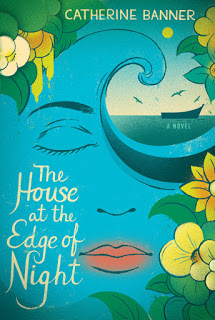
The House at the Edge of the Night by Catherine Banner

What better book to read on your honeymoon than one that centers on a long, happy marriage which withstands world wars, local gossip, and rowdy children? This novel follows several generations on Castellamare, a fictional island off the coast of Sicily, telling the story of Italy's last century through the lives of the Esposito family. It's best read with a snack of arancini and a glass of limoncello.
Read about another entry on the list.

--Marshal Zeringue

Anthony Ryan's "The Waking Fire," the movie

Featured at My Book, the Movie: The Waking Fire by Anthony Ryan.

The entry begins:
Writers are notoriously bad at casting - Ian Fleming wanted Cary Grant to play James Bond for example (eesh) – and I’m always reluctant to link actors to my characters as I prefer to leave it to the reader’s imagination. That being said, I did have some actors in mind when writing The Waking Fire so what the hell, here goes (I’m sure they’ll all be available and won’t cost too much):

Claydon Torcreek – John Boyega.

Braddon Torcreek – Lawrence...[read on]
Visit Anthony Ryan's website.

The Page 69 Test: The Waking Fire.

My Book, the Movie: The Waking Fire.

--Marshal Zeringue

Tuesday, July 12, 2016

What is Simone Zelitch reading?

Featured at Writers Read: Simone Zelitch, author of Judenstaat.

Her entry begins:
A few weeks ago, I picked up a book that had been on my shelf for a while, Rasheeda Phillips’s Recurrence Plot and Other Time Travel Tales. Rasheeda took a fiction class with me years ago, and she’s a housing attorney with with Community Legal Services, as well as the creator of The Afrofuturist Affair. When is the last time a book gave me actual nightmares? This one did.

Recurrence Plot begins the day a woman turns twenty-one. She gave birth at the age of fourteen—like her mother before her—a path that feels inevitable; she takes her own life on her twenty-first birthday—like her mother before her. Her daughter grows up remembering the future, and the power tamped down by medication. A home-made time-machine creates connections between her past and future selves, with ambiguous consequences. She investigates a research institute at the fictional, sinister Parallel University which experiments on young black teens who are “at risk” for criminal behavior, assuming that their lives lead in one direction: they emerge hardened and changed.

The book interpolates expository passages about how the brain and body process time, as well as allusions to quantum physics, and segments that feel like a “choose your own adventure story” or are intended to be read backwards. Does time only flow forward? Is its direction inevitable? These questions are played out in poor African-American communities in my hometown of Philadelphia. Recurrence Plot is...[read on]
About Judenstaat, from the publisher:
Simone Zelitch has created an amazing alternate history in Judenstaat. On April 4th, 1948 the sovereign state of Judenstaat was created in the territory of Saxony, bordering Germany, Poland, and Czechoslovakia.

Forty years later, Jewish historian Judit Klemmer is making a documentary portraying Judenstaat's history from the time of its founding to the present. She is haunted by the ghost of her dead husband, Hans, a Saxon, shot by a sniper as he conducted the National Symphony. With the grief always fresh, Judit lives a half-life, until confronted by a mysterious, flesh-and-blood ghost from her past who leaves her controversial footage on one of Judenstaat's founding fathers--and a note:

"They lied about the murder."

Judit's research into the footage, and what really happened to Hans, embroils her in controversy and conspiracy, collective memory and national amnesia, and answers far more horrific than she imagined.
Visit Simone Zelitch's website.

The Page 69 Test: Judenstaat.

My Book, The Movie: Judenstaat.

Writers Read: Simone Zelitch.

--Marshal Zeringue

Pg. 69: Caroline Angell's "All the Time in the World"

Featured at the Page 69 Test: All the Time in the World by Caroline Angell.

About the book, from the publisher:
An unforgettable debut about a young woman's choice between the future she's always imagined and the people she's come to love.

Charlotte, a gifted and superbly trained young musician, has been blindsided by a shocking betrayal in her promising career when she takes a babysitting job with the McLeans, a glamorous Upper East Side Manhattan family. At first, the nanny gig is just a way of tiding herself over until she has licked her wounds and figured out her next move as a composer in New York. But, as it turns out, Charlotte is naturally good with children and becomes as deeply fond of the two little boys as they are of her. When an unthinkable tragedy leaves the McLeans bereft, Charlotte is not the only one who realizes that she's the key to holding little George and Matty's world together. Suddenly, in addition to life's usual puzzles, such as sorting out which suitor is her best match, she finds herself with an impossible choice between her life-long dreams and the torn-apart family she's come to love. By turns hilarious, sexy, and wise, Caroline Angell's remarkable and generous debut is the story of a young woman's discovery of the things that matter most.
Visit Caroline Angell's website and Twitter perch.

My Book, The Movie: All the Time in the World.

The Page 69 Test: All the Time in the World.

--Marshal Zeringue

Five top books that find beauty in the apocalypse

Sam Reader is a writer and conventions editor for The Geek Initiative. He also writes literary criticism and reviews at strangelibrary.com. One of his five "books that give us hope that our apocalyptic future will, at least, be beautiful," as shared at the B&N Sci-Fi & Fantasy Blog:
Night of the Animals, by Bill Broun

Night of the Animals may take place in an oppressive dystopia where the newly restored King of England rules with an iron fist and a suicide cult runs rampant as a comet looms in the sky, but it’s one of the most aesthetically pleasing end-of-everything scenarios I’ve ever encountered. Broun uses bold color, light, and contrast choices paired with vivid descriptions to create a book that feels utterly, gorgeously magical, even when depicting citywide riots, or a standoff between the King’s forces and the hero in the middle of the London Zoo. Add a bunch of hallucinatory sequences involving possibly magic animals, and the result is a pretty, pretty apocalyptic dystopian fantasia that stays with you long after the book’s close.
Read about another entry on the list.

--Marshal Zeringue

Pg. 99: Peter Webb's "Imagining the Arabs"

Featured at the Page 99 Test: Imagining the Arabs: Arab Identity and the Rise of Islam by Peter Webb.

About the book, from the publisher:
Who are the Arabs? When did people begin calling themselves Arabs? And what was the Arabs' role in the rise of Islam? Investigating these core questions about Arab identity and history through close interpretation of pre-Islamic evidence and the extensive Arabic literary corpus in tandem with theories of identity and ethnicity prompts new answers to the riddle of Arab origins and fundamental reinterpretations of early Islamic history.

It is revealed that the time-honoured stereotypes depicting Arabs as ancient Arabian Bedouin are entirely misleading: the essence of Arab identity was in fact devised by Muslims during the first centuries of Islam. Arab identity emerged and evolved as groups imagined new notions of community to suit the radically changing circumstances of life in the early Caliphate. The idea of 'the Arab' was a device used by Muslims to articulate their communal identity, to negotiate post-Conquest power relations, and to explain the rise of Islam. Over Islam's first four centuries, political elites, genealogists, poetry collectors, historians and grammarians all participated in a vibrant process of imagining and re-imagining Arab identity and history, and the sum of their works established a powerful tradition that influences Middle Eastern communities to the present day.
Learn more about Imagining the Arabs at the Edinburgh University Press website.

The Page 99 Test: Imagining the Arabs.

--Marshal Zeringue

Monday, July 11, 2016

What is Tiffany Reisz reading?

Featured at Writers Read: Tiffany Reisz, author of The Bourbon Thief.

Her entry begins:
When I’m not writing books, I’m reading books. Here are a few of the fabulous books I’ve read so far this year.

While looking for a good Gothic romance, I stumbled across a review that recommended Dark Dance by Tanith Lee. It’s the first book in her Blood Opera series that features vampire-ish semi-immortal creatures and their bizarre subculture. In Dark Dance we not only get father-daughter incest but a demon baby to boot! I’m currently reading Darkness, I, the third in the series and it’s also delightfully bizarre....[read on]
About The Bourbon Thief, from the publisher:
Betrayal, revenge and a family scandal that bore a 150–year–old mystery

When Cooper McQueen wakes up from a night with a beautiful stranger, it's to discover he's been robbed. The only item stolen—a million-dollar bottle of bourbon. The thief, a mysterious woman named Paris, claims the bottle is rightfully hers. After all, the label itself says it's property of the Maddox family who owned and operated the Red Thread Bourbon distillery since the last days of the Civil War, until the company went out of business for reasons no one knows… No one except Paris.

In the small hours of a Louisville morning, Paris unspools the lurid tale of Tamara Maddox, heiress to the distillery that became an empire. Theirs is a legacy of wealth and power, but also of lies, secrets and sins of omission. Why Paris wants the bottle of Red Thread remains a secret until the truth of her identity is at last revealed, and the century-old vengeance Tamara vowed against her family can finally be completed.
Visit Tiffany Reisz's website.

The Page 69 Test: The Bourbon Thief.

Writers Read: Tiffany Reisz.

--Marshal Zeringue

Pg. 69: Anthony Ryan's "The Waking Fire"

Featured at the Page 69 Test: The Waking Fire by Anthony Ryan.

About the book, from the publisher:
Throughout the vast lands controlled by the Ironship Trading Syndicate, nothing is more prized than the blood of drakes. Harvested from captive or hunted Reds, Greens, Blues and Blacks, it can be distilled into elixirs that bestow fearsome powers on the rare men and women known as the Blood-blessed.

But not many know the truth: that the lines of drakes are weakening. If they fail, war with the neighbouring Corvantine Empire will follow swiftly. The Syndicate’s last hope resides in whispers of the existence of another breed of drake, far more powerful than the rest, and the few who have been chosen by fate to seek it.

Claydon Torcreek is a petty thief and an unregistered Blood-blessed who finds himself pressed into service by the Protectorate and sent to wild, uncharted lands in search of a creature he believes is little more than legend. Lizanne Lethridge is a formidable spy and assassin facing gravest danger on an espionage mission deep into the heart of enemy territory. And Corrick Hilemore is the second lieutenant of an Ironship cruiser whose pursuit of ruthless brigands leads him to a far greater threat at the edge of the world.

As lives and empires clash and intertwine, as the unknown and the known collide, all three must fight to turn the tide of a coming war, or drown in its wake.
Visit Anthony Ryan's website.

The Page 69 Test: The Waking Fire.

--Marshal Zeringue

Caroline Angell's "All the Time in the World," the movie

Featured at My Book, The Movie: All the Time in the World by Caroline Angell.

The entry begins:
I hear the voices of my characters pretty distinctly when I’m working on a novel or a play. (Now there’s a sentence that will mark me for the nuthouse right off the bat.) I mention this because for me as a writer, the process is not as visual as it is auditory. I think a lot about essence, and the speech patterns and cadence of characters’ voices while I’m writing. Stylistically, I can see the movie of my book being similar to the TV show Parenthood, where the dialogue is messy and sometimes overlaps. No one says anything perfectly, but the moments come through in a vital and authentic manner.

I consciously try not to go too far into physical descriptions of my characters, unless it’s necessary to the point of view I’m working from. Mainly because I would love for a reader (or an actor) to be able to pick up my book and say, I see myself in this situation. I can relate to this. For that reason, I haven’t given a whole lot of consideration to how the movie might be cast.

But, I mean, if one of Meryl Streep’s kids wanted to...[read on]
Visit Caroline Angell's website and Twitter perch.

My Book, The Movie: All the Time in the World.

--Marshal Zeringue

Ramona Ausubel's 6 favorite books

Ramona Ausubel's new novel is Sons and Daughters of Ease and Plenty. One of her six favorite books, as shared at The Week magazine:
Kidnapped by Robert Louis Stevenson

Rickety stone towers, a dishonest, blunderbuss-carrying uncle, murder, a shipwreck, and a chase through the Scottish Highlands. David Balfour, 17, has much to overcome in order to survive and claim his father's fortune. Kidnapped is the very definition of an adventure story.
Read about another book on the list.

Kidnapped also appears among M.C. Beaton's six best novels, Robert Wilton's ten top civil war novels, Janis MacKay's top ten books set on the ocean, Joshua Glenn's top 32 adventure novels of the 19th century, Charlie Fletcher's top ten swashbuckling tales of derring-do, and on John Mullan's lists of ten of the best wicked uncles in literature, ten of the best misers in literature, ten of the best shipwrecks, and ten of the best towers in literature.

--Marshal Zeringue

Sunday, July 10, 2016

What is Jane Rogers reading?

Featured at Writers Read: Jane Rogers, author of Conrad & Eleanor: A Novel.

Her entry begins:
I’m usually reading several books at the same time, for various reasons; often my reading has to do with other writers I am meeting, or with research. The research might be towards a novel, though at the moment two of the books I’m reading are for research towards a radio drama and a piece of online journalism. Then there are the books I read because they’re recommended by people I trust, or because of brilliant reviews, or simply because I want to. Finally, I seem to spend a lot of my life on trains, and size is a factor in the book I chose to take with me. I hate the fashion for huge books that don’t fit easily in my backpack or handbag. So, here are four that I have on the go at the moment:

Robert Louis Stevenson, In the South Seas (research), which contains his letters and essays about his travels in the South Seas in the last years of his life. Stevenson is one of the best writers ever, it amazes me that he is not more highly regarded by English-speaking readers. The French revere him! I’m working on...[read on]
About Conrad & Eleanor, from the publisher:
From the multi-award-winning and critically acclaimed author of The Testament of Jessie Lamb comes this riveting novel about the devastating secrets revealed in the midst of a disintegrating marriage.

The story of a marriage, and of two lives in science.

When Conrad fails to return from a conference, Eleanor wonders if it is because of the affair she is having? Or perhaps it is because his research into transgenic monkey hearts is stalling; perhaps he is sick of having the less successful career of the two of them? She is a leading expert in stem cell research. Their grown-up children suspect Eleanor of murdering their father; El secretly fears that what has driven Con away is his discovery of their daughter Cara’s parentage.

While his family in Manchester, England, scrabble for clues and reasons, Conrad—alone, confused, and on the run from a crazed animal rights activist—loses himself in the cold foggy streets of Bologna. He revisits the stages of his long marriage to El, from the happiness of the year of Cara’s birth to the grief and anger he now feels. Both partners are forced to re-examine their relationship, and, in the process, to move closer to an understanding of what it is that matters most to each of them.

Conrad and Eleanor is a radical, remarkably nuanced look at marriage.
Visit Jane Rogers's website.

The Page 69 Test: Conrad & Eleanor.

Writers Read: Jane Rogers.

--Marshal Zeringue

Five top romantic second-chance love stories

At B&N Reads Christina Merrill tagged five romantic second-chance love stories, including:
Where She Went, by Gayle Forman

Readers (especially YA fans) will love the sequel to If I Stay. Set three years later, the story continues the story of Adam and Mia, the latter who lost her family in a car crash. The sequel is told from Adam’s point of view and takes place over the course of one night. Adam is now an international rock star, and he’s going through some personal and professional turmoil. He and Mia, now an up-and-coming classical musician, reconnect in New York City after he catches a performance of hers. They’ve each changed and developed and matured in their own ways, but their feelings for each other are still there. It’s really quite beautiful to read about these two young people, who had such deep feelings for each other at an even younger age, learn about each other after they’ve had some time apart.
Read about another entry on the list.

The Page 69 Test: If I Stay.

The Page 69 Test: Where She Went.

--Marshal Zeringue