Thursday, July 09, 2015

Pg. 69: Anica Mrose Rissi's "Anna, Banana, and the Monkey in the Middle"

Featured at the Page 69 Test: Anna, Banana, and the Monkey in the Middle (Book #2 of Anna, Banana) by Anica Mrose Rissi.

About the book, from the publisher:
Anna finds herself torn between two friends in the second book of a charming illustrated chapter book series about the joys and challenges of elementary school friendships.

Sadie and Isabel are Anna’s two best friends, and Anna can’t wait to go with them on the class field trip to the zoo—but she keeps getting caught in the middle. Isabel wants Anna to see the tortoise with her, but Sadie wants to see the spiny anteater. Isabel wants to do their group report on giant pandas, while Sadie wants them to write about zebras. With a little help from her beloved dog, Banana, as well as some wise advice from her family, can Anna figure out what it means to be a best friend to two very different people—and still be a friend to herself?
Visit Anica Mrose Rissi's website.

Coffee with a Canine: Anica Mrose Rissi & Arugula.

The Page 69 Test: Anna, Banana, and the Monkey in the Middle.

--Marshal Zeringue

Lori Lansens's "The Mountain Story," the movie

Featured at My Book, The Movie: The Mountain Story by Lori Lansens.

The entry begins:
I had a short career as a screenwriter and what I remember most is that producers would say that my screenplays read like novels. (I knew they didn’t mean it in a good way!) Now, when readers tell me that my novels leave them with the sense that they’ve just watched a movie, I’m chuffed. The Mountain Story is an adventure story about four people lost together in the mountain wilderness for five days without food, water or shelter. The protagonist is an eighteen-year-old boy so when I think of the novel as a movie I look at the stars of the Divergent and Hunger Games series as the right type, only younger. The three women lost with Wolf Truly in the mountain wilderness that overlooks Palm Springs are from three different generations – there’s a girl still in her teens – I picture the teenaged Kali Hawk, a young Lisa Bonet, Rihanna. There is an attractive hiker in her late thirties, a blonde triathlete, and I did imagine...[read on]
Visit Lori Lansens's website.

My Book, The Movie: The Mountain Story.

--Marshal Zeringue

Top ten merry adulterers in literature

Eliza Kennedy attended the University of Iowa and Harvard Law School, where she was an editor of the Harvard Law Review. After graduation she served as a law clerk for a federal judge, then practiced litigation for several years at a prestigious Manhattan law firm. I Take You is her first novel.

One of Kennedy's top ten gleeful adulterers in literature, as shared at the Guardian:
Rabbit Angstrom in Rabbit, Run by John Updike

We do a lot of things wrong here in America, but I like to think we do adultery right. Take, for example, Rabbit Angstrom, former high-school basketball star and eternal charming loser. He walks out on his pregnant wife one night, and just keeps running. He falls in with Ruth Leonard, a tough-talking, sweetly vulnerable stenographer-prostitute, whose “thighs fill the front of her pseudo-silk pale-green dress so that even standing up she has a lap”. After dallying with Ruth for a few months, he returns to his wife, only to change his mind again. Eventually, tragedy strikes, but because Rabbit’s an asshole, not because he’s an adulterer. Even then, it leaves him largely untouched. Well played.
Read about another entry on the list.

Rabbit, Run figures among Sue Townsend's six best books, Julian Barnes's best books to travel with, William Sutcliffe's top 10 relationship novels, and Aifric Campbell's top ten list of favorite jobs in fiction.

--Marshal Zeringue

Pg. 99: Cynthia Barnett's "Rain: A Natural and Cultural History"

Featured at the Page 99 Test: Rain: A Natural and Cultural History by Cynthia Barnett.

About the book, from the publisher:
Rain is elemental, mysterious, precious, destructive.

It is the subject of countless poems and paintings; the top of the weather report; the source of the world’s water. Yet this is the first book to tell the story of rain.

Cynthia Barnett’s Rain begins four billion years ago with the torrents that filled the oceans, and builds to the storms of climate change. It weaves together science—the true shape of a raindrop, the mysteries of frog and fish rains—with the human story of our ambition to control rain, from ancient rain dances to the 2,203 miles of levees that attempt to straitjacket the Mississippi River. It offers a glimpse of our “founding forecaster,” Thomas Jefferson, who measured every drizzle long before modern meteorology. Two centuries later, rainy skies would help inspire Morrissey’s mopes and Kurt Cobain’s grunge. Rain is also a travelogue, taking readers to Scotland to tell the surprising story of the mackintosh raincoat, and to India, where villagers extract the scent of rain from the monsoon-drenched earth and turn it into perfume.

Now, after thousands of years spent praying for rain or worshiping it; burning witches at the stake to stop rain or sacrificing small children to bring it; mocking rain with irrigated agriculture and cities built in floodplains; even trying to blast rain out of the sky with mortars meant for war, humanity has finally managed to change the rain. Only not in ways we intended. As climate change upends rainfall patterns and unleashes increasingly severe storms and drought, Barnett shows rain to be a unifying force in a fractured world. Too much and not nearly enough, rain is a conversation we share, and this is a book for everyone who has ever experienced it.
Visit Cynthia Barnett's website.

The Page 99 Test: Rain: A Natural and Cultural History.

--Marshal Zeringue

Wednesday, July 08, 2015

What is Christine Sneed reading?

Featured at Writers Read: Christine Sneed, author of Paris, He Said.

Her entry begins:
I just finished Andre Dubus III’s soulful, beautifully written memoir Townie. Corny as this will probably sound, I can’t see myself ever forgetting this book. Dubus’s rendering of his and his three siblings’ upbringing in tough, economically declining mill towns outside of Boston is searing, sometimes tragic, but most of all, a remarkable testament to Dubus’s (and by extension, his siblings’) ability to transcend a childhood and adolescence marked at times by serious hardship. He examines with arresting insight a number of dualities, in particular, his predilection toward physical violence even as he began to realize that the world is in desperate need of more kindness and mindfulness. In this amazing book, Dubus III is viewing the first four decades of his life through the prism of....[read on]
About Paris, He Said, from the publisher:
Jayne Marks is questioning the choices she has made in the years since college and is struggling to pay her bills in Manhattan when she is given the opportunity to move to Paris with her wealthy lover and benefactor, Laurent Moller, who owns and operates two art galleries, one in New York, the other in Paris. He offers her the time and financial support she needs to begin her career as a painter and also challenges her to see who and what she will become if she meets her artistic potential.

Laurent, however, seems to have other women in his life and Jayne, too, has an ex-boyfriend, much closer to her own age, whom she still has feelings for. Bringing Paris gloriously to life, Paris, He Said is a novel about desire, beauty, and its appreciation, and of finding yourself presented with the things you believe you've always wanted, only to wonder where true happiness lies.
Visit Christine Sneed's website.

Writers Read: Christine Sneed.

--Marshal Zeringue

Pg. 69: Carla Norton's "What Doesn't Kill Her"

Featured at the Page 69 Test: What Doesn't Kill Her by Carla Norton.

About the book, from the publisher:
Reeve LeClaire is a college student, dammit, not Daryl Wayne Flint's victim. Not anymore-not when Reeve is finally recovering a life of her own after four years of captivity.

Flint is safely locked up in Olshaker Psychiatric Hospital, where he belongs. He is walking the grounds of the forensic unit, performing his strange but apparently harmless rituals. It seems that he is still suffering the effects of the head injury he suffered in the car crash that freed Reeve seven years ago. Post-concussive syndrome, they call it.

For all that Flint seems like a model patient, he has long been planning his next move. When the moment arrives, he gets clean away from the hospital before the alarm even sounds. And Reeve is shocked out of her new life by her worst nightmare: Her kidnapper has escaped. Less than 24 hours later, Flint kills someone from his past--and Reeve's blocked memories jolt back into consciousness. As much as she would like to forget him, she knows this criminal better than anyone else. When Flint evades capture, baffling authorities and leaving a bloody trail from the psychiatric lock-up to the forests of Washington state, Reeve suddenly realizes that she is the only one who can stop him.

Reeve is an irresistibly brave and believable heroine in Carla Norton's heart-stopping new thriller, What Doesn't Kill Her, about a young woman who learns to fight back.
Visit Carla Norton's website, Facebook page, and Twitter perch.

The Page 69 Test: What Doesn't Kill Her.

--Marshal Zeringue

Seven of the best literary horror titles

At B & N Reads, Kelly Davio tagged seven of the best literary horror titles--books that "are as well written as they are goosebump-inducing"--including:
Hold the Dark, by William Giraldi

Set in the remote village of Keelut, Alaska, Giraldi’s violent, unnerving tale of vengeance is written in a language as fierce and merciless as the landscape its characters inhabit. When nature writer Russell Core finds himself summoned to Keelut to help recover the remains of a child snatched by wolves, Core discovers there’s more to the child’s death than anyone in the town is willing to reveal. Hold the Dark’s horror is not a supernatural one; instead, the true terror of the story is in the very human capacity for violence.
Read about another entry on the list.

Writers Read: William Giraldi (September 2011).

--Marshal Zeringue

Brendan DuBois's "Blood Foam," the movie

Featured at My Book, The Movie: Blood Foam by Brendan DuBois.

The entry begins:
Ever since my first Lewis Cole novel (Dead Sand) was published back in 1994 (!), I've had numerous requests to cast the character of Lewis in a Hollywood film or television show. Lewis is a former Department of Defense research analyst who was pensioned off from his job after surviving a disastrous and top secret training accident. His current 'day job' is a columnist for a regional magazine called Shoreline. He's not particularly athletic and quick with his fists --- like Robert Parker's Spenser --- but he does have a presence. When my first novels came out, I thought that a younger Sam Shepard would make a good Lewis Cole. Now, years later, I think...[read on]
Visit Brendan DuBois's website.

My Book, The Movie: Blood Foam.

--Marshal Zeringue

Tuesday, July 07, 2015

What is Andrew Roe reading?

Featured at Writers Read: Andrew Roe, author of The Miracle Girl.

His entry begins:
I’m going through one of those fickle phases where I’m reading more than one book, bouncing back and forth, simultaneously enjoying the variety and freedom while also feeling a little weird and unfaithful, like I can’t fully commit.

So here’s some of what’s currently on my reading rotation: Jonathan Evison’s This Is Your Life, Harriet Chance!, which will be published in September by my publisher Algonquin Books and chronicles the life of the 79-year-old title character, who re-evaluates her life in the wake of her husband’s death (I wasn’t planning on reading this one yet, but I picked it up this past weekend and couldn’t stop); Sean Wilentz’s Bob Dylan in America, which puts a historical and cultural lens on Dylan and his work, focusing on key points in his decades-long career; and...[read on]
About The Miracle Girl, from the publisher:
The crowds keep coming. More and more every day it seems . . . drawn by rumor and whisper and desperate wish. Somehow they heard about the little girl on Shaker Street.

They come to see eight-year-old Anabelle Vincent, who lies in a comalike state—unable to move or speak. They come because a visitor experienced what seemed like a miracle and believed it was because of Anabelle. Word spread. There were more visitors. More miracles. But is there a connection? And does it matter?

Set against the backdrop of the approaching millennium—with all its buzz about reckoning and doom–this impressive debut novel is narrated by Anabelle herself; by her devoted mother, who cares for her child while struggling to make sense of the media frenzy surrounding her; by Anabelle’s estranged father, who is dealing with the guilt of his actions; and by the people who come seeking the child’s help, her guidance, and her healing. Yet it tells a larger cultural story about the human yearning for the miraculous to be true, about how becoming a believer—in something, anything, even if you don’t understand it—can sustain you.
Learn more about the book and author at Andrew Roe's website.

My Book, The Movie: The Miracle Girl.

The Page 69 Test: The Miracle Girl.

Writers Read: Andrew Roe.

--Marshal Zeringue

Six of the best books about "almost magical" women

Karen Joy Fowler's books include the novels The Jane Austen Book Club and We Are All Completely Beside Ourselves and the short-story collection Black Glass. One of Fowler's six favorite books about "almost magical" women, as shared at The Week magazine:
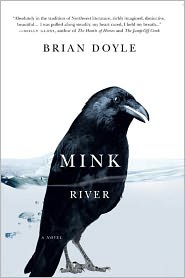
Mink River by Brian Doyle

There are magical men and magical crows in the fictional town of Neawanaka, Oregon. Still, Neawanaka's nonmagical women more than hold their own. Doyle's 2011 novel is a new and really exciting discovery for me. I'm still under its spell and hope to remain there.
Read about another book on the list.

The Page 69 Test: Mink River.

Also see: Karen Joy Fowler's top ten books about intelligent animals.

--Marshal Zeringue

Pg. 69: Nina George's "The Little Paris Bookshop"

Featured at the Page 69 Test: The Little Paris Bookshop: A Novel by Nina George.

About the book, from the publisher:
“There are books that are suitable for a million people, others for only a hundred. There are even remedies—I mean books—that were written for one person only…A book is both medic and medicine at once. It makes a diagnosis as well as offering therapy. Putting the right novels to the appropriate ailments: that’s how I sell books.”

Monsieur Perdu calls himself a literary apothecary. From his floating bookstore in a barge on the Seine, he prescribes novels for the hardships of life. Using his intuitive feel for the exact book a reader needs, Perdu mends broken hearts and souls. The only person he can’t seem to heal through literature is himself; he’s still haunted by heartbreak after his great love disappeared. She left him with only a letter, which he has never opened.

After Perdu is finally tempted to read the letter, he hauls anchor and departs on a mission to the south of France, hoping to make peace with his loss and discover the end of the story. Joined by a bestselling but blocked author and a lovelorn Italian chef, Perdu travels along the country’s rivers, dispensing his wisdom and his books, showing that the literary world can take the human soul on a journey to heal itself.

Internationally bestselling and filled with warmth and adventure, The Little Paris Bookshop is a love letter to books, meant for anyone who believes in the power of stories to shape people’s lives.
Visit Nina George's website.

My Book, The Movie: The Little Paris Bookshop.

The Page 69 Test: The Little Paris Bookshop.

--Marshal Zeringue

Pg. 99: Roland Clark's "Holy Legionary Youth"

Featured at the Page 99 Test: Holy Legionary Youth: Fascist Activism in Interwar Romania by Roland Clark.

About the book, from the publisher:
Founded in 1927, Romania’s Legion of the Archangel Michael was one of Europe’s largest and longest-lived fascist social movements. In Holy Legionary Youth, Roland Clark draws on oral histories, memoirs, and substantial research in the archives of the Romanian secret police to provide the most comprehensive account of the Legion in English to date. Clark approaches Romanian fascism by asking what membership in the Legion meant to young Romanian men and women. Viewing fascism “from below,” as a social category that had practical consequences for those who embraced it, he shows how the personal significance of fascism emerged out of Legionaries’ interactions with each other, the state, other political parties, families and friends, and fascist groups abroad. Official repression, fascist spectacle, and the frequency and nature of legionary activities changed a person’s everyday activities and relationships in profound ways.

Clark’s sweeping history traces fascist organizing in interwar Romania to nineteenth-century grassroots nationalist movements that demanded political independence from the Austro-Hungarian Empire. It also shows how closely the movement was associated with the Romanian Orthodox Church and how the uniforms, marches, and rituals were inspired by the muscular, martial aesthetic of fascism elsewhere in Europe. Although antisemitism was a key feature of official fascist ideology, state violence against Legionaries rather than the extensive fascist violence against Jews had a far greater impact on how Romanians viewed the movement and their role in it. Approaching fascism in interwar Romania as an everyday practice, Holy Legionary Youth offers a new perspective on European fascism, highlighting how ordinary people “performed” fascism by working together to promote a unique and totalizing social identity.
Learn more about Holy Legionary Youth at the Cornell University Press website.

My Book, The Movie: Holy Legionary Youth.

The Page 99 Test: Holy Legionary Youth.

--Marshal Zeringue

Monday, July 06, 2015

Tom Harper's "Zodiac Station," the movie

Featured at My Book, The Movie: Zodiac Station by Tom Harper.

The entry begins:
Strangely enough, I rarely have a clear idea of what my protagonists look like. If I’m writing in the first person, I see the world through their eyes but I never see their face. I noticed, when I started my career, that most first-person books have the hero check themselves in a mirror or a shop window early in chapter one, so the author can shoehorn in a description. I decided that was artificial, and avoided it – but the downside is that no-one (including me) really knows what my protagonists look like.

The main narrator of Zodiac Station is Tom Anderson, a down-on-his-luck researcher with a stalled career and a young son to look after. Out of the blue, he gets the opportunity of a lifetime, to go and work for a big-name scientist at Zodiac Station, a research base locked in the polar ice on the arctic island of Utgard. Inevitably, things don’t go according to plan.
Anderson undergoes a strong physical transformation in the course of the book, so you’d want someone who can play an average joe and then muscle up. Tom Hardy might be good: if you compare him as...[read on]
Visit Tom Harper's website.

My Book, The Movie: Zodiac Station.

--Marshal Zeringue

What is Jonathan David Kranz reading?

Featured at Writers Read: Jonathan David Kranz, author of Our Brothers at the Bottom of the Bottom of the Sea.

His entry begins:
Middlemarch

At close to 800 pages and with its imposing Masterpiece Theater air, George Eliot’s Middlemarch has long been a novel from which I’d successfully kept my distance. But all the talk around Rebecca Mead’s book, My Life in Middlemarch, caught my ear and piqued my curiosity.

I’m glad it did. Middlemarch has so many virtues (many of which Mead avidly articulates in her study), but what stands out for me is that Eliot takes seriousness seriously. Her principal characters, Dorothea Brooke and Dr. Tertius Lydgate, hunger for significant work, hers in a vague calling to greater social good and his in...[read on]
About Our Brothers at the Bottom of the Bottom of the Sea, from the publisher:
Don't fall, Ethan scrawls in red permanent marker across the rides and signs of Sea Town. Since his brother Jason's death, Ethan can't let go of his big brother.

Don't fall, Rachel reads as she prepares to dump back into the ocean the shells her brother Curtis collected. Curtis had Down syndrome, but that isn't why he plummeted to his death from the Rock-It Roll-It Coaster.

Together, Ethan and Rachel are about to discover just how far a man will go to protect his kingdom.

With lyrical storytelling, Jonathan David Kranz spins an irresistible tale of mystery and grief, guilt and culpability.
Visit Jonathan David Kranz's website.

The Page 69 Test: Our Brothers at the Bottom of the Bottom of the Sea.

Writers Read: Jonathan David Kranz.

--Marshal Zeringue

Ten top YA books about teen pregnancy

The Baby, Lisa Drakeford's first novel, was shortlisted for the (London) Times / Chicken House children’s fiction competition 2014. One of her top ten Young Adult books about teen pregnancy, as shared at the Guardian:
Trouble by Non Pratt

I loved this. It’s as up to date as you can get. Contemporary writing, language, setting and situation. Fifteen-year-old Hannah finds out she’s pregnant and is not willing to give the identity of the father. Aaron, a new boy at school offers to assume the role instead. The book is written from both points of view. I love Aaron for his cleverness and his sensitivity, but it’s Hannah’s character I really admire. Non Pratt gets her just right. I’ve seen so many Hannahs in schools over the years: impulsive, chaotic, impetuous, feisty, funny but incredibly likeable. And I’m also impressed with the way the author covers friendship. The relationships in Trouble are complicated and full of teenage laws which are broken, mended and re-broken. So realistic, so insightful, so clever.
Read about another entry on the list.

--Marshal Zeringue

Coffee with a canine: Kate Charles & Rosie

Featured at Coffee with a Canine: Kate Charles & Rosie.

The author, on how she and Rosie were united:
We lost our last dog, a Patterdale terrier, to heart disease way too young. It was the first time in over 30 years that our home was without a dog – we’d always had overlapping dogs before, but Gemma was much happier as an ‘only dog’. We did our research and decided that a Border Terrier would suit our temperaments and life-style. I kept my eye on various internet puppy sites, and when I spotted a litter which had been born on the day Gemma died, I...[read on]
About  False Tongues, the latest Callie Anson Mystery by Kate Charles, from the publisher:
The Reverend Callie Anson should have learned her lesson by now: revisiting the past is seldom a good idea. But she succumbs to peer pressure and attends a reunion at her theological college in Cambridge, where she is forced to confront painful memories – and the presence of her clueless ex, Adam.

Margaret Phillips, the Principal of the college, has a chance for happiness but before she can grasp it she has to deal with her own ghosts – as well as corrosive, intrusive gossip. Both Margaret and Callie learn something about themselves, and about forgiveness, from wise retired priest John Kingsley.

Meanwhile, in London, police officers Neville Stewart and Mark Lombardi are involved with the latest stabbing of a teenager. Was the victim – gifted, popular schoolboy Sebastian Frost – all he seemed to be, or was there something in his life that led inevitably to his death? The police find themselves plunged into the queasy world of cyber-bullying, where nothing may be as it seems.

While they’re apart, Callie and Mark’s relationship is on hold, and his Italian family continues to be an issue. Will Mark realize, before it’s too late, that while his family will always be important to him, he is entitled to something for himself?
Visit Kate Charles's website.

Coffee with a Canine: Kate Charles & Rosie.

The Page 69 Test: False Tongues.

--Marshal Zeringue

Pg. 69: Catherine Winn's "Beyond Suspicion"

Featured at the Page 69 Test: Beyond Suspicion by Catherine A. Winn.

About the book, from the publisher:
Her mom’s remarriage has been hard on fifteen year old Shelby. Roger is strict and treats her like a child. At least they’re letting her go to her first boy-girl party. That is until she gets home from school and finds that Roger has changed his mind―he wants Shelby to babysit her year-old brother Josh. It’s so unfair! Fuming, Shelby takes Josh in his stroller to the park. After all, it’s not his fault. Someone sets off fireworks, distracting Shelby. When she turns around―Josh is gone. Shelby tells the police she’s seen a white van cruising the neighborhood lately, and she thinks she saw it at the park as well. But to her horror, the police are not interested: Pointing to angry texts to her girlfriends about getting back at Roger, they accuse her of causing Josh’s disappearance! The police focus on the woods around the park, driving Shelby wild with fear and anger that the kidnappers will get away. With TV reporters all over the front yard, Shelby sneaks out the back to find her brother, any way she can. So begins Shelby’s race against time―and against a world that has turned on her. And yet she finds help along the way. There’s mysterious Matt, who says he wants to help, but doesn’t seem to want anyone to know it. And there’s Jess, who watches out for Shelby as, against the odds, she tracks down the kidnappers down just as they are leaving town.
Visit Catherine A. Winn's website.

My Book, The Movie: Beyond Suspicion.

The Page 69 Test: Beyond Suspicion.

--Marshal Zeringue

Sunday, July 05, 2015

Nina George's "The Little Paris Bookshop," the movie

Featured at My Book, The Movie: The Little Paris Bookshop by Nina George.

From her entry:
You see: I am not so much into casting. I am also not so much into movies or celebs, so I am not sure, which living or dead actor could go for M. Perdu or all the stuff and personage. I never saw Jean Perdu from outside, I saw him from inside. If his eyes are blue, green or warm, if his hair is brown or gone – this was never the point.

And: I still believe that making movies is an art of its own. A regisseur, an actress, a cutter – they are artists in their manner, and experts to develop a new piece of art out of any book! So when I now say: Ehm, maybe George Clooney would fit?, this may not be the perfect choice for...[read on]
Visit Nina George's website.

My Book, The Movie: The Little Paris Bookshop.

--Marshal Zeringue

What is Victoria Shorr reading?

Featured at Writers Read: Victoria Shorr, author of Backlands.

Her entry begins:
Funny you should ask—I am on a Coleridge bender at the moment, and it's all I want to talk about. It started this winter, when someone mentioned Alathea Hayter's Voyage in Vain, about Coleridge traveling to Malta to escape home—and opium. Something caught my imagination—I knew little of Coleridge beyond what we all know, "Kubla Khan," the interrupted opium dream. I picked up the book, and found myself immediately drawn—as were so many of Coleridge's contemporaries—into a life of seething, half-thrilling, half maddening poetic passion, and the era of the Sublime—almost a voyage itself, far away from our own "Get Comfortable" lives and times. I then went on to the two volume biography by the brilliant Richard Holmes...[read on]
About Backlands, from the publisher:
In this Bonnie and Clyde story of love and betrayal, a band of outlaws fight for control of the brutal Brazilian outback.

Set in the sparse frontier settlements of northeastern Brazil—a dry, forbidding, and wild region the size of Texas, known locally as the Sertao—Backlands tells the true story of a group of nomadic outlaws who reigned over the area from about 1922 until 1938. Taking from the rich, admired—and feared—by the poor, they were led by the famously charismatic bandit Lampiao. The gang maintained their influence by fighting off all the police and soldiers the region could muster.

A one-eyed goat rancher who first set out to avenge his father's murder in a lawless land, Lampiao proved to be too good a leader, fighter, and strategist to ever return home again. By 1925 he commanded the biggest gang of outlaws in Brazil. Known to this day as a "prince," Lampiao had everything: brains, money, power, charisma, and luck. Everything but love, until he met Maria Bonita.

"You teach me to make lace, and I'll teach you to make love"—this was the song the bandits marched to, across the vast open reaches of their starkly beautiful backlands, and it was Maria Bonita who made it come true. She was stuck in a loveless marriage when she met Lampiao, but she rode off with him, becoming "Queen of the Bandits." Together the couple—still celebrated folk heroes—would become the country's most wanted figures, protecting their extraordinary freedom through cunning.

Victoria Shorr's stunning literary debut tells Maria's story, her narrative of the intense freedoms, terrors, and sorrows of this chosen life, the end of which is clear to her all along. With the federal government in Rio mobilizing against the bandits, Backlands describes the epic final days of Lampiao’s "fatal month," July on the River of Disorder, as the gang struggles to summon their good star to save them one more time.
Visit Victoria Shorr's website.

The Page 69 Test: Backlands. 

My Book, The Movie: Backlands.

Writers Read: Victoria Shorr.

--Marshal Zeringue

Eight top revolutionary SF/F novels

"Revolution and rebellion are powerful concepts in real life and in fiction," Jeff Somers reminds us. "Science fiction and fantasy in particular offer us the opportunity to imagine revolutions both glorious and sinister, epic and underwhelming." One of Somers's top eight revolutionary SF/F novels, as shared at the B & N Sci-Fi & Fantasy Blog:
To Reign in Hell, by Steven Brust

Heavily inspired by Milton’s Paradise Lost, Brust recreates the story of Satan’s revolt in heaven with a reimagining that casts Yahweh as merely the greatest among equals who have created a fortress of order against chaos—known as Heaven. Heaven is not impervious, however, and is destroyed several times, prompting Yahweh, who declares himself god, to propose the creation of a second stronghold: Earth. Satan, tasked with compelling angels to sacrifice themselves in order to bring Yahweh’s vision to fruition, doubts the new deity’s right to demand so much from other angels, and slowly moves towards open rebellion. For his trouble, he is cast out, forming his own third fortress against chaos: Hell.
Read about another entry on the list.

--Marshal Zeringue

Pg. 99: Mara Buchbinder's "All in Your Head"

Featured at the Page 99 Test: All in Your Head: Making Sense of Pediatric Pain by Mara Buchbinder.

About the book, from the publisher:
Although pain is a universal human experience, many view the pain of others as private, resistant to language, and, therefore, essentially unknowable. And, yet, despite the obvious limits to comprehending another’s internal state, language is all that we have to translate pain from the solitary and unknowable to a phenomenon richly described in literature, medicine, and everyday life. Without denying the private dimensions of pain, All in Your Head offers an entirely fresh perspective that considers how pain may be configured, managed, explained, and even experienced in deeply relational ways.

Drawing on ethnographic fieldwork in a pediatric pain clinic in California, Mara Buchbinder explores how clinicians, adolescent patients, and their families make sense of puzzling symptoms and work to alleviate pain. Through careful attention to the language of pain—including narratives, conversations, models, and metaphors—and detailed analysis of how young pain sufferers make meaning through interactions with others, her book reveals that however private pain may be, making sense of it is profoundly social.
Learn more about All in Your Head at the University of California Press website.

The Page 99 Test: All in Your Head.

--Marshal Zeringue

Saturday, July 04, 2015

Laura Levine's "Death by Tiara," the movie

Featured at My Book, The Movie: Death by Tiara by Laura Levine.

The entry begins:
Because my mysteries are comedic and my heroine, Jaine Austen, has been known to sling a one-liner or two—and because she’s not your typical Hollywood Skinny Girl—I thought comedienne Carolyn Rea would make a terrific Jaine. Of course, that was fourteen years ago when I first started writing the series. Now I’d love to get Melissa...[read on]
Visit Laura Levine's website.

The Page 69 Test: Killing Cupid.

My Book, The Movie: Death by Tiara.

--Marshal Zeringue

Five fictional books-within-a-book too dangerous to read

At B & N Reads, Ella Cosmo tagged five fictional books too dangerous to read, including:
Lullaby, by Chuck Palahniuk

In Palahniuk’s Lullaby, a children’s book is the source of a unique and terrifying outbreak. Simply named Poems & Rhymes, the book’s dark magic is triggered by reading the lullabies written inside; doing so imbues the reader with the power to kill instantly. This dark magic is uncovered by reporter Carl Streator, who embarks upon a breakneck quest to stop the spread of the infection by any means necessary. Accompanied by what can only be described as a ragtag group of co-adventurers, the novel is by turns refreshingly humorous and terrifying, keeping readers on their toes. Lullaby is one of those books that keeps you up late at night, because you just have to find out what happens next. Almost as though the power of Lullaby has infected you, too…
Read about another entry on the list.

Lullaby is among Ella Cosmo's five top supernatural books that promise to keep you up late at night.

--Marshal Zeringue

Pg. 69: Andrew Roe's "The Miracle Girl"

Featured at the Page 69 Test: The Miracle Girl by Andrew Roe.

About the book, from the publisher:
The crowds keep coming. More and more every day it seems . . . drawn by rumor and whisper and desperate wish. Somehow they heard about the little girl on Shaker Street.

They come to see eight-year-old Anabelle Vincent, who lies in a comalike state—unable to move or speak. They come because a visitor experienced what seemed like a miracle and believed it was because of Anabelle. Word spread. There were more visitors. More miracles. But is there a connection? And does it matter?

Set against the backdrop of the approaching millennium—with all its buzz about reckoning and doom–this impressive debut novel is narrated by Anabelle herself; by her devoted mother, who cares for her child while struggling to make sense of the media frenzy surrounding her; by Anabelle’s estranged father, who is dealing with the guilt of his actions; and by the people who come seeking the child’s help, her guidance, and her healing. Yet it tells a larger cultural story about the human yearning for the miraculous to be true, about how becoming a believer—in something, anything, even if you don’t understand it—can sustain you.
Learn more about the book and author at Andrew Roe's website.

My Book, The Movie: The Miracle Girl.

The Page 69 Test: The Miracle Girl.

--Marshal Zeringue

Friday, July 03, 2015

Ten top books about the mafia

Born in Sicily, Roberto Dainotto is professor of romance studies and literature at Duke University, where he teaches courses on modern and contemporary Italian culture. His latest book is The Mafia: A Cultural History.

One of Dainotto's top ten books about the mafia, as shared at the Guardian:
Mafia Brotherhoods by John Dickie (2014)

Historian Dickie is a master storyteller – which is fortunate for the reader of this 800-page tome, whose pages turn very quickly. It is one of the few books I know that attempt to trace the exhaustive history not of one, but of three Italian criminal organisations: ’ndrangheta, camorra, and mafia.
Read about another entry on the list.

Also see Alice-Azania Jarvis's reading list on the mafia.

--Marshal Zeringue

Victoria Shorr's "Backlands," the movie

Featured at My Book, The Movie: Backlands by Victoria Shorr.

The entry begins:
The characters in Backlands were real people, Brazilian outlaws, brave and tough and smart, and having traveled in the region and talked to so many people like them, people who knew them, it's harder for me to make that leap into casting than it would be for someone who only knew their story. The dream would be to cast the movie the way they cast Tom Jones, which absolutely caught the book by the tail. But...[read on]
Visit Victoria Shorr's website.

The Page 69 Test: Backlands. 

My Book, The Movie: Backlands.

--Marshal Zeringue

Pg. 99: Sara Solovitch's "Playing Scared"

Featured at the Page 99 Test: Playing Scared: A History and Memoir of Stage Fright by Sara Solovitch.

About the book, from the publisher:
Stage fright is one of the human psyche's deepest fears. Laurence Olivier learned to adapt to it, as have actors Salma Hayek and Hugh Grant. Musicians such as George Harrison and Adele have battled it and learned to cope. Others never do: In 1973, Pittsburgh Pirates All-Star pitcher Steve Blass suddenly could no longer find the strike zone; his career ended soon after. Surveys in the United States repeatedly rank public speaking as one of the top fears, affecting up to 74 percent of people.

Sara Solovitch studied piano as a young child and fell in love with music. At ten, she played Bach and Mozart in her hometown's annual music festival, but was overwhelmed by fear. As a teen, she attended Eastman School of Music, where stage fright led her to give up aspirations of becoming a professional pianist. In her late fifties, Sara gave herself a one-year deadline to tame performance anxiety and play before an audience. She resumed music lessons, while exploring meditation, exposure therapy, cognitive therapy, biofeedback, beta blockers, and other remedies. She performed in airports, hospitals, and retirement homes before renting a public hall and performing for fifty guests on her sixtieth birthday.

Using her own journey as inspiration, Solovitch has written a thoughtful and insightful examination of the myriad causes of stage fright and the equally diverse ways to overcome it, and a tribute to pursuing personal growth at any age.
Visit Sara Solovitch's website.

My Book, The Movie: Playing Scared.

Writers Read: Sara Solovitch.

The Page 99 Test: Playing Scared.

--Marshal Zeringue
What is Carola Dunn reading?

Featured at Writers Read: Carola Dunn, author of Superfluous Women (Daisy Dalrymple Mysteries, Volume 22).

Her entry begins:
I've been travelling, driving from Oregon to Southern California and back. The perfect reading for the motel evenings (and also for staying in a house with young children) is Discover magazine. I've been a subscriber since it was called Science '80. Every issue is full of fascinating stories about what's going on in the world of scientific research, from archeology, anthropology, and medicine to cosmology. I always read it from cover to cover, though I usually don't understand the physics, even at this popular level.

The latest issue but one has an article about an astrophysicist who has come up with a hypothesis about dark matter: that it doesn't exist. His theory, based on a development of Newtonian gravity, would do away with the clash between Einsteinian gravity and quantum mechanics. I don't claim to fully comprehend the arguments but that sounds to me like a good idea! The great thing about Discover is that it doesn't bombard me with math which I wouldn't understand at...[read on]
About Superfluous Women, from the publisher:
In England in the late 1920s, The Honourable Daisy Dalrymple Fletcher, on a convalescent trip to the countryside, goes to visit three old school friends in the area. The three, all unmarried, have recently bought a house together. They are a part of the generation of "superfluous women"--brought up expecting marriage and a family, but left without any prospects after more than 700,000 British men were killed in the Great War.

Daisy and her husband Alec--Detective Chief Inspector Alec Fletcher, of Scotland Yard --go for a Sunday lunch with Daisy's friends, where one of the women mentions a wine cellar below their house, which remains curiously locked, no key to be found. Alec offers to pick the lock, but when he opens the door, what greets them is not a cache of wine, but the stench of a long-dead body.

And with that, what was a pleasant Sunday lunch has taken an unexpected turn. Now Daisy's three friends are the most obvious suspects in a murder and her husband Alec is a witness, so he can't officially take over the investigation. So before the local detective, Superintendent Underwood, can officially bring charges against her friends, Daisy is determined to use all her resources (Alec) and skills to solve the mystery behind this perplexing locked-room crime.
Learn more about the book and author at Carola Dunn's website and blog.

Coffee with a Canine: Carola Dunn and Trillian.

The Page 69 Test: Heirs of the Body.

The Page 69 Test: Superfluous Women.

Writers Read: Carola Dunn.

--Marshal Zeringue

Thursday, July 02, 2015

Pg. 69: Jonathan David Kranz's "Our Brothers at the Bottom of the Bottom of the Sea"

Featured at the Page 69 Test: Our Brothers at the Bottom of the Bottom of the Sea by Jonathan David Kranz.

About the book, from the publisher:
Don't fall, Ethan scrawls in red permanent marker across the rides and signs of Sea Town. Since his brother Jason's death, Ethan can't let go of his big brother.

Don't fall, Rachel reads as she prepares to dump back into the ocean the shells her brother Curtis collected. Curtis had Down syndrome, but that isn't why he plummeted to his death from the Rock-It Roll-It Coaster.

Together, Ethan and Rachel are about to discover just how far a man will go to protect his kingdom.

With lyrical storytelling, Jonathan David Kranz spins an irresistible tale of mystery and grief, guilt and culpability.
Visit Jonathan David Kranz's website.

The Page 69 Test: Our Brothers at the Bottom of the Bottom of the Sea.

--Marshal Zeringue

Andrew Roe's "The Miracle Girl," the movie

Featured at My Book, The Movie: The Miracle Girl by Andrew Roe.

The entry begins:
My wife is my first reader, and when she read The Miracle Girl for the first time, one of the first things she told me was that it would make a good movie. I hadn’t thought of that while writing it, plus it always seemed like turning the book into a movie would be a challenge due to the large cast of characters and multiple points of view, as well as the significant amount of time/pages spent on interior stuff. All that said, however, I’d love it if my novel was adapted into a film. Who wouldn’t?

Jennifer Connelly was my wife’s choice to play the title character’s mother, Karen, who’s overwhelmed by caring for her daughter (eight-year-old Anabelle is in a coma-like state after a car accident) and also must deal with the growing number of visitors to her house who believe the girl can perform miracles. And I liked that choice, too, but over time (I worked on the book for several years) we both agreed that, since the character in the book is in her late 20s, Jennifer Connelly had probably aged out of the appropriate demographic. So another Jennifer might work better: Jennifer...[read on]
Learn more about the book and author at Andrew Roe's website.

My Book, The Movie: The Miracle Girl.

--Marshal Zeringue

Top ten Hollywood novels

Michael Friedman’s new book is Martian Dawn & Other Novels, a collection of three novels.

One of the author's ten best Hollywood novels, as shared at Publishers Weekly:
Children of Light by Robert Stone (1986)

I love this novel’s pacing and crisp dialogue; the deftness with which Stone draws his colorful minor characters; and the authority with which he handles the details of a film set. Divorced screenwriter, playwright and actor Gordon Walker is a major league coke addict, alcoholic and ladies man. Despite all good advice to the contrary, he insists on travelling from LA to the Mexico film set where his screenplay (an adaptation of the novel The Awakening by Kate Chopin) is being shot to visit old flame Lee Verger, the movie’s schizophrenic star. You know it’s not going to be pretty, and it isn’t.
Read about another book on the list.

Children of Light is among David Bowman's five great noir novels from the post-Chandler generations and Jane Ciabattari's five best novels on Hollywood.

--Marshal Zeringue

Coffee with a canine: Bill Vaughn & Hanna and Zoe

Featured at Coffee with a Canine: Bill Vaughn & Hanna and Zoe.

The author, on daily life with his dogs:
The dogs sleep with us. Zoe likes to get going at dawn, so we rarely get to sleep in. As the coffee brews we start off with ten minutes of Chuckit at a distance of a hundred yards. (Or this could be Farley, depending on what pasture we use.) Hanna doesn’t fetch, but prefers to carry a tennis ball as she “herds” Zoe. After their breakfast and the decanting of our coffee into a carafe, we play another ten minutes of Chuckit (or Farley). Then they run down our long driveway to help us fetch the newspaper. Later, the dogs play Fence. This is a game they invented in which they run along one of our four-hundred-yard fencelines—sealed with steel webbing to keep them in, as the many free-range neighbor dogs chase them from the safety of the other side. Much barking, much gnashing. In the afternoon they play Big Ball, a big inflated horse ball the dogs like to throw themselves against and push around. Then there will be swimming and stick-chasing in one of our sloughs. The day might include more chase games, moshing and maybe White Ball, a game the dogs play with a soccer ball. At dinner, they...[read on]
About Vaughn's book, Hawthorn: The Tree That Has Nourished, Healed, and Inspired Through the Ages, from the publisher:
One of humankind’s oldest companions, the hawthorn tree is bound up in the memories of every recorded age and the plot lines of cultures across the Northern Hemisphere. In Hawthorn, Bill Vaughn examines the little-recognized political, cultural, and natural history of this ancient spiky plant. Used for thousands of years in the impenetrable living fences that defined the landscapes of Europe, the hawthorn eventually helped feed the class antagonism that led to widespread social upheaval. In the American Midwest, hawthorn-inspired hedges on the prairies made nineteenth-century farming economically rewarding for the first time. Later, in Normandy, mazelike hedgerows bristling with these thorns nearly cost the Allies World War II. Vaughn shines light on the full scope of the tree’s influence over human events. He also explores medicinal value of the hawthorn, the use of its fruit in the world’s first wine, and the symbolic role its spikes and flowers played in pagan beliefs and Christian iconography. As entertaining as it is illuminating, this book is the first full appreciation of the hawthorn’s abundant connections with humanity.
Visit Bill Vaughn's website.

Coffee with a Canine: Bill Vaughn & Hanna and Zoe.

--Marshal Zeringue

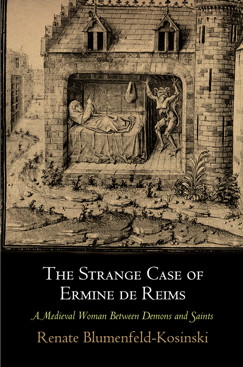
Pg. 99: Renate Blumenfeld-Kosinski's "The Strange Case of Ermine de Reims"

Featured at the Page 99 Test: The Strange Case of Ermine de Reims: A Medieval Woman Between Demons and Saints by Renate Blumenfeld-Kosinski.

About the book, from the publisher:
In 1384, a poor and illiterate peasant woman named Ermine moved to the city of Reims with her elderly husband. Her era was troubled by war, plague, and schism within the Catholic Church, and Ermine could easily have slipped unobserved through the cracks of history. After the loss of her husband, however, things took a remarkable but frightening turn. For the last ten months of her life, Ermine was tormented by nightly visions of angels and demons. In her nocturnal terrors, she was attacked by animals, beaten and kidnapped by devils in disguise, and exposed to carnal spectacles; on other nights, she was blessed by saints, even visited by the Virgin Mary. She confessed these strange occurrences to an Augustinian friar known as Jean le Graveur, who recorded them all in vivid detail.

Was Ermine a saint in the making, an impostor, an incipient witch, or a madwoman? Renate Blumenfeld-Kosinski ponders answers to these questions in the historical and theological context of this troubled woman's experiences. With empathy and acuity, Blumenfeld-Kosinski examines Ermine's life in fourteenth-century Reims, her relationship with her confessor, her ascetic and devotional practices, and her reported encounters with heavenly and hellish beings. Supplemented by translated excerpts from Jean's account, The Strange Case of Ermine de Reims brings to life an episode that helped precipitate one of the major clerical controversies of late medieval Europe, revealing surprising truths about the era's conceptions of piety and possession.
Writers Read: Renate Blumenfeld-Kosinski.

My Book, The Movie: The Strange Case of Ermine de Reims.

The Page 99 Test: The Strange Case of Ermine de Reims.

--Marshal Zeringue

Wednesday, July 01, 2015

What is Sara Solovitch reading?

Featured at Writers Read: Sara Solovitch, author of Playing Scared: A History and Memoir of Stage Fright.

Her entry begins:
I’m in the middle of Francine Prose’s novel, Bigfoot Dreams. Like all her books, it’s sharp-elbowed and wickedly funny. Prose has a way of commenting on the culture that makes you look at things in a whole new light. In this book, she tells the story of a smart and cynical reporter whose job it is to make up stories for her sleazy tabloid newspaper. One day, she makes up a story that turns out to be true – truer than she ever could have imagined. And that’s the story that ruins everybody’s life. This is a book about a midlife crisis in which...[read on]
About Playing Scared, from the publisher:
Stage fright is one of the human psyche's deepest fears. Laurence Olivier learned to adapt to it, as have actors Salma Hayek and Hugh Grant. Musicians such as George Harrison and Adele have battled it and learned to cope. Others never do: In 1973, Pittsburgh Pirates All-Star pitcher Steve Blass suddenly could no longer find the strike zone; his career ended soon after. Surveys in the United States repeatedly rank public speaking as one of the top fears, affecting up to 74 percent of people.

Sara Solovitch studied piano as a young child and fell in love with music. At ten, she played Bach and Mozart in her hometown's annual music festival, but was overwhelmed by fear. As a teen, she attended Eastman School of Music, where stage fright led her to give up aspirations of becoming a professional pianist. In her late fifties, Sara gave herself a one-year deadline to tame performance anxiety and play before an audience. She resumed music lessons, while exploring meditation, exposure therapy, cognitive therapy, biofeedback, beta blockers, and other remedies. She performed in airports, hospitals, and retirement homes before renting a public hall and performing for fifty guests on her sixtieth birthday.

Using her own journey as inspiration, Solovitch has written a thoughtful and insightful examination of the myriad causes of stage fright and the equally diverse ways to overcome it, and a tribute to pursuing personal growth at any age.
Visit Sara Solovitch's website.

My Book, The Movie: Playing Scared.

Writers Read: Sara Solovitch.

--Marshal Zeringue

Catherine A. Winn's "Beyond Suspicion," the movie

Featured at My Book, The Movie: Beyond Suspicion by Catherine A. Winn.

The entry begins:
Beyond Suspicion made into a movie, “Woo-hoo!” Where do I sign?

If I could pick the lead? Willow Shields from The Hunger Games would be the only actress on my list.

Shelby Palmer, my main character, changes from a sweet, naïve, aggravated-by-parents fifteen-year-old sophomore from suburbia to a courageous young woman who draws on inner strength in a life and death struggle to save her little brother and herself from murderous...[read on]
Visit Catherine A. Winn's website.

My Book, The Movie: Beyond Suspicion.

--Marshal Zeringue

Six irresistible literary genre benders

At B & N Reads Nicole Hill tagged six "literary works that break barriers, combining genre tropes and standards to produce entirely unique, enthralling stories," including:
The Book of Speculation, by Erika Swyler

Is there anything more fulfilling than a book about books? Swyler’s savvy enough to know the answer is no, and thus centers her debut on Simon, a young librarian, with a, shall we say, dysfunctional family background involving a whole lot of circus folk. As so often happens, a mysterious book shows up on his doorstep one day. The book is a log from an 18th-century traveling carnival, which would be odd enough, but it also details strange reports of magic and misfortune, including the drowning of a circus mermaid. As it happens, Simon’s family tree is filled with women who’ve met watery ends, and all on the same date. Part historical thriller, part mystery, and part fantasy, The Book of Speculation traces this family curse and unravels a quandary generations in the making.
Read about another entry on the list.

--Marshal Zeringue

Pg. 69: Victoria Shorr's "Backlands"

Featured at the Page 69 Test: Backlands by Victoria Shorr.

About the book, from the publisher:
In this Bonnie and Clyde story of love and betrayal, a band of outlaws fight for control of the brutal Brazilian outback.

Set in the sparse frontier settlements of northeastern Brazil—a dry, forbidding, and wild region the size of Texas, known locally as the Sertao—Backlands tells the true story of a group of nomadic outlaws who reigned over the area from about 1922 until 1938. Taking from the rich, admired—and feared—by the poor, they were led by the famously charismatic bandit Lampiao. The gang maintained their influence by fighting off all the police and soldiers the region could muster.

A one-eyed goat rancher who first set out to avenge his father's murder in a lawless land, Lampiao proved to be too good a leader, fighter, and strategist to ever return home again. By 1925 he commanded the biggest gang of outlaws in Brazil. Known to this day as a "prince," Lampiao had everything: brains, money, power, charisma, and luck. Everything but love, until he met Maria Bonita.

"You teach me to make lace, and I'll teach you to make love"—this was the song the bandits marched to, across the vast open reaches of their starkly beautiful backlands, and it was Maria Bonita who made it come true. She was stuck in a loveless marriage when she met Lampiao, but she rode off with him, becoming "Queen of the Bandits." Together the couple—still celebrated folk heroes—would become the country's most wanted figures, protecting their extraordinary freedom through cunning.

Victoria Shorr's stunning literary debut tells Maria's story, her narrative of the intense freedoms, terrors, and sorrows of this chosen life, the end of which is clear to her all along. With the federal government in Rio mobilizing against the bandits, Backlands describes the epic final days of Lampiao’s "fatal month," July on the River of Disorder, as the gang struggles to summon their good star to save them one more time.
Visit Victoria Shorr's website.

The Page 69 Test: Backlands.

--Marshal Zeringue