Tuesday, November 22, 2011

Pg. 69: Nancy Jensen's "The Sisters"

The current feature at the Page 69 Test: The Sisters by Nancy Jensen.

About the book, from the publisher:
In the tradition of Marilynne Robinson’s Housekeeping and Elizabeth Strout’s Olive Kitteridge, a dazzling debut novel about the family bonds that remain even when they seem irretrievably torn apart

Growing up in hardscrabble Kentucky in the 1920s, with their mother dead and their stepfather an ever-present threat, Bertie Fischer and her older sister Mabel have no one but each other—with perhaps a sweetheart for Bertie waiting in the wings. But on the day that Bertie receives her eighth-grade diploma, good intentions go terribly wrong. A choice made in desperate haste sets off a chain of misunderstandings that will divide the sisters and reverberate through three generations of women.

What happens when nothing turns out as you planned? From the Depression through World War II and Vietnam, and smaller events both tragic and joyful, Bertie and Mabel forge unexpected identities that are shaped by unspeakable secrets. As the sisters have daughters and granddaughters of their own, they discover that both love and betrayal are even more complicated than they seem.

Gorgeously written, with extraordinary insight and emotional truth, Nancy Jensen’s powerful debut novel illuminates the far-reaching power of family and family secrets.
Learn more about the book and author at Nancy Jensen's website.

My Book, The Movie: The Sisters.

Writers Read: Nancy Jensen.

The Page 69 Test: The Sisters.

--Marshal Zeringue

Monday, November 21, 2011

Pg. 99: Susan Herman's "Taking Liberties"

The current feature at the Page 99 Test: Taking Liberties: The War on Terror and the Erosion of American Democracy by Susan N. Herman.

About the book, from the publisher:
In this eye-opening work, the president of the ACLU takes a hard look at the human and social costs of the War on Terror. A decade after 9/11, it is far from clear that the government's hastily adopted antiterrorist tactics--such as the Patriot Act--are keeping us safe, but it is increasingly clear that these emergency measures in fact have the potential to ravage our lives--and have already done just that to countless Americans.

From the Oregon lawyer falsely suspected of involvement with terrorism in Spain to the former University of Idaho football player arrested on the pretext that he was needed as a "material witness" (though he was never called to testify), this book is filled with unsettling stories of ordinary people caught in the government's dragnet. These are not just isolated mistakes in an otherwise sound program, but demonstrations of what can happen when our constitutional protections against government abuse are abandoned. Whether it's running a chat room, contributing to a charity, or even urging a terrorist group to forego its violent tactics, activities that should be protected by the First Amendment can now lead to prosecution. Blacklists and watchlists keep people grounded at airports and strand American citizens abroad, although these lists are rife with errors--errors that cannot be challenged. National Security Letters allow the FBI to demand records about innocent people from libraries, financial institutions, and internet service providers without ever going to court. Government databanks now brim with information about every aspect of our private lives, while efforts to mount legal challenges to these measures have been stymied.

Barack Obama, like George W. Bush, relies on secrecy and exaggerated claims of presidential prerogative to keep the courts and Congress from fully examining whether these laws and policies are constitutional, effective, or even counterproductive. Democracy itself is undermined. This book is a wake-up call for all Americans, who remain largely unaware of the post-9/11 surveillance regime's insidious and continuing growth.
Learn more about Taking Liberties at the Oxford University Press website.

Susan N. Herman became president of the American Civil Liberties Union in 2008 after serving on its national board for twenty years. A constitutional scholar and chaired professor at Brooklyn Law School, she is the co-editor (with Paul Finkelman) of Terrorism, Government, and Law and the author of The Right to a Speedy and Public Trial.

The Page 99 Test: Taking Liberties.

--Marshal Zeringue

Larry McMurtry's 5 best travel books

Larry McMurtry is the author of twenty-nine novels, including the Pulitzer Prize-winning Lonesome Dove. His other works include two collections of essays, three memoirs, and more than thirty screenplays, including the coauthorship of Brokeback Mountain, for which he received an Academy Award.

His new novel is The Berrybender Narratives.

One of McMurtry's five best travel books, as told to the Wall Street Journal:
A Time of Gifts
by Patrick Leigh Fermor (1977)

In 1933, when Patrick Leigh Fermor was a restless 18-year-old, he set out, with only minimal preparation, to walk from the Hook of Holland to Constantinople. "A Time of Gifts," about the trip's first stage, is a lovely account of how welcoming Europe was just before it stopped being welcoming for a very long time. When the book ends, he has reached Hungary. A second volume, "Between the Woods and the Water" (1986), gets him to the Iron Gates gorge on the Danube between Serbia and Romania. It is rumored that the final volume, taking him to the Golden Horn, is in the publisher's hands. I hope so. Leigh Fermor was a commando on Crete during the war years and even captured an important German general, an episode filmed as "Ill Met by Moonlight," in which Dirk Bogarde plays Leigh Fermor. He lived much of his life in Greece and was a lifelong friend of the former Deborah Mitford, now the Dowager Duchess of Devonshire; the recently published "In Tearing Haste" is a volume of their letters. Patrick Leigh Fermor died in June at age 96.
Read about another book on McMurtry's list.

Also see: Samuel Muston's ten best travel books, Tony Hiss's six favorite travel reads, Don George's top 10 travel books of the last century, Peter Mayle's 6 favorite travel books, Laura Landro's five best books about travel, and Paul Collins'a 10 oddest travel guides.

--Marshal Zeringue

Charles Lemert's "Why Niebuhr Matters," the movie

Now showing at My Book, The Movie: Why Niebuhr Matters by Charles Lemert.

The entry begins:
If Hollywood could do wonderful movies on, among others, the mathematical genius, John Nash (A Beautiful Mind) or Tolstoy (The Last Station), it could certainly make a popular, perhaps a hit, film out the life of Reinhold Niebuhr. Niebuhr's mind wove in and out of political controversy and very high-minded philosophy and theology. The drama and wonder of his life lies in his unblinking engagement with the evil of Hitler and post-war American arrogance combined with his calm in overcoming a debilitating stroke to continue his work as the most important moral and political thinker of mid-century America. I would see his role played very well by the Brad...[read on]
Learn more about the book and author at Charles Lemert's website and the Yale University Press.

Charles Lemert is Senior Fellow at Yale's Center for Comparative Research. His recent books include The Structural Lie: Small Clues to Globalization (Paradigm, 2011).

The Page 99 Test: Why Niebuhr Matters.

My Book, The Movie: Why Niebuhr Matters.

--Marshal Zeringue

What is David Rothenberg reading?

The current featured contributor at Writers Read: David Rothenberg, author of Survival of the Beautiful: Art, Science, and Evolution.

Part of his entry:
Since I’m writing a book on insect sound and music I must sometimes read nonfiction, especially things in the midst of my odd subjects, and there is a wonderful recent book on singing insects, Cricket Radio by John Himmelman, which presents a real love and attentiveness to the songs of crickets, katydids, and shieldbearers in the browning autumn woods of Connecticut shores. People tend to love these sounds for the melancholy march of the seasons that they convey, but we rarely play close attention to what we’re hearing. My next book will try to connect these resounding overlapping rhythms to the idea of music, and...[read on]
About Survival of the Beautiful, from the publisher:
A brilliant investigation of why nature is beautiful and how art has influenced science, sure to stimulate readers of The Art Instinct.

"The peacock's tail," said Charles Darwin, "makes me sick." That's because the theory of evolution as adaptation can't explain why nature is so beautiful. It took the concept of sexual selection for Darwin to explain that, a process that has more to do with aesthetics than the practical. Survival of the Beautiful is a revolutionary new examination of the interplay of beauty, art, and culture in evolution. Taking inspiration from Darwin's observation that animals have a natural aesthetic sense, philosopher and musician David Rothenberg probes why animals, humans included, have innate appreciation for beauty-and why nature is, indeed, beautiful.

Sexual selection may explain why animals desire, but it says very little about what they desire. Why will a bowerbird literally murder another bird to decorate its bower with the victim's blue feathers? Why do butterfly wings boast such brilliantly varied patterns? The beauty of nature is not arbitrary, even if random mutation has played a role in evolution. What can we learn from the amazing range of animal aesthetic behavior-about animals, and about ourselves?

Readers who enjoyed the bestsellers The Art Instinct and The Mind's Eye will find Survival of the Beautiful an equally stimulating and profound exploration of art, science, and the creative impulse.
Learn more about the book and author at the Survival of the Beautiful website.

Writers Read: David Rothenberg.

--Marshal Zeringue

Sunday, November 20, 2011

Ten of the best titles in the form of questions

At the Guardian, John Mullan named ten of the best titles in the form of questions.

One entry on the list:
Who's Afraid of Virginia Woolf? by Edward Albee

George and Martha, an American academic and his wife, entertain Nick and Honey, a new professor at a New England college and his wife. As the booze flows, George and Martha make the younger couple participants in a game of marital humiliation. Martha, mocking academic folly, sings the title.
Read about another title on the list.

--Marshal Zeringue

Pg. 69: Gary Corby's "The Ionia Sanction"

The current feature at the Page 69 Test: The Ionia Sanction by Gary Corby.

About the book, from the publisher:
Athens, 460 B.C. Life's tough for Nicolaos, the only investigating agent in ancient Athens. His girlfriend's left him and his boss wants to fire him. But when an Athenian official is murdered, the brilliant statesman Pericles has no choice but to put Nico on the job.

The case takes Nico, in the company of a beautiful slave girl, to the land of Ionia within the Persian Empire. The Persians will execute him on the spot if they think he's a spy. Beyond that, there are only a few minor problems:

He's being chased by brigands who are only waiting for the right price before they kill him.

Somehow he has to placate his girlfriend, who is very angry about that slave girl.

He must meet Themistocles, the military genius who saved Greece during the Persian Wars, and then defected to the hated enemy.

And to solve the crime, Nico must uncover a secret that could not only destroy Athens, but will force him to choose between love, and ambition, and his own life.
Learn more about the book and author at Gary Corby's blog.

The Page 69 Test: The Pericles Commission.

Writers Read: Gary Corby (November 2010).

My Book, The Movie: The Pericles Commission.

My Book, The Movie: The Ionia Sanction.

Writers Read: Gary Corby.

The Page 69 Test: The Ionia Sanction.

--Marshal Zeringue

Pg. 99: Wendy Pearlman's "Violence, Nonviolence, and the Palestinian National Movement"

The current feature at the Page 99 Test: Violence, Nonviolence, and the Palestinian National Movement by Wendy Pearlman.

About the book, from the publisher:
Why do some national movements use violent protest and others nonviolent protest? Wendy Pearlman shows that much of the answer lies inside movements themselves. Nonviolent protest requires coordination and restraint, which only a cohesive movement can provide. When, by contrast, a movement is fragmented, factional competition generates new incentives for violence and authority structures are too weak to constrain escalation. Pearlman reveals these patterns across one hundred years in the Palestinian national movement, with comparisons to South Africa and Northern Ireland. To those who ask why there is no Palestinian Gandhi, Pearlman demonstrates that nonviolence is not simply a matter of leadership. Nor is violence attributable only to religion, emotions, or stark instrumentality. Instead, a movement's organizational structure mediates the strategies that it employs. By taking readers on a journey from civil disobedience to suicide bombings, this book offers fresh insight into the dynamics of conflict and mobilization.
Learn more about Violence, Nonviolence, and the Palestinian National Movement at the Cambridge University Press website.

Wendy Pearlman is Assistant Professor of Political Science and the Crown Junior Chair in Middle East Studies at Northwestern University.

The Page 99 Test: Violence, Nonviolence, and the Palestinian National Movement.

--Marshal Zeringue

Saturday, November 19, 2011

What is L. E. Modesitt, Jr. reading?

This weekend's featured contributor at Writers Read: L. E. Modesitt, Jr., author of Scholar.

His entry begins:
While I’d seen a number of recommendations for Mary Robinette Kowal’s Shades of Milk and Honey, the ones I’d seen didn’t prepare me for the book itself, and frankly, if they had, I might not have read it at all. That’s because the book is essentially a gentle and fascinating fusion of a regency romantic mystery and fantasy, and I’ve been more than a little repulsed by the myriad of regency knock-offs dealing with zombies, werewolves, vampires, and steampunk. Shades of Milk and Honey...[read on]
About Scholar, from the publisher:
Hundreds of years before the time of Imager, the continent of Lydar is fragmented. Years of war have consolidated five nations into three--Bovaria, Telaryn, and Antiago. Quaeryt is a scholar and a friend of Bhayar, the young ruler of Telaryn. Worried about his future and the escalating intrigues in Solis, the capital city, Quaeryt persuades Bhayar to send him to Tilbor, conquered ten years earlier by Bhayar’s father, in order to see if the number and extent of occupying troops can be reduced so that they can be re-deployed to the border with warlike Bovaria.

Quaeryt has managed to conceal the fact that he is an imager, since the life expectancies of imagers in Lydar is short. Just before Quaeryt departs, Bhayar’s youngest sister passes a letter to the scholar-imager, a letter that could well embroil Quaeryt in the welter of court politics he had hoped to leave behind. On top of that, on his voyage and journey to Tilbor he must face pirates, storms, poisonings, attempted murder, as well as discovering the fact that he is not quite who he thought he was. To make it all worse, the order of scholars to which he belongs is jeopardized in more ways than one.
Learn more about the author and his work at L. E. Modesitt, Jr.'s website.

L.E. Modesitt, Jr. is the bestselling author of many published novels--Scholar is his 59th--encompassing two science fiction series and three fantasy series, as well as several other novels in the science fiction genre.

My Book, The Movie: L. E. Modesitt, Jr.'s Flash.

The Page 69 Test: The Lord-Protector's Daughter.

The Page 69 Test: Empress of Eternity.

The Page 69 Test: Scholar.

Writers Read: L. E. Modesitt, Jr.

--Marshal Zeringue

Matthue Roth's "Losers," the movie

Now showing at My Book, the Movie: Losers by Matthue Roth.

Part of the entry:
Losers is my pride and joy. It's truer-to-life than my memoir, sort of an autobiography of my best friend. Over the course of a weekend, Jupiter Glazer, a Russian immigrant geek kid, sheds his accent, discovers punk, and accidentally gets into a relationship with the hottest girl in school.

The trouble with casting a movie about teenagers is that, as soon as you say a teenager's name, they've suddenly turned 35 years old. So I'm just going to pretend that I'm casting for the afterlife, and anybody's fair game.

Hollywood would probably want Jupiter to look like Christian Slater in Heathers. I'm going to go with Ewan McGregor, though -- five years before Trainspotting, with his hair a little shaggier and his eyes a little more feral.

His best friend, Vadim, in my head was always an Igor type. (Except, of course, that in Russia "Igor" is a name that real people actually have, and one of my best friends is named Igor, so I need to watch the references around him.) He's cool in his own way, but we'd probably have to prettify him up, so instead of, like, a 14-year-old Kyle...[read on]
Learn more about the author and his work at the official Matthue Roth website.

My Book, the Movie: Losers.

--Marshal Zeringue

Ann Beattie's 6 favorite books

Ann Beattie's new book is Mrs. Nixon: A Novelist Imagines a Life.

One of Beattie's six favorite books, as told to The Week magazine:
Dubliners by James Joyce

This collection's final story, "The Dead," is usually agreed to be Joyce's best. Why do writers love it? In part because of the sheer brilliance of the language in the ending's epiphany, which is utterly unparaphrasable.
Read about another book on the list.

Dubliners is one of Ciarán Hinds's six best books.

--Marshal Zeringue

Friday, November 18, 2011

Pg. 99: Charles Lemert's "Why Niebuhr Matters"

The current feature at the Page 99 Test: Why Niebuhr Matters by Charles Lemert.

About the book, from the publisher:
Reinhold Niebuhr (1892–1971) was a Protestant preacher, an influential religious thinker, and an important moral guide in mid-twentieth-century America. But what does he have to say to us now? In what way does he inform the thinking of political leaders and commentators from Barack Obama and Madeleine Albright to David Brooks and Walter Russell Mead, all of whom acknowledge his influence? In this lively overview of Niebuhr's career, Charles Lemert analyzes why interest in Niebuhr is rising and how Niebuhr provides the answers we ache for in the face of seismic shifts in the global order.

In the middle of the twentieth century, having outgrown a theological liberalism, Niebuhr challenged and rethought the nonsocialist Left in American politics. He developed a political realism that refused to sacrifice ideals to mere pragmatism, or politics to bitterness and greed. He examined the problem of morality in an immoral society and reimagined the balance between rights and freedom for the individual and social justice for the many. With brevity and deep insight, Lemert shows how Niebuhr's ideas illuminate our most difficult questions today.
Learn more about the book and author at Charles Lemert's website and the Yale University Press.

Charles Lemert is Senior Fellow at Yale's Center for Comparative Research. His recent books include The Structural Lie: Small Clues to Globalization (Paradigm, 2011).

The Page 99 Test: Why Niebuhr Matters.

--Marshal Zeringue

Five best books on fanaticism

Alan Charles Kors is a professor of history at the University of Pennsylvania and editor in chief of the Encyclopedia of the Enlightenment (Oxford). In 2008 he named five essential works about fanaticism for the Wall Street Journal.

One title on the list:
Moral Panic
by John Fekete

In 1993, the "Final Report of the Canadian Panel on Violence Against Women" set off what John Fekete, a man of the left and a major figure in academic cultural studies, compellingly termed a "moral panic," a fanaticism that led to willful bad science, to callous indifference to truth and criticism, to zealous bad law and policy, and to efforts to transform coercively the freedoms and dignities of an entire people. How else to save Canadian women from the violence of the warlocks except by creating a yet larger political state to infantilize both sexes and to effect a moral regeneration of men across the barbarism that is Canada? Fekete, a professor at Trent University in Ontario, offers a deeply disturbing account of the treacherous union of modern political superstitions with the totalizing exercise of power that sanctimonious passion invariably demands. His trenchant analysis of statistical fraud in the service of political aims is itself worth the reading. "Moral Panic" is an indispensable guide to the fanaticism of our times.
Read about another book on the list.

--Marshal Zeringue

What is Nancy Jensen reading?

The current featured contributor at Writers Read: Nancy Jensen, author of The Sisters.

Her entry begins:
A few years ago I read Rosemary Ashton’s George Eliot: A Life. As literary biographies go, this is a good one, exhaustively researched, smart, and well-written, but I recall only a single detail from the book with clarity. In a letter to her friend Charles Bray, Eliot describes a typical day in the home she shared with George Lewes: “[We] are happier every day—writing hard, walking hard, reading Homer and science and rearing tadpoles. I read aloud for about three hours every evening.... We breakfast at ½ past 8, read to ourselves till 10, write till ½ past 1, walk till nearly 4, and dine at 5, regretting each day as it goes.”

The letter has stayed with me out of the pure power of envy. How could any serious writer not long for such a life? It’s a life, of course, that requires a stable, independent income to fill in the gaps that Eliot’s and Lewes’ modest writing income couldn’t fill—a life with ill-paid servants busy in the background making the beds, washing the clothes, preparing the meals, sweeping the hall, running the errands. I try not to think about the servants, because the sensibilities born from my American working class background recoil from the idea, but still I linger over the vision of a day that turns on reading, writing, and the long walk conducive to conversation and contemplation.

Alas, my life is nothing like that. Maybe one of these days I’ll earn enough from my writing, consistently enough, to quit my day job, but for now I have to cling to my position as a university professor—and it’s this job that governs most of my choices about what to read. It’s not that I don’t enjoy the books I teach—I do. This semester alone, I’m teaching a course in the family novel, beginning with Sons and Lovers and ending with the just-released Justin Torres novel-in-stories, We the Animals. I’m...[read on]
About The Sisters, from the publisher:
In the tradition of Marilynne Robinson’s Housekeeping and Elizabeth Strout’s Olive Kitteridge, a dazzling debut novel about the family bonds that remain even when they seem irretrievably torn apart

Growing up in hardscrabble Kentucky in the 1920s, with their mother dead and their stepfather an ever-present threat, Bertie Fischer and her older sister Mabel have no one but each other—with perhaps a sweetheart for Bertie waiting in the wings. But on the day that Bertie receives her eighth-grade diploma, good intentions go terribly wrong. A choice made in desperate haste sets off a chain of misunderstandings that will divide the sisters and reverberate through three generations of women.

What happens when nothing turns out as you planned? From the Depression through World War II and Vietnam, and smaller events both tragic and joyful, Bertie and Mabel forge unexpected identities that are shaped by unspeakable secrets. As the sisters have daughters and granddaughters of their own, they discover that both love and betrayal are even more complicated than they seem.

Gorgeously written, with extraordinary insight and emotional truth, Nancy Jensen’s powerful debut novel illuminates the far-reaching power of family and family secrets.
Learn more about the book and author at Nancy Jensen's website.

Nancy Jensen, who received an MFA in Writing from Vermont College, has published stories and essays in numerous literary journals, including The Louisville Review, Other Voices, and Northwest Review. She was awarded an Artist Enrichment Grant from the Kentucky Foundation for Women and an Al Smith Fellowship from the Kentucky Arts Council, and teaches English at Eastern Kentucky University.

My Book, The Movie: The Sisters.

Writers Read: Nancy Jensen.

--Marshal Zeringue

Pg. 69: L.E. Modesitt, Jr.'s "Scholar"

The current feature at the Page 69 Test: Scholar: A Novel in the Imager Portfolio by L.E. Modesitt, Jr.

About the book, from the publisher:
Hundreds of years before the time of Imager, the continent of Lydar is fragmented. Years of war have consolidated five nations into three--Bovaria, Telaryn, and Antiago. Quaeryt is a scholar and a friend of Bhayar, the young ruler of Telaryn. Worried about his future and the escalating intrigues in Solis, the capital city, Quaeryt persuades Bhayar to send him to Tilbor, conquered ten years earlier by Bhayar’s father, in order to see if the number and extent of occupying troops can be reduced so that they can be re-deployed to the border with warlike Bovaria.

Quaeryt has managed to conceal the fact that he is an imager, since the life expectancies of imagers in Lydar is short. Just before Quaeryt departs, Bhayar’s youngest sister passes a letter to the scholar-imager, a letter that could well embroil Quaeryt in the welter of court politics he had hoped to leave behind. On top of that, on his voyage and journey to Tilbor he must face pirates, storms, poisonings, attempted murder, as well as discovering the fact that he is not quite who he thought he was. To make it all worse, the order of scholars to which he belongs is jeopardized in more ways than one.
Learn more about the author and his work at L. E. Modesitt, Jr.'s website.

L.E. Modesitt, Jr. is the bestselling author of many published novels--Scholar is his 59th--encompassing two science fiction series and three fantasy series, as well as several other novels in the science fiction genre.

My Book, The Movie: L. E. Modesitt, Jr.'s Flash.

The Page 69 Test: The Lord-Protector's Daughter.

The Page 69 Test: Empress of Eternity.

The Page 69 Test: Scholar.

--Marshal Zeringue

Thursday, November 17, 2011

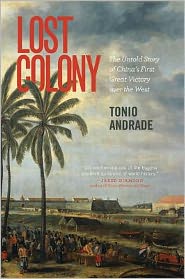
Pg. 99: Tonio Andrade's "Lost Colony"

The current feature at the Page 99 Test: Lost Colony: The Untold Story of China's First Great Victory over the West by Tonio Andrade.

About the book, from the publisher:
During the seventeenth century, Holland created the world's most dynamic colonial empire, outcompeting the British and capturing Spanish and Portuguese colonies. Yet, in the Sino-Dutch War--Europe's first war with China--the Dutch met their match in a colorful Chinese warlord named Koxinga. Part samurai, part pirate, he led his generals to victory over the Dutch and captured one of their largest and richest colonies--Taiwan. How did he do it? Examining the strengths and weaknesses of European and Chinese military techniques during the period, Lost Colony provides a balanced new perspective on long-held assumptions about Western power, Chinese might, and the nature of war.

It has traditionally been asserted that Europeans of the era possessed more advanced science, technology, and political structures than their Eastern counterparts, but historians have recently contested this view, arguing that many parts of Asia developed on pace with Europe until 1800. While Lost Colony shows that the Dutch did indeed possess a technological edge thanks to the Renaissance fort and the broadside sailing ship, that edge was neutralized by the formidable Chinese military leadership. Thanks to a rich heritage of ancient war wisdom, Koxinga and his generals outfoxed the Dutch at every turn.

Exploring a period when the military balance between Europe and China was closer than at any other point in modern history, Lost Colony reassesses an important chapter in world history and offers valuable and surprising lessons for contemporary times.
Learn more about Lost Colony at the Princeton University Press website.

The Page 99 Test: Lost Colony.

--Marshal Zeringue

Top 10 books about Marilyn Monroe

Michel Schneider has written on psychoanalysis, Baudelaire, Proust, Schumann and Glenn Gould. His latest novel is Marilyn's Last Sessions.

For the Guardian he selected a top ten list of books on Marilyn Monroe, including:
Marilyn Monroe: The Biography by Donald Spoto

Using more than 150 interviews and some 35,000 pages of previously sealed files, including Monroe's diaries, letters, and other personal and revealing documents, this is certainly the best and most accurate biography of Marilyn. Spoto reveals new details of every aspect of her life, and her mysterious death. No, Marilyn was not killed by the Kennedys. Her suicide may have been accidental, after being fed all those barbiturates by different people over the years; and Greenson and her housekeeper, Eunice Murray, may have had a hand in it.
Read about another book on the list.

--Marshal Zeringue

What is Gary Corby reading?

The current featured contributor at Writers Read: Gary Corby, author of The Pericles Commission and The Ionia Sanction.

One book tagged in his entry:
A Game of Lies by Rebecca Cantrell. Third in the series of adventures of Hannah Vogel, as she fights the Nazi machine. The first two are A Trace of Smoke and A Night of Long Knives. Rebecca's an expert on the Nazi era, and it shows in her meticulous research and her writing that is, amazingly, reminiscent of the...[read on]
About The Ionia Sanction, from the publisher:
Athens, 460 B.C. Life's tough for Nicolaos, the only investigating agent in ancient Athens. His girlfriend's left him and his boss wants to fire him. But when an Athenian official is murdered, the brilliant statesman Pericles has no choice but to put Nico on the job.

The case takes Nico, in the company of a beautiful slave girl, to the land of Ionia within the Persian Empire. The Persians will execute him on the spot if they think he's a spy. Beyond that, there are only a few minor problems:

He's being chased by brigands who are only waiting for the right price before they kill him.

Somehow he has to placate his girlfriend, who is very angry about that slave girl.

He must meet Themistocles, the military genius who saved Greece during the Persian Wars, and then defected to the hated enemy.

And to solve the crime, Nico must uncover a secret that could not only destroy Athens, but will force him to choose between love, and ambition, and his own life.
Learn more about the book and author at Gary Corby's blog.

Gary Corby is a novelist and former systems programmer at Microsoft. He lives in Australia with his wife and two daughters. His debut novel is The Pericles Commission.

My Book, The Movie: The Ionia Sanction.

Writers Read: Gary Corby.

--Marshal Zeringue

Nancy Jensen's "The Sisters," the movie

Now showing at My Book, The Movie: The Sisters by Nancy Jensen.

The entry begins:
The first words out of my stepfather’s mouth when I called to tell him and my mother that St. Martin’s Press had made an offer for my novel The Sisters: “Tell them we want to be old-people extras in the movie!” Though my stepfather was the first, he certainly was not the only person who, on hearing news of impending publication, leapt immediately to some version of the same question: “What about the movie?”

I’m a film junkie—films like The Remains of the Day, Howard’s End, Enchanted April, All About Eve, Cinema Paradiso and Gosford Park give me the same deep, reflective pleasure I get from literature—so the idea of a gorgeous, well-written, brilliantly cast and subtly directed film based on The Sisters is alluring. Of course I’ve thought about it. A lot. But the instant someone asks me whom I would cast if I had a say—not that I would—I can never think of what American film actress would be right to play Bertie or Mabel or Grace or any of the other principal characters. I can only think of who would be wrong.

The trouble is all that...[read on]
Learn more about the book and author at Nancy Jensen's website.

Nancy Jensen, who received an MFA in Writing from Vermont College, has published stories and essays in numerous literary journals, including The Louisville Review, Other Voices, and Northwest Review. She was awarded an Artist Enrichment Grant from the Kentucky Foundation for Women and an Al Smith Fellowship from the Kentucky Arts Council, and teaches English at Eastern Kentucky University.

My Book, The Movie: The Sisters.

--Marshal Zeringue

Wednesday, November 16, 2011

Pg. 99: Franklin E. Zimring's "The City that Became Safe"

The current feature at the Page 99 Test: The City that Became Safe: New York's Lessons for Urban Crime and Its Control by Franklin E. Zimring.

About the book, from the publisher:
The 40% drop in crime that occurred across the U.S. from 1991 to 2000 largely remains an unsolved mystery. Even more puzzling then is the crime rate drop in New York City, which lasted twice long and was twice as large. This 80% drop in crime over nineteen years represents the largest crime decline on record.

In The City that Became Safe, Franklin Zimring sets off in search of the New York difference through a detailed and comprehensive statistical investigation into the city's falling crime rates and possible explanations. If you listen to City Hall, aggressive police created a zero tolerance law enforcement regime that drove crime rates down. Is this self-serving political sound bite true? Are the official statistics generated by the police accurate? Zimring shows the numbers are correct and argues that some combination of more cops, new tactics, and new management can take some credit for the decline, but zero tolerance policing and quality of life were never a consistent part of the NYPD's strategy. That the police can make a difference in preventing crime overturns decades of conventional wisdom for criminologists, but Zimring points out the New York experience challenges the major assumptions dominating American crime and drug control policies that most everyone else has missed. First, imprisonment in actually New York decreased significantly from 1990 to 2009 and was well below the national average, proving that it is possible to have substantially less crime without increases in incarceration. Second, the NYPD sharply reduced drug violence (over 90%) without any reduction in hard drug use. In other words, they won the war on drug violence without winning the war on drugs. Finally, the stability of New York's population, economy, education, demographics, or immigration patterns calls into question the long-accepted cultural and structural causes of violence in America's cities. That high rates of crime are not hard wired into modern city life is welcome news for policy makers, criminal justice officials, and urban dwellers everywhere.
Learn more about The City that Became Safe at the Oxford University Press website.

The Page 99 Test: The City that Became Safe.

--Marshal Zeringue