Tuesday, December 01, 2015

Pg. 99: Noha Mellor's "The Egyptian Dream"

Featured at the Page 99 Test: The Egyptian Dream: Egyptian National Identity and Uprisings by Noha Mellor.

About the book, from the publisher:
The story of Egyptian identity from the beginning of the twentieth century is one constructed by statesmen, intellectuals and Islamic thinkers. This book argues that the current fragmentation of Egypt's political scene reflects the increasing social division in a country where 'the people' are demanding a redefinition of their national identity. Scrutinising the society behind the uprisings that began in 2011 and their diverse economic, ideological and sectorial demands, it also looks at the desperate state's attempt to construct a unified Egyptian identity - an attempt which has resulted in further splitting Egyptian society.
Learn more about The Egyptian Dream at the Edinburgh University Press website.

The Page 99 Test: The Egyptian Dream.

--Marshal Zeringue

Monday, November 30, 2015

Bridget Asher's "All of Us and Everything," the movie

Featured at My Book, The Movie: All of Us and Everything by Bridget Asher.

The entry begins:
I see Susan Sarandon and J.K. Simmons are starring in The Meddler and I'm very much looking forward to their chemistry. They'd be wonderful as the eccentric Augusta Rockwell and the sentimental spy she fell in love with.

I'd love to see Uma Thurman or Nicole Kidman or Naomi Watts as the oldest sister, trying to stay in control as her life veers off course; Kate Hudson could play a really messy middle sister, Liv Rockwell -- a shout to her performance in Almost Famous; and Natalie...[read on]
Learn more about the book and author at Bridget Asher's website and blog.

The Page 69 Test: All of Us and Everything.

Writers Read: Bridget Asher.

My Book, The Movie: All of Us and Everything.

--Marshal Zeringue

Rick Moody's 6 favorite books that take place in hotels

Rick Moody's new novel is Hotels of North America. One of his six favorite books that take place in hotels, as shared at The Week magazine:
The Invention of Everything Else by Samantha Hunt

This 2008 novel about the last days of the inventor Nikola Tesla is set in the Hotel New Yorker, and it has a lot to do with physics, magic, and the sheer beauty of language. Hunt has a new novel, Mr. Splitfoot, coming out in January, and based on past experience I am sure that one will be great, too.
Read about another entry on the list.

The Page 99 Test: The Invention of Everything Else.

--Marshal Zeringue

Coffee with a canine: Lisa J. Edwards & Pinball

Featured at Coffee with a Canine: Lisa J. Edwards & Pinball.

The author, on Pinball's best pals:
I am Pinball’s first best pal, then he has a couple doggie friends who set up play dates with him. He loves my son, and Auntie Jill is his second or third favorite human (I can’t know what order we all fall into). Pinball loves to be where my son, Indy is. Initially I had to manage the dogs to keep the newborn safe, but now I have to manage the three-year-old boy to keep the dog safe. I am sure it will balance out shortly.

Pinball’s two doggie housemates passed away last year and he was inconsolable for several months. He is getting used to being the only dog while...[read on]
About Please Don't Bite the Baby, from the publisher:
Please Don't Bite the Baby (and Please Don't Chase the Dogs), chronicles certified professional dog trainer Lisa Edwards’ endearing and entertaining journey to ensure that her household survives and thrives when she introduces her son to her motley pack of animals. As Lisa knows all too well, the dog/child relationship is simultaneously treasured, misunderstood, and sometimes feared. In a twist, Lisa's dog training techniques inevitably seep into how she navigates her first year with baby to mixed but enlightening results.

Lisa includes her best training techniques for the everyday pet owner itemized at the end of each chapter. This book is important for parents, grandparents, and caregivers who have dogs and young children together and want to ensure safety for all.
Visit Lisa J. Edwards's website.

Coffee with a Canine: Lisa Edwards & Boo, Porthos, and Pinball.

Writers Read: Lisa Edwards.

Coffee with a Canine: Lisa J. Edwards & Pinball.

--Marshal Zeringue

What is Patricia Appelbaum reading?

Featured at Writers Read: Patricia Appelbaum, author of St. Francis of America: How a Thirteenth-Century Friar Became America's Most Popular Saint.

Her entry begins:
Because someone close to me is working in Haiti right now, I’ve been rereading Karen McCarthy Brown’s Mama Lola: A Vodou Priestess in Brooklyn. It’s very rich. Not only was Brown one of the first to use ethnographic methods to study religion, her book did more than any other to make Haitian Vodou visible and respected. I sometimes assign excerpts to my students to show them that Vodou isn’t just about sticking pins into dolls – which is new information for many of them.

In Brown’s innovative presentation, the chapters alternate between ethnography and storytelling. Each pair of chapters focuses on one of the Vodou spirits, from the peasant Azaka, earthy and local, to Gede, the spirit of death and transformation, who takes on particular importance in the Haitian diaspora. The stories, based in Mama Lola’s family history...[read on]
About St. Francis of America, from the publisher:
How did a thirteenth-century Italian friar become one of the best-loved saints in America? Around the nation today, St. Francis of Assisi is embraced as the patron saint of animals, beneficently presiding over hundreds of Blessing of the Animals services on October 4, St. Francis's Catholic feast day. Not only Catholics, however, but Protestants and other Christians, Hindus, Buddhists, Jews, and nonreligious Americans commonly name him as one of their favorite spiritual figures. Drawing on a dazzling array of art, music, drama, film, hymns, and prayers, Patricia Appelbaum explains what happened to make St. Francis so familiar and meaningful to so many Americans.

Appelbaum traces popular depictions and interpretations of St. Francis from the time when non-Catholic Americans "discovered" him in the nineteenth century to the present. From poet to activist, 1960s hippie to twenty-first-century messenger to Islam, St. Francis has been envisioned in ways that might have surprised the saint himself. Exploring how each vision of St. Francis has been shaped by its own era, Appelbaum reveals how St. Francis has played a sometimes countercultural but always aspirational role in American culture. St. Francis's American story also displays the zest with which Americans borrow, lend, and share elements of their religious lives in everyday practice.
Learn more about St. Francis of America at the University of North Carolina Press website.

Writers Read: Patricia Appelbaum.

--Marshal Zeringue

Sunday, November 29, 2015

Pg. 69: Joseph Wallace's "Slavemakers"

Featured at the Page 69 Test: Slavemakers by Joseph Wallace.

About the book, from the publisher:
The new postapocalyptic thriller from the author of Invasive Species

IT’S THEIR TERRITORY NOW.

Twenty years ago, venomous parasitic wasps known as “thieves” staged a massive, apocalyptic attack on another species—Homo sapiens—putting them on the brink of extinction.

But some humans did survive. The colony called Refugia is home to a population of 281, including scientists, a pilot, and a tough young woman named Kait. In the African wilderness, there’s Aisha Rose, nearly feral, born at the end of the old world. And in the ruins of New York City, there’s a mysterious, powerful boy, a skilled hunter, isolated and living by his wits.

As the survivors journey through the wastelands, they will find that they are not the only humans left on earth. Not by a long shot.

But they may be the only ones left who are not under the thieves’ control…
Visit Joseph Wallace's website.

The Page 69 Test: Slavemakers.

--Marshal Zeringue

Cover story: "Chastity in Early Stuart Literature and Culture"

Bonnie Lander Johnson is Fellow and Lecturer at Selwyn College, Cambridge. Her new book is Chastity in Early Stuart Literature and Culture.

Here she explains the connection of the book's cover to the pages within:
Van Dyke’s family portrait of Charles I places the King, Henrietta Maria, and their children in the foreground of a space adorned with colonnades, billowing silk and a sweeping backdrop of the stormy clouds and London waters over which the family reign. The portrait situates the marital delight and prodigious fertility of the Caroline monarchy in a framework at once epic and domestic. So why is it on the cover of a book about chastity? To those contemporary westerners who do not practice chastity for religious reasons, the virtue is usually interpreted as an archaic or literary form of celibacy or virginity. In fact it is a virtue that governs all stages of a person’s life, is central to Christendom’s understanding of marriage, and was, this book argues, one of the most important conceptual programmes of the early Stuart period. Elizabeth I may be the most famous chaste icon of British royal history but her Stuart successors were far more invested in the virtue and its role in marriage, monarchy, politics, medicine, and the arts. Chastity in Early Stuart Literature and Culture argues that the combined blessings of chastity and fertility were also central to the controversies from which the Civil Wars emerged. It could be said that when he was beheaded, Charles I became a martyr not just to the Royalist cause but also to chastity.

However, it was not only the court and its supporters who celebrated the blessings of chastity: the pro-Parliamentary plain-religionists who eventually deposed the King were also trying to claim the virtue for their cause. Both sides interpreted chastity differently and from their struggle emerged some of the period’s most developed forms of rhetorical posturing. In a new world of public debate, in which mass print enabled the rapid dissemination of fiery sermons and political theory, the court couldn’t just utilise its elaborate spectacles to celebrate and promote its virtue and power. Instead, it needed to use masques, court ceremonials, and public appearances to answer criticisms from dissenters. This book reads the arguments posed by various court spectacles (including the Queen’s birthing rituals) as responses to anti-court claims about the unchastity corrupting the Stuart monarchy and its Church.

Throughout the 1630s the court’s claims to chastity, primarily through the prodigiously fertile body of the Queen and her elaborate masques, were highly successful. But the young John Milton was preparing to enter the debate with his own masque of chastity. Milton’s skilful recoding of the virtue as Protestant spiritual adventure bolstered the moral strength of pro-Parliamentary arguments. Within a decade the family members in Van Dyke’s portrait were all dead or in hiding and the portrait’s depiction of chastity as familial, fertile, and spectacular was replaced with a version of chastity more at home in the written word, more masculine, and more martial: a steely and inviolate virtue fit for revolution.
Learn more about Chastity in Early Stuart Literature and Culture at the Cambridge University Press website.

--Marshal Zeringue

Five notable books with fictitious works of art

Anne Charnock's debut novel A Calculated Life, was a finalist for the 2013 Philip K. Dick and Kitschies Golden Tentacle Awards. Her new novel is Sleeping Embers of an Ordinary Mind. One of her five favorite books with fictitious works of art, as shared at Tor.com:
Station Eleven by Emily St. John Mandel

Emily St. John Mandel depicts a post-apocalyptic world in which her characters desire more than mere survival. The central character, Kirsten, safeguards her own personal art treasures—two hand-drawn comic books, the hero of which is Dr. Eleven. Mandel’s interweaving and beautifully written narrative flits back and forth in time, connecting Kirsten with characters in the pre-apocalyptic world, including Miranda, the author of the unpublished comics.
Read about another book on the list.

Station Eleven is among the Washington Post's ten best books of 2014.

--Marshal Zeringue

Pg. 99: Christian Lange's "Paradise and Hell in Islamic Traditions"

Featured at the Page 99 Test: Paradise and Hell in Islamic Traditions by Christian Lange.

About the book, from the publisher:
The Muslim afterworld, with its imagery rich in sensual promises, has shaped Western perceptions of Islam for centuries. However, to date, no single study has done justice to the full spectrum of traditions of thinking about the topic in Islamic history. The Muslim hell, in particular, remains a little studied subject. This book, which is based on a wide array of carefully selected Arabic and Persian texts, covers not only the theological and exegetical but also the philosophical, mystical, topographical, architectural and ritual aspects of the Muslim belief in paradise and hell, in both the Sunni and the Shiʿi world. By examining a broad range of sources related to the afterlife, Christian Lange shows that Muslim religious literature, against transcendentalist assumptions to the contrary, often pictures the boundary between this world and the otherworld as being remarkably thin, or even permeable.
Learn more about Paradise and Hell in Islamic Traditions at the Cambridge University Press website.

The Page 99 Test: Paradise and Hell in Islamic Traditions.

--Marshal Zeringue

Saturday, November 28, 2015

David Mitchell's top 6 reads

David Mitchell's novels include The Thousand Autumns of Jacob de Zoet, Cloud Atlas, Black Swan Green, and most recently, Slade House. One title from his "life in books," as shared at the Telegraph:
Le Grand Meaulnes (The Lost Domain), by Henri Alain-Fournier

I read this at 18 or 19 and can’t quite capture why it’s so beautiful, but it is. If something’s French and has been in print for over 50 years, then read it.
Read about another book on the list.

Also see: David Mitchell's six favorite books.

--Marshal Zeringue

What is Michael Livingston reading?

Featured at Writers Read: Michael Livingston, author of The Shards of Heaven.

His entry begins:
I'm a professor specializing in the cultural history of the Middle Ages while writing a historical fantasy series set during the rise of the Roman Empire … so my reading list at any given moment is, well, diverse.

On the Roman front, I've been reading Philo of Alexandria's De vita contemplativa, the study of a sect of ascetic Jews living near Alexandria. The work has been very useful for one of the major plot elements of the sequel to The Shards of Heaven, but I can't say I'd recommend it for pure pleasure reading.

On the other hand, if pure reading pleasure is your thing, I did just finish one fun novel (John Scalzi's Redshirts) and am preparing to...[read on]
About The Shards of Heaven, from the publisher:
Julius Caesar is dead, assassinated on the senate floor, and the glory that is Rome has been torn in two. Octavian, Caesar's ambitious great-nephew and adopted son, vies with Marc Antony and Cleopatra for control of Caesar's legacy. As civil war rages from Rome to Alexandria, and vast armies and navies battle for supremacy, a secret conflict may shape the course of history.

Juba, Numidian prince and adopted brother of Octavian, has embarked on a ruthless quest for the Shards of Heaven, lost treasures said to possess the very power of the gods-or the one God. Driven by vengeance, Juba has already attained the fabled Trident of Poseidon, which may also be the staff once wielded by Moses. Now he will stop at nothing to obtain the other Shards, even if it means burning the entire world to the ground.

Caught up in these cataclysmic events, and the hunt for the Shards, are a pair of exiled Roman legionnaires, a Greek librarian of uncertain loyalties, assassins, spies, slaves . . . and the ten-year-old daughter of Cleopatra herself.

Michael Livingston's The Shards of Heaven reveals the hidden magic behind the history we know, and commences a war greater than any mere mortal battle.
Visit Michael Livingston's website.

My Book, The Movie: The Shards of Heaven.

The Page 69 Test: The Shards of Heaven.

Writers Read: Michael Livingston.

--Marshal Zeringue

Four books that changed Samantha Van Leer

Samantha Van Leer is the co-author, with her mother Jodi Picoult, of two young-adult fairy tales. One of four books that changed the writer, as shared at the Sydney Morning Herald:
PHANTOMS IN THE BRAIN
V.S. Ramachandran

Ramachandran is a neuroscientist who studies phantom feelings, such as phantom limbs, phantom pain, phantom pregnancies. He writes hardcore science in an accessible, easy-to-read form. His insight into the mind and the crazy mirages it creates was addicting. As an author and a psychology major, it was cool to see a book that bridged the gap between highly scientific writing and popular non-fiction.
Read about another book on the list.

--Marshal Zeringue

Pg. 69: Gini Koch's "Alien in Chief"

Featured at the Page 69 Test: Alien in Chief by Gini Koch.

About the book, from the publisher:
Alien in Chief is the latest adventure in Gini Koch’s rollicking and snarky Alien series and the thrilling sequel to Alien Separation.
Learn more about the book and author at Gini Koch's website.

The Page 69 Test: Touched by an Alien.

The Page 69 Test: Alien in Chief.

--Marshal Zeringue

Friday, November 27, 2015

Five top novels set in a single pressure cooker location

Jeff Somers is the author of Lifers, the Avery Cates series from Orbit Books, Chum from Tyrus Books, and We Are Not Good People from Pocket/Gallery. He has published over thirty short stories as well. One of Somers's five top "bottle novels" where "the writers confine everyone in a single pressure cooker location, set the timer, and see what happens," as shared at B & N Reads:
Bel Canto, by Ann Patchett

Most bottle novels have limited characters to suit their limited settings, but Patchett goes in the other direction, setting her story almost entirely in the large home of the vice president of an unnamed South American country as an entire party of guests is taken hostage and held captive, allowing the author to explore the relationships between them in intense detail as they struggle through a terrible situation. Although the story does leave the house eventually, the main focus is how strangers can come together and form a community in a short time—including the terrorists who instigated the whole affair. The confined setting makes it one of Patchett’s most popular, powerful books.
Read about another entry on the list.

Bel Canto is among Tatjana Soli's six favorite books that conjure exotic locales, Kathryn Williams's six top novels set in just one place, Dell Villa's top eight books to read when you’re in the mood to cry for days, John Mullen's ten best birthday parties in literature, and Joyce Hackett's top ten musical novels.

--Marshal Zeringue

Pg. 99: Timothy Cheek's "The Intellectual in Modern Chinese History"

Featured at the Page 99 Test: The Intellectual in Modern Chinese History by Timothy Cheek.

About the book, from the publisher:
This vivid narrative history of Chinese intellectuals and public life provides a guide to making sense of China today. Timothy Cheek presents a map and a method for understanding the intellectual in the long twentieth century, from China's defeat in the Sino-Japanese war in 1895 to the 'Prosperous China' since the 2008 Beijing Olympics. Cheek surveys the changing terrain of intellectual life over this transformative century in Chinese history to enable readers to understand a particular figure, idea or debate. The map provides coordinates to track different times, different social worlds and key concepts. The historical method focuses on context and communities during six periods to make sense of ideas, institutions and individual thinkers across the century. Together they provide a memorable account of the scenes and protagonists, and arguments and ideas, of intellectuals and public life in modern China.
Learn more about The Intellectual in Modern Chinese History at the Cambridge University Press website.

The Page 99 Test: The Intellectual in Modern Chinese History.

--Marshal Zeringue

Ten of the most arresting crime novels of 2015

J. Kingston Pierce is both the editor of The Rap Sheet and the senior editor of January Magazine. At Kirkus, he tagged ten of the more memorable crime novels he read this year, including:
The Mulberry Bush, by Charles McCarry

Former journalist and CIA “deep cover” operative Charles McCarry brings us an unnamed young American narrator who, following the downfall of his estranged father—a brilliant but prankish intelligence agent whose persistent unwillingness to play by conventional rules doomed him at “Headquarters” (McCarry’s stand-in for the CIA)—sets out to revenge his parent by taking on a mission that appears to benefit Headquarters, but should ultimately leave it damaged. After contriving his recruitment into the agency, the narrator is first sent to prove himself in the Middle East (where he arranges assassinations), but then infiltrates what remains of a leftist revolutionary group in Argentina with ties to Russia. That circle was once led by a charismatic but complicated idealist named Alejandro Aguilar, and it’s his 29-year-old daughter, the captivating Luz, who McCarry’s protagonist falls in love with and endeavors to employ—along with her influential but enigmatic foster father, and a crafty Russian embassy official—in carrying out his retribution plot. This is a slow-burning yarn, and some of its players (notably Luz) are given billboard billing without having much to do. However, McCarry redeems himself through his dexterous juxtaposition of the high-minded ideals and oft-ridiculous reality of modern spycraft.
Read about another entry on the list.

--Marshal Zeringue

Elizabeth Lee's "Nuts and Buried," the movie

Featured at My Book, The Movie: Nuts and Buried by Elizabeth Lee.

The entry begins:
Let me see . . . Amy Schumer as Lindy Blanchard—because she’d know how to capture Lindy’s sassiness and getting-even techniques.

As Meemaw, Lindy’s grandmother, I’d cast...[read on]
Learn more about the author and her work at Elizabeth Kane Buzzelli's website and blog.

The Page 69 Test: Nuts and Buried.

Writers Read: Elizabeth Lee.

My Book, The Movie: Nuts and Buried.

--Marshal Zeringue

Thursday, November 26, 2015

Five of your great-grandma’s best dirty books

Amy Stewart's latest book is the novel, Girl Waits with Gun. One of her top five lurid novels about innocent girls led astray from early in the last century, as shared at The Daily Beast:
Little Lost Sister by Virginia Brooks (1914)

“A Serpent Whispers and a Woman Listens,” warns the title of Chapter V. Poor Elsie is promised a life on the stage, only to be led to ruin.

“‘Cabarets?’ The girl’s interest was aroused. ‘What’s a cabaret?’

“‘A cabaret,’ said Druce, ‘is a restaurant where ladies and gentlemen dine. A fine great hall, polished floors, rugs, palms, a lot of little tables, colored lights, flowers, silver, cut glass, perfumes, a grand orchestra—get that in your mind—and then the orchestra strikes up and you come down the aisle, right through the crowd, and sing to them.’

“‘Oh, I’d love to do that,’ said the girl.”
Read about another entry on the list.

--Marshal Zeringue

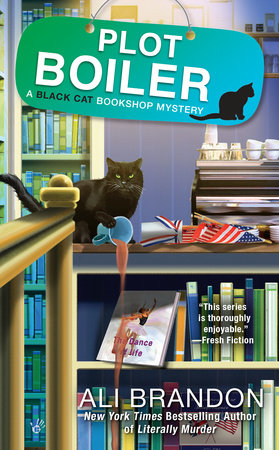
Pg. 69: Ali Brandon's "Plot Boiler"

Featured at the Page 69 Test: Plot Boiler by Ali Brandon.

About the book, from the publisher:
The New York Times bestselling author of Literally Murder returns to Pettistone’s Fine Books, where the silence of Hamlet the cat speaks volumes about two mysterious deaths…

It’s almost Fourth of July, and to boost customer traffic in their Brooklyn neighborhood, bookseller Darla Pettistone decides to throw a block party. All the local shop owners are thrilled—except the proprietor of Perky’s Coffee Shop, who thinks Darla is trying to poach his customers by selling her own caffeinated brew in her new bookshop cafĂ©.

But when Hamlet comes upon the owner’s not-so-perky wife, it’s clear a killer has crashed the party. And when a second local business owner shuffles off this mortal coil—as Hamlet’s namesake would say—Darla and her curious cat must perform some fancy footwork to shine a spotlight on a secret worth killing for…
Learn more about the book and author at the official Ali Brandon--AKA Diane A.S. Stuckart--website.

Coffee with a Canine: Diane Stuckart & Ranger, Delta, Oliver and Paprika.

My Book, The Movie: Double Booked for Death.

The Page 69 Test: Words with Fiends.

The Page 69 Test: Plot Boiler.

--Marshal Zeringue

Five top historical YA novels about wayward women

At the BN Teen Blog Nicole Hill tagged five top historical YA novels about adventurous and independent-minded women, including:
A Madness So Discreet, by Mindy McGinnis

Things are going even worse for Grace in McGinnis’s haunting tale of false imprisonment and the power of secrets. Grace is far from insane, but her father packs her away to an asylum to hide a traumatic family history and the child in her belly. Grace is sane, but she’s surrounded by madness. Then, at her lowest moment, she’s plucked from this hell by a young doctor, who sees a clever young woman perfect to serve as his assistant at crime scenes. But Grace may be entering a world even more mad than the one she left.
Read about another entry on the list.

Visit Mindy McGinnis's website and blog.

The Page 69 Test: Not a Drop to Drink.

The Page 69 Test: In a Handful of Dust.

--Marshal Zeringue