Friday, December 09, 2011

What is Brian Ruckley reading?

The current featured contributor at Writers Read: Brian Ruckley, author of The Godless World fantasy trilogy and The Edinburgh Dead.

His entry begins:
I'm a bad reader. I've become constitutionally incapable of reading a single book, from start to finish, without getting distracted by some appealing new prospect. As a result, I've always got at least two or three books sitting at the bedside, which I'll dip into as the fancy takes me. Means it takes me a long time to finish a book, but at least it has the virtue of keeping things varied and interesting, I suppose.

Anyway, right now, three books I'm working my way through bit by bit:

Mussolini, A New Life by Nicholas Farrell. An intimidatingly thick, dense biography of Il Duce. I'm an incurable fan of all sorts of history, from cavemen to the 20th century, and this was a rather random pick at the library. By its sheer weight it looked certain to cure my ignorance of the guy who pioneered Fascism. And it's certainly doing that: a fascinatingly detailed look at his life and the amazingly chaotic state of Italian politics in the 1920s. It's more sympathetic to Mussolini than you might expect, which is...[read on]
About The Edinburgh Dead, from the publisher:
Edinburgh: 1828

In the starkly-lit operating theaters of the city, grisly experiments are being carried out on corpses in the name of medical science. But elsewhere, there are those experimenting with more sinister forces.

Amongst the crowded, sprawling tenements of the labyrinthine Old Town, a body is found, its neck torn to pieces. Charged with investigating the murder is Adam Quire, Officer of the newly- formed Edinburgh Police. The trail will lead him into the deepest reaches of the city's criminal underclass, and to the highest echelons of the filthy rich.

Soon Quire will discover that a darkness is crawling through this city of enlightenment - and no one is safe from its corruption.

The Edinburgh Dead is a powerful fusion of gothic horror, history, and the fantastical.
Learn more about The Edinburgh Dead at Brian Ruckley's website.

Ruckley's books include the fantasy trilogy The Godless World, which consists of the books Winterbirth, Bloodheir, and Fall of Thanes.

My Book, The Movie: the Godless World trilogy.

The Page 69 Test: The Edinburgh Dead.

Writers Read: Brian Ruckley.

--Marshal Zeringue

Top five recent novels that channel classics

At The Daily Beast Caryn James named five top recent novels that channel classics.

One book on the list:
Bridget Jones’s Diary
by Helen Fielding

The popularity of the novel and Renee Zellweger’s movie version may have obscured how smart and witty Fielding’s comedy of manners is. Her references to Pride and Prejudice are blatant and playful. Bridget loves Mark Darcy, although at first she finds him arrogant and self-absorbed, just as Elizabeth Bennet regards her Mr. Darcy. Fielding layers on the allusions by having Bridget swoon repeatedly over Colin Firth in the TV miniseries of P and P, a nod to how the romantic ideal of Darcy has morphed and persisted into the present.

Fielding’s more crucial inheritance from Jane Austen appears in her astute observations of courtship rituals and how women think about them, updated to include shags. When Bridget dresses for a date and worries about Daniel—her boss and the wrong man—lifting her skirt to find her industrial-strength tummy-controlling undies (which increase the odds he’ll want to seduce her at all) it’s a moment of familiarity and comic delight for us, just as Elizabeth’s being “obliged by the scarceness of gentlemen to sit down for two dances” must have sent a chill of recognition through Austen’s first readers.
Read about another entry on the list.

Bridget Jones's Diary also appears on Sean O'Hagan's list of the ten best fictional hangovers in print, film and song, Christina Koning's list of the best of chick-lit, and a list of eight books for the broken-hearted.

Also see John Mullan's list of ten of the best novels that retell a story previously told in a classic work of literature and twice-told tales.

--Marshal Zeringue

Pg. 69: Larry Karp's "A Perilous Conception"

The current feature at the Page 69 Test: A Perilous Conception by Larry Karp.

About the book, from the publisher:
It’s 1976. Despite fierce international controversy over whether in vitro fertilization should ever be performed in humans, doctors around the world race to be first to produce a baby by this procedure. Dr. Colin Sanford, a brilliant, ambitious obstetrician in the Pacific Northwest city of Emerald, has a plan. He recruits Dr. Giselle Hearn, an experienced laboratory geneticist-embryologist at the University. Drs. Sanford and Hearn, working secretly, set out to put their names in history books.

Several months later, Dr. Sanford’s patient, Joyce Kennett, gives birth to a healthy boy, and Sanford prepares to make an announcement at a press conference. But before it convenes, Ms. Kennett’s schizophrenic husband kills Dr. Hearn and then himself. Police Detective Bernie Baumgartner’s investigation is hampered by pressure from influential people at the University who want to control sensationalism that might harm the institution. Tenacious Baumgartner suspects more at play…
Learn more about the book and author at Larry Karp's website and blog.

My Book, The Movie: A Perilous Conception.

The Page 69 Test: A Perilous Conception.

--Marshal Zeringue

Thursday, December 08, 2011

Pg. 99: Arthur J. Magida's "The Nazi Seance"

The current feature at the Page 99 Test: The Nazi Séance: The Strange Story of the Jewish Psychic in Hitler's Circle by Arthur J. Magida.

About the book, from the publisher:
World War I left Berlin, and all of Germany, devastated. Charlatans and demagogues eagerly exploited the desperate crowds. Fascination with the occult was everywhere – in private séances, personalized psychic readings, communions with the dead – as people struggled to escape the grim reality of their lives. In the early 1930s, the most famous mentalist in the German capital was Erik Jan Hanussen, a Jewish mind reader originally from Vienna who became so popular in Berlin that he rubbed elbows with high ranking Nazis, became close with top Storm Troopers, and even advised Hitler.

Called “Europe’s Greatest Oracle Since Nostradamus,” Hanussen assumed he could manipulate some of the more incendiary personalities of his time just as he had manipulated his fans. He turned his occult newspaper in Berlin into a Nazi propaganda paper, personally assured Hitler that the stars were aligned in his favor, and predicted the infamous Reichstag Fire that would solidify the Nazis’ grip on Germany.

Seasoned with ruminations about wonder and magic (and explanations of Hanussen’s tricks), The Nazi Séance is a disturbing journey into a Germany as it descends into madness—aided by a “clairvoyant” Jew oblivious to the savagery of men who pursued a Reich they fantasized would last 1,000 years.
Learn more about the book and author at Arthur J. Magida's website.

The Page 99 Test: The Nazi Séance.

--Marshal Zeringue

10 great American dystopias

At io9 Annalee Newitz tagged ten great American dystopias, including:
The Hunger Games

This trilogy of novels by Suzanne Collins, soon to be a series of feature films, combine the most frightening aspects of Gamer and Julian Comstock. America has become an impoverished, resource-depleted country called Panem where most people starve on government rations and a few lucky elites live like royalty in the Capitol. Every year, a handful of young people are chosen to compete to the death in a televised ritual called The Hunger Games.
Why is this an American dystopia?
Set in what was once US territory, it is about our fears of economic collapse combined with a terror of how reality television can be used as a form of propaganda and torture.
Read about another novel on the list.

The Hunger Games also appears on Philip Webb's top ten list of pulse-racing adventure books, Charlie Higson's top ten list of fantasy books for children, and Megan Wasson's list of five fantasy series geared towards teens that adults will love too.

--Marshal Zeringue

What is Mignon F. Ballard reading?

The current featured contributor at Writers Read: Mignon F. Ballard, author of Miss Dimple Rallies to the Cause.

Her entry begins:
Although I’m not currently reading this author, I do come back to him from time to time – especially when my spirits need a boost. I’m speaking of everybody’s favorite Yorkshire veterinarian, James Herriot. While adept at making fun of himself in just about any situation, he could also touch your heart. Unfortunately, he died several years ago so we fans have to be content to read his books over and over.

I’ll admit it – I’m an Anglophile, and Herriot’s tales place me right smack in the middle of the Yorkshire countryside with all those wonderful plainspoken characters. The relationship he shares with his eccentric co-workers never fails to involve some kind of complicated and comical dilemma that makes me forget my own problems because I’m laughing so hard at his. And I doubt if I’ll ever need to put this experience to use, but after reading Herriot, I do believe I...[read on]
About Miss Dimple Rallies to the Cause, from the publisher:
Life in small-town America during World War II springs vividly to life as schoolteacher Miss Dimple and her fellow townspeople battle valiantly against worry, rationing, and crime at home as well as abroad.

It's September 1943, and the town of Elderberry, Georgia, including their beloved first-grade teacher, Miss Dimple Kilpatrick, has exciting plans for the Bond Rally to support the troops fighting the war abroad. Miss Dimple's friend, Virginia Balliew, has agreed to chair the big event, with the help of Buddy Oglesby. But when children discover a skeleton at the edge of a field, and Buddy disappears along with the war bond money, it's clear that something is amiss in the little town; and Miss Dimple, along with her fellow teachers, is soon on the case.
Learn more about the author and her work at Mignon Ballard's website.

My Book, The Movie: Miss Dimple Rallies to the Cause.

The Page 69 Test: Miss Dimple Rallies to the Cause.

Writers Read: Mignon F. Ballard.

--Marshal Zeringue

Ed Kovacs's "Storm Damage," the movie

Now showing at My Book, The Movie: Storm Damage by Ed Kovacs.

The entry begins:
I don’t keep up with who the flavors of the year are, acting-wise. Since the hero of my crime novel Storm Damage is a genuine tough guy and MMA fighter who’s also smart and strongly ethical, I’d have to go with either Daniel Craig or Jason Statham, although my hero is written a bit younger. Statham because he’s physical and looks more like the character I imagined; Craig because he’s the whole package and brought a deadliness to the Bond role that had been sorely lacking for decades. No doubt there are many more great candidates and I probably make for a lousy casting director!

For my female lead...[read on]
Learn more about the book and author at Ed Kovacs's website.

Kovacs has worked for many years as a private security contractor deploying to challenging locations worldwide. He is a member of AFIO, Association for Intelligence Officers, the International Thriller Writers organization, and the Mystery Writers of America.

My Book, The Movie: Storm Damage.

--Marshal Zeringue

Wednesday, December 07, 2011

Pg. 99: Nico Slate's "Colored Cosmopolitanism"

The current feature at the Page 99 Test: Colored Cosmopolitanism: The Shared Struggle for Freedom in the United States and India by Nico Slate.

About the book, from the publisher:
A hidden history connects India and the United States, the world’s two largest democracies. From the late nineteenth century through the 1960s, activists worked across borders of race and nation to push both countries toward achieving their democratic principles. At the heart of this shared struggle, African Americans and Indians forged bonds ranging from statements of sympathy to coordinated acts of solidarity. Within these two groups, certain activists developed a colored cosmopolitanism, a vision of the world that transcended traditional racial distinctions. These men and women agitated for the freedom of the “colored world,” even while challenging the meanings of both color and freedom.

Colored Cosmopolitanism is the first detailed examination of both ends of this transnational encounter. Nico Slate tells the stories of neglected historical figures, like the “Eurasian” scholar Cedric Dover, and offers a stunning glimpse of people we thought we knew. Prominent figures such as Mahatma Gandhi, Jawaharlal Nehru, Swami Vivekananda, Booker T. Washington, W. E. B. Du Bois, and Martin Luther King Jr. emerge as never before seen. Slate reveals the full gamut of this exchange—from selective appropriations, to blatant misunderstandings, to a profound empathy—as African Americans and South Asians sought a united front against racism, imperialism, and other forms of oppression.
Learn more about Colored Cosmopolitanism at the Harvard University Press website.

Nico Slate is Assistant Professor of History at Carnegie Mellon University.

The Page 99 Test: Colored Cosmopolitanism.

--Marshal Zeringue

Ten of the best hunting scenes in literature

At the Guardian, John Mullan named ten of the most memorable hunting scenes in literature.

One title on the list:
Brideshead Revisited by Evelyn Waugh

Sebastian Flyte shows that he is going to be a dutiful member of his family by riding to hounds. After a bumper stirrup cup he sets off with the other toffs over the Marchmain acres. However, it is all a ruse to escape his mother (and the other riders) in order to go off and get sloshed in a local pub.
Read about another entry on the list.

Brideshead Revisited is one of Robert Irwin's top ten quest narratives, Val McDermid's top ten Oxford novels, and Christopher Buckley's best books.

--Marshal Zeringue

Pg. 69: Reed Farrel Coleman's "Hurt Machine"

The current feature at the Page 69 Test: Hurt Machine by Reed Farrel Coleman.

About the book, from the publisher:
The seventh Moe Prager mystery.

At a pre-wedding party for his daughter Sarah, Moe Prager is approached by his ex-wife and former PI partner Carmella Melendez. It seems Carmella’s estranged sister Alta has been murdered, but no one in New York City seems to care. Why? Alta, a FDNY EMT, and her partner had months earlier refused to give assistance to a dying man at a fancy downtown eatery. Moe decides to help Carmella as a means to distract himself from his own life and death struggle. Making headway on the case is no mean feat as no one, including Alta’s partner Maya Watson, wants to cooperate. Moe chips away until he discovers a cancer roiling just below the surface, a cancer whose symptoms include bureaucratic greed, sexual harassment, and blackmail. But is any of it connected to Alta’s brutal murder?
Learn more about the book and author at Reed Farrel Coleman's website.

The Page 69 Test: Redemption Street.

The Page 69 Test: Empty Ever After.

My Book, the Movie: The Moe Prager Mystery Series.

The Page 69 Test: Innocent Monster.

Writers Read: Reed Farrel Coleman (October 2010).

The Page 69 Test: Hurt Machine.

--Marshal Zeringue

What is Tom Lowe reading?

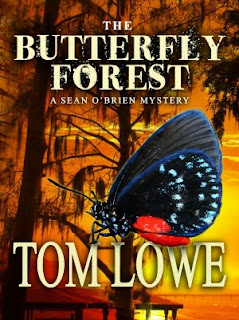
The current featured contributor at Writers Read: Tom Lowe, author of The Butterfly Forest.

His entry begins:
I'm currently reading Feast Day of Fools, by James Lee Burke. Burke is a lyrical storyteller, with a good sense of the human psychological condition and how close evil can live under the skin of some people.

The book I finally got around to reading is the first in the Stieg Larsson "Millennium Trilogy," The Girl with the Dragon Tattoo. I picked up because I'd seen the film trailer starring Daniel Craig and Rooney Mara. Yep, the cross-promotion can work. I think Larsson did a solid job with this novel. It's...[read on]
About The Butterfly Forest:
It’s the subtle signs that Sean O’Brien notices first. The lingering glances that linger a moment too long. Glances that become stares. Stares that are quickly averted when the perpetrator knows he’s been spotted. O’Brien is minding his own business in a Walmart when he sees a predator stalking two women through the store. O’Brien has no idea that this morning in a Walmart will connect to a tragic morning seven decades earlier.

On a cool January morning in 1935, FBI agents surround a home secluded near the Ocala National Forest. By the end of the day, four thousand bullets rip through the house. The onslaught killed Ma Barker and one of her gangster sons. It is the most volatile and infamous shootout in the history of the FBI.

Seventy years later, two college students enter the forest to release the rare and endangered atala butterflies. The atala can only live in areas where the scarce coontie plants are found. They are found in the forest. Something else is hidden there – something that dates back to the deaths of Barker Gang members.

Sean O’Brien is led into this world from a Walmart parking lot where he follows a predator who is stalking two women. O’Brien prevents the abduction, and he opens the door to a new relationship. Also, he opens a dark door to an horror that lies secluded inside one of America's largest national forests. Three bodies are discovered, and police think an old man, a former San Quentin inmate, is responsible. O’Brien believes it’s something else, something hidden deep in the forest. To prove it, he’s forced to find it. He follows veiled tracks as they lead him farther into the woods where a horror, something more vicious than anything the Barker Gang ever did, awaits him.
Learn more about the book and author at Tom Lowe's website.

Lowe's previous Sean O'Brien mystery/thrillers include A False Dawn and The 24th Letter.

The Page 69 Test: The 24th Letter.

My Book, The Movie: The Butterfly Forest.

The Page 69 Test: The Butterfly Forest.

Writers Read: Tom Lowe.

--Marshal Zeringue

Tuesday, December 06, 2011

Pg. 99: Sarah Elkind's "How Local Politics Shape Federal Policy"

Today's feature at the Page 99 Test: How Local Politics Shape Federal Policy: Business, Power, and the Environment in Twentieth-Century Los Angeles by Sarah S. Elkind.

About the book, from the publisher:
Focusing on five Los Angeles environmental policy debates between 1920 and 1950, Sarah Elkind investigates how practices in American municipal government gave business groups political legitimacy at the local level as well as unanticipated influence over federal politics.

Los Angeles's struggles with oil drilling, air pollution, flooding, and water and power supplies expose the clout business has had over government. Revealing the huge disparities between big business groups and individual community members in power, influence, and the ability to participate in policy debates, Elkind shows that business groups secured their political power by providing Los Angeles authorities with much-needed services, including studying emerging problems and framing public debates. As a result, government officials came to view business interests as the public interest. When federal agencies looked to local powerbrokers for project ideas and political support, local business interests influenced federal policy, too. Los Angeles, with its many environmental problems and its dependence upon the federal government, provides a distillation of national urban trends, Elkind argues, and is thus an ideal jumping-off point for understanding environmental politics and the power of business in the middle of the twentieth century.
Learn more about How Local Politics Shape Federal Policy at the the University of North Carolina Press website.

The Page 99 Test: How Local Politics Shape Federal Policy.

--Marshal Zeringue

Five top books on food production

Tomatoland, Barry Estabrook’s book about how industrial agriculture has ruined the tomato in all ways–gastronomic, environmental, and in terms of labor abuse–was published in the summer of 2011.

Estabrook blogs at politics of the plate.

One of his top five books on food production, as told to Daisy Banks at The Browser:
Fast Food Nation
by Eric Schlosser

Another group of corporations on many people’s black list in the world of food production are fast-food businesses. Eric Schlosser’s Fast Food Nation really got people thinking about just what eating a burger a day is actually doing to us.

Eric Schlosser takes apart a single fast-food meal and shows not only how it affects our health but also how the people who serve it to you are treated. He also looks at how the people in the slaughterhouses working with the cattle are treated, and so it shows you the true picture of the all-American meal – burgers and fries.

And this book has had an effect on that industry. Big companies like McDonald’s seem to be going out of their way to show how things are sourced and making an effort to provide healthier options and give more information about their food.

Yes, it has been 10 years since that book came out and I recently interviewed Eric Schlosser and asked him if things have improved and he said yes. People are getting much more aware of childhood obesity and the role fast food plays. And certainly in the States fast-food restaurants are required to give calorie counts, so people can see just how much sugar and fat are in some of these things. Eric said there had been a lot of progress on that front, but sadly the situation with the labour has got worse.
Read about another book Estabrook tagged at The Browser.

--Marshal Zeringue

Larry Karp's "A Perilous Conception," the movie

Now showing at My Book, The Movie: A Perilous Conception by Larry Karp.

The entry begins:
My characters develop slowly as I write their stories, and as I get to know them better and better, they etch their appearances and behaviors into my mind. But the range of images readers construct of these same characters astonishes me. Seems that no one sees or hears quite the same people I do.

I think this probably represents success. A partnership exists between writers and readers, and my stories appear to give readers enough material to engage them, but allow them sufficient leeway to graft their own ideas neatly onto mine.

So if someone were to make a movie from A Perilous Conception, I wouldn't have any concerns about who should play Dr. Colin Sanford, Detective Bernie Baumgartner, or new-mother Joyce Kennett. Whoever...[read on]
Learn more about the book and author at Larry Karp's website and blog.

My Book, The Movie: A Perilous Conception.

--Marshal Zeringue

Jack Jacobs's 6 favorite books about war

Jack Jacobs is one of 144 Medal of Honor recipients featured in Medal of Honor, a new book of photographs and profiles assembled to commemorate the medal's 150th anniversary.

One of Jacobs's six favorite books about war, as told to The Week magazine:
A Rumor of War by Philip Caputo

No human enterprise gives young people such authority and responsibility at an early age as war. Caputo, a young Marine lieutenant, learned the hard way the toll such responsibility can take when Marines under his supervision made the decision to kill two captives in Vietnam.
Read about another book on the list.

--Marshal Zeringue

Monday, December 05, 2011

Pg. 69: Mignon Ballard's "Miss Dimple Rallies to the Cause"

The current feature at the Page 69 Test: Miss Dimple Rallies to the Cause by Mignon F. Ballard.

About the book, from the publisher:
Life in small-town America during World War II springs vividly to life as schoolteacher Miss Dimple and her fellow townspeople battle valiantly against worry, rationing, and crime at home as well as abroad.

It's September 1943, and the town of Elderberry, Georgia, including their beloved first-grade teacher, Miss Dimple Kilpatrick, has exciting plans for the Bond Rally to support the troops fighting the war abroad. Miss Dimple's friend, Virginia Balliew, has agreed to chair the big event, with the help of Buddy Oglesby. But when children discover a skeleton at the edge of a field, and Buddy disappears along with the war bond money, it's clear that something is amiss in the little town; and Miss Dimple, along with her fellow teachers, is soon on the case.
Learn more about the author and her work at Mignon Ballard's website.

My Book, The Movie: Miss Dimple Rallies to the Cause.

The Page 69 Test: Miss Dimple Rallies to the Cause.

--Marshal Zeringue

Pg. 99: Douglas W. Allen's "The Institutional Revolution"

Today's feature at the Page 99 Test: The Institutional Revolution: Measurement and the Economic Emergence of the Modern World by Douglas W. Allen.

About the book, from the publisher:
Few events in the history of humanity rival the Industrial Revolution. Following its onset in eighteenth-century Britain, sweeping changes in agriculture, manufacturing, transportation, and technology began to gain unstoppable momentum throughout Europe, North America, and eventually much of the world—with profound effects on socioeconomic and cultural conditions.

In The Institutional Revolution, Douglas W. Allen offers a thought-provoking account of another, quieter revolution that took place at the end of the eighteenth century and allowed for the full exploitation of the many new technological innovations. Fundamental to this shift were dramatic changes in institutions, or the rules that govern society, which reflected significant improvements in the ability to measure performance—whether of government officials, laborers, or naval officers—thereby reducing the role of nature and the hazards of variance in daily affairs. Along the way, Allen provides readers with a fascinating explanation of the critical roles played by seemingly bizarre institutions, from dueling to the purchase of one’s rank in the British Army.

Engagingly written, The Institutional Revolution traces the dramatic shift from premodern institutions based on patronage, purchase, and personal ties toward modern institutions based on standardization, merit, and wage labor—a shift which was crucial to the explosive economic growth of the Industrial Revolution.
Learn more about The Institutional Revolution at the University of Chicago Press website.

Douglas W. Allen is the Burnaby Mountain Professor of Economics at Simon Fraser University in Canada. He is the author of numerous books, including The Nature of the Farm: Contracts, Risk, and Organization in Agriculture.

The Page 99 Test: The Institutional Revolution.

--Marshal Zeringue

The 10 best fictional sleuths

For The Observer, Euan Ferguson came up with a list of the ten best fictional sleuths.

One entry on the list:
John Rebus
Ian Rankin

The Americans have heroes or antiheroes. Here, we have something in between in both Rebus and [Colin Dexter's Endeavour] Morse, who share a human middle ground where they can’t quite decide whether they want to be hero or antihero. But both are sleuths – more so than Poirot and Marple, who always failed to resonate for me, mainly because those things didn’t even come close to happening. Rankin’s Edinburgh is as true as it gets. Jack Rebus sits in the Oxford Bar, trying to be Scottishly unbotherable and unbothered and suddenly gets the connection. Black and Blue is his finest.
Read about another character on the list.

--Marshal Zeringue

What is Matt Rees reading?

The current featured contributor at Writers Read: Matt Rees, author of the Omar Yussef Mysteries and Mozart's Last Aria.

His entry begins:
The Confession – Olen Steinhauer

I’ve read a few of Steinhauer’s excellent thrillers over the years, but after getting into The Nearest Exit, his best and most recent, I decided to fill in the gaps with this one. Given that I’ve written about Bethlehem and Gaza and Nablus during times of conflict in my Palestinian crime series, as an antidote to the usual journalistic perspective on them, I enjoy Steinhauer’s approach to Eastern Europe during the turbulent mid-1950s: it’s a period I’ve often read about in history books, but history like journalism tends to focus on politics instead of human interactions. For me, the big political picture was never really enough; I was more interested in the fact that Hungary, 1956, led my grandfather to quit the Communist Party. Steinhauer...[read on]
About Mozart's Last Aria, from the publisher:
The news arrives in a letter to his sister, Nannerl, in December 1791. But the message carries more than word of Nannerl’s brother’s demise. Two months earlier, Mozart confided to his wife that his life was rapidly drawing to a close ... and that he knew he had been poisoned.

In Vienna to pay her final respects, Nannerl soon finds herself ensnared in a web of suspicion and intrigue—as the actions of jealous lovers, sinister creditors, rival composers, and Mozart’s Masonic brothers suggest that dark secrets hastened the genius to his grave. As Nannerl digs deeper into the mystery surrounding her brother’s passing, Mozart’s black fate threatens to overtake her as well.

Transporting readers to the salons and concert halls of eighteenth-century Austria, Mozart’s Last Aria is a magnificent historical mystery that pulls back the curtain on a world of soaring music, burning passion, and powerful secrets.
Learn more about the book and author at Matt Beynon Rees' website and blog.

My Book, The Movie: Mozart's Last Aria.

The Page 69 Test: Mozart's Last Aria.

Writers Read: Matt Rees.

--Marshal Zeringue

Sunday, December 04, 2011

Mary O'Connell's "The Sharp Time," the movie

Now showing at My Book, The Movie: The Sharp Time by Mary O'Connell.

The entry begins:
I’ve already watched The Sharp Time in my head with this perfect cast. A girl can dream, and hope, and pray that someone buys the movie rights…

My dream cast for The Sharp Time, the movie:

Kyle Chandler as Henry Charbonneau: Calling all you Friday Night Lights devotees! Who wouldn’t want to see Coach Taylor play against type as a quirky vintage clothing storeowner? Vintage Frocks, Beautiful Shop, Can’t lose…

Sinead O’Connor as Erika of Erika’s Erotic Confections: Sinead O’Connor was so amazing as The Virgin Mary in The Butcher Boy and I certainly envision her as the kind-hearted baker with the edgy exterior. (I also listened to “Theology” incessantly while I wrote The Sharp Time.)

Clint...[read on]
Learn more about the book and author at Mary O'Connell's website.

My Book, The Movie: The Sharp Time.

--Marshal Zeringue

Five top books on dangerous political minds

One title on the Barnes & Noble Review's list of five books on dangerous minds:
Wolf Hall
by Hilary Mantel

This fictional portrait of the commoner who rose to become Henry VIII's legal adviser and chief fixer put the spotlight on a lawyer whose role in English history had long been shadowy, in more than one sense. A self-educated commercial man -- and former mercenary soldier -- in an age that still looked to feudal ties as the foundation of society, Thomas Cromwell supervised Henry's dissolution of the monasteries, and the execution of Sir Thomas More. Mantel brings humanity -- and even a kind of heroism -- to a figure often understood as one of the great schemers of his age.
Read about another book on the list.

Wolf Hall made Lev Grossman's list of the top ten fiction books of 2009 and is one of Geraldine Brooks's favorite works of historical fiction; Matt Beynon Rees called it "[s]imply the best historical novel for many, many years."

--Marshal Zeringue

Pg. 99: William deBuys's "A Great Aridness"

Today's feature at the Page 99 Test: A Great Aridness: Climate Change and the Future of the American Southwest by William deBuys.

About the book, from the Oxford University Press:
With its soaring azure sky and stark landscapes, the American Southwest is one of the most hauntingly beautiful regions on earth. Yet staggering population growth, combined with the intensifying effects of climate change, is driving the oasis-based society close to the brink of a Dust-Bowl-scale catastrophe.

In A Great Aridness, William deBuys paints a compelling picture of what the Southwest might look like when the heat turns up and the water runs out. This semi-arid land, vulnerable to water shortages, rising temperatures, wildfires, and a host of other environmental challenges, is poised to bear the heaviest consequences of global environmental change in the United States. Examining interrelated factors such as vanishing wildlife, forest die backs, and the over-allocation of the already stressed Colorado River--upon which nearly 30 million people depend--the author narrates the landscape's history--and future. He tells the inspiring stories of the climatologists and others who are helping untangle the complex, interlocking causes and effects of global warming. And while the fate of this region may seem at first blush to be of merely local interest, what happens in the Southwest, deBuys suggests, will provide a glimpse of what other mid-latitude arid lands worldwide--the Mediterranean Basin, southern Africa, and the Middle East--will experience in the coming years.

Written with an elegance that recalls the prose of John McPhee and Wallace Stegner, A Great Aridness offers an unflinching look at the dramatic effects of climate change occurring right now in our own backyard.
Learn more about the book and author at William deBuys's website.

The Page 99 Test: A Great Aridness.

--Marshal Zeringue

Pg. 69: Tom Lowe's "The Butterfly Forest"

The current feature at the Page 69 Test: The Butterfly Forest by Tom Lowe.

About the book:
It’s the subtle signs that Sean O’Brien notices first. The lingering glances that linger a moment too long. Glances that become stares. Stares that are quickly averted when the perpetrator knows he’s been spotted. O’Brien is minding his own business in a Walmart when he sees a predator stalking two women through the store. O’Brien has no idea that this morning in a Walmart will connect to a tragic morning seven decades earlier.

On a cool January morning in 1935, FBI agents surround a home secluded near the Ocala National Forest. By the end of the day, four thousand bullets rip through the house. The onslaught killed Ma Barker and one of her gangster sons. It is the most volatile and infamous shootout in the history of the FBI.

Seventy years later, two college students enter the forest to release the rare and endangered atala butterflies. The atala can only live in areas where the scarce coontie plants are found. They are found in the forest. Something else is hidden there – something that dates back to the deaths of Barker Gang members.

Sean O’Brien is led into this world from a Walmart parking lot where he follows a predator who is stalking two women. O’Brien prevents the abduction, and he opens the door to a new relationship. Also, he opens a dark door to an horror that lies secluded inside one of America's largest national forests. Three bodies are discovered, and police think an old man, a former San Quentin inmate, is responsible. O’Brien believes it’s something else, something hidden deep in the forest. To prove it, he’s forced to find it. He follows veiled tracks as they lead him farther into the woods where a horror, something more vicious than anything the Barker Gang ever did, awaits him.
Learn more about the book and author at Tom Lowe's website.

Lowe's previous Sean O'Brien mystery/thrillers include A False Dawn and The 24th Letter.

The Page 69 Test: The 24th Letter.

My Book, The Movie: The Butterfly Forest.

The Page 69 Test: The Butterfly Forest.

--Marshal Zeringue

Saturday, December 03, 2011

What is Will McIntosh reading?

This weekend's featured contributor at Writers Read: Will McIntosh, author of Soft Apocalypse.

One book tagged in his entry:
James Tiptree, Jr.: The Double Life of Alice B. Sheldon, by Julie Phillips.

I bought my first Tiptree, Jr. book when I was in seventh grade. The stories were too adult for me then, and there weren’t enough robots and dinosaurs in them. I vividly recall abandoning the paperback edition of Ten Thousand Light Years from Home on a window ledge at school. As an adult I tried her work again, and was better able to appreciate it. When I finish reading about her life, I’m going back to read more of her fiction. I think I’ll get even more out of it in the context of her fascinating, tragic life. Her mom took her into the jungles of Africa, for treks that lasted weeks at a time, when she was six! Julie Phillips tells...[read on]
Among the early praise for Soft Apocalypse:
"In this moving debut from Hugo-winner McIntosh, the prosperous world of 2023 ends not with a bang but with a crackle, the sound of genetically engineered bamboo growing overnight and destroying roads and buildings. Naïve college graduate Jasper struggles to trade charged batteries for food as his "tribe" wanders the Georgia countryside, dodging local cops and designer diseases. Settling in Savannah, they try to find some stability in a crumbling city beset by anarchist gangs and the "scientist-rebels" who release tailored organisms to hasten societal collapse. In the end, each member of the tribe must decide what to give up in order to survive. ...McIntosh strongly delineates his characters and makes Jasper's struggles very affecting. Though it may be soft, this apocalypse has plenty of sharp edges."
--Publishers Weekly

"Bottom line: If Soft Apocalypse isn't nominated for a Hugo or Nebula Award, I will eat the entire book page by page..."
--Paul Goat Allen

"Soft Apocalypse, while not perfect, is a great achievement for a debut. It took me by surprise early on and never let go. It’s a short, effective dystopian novel that should go down well with people who enjoyed the aforementioned Julian Comstock: A Story of 22nd America by Robert Charles Wilson or even The Rift by Walter Jon Williams.... The real sadness of Soft Apocalypse is seeing normal people operating under the illusion that life will still go back to what it used to be. They try to hold down a job or complete a post-grad degree, and even though the world falls apart around them, the changes are too gradual for them to lose hope completely. It’s like watching rats in a maze, unaware that their paths are slowly being closed off around them and the maze is starting to catch fire at the edges. A soft apocalypse, indeed."
--Stefan Raets
Visit Will McIntosh's website.

My Book, The Movie: Soft Apocalypse.

Writers Read: Will McIntosh.

--Marshal Zeringue

Five best books about the French Resistance

Caroline Moorehead's latest book is A Train in Winter: An Extraordinary Story of Women, Friendship, and Resistance in Occupied France.

One of her five best books on the French Resistance, as told to the Wall Street Journal:
Fashion Under the Occupation
by Dominique Veillon (2002)

Occupation moved France rapidly from a country of plenty to one of penury. Within a few months, ration cards regulated nearly every aspect of life, a black market flourished and families were hungry. Belying the somewhat flippant title of "Fashion Under the Occupation," Dominique Veillon's book is an engrossing account of life during four years of French vassalage. Housewives spent their days queuing for food; bicycles replaced cars; women kept warm by putting mustard in their socks and wearing rabbit skin and squirrel muffs, clattering over cobblestones in wooden clogs. As more and more of France's food and resources were sent east to feed and clothe Germans, the French seized on the ersatz, experimenting with making clothes using hemp and reeds and bean stalks. This is social history at its most absorbing.
Read about another book on the list.

--Marshal Zeringue

Mary Stanton's "Angel Condemned," the movie

Now showing at My Book, The Movie: Angel Condemned by Mary Stanton.

The entry begins:
Brianna Winston-Beaufort: Kyra Sedgwick (who can act being 28 even if she isn't).

Sam Hunter: George...[read on]
About Angel Condemned, Stanton's fifth Beaufort & Company mystery:
Representing her Aunt Cissy’s fiancé, museum curator Prosper White, in a case of fraud, attorney and celestial advocate Brianna Winston-Beaufort hopes to settle the matter out of court. But when Prosper is murdered and Cissy’s arrested for the crime, Bree will have to solve the mystery of the Cross of Justinian—an artifact of interest in both Prosper’s lawsuit and Bree’s celestial case—to clear her aunt’s name...
Learn more about the book and author at Mary Stanton's website and blog.

My Book, The Movie: Angel Condemned.

--Marshal Zeringue

Friday, December 02, 2011

Pg. 99: Julia A. Ericksen's "Dance With Me"

The current feature at the Page 99 Test: Dance With Me: Ballroom Dancing and the Promise of Instant Intimacy by Julia A. Ericksen.

About the book, from the publisher:
Rumba music starts and a floor full of dancers alternate clinging to one another and turning away. Rumba is an erotic dance, and the mood is hot and heavy; the women bend and hyperextend their legs as they twist and turn around their partners. Amateur and professional ballroom dancers alike compete in a highly gendered display of intimacy, romance and sexual passion.

In Dance With Me, Julia Ericksen, a competitive ballroom dancer herself, takes the reader onto the competition floor and into the lights and the glamour of a world of tanned bodies and glittering attire, exploring the allure of this hyper-competitive, difficult, and often expensive activity. In a vivid ethnography accompanied by beautiful photographs of all levels of dancers, from the world’s top competitors to social dancers, Ericksen examines the ways emotional labor is used to create intimacy between professional partners and between professionals and their students, illustrating how dancers purchase intimacy. She shows that, while at first glance, ballroom presents a highly gendered face with men leading and women following, dancing also transgresses gender.
Learn more about Dance With Me at the NYU Press website.

Julia A. Ericksen is Professor of Sociology at Temple University and author of Kiss and Tell: Surveying Sex in the Twentieth Century and Taking Charge of Breast Cancer.

The Page 99 Test: Dance With Me.

--Marshal Zeringue

What is Marie Lu reading?

The current featured contributor at Writers Read: Marie Lu, author of Legend.

Her entry begins:
I just finished The Name of the Wind by Patrick Rothfuss. Now, this is a book that has been recommended to me by no less than a dozen people on various occasions, but I kept putting it off simply because of its size. (I know, I know. And this coming from a fantasy fan! I'm ashamed of myself...) Finally I decided that I needed to sit down and read it--and I'm kicking myself for having waited so long. The book is utterly fantastic. It's rare to find such in-depth worldbuilding even in fantasy, and Rothfuss does it like no one else--folklore, folk songs, a beautifully intricate magic system, a currency system that actually made me *feel* its worth, an unconventional storytelling style (that...[read on]
About Legend, from the publisher:
What was once the western United States is now home to the Republic, a nation perpetually at war with its neighbors. Born into an elite family in one of the Republic's wealthiest districts, fifteen-year-old June is a prodigy being groomed for success in the Republic's highest military circles. Born into the slums, fifteen-year-old Day is the country's most wanted criminal. But his motives may not be as malicious as they seem.

From very different worlds, June and Day have no reason to cross paths - until the day June's brother, Metias, is murdered and Day becomes the prime suspect. Caught in the ultimate game of cat and mouse, Day is in a race for his family's survival, while June seeks to avenge Metias's death. But in a shocking turn of events, the two uncover the truth of what has really brought them together, and the sinister lengths their country will go to keep its secrets.

Full of nonstop action, suspense, and romance, this novel is sure to move readers as much as it thrills.
Learn more about the book and author at Marie Lu's website and blog.

Writers Read: Marie Lu.

--Marshal Zeringue

Top 10 essays

Harry Mount is a journalist, author and editor of the Notting Hill Editions Journal, which commissions a new essay every week.

One of his top ten essays, as told to the Guardian:
Michel de Montaigne, "On the Cannibals" (1595)

Montaigne is regularly wheeled out as the father of the essay. Debatable, I'd say – the baggy definition of the essay includes much older works.

Still, as well as being early on the essay scene, Montaigne was a natural essay-writer. His essay on cannibalism introduces devices that crop up again and again among the essayists that followed through the centuries. Taking the cannibalism of the Tupinamba tribesmen of Brazil, he uses it as a general analogy for barbarism. "Every man calls barbarous anything he is not accustomed to," he writes, expanding the subject into a discussion on the ideas of primitivism, natural purity and perfection.
Read about another essay on the list.

Read Montaigne's essay online.

--Marshal Zeringue

Pg. 69: J. Sydney Jones's "The Silence"

The current feature at the Page 69 Test: The Silence by J. Sydney Jones.

About the book, from the publisher:
Vienna, 1900. Lawyer Karl Werthen is puzzling over the suicide of a local councilman when he is assigned by Karl Wittgenstein, a powerful industrialist with many enemies, to find his recently missing son, Hans. Werthen quickly discovers that the young man appears to be alive and well in another country. But when a friend of Hans – a journalist who wrote a number of articles claiming the councilman who committed suicide was corrupt – is found dead, also from a self-inflicted gunshot wound, Werthen fears that sinister forces are at work...
Learn more about the book and author at J. Sydney Jones' website and blog.

Read "The Story Behind the Story: The Silence,” at The Rap Sheet.

The Page 69 Test: The Empty Mirror.

The Page 69 Test: Requiem in Vienna.

The Page 69 Test: The Silence.

--Marshal Zeringue

Thursday, December 01, 2011

Pg. 99: Timothy Matovina's "Latino Catholicism"

Today's feature at the Page 99 Test: Latino Catholicism: Transformation in America's Largest Church by Timothy Matovina.

About the book, from the publisher:
Most histories of Catholicism in the United States focus on the experience of Euro-American Catholics, whose views on such concerns as church reform, social issues, and sexual ethics have dominated public debates. Latino Catholicism provides a comprehensive overview of the Latino Catholic experience in America from the sixteenth century to today, and offers the most in-depth examination to date of the important ways the U.S. Catholic Church, its evolving Latino majority, and American culture are mutually transforming one another.

Timothy Matovina assesses how Latinos' attempts to celebrate their faith and bring it to bear on the everyday realities of their lives have shaped parishes, apostolic movements, leadership, ministries, worship, voting patterns, social activism, and much more. At the same time, the lives and faith of Latino Catholics are being dramatically refashioned through the multiple pressures of assimilation, the upsurge of Pentecostal and evangelical religion, other types of religious pluralism, growing secularization, and ongoing controversies over immigration and clergy sexual abuse. Going beyond the widely noted divide between progressive and conservative Catholics, Matovina shows how U.S. Catholicism is being shaped by the rise of a largely working-class Latino population in a church whose leadership at all levels is still predominantly Euro-American and middle class.

Latino Catholicism highlights the vital contributions of Latinos to American religious and social life, demonstrating in particular how their engagement with the U.S. cultural milieu is the most significant factor behind their ecclesial and societal impact.
Learn more about Latino Catholicism at the Princeton University Press website.

The Page 99 Test: Latino Catholicism.

--Marshal Zeringue

Top 10 books about the planet

Nick Crane is a cartographer, explorer, writer and television presenter in the UK. In 1992–3, he walked across Europe, from the Atlantic Ocean to the Black Sea.

His latest book is Barefoot Books World Atlas.

One of Crane's top ten books about the planet, as told to the Guardian:
The Magic of Reality by Richard Dawkins

Ever wondered how rainbows got their colours, or what happens if you cut something into ever smaller pieces? This stunning book tells it as it is. Dawkins (the author of serious books such as The Selfish Gene) and the gifted illustrator Dave McKean (whose CV includes designs for Harry Potter characters) have teamed up to prove that scientific reality is far more exciting than myth and make-believe. Read this and you become a believer in our greatest miracle story - the story of our own planet. And it's all true!
Read about another book on the list.

--Marshal Zeringue

What is Donna Gephart reading?

The current featured contributor at Writers Read: Donna Gephart, author of How to Survive Middle School.

Her entry begins:
Since I write for children, I read everything from picture books to novels for adults. Here is a favorite in each category:

Adults:

Ella Minnow Pea by Mark Dunn. This epistolary novel is one of the most clever I've read. It was recommended by my 10th grade English teacher, with whom I still keep in touch. In this book, a tiny island nation pays tribute to the creator of the phrase: "The quick brown fox jumps over the lazy dog." A statue with these words falls prey to time and weather and letters begin to fall off. Residents of the island are then not permitted to use those letters in their correspondence. It's fun to read the correspondence as fewer and fewer letters of the alphabet are used.

Young Adults:

The Absolutely True Diary of a Part-Time Indian by Sherman Alexie. This somewhat autobiographical novel dances the line between heartbreaking and...[read on]
About How to Survive Middle School, from the publisher:
Eleven-year-old David Greenberg dreams of becoming a TV superstar like his idol, Jon Stewart. But in real life, David is just another kid terrified of starting his first year at Harman Middle School. With a wacky sense of humor and hilarious Top 6½ Lists, David spends his free time making TalkTime videos, which he posts on YouTube.

But when David and his best friend have a fight, David is lucky enough to make a pretty cool new friend, Sophie—who just (gulp) happens to be a girl. Sophie thinks David's videos are hilarious, and she starts sending out the links to everyone she knows. Sophie's friends tell their friends, and before David knows it, thousands of people are viewing his videos—including some of the last people he would have expected.
Writers Read: Donna Gephart.

--Marshal Zeringue

Will McIntosh's "Soft Apocalypse," the movie

Now showing at My Book, The Movie: Soft Apocalypse by Will McIntosh.

The entry begins:
Jasper. The lead has to be someone who can step outside the typical Courageous Hero role and play an average guy in an awful situation. A guy who is often scared and confused, who starts out kind of immature and is forced by circumstances to grow up. I think James Franco is the guy. He has the right look and the right emotional range to pull it off, and he seems to thrive on challenging, atypical roles.

Ange. Since Ange is based on a real person, I asked her to cast herself. She thought Angelina Jolie would be good, because, “She's a total edgy badass, but with a soft side that only gets seen by the select few closest to her.” I’m wondering if she’s too old for the part. Ange is 26 at the start, maybe 34 in her last scene. Jolie is 36. If the director balks, I’d going with Amanda...[read on]
Learn more about the book and author at Will McIntosh's website.

Will McIntosh is a Hugo award winner and Nebula finalist whose short stories have appeared in Asimov’s (where he won the 2010 Reader's Award for short story), Strange Horizons, and Science Fiction and Fantasy: Best of the Year, and others. His debut novel, Soft Apocalypse, was published by Night Shade Books in 2011, and his second novel, Hitchers, will be out in February, 2012. A New Yorker transplanted to the rural south, McIntosh is a psychology professor at Georgia Southern University. In 2008 he became the father of twins.

My Book, The Movie: Soft Apocalypse.

--Marshal Zeringue