Saturday, April 23, 2011

Scott Mariani's "The Mozart Conspiracy," the movie

Now showing at My Book, The Movie: The Mozart Conspiracy by Scott Mariani.

The entry begins:
Especially now that my Ben Hope series has been optioned for film, lots of readers ask me who I see playing the lead role and come up with their own suggestions, ranging from Clive Owen to Jason Statham. I don’t have any particular actor in mind while writing Ben, although I can think of a few with the right qualities – it would have to be someone with the depth to bring out Ben’s more vulnerable and sensitive side, while maintaining his toughness and strength. Paul Bettany could do it very well, so could Ewan McGregor. Among the US talent, Leo DiCaprio would make an excellent Ben Hope, and I also like the idea of Timothy Olyphant in the role.

As for the character of Leigh Llewellyn, international opera star and Ben’s first true love, my vision of her has always been clear: she’s beautiful, she’s a singer, she’s...[read on]
Learn more about the book and author at the official The Mozart Conspiracy website.

The Page 69 Test: The Mozart Conspiracy.

My Book, The Movie: The Mozart Conspiracy.

--Marshal Zeringue

Top 5 non-religious books on living a good life

One title on A.C. Grayling's top 5 list of non-religious books on living a good life:
Richard Dawkins, The Greatest Show on Earth, 2009

What could be a greater show than the story of life on this planet, evolving into myriads of intriguing, exotic, amazing forms over billions of years since the first minute organisms emerged from organic soup? Dawkins knows his stuff and writes superbly about it, giving a compelling biography of the descent of life through the eons. By understanding our place in the natural order, we can better understand what is good for human beings. Those who only know one side of Dawkins should experience the scientist and lover of nature for themselves.
Read about another book on the list.

Dawkins was asked, "[Is] it difficult for a creationist to read this book without feeling insulted? Won't that hurt your goal?" Learn how he answered.

--Marshal Zeringue

Friday, April 22, 2011

What is Russel D. McLean reading?

The current featured contributor at Writers Read: Russel D. McLean, author of The Good Son and The Lost Sister.

His entry begins:
In preparation for a Reader's Day at a Scottish Library later this year, I've been asked to select two books to discuss with readers. One of them has to be mine. The other is a book of my choosing. This has meant a lot of searching on my part. Here in the UK, so many authors I love (such as Lawrence Block) seem to be hard to find at the moment, while certain other titles have been rejected on strict terms I've set for myself. But it's been fun immersing myself in the books I love.

In the last week, I've read George Pelecanos's Drama City, which reminded me just why I love this man's work so much - the style, the attitude, the sheer power of his writing. Even on a second or third reading, you're suckered into his world. Drama City is especially good as the story of someone...[read on]
Among the early praise for The Lost Sister:
"[The Lost Sister] excels in establishing J. McNee as a character worth following, someone motivated by a desire to make up for previous failures, a P.I. capable of establishing distinction from so many of his wisecracking, philosophizing brethren."
--J. Kingston Pierce for Kirkus Reviews

"There’s a violent undercurrent always ready to surface in McLean’s gritty take-no-prisoners prose and storytelling. Once he begins, you are roped in to the end, regardless of how many excuses you make to yourself to put the book down. The noir trinities are keenly and astutely observed: Dirty. Bloody. Menacing. They are all here, delivered expertly by a telling hand."
--Sam Millar for New York Journal of Books

"...begins to open up McNee’s psychological baggage, making him more human and understandable...for readers who like Brian McGilloway and Michael Koryta, two authors who introduced fresh voices and individual takes on crime."
--Library Journal (starred review)
Learn more about The Lost Sister at Russel McLean's website and blog.

The Page 69 Test: The Good Son.

Writers Read: Russel D. McLean.

--Marshal Zeringue

Pg. 99: John Pollack's "The Pun Also Rises"

The current feature at the Page 99 Test: The Pun Also Rises: How the Humble Pun Revolutionized Language, Changed History, and Made Wordplay More Than Some Antics by John Pollack.

About the book, from the publisher:
A former word pun champion's funny, erudite, and provocative exploration of puns, the people who make them, and this derided wordplay's remarkable impact on history.

The pun is commonly dismissed as the lowest form of wit, and punsters are often unpopular for their obsessive wordplay. But such attitudes are relatively recent developments. In The Pun Also Rises, John Pollack-a former World Pun Champion and presidential speechwriter for Bill Clinton-explains why such wordplay is significant: It both revolutionized language and played a pivotal role in making the modern world possible. Skillfully weaving together stories and evidence from history, brain science, pop culture, literature, anthropology, and humor, The Pun Also Rises is an authoritative yet playful exploration of a practice that is common, in one form or another, to virtually every language on earth.

At once entertaining and educational, this engaging book answers fundamental questions: Just what is a pun, and why do people make them? How did punning impact the development of human language, and how did that drive creativity and progress? And why, after centuries of decline, does the pun still matter?
Learn more about the book and author at the official The Pun Also Rises website.

John Pollack, who won the 1995 O. Henry Pun-Off World Championships, was a Presidential Speechwriter for Bill Clinton. Earlier, he worked as a foreign correspondent in Spain, as a field assistant in Antarctica, and as a strolling violinist on Mackinac Island.

The Page 99 Test: The Pun Also Rises.

--Marshal Zeringue

The 10 best new history books

At the Independent, Samuel Muston tagged the 10 best new history books.

One title on the list:
Boardwalk Empire: The Birth, High Times, and Corruption of Atlantic City by Nelson Johnson

Nelson Johnson's tale of Atlantic City's rise from small seaside resort to modern-day Gomorrah is as good, if not better, than the television series.
Read about another book on the list.

--Marshal Zeringue

Pg. 69: Rae Meadows's "Mothers and Daughters"

The current feature at the Page 69 Test: Mothers and Daughters by Rae Meadows.

About the book, from the publisher:
A rich and luminous novel about three generations of women in one family: the love they share, the dreams they refuse to surrender, and the secrets they hold

Samantha is lost in the joys of new motherhood—the softness of her eight-month-old daughter's skin, the lovely weight of her child in her arms—but in trading her artistic dreams to care for her child, Sam worries she's lost something of herself. And she is still mourning another loss: her mother, Iris, died just one year ago.

When a box of Iris's belongings arrives on Sam's doorstep, she discovers links to pieces of her family history but is puzzled by much of the information the box contains. She learns that her grandmother Violet left New York City as an eleven-year-old girl, traveling by herself to the Midwest in search of a better life. But what was Violet's real reason for leaving? And how could she have made that trip alone at such a tender age?

In confronting secrets from her family's past, Sam comes to terms with deep secrets from her own. Moving back and forth in time between the stories of Sam, Violet, and Iris, Mothers and Daughters is the spellbinding tale of three remarkable women connected across a century by the complex wonder of motherhood.
Read an excerpt from Mothers and Daughters, and learn more about the book and author at Rae Meadows's website.

The Page 69 Test: Mothers and Daughters.

--Marshal Zeringue

Thursday, April 21, 2011

What is Hallie Ephron reading?

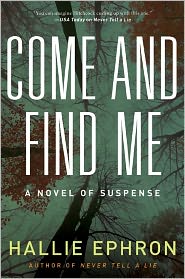
The current featured contributor at Writers Read: Hallie Ephron, author of Come and Find Me.

Her entry begins:
I'm reading a memoir by Caitlin Shetterly, Made for You and Me: Going West, Going Broke, Finding Home. I met Caitlin at a literary festival in Florida, and I couldn't wait to start the book when I got home.

She started it as a diary during the recession. She and her photographer husband had a 2-month-old son, an empty bank account and an apartment in Los Angeles they could no longer afford. Here's how she...[read on]
Among the early praise for Come and Find Me:
“Psychologically astute and emotionally gripping ... Ephron understands that the fears we inflict upon ourselves can be more crippling than a man with a gun . . . A unique and compelling novel to be read more than once.”
—Mystery Scene

“Propelled me from first page to last in a single sitting.”
—Bookreporter.com

“A compelling yarn of deception and danger ... a cautionary tale about the power of information technology ... And although this novel seems to be a stand-alone, readers can hope that a sequel is not out of the question.”
Richmond Times-Dispatch

“Ephron excels in creating an authentic view of an agoraphobic for whom the mere thought of walking down the driveway to the mailbox can immobilize her ... Diana’s emotional fragility gives a unique perspective to this character’s psyche.”
Times Leader
Learn more about the book and author at Hallie Ephron's website and blog.

The Page 69 Test: Never Tell A Lie.

Writers Read: Hallie Ephron.

--Marshal Zeringue

Pg. 99: David J. Linden's "The Compass of Pleasure"

Today's feature at the Page 99 Test: The Compass of Pleasure: How Our Brains Make Fatty Foods, Orgasm, Exercise, Marijuana, Generosity, Vodka, Learning, and Gambling Feel So Good by David J. Linden.

About the book, from the publisher:
A leading brain scientist's look at the neurobiology of pleasure-and how pleasures can become addictions.

Whether eating, taking drugs, engaging in sex, or doing good deeds, the pursuit of pleasure is a central drive of the human animal. In The Compass of Pleasure Johns Hopkins neuroscientist David J. Linden explains how pleasure affects us at the most fundamental level: in our brain.

As he did in his award-winning book, The Accidental Mind, Linden combines cutting-edge science with entertaining anecdotes to illuminate the source of the behaviors that can lead us to ecstasy but that can easily become compulsive. Why are drugs like nicotine and heroin addictive while LSD is not? Why has the search for safe appetite suppressants been such a disappointment? The Compass of Pleasure concludes with a provocative consideration of pleasure in the future, when it may be possible to activate our pleasure circuits at will and in entirely novel patterns.
David J. Linden, Ph.D., is a Professor in the Department of Neuroscience at the Johns Hopkins University School of Medicine. His publications include The Accidental Mind, his book that "seeks to explain how brain evolution has given rise to those qualities that most profoundly shape our human experience."

Read about the collection of short stories Linden called "knee-slapping funny, surreal and profound all at once," at Writers Read: David J. Linden.

Visit the official The Compass of Pleasure blog.

The Page 99 Test: The Compass of Pleasure.

--Marshal Zeringue

Top 10 quest narratives

Robert Irwin has published six novels including The Arabian Nightmare, The Mysteries of Algiers, Exquisite Corpse, and Satan Wants Me. He is the author of ten works of non-fiction including The Arabian Nights: A Companion, Night and Horses and the Desert: The Penguin Anthology of Classical Arabic Literature and For Lust of Knowing. His latest book, Memoirs of a Dervish: Sufis, Mystics and the Sixties, is out this month in the UK.

For the Guardian he named a top ten list of quest narratives. One book on the list:
Siddhartha by Hermann Hesse

First published in 1922, Hesse's slender novel chronicled the quest of the Brahmin Siddhartha to conquer suffering and fear. His path was not straightforward, for asceticism and meditation did not of themselves bring fulfilment. It was necessary for him to abandon the ascetic way and immerse himself in the worlds of money and sex in order to fully understand what it is to be human. Only after many years was he truly able to renounce the world and find ultimate fulfilment toiling as a simple ferryman.
Read about another novel on the list.

--Marshal Zeringue

Jesse Bullington's "The Enterprise of Death," the movie

Now showing at My Book, The Movie: The Enterprise of Death by Jesse Bullington.

The entry begins:
Awa would possibly be the toughest to cast, as the novel follows her from adolescence to adulthood. I think either Naomie Harris or Meagan Good would be awesome as adult Awa, but it might be tough since the book opens with her as a young teenager. I think Keke Palmer or Camille Winbush would make a good younger Awa, but then there’s the opposite problem of their maybe not being old enough for the later sequences. Perhaps the solution would be to make it an animated film, and then she could be voiced, young and old, by Angela Bassett or N’Bushe Wright.

At first I was thinking Niklaus Manuel could be played by Sam...[read on]
Read an excerpt from The Enterprise of Death, and learn more about the book and author at Jesse Bullington's website and blog.

The Page 69 Test: The Sad Tale of the Brothers Grossbart.

The Page 69 Test: The Enterprise of Death.

Writers Read: Jesse Bullington.

My Book, The Movie: The Enterprise of Death.

--Marshal Zeringue

Wednesday, April 20, 2011

What is Brett Battles reading?

Today's featured contributor at Writers Read: Brett Battles, author of The Silenced.

His entry begins:
I’m currently reading Blake Crouch’s Run.

Oh.

My.

God.

Is this good, or what? The only reason I’m not reading it at this very moment is I have to work sometime.

Here’s the set up…what if one day you discover a high percentage of the population has gone crazy, but in an organized, working together kind of way to kill those who aren’t like them? And what if as you’re huddled at home with your family trying to figure out what to do, one of these maniacs is reading off names and addresses over the radio of people who need to be killed, and he reads off your name?

That’s basically the set up for Run. It starts...[read on]
Among the early praise for The Silenced:
"The Silenced, a complex, action-packed international cat and mouse game, will be catnip for thriller readers. Old and new fans will rejoice that Jonathan Quinn is back in the game—sharper, more dangerous, and more human than ever."
—John Lescroart, New York Times best selling author of Damage

"The Silenced is a thriller in every sense of the word, full of double-backs and triple crosses, linked by a story that moves like a fuse and characters the reader genuinely cares about. It's Battles' best book yet."
—Timothy Hallinan, author of the Poke Rafferty Bangkok thrillers

"A gripping read. The plot grabs you and won't let go. Quinn is as cool as ever."
—Meg Gardiner, author of The Liar's Lullaby

"Action-packed and dripping with tension, Jonathan Quinn is ready to join Gabriel Allon and Mitch Rapp in the pantheon of elite spy thriller characters. Battles is only getting better, and The Silenced is the best Quinn yet."
—Jason Pinter, bestselling author of The Mark and The Fury
Learn more about the book and author at Brett Battles' website and blog.

Read: Tim Hallinan interviews Brett Battles.

The Page 69 Test: The Cleaner.

The Page 69 Test: The Deceived.

The Page 69 Test: Shadow of Betrayal.

The Page 69 Test: The Silenced.

The Page 69 Test: Little Girl Gone.

Writers Read: Brett Battles.

--Marshal Zeringue

Pg. 99: Amy Ellis Nutt's "Shadows Bright as Glass"

The current feature at the Page 99 Test: Shadows Bright as Glass: The Remarkable Story of One Man's Journey from Brain Trauma to Artistic Triumph by Amy Ellis Nutt.

About the book, from the publisher:
On a sunny fall afternoon in 1988, Jon Sarkin was playing golf when, without a whisper of warning, his life changed forever. As he bent down to pick up his golf ball, something strange and massive happened inside his head; part of his brain seemed to unhinge, to split apart and float away. For an utterly inexplicable reason, a tiny blood vessel, thin as a thread, deep inside the folds of his gray matter had suddenly shifted ever so slightly, rubbing up against his acoustic nerve. Any noise now caused him excruciating pain.

After months of seeking treatment to no avail, in desperation Sarkin resorted to radical deep-brain surgery, which seemed to go well until during recovery his brain began to bleed and he suffered a major stroke. When he awoke, he was a different man. Before the stroke, he was a calm, disciplined chiropractor, a happily married husband and father of a newborn son. Now he was transformed into a volatile and wildly exuberant obsessive, seized by a manic desire to create art, devoting virtually all his waking hours to furiously drawing, painting, and writing poems and letters to himself, strangely detached from his wife and child, and unable to return to his normal working life. His sense of self had been shattered, his intellect intact but his way of being drastically altered. His art became a relentless quest for the right words and pictures to unlock the secrets of how to live this strange new life. And what was even stranger was that he remembered his former self.

In a beautifully crafted narrative, award-winning journalist and Pulitzer Prize finalist Amy Ellis Nutt interweaves Sarkin's remarkable story with a fascinating tour of the history of and latest findings in neuroscience and evolution that illuminate how the brain produces, from its web of billions of neurons and chaos of liquid electrical pulses, the richness of human experience that makes us who we are. Nutt brings vividly to life pivotal moments of discovery in neuroscience, from the shocking "rebirth" of a young girl hanged in 1650 to the first autopsy of an autistic savant's brain, and the extraordinary true stories of people whose personalities and cognitive abilities were dramatically altered by brain trauma, often in shocking ways.

Probing recent revelations about the workings of creativity in the brain and the role of art in the evolution of human intelligence, she reveals how Jon Sarkin's obsessive need to create mirrors the earliest function of art in the brain. Introducing major findings about how our sense of self transcends the bounds of our own bodies, she explores how it is that the brain generates an individual "self" and how, if damage to our brains can so alter who we are, we can nonetheless be said to have a soul.

For Jon Sarkin, with his personality and sense of self permanently altered, making art became his bridge back to life, a means of reassembling from the shards of his former self a new man who could rejoin his family and fashion a viable life. He is now an acclaimed artist who exhibits at some of the country's most prestigious venues, as well as a devoted husband to his wife, Kim, and father to their three children. At once wrenching and inspiring, this is a story of the remarkable human capacity to overcome the most daunting obstacles and of the extraordinary workings of the human mind.
Learn more about the book and author at Amy Ellis Nutt's website.

Amy Ellis Nutt has been a staff writer at The Star-Ledger newspaper in Newark, NJ since November 1997. She was awarded the 2011 Pulitzer Prize for feature writing for her story “The Wreck of the Lady Mary,” which ran as a 20-page special section of The Star-Ledger in November 2010.

The Page 99 Test: Shadows Bright as Glass.

--Marshal Zeringue

The 10 best fictional mothers

The Observer came up with a list of the ten best fictional mothers, including:
Mrs March
Little Women

Louisa May Alcott’s saccharine vision of maternal perfection, Mrs March is endlessly patient, an ideal housekeeper and a highly principled woman. She protects her four children while still allowing them the freedom to make their own mistakes. Known by her daughters as “Marmee”, Mrs March (played by Susan Sarandon in the 1994 film) has a strong religious faith and yet is unconventional by the standards of the day. Unlike many 19th-century mothers, she does not push her girls to marry for money, instead ensuring they are educated and can make decisions for themselves.
Read about another mother on the list.

Little Women also appears on Eleanor Birne's top ten list of books on motherhood, Erin Blakemore's list of five gutsy heroines to channel on an off day, Kate Saunders' critic's chart of mothers and daughters in literature, and Zoë Heller's list of five memorable portraits of sisters. It is a book that disappointed Geraldine Brooks on re-reading.

Also see a list of the 10 worst mothers in fiction.

--Marshal Zeringue

Pg. 69: Ben Kane's "The Road to Rome"

The current feature at the Page 69 Test: The Road to Rome: A Novel of the Forgotten Legion by Ben Kane.

About the book, from the publisher:
In 48 B.C., having survived a disastrous campaign in Pythia as part of the Forgotten Legion and spent years fighting their way back to Rome, Romulus and Tarquinius have finally made it as far as Alexandria. On arrival, though, they find themselves in the midst of the Roman Civil War, are press-ganged into Caesar’s thinning legions and greatly outnumbered and fighting for their lives against the Egyptian army. Meanwhile in Rome, Romulus’ twin sister Fabiola, having caught only a glimpse of her long-missing twin before being forced to flee Egypt for Rome, lives in fear for her life, loved by Brutus, but wooed by Marcus Antonius, his deadly enemy.

From the battlefields of Asia Minor and North Africa, to the lawless streets of Rome and the gladiator arena, they all face death and danger daily, until 44 B.C. when their individual roads all lead them to Rome where the future of the republic lies unexpectedly in their hands.
Learn more about the book and author at Ben Kane's website and blog.

Writers Read: Ben Kane.

My Book, The Movie: The Forgotten Legion trilogy.

The Page 69 Test: The Road to Rome.

--Marshal Zeringue

Tuesday, April 19, 2011

What is Robert J. Sawyer reading?

The current featured contributor at Writers Read: Robert Sawyer, author of WWW: Wonder.

His entry begins:
Right now, on the nonfiction front, I'm reading and thoroughly enjoying Rawhide Down: The Near Assassination of Ronald Reagan by Del Quentin Wilber.

I'm reading this for two reasons. First, the novel I'm currently writing, called Triggers, deals with an attempt to assassinate the current US president on the 50th anniversary of the JFK assassination -- and a neat science-fictional idea that spins out from that. In my novel, the injured president is taken to George Washington University Hospital, just as Reagan was; I recently had a great behind-the-scenes tour there.

Second, although I don't know Del Quentin Wilber, I do know his uncle, Rick Wilber, a very fine science-fiction writer in his own right; in fact, it was Rick who first alerted me to his nephew's book. I bought Rawhide Down for my Kindle the day it came out in March, and the book has since...[read on]
Among the reviews for Sawyer's WWW trilogy:
Praise for Wake:

"Sawyer continues to push the boundaries with his stories of the future made credible. His erudition, eclecticism, and masterly storytelling make Wake a choice selection."
Library Journal

"Wildly thought-provoking. The thematic diversity — and profundity — makes this one of Sawyer's strongest works to date."
Publishers Weekly (starred review)

Praise for Watch:

"In Watch, Sawyer shows his genius in combining cutting-edge scientific theories and technological developments with real human characters. His works are both revelatory and thought-provoking."
The Globe and Mail

"This is a complex and fascinating book. Sawyer maintains the same high level interplay of ideas and action that characterizes all his work."
National Post

Praise for Wonder:

"Action-packed; the tale ties up seemingly every thread. Readers will enjoy Robert J. Sawyers deep look at the Web age of American power in which leaders believe they need threats like Big Brother is watching you even when none exists."
—Alternative-worlds.com

"This is Robert J. Sawyer at his very best."
Analog
Learn more about the books and author at Robert J. Sawyer's website and blog.

The Page 69 Test: WWW: Wake.

The Page 69 Test: WWW: Watch.

The Page 69 Test:: WWW: Wonder.

Writers Read: Robert Sawyer.

--Marshal Zeringue

Lou Manfredo's "Rizzo's Fire," the movie

Now showing at My Book, The Movie: Rizzo's Fire by Lou Manfredo.

The entry begins:
My first Joe Rizzo novel, Rizzo's War, was published both in hard cover and audiobook. Emmy Award winning actor, Bobby Cannavale, performed as reader, and when first I heard his Rizzo rendition I was shocked: It was exactly the voice I’d been hearing in my ear as I wrote the book. His performance was chillingly picture perfect.

I’ve recently watched Mr. Cannavale in his recurring role on the CBS crime drama Blue Bloods, and I am thoroughly convinced. If ever there is a Joe Rizzo movie, Mr. Cannavale would be perfect.

In writing Rizzo's War, I had merely a blurry, faceless image of Rizzo in my mind’s eye. But with Rizzo's Fire...[read on]
Read more about Rizzo's Fire and Rizzo's War.

The Page 69 Test: Rizzo's War.

Writers Read: Lou Manfredo.

My Book, The Movie: Rizzo's Fire.

--Marshal Zeringue

Pg. 99: Stephen Singular's "The Wichita Divide"

Today's feature at the Page 99 Test: The Wichita Divide: The Murder of Dr. George Tiller and the Battle over Abortion by Stephen Singular.

About the book, from the publisher:
The New York Times bestselling author offers an in-depth account of the life and death of a controversial doctor, the debate that sparked his assassination, and the place where two Americas collide

On May 31, 2009, Scott Roeder walked into a Wichita church, drew a pistol, and shot Dr. George Tiller at point blank range. Tiller, who was the most public practitioner of late-term abortions in America, had been a lightning rod for controversy, regularly referred to in the conservative media as “Tiller, the Baby Killer.”

Tiller’s death was a pivotal, public murder in a war that has been raging for decades. It’s a war of violently opposing ideologies, encompassing abortion, but also questions of privacy, sexuality, and religion. It’s being fought in our nation’s courtrooms, school and churches, on television sets, at our dinner tables, and in our bedrooms. And more and more, the key battlegrounds are in Kansas, once home to Brown vs. Board of Education and some of the bloodiest conflicts of the Civil War.

This is a gripping look at a cold-blooded terrorist action, two men representing opposite ideological extremes, and the region where those violent forces clash.
Learn more about the book and author at Stephen Singular's website and blog.

The Page 99 Test: The Wichita Divide.

--Marshal Zeringue

Ten of the best visits to Brighton in literature

For the Guardian, John Mullan tagged a list of ten of the best visits to Brighton in literature.

One novel on the list:
Vanity Fair by William Makepeace Thackeray

Good but wet Amelia Sedley marries George Osborne and they go to Brighton for their honeymoon. "Brighton, a clean Naples with genteel lazzaroni – for Brighton, that always looks brisk, gay, and gaudy, like a harlequin's jacket". Brighton, where roués and women of doubtful virtue forgather, and where Amelia will again encounter Becky Sharp, Queen of Vanity Fair.
Read about another book on the list.

Vanity Fair also appears on Thomas Mallon's list and John Mullan's list of ten of the best pianos in literature.

--Marshal Zeringue

Monday, April 18, 2011

What is Mark Russinovich reading?

The current featured contributor at Writers Read: Mark Russinovich, author of Zero Day.

His entry begins:
One of the great blurbs my agent secured for Zero Day is by Nelson DeMille. I’d of course seen his books on the bestseller lists and on the display racks at the book store, but had never read one. When I told my friends about the blurb, many said that DeMille was among their favorite authors. The genres I spend most of my time in are thrillers, non-fiction and science fiction, but I decided that getting acquainted with the works of someone that so generously provided a blurb and that has such a great reputation with my reading friends would probably pay off.

I went to Amazon and found...[read on]
Among the early praise for Zero Day:
"Mark came to Microsoft in 2006 to help advance the state of the art of Windows, now in his latest compelling creation he is raising awareness of the all too real threat of cyber terrorism."
--Bill Gates

"CyberTerrorism. Get used to that word and understand it because you're going to see more of it in the newspapers and hear it on the news in the not too distant future. Mark Russinovich is a CyberSecurity expert who has turned his considerable knowledge into a very scary and too plausible novel. Zero Day is not science fiction; it is science fact, and it is a clear warning of Doomsday. A must-read for all Americans and for those entrusted with our security and our survival."
--Nelson DeMille

"While what Mark wrote is fiction, the risks that he writes about eerily mirror many situations that we see today."
--Howard A. Schmidt, White House Cyber Security Coordinator

"An up-to-the-moment ticking-clock thriller, Zero Day imagines the next 9/11 in a frightening but all too believable way. An expert in the field, Mark Russinovich writes about cyberterrorism with a mix of technical authority and dramatic verve. I was riveted."
--William Landay, author of The Strangler
Read an excerpt from the novel, and learn more about the book and author at the Zero Day website and blog.

The Page 69 Test: Zero Day.

Writers Read: Mark Russinovich.

--Marshal Zeringue

Pg. 99: Steven J. Brams's "Game Theory and the Humanities"

Today's feature at the Page 99 Test: Game Theory and the Humanities: Bridging Two Worlds by Steven J. Brams.

About the book, from the publisher:
Game theory models are ubiquitous in economics, common in political science, and increasingly used in psychology and sociology; in evolutionary biology, they offer compelling explanations for competition in nature. But game theory has been only sporadically applied to the humanities; indeed, we almost never associate mathematical calculations of strategic choice with the worlds of literature, history, and philosophy. And yet, as Steven Brams shows, game theory can illuminate the rational choices made by characters in texts ranging from the Bible to Joseph Heller's Catch-22 and can explicate strategic questions in law, history, and philosophy.

Brams's strategic exegesis of texts helps the reader relate characters' goals to their choices and the consequences of those choices. Much of his analysis is based on the theory of moves (TOM), which is grounded in game theory, and which he develops gradually and applies systematically throughout. TOM illuminates the dynamics of player choices, including their misperceptions, deceptions, and uses of different kinds of power.

Brams examines such topics as Abraham’s decision to offer his son for sacrifice when God commanded him to do so; the outcome and payoff matrix of Pascal’s wager on the existence of God; and the strategic games played by presidents and Supreme Court justices; frustration games, as illustrated by the strategic use of sexual abstinence in Aristophanes’s Lysistrata; and how information was slowly uncovered in the game played by Hamlet and Claudius. Going beyond the explication of these specific situations, Brams also derives propositions about "generic games," applicable to a broad class of situations. The reader gains not just new insights into the actions of certain literary and historical characters but also a larger strategic perspective on the choices that make us human.
Learn more about Game Theory and the Humanities at the MIT University Press website.

Steven J. Brams is Professor of Politics at New York University.

The Page 99 Test: Game Theory and the Humanities.

--Marshal Zeringue