Saturday, October 28, 2006

The best sportswriting

Richard Whitehead, the deputy editor of books at the Times (London), named the six best William Hill Sports Book of the Year winners.

Here are three of Whitehead's picks:
Seabiscuit by Laura Hillenbrand (2001)

Written at the same cracking pace as the horse races she so dazzlingly re-creates.

Fever Pitch by Nick Hornby (1992)

No one has captured better the sheer neurotic misery of fandom.

A Good Walk Spoiled by John Feinstein (1995)

Diverse and anecdotal, Feinstein follows golf pros, both top players and journeymen, during a US tour season.

Click here to see the other three titles on the list.

--Marshal Zeringue

Friday, October 27, 2006

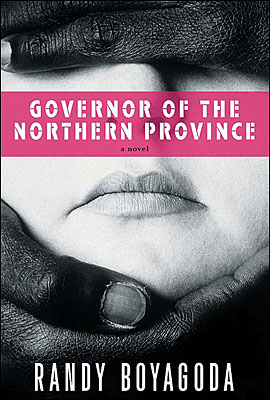
Pg.69: "Governor of the Northern Province"

"Nice liberal Canada skewered for dinner: A T.O. smartypants creates a war criminal to send up smug Canuck hypocrisy and gets a Giller Prize nod for his trouble"
—headline from a major review of Governor of the Northern Province in the Toronto Star
Governor of the Northern Province is Randy Boyagoda’s debut novel, a story "about an ex–African warlord named Bokarie who moves to small-town Canada—a place of comfort and tolerance, a place free from judgment and punishment for his gruesome doings in the northern province of his native African country, Atwenty."

I asked Randy to apply the "page 69 test" to his book; this is what he reported:
Does p. 69 of Governor of the Northern Province represent what the novel attempts on whole?

Yes, insofar as the page registers some of the enjoyments and difficulties that an ex-African warlord encounters in leading a life of meek politeness in small-town Canada, which is the premise of the novel on whole. The page also suggests another important dimension of the book — the clumsy, well-intentioned ways that white liberal Westerners attempt to make especially exotic newcomers welcome in their communities. Page 69 of Governor of the Northern Province concerns a conversation between the novel’s main character, Bokarie, and a new bride, as they dance together at her wedding. Bokarie has attended the wedding as her limousine driver, which brings out of the rather drunk bride a tearful apology for the racial implications of his being forced to do such work, and then a maudlin confession about a black man from her own past. Bokarie is enjoying all of this a great deal, especially since he’s pressed close to her and she, like the other Westerners he’s met, is happily “blaring her indignation on his behalf.” But as much as he likes the feel of a “gauze-swaddled pelvis,” he can’t avoid the sound the bride makes as she sucks away on a beer bottle. She brings the bottle too quickly against her teeth, creating a “CLICK-SMACK!” that recalls memories of an event in Africa that Bokarie would rather forget. Eventually, he excuses himself and leaves the reception hall to clear his head; meanwhile, the bride is given some coffee and other wedding guests evaluate the dance moves of the new African in town, speculating on the faraway sources of his impressive rhythm: “‘Must be from all that drumming you see on those documentaries.’”
Many thanks to Randy for the input.

Click here to read several reviews of Governor of the Northern Province.

Here is one question and answer from a Torontoist interview with the author:
You've mentioned in interviews that your novel satirizes a few Canadianisms do you think Canadian literature doesn't do enough of this? Why do you think that is?

We no longer trust humour as a way to say something serious. Canadians take themselves terribly seriously, are righteous and solemn about the nation's significance to the world at-large, and myopically proud of the nation's virtues. And so much of contemporary literature simply affirms these tendencies, instead of offering a hard check against them, which is what I'm trying to do with this novel. A satirical novel about a genocidal African warlord moving to small-town Canada and becoming a convenience store clerk and political operative proposes that multiculturalism, diversity and tolerance - Canada's holy trinity - aren't entirely pristine virtues, but can in fact be vices.

Randy Boyagoda is an English professor at Ryerson University. He writes for various North American periodicals--he reviewed Ngugi wa Thiong'o's new novel in Harper's September issue--and is a contributing editor to The Walrus magazine.

Shortly after Orhan Pamuk of Turkey was awarded this year's Nobel Prize in Literature, Boyagoda wrote in the New York Times:

No doubt, the latest Nobel laureate's books will be taken up with immediate interest by thoughtful readers searching for wisdom about the violent crosscurrents of religion, politics, history and culture whipsawing our world. But one can only hope that this rush to conscript Mr. Pamuk as a literary mediator in the clash of civilizations will fail.

If it doesn't, we risk missing the core insight of his work: that the chaos of cultural upheaval, and equally the harmony of intercultural connection, is always secondary to what Mr. Pamuk's fellow Nobel laureate, William Faulkner, described as ''the problems of the human heart in conflict with itself.''

Previous "page 69 tests":
John Gittings, The Changing Face of China
Rachel Kadish, Tolstoy Lied
Eric Rauchway, Blessed Among Nations
Tim Brookes, Guitar and other books
Ruth Padel, Tigers in Red Weather
William Haywood Henderson, Augusta Locke
Jed Horne, Breach of Faith
Robert Greer, The Fourth Perspective
David Plotz, The Genius Factory
Michael Allen Dymmoch, White Tiger
Patrick Thaddeus Jackson, Civilizing the Enemy
Tom Lutz, Doing Nothing
Libby Fischer Hellmann, A Shot To Die For
Nelson Algren, The Man With the Golden Arm
Bob Harris, Prisoner of Trebekistan
Elaine Flinn, Deadly Collection
Louise Welsh, The Bullet Trick
Gregg Hurwitz, Last Shot
Martha Powers, Death Angel
N.M. Kelby, Whale Season
Mario Acevedo, The Nymphos of Rocky Flats
Dominic Smith, The Mercury Visions of Louis Daguerre
Simon Blackburn, Lust
Linda L. Richards, Calculated Loss
Kevin Guilfoile, Cast of Shadows
Ronlyn Domingue, The Mercy of Thin Air
Shari Caudron, Who Are You People?
Marisha Pessl, Special Topics in Calamity Physics
John Sutherland, How to Read a Novel
Steven Miles, Oath Betrayed
Alan Brown, Audrey Hepburn's Neck
Richard Dawkins, The Ancestor's Tale

--Marshal Zeringue

Six books notable for their food prose

David Kamp, a Vanity Fair contributing editor and the author of The United States of Arugula: How We Became a Gourmet Nation, named six books that are "notable for their delectable food prose" for The Week magazine.

Here is a healthy serving from his list:
Between Meals by A.J. Liebling

Liebling was a New Yorker journalist who only dabbled in food writing but was nevertheless, in my opinion, America’s best food writer. This short book compiles his recollections of eating his way through Paris—in both the 1920s and ’40s. Liebling was roly-poly; were he alive today, he would be upheld as an exhibit of America’s “obesity epidemic.” But he was discriminating in his gluttony, and these buoyant essays evoke a wonderful era when such behavior was morally permissible.

The Age of Innocence by Edith Wharton

Great novel, great gastro-porn dinner scenes. Like Liebling, Wharton offers a look back at a time when gourmandism was an extreme sport. The wealthy Mingott family gorges itself on oysters, terrapin soup, canvasback duck, and vintage wines. One character actually says, “I’ve been a little gouty since my last dinner at the Lovell Mingotts’.”

Kitchen Confidential by Anthony Bourdain

This book is no longer a sleeper hit, obviously; Bourdain is a brand now. But I think that Kitchen Confidential will be looked back upon as a watershed moment in food lit—when it became allowable to write about chefs, kitchens, and cookery with guts and savage humor, and without the twee voice that still permeates the food magazines.
Click here to read about Kamp's other three book selections.

Learn more about The United States of Arugula here, and click here to read an excerpt.

Foodies hungry to read more dining related items on the blog should click here,
here, and here.

--Marshal Zeringue

What is Barry Pepper reading?

The actor Barry Pepper (Flags of Our Fathers, Saving Private Ryan, The Green Mile) recently talked to the Christian Science Monitor about what he was listening to and viewing for entertainment. And reading:
I'm one of those readers who has several books on the go at once. I'm reading books on learning the guitar and learning Spanish, just for personal interest. I'm also reading Noam Chomsky's Failed States. The book I've been reading most recently is Don Quixote. Terry Gilliam had began shooting a film version with Johnny Depp. I saw a documentary ["Lost in La Mancha"] about that movie, and I thought, "I've got to read it." It's an excellent book - definitely in my top 100.
Click here to read about what Pepper is watching and listening to.

--Marshal Zeringue

An unusual list

From Mark Sanderson's "Literary Life" column at the Telegraph (London):

What do the following, mainly obscure, works have in common? Diversity and Evolutionary Biology of Tropical Flowers by Peter K. Endress, Merriam Webster's Dictionary of Synonyms, Measuring and Controlling Interest Rate and Credit Risk by Frank J. Fabozzi, Steven V. Mann and Moorad Choudhry, Ultimate Healing: The Power of Compassion by Lama Zopa Rinpoche, The Holy Qur'an translated (in 1934) by Abdullah Yusuf Ali, Peterson's Study Abroad 2006, Hegemony or Survival: America's Quest for Global Dominance by Noam Chomsky, Merriam-Webster's Dictionary of English Usage, Perrine's Literature: Structure, Sound, and Sense by Thomas R. Arp and Greg Johnson and Build Your Own All-Terrain Robot by Brad Graham and Kathy McGowan.

According to Google, they are the 10 English-language titles most often consulted via their Book Search facility. Google users must either be extraordinarily learned or the facility is only used by bored-to-death academics.

--Marshal Zeringue

Thursday, October 26, 2006

Cormac McCarthy's "The Road"

I've just posted a review of The Road over at Spot-on. The opening lines of the review:
Cormac McCarthy’s new novel The Road may be the most terrifying, heartbreaking and soul-crushing book I have ever read. And it is a love story.
Two thoughts that I didn't mention in the review:

First, to repeat some lines from an earlier post about "The numerology of Cormac McCarthy":
here is a striking passage, spoken by an old man the two central characters ("the man" and "the boy") meet on The Road:
When we're all gone at last there'll be nobody here but death and his days will be numbered too. He'll be out in the road there with nothing to do and nobody to do it to. He'll say: Where did everybody go? And that's how it will be. What's wrong with that?
Just to give you a sense of the story, that quote is one of the more comforting passages in the book.
Second, readers who are put off by the Faulknerian flights of lyricism in earlier novels may want to consider giving the writer another chance with The Road. (I happen to like McCarthy doing that Faulkner thing--though there are times when he can hit a really sour note with it.) As William Kennedy put it in his review of The Road:
on the basis of No Country for Old Men and The Road it does seem that he has put aside the linguistic excesses and the philosophizing for which he has been both venerated and mocked — those Faulknerian convolutions, the Melvillean sermonizing — and opted for terse dialogue and spartan narrative, a style he inherited from another of his ancestors, Hemingway, and long ago made his own.
--Marshal Zeringue

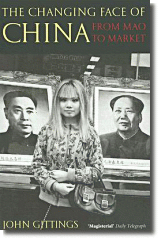
Pg. 69: "The Changing Face of China"

John Gittings is a writer on China and world affairs. His most recent book is The Changing Face of China: From Mao to Market, which Rana Mitter has called "The best single-volume history of the People's Republic of China from 1949 to the present."

I asked John to apply the "page 69 test" to his book. Here is what he reported:
China's students become a "vanguard force" on p.69 of my book at a critical moment in its modern history. It was the summer of 1966 at the start of the Great Proletarian Cultural Revolution. Nowadays the official Chinese line on the decade which followed till Mao's death is that it was "ten years of chaos" and there is nothing more to say. But I take seriously Mao's aim at the time to create "a new generation of 'revolutionary successors'," and I put it in the context of a tradition of student dissent, even rebellion, going back half a century. Hence the chapter title "The Rebel Alternative." Of course the idealistic strand in the Cultural Revolution was nullified by Mao's vicious score-settling with his critics, by the opportunists who jumped on the revolutionary band-wagon and by the ignorance and fanaticism of many Red Guards and Rebels themselves. Nor was it a spontaneous movement: I also describe on p. 69 how the Red Guards were launched at a meeting in Beijing University where the main speaker was connected to "Mao's secret policeman" Kang Sheng. But I go on to argue that the future democracy movement, leading right up to the Tiananmen Square demonstrations in 1989, grew out of those frustrated ideals: very early on many young Chinese, adrift in this turbulent movement, began to ask the big question "Whither China" which is still being asked today.

[Excerpt from p.69]

Throughout the revolution, the students had never been more than an auxiliary force. In the Cultural Revolution of 1966-8 (the broader definition extending it to 1976 was only made retrospectively) they became the vanguard force. Already concerned to create a new generation of `revolutionary successors' which would steer China away from the revisionist trap into which the Soviet Union had fallen, Mao pinned his faith upon its youth. The Red Guards were loose groupings of college and secondary school students, formed initially to `struggle' against teachers and cadres in their own institutions but soon encouraged to act as the catalyst of a wider movement. Red Guards could be as young as 12 or as old as 30, but the majority were in their teens.
Many thanks to John for the input on his book.

Learn more about
The Changing Face of China here at the Oxford University Press website. Click here to read an excerpt.

Lucian W. Pye called The Changing Face of China
"a vivid history" in his review in Foreign Affairs:
Drawing on his firsthand experience, he recaptures the simultaneous absurdity and utopian idealism of the Mao era and depicts the conflicting sentiments of China-watchers as they observed the power struggles of that time.... Looking to the future, Gittings anticipates the gradual expansion of politics but not the disintegration of the party. He identifies economic problems, but none that will fundamentally threaten China's progress. He is most pessimistic about environmental degradation and the escalating demands of a growing population on an inadequate natural-resource base....
For selected newspaper articles by Gittings, click here; for journal articles, click here; for books and book chapters, click here.

His most recent article at the Guardian is about the career and funeral of Chinese democrat Lin Mu.

He wrote the chapter "What if Mao had met Roosevelt," in Duncan Brack ed., President Gore, and other things that never happened.

Previous "page 69 tests":
Rachel Kadish, Tolstoy Lied
Eric Rauchway, Blessed Among Nations
Tim Brookes, Guitar and other books
Ruth Padel, Tigers in Red Weather
William Haywood Henderson, Augusta Locke
Jed Horne, Breach of Faith
Robert Greer, The Fourth Perspective
David Plotz, The Genius Factory
Michael Allen Dymmoch, White Tiger
Patrick Thaddeus Jackson, Civilizing the Enemy
Tom Lutz, Doing Nothing
Libby Fischer Hellmann, A Shot To Die For
Nelson Algren, The Man With the Golden Arm
Bob Harris, Prisoner of Trebekistan
Elaine Flinn, Deadly Collection
Louise Welsh, The Bullet Trick
Gregg Hurwitz, Last Shot
Martha Powers, Death Angel
N.M. Kelby, Whale Season
Mario Acevedo, The Nymphos of Rocky Flats
Dominic Smith, The Mercury Visions of Louis Daguerre
Simon Blackburn, Lust
Linda L. Richards, Calculated Loss
Kevin Guilfoile, Cast of Shadows
Ronlyn Domingue, The Mercy of Thin Air
Shari Caudron, Who Are You People?
Marisha Pessl, Special Topics in Calamity Physics
John Sutherland, How to Read a Novel
Steven Miles, Oath Betrayed
Alan Brown, Audrey Hepburn's Neck
Richard Dawkins, The Ancestor's Tale

--Marshal Zeringue

Wednesday, October 25, 2006

Pg. 69: "Tolstoy Lied"

You spy a novel with a title that proclaims your all-time favorite writer lied. What do you do?

That's the question which confronted me when I noticed Rachel Kadish's Tolstoy Lied: a Love Story. So of course I got in touch with the author and asked her to apply the "page 69 test" to her novel.

It turns out, as you may have guessed, that she's not only a huge Tolstoy fan--it's mainly the first line of Anna Karenina about which her narrator has doubts--but an enthusiast of Moby-Dick, my favorite nineteenth-century American novel.

Here's what Rachel said about page 69:
Tracy Farber, the narrator of Tolstoy Lied: a Love Story, believes that Tolstoy’s most widely quoted maxim (“Happy families are all alike; every unhappy family is unhappy in its own way”) is actually a cop-out. Why, she wonders, do we fall for this notion that only unhappiness is interesting…that if you’re not tragic you’ve become boring, undifferentiated, a sort of emotional sell-out? Why, she wonders, is it so hard for us to acknowledge that happiness can be riveting, deeply challenging, anything but dull?

Tolstoy Lied: a Love Story is a novel about a woman who tries to live both a passionate and an honest life. It’s a novel of ideas, but in a sense it’s a novel of ideas on helium. I had a lot of fun writing this book. There were some serious and controversial things I wanted to say about love, marriage, academia. But I wanted to enjoy doing so – I’ve always loved that quote ascribed to Emma Goldman: If I can’t dance I don’t want to be part of your revolution. It was essential to me to laugh while writing Tracy’s story.

Page 69 is part of a scene in which Tracy’s passion for the intellectual life emerges. Her academic life—its richness, its texture, its daily battles, is a fundamental element of the book. I did a great deal of research in writing Tracy’s academic passions and those of her colleagues. Page 69 is part of the introduction to this world. (And while I made up the Tower of Babel cartoon, the conference flyer advertising “pellucid” skies is actually something I saw in a university English Department.)

What page 69 doesn’t touch is the book’s lighter moments, moments when Tracy’s vision of love and marriage ventures into the surreal…moments of sheer slapstick.

Tracy believes that happiness isn’t the absence of trouble, but rather the ability to live well alongside trouble. The book serves up plenty of trouble, but also its opposite. Page 69 communicates that this is a novel of ideas. For the helium, see the rest of the book.
Many thanks to Rachel for the insights into her novel.

Click here to read an excerpt from Tolstoy Lied.

Some praise for Tolstoy Lied from other writers:
"Utterly absorbing....This is a novel bursting with the immediacy of experience and the profundity of reflection." --Rebecca Goldstein

"Tolstoy Lied is a brilliant novel, one of the wisest books I've read about love." --Carol Gilligan

"Tolstoy Lied is a love story with heft, weight, and dazzle. Rachel Kadish has written an infectiously enjoyable novel." --Tova Mirvis
The reviewer for the San Francisco Chronicle wrote, "Kadish has penned a light-footed, wholly unromanticized contemporary love story that cuts to the very core of what a love story should be: not about how we find happiness, but about what it means to do so."

For more Tolstoy Lied reviews, click here.

Click here to read a Q & A with the author about the novel.

Rachel's debut novel, From a Sealed Room, earned praise from an impressive group of writers; a sample--
"A gifted writer, astonishingly adept at nuance, narration, and the politics of passion." --Toni Morrison

"Rachel Kadish has written a book that's wise beyond the years of most Americans. From the opening page, her novel brilliantly braids history, religion, family, and eros. I was moved by it, and very impressed. This is the debut of a remarkable young writer.” --Russell Banks
Click here for more reviews.

Click here to read Kadish's short story, "The Argument," in Zoetrope: All-Story.

Previous "page 69 tests":
Eric Rauchway, Blessed Among Nations
Tim Brookes, Guitar and other books
Ruth Padel, Tigers in Red Weather
William Haywood Henderson, Augusta Locke
Jed Horne, Breach of Faith
Robert Greer, The Fourth Perspective
David Plotz, The Genius Factory
Michael Allen Dymmoch, White Tiger
Patrick Thaddeus Jackson, Civilizing the Enemy
Tom Lutz, Doing Nothing
Libby Fischer Hellmann, A Shot To Die For
Nelson Algren, The Man With the Golden Arm
Bob Harris, Prisoner of Trebekistan
Elaine Flinn, Deadly Collection
Louise Welsh, The Bullet Trick
Gregg Hurwitz, Last Shot
Martha Powers, Death Angel
N.M. Kelby, Whale Season
Mario Acevedo, The Nymphos of Rocky Flats
Dominic Smith, The Mercury Visions of Louis Daguerre
Simon Blackburn, Lust
Linda L. Richards, Calculated Loss
Kevin Guilfoile, Cast of Shadows
Ronlyn Domingue, The Mercy of Thin Air
Shari Caudron, Who Are You People?
Marisha Pessl, Special Topics in Calamity Physics
John Sutherland, How to Read a Novel
Steven Miles, Oath Betrayed
Alan Brown, Audrey Hepburn's Neck
Richard Dawkins, The Ancestor's Tale

--Marshal Zeringue

A literary guide to Baltimore

Laura Lippman, who is most responsible for my mental map of Baltimore with her many novels set there, wrote Salon's literary guide for her semi-beloved city.

One title from a half-century ago:
William Manchester's City of Anger has the inevitable anachronisms of any 1953 novel that takes on race relations, but the title remains depressingly apt. Manchester, who worked for the Evening Sun (my former employer as well), begins with one of the best descriptions I've ever read of my hometown: "The city faced the bay. In the days of sailing vessels all the people had lived in a horseshoe of homes circling the downtown basin, and everyone could see the water, and the land behind was wild. Now the skyline blocked out the bay, and those who could had moved inland and built in the green corridor of the Valley. But the horseshoe remained, a vast arc of decaying houses running from sea to sea, walling the skyline in and the suburbs out."
Baltimore in the 1980s is represented by an unlikely trio--John Waters, Anne Tyler, and Robert Ward:

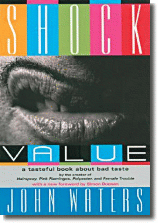
Waters, the well-known film director, isn't the figment of someone else's imagination, but he's quite the character and a terrific writer to boot. His memoir, Shock Value (1981), is a wonderful story about a self-confessed odd duck growing up in the suburbs, obsessed with the city's seamier side.... At one point, Waters counsels the powers-that-be to change the city's slogan to "Come to Baltimore and Be Shocked"--and the Chamber of Commerce actually complied in 2000, printing up thousands of yellow-and pink bumper stickers as a tribute to Waters. His essays, collected in Crackpot (1986), also have their share of Baltimore moments, most notably "Ladies and Gentlemen ... the Nicest Kids in Town," a completely sincere paean to a local dance show. That piece evolved into "Hairspray," the low-budget film, which became "Hairspray," the Broadway phenomenon, which is now "Hairspray," a motion picture so major that it can't even be filmed in Baltimore.

I know that Anne Tyler is, for most of America, the first name in Baltimore fiction, but I'm almost reluctant to include her here. Tyler, like Baker, transcends Baltimore, although she does the gentle lunacy of the WASPy North Side precincts very well, particularly in The Accidental Tourist (1985). Still, I've always maintained that Tyler isn't a Baltimore writer, but a great writer who happens to live in Baltimore. Charm City is not her primary subject, but her default setting.

As for Ward:
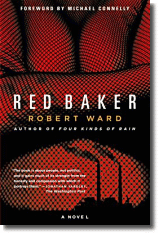
In [his] Red Baker (1985), ...the novel's recently laid-off, eponymous steelworker tells us: "There never was a story with a happy ending in Baltimore," yet opines later: "Even the worst of times aren't all that bad." But Red was conceived by Ward in the early 1980s. He probably couldn't envision a day when his company's real-life counterpart, Bethlehem Steel, would be bought by other companies, which would then cut off retirees' health benefits. Baltimore reveres its working-class past, but it doesn't have as much affection for the actual workers still among us. Thankfully, Red ultimately finds contentment -- not in Baltimore, but in a desert, the perfect diametric for a polluted mid-Atlantic city where the snow is so lumpy that Red compares it to grits. (Ward, who was nominated for the National Book Award for Red Baker, made a similar journey, heading west to write for television -- "Hill Street Blues," "Miami Vice" -- while keeping his hand in as a novelist.)
Lippman's heart is with the Baltimore of The Wire, the best show on television.
Madison Smartt Bell tilled the same territory for a novel, the nicely understated Ten Indians (1996), which examines the tyranny of good intentions. A white psychologist opens a martial arts studio in a poor black neighborhood, and it ain't "The Karate Kid." Bell has the courage to remind his readers that it's pretty damn hard to save anyone, yourself included.
There's more: read Lippman's essay here.

"Laura Lippman's books are possessed of a subtle understanding of emotional architecture that leaves me breathless," wrote novelist Marcus Sakey in this post.

In this post I praise Lippman for, among other virtues, praising Mildred Pierce.

Other items in Salon's literary guide series include:
A literary guide to Argentina
A literary guide to Afghanistan
A literary guide to Louisiana
A literary guide to Australia
A literary guide to Norway
A literary guide to Turkey
A literary guide to Japan
A literary guide to Martha's Vineyard
A literary guide to West Texas
A literary guide to Togo
A literary guide to Brooklyn
A literary guide to Miami

--Marshal Zeringue

"The Complete Book of Aunts"

"With the contemporary nuclear family splitting and reconfiguring itself into a dizzying number of shapes, it might seem as though the aunt has had her day," writes Kathryn Hughes of The Complete Book of Aunts by Rupert Christiansen, theatre critic for the London Telegraph.
The time when the sister of either a mother or father actually meant something in a child's life has probably gone for good. Instead there's a whole army of pseudo-aunties - anyone from the childminder to daddy's girlfriend - who take on the functions previously carried out by a woman with a Hillman Imp and a dachshund, who could be relied upon to send you a classic novel for your birthday.

Still, says Rupert Christiansen, in this charming, clever and quirky study, that's no reason to let the aunt slide unremembered into the dust box of history. Instead, we should celebrate her while she is still, just about, a figure who means something to most of us. And so he sets off on a wonderful treasure hunt to discover the best, worst, naughtiest, nastiest and most glamorous (not all of them have moustaches) aunts in 20th-century life and literature.
There is no indication this book will be available soon in the U.S. A pity: Jane Austen as aunt--and as a creator of several literary aunts--sounds interesting. Hughes again:
Jane Austen...reveals herself to be a model aunt, treating her nieces as both equals and playfellows, taking their not-very-good writing seriously and urging them on to the sort of love affairs that she never quite managed for herself. Austen's literary aunts, by contrast, fall far short of these exacting standards. Darcy's aunt, Lady Catherine de Burgh, is a monster of self-regard, while Fanny Price's aunts Bertram and Norris are, respectively, a passive-aggressive tyrant and a bully. Interestingly, one of Austen's few helpful literary aunts turns out to be that liminal thing, an aunt by marriage. In Pride and Prejudice it is Mrs Bennet's brother's wife, Mrs Gardiner, who is able to give Lizzy the kind of calm, straight-speaking advice in which the species is supposed to specialise.
Click here to read the whole review.

--Marshal Zeringue

Tuesday, October 24, 2006

Pg. 69: "Blessed Among Nations"

Eric Rauchway, a history professor at the University of California, Davis, is the author of Murdering McKinley: The Making of Theodore Roosevelt's America and, more recently, Blessed Among Nations: How the World Made America.

Among the considerable praise Blessed Among Nations has attracted, two endorsements stood out for me:
Written by an accomplished, imaginative historian who well understands those beginnings of modern America -- the years of the Progressive Era -- this book on one level suggests why socialism never took root in the United States, and why the supposed melting pot and the early Federal Reserve System worked as they did, but on quite another level develops a highly revealing argument how Americans' faith in their "empire" and their exceptionalism shaped in often unexpected ways what we now call globalization and their part in it. —Walter LaFeber, Tisch University Professor, Cornell University
American ‘exceptionalism’ is one of those things often asserted, seldom convincingly proved. By setting the history of the United States in the context of the history of the first age of globalization, Eric Rauchway has come up with a powerful new argument about what exactly made the American experience different. Blessed Among Nations is both brilliant and convincing. For the breadth of his vision, the author deserves to be blessed among U.S. historians” —Niall Ferguson, Laurence A. Tisch Professor of History at Harvard University and author of Colossus: The Rise and Fall of the American Empire
I asked Eric to apply the "page 69 test" to his book. Here is what he reported:
Blessed Among Nations is a book about how globalization has made America exceptional in specific and enduring ways, and page 69 provides a good example of how it works. It's part of a discussion of immigration to the US in the decades around 1900. It begins by noting the volume of immigration, which was "enough to make any paymaster cheerful on seeing the shiploads of people sail past the Statue of Liberty": more immigrants meant more laborers, and a lower price for labor. But, as page 69 goes on to explain, what made immigration to the US look different from immigration to other New World nations was not volume, but variety: there were more different kinds of people going to the US than to anywhere else. Employers loved this diversity: they could hire a workforce split between Polish Catholics and German Protestants, or some other selection of ethnic antagonists that would tend to dampen any feeling of worker solidarity. For the same reasons, union leaders hated ethnic diversity, and as page 69 goes on to note, the American Federation of Labor became in the late 1890s an avid advocate of the literacy test to restrict the immigration of unskilled workers.

So page 69 advances the book's story substantially: this is a story about how international factors affected America, and here we find some examples. Which is good: it is by intention a short book, briskly told, and it would be a shame if any given page did not obviously move the ball downfield.

The page also provides a good example of the book's method. It moves from a trend you can see in the data (the previous page has a chart) but, because that's very impersonal, the discussion moves from the abstract trend to specific examples, and culminates with some actual historical people responding to this trend -- page 69 mentions of Samuel Gompers's pamphlet, "Meat vs. Rice: American Manhood vs. Asiatic Coolieism," and has a quotation from Henry George about how laborers are "imported ... for the express purpose of reducing wages and making employers independent of their men." Moving from data to examples and vivid historical language is, I think and hope, the best way to tell a big story.
Many thanks to Eric Rauchway for the input on his book.

Click here to read an excerpt from Blessed Among Nations.

Joshua Zeitz, a contributing editor of American Heritage magazine, wrote an enthusiastic review of the book; read it here.

Read an interview with the author by Scott McLemee of Inside Higher Ed here, and click here to listen to an interview with KQED's Michael Krasny.

Want to know "What's the difference between a progressive and a liberal?" Rauchway provides one answer here, with a follow-up here.

And the good professor offers some advice here for students on "How Not to Get an A."

Previous "page 69 tests":
Tim Brookes, Guitar and other books
Ruth Padel, Tigers in Red Weather
William Haywood Henderson, Augusta Locke
Jed Horne, Breach of Faith
Robert Greer, The Fourth Perspective
David Plotz, The Genius Factory
Michael Allen Dymmoch, White Tiger
Patrick Thaddeus Jackson, Civilizing the Enemy
Tom Lutz, Doing Nothing
Libby Fischer Hellmann, A Shot To Die For
Nelson Algren, The Man With the Golden Arm
Bob Harris, Prisoner of Trebekistan
Elaine Flinn, Deadly Collection
Louise Welsh, The Bullet Trick
Gregg Hurwitz, Last Shot
Martha Powers, Death Angel
N.M. Kelby, Whale Season
Mario Acevedo, The Nymphos of Rocky Flats
Dominic Smith, The Mercury Visions of Louis Daguerre
Simon Blackburn, Lust
Linda L. Richards, Calculated Loss
Kevin Guilfoile, Cast of Shadows
Ronlyn Domingue, The Mercy of Thin Air
Shari Caudron, Who Are You People?
Marisha Pessl, Special Topics in Calamity Physics
John Sutherland, How to Read a Novel
Steven Miles, Oath Betrayed
Alan Brown, Audrey Hepburn's Neck
Richard Dawkins, The Ancestor's Tale

--Marshal Zeringue

A new Elmore Leonard novel

Good news from the official Elmore Leonard website:
New Elmore Leonard Novel - May 8, 2007

Elmore has just completed his 41st novel,

Up in Honey’s Room

It will be published by William Morrow on May 8, 2007.

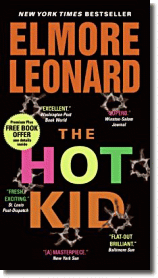
The novel is part of what could be called, “The Webster Saga.” The Webster in question is of course Carl Webster, the Hot Kid of the Marshal Service, who in the novel, The Hot Kid, becomes a legendary lawman going after Depression era bandits and the like.

Carl’s legend continued in Comfort to the Enemy, a serial novel published by the New York Times in 2005. In this story, Carl helped the government find escaped German POWs in Oklahoma particularly at Deep Fork near his family home.

Now in, Up in Honey’s Room, Carl comes to Detroit to find a couple escaped German POWs and finds first a degenerate Nazi spy ring and some hot women who are as dangerous as they are fun. Plenty of surprises in this book.

The good folks at the Elmore Leonard site also approvingly picked up on my argument about Killshot as a feminist story. What a relief! I would be crushed if they had said I had it all wrong.

--Marshal Zeringue

Louise Welsh's literary top 10

I just came across this list by Louise Welsh, an author whose work I've already praised here and here.

From her literary top 10 list:
My favourite novel that nobody else seems to have heard of

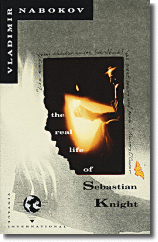
I’m sure lots of folk must have read Vladimir Nabokov’s The Real Life of Sebastian Knight, but no one I’ve ever mentioned it to has. It’s a brilliant detective novel, an exploration of memoir, memory, identity and the art of fiction. Sebastian is a writer and, while I recognise it can be a failure of imagination to simply write about writers, I like books about my profession as much as plumbers, nurses, sales assistants probably enjoy books about theirs. Sebastian’s brother finds part of a short story on his desk. “As he a heavy sleeper, Roger Rogerson, old Rogerson bought old Rogers bought, so afraid Being a heavy sleeper, old Rogers was so afraid of missing tomorrows…” A great evocation of the writer’s craft.
As it happens, I've read the novel and, while it may not be "my favourite novel that nobody else seems to have heard of," is among my favored Nabokov novels.

--Marshal Zeringue

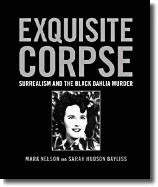
"Exquisite Corpse"

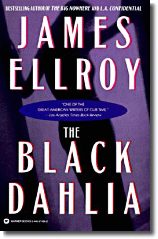
The film version of The Black Dahlia, which I had been looking forward to for so long, is finally out. My bottom line: disappointing.

But the story of the "Black Dahlia"--the actual murder and dismemberment of Elizabeth Short in Los Angeles in January 1947--will doubtless go on and almost certainly will spawn more books, fiction and nonfiction, and movies.

The actual facts of the Short case (still unsolved), James Ellroy's brilliant novel The Black Dahlia, the story of the brutal murder of Ellroy's own mother (also in L.A., 11 years after the Dahlia, and a passing familiarity with related books have left me confused about what is fact and what is fiction. Which I discovered when I tried to explain all this Dahlia stuff to someone the other day.

David Thomson (whose recent appearance on the blog is here) has a long review in The New Republic which not only clears up many of the details that have me confused but also develops an interesting argument about the place of the Dahlia in postwar American (and southern California) history, the movie business, and...(believe it or not) Surrealism.

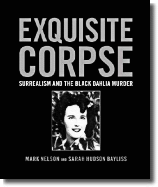
Integral to his broader theme is the true story of George Hodel, a man who may well have killed Elizabeth Short. And the man who figured out Hodel's past? His son Steve, a retired LAPD homicide detective, who presented the case a few years ago in a book titled Black Dahlia Avenger. Thomson's essay lays out the story of that book in his review, but his main subject is another book, Exquisite Corpse: Surrealism and the Black Dahlia Murder by Mark Nelson and Sarah Bayliss.

Here is the third part of Thomson's four-part review:

Now comes Exquisite Corpse. It is a strange book, sketchy but unforgettable, tendentious but instructive. It is the work of Mark Nelson, a design director, and Sarah Hudson Bayliss, an art history journalist. Its area of autopsy is that of art history, of a corpse so "exquisite" that complicity in its making may extend to a loose circle of surrealists or pseuds in Los Angeles who were motivated by sexual curiosity, a search for the acte gratuit, and by a larger postwar feeling that evil had been let loose and would not go back into the bottle. In brief, Exquisite Corpse reckons that the stark whiteness glimpsed on January 15, 1947 was not just a sign of murder but also a tableau alluding to several works of art -- a terrible private joke. The authors accept George Hodel as the mind making the connection, but they feel that he may have been part of a circle of picture-makers entranced by the morbid dislocation of body parts that had begun with Picasso and Cubism.

Exquisite Corpse looks like a coffeetable book, but the coffee is sickly. And the reader of Exquisite Corpse needs to have Steve Hodel's book on hand. Nelson and Bayliss come no closer to clinching the sort of case that might be won in court, but they do spread highbrow suspicion in tracking the iconography of the severed body, defaced flesh, and upraised arms. They really urge us to look. Surely, you may say, these formal resemblances could be mere coincidence -- after all, Picasso was a pioneer in re-arranging the body, Magritte did a disturbing and enticing picture of a body-face called Le Viol, and many artists of the last hundred years -- the age of film, by the way -- were driven by sexual obsession and a taste for non-naturalistic representation. Bill Copley did pictures of nudes and clothed doctors with exotic rows of surgical hardware. Francis Bacon seems to have had more "cuts" of meat than a butcher or a film editor. ("Cutting" is the term that connects those two arts.)

In linking pictures by Man Ray, Duchamp, and Copley, the authors have made us think anew about art and murder. And here's the rub: the intellectual daring of such pictures cannot quite be separated from a torturer's coolness. Do Man Ray's nude studies of Lee Miller celebrate sex and "togetherness," or are they part of a new level of alienation and dismantling aggression in which the body gazed upon begins to come apart? There is also the gathering of evidence that suggests these artists were spokes in George Hodel's wheel. It is all speculation, of course, but the speculation is highly suggestive. One way or another, hasn't Los Angeles taken pains to provide us with beautiful corpses, and the play of seeming to be their killers? Why should artists not be aroused by our recklessness, by our silly faith -- inculcated in us by the movies -- that voyeurs cannot cry out in pain because that would stop the show?

You want examples? OK. In July 1947, Duchamp collaborated on a deluxe edition of a catalogue called Le Surréalisme en 1947 for an exhibition at the Galerie Maeght in Paris. Nine hundred ninety-nine handmade copies had a breast -- a falsie -- on the cover, made of foam rubber surrounded by black velvet. You are obliged to hold the breast while reading the catalogue. A fine joke; but the authors of Exquisite Corpse add that "it is noteworthy ... that Duchamp's image of a single breast appeared just months after Elizabeth Short's body, absent her right breast, was discovered." Duchamp made several visits to Los Angeles, where he mixed with Man Ray, Bill Copley, Walter Arensberg (the art collector), Albert Lewin (the aesthete and film director who made The Picture of Dorian Gray), and Lloyd Wright. And it is clear that George Hodel was part of the same group. Which proves ...?

Or try to follow this trail. Hodel was also associated with the writer Ben Hecht. In 1925, in Pasadena, Hodel published a magazine called Fantasia, which celebrated Hecht's first novel, The Kingdom of Evil: A Continuation of the Journal of Fantazius Mallare. Magazine and novel alike were heavily under the influence of surrealism, of fantasies about murders committed in dreams and under hypnosis. The novel features a woman who feels that "there was something more to give him. She would remove something of herself -- her arm, her breasts, her white thighs.... She listened and wished to die in his hands." And Hecht, dabbling in psychoanalysis, would write the screenplay of Spellbound, that very odd Hitchcock film with a dream sequence by Salvador Dalí, about a man who believes he has committed a murder and cannot help reliving it in a dream. Put that next to George Hodel's remarks to the police after he was arrested for the rape of his daughter, quoted in the Los Angeles Daily News: "Everything is a dream to me. I believe someone is trying to hypnotize me. I want to consult by [sic] psychiatrist but I don't trust him. He might find something wrong with me. If this is real and I am really here, then these other things must have happened." None of this would stand up even in a film as foolish as Spellbound, though it makes Hodel's acquittal in the rape trial harder to credit.
More? Well, John Huston was a bit of a sadist, and was also interested in hypnosis. And here we come upon delicate ground -- personal comment on an artistic hero. Huston was a man of action as well as a great storyteller, but also a user of people, a gambler, a reckless soul. As a young man he killed someone in a driving accident, and the matter was covered up. And he did say that the thing he loved about film-making was the power, the sadism. In The Maltese Falcon, Wilmer, the gunsel (Elisha Cook Jr.), looks at Sam Spade's body, collapsed after being drugged, and kicks him in the head. In the same film, Spade slaps Joel Cairo (Peter Lorre) around and hisses, "Wait till he learns to like it!" Many years later, in Chinatown, Huston played Noah Cross, one of the bleakest villains in Hollywood pictures -- a man who rapes his own daughter -- and did him with relish; and in a very bad film called De Sade he even played the marquis himself. Huston and George Hodel were married to the same woman. Why, I even bumped into Huston once myself at the Cannes Film Festival. "Easy there, sonny," he sighed, as if guessing I had murder on my mind.

The "coup" in Exquisite Corpse is a Duchamp picture called Étant donnés, worked on apparently from 1946 to 1966, for which Duchamp took a first photograph (of a waterfall) only six months before the murder of Elizabeth Short. Six degrees of separation? A waterfall in Europe, I hasten to add -- and this news produces something less than a frisson; but then you look at the picture, and the splay of the female body seems as fresh and dance-like as on that January morning. Had Duchamp seen the first photographs? Did someone in L.A. pass them on -- as FYI, or as tribute? Now there's a frisson. Of course, Duchamp could have seen the pictures and felt moved to imitate them in some way without having a toehold in a murder plot. That is the most intriguing point, the complicity that hangs over our repressed murderousness, and lends an air of dread to our separated kinship. Sometime in the last century we picked up murder -- ordinary murder -- as a kind of virus. It is in our blood now, and most of us hope our immune system is robust. But we know that first fever of the illness. We have felt it.

Fascinating.
--Marshal Zeringue

Monday, October 23, 2006

Pg. 69: Tim Brookes's bookshelf

Tim Brookes is the author of seven books and numerous articles that appeared in Harper’s, the Atlantic Monthly, the New York Times Magazine, National Geographic, Outside, the Boston Globe, American History and some 50 other publications. He is a contributing editor for the U.S. Airways magazine Attache and has been a regular essayist for National Public Radio since 1989.

I asked him to apply the "page 69 test" to his book Guitar: An American Life. He did a little better than that, responding with a report that quickly plumped up the size of the sample for the test. Here's his response:
I found four of my books on my office shelf and decided to apply the Page 69 test to all of them.

Signs of Life: A Memoir of Hospice

Page 69 is in almost every way not representative of the book as a whole. It takes place in the pathology department of a major teaching university, where I went to see a corpse. The book is about life, though, not death; the chapter in the path lab only went to show how insignificant death, and a dead body, is. It is simply protein that has lost purpose and meaning.

The strange thing is that I actually opened the book at page 89, and page 89 turned out to be exactly the spot-on quintessence that McLuhan had in mind. “[M]y mother’s experience of her dying was bound to differ from mine, or Sally’s, or Jennie’s, or Alan’s; in fact, like an asthma attack, it might be more harrowing for the helpless onlooker.” That’s perhaps the most important lesson I learned from my mother’s dying: not to project my own anxious and uninformed meaning onto her experience.

A Hell of a Place to Lose a Cow

Page 69 does pretty well here in my book about hitchhiking around North America, first in 1973 and then again in 1998. It’s the last page of a chapter, and I sum it up with a journal entry: “My days are parabolic. In the morning I’m young and optimistic; by evening I’m the middle-aged man falling to earth, missing his family.” This is the Signs of Life insight revisited: what I thought of America had less to do with America than with what I was thinking, which in turn had to do with my energy, and my mood. You may think that you’re walking out to look for America, but in fact you hitchhike 8,000 miles to try to understand yourself.

Behind the Mask: How the World Survived SARS

Page 69 is pretty unremarkable in some respects: a senior WHO doctor is explaining how they respond to outbreaks of infectious disease, how different outbreaks call for different responses. It’s not an especially exciting page, but in a sense this is what the whole story is about, a terrifying global threat contained by a (mostly) calm bureaucratic response.

Guitar: An American Life

I’ve no idea what is on page 69. Wow. It turns out to be a catalogue of guitarists who learned on home-made guitars, guitars with one string, guitars made of cigar boxes: Jimi Hendrix, Carl Perkins, Blind Willie Johnson, Muddy Waters, Buddy Guy, Albert Collins, Eddie Lang, Albert Kind, Roy Clark, Josh White, Lightnin’ Hopkins. And yes, this works as a core sentiment. Even though half the book is about the making of a beautiful and fairly expensive custom guitar, the simple fact is that the guitar grew and flourished because it has always been a folk instrument, easy to make, easy to carry, easy to play at a basic level. Nobody ever needed a fancy guitar to become good, or become famous. It was always the drive, and sometimes the desperation, that carried them on, and in turn made that cheap homemade guitar all the more important to them, the traveling companion, the rider by their side.
Many thanks to Tim for the report.

Among the praise for Guitar:
“Brookes takes us on a riveting autobiographical odyssey through a charged, emotional world atremble with soulful yearnings, suspense and evolving American musical styles. . . . Makes you want to grab a guitar and crank out a few bars of the Stones’ “Satisfaction”. . . . His loving blend of lore and craft makes this book a must for guitarists.” —Louis Sahagun, Los Angeles Times
Read this rave review in the San Diego Union-Tribune.

Click here to see "Tim Brookes’s 100 Great Guitarists Who Weren't on Rolling Stone's 100 Greatest Guitarists of All Time List."

The author page for Tim at NPR is loaded with goodies. Click here to listen to him tell the story of his guitar and to read an excerpt from Guitar: An American Life. You can also listen to a number of his commentaries including "Driveway Evils," "Forgotten Resolutions," and "Cricket and Baseball," and hear him play a couple of tunes on his guitar.

Previous "page 69 tests":
Ruth Padel, Tigers in Red Weather
William Haywood Henderson, Augusta Locke
Jed Horne, Breach of Faith
Robert Greer, The Fourth Perspective
David Plotz, The Genius Factory
Michael Allen Dymmoch, White Tiger
Patrick Thaddeus Jackson, Civilizing the Enemy
Tom Lutz, Doing Nothing
Libby Fischer Hellmann, A Shot To Die For
Nelson Algren, The Man With the Golden Arm
Bob Harris, Prisoner of Trebekistan
Elaine Flinn, Deadly Collection
Louise Welsh, The Bullet Trick
Gregg Hurwitz, Last Shot
Martha Powers, Death Angel
N.M. Kelby, Whale Season
Mario Acevedo, The Nymphos of Rocky Flats
Dominic Smith, The Mercury Visions of Louis Daguerre
Simon Blackburn, Lust
Linda L. Richards, Calculated Loss
Kevin Guilfoile, Cast of Shadows
Ronlyn Domingue, The Mercy of Thin Air
Shari Caudron, Who Are You People?
Marisha Pessl, Special Topics in Calamity Physics
John Sutherland, How to Read a Novel
Steven Miles, Oath Betrayed
Alan Brown, Audrey Hepburn's Neck
Richard Dawkins, The Ancestor's Tale

--Marshal Zeringue

A literary guide to Argentina

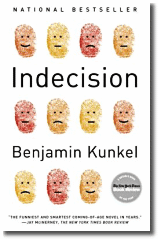
Benjamin Kunkel, the author of Indecision, a novel, and an editor of n+1 magazine, writes in Salon of Argentina as a "country [that] remains wealthy in comparison to its neighbors and as literate as our own, and its food, land and extraordinarily handsome people are nothing short of spectacular. But the feeling of what might have been hangs over Argentina. Each new effort at democracy, prosperity and hope seems threatened by a reversion to frontier lawlessness, poverty and emptiness."

He adds that the "pathos of Argentina, after all, is that it might have had everything."

Among the literary guides to Argentina that Kunkel cites are outsiders Bruce Chatwin (In Patagonia, 1977) and V. S. Naipaul, author of "a half-insightful, half-prejudiced 90-page sketch of the country."

Home-grown Borges of course gets his due.

Kunkel also appreciates:
César Aira, one of the most interesting living Argentine writers, writes in An Episode in the Life of a Landscape Painter (2000) of "expanses resonant with emptiness," and treats the theme in a new way. Aira recognizes at whose expense--the Indians'--the emptiness was created. As a parable of mere description in the service of colonization, this frightening novella is one that Edward Said might have admired.
And then there are the famous books:

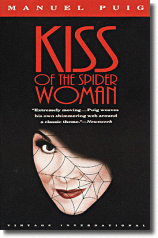
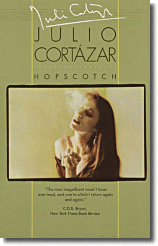
The best-known Argentine novels are Hopscotch by Julio Cortázar (who died in exile in Paris), and Kiss of the Spider Woman by Manuel Puig (who died in exile in New York). Hopscotch (1966) has not aged gracefully: With its rhapsodic conversations, allegedly jazzlike prose and bohemian cast of characters, it seems like the work of a sort of superior Kerouac. Kiss of the Spider Woman (1974) is something else. Two Argentine cellmates, the one guilty of homosexuality, the other of Marxism, talk about movies and revolution, and, between sessions of torture at the hands of the police, fall in love. In its combination of political commitment and pop-cultural dizziness, in the terrible pain that it describes and the great pleasure that it gives, this is the novel that half the writers living in Brooklyn, N.Y., today have always longed to write.

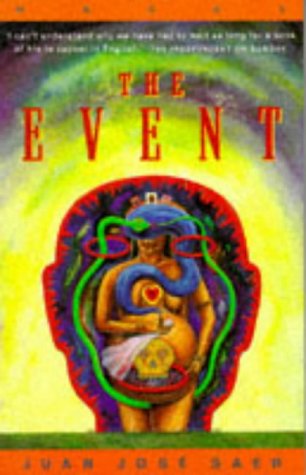
Juan José Saer (who died last year in Paris) is not as well-known as Cortázar or Puig, but he deserves to be mentioned in their company. His fine novel The Event (1988) concerns the efforts of an Italian immigrant -- a rancher and magician -- to do two things: make a fortune on the pampas, and prove the truth of his metaphysical conviction that mind can command matter, that the visible world is the least and flimsiest aspect of reality. The force of the novel is to show how this conviction is done in by obdurate Argentina, especially the implacable landscape of the pampas. In a magnificent passage, Saer describes "the precarious settlements that were forming on the flat surface of the oldest land in the world, covered by the sediment of continents and of extinct species and pulverized by time and harsh weather, that unreal and empty space that the conquistadors took special care to avoid but that, the Indians first, then later cows and horses, and shortly thereafter adventurers, soldiers and landowners, and then later still the disinherited of the whole world who had arrived in overcrowded ships, stubbornly persisted in crossing again and again, gray, hallucinated figures, leaving fleeting traces that the strong winds and the rain undertook almost immediately to efface."

I don't wholeheartedly agree with Kunkel's assessment that Hopscotch "has not aged gracefully," but I know what he means: it's an amazing book, and yet....

Related trivia: Asked, "What was the book that most influenced your life or your career as a writer?," Anthony Swofford, author of Jarhead, replied:
Hopscotch by Julio Cortázar; this book dazzled me when I first read it in college and still does, any day of the week. I will read it again and again until I die. Its inventiveness and cunning taught me that anything is possible with prose, and its intellectual and aesthetic fierceness taught me that a writer should always have lofty goals for her work. Also, it's highly entertaining and deeply sexy.
I know what he means, too.


Click here to read Kunkel's article.

Also Argentina-related here on the blog: a brief review of The Tango Singer by Tomás Eloy Martínez.

Other items in Salon's literary guide series include:
A literary guide to Afghanistan
A literary guide to Louisiana
A literary guide to Australia
A literary guide to Norway
A literary guide to Turkey
A literary guide to Japan
A literary guide to Martha's Vineyard
A literary guide to West Texas
A literary guide to Togo
A literary guide to Brooklyn
A literary guide to Miami

--Marshal Zeringue