Saturday, November 11, 2006

Pg. 69: "The Washington Story"

Adam Langer is an author, journalist, playwright and filmmaker. His books include the novels Crossing California and The Washington Story, and three nonfiction reference works, CitySmart Guide to Chicago, Film Festival Guide, and The Madness of Art.

I asked Adam to apply the "page 69 test" to The Washington Story; this is what he reported:
Funny you should ask me to do this. After all, while I was senior editor of Book Magazine, faced at times with the unenviable task of opening the mail and trying to determine which books merited review coverage, I occasionally resorted to a self-explanatory critical technique that I called “Page Sixty-Seven, Paragraph Four.” A character in my next novel, Ellington Boulevard (Spiegel & Grau, 2007) is a literary critic who uses the same technique.

Is it unfair to judge a book using this sub-Cliffs’ Notes form of review? Probably. Though, since we were woefully understaffed at Book, I suspect that our editorial staff was reading at least one more paragraph than most other book review staffs. At any rate, now that I have the responsibility of analyzing my own book using the similar, though significantly more accurate measure stick of an entire page, I can say that the “Page 69” tool is useful yet entirely misleading for my novel The Washington Story.

A reader of Page 69 would learn the following:

* An aspiring filmmaker named Mel Coleman had made his living directing low-rent industrial movies.
* He has cast a woman named Michelle in his latest industrial flick.
* He will most probably have some sort of relationship (possibly romantic) with Michelle with whom he has a history dating back to her sister’s Bat Mitzvah.
* He has a foul mouth.
* And an attitude.
* And lousy fashion sense.

That’s not a bad summary for the interaction of the two major characters in my novel. Mel and Michelle’s romantic desires and their artistic ambitions form one of the major conflicts here. And, there’s a fair amount of dense character detail and Chicago-specific trivia on Page 69, which is representative of the book as a whole.

The only problem is that I structured my novel as five separate-but-interlinked novellas, loosely based on the Five Books Of Moses. The above analysis works fairly well for Book II, but comes up short when providing information about Book I and Books III-V, each of which has different characters, tones, moods, rhythms, and so forth.

Perhaps a new sort of test is needed: Allow me to recommend the “Page 34./Page 69 /Page 213/Page 341/Page 409 Test.” Although, just for the record, I tried the Page 69 test on the most-recent draft of Ellington Boulevard; it works a whole lot better.
Many thanks to Adam for the input.
In The Washington Story, "Langer has produced a tender and generous book... ...pleasurable a read, for its wit and its eye and its capacious heart." -- Chicago Tribune
To read more reviews of The Washington Story from the Los Angeles Times, Kansas City Star, Miami Herald, and other major newspapers, click here.

For more reviews, interviews, articles and multimedia by and about Adam, click here. For information about and excerpts from Adam's many plays, click here.
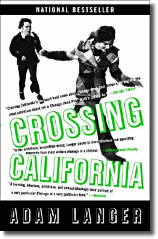
Adam sees The Washington Story "not as one sequel to his debut novel Crossing California, but as five separate-yet-interlinked sequels."

Crossing California was picked by Amazon.com as one of the top fifty books of 2004, #2 in Fiction (Philip Roth was #1). It was selected by Newsday, the Chicago Tribune, the St. Louis Post-Dispatch, the Pittsburgh Post-Gazette and Publishers Weekly as a Best Book of 2004.

Click here for the Publishers Weekly interview with Adam about Crossing California.

Watch for Adam's third novel, Ellington Boulevard, in 2007.

Previous "page 69 tests":
Michael Scott Moore, Too Much of Nothing
Frank Schaeffer, Baby Jack
Wyn Cooper, Postcards from the Interior
Ivan Goncharov, Oblomov
Maureen Ogle, Ambitious Brew
Cass Sunstein, Infotopia
Paul W. Kahn, Out of Eden
Paul Lewis, Cracking Up
Pagan Kennedy, Confessions of a Memory Eater
David Greenberg, Nixon's Shadow
Duane Swierczynski, The Wheelman
George Levine, Darwin Loves You
John Barlow, Intoxicated
Alicia Steimberg, The Rainforest
Alan Wolfe, Does American Democracy Still Work?
John Dickerson, On Her Trail
Marcus Sakey, The Blade Itself
Randy Boyagoda, Governor of the Northern Province
John Gittings, The Changing Face of China
Rachel Kadish, Tolstoy Lied
Eric Rauchway, Blessed Among Nations
Tim Brookes, Guitar and other books
Ruth Padel, Tigers in Red Weather
William Haywood Henderson, Augusta Locke
Jed Horne, Breach of Faith
Robert Greer, The Fourth Perspective
David Plotz, The Genius Factory
Michael Allen Dymmoch, White Tiger
Patrick Thaddeus Jackson, Civilizing the Enemy
Tom Lutz, Doing Nothing
Libby Fischer Hellmann, A Shot To Die For
Nelson Algren, The Man With the Golden Arm
Bob Harris, Prisoner of Trebekistan
Elaine Flinn, Deadly Collection
Louise Welsh, The Bullet Trick
Gregg Hurwitz, Last Shot
Martha Powers, Death Angel
N.M. Kelby, Whale Season
Mario Acevedo, The Nymphos of Rocky Flats
Dominic Smith, The Mercury Visions of Louis Daguerre
Simon Blackburn, Lust
Linda L. Richards, Calculated Loss
Kevin Guilfoile, Cast of Shadows
Ronlyn Domingue, The Mercy of Thin Air
Shari Caudron, Who Are You People?
Marisha Pessl, Special Topics in Calamity Physics
John Sutherland, How to Read a Novel
Steven Miles, Oath Betrayed
Alan Brown, Audrey Hepburn's Neck
Richard Dawkins, The Ancestor's Tale

--Marshal Zeringue

War poems

November 11 is Veterans Day in the U.S., Armistice Day elsewhere.

Rachel Campbell-Johnston, poetry critic for the London Times, named her six favorite war poems for the occasion.

Among her choices:
"On Being Asked for a War Poem" by W. B. Yeats

The master’s reply is a silence that sings louder than words.

"In Time of 'The Breaking of Nations'" by Thomas Hardy

Gazes through the gunsmoke at what will survive.

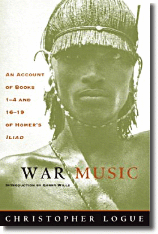
War Music by Christopher Logue

Stunning adaptation of Homer spanning Jacobean glee in bloodshed to pithy contemporary politics.
Click here for Campbell-Johnston's other picks.

I don't know much about the other works but I'm a great admirer of Logue's War Music.

Here's the publisher's description:
In his brilliant rendering of eight books of Homer's Iliad, Logue here retells some of the most evocative episodes of the war classic, including the death of Patroclus and Achilles's fateful return to battle, that sealed the doom of Troy. Compulsively readable, Logue's poetry flies off the page, and his compelling descriptions of the horrors of war have a surreal, dreamlike quality that has been compared to the films of Kurosawa. Retaining the great poem's story line but rewriting every incident, Logue brings the Trojan War to life for modern audiences.
Compulsively readable, indeed.

--Marshal Zeringue

Friday, November 10, 2006

Pg. 69: "Too Much of Nothing"

Michael Scott Moore is a novelist and reporter living in Berlin. The title of his debut novel Too Much of Nothing comes from an old Dylan song:

Everybody’s doin’ somethin’
I heard it in a dream
But when there’s too much of nothing
It just makes a fella mean

I asked Mike to apply the "page 69 test" to his novel. Here is what he reported:
Page 69 of Too Much of Nothing is very simple. It says, “Part Three.”

I figure this gives me freedom to write about Part Three as a whole, though, and Part Three is the section where my two teenage heroes meet Rick Fisher, the dark prince who leads Tom and Eric from naĆ®ve and sheltered beach-town lives into L.A.’s counterculture, a demimonde they imagine as “adult.” Rick’s a sort of Mickey Dora figure updated for the 1980s, although when I wrote the novel I had no idea how much Mickey Dora’s influence on early surfers was like Rick Fisher’s influence on my hapless kids:

“He showed us music that made more sense than anything we heard on the radio,” Eric narrates in Part Three; “he introduced us to a grown-up version of our own discontent. To us, a man like Rick Fisher, who exuded grim integrity like a modern-day Shane, seemed streetwise enough to reveal whatever our neighborhood was revealing from us about Real Life … Here was a man who’d been raised in our suburb without developing the prejudices of our parents, and his stripped-down attitude gave him an irresistible glamor, the cruel romantic sheen of a man who could see through all the social-climbing bullshit of his hokey hometown.”

The parallels between the fictional surf scene in Too Much of Nothing and Malibu’s real early surf scene only occurred to me later, starting with a moment after my step-dad read the novel and said, “You know, forty years separate us, but a lot of what happened in your book went on when I was a kid.”
Many thanks to Mike for the input.

To learn more about Mickey Dora, "the first king of Malibu, James Dean on a surfboard," click here.

To read an excerpt from Too Much of Nothing, click here.

Among the praise for the novel:

“A beautiful novel that manages to be scary, funny, and absolutely compelling. Moore’s talent for transporting the reader into the very heart of his fictional California surf town is astonishing. I love this book.”

--Joy Nicholson, author of The Tribes of Palos Verdes

“Too Much of Nothing is a clever and merciless look back at teenaged friendship, and at two boys’ jaded coming of age in mid-’80s L.A. Michael Scott Moore’s dead hero recalls all of the romantic terrors and joys of high school with a wry, cold eye. A truly accomplished and absorbing debut.”

--Stewart O’Nan, author of A Prayer for the Dying and The Night Country

There are more endorsements at the bottom of this page.

Click here to look in on Mike's blog, and here for the official Michael Scott Moore homepage.

A year ago he bid auf Wiedersehen to German Foreign Minister Joschka Fischer in this Slate column. Click here for more of Mike's nonfiction.

Previous "page 69 tests":
Frank Schaeffer, Baby Jack
Wyn Cooper, Postcards from the Interior
Ivan Goncharov, Oblomov
Maureen Ogle, Ambitious Brew
Cass Sunstein, Infotopia
Paul W. Kahn, Out of Eden
Paul Lewis, Cracking Up
Pagan Kennedy, Confessions of a Memory Eater
David Greenberg, Nixon's Shadow
Duane Swierczynski, The Wheelman
George Levine, Darwin Loves You
John Barlow, Intoxicated
Alicia Steimberg, The Rainforest
Alan Wolfe, Does American Democracy Still Work?
John Dickerson, On Her Trail
Marcus Sakey, The Blade Itself
Randy Boyagoda, Governor of the Northern Province
John Gittings, The Changing Face of China
Rachel Kadish, Tolstoy Lied
Eric Rauchway, Blessed Among Nations
Tim Brookes, Guitar and other books
Ruth Padel, Tigers in Red Weather
William Haywood Henderson, Augusta Locke
Jed Horne, Breach of Faith
Robert Greer, The Fourth Perspective
David Plotz, The Genius Factory
Michael Allen Dymmoch, White Tiger
Patrick Thaddeus Jackson, Civilizing the Enemy
Tom Lutz, Doing Nothing
Libby Fischer Hellmann, A Shot To Die For
Nelson Algren, The Man With the Golden Arm
Bob Harris, Prisoner of Trebekistan
Elaine Flinn, Deadly Collection
Louise Welsh, The Bullet Trick
Gregg Hurwitz, Last Shot
Martha Powers, Death Angel
N.M. Kelby, Whale Season
Mario Acevedo, The Nymphos of Rocky Flats
Dominic Smith, The Mercury Visions of Louis Daguerre
Simon Blackburn, Lust
Linda L. Richards, Calculated Loss
Kevin Guilfoile, Cast of Shadows
Ronlyn Domingue, The Mercy of Thin Air
Shari Caudron, Who Are You People?
Marisha Pessl, Special Topics in Calamity Physics
John Sutherland, How to Read a Novel
Steven Miles, Oath Betrayed
Alan Brown, Audrey Hepburn's Neck
Richard Dawkins, The Ancestor's Tale

--Marshal Zeringue

Thirty minutes with Thucydides

I've got a new post up over at Spot-On. It opens:

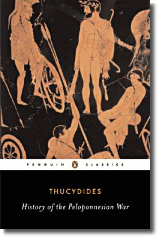
Thucydides is one of those writers much invoked but seldom read. Which is a shame, because within his History of the Peloponnesian War are some great stories about ancient Greece and several very important insights about human behavior that remain instructive today. That is not to say that the History has the winning answer to the war in Iraq or a compelling argument about how to prevent terrorist attacks. But it does offer an illustration of how the logic of war entails a dynamic relationship where one party's actions, motivated by what Thucydides (and Hobbes) calls a "necessity of nature," can and usually does drive its opponents to reciprocate and often escalate the violence.

I cannot imagine that Thucydides would be surprised by the course of the war in Iraq or by the April 2006 National Intelligence Estimate's finding that that war is creating more jihadists. And though he might not counsel Washington to continue on its present course, he certainly would not be shocked if it did so. His view is tragic, after all.

The History is a source of wisdom, not an instruction manual. It shows what happens within a society that ignores the logic of war. Not that the non-scholar should read the entire History; I did so in graduate school and can confidently state that vast sections may be avoided. Yet the Melian Dialogue and the Mytilenian Debate are among the episodes well worth the trouble: you can read them both in less time than it takes to watch a single re-run of Fear Factor.

Click here to read the rest.

--Marshal Zeringue

The writers in "Echo Park"

I usually like to see literary references pop up in stories: they remind me of good stories I've read (or, more likely, I'd like to read), and they show that the author regards himself as part of the continuous history of storytelling.

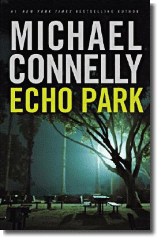
I caught a few cool nods to other writers in Michael Connelly's new Harry Bosch novel, Echo Park; I'll bet I missed some, too.

Literary echo #1: On page 10 a famous poet is invoked to establish that while Harry Bosch isn't terribly literary, he can be a savvy interrogator. He and his partner are interviewing the landlord (Mr. "Kay") of a property where a murder clue has turned up.
"She went missing ten days ago," Bosch said. "That would have been Tuesday the ninth. You remember anything from back then? Anything unusual around here?"

Kay shook his head.

"I wasn't here. I was on vacation in Italy."

Bosch smiled.

"I love Italy. Where'd you go?"

Kay's face brightened.

"I went up to Lake Como and then over to a small hill town called Asolo. It's where Robert Browning lived."

Bosch nodded like he knew the places and knew who Robert Browning was.
As far as I can tell, there is no link to Browning in the story. Browning did refer to William Johnson Fox as his "literary father" and there is a character in Echo Park whose name and aliases play on a fox motif, but those feel like a coincidences.

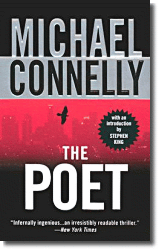
Connelly of course has written a book called The Poet. I don't recall if there are any Robert Browning overtones to it.

Literary echo #2: On page 51 Bosch is reading files in his case and reflects on the slogan printed on his coffee mug.
His mug had come from a famous writer and television producer named Stephen Cannell who had spent time with the OU Unit while researching a project. Printed on the side of the mug was Cannell's favorite piece of writing advice. It said What's the bad guy up to? Bosch liked it because he thought it was a good question for a real detective to always be considering as well.
Cannell is a prolific writer and producer in real life; you may not have read his books but I'll bet you know some of his shows.

What's the Connelly-Cannell connection? The answer popped up when Book Help Web interviewed Connelly about Echo Park:
Book Help Web: In Echo Park, your detective Harry Bosch and his partner Kiz Rider both have coffee cups with the motto "What's the bad guy up to?" given to them by a visiting writer. Is this advice that you follow when writing? Do you keep a hidden timeline or background of what the bad guy is doing throughout the story?

Michael Connelly: It was advice from Stephen Cannell, who writes good books and TV shows. I heard that he had such a motto hanging in his office. So I asked if I could adopt it for this story. It['s] one of those connections between the art of writing and the art of detective work. I keep in mind the lives of characters off the page. This would include the bad guy. But I don't keep any sort of timeline or outline written down. I keep it all in my head. I should say I try to.
Literary echo #3: Page 168 finds Bosch and his colleagues at a secluded wooded site where the confessed killer they have in custody has led them to a body he says he buried.
"We're here, Detective. You've finally found Marie."

"Where?"

Wait's smile broadened.

"You're standing on her."

Bosch abruptly stepped back a pace and Waits laughed.

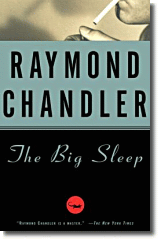
"Don't worry, Detective Bosch, I don't think she minds. What was it the great man wrote about sleeping the big sleep? About not caring about the nastiness of how you died or where you fell?"

Bosch looked at him for a long moment, wondering about the literary airs of the window washer. Waits seemed to read him.

"I've been in jail since May, Detective. I've done a lot of reading."
Bosch doesn't know who Waits has been reading but we do: Raymond Chandler. Chandler wrote:
"What did it matter where you lay once you were dead? In a dirty sump or in a marble tower on top of a high hill. You were dead, you were sleeping the big sleep, you were not bothered by things like that. Oil and water were the same as wind and air to you. You just slept the big sleep, not caring about the nastiness of how you died or where you fell. Me, I was part of the nastiness now."
It's no surprise that Connelly would invoke Chandler. From an interview in 2005 with Connelly:
What was the book that most influenced your life or your career as a writer -- and why?

The Long Goodbye by Raymond Chandler. I read it in college and immediately subscribed to the idea of the crime novel as art. The book's evocation of Los Angeles and the social commentary on the city inspired me to become a writer.
Literary echo #4: On page 211 Bosch is on the phone with a reporter with whom he has traded information in past. He wants the unlisted telephone number of a politician who has slimed Bosch in the papers. The reporter doesn't want to give up the number and risk getting caught.
Bosch quickly grabbed the Daily News, which was folded to the page with the political fallout story. He read the byline.

"Okay, well maybe Sarah Weinman or Duane Swierczynski will feel comfortable giving it to me. They might want to have an IOU from somebody who's in the middle of this thing."
It works: Harry gets the number.

Sarah Weinman and Duane Swierczynski don't cover crime in L.A. for the Daily News, but they're real persons who are up to their ears in crime elsewhere.

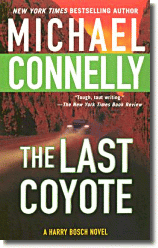
In fact, I learned from Swierczynski's blog that Connelly's sentimental favorite novel is The Last Coyote, which reminded me of a passing comment Bosch makes when someone cautions him about visiting the aforementioned wooded crime scene alone. You could twist an ankle and be stuck out there all night with the coyotes, he's told. That's OK, Harry says, I've got my phone...and I like the coyotes.

--Marshal Zeringue

Thursday, November 09, 2006

What is Christian Bale reading?

The actor Christian Bale recently talked to the Christian Science Monitor about what he was listening to and viewing for entertainment. And reading:
I just started reading The Outsider by Colin Wilson. It was written, I believe, in the 1950s when he was in his early 20s, and he was kind of lauded as being the next great voice of his generation. It's the viewpoint of the outsider in society, and his ideas on that. I read a review of it last year while in an airport, ripped it out, made a note of it, and just found it recently.
Click here to read about what Bale is watching and listening to.

Christian Bale's latest movie is "Harsh Times," in which he plays a Gulf War veteran on the loose in the underbelly of Los Angeles, opens this week.

Here's the teaser paragraph to a 2004 Guardian article about Colin Wilson:
In 1956 The Outsider made him an overnight sensation, but ever since Colin Wilson has been an outsider himself - a knicker fetishist, a social misfit and the author of 110 books that even his publisher didn't want. He hopes his new autobiography will finally convince the world of his greatness.
--Marshal Zeringue

Pg. 69: "Baby Jack"

Frank Schaeffer is the author of the acclaimed and commercially successful novels, Portofino, Zermatt, and Saving Grandma.

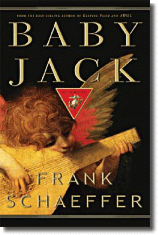
His new novel is Baby Jack.

I asked Frank to apply the "page 69 test" to Baby Jack. Here is what he reported:
Page 69 of Baby Jack is the turning point of my novel. Weird coincidence! Baby Jack is about a family torn apart by a son’s decision to enlist in the Marines. They are rich, snobs, and typical of the class that never serves these days. Their son defies them.

Here is page 96 of Baby Jack, my fourth novel:

Charleston Airport 0200: not supposed to be keeping journal—hide pages between pictures in little family album they let you bring—waiting for bus—writing on scraps—

Half recruits haven’t slept or were drinking last night—ragged—ass! OK—but nervous—


Speech by Marine in waiting area: “You are now an official United States Marine Corps recruit—as such you are punishable under the Uniform Code of Military Justice—UCMJ—set of rules and regulations that all military personnel must abide by—you will be punished—do you understand recruits?”


“Yes, sir!”


“From now on when you speak to a Marine, civilian or sailor the last word out of your mouth will be sir—like this: yes sir, no sir, yes ma’am, no ma’am. Do you understand, recruits?”


“Yes, sir!”


“You will be at the position of attention—position of attention is—your heels are together, feet at a
45° angle, legs are straight—not stiff at the knees, fingers curled, thumb along trousers seems, head and eyes straight to the front, and your mouth is shut!”

Baby Jack is told in the voices of five people, the mother, father, son, sister and girlfriend. In them we “hear” the voices of modern America, a parable as it were about what we owe or what we deserve.

Page 69 is the first notations (made in a rush) by Jack Ogden in his illicit journal he is scribbling on any old thing as he goes to Parris Island boot camp. It is a good and bad representation of the rest of the book—“good” because it is the onset of the change Jack will undergo as he moves from selfish privilege to life as a Marine, “bad” because the voices of the rest of the family are missing so the reader won’t get the scope of the book from this page.

When you write a novel in five voices, and the reader dips in on one scene in one voice, it’s hard to get a feel for the texture. But rest assured that every voice here is given space, even the voice of God, who shows up after Jack is killed and the family begins to disintegrate.

Yes, Jack is killed. And he is killed after his father has stopped speaking to him. So how is redemption found in tragedy? And does sacrifice, honor and “duty” still have a place in the world?
Many thanks to Frank for the input about the novel.

Click here to read an excerpt from Baby Jack.

The reviewer for USA Today wrote:

The author lets each character speak in alternating chapters. (In heaven, Jack befriends a down-to-earth God who is a "wannabe theatre director.") The reader marvels at how Schaeffer makes this concise chorus of social conviction moving and memorable by emphasizing emotion over description.

By no means is Baby Jack another War and Peace. Think War and People instead.

From Ward Carroll's review:
Frank Schaeffer has done what only the likes of Stephen Crane have managed before him, capturing atmospheres in ways his pedigree would suggest impossible. Baby Jack's pathos is matched only by its originality, sincerity, and attention to the details of human emotion. This work reveals a writer who understands service, sacrifice, family, war, love, hate -- life -- in ways that transcend the here and now. He even brings God into the mix. (I won't wreck it; let's just say Schaeffer pulls it off with aplomb.)

Baby Jack is a triumph and a modern masterpiece. Read it and be moved.
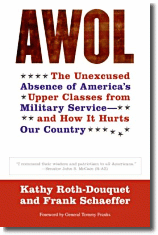
Frank has also written four non-fiction books including Keeping Faith: A Father-Son Story About Love and the United States Marine Corps (co-authored with his Marine son John). Frank’s second book on the subject of his son’s service in the military was Faith Of Our Sons: A Father’s Wartime Diary (2004). Frank’s book Voices from the Front: Letters Home From America’s Military Family was followed by AWOL: The Unexcused Absence of America’s Upper Classes From Military Service – And How It Hurts Our Country (co-authored with Kathy Roth-Douquet, foreword by Gen. Tommy Franks.)

A week before election day, Frank published an Op-Ed essay in the Dallas Morning News. It opened: "I'm a Christian, a writer, a military parent and a registered Republican." Click here to read what followed.

For other Op-Eds by Frank, click here.

Click here to visit Frank Schaeffer's official webpage.

Previous "page 69 tests":
Wyn Cooper, Postcards from the Interior
Ivan Goncharov, Oblomov
Maureen Ogle, Ambitious Brew
Cass Sunstein, Infotopia
Paul W. Kahn, Out of Eden
Paul Lewis, Cracking Up
Pagan Kennedy, Confessions of a Memory Eater
David Greenberg, Nixon's Shadow
Duane Swierczynski, The Wheelman
George Levine, Darwin Loves You
John Barlow, Intoxicated
Alicia Steimberg, The Rainforest
Alan Wolfe, Does American Democracy Still Work?
John Dickerson, On Her Trail
Marcus Sakey, The Blade Itself
Randy Boyagoda, Governor of the Northern Province
John Gittings, The Changing Face of China
Rachel Kadish, Tolstoy Lied
Eric Rauchway, Blessed Among Nations
Tim Brookes, Guitar and other books
Ruth Padel, Tigers in Red Weather
William Haywood Henderson, Augusta Locke
Jed Horne, Breach of Faith
Robert Greer, The Fourth Perspective
David Plotz, The Genius Factory
Michael Allen Dymmoch, White Tiger
Patrick Thaddeus Jackson, Civilizing the Enemy
Tom Lutz, Doing Nothing
Libby Fischer Hellmann, A Shot To Die For
Nelson Algren, The Man With the Golden Arm
Bob Harris, Prisoner of Trebekistan
Elaine Flinn, Deadly Collection
Louise Welsh, The Bullet Trick
Gregg Hurwitz, Last Shot
Martha Powers, Death Angel
N.M. Kelby, Whale Season
Mario Acevedo, The Nymphos of Rocky Flats
Dominic Smith, The Mercury Visions of Louis Daguerre
Simon Blackburn, Lust
Linda L. Richards, Calculated Loss
Kevin Guilfoile, Cast of Shadows
Ronlyn Domingue, The Mercy of Thin Air
Shari Caudron, Who Are You People?
Marisha Pessl, Special Topics in Calamity Physics
John Sutherland, How to Read a Novel
Steven Miles, Oath Betrayed
Alan Brown, Audrey Hepburn's Neck
Richard Dawkins, The Ancestor's Tale

--Marshal Zeringue
Wednesday, November 08, 2006

CƩlestine Vaite's book picks

CƩlestine Vaite, the author of a trilogy about cleaning woman Materena Mahi ("the best listener in Tahiti") came up with an interesting list of books for The Week magazine.
Once Were Warriors by Alan Duff

This book was so meant to burst into my life. It enriched my Tahitian thinking right from the first page. Its long-suffering protagonist, Beth, fascinated me. I could see her in flesh and bones. Sometimes she was one of my cousins, other times, she was my mother.

Une Vie
(A Woman’s Life) by Guy de Maupassant

I was 11 when Sister Bernadette recommended I read this book. I instantly felt compassion for the heroine, Jeanne. What a sad life! I read the book again at 16 and discovered a new Jeanne. What a strong woman! I’ve been reading Une Vie every five years now and each time, Jeanne speaks to my heart differently.

In My Skin by Kate Holden

This memoir from an “ordinary” Australian woman, raised in an “ordinary” middle-class family, who became a heroin addict, prostitute, and survivor, is a haunting tale without self-pity. The writing is honest, direct, flawless, and deep.
Click here to read about the other books on Vaite's list.

The first two of Vaite's "Materena" novels, Frangipani and Breadfruit, have recently been published by Back Bay.

--Marshal Zeringue

Pg. 69: "Postcards from the Interior"

Wyn Cooper has published three books of poems: The Country of Here Below (Ahsahta Press, 1987), The Way Back (White Pine Press, 2000), and Postcards from the Interior, (BOA Editions, 2005), as well as a chapbook, Secret Address (Chapiteau Press, 2002).

In 1993, “Fun,” a poem from his first book, was turned into Sheryl Crow’s Grammy-winning song “All I Wanna Do.”

I asked Wyn to apply the "page 69 test" to Postcards from the Interior. Here is what he reported:
Page 69 of my newest collection of poems, Postcards from the Interior, is the Acknowledgments page. Not the page where I thank people, but the page where I list all the places the poems have appeared before. In early 2000, I was asked by the then-editor of West Branch magazine to write a "postcard" poem from the town I live in, Halifax, Vermont. I asked what he meant by this, and was instructed to write a prose poem about someone or something quirky in Halifax. It was the easiest assignment I'd ever been given, as I collect historical tidbits in my head about this part of the state. I wrote it in under an hour and wanted to keep going. So, over the next 2 years, I wrote some 200 postcard poems, from places in Vermont, places all over the world I had (or hadn't) visited, and eventually from states of mind, and feelings, like "Postcard from Desire."

The acknowledgements page shows the success of my undertaking, at least in terms of success with editors of literary magazines. Of the 52 poems in the book, 30 were published in magazines, 4 were reprinted in other magazines, 16 were published in a chapbook, Secret Address, and 6 were set to music by the novelist Madison Smartt Bell.
Many thanks to Wyn for the input.

In 2003, Gaff Music released Forty Words for Fear, a CD of songs based on poems and lyrics by Cooper, set to music and sung by the novelist Madison Smartt Bell. It has been featured on NPR’s Weekend Edition and World CafĆ©, and has been written about in Esquire, the New York Times Magazine, the New York Observer, and elsewhere. Songs from the CD have been featured on four TV shows.

Click here to learn more about Forty Words for Fear.

Click here for a cool comment by Madison Smartt Bell about his collaboration with Wyn.

In 1994 the New York Times asked him a few questions about "Fun" and the Sheryl Crow song, including:

Q: Are you getting rich?

A: I've already made more than twice my teaching salary. The most I ever got paid for a poem before this was $100.

Q: Do you have any other claims to fame?

A: I made Madonna's first movie. We went to the same high school, and we made this film in which we pretended to fry an egg on her stomach and another girl ate the egg.

Several of Wyn's poems are available online, including:
"Postcard from the Party"
"On Eight Mile"
"Desert, With Train"
"Postcard from Seasburg"
"Fun"
"Postcard from Success"
"Monkey, Mirror, Troll, Brush"

Enough freebies: go buy a book and support a poet.

Click here to learn a bit more about Cooper's career, including how "Fun" came to the attention of Sheryl Crow.

Wyn also helps promote books by helping run the Brattleboro Literary Festival in Vermont. They bring 30 writers in from around the country to give free readings and talks on Columbus Day weekend: 2006 was their fifth year, and over 3,000 people attended.

Click here to visit Wyn Cooper's official website and here for his publisher's.

Previous "page 69 tests":
Ivan Goncharov, Oblomov
Maureen Ogle, Ambitious Brew
Cass Sunstein, Infotopia
Paul W. Kahn, Out of Eden
Paul Lewis, Cracking Up
Pagan Kennedy, Confessions of a Memory Eater
David Greenberg, Nixon's Shadow
Duane Swierczynski, The Wheelman
George Levine, Darwin Loves You
John Barlow, Intoxicated
Alicia Steimberg, The Rainforest
Alan Wolfe, Does American Democracy Still Work?
John Dickerson, On Her Trail
Marcus Sakey, The Blade Itself
Randy Boyagoda, Governor of the Northern Province
John Gittings, The Changing Face of China
Rachel Kadish, Tolstoy Lied
Eric Rauchway, Blessed Among Nations
Tim Brookes, Guitar and other books
Ruth Padel, Tigers in Red Weather
William Haywood Henderson, Augusta Locke
Jed Horne, Breach of Faith
Robert Greer, The Fourth Perspective
David Plotz, The Genius Factory
Michael Allen Dymmoch, White Tiger
Patrick Thaddeus Jackson, Civilizing the Enemy
Tom Lutz, Doing Nothing
Libby Fischer Hellmann, A Shot To Die For
Nelson Algren, The Man With the Golden Arm
Bob Harris, Prisoner of Trebekistan
Elaine Flinn, Deadly Collection
Louise Welsh, The Bullet Trick
Gregg Hurwitz, Last Shot
Martha Powers, Death Angel
N.M. Kelby, Whale Season
Mario Acevedo, The Nymphos of Rocky Flats
Dominic Smith, The Mercury Visions of Louis Daguerre
Simon Blackburn, Lust
Linda L. Richards, Calculated Loss
Kevin Guilfoile, Cast of Shadows
Ronlyn Domingue, The Mercy of Thin Air
Shari Caudron, Who Are You People?
Marisha Pessl, Special Topics in Calamity Physics
John Sutherland, How to Read a Novel
Steven Miles, Oath Betrayed
Alan Brown, Audrey Hepburn's Neck
Richard Dawkins, The Ancestor's Tale

--Marshal Zeringue

Top 10 adult books for teenagers

Meg Rosoff, the author of How I Live Now, the tale of a 15-year-old American girl sent to live with her cousins in a future England just as a third world war is breaking out, compiled a top 10 list of adult books for teenagers for the Guardian.

Here are a few titles from the list:

All the Pretty Horses by Cormac McCarthy

It's the last gasp of the American Western, pre-second world war, and a 16-year-old year old orphan sets off on horseback to Mexico to find work. This book wasn't published until 1992, but if it had been around when I was a teenager, I'd have lost my mind with happiness. Lots of horses, violence, a disappearing way of life, and wonderful, brutal, poetic use of language.

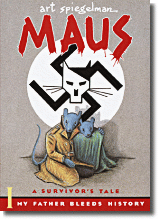
Maus by Art Spiegelman

If you've never read a graphic novel, this is the place to start. Spiegelman's attempts to talk with his irrascible elderly father about his experiences in Auschwitz form the basis of this vivid, chilling, personal account of life in a second world war concentration camp. The depiction of Germans as cats and Jews as mice somehow does the opposite of trivializing the subject.

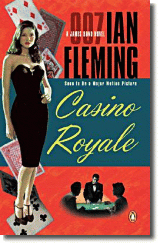
Casino Royale and Live and Let Die by Ian Fleming

These two original James Bond books, written in 1953 and 1954, leave the movies and all the pretender follow-up books in the dust. Gritty, sexy, beautifully written and filled with amazing adventures, they date from the heady days of the international cold war, when spies were hard and gadgets were thrilling. The good news is that if you love them as much as I did, there are about a dozen more to follow that are equally good.

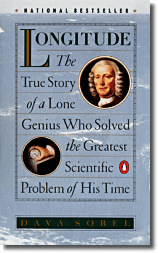
Longitude by Dava Sobel

I love books that race along with a great story and impart a big chunk of history while you're not noticing. This book makes the 18th century feel as immediate as last month, and presents science as the creative problem-solving field it really is (not that dull stuff they make you memorise in school).

Click here to see the remaining titles on Rosoff's list.

Rosoff's latest novel, Just In Case, is about a teenage boy who suddenly realizes the fragility of life.

--Marshal Zeringue

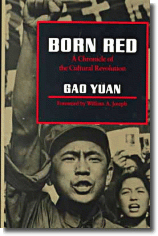
"Born Red: A Chronicle of the Cultural Revolution"

Fan that I am of Golden Arches East, I contacted its editor, Professor James L. Watson of Harvard University, and asked him if there was a book he would recommend to non-academic audiences to introduce them to his general field of study. Here's his reply.
I would recommend the following for people (of all ages) who want to know something of the Maoist background to contemporary China (it is a great read and my students have a hard time putting it down once they start it):

Yuan Gao's Born Red: A Chronicle of the Cultural Revolution.

I have used this book for years and although it was published years ago, it is still in print and still sells well for Stanford University Press.
Click here to read more endorsements for Born Red.

--Marshal Zeringue

Tuesday, November 07, 2006

Pg. 69: "Oblomov"

". . . [Goncharov] is ten heads above me in talent."—Anton Chekov

"Oblomov is a truly great work, the likes of which one has not seen for a long, long time. ... I am in rapture over Oblomov and keep rereading it."—Leo Tolstoy

How many novels can boast praise like that?

Ivan Goncharov's Oblomov, first published in 1859, has just been reissued in a new translation by Stephen Pearl with an Introduction by Galya Diment and Foreword by Tatyana Tolstaya.

I shamelessly asked Galya Diment to put aside her own work--she is professor and chair of the department of Slavic Languages and Literatures at the University of Washington--and apply the "page 69 test" to Oblomov. She generously agreed to help; here is her reply:

Page 69 of Oblomov foresees most of the major developments in the novel while capturing a rather typical day in the life of Ilya Ilyich Oblomov. The protagonist, reclining on his couch, as always, is visited by his doctor who is urging him to dramatically change his sedentary lifestyle, to stop “brooding” because it leads to a “mental stress,” and to engage in “light conversation, especially with ladies.” This is of course the same instructions that he will later get from his closest friend Stoltz, whose advice, unlike that of the doctor, he will accept, albeit still reluctantly. He thus will – at least for a while – attempt to leave his couch more often and to brood less by having more productive thoughts about important issues, like bettering the conditions of his serfs. He also will, of course, engage in conversations, light and otherwise, with a new “lady” in his life: Olga.

The doctor’s suggestions that Oblomov should go abroad will not be heeded even when they are supported by Stoltz, and in that, too, this page is very symbolic of the novel as a whole. It is Stoltz, Oblomov’s half-German, half-Russian childhood friend, who is comfortable shuttling between the two worlds, Europe and Russia. Oblomov, as a “pure” and “true” Russian, is not. His “pure” and “true” Russian apathy makes him content to limit the space his body inhabits to an “Asiatic” robe and a couch in his Petersburg apartment.

This page also reveals another essential, and to some, unexpected, aspect of Oblomov: he is a not a caricature but, in fact, a very likable character who is smart and has a well-defined sense of irony. While the doctor spouts good practical advice with which we, as readers, may find it easy to agree, at least in the most general terms, Oblomov’s cutting remarks stop us in our tracks for they underscore the shallowness of the doctor’s character. When the physician recommends Paris, with its “theatres, balls, fancy-dress parties… noise, laughter,” Oblomov interrupts him with a sarcastic question: “You are not leaving anything out by any chance?” But Oblomov’s sarcasm is lost on the not-so-bright doctor who responds in all seriousness: “Well, a little sea air wouldn’t hurt…”

All in all not a bad page at all for giving the reader a taste for this marvelous, intelligent, and witty novel!

Many thanks to Galya for her treatment of the question.

Oblomov fans interested in learning more about the novel may consult Goncharov's "Oblomov": A Critical Companion, edited by Professor Diment.

Diment is also the author of Pniniad: Vladimir Nabokov and Marc Szeftel (University of Washington Press) and The Autobiographical Novel of Co-Consciousness: Goncharov, Woolf, and Joyce (University Press of Florida).

Last month I linked to Gary Shteyngart's recent homage to Oblomov. As I indicated in that post, while I do not rate Goncharov with the best of Tolstoy--I don't rate anyone with the best of Tolstoy--Oblomov is one of those great books that even readers who avoid so-called "classics" will likely enjoy.

Previous "page 69 tests":
Maureen Ogle, Ambitious Brew
Cass Sunstein, Infotopia
Paul W. Kahn, Out of Eden
Paul Lewis, Cracking Up
Pagan Kennedy, Confessions of a Memory Eater
David Greenberg, Nixon's Shadow
Duane Swierczynski, The Wheelman
George Levine, Darwin Loves You
John Barlow, Intoxicated
Alicia Steimberg, The Rainforest
Alan Wolfe, Does American Democracy Still Work?
John Dickerson, On Her Trail
Marcus Sakey, The Blade Itself
Randy Boyagoda, Governor of the Northern Province
John Gittings, The Changing Face of China
Rachel Kadish, Tolstoy Lied
Eric Rauchway, Blessed Among Nations
Tim Brookes, Guitar and other books
Ruth Padel, Tigers in Red Weather
William Haywood Henderson, Augusta Locke
Jed Horne, Breach of Faith
Robert Greer, The Fourth Perspective
David Plotz, The Genius Factory
Michael Allen Dymmoch, White Tiger
Patrick Thaddeus Jackson, Civilizing the Enemy
Tom Lutz, Doing Nothing
Libby Fischer Hellmann, A Shot To Die For
Nelson Algren, The Man With the Golden Arm
Bob Harris, Prisoner of Trebekistan
Elaine Flinn, Deadly Collection
Louise Welsh, The Bullet Trick
Gregg Hurwitz, Last Shot
Martha Powers, Death Angel
N.M. Kelby, Whale Season
Mario Acevedo, The Nymphos of Rocky Flats
Dominic Smith, The Mercury Visions of Louis Daguerre
Simon Blackburn, Lust
Linda L. Richards, Calculated Loss
Kevin Guilfoile, Cast of Shadows
Ronlyn Domingue, The Mercy of Thin Air
Shari Caudron, Who Are You People?
Marisha Pessl, Special Topics in Calamity Physics
John Sutherland, How to Read a Novel
Steven Miles, Oath Betrayed
Alan Brown, Audrey Hepburn's Neck
Richard Dawkins, The Ancestor's Tale

--Marshal Zeringue

"Does an artist need to suffer to create?"

I've recently posted a few items about the poet Robin Robertson (see here, here, and here).

Today the Guardian runs an interview by Natalie Hanman with Robertson.

Among her questions: "Does an artist need to suffer to create?"

Click here to read the poet's answer.

--Marshal Zeringue

Pg. 69: "Ambitious Brew"

Ambitious Brew: The Story of American Beer is Maureen Ogle's new book about the history of American beer.

One would think we would know a lot more about this beverage that is as American as baseball and apple pie--actually, more American than apple pie. (When was the last time you saw forty-five apple pie commercials during a baseball game?) Yet I only had to skim Ambitious Brew's reviews and synopsis to realize I had no clue what the real story was.

I asked Maureen to apply the "page 69 test" to her book. Here is her reply:
Ambitious Brew examines 150 years of American beer, from the German immigrants who founded the brewing industry in the mid-nineteenth century to the microbrewers who transformed it in the 1980s and 1990s.

As a historian, I'm drawn to the everyday “stuff” that we take for granted, and to the lives of men and women whose drive and ambition compel them to create something from nothing. But like my two previous books (one a history of plumbing, the other the story of Key West, Florida), this one also explores my fondest fascination: what does it mean to be an American?

In Ambitious Brew, the lives of various brewers enabled me to think about the meaning of the “American dream” -- a vague concept whose tangible reality is typically mired in political rhetoric -- and the way in which opportunity shaped not just their lives, but the beer we Americans drink.

Finally, I try to structure my narratives around the lives of real people, using the kind of detail that humanizes the long-dead-and-buried.

To my delight, page 69 exemplifies my goals. Now whether it would persuade anyone to read the rest of the book -- well, that I don't know!

From page 69:

But the brewers' success also rested on what is too often overlooked by those eager to condemn the era's industrialists: captains of industry like [the brewing giants] amassed their wealth during decades of hard work. [Frederick] Pabst . . . left the house, which stood on the same grounds as the brewery until the early 1890s, each day before breakfast to tour the brewery and check on the day's work. That round completed, he returned home for a quick meal and then hustled back to the plant, where, except for a lunchbreak, he stayed until six o'clock. “He knew the different bottling machines just as well as the men operating them,” an employee once said, “and he took a pride in making a personal inspection” daily.

Adolphus Busch never claimed to be a “practical brewer”--indeed, almost none of the century's titans possessed formal training as a brewmaster--but few men in the business knew as much as he did about making lager, and he deserves recognition as one of the great American brewmasters. He analyzed and mastered every detail of brewing . . . . Study inspired confidence. “I am the maltster [and] superintendent of the malt-house,” he once explained, “ . . . and I am the buyer of the barley and the hops and I keep a general superintendence of the brewing process, fermenting process and stirring process.” Each day, he said, “I examine the barley” and visit “the malt houses with my various foremen and give them orders how I want everything done; . . . .”
Many thanks to Maureen for the input.

Click here to read an excerpt from Ambitious Brew.

Ever wonder how a writer is inspired to write on this subject and not that one? Click here for Maureen's inspiration.

To find out what happens when a self-professed "beer nerd" meets a beer historian, click here.

There is something about a book about beer that stirs people up. Click here and here for reviews and reactions to reviews (and comments on the reactions to the reviews) that seem to have started with an interest in Ambitious Brew and then took on a life of their own.

Did you know that "American brewing peaked in 1873, when there were 4131 breweries? By 1978, the industry's low point, forty-one brewers operated eighty-nine plants. Today breweries number a healthy 1400. " For more "Did you know?" beer history trivia, click here.

Maureen's previous books are Key West: History of an Island of Dreams and All the Modern Conveniences: American Household Plumbing, 1840-1890.

Previous "page 69 tests":
Cass Sunstein, Infotopia
Paul W. Kahn, Out of Eden
Paul Lewis, Cracking Up
Pagan Kennedy, Confessions of a Memory Eater
David Greenberg, Nixon's Shadow
Duane Swierczynski, The Wheelman
George Levine, Darwin Loves You
John Barlow, Intoxicated
Alicia Steimberg, The Rainforest
Alan Wolfe, Does American Democracy Still Work?
John Dickerson, On Her Trail
Marcus Sakey, The Blade Itself
Randy Boyagoda, Governor of the Northern Province
John Gittings, The Changing Face of China
Rachel Kadish, Tolstoy Lied
Eric Rauchway, Blessed Among Nations
Tim Brookes, Guitar and other books
Ruth Padel, Tigers in Red Weather
William Haywood Henderson, Augusta Locke
Jed Horne, Breach of Faith
Robert Greer, The Fourth Perspective
David Plotz, The Genius Factory
Michael Allen Dymmoch, White Tiger
Patrick Thaddeus Jackson, Civilizing the Enemy
Tom Lutz, Doing Nothing
Libby Fischer Hellmann, A Shot To Die For
Nelson Algren, The Man With the Golden Arm
Bob Harris, Prisoner of Trebekistan
Elaine Flinn, Deadly Collection
Louise Welsh, The Bullet Trick
Gregg Hurwitz, Last Shot
Martha Powers, Death Angel
N.M. Kelby, Whale Season
Mario Acevedo, The Nymphos of Rocky Flats
Dominic Smith, The Mercury Visions of Louis Daguerre
Simon Blackburn, Lust
Linda L. Richards, Calculated Loss
Kevin Guilfoile, Cast of Shadows
Ronlyn Domingue, The Mercy of Thin Air
Shari Caudron, Who Are You People?
Marisha Pessl, Special Topics in Calamity Physics
John Sutherland, How to Read a Novel
Steven Miles, Oath Betrayed
Alan Brown, Audrey Hepburn's Neck
Richard Dawkins, The Ancestor's Tale

--Marshal Zeringue

Bizarre books

In the Telegraph's Seven magazine, Brian Lake writes about his book with Russell Ash, Fish Who Answer the Telephone and Other Bizarre Books.

‘Bizarre books’ fall into a fairly small number of categories. The most immediately funny are old titles which, because of changes in our usage of language, mean something quite different now: Drummer Dick’s Discharge, Erections on Allotments, Two Men Came Together (The story of Mr Rolls and Mr Royce), Shag the Pony (or Shag the Caribou, for that matter), Invisible Dick.

Process of linguistic change can be quite fast: Queer Shipmates was published in 1962. There is a lot of fun in matching an author’s name to the title – ‘Over the Cliff,' by Eileen Dover, is fictional, but these are all real: William Battie wrote his Treatise on Madness in 1758, Supt James Bent reminisced on Criminal Life: Forty-two Years as a Police Officer in 1891 and Wilhelmina Stitch wove Silken Threads in 1927.

The original Fish Who Answer the Telephone, 1937, from which we steal the title of our new collection of bizarre books, is a classic example of a serious book parading under an apparently bizarre title. Professor Frolov, a colleague of Pavlov, writes of animal experiments in which even a goldfish can ‘learn’ that the sound of a telephone will mean an electric shock.

There is more of the story here.

--Marshal Zeringue