Wednesday, June 22, 2016

Pg. 69: Eleanor Kuhns's "The Devil's Cold Dish"

Featured at the Page 69 Test: The Devil's Cold Dish: A Will Rees Mystery by Eleanor Kuhns.

About the book, from the publisher:
Will Rees is back home on his farm in 1796 Maine with his teenage son, his pregnant wife, their five adopted children, and endless farm work under the blistering summer sun. But for all that, Rees is happy to have returned to Dugard, Maine, the town where he was born and raised, and where he's always felt at home. Until now. When a man is found dead - murdered - after getting into a public dispute with Rees, Rees starts to realize someone is intentionally trying to pin the murder on him. Then, his farm is attacked, his wife is accused of witchcraft, and a second body is found that points to the Rees family. Rees can feel the town of Dugard turning against him, and he knows that he and his family won't be safe there unless he can find the murderer and reveal the truth...before the murderer gets to him first.
Learn more about the book and author at Eleanor Kuhns's blog and Facebook page.

Coffee with a Canine: Eleanor Kuhns & Shelby.

My Book, The Movie: Death of a Dyer.

The Page 69 Test: Death of a Dyer.

The Page 69 Test: Death in Salem.

The Page 69 Test: The Devil's Cold Dish.

--Marshal Zeringue

What is Erica Westly reading?

Featured at Writers Read: Erica Westly, author of Fastpitch: The Untold History of Softball and the Women Who Made the Game.

Her entry begins:
I like to read a mix of fiction and nonfiction. I'm currently toggling between C by Tom McCarthy and Jan Cleere's Never Don't Pay Attention: The Life of Rodeo Photographer Louise L. Serpa, two very different books, although both are history-focused. I tend to be drawn to stories set in the past, particularly the first half of the twentieth century. In C, I get to experience World War I-era Europe through the eyes of a troubled but highly intelligent fictional character. The narrative is full of surprises, and the writing is beautiful. With Never Don't Pay Attention...[read on]
About Fastpitch, from the publisher:
If you think softball is just a “women’s version” of the great American pastime of baseball—well, think again.

Fastpitch softball is one of the most widely played sports in the world, with tens of millions of active participants in various age groups. But the origins of this beloved sport and the charismatic athletes who helped it achieve prominence in the mid-twentieth century have been largely forgotten, until now.

Fastpitch brings to life the eclectic mix of characters that make up softball’s vibrant 129-year history. From its humble beginnings in 1887, when it was invented in a Chicago boat club and played with a broomstick, to the rise in the 1940s and 1950s of professional-caliber company-sponsored teams that toured the country in style, softball’s history is as diverse as it is fascinating. Though it’s thought of today as a woman’s sport, fastpitch softball’s early years featured several male stars, such as the vaudeville-esque Eddie Feigner, whose signature move was striking out batters while blindfolded.

But because softball was one of the only team sports that women were allowed to play competitively, it took on added importance for female athletes. Top fastpitch teams of the 1940s, ‘50s, and ‘60s, such as the New Orleans Jax Maids and Connecticut’s Raybestos Brakettes, gave women access to employment and travel opportunities that would have been unavailable to them otherwise. At a time when female athletes had almost no prospects, softball offered them a chance to flourish. Women put off marriage and moved across the country just for a shot at joining a strong team.

Told from the perspective of such influential players as Bertha Ragan Tickey, who set strikeout records and taught Lana Turner to pitch, and Joan Joyce, who struck out baseball legend Ted Williams and helped found a professional softball league with Billie Jean King, Fastpitch chronicles softball’s rich history and its uncertain future (as evidenced by its controversial elimination from the 2012 Olympics and the mounting efforts to have it reinstated). A celebration of this unique American sport and the role it plays in our culture today, Fastpitch is as entertaining as it is inspiring.
Visit Erica Westly's website.

Writers Read: Erica Westly.

--Marshal Zeringue

Six top books on the debate over guns rights

Adam Winkler, a professor of constitutional law at the University of California, Los Angeles, has been featured on CNN and in the New York Times, the Wall Street Journal, and The New Republic.

His many publications include the book, Gunfight: The Battle over the Right to Bear Arms in America.

One of six other books Winkler recommends you read if you want to understand the politics of guns in America, as shared at the Washington Post:
The Gunning of America: Business and the Making of American Gun Culture by Pamela Haag

Haag uses the remarkable story of the Winchester Repeating Arms Company to illustrate how American gun manufacturers remade America’s gun culture. In pursuit of sales, Winchester and other companies marketed their products as tools of empowerment. This effort, launched in the 19th century, transformed a mundane object into a potent symbol of American liberty and kick-started the modern gun rights movement.
Read about another book on the list.

The Page 99 Test: The Gunning of America: Business and the Making of American Gun Culture by Pamela Haag.

The Page 99 Test: Gunfight: The Battle over the Right to Bear Arms in America by Adam Winkler.

--Marshal Zeringue

Pg. 99: Peter J. Holliday's "American Arcadia"

Featured at the Page 99 Test: American Arcadia: California and the Classical Tradition by Peter J. Holliday.

About the book, from the publisher:
A vivid and engaging exploration of California's debt to the ancient world

Discussing the influence of the classics on America is nothing new; indeed, classical antiquity could be considered second only to Christianity as a force in modeling America's national identity. What has never been explored until now is how, from the beginning, Californians in particular chose to visually and culturally craft their new world using the rhetoric of classical antiquity.

Through a lively exploration of material culture, literature, and architecture, American Arcadia offers a tour through California's development as a Mediterranean haven from the late nineteenth century to the present. In its earliest days, California was touted as the last opportunity for alienated Yankees to establish the refined gentleman-farmer culture envisioned by Jefferson and build new cities free of the filth and corruption of those they left back East. Through architecture and landscape design Californians fashioned an Arcadian setting evocative of ancient Greece and Rome.Later, as Arcadia gave way to urban sprawl, entire city plans were drafted to conjure classical antiquity, self-styled villas dotted the hills, and utopian communities began to shape the state's social atmosphere.

Art historian Peter J. Holliday traces the classical influence primarily through the evidence of material culture, yet the book emphasizes the stories and people, famous and forgotten, behind the works, such as Florence Yoch, the renowned landscape designer and set designer for Gone with the Wind, and "Sister Aimee" Semple McPherson, the most publicized Christian evangelist of her day, whose sermons filled the Pantheon-like Angelus Temple. Telling stories from the creation of the famed aqueducts that turned the semi-arid landscape to a cornucopia of almonds, alfalfa, and oranges to the birth of the body-sculpting movement, American Arcadia offers readers a new way of seeing our past and ourselves.
Learn more about American Arcadia at the Oxford University Press website.

The Page 99 Test: American Arcadia.

--Marshal Zeringue

Tuesday, June 21, 2016

What is A. J. Hartley reading?

Featured at Writers Read: A. J. Hartley, author of Steeplejack.

His entry begins:
I’m currently reading the first book in Maggie Stiefvater’s Raven cycle, a book that was recommended to me by several friends and which instantly captivated me. It’s a contemporary paranormal YA centering on Blue Sargent whose family are all clairvoyant. Blue’s (somewhat disappointing) talent is that she amplifies the talents of her relatives while not actually being clairvoyant herself. During a seasonal festival in which those about to die manifest spectrally in the local graveyard, Blue is surprised and alarmed to find that not only can she can see and hear one of them—a boy close to her own age—she leaves certain that she is somehow to be responsible for the boy’s death.

It’s a compelling premise for an intriguing and atmospheric novel, but it’s the sentence level writing that really appeals to me. I like my fiction to contain...[read on]
About Steeplejack, from the publisher:
Thoughtfully imaginative and action-packed, Steeplejack is New York Times bestselling A. J. Hartley's YA debut set in a 19th-century South African fantasy world

Seventeen-year-old Anglet Sutonga lives repairing the chimneys, towers, and spires of the city of Bar-Selehm. Dramatically different communities live and work alongside each other. The white Feldish command the nation’s higher echelons of society. The native Mahweni are divided between city life and the savannah. And then there’s Ang, part of the Lani community who immigrated over generations ago as servants and now mostly live in poverty on Bar-Selehm’s edges.

When Ang is supposed to meet her new apprentice Berrit, she instead finds him dead. That same night, the Beacon, an invaluable historical icon, is stolen. The Beacon’s theft commands the headlines, yet no one seems to care about Berrit’s murder—except for Josiah Willinghouse, an enigmatic young politician. When he offers her a job investigating his death, she plunges headlong into new and unexpected dangers.

Meanwhile, crowds gather in protests over the city’s mounting troubles. Rumors surrounding the Beacon’s theft grow. More suspicious deaths occur. With no one to help Ang except Josiah’s haughty younger sister, a savvy newspaper girl, and a kindhearted herder, Ang must rely on her intellect and strength to resolve the mysterious link between Berrit and the missing Beacon before the city descends into chaos.
Visit A. J. Hartley's website.

The Page 69 Test: Steeplejack.

Writers Read: A. J. Hartley.

--Marshal Zeringue

Pg. 69: Matthew Carr's "The Devils of Cardona"

Featured at the Page 69 Test: The Devils of Cardona by Matthew Carr.

About the book, from the publisher:
In this gripping historical thriller set in sixteenth-century Spain, a Catholic priest is murdered by a mysterious Muslim avenger as the Inquisition continues to force Moriscos to live and worship as Christians.

In March 1584, the priest of Belamar de la Sierra, a small town in Aragon near the French border, is murdered in his own church. Most of the town’s inhabitants are Moriscos, former Muslims who converted to Catholicism. Anxious to avert a violent backlash on the eve of a royal visit, an adviser to King Philip II appoints local magistrate Bernardo de Mendoza to investigate. A soldier and humanist, Mendoza doesn’t always live up to the moral standards expected of court officials, but he has a reputation for incorruptibility.

From the beginning, Mendoza finds almost universal hatred for the priest. And it isn’t long before he’s drawn into a complex and dangerous world in which greed, fanaticism, and state policy overlap. And as the killings continue, Mendoza’s investigation is overshadowed by the real prospect of an ethnic and religious civil war.

By turns an involving historical thriller and a novel with parallels to our own time, The Devils of Cardona is an unexpected and compelling read.
Visit Matthew Carr's website.

The Page 69 Test: The Devils of Cardona.

--Marshal Zeringue

Seven of the best geeky love stories in YA literature

At the BN Teen Blog, Shaun Byron Fitzpatrick tagged seven geeky love stories that prove nerd love is the best love, including:
Cure for the Common Universe, by Christian McKay Heidicker

Jaxon is kind of a big deal when it comes to gaming. Which makes sense, considering he spends hours and hours a day playing video games, often at the expense of doing homework, spending time with his family, and making actual real-life friends. Not to mention gaming isn’t exactly conducive to finding a girlfriend. Until, that is, Jaxon randomly meets a beautiful girl who agrees to go on a date with him. Too bad he’s then promptly sent off to video game rehab in the middle of nowhere. The only way Jaxon can be released in time for his date is if he can prove he’s beaten his addiction by gaining enough rehab “points” to be released. So what’s Jaxon going to do? He’s going to game the system, of course. All’s fair in love and video games.
Read about another entry on the list.

--Marshal Zeringue

Bill Schutt & J. R. Finch's "Hell’s Gate," the movie

Featured at My Book, The Movie: Hell's Gate: A Thriller by Bill Schutt and J. R. Finch.

The entry begins:
I’ve been a huge movie buff for as long as I can remember so I guess it’s no surprise that when I wrote my first novel it would be highly cinematic. There are certainly scenes and dialogue in Hell’s Gate that were inspired by Apocalypse Now, Mimic and especially, The Thing (1951). I’ve always been impressed by the wonderful overlapping dialogue in the latter film and we both worked many long hours to get the dialogue in Hell’s Gate to sound natural. These are witty, intelligent people (good and bad) who are thrown into some extremely strange situations and where they face some ‘things’ that no character has ever faced in a novel before. As such, we had a ball imagining how they’d react. Our book also has a very dark tone and I listened to a great deal of Bernard Herrmann while writing Hell’s Gate (especially soundtracks to films like Psycho and Vertigo). Happily, both Mr. Herrmann and Alfred Hitchcock show up as characters in the Hell’s Gate sequel we’re currently finishing. It’s an honor to pay homage to these giants.

As for who would play our characters if Hell’s Gate were made into a film, well, that’s a dream question for a film lover like me. I can certainly see Ryan Reynolds playing our smart talking hero R. J. MacCready and I think Zach Galifianakis would be perfect for Mac’s long-lost, and slightly warped best friend, Bob Thorne. The part of Yanni Thorne (Bob’s indigenous Brazilian wife) is...[read on]
My Book, The Movie: Hell's Gate.

--Marshal Zeringue

Monday, June 20, 2016

Six top YA books set in pre-gentrified NYC

Sarah Skilton is the author of Bruised, a martial arts drama for young adults; and High and Dry, a hardboiled teen mystery. At the B&N Teen blog she tagged six YA books that take place when New York City was pretty gritty, including:
Tell the Wolves I’m Home, by Carol Rifka Brunt

June Elbus is 14 in 1987, the year her beloved uncle Finn, a kindhearted painter living in NYC, dies of AIDS. At the time, the little-understood illness was highly stigmatized, and Finn’s death causes a rift in June’s family; her parents blame his heretofore secret boyfriend, Toby, and June no longer connects with her changeable older sister. But June and Toby unexpectedly begin to lean on one another during their time of mutual grief, building a friendship that helps assuage each other’s loneliness.
Read about another entry on the list.

Tell the Wolves I’m Home is among James Mustich's top five books ready to be brought to the silver screen.

--Marshal Zeringue

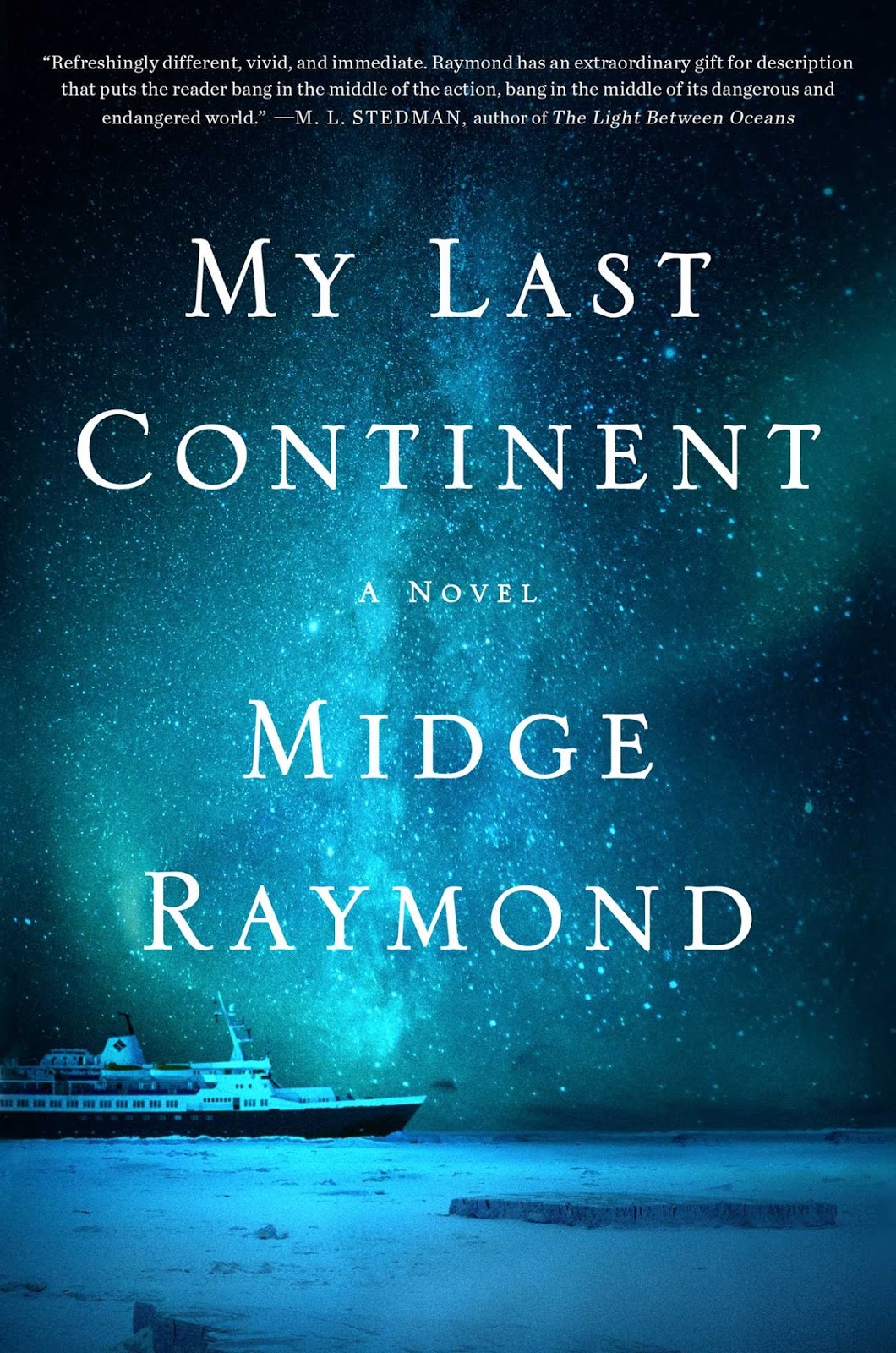
Pg. 69: Midge Raymond's "My Last Continent"

Featured at the Page 69 Test: My Last Continent: A Novel by Midge Raymond.

About the book, from the publisher:
An unforgettable debut with an irresistible love story, My Last Continent is a big-hearted, propulsive novel set against the dramatic Antarctic landscape—“original and entirely authentic love story” (Graeme Simsion, author of The Rosie Project).

It is only at the end of the world—among the glacial mountains, cleaving icebergs, and frigid waters of Antarctica—where Deb Gardner and Keller Sullivan feel at home. For the few blissful weeks they spend each year studying the habits of emperor and Adélie penguins, Deb and Keller can escape the frustrations and sorrows of their separate lives and find solace in their work and in each other. But Antarctica, like their fleeting romance, is tenuous, imperiled by the world to the north.

A new travel and research season has just begun, and Deb and Keller are ready to play tour guide to the passengers on the small expedition ship that ferries them to their research destination. But this year, Keller fails to appear on board. Then, shortly into the journey, Deb’s ship receives an emergency signal from the Australis, a cruise liner that has hit desperate trouble in the ice-choked waters of the Southern Ocean. Soon Deb’s role will change from researcher to rescuer; among the crew of that sinking ship, Deb learns, is Keller.

As Deb and Keller’s troubled histories collide with this catastrophic present, Midge Raymond’s phenomenal novel takes us on a voyage deep into the wonders of the Antarctic and the mysteries of the human heart. My Last Continent is packed with emotional intelligence and high stakes—a harrowing, searching novel of love and loss in one of the most remote places on earth, a land of harsh beauty where even the smallest missteps have tragic consequences—“Half adventure, half elegy, and wholly recommended” (Karen Joy Fowler, author of We Are All Completely Beside Ourselves).
Learn more about the author and her work at Midge Raymond's website.

The Page 69 Test: My Last Continent.

--Marshal Zeringue

What is Steven Rowley reading?

Featured at Writers Read: Steven Rowley, author of Lily and the Octopus.

His entry begins:
I'm always reading three things at once. Am I alone in that? I think not. I have a book in every room. The worst thing that can happen to me is that I sit down and there's not a book within reach. The Worst Thing. (Hyperbole.)

The Nest by Cynthia D'Aprix Sweeney. I am the oldest of four, just as Leo Plumb is the oldest of four. Hopefully I don't cause the rest of my siblings quite as much distress. Families are rich (in emotion and shared history -- I make this distinction because the titular nest is the family trust) and complicated and impossible to understand from the outside. But there is no relationship like the sibling relationship and god help anyone who tries to come between brothers and sisters. Sweeney has created four fully-realized main characters -- each who could carry their own novel. Together, however, they...[read on]
About Lily and the Octopus, from the publisher:
Combining the emotional depth of The Art of Racing in the Rain with the magical spirit of The Life of Pi, Lily and the Octopus is an epic adventure of the heart.

When you sit down with Lily and the Octopus, you will be taken on an unforgettable ride.

The magic of this novel is in the read, and we don’t want to spoil it by giving away too many details.

We can tell you that this is a story about that special someone: the one you trust, the one you can’t live without.

For Ted Flask, that someone special is his aging companion Lily, who happens to be a dog.

Lily and the Octopus reminds us how it feels to love fiercely, how difficult it can be to let go, and how the fight for those we love is the greatest fight of all.

Remember the last book you told someone they had to read?

Lily and the Octopus is the next one.
Visit Steven Rowley's website.

Coffee with a Canine: Steven Rowley & Tilda Swinton.

My Book, The Movie: Lily and the Octopus.

Writers Read: Steven Rowley.

--Marshal Zeringue

Pg. 99: Ron E. Hassner's "Religion on the Battlefield"

Featured at the Page 99 Test: Religion on the Battlefield by Ron E. Hassner.

About the book, from the publisher:
How does religion shape the modern battlefield? Ron E. Hassner proposes that religion acts as a force multiplier, both enabling and constraining military operations. This is true not only for religiously radicalized fighters but also for professional soldiers. In the last century, religion has influenced modern militaries in the timing of attacks, the selection of targets for assault, the zeal with which units execute their mission, and the ability of individual soldiers to face the challenge of war. Religious ideas have not provided the reasons why conventional militaries fight, but religious practices have influenced their ability to do so effectively.

In Religion on the Battlefield, Hassner focuses on the everyday practice of religion in a military context: the prayers, rituals, fasts, and feasts of the religious practitioners who make up the bulk of the adversaries in, bystanders to, and observers of armed conflicts. To show that religious practices have influenced battlefield decision making, Hassner draws most of his examples from major wars involving Western militaries. They include British soldiers in the trenches of World War I, U.S. pilots in World War II, and U.S. Marines in Iraq and Afghanistan. Hassner shows that even modern, rational, and bureaucratized military organizations have taken—and must take—religious practice into account in the conduct of war.
Learn more about Religion on the Battlefield at the Cornell University Press website.

The Page 99 Test: War on Sacred Grounds.

The Page 99 Test: Religion on the Battlefield.

--Marshal Zeringue

Sunday, June 19, 2016

Five of the best dad moments in SFF history

Jeff Somers is the author of Lifers, the Avery Cates series from Orbit Books, Chum from Tyrus Books, and We Are Not Good People from Pocket/Gallery. One of his top five dad moments in science fiction & fantasy history, as shared at the B&N Sci-Fi & Fantasy blog:
Ned Stark Has a Very Bad Day (Game of Thrones, by George R.R. Martin)

Ned Stark strength pervades the entirety of A Song of Ice and Fire (so far) despite (spoilers!) the fact that he’s been dead throughout most of it. Ned is an example of a just man, a man who strove to teach his family what it means to be responsible—to your vassals, your lord, and to the people you rule—but in his ultimate Moment of Doom, he’s also an example of a man who is very, very bad at playing politics. Despite everything that has gone wrong for the Lord of Winterfell, Ned is just as surprised as the reader when his expected sentence of exile is revoked, and the scene quickly transitions into Ned’s very own terrible, horrible, no good, very bad day. It’s not inspiring, but it’s definitely one of the most memorable Dad Moments in SFF.
Read about another entry on the list.

A Game of Thrones is among Julie Kagawa's top ten dragons in fiction, Ryan Britt's six best Scout Finches from sci-fi & fantasy, Charlotte Seager's top five spoiled suppers in literature, Melissa Grey's five top female characters of under-appreciated strength, Non Pratt's top ten toxic friendships in literature, Becky Ferreira's eight best siblings in literature, and Nicole Hill's top six books on gluttony. A Song of Ice and Fire is among Ferreira's six favorite redheads in literature and six best books with dragons, Joel Cunningham's seven top books featuring long winters. The Red Wedding in A Storm of Swords is one of Ferreira's top six most momentous weddings in fiction. The Lannister family from A Game of Thrones is one of Jami Attenberg's top ten dysfunctional families in literature.

--Marshal Zeringue

Karin Salvalaggio's "Walleye Junction," the movie

Featured at My Book, The Movie: Walleye Junction: Macy Greeley Mysteries (Volume 3) by Karin Salvalaggio.

The entry begins:
Walleye Junction, the third novel in the Macy Greeley mystery series, is set in a rural community in northern Montana. Tucked beneath the majestic peaks of the Whitefish Range, the Flathead Valley is an area of outstanding natural beauty. Given this richly visual material it’s hardly surprising that my readers often ask if my novels will ever be made into films. Unfortunately, I’m still waiting for Hollywood to call, but in the meantime it’s fun to fantasize. I recently sat down with a friend who works in the film industry to discuss who would be ideal to play the various roles in Walleye Junction. It was only after drinking an entire bottle of wine and some serious soul-searching that we agree on a cast list. Hard work but someone has to do it!

Macy Greeley, the special investigator central to the series, isn't ever described as attractive yet people are drawn to her. I like to think it boils down to a healthy mix of intelligence, charisma and tenacity. Though I'd originally chosen Jessica Chastain for the role, my girlfriend convinced me that Ruth Wilson (The Affair, Luther) would be the better choice.

Emma Long has returned to her hometown Walleye Junction following her father's murder. She is a woman who I'd describe as elegantly detached - even when devastated her actions are carefully contained. We agreed that Elizabeth...[read on]
Visit Karin Salvalaggio's website.

The Page 69 Test: Burnt River.

My Book, The Movie: Walleye Junction.

--Marshal Zeringue

Ten of the best fictional fathers

At the Telegraph Jamie Fewery tagged the ten best fictional fathers, including:
William Stoner in Stoner by John Williams

Named by many as the novel of 2013, despite being published in 1965 (I’ll leave you to look up the story of the rediscovery). Stoner is, by every measure, a classic. And Stoner himself is a beautiful character, though often painful to read. He is a father who loves and wants to care for his daughter, but finds himself involuntarily estranged from her. Heartbreaking.
Read about another father on the list.

Stoner is among Colum McCann's top ten novels featuring poets.

--Marshal Zeringue

Saturday, June 18, 2016

Pg. 69: Claire Humphrey's "Spells of Blood and Kin"

Featured at the Page 69 Test: Spells of Blood and Kin: A Dark Fantasy by Claire Humphrey.

About the book, from the publisher:
Where we love, we ruin…

Some families hand down wealth through generations; some hand down wisdom. Some families, whether they want to or not, hand down the secret burdens they carry and the dangerous debts they owe.

Lissa Nevsky's grandmother leaves her a big, empty house, and a legacy of magic: folk magic, old magic, brought with Baba when she fled the Gulag. In the wake of her passing, the Russian community of Toronto will depend on Lissa now, to give them their remedies and be their koldun'ia. But Lissa hasn't had time to learn everything Baba wanted to teach her—let alone the things Baba kept hidden.

Maksim Volkov's birth family is long dead, anything they bestowed on him long turned to dust. What Maksim carries now is a legacy of violence, and he does not have to die to pass it on. When Maksim feels his protective spell fail, he returns to the witch he rescued from the Gulag, only to find his spell has died along with the one who cast it. Without the spell, it is only a matter of time before Maksim's violent nature slips its leash and he infects someone else—if he hasn't done so already.

Nick Kaisaris is just a normal dude who likes to party. He doesn't worry about family drama. He doesn't have any secrets. All he wants is for things to stay like they are right now, tonight: Nick and his best buddy Jonathan, out on the town. Only Nick is on a collision course with Maksim Volkov, and what he takes away from this night is going to crack open Nick's nature until all of his worst self comes to light.

Lissa's legacy of magic might hold the key to Maksim's salvation, if she can unravel it in time. But it's a legacy that comes at a price. And Maksim might not want to be saved…
Visit Claire Humphrey's website.

The Page 69 Test: Spells of Blood and Kin.

--Marshal Zeringue

What is Jamie Brenner reading?

Featured at Writers Read: Jamie Brenner, author of The Wedding Sisters.

Her entry begins:
I used to have a difficult time reading novels while I was writing a novel, but I missed reading so much I forced myself to get over it. Now I especially seek out books that are very strong in the area I have to work the hardest: description. Recently, I had the good fortune to read two books back-to-back (with titles that are the same just inverted -- strange, right?) that just astounded me in this department. The first was Bittersweet by Miranda Beverly-Whittemore. She describes a woman’s cottage so vividly I think of it now as...[read on]
About The Wedding Sisters, from the publisher:
Meryl Becker is living a mother's dream. The oldest of her three beautiful daughters, Meg, is engaged to a wonderful man from one of the country's most prominent families. Of course, Meryl wants to give Meg the perfect wedding. Who wouldn't? But when her two younger daughters, Amy and Jo, also become engaged to celebrated bachelors, Meryl has to admit that three weddings is more than she and her husband, Hugh, can realistically afford.

The solution? A triple wedding! At first, it's a tough sell to the girls, and juggling three sets of future in-laws is a logistical nightmare. But when Hugh loses his teaching job, and Meryl's aging mother suddenly moves in with them, a triple wedding is the only way to get all three sisters down the aisle. When the grand plan becomes public, the onslaught of media attention adds to Meryl's mounting pressure. Suddenly, appearances are everything - and she will do whatever it takes to keep the wedding on track as money gets tight, her mother starts acting nutty, and her own thirty year marriage starts to unravel.

In the weeks leading up to the nuptials, secrets are revealed, passions ignite, and surprising revelations show Meryl and her daughters the true meaning of love, marriage and family. Jamie Brenner's The Wedding Sisters invites readers to the most unpredictable wedding of the year.
Visit Jamie Brenner's website.

Writers Read: Jamie Brenner.

--Marshal Zeringue

Pg. 99: Mark Hanna's "Pirate Nests and the Rise of the British Empire, 1570-1740"

Featured at the Page 99 Test: Pirate Nests and the Rise of the British Empire, 1570-1740 by Mark G. Hanna.

About the book, from the publisher:
Analyzing the rise and subsequent fall of international piracy from the perspective of colonial hinterlands, Mark G. Hanna explores the often overt support of sea marauders in maritime communities from the inception of England's burgeoning empire in the 1570s to its administrative consolidation by the 1740s. Although traditionally depicted as swashbuckling adventurers on the high seas, pirates played a crucial role on land. Far from a hindrance to trade, their enterprises contributed to commercial development and to the economic infrastructure of port towns.

English piracy and unregulated privateering flourished in the Pacific, the Caribbean, and the Indian Ocean because of merchant elites' active support in the North American colonies. Sea marauders represented a real as well as a symbolic challenge to legal and commercial policies formulated by distant and ineffectual administrative bodies that undermined the financial prosperity and defense of the colonies. Departing from previous understandings of deep-sea marauding, this study reveals the full scope of pirates' activities in relation to the landed communities that they serviced and their impact on patterns of development that formed early America and the British Empire.
Learn more about Pirate Nests and the Rise of the British Empire, 1570-1740 at the University of North Carolina Press website.

The Page 99 Test: Pirate Nests and the Rise of the British Empire, 1570-1740.

--Marshal Zeringue

Eleven of the worst fathers in fiction

One of the eleven worst fathers in fiction:
Pap Finn [from Finn by Jon Clinch]

As mean and violent as ever, here’s a touch of gruesome to add to the story of Huck Finn’s abusive father.
Read about another entry on the list.

The Page 69 Test: Finn.

--Marshal Zeringue

Friday, June 17, 2016

Pg. 69: A. J. Hartley's "Steeplejack"

Featured at the Page 69 Test: Steeplejack by A. J. Hartley.

About the book, from the publisher:
Thoughtfully imaginative and action-packed, Steeplejack is New York Times bestselling A. J. Hartley's YA debut set in a 19th-century South African fantasy world

Seventeen-year-old Anglet Sutonga lives repairing the chimneys, towers, and spires of the city of Bar-Selehm. Dramatically different communities live and work alongside each other. The white Feldish command the nation’s higher echelons of society. The native Mahweni are divided between city life and the savannah. And then there’s Ang, part of the Lani community who immigrated over generations ago as servants and now mostly live in poverty on Bar-Selehm’s edges.

When Ang is supposed to meet her new apprentice Berrit, she instead finds him dead. That same night, the Beacon, an invaluable historical icon, is stolen. The Beacon’s theft commands the headlines, yet no one seems to care about Berrit’s murder—except for Josiah Willinghouse, an enigmatic young politician. When he offers her a job investigating his death, she plunges headlong into new and unexpected dangers.

Meanwhile, crowds gather in protests over the city’s mounting troubles. Rumors surrounding the Beacon’s theft grow. More suspicious deaths occur. With no one to help Ang except Josiah’s haughty younger sister, a savvy newspaper girl, and a kindhearted herder, Ang must rely on her intellect and strength to resolve the mysterious link between Berrit and the missing Beacon before the city descends into chaos.
Visit A. J. Hartley's website.

The Page 69 Test: Steeplejack.

--Marshal Zeringue