Wednesday, August 28, 2013

Tracy Guzeman's "The Gravity of Birds," the movie

Now showing at My Book, The Movie: The Gravity of Birds by Tracy Guzeman.

The entry begins:
What a blissful assignment! Populating a film version of The Gravity of Birds with actors of my own choosing seems like the best possible way to procrastinate for a while. But since the narrative goes back and forth in time, I’d need a handful of Alices, a few Natalies, certainly more than one Thomas, and at least a pair of Finches. (Or else one extremely talented makeup artist.) I’m hard pressed to identify young actors that would bear enough resemblance to their older counterparts, something that often pulls me out of the action when I’m watching a film where the actors age dramatically. But for certain characters, at certain points in the novel, choosing a card-carrying SAG (or Equity) member is a piece of cake.

I didn’t have him in mind when I wrote the character, but now when I imagine Dennis Finch, the art history professor, I can only picture the brilliant Michael...[read on]
Learn more about the book and author at Tracy Guzeman's website and blog.

Writers Read: Tracy Guzeman.

My Book, The Movie: The Gravity of Birds.

--Marshal Zeringue

Five recent great, underrated books

Gabe Habash named five recent "great books with sales that don’t represent their worth" for PWxyz, the news blog of Publishers Weekly, including:
Satantango by László Krasznahorkai

If you want a heart-stopping book, this is it. Krasznahorkai has been called “the Hungarian master of the apocalypse” by Susan Sontag, while James Wood said reading him is “one of the most profoundly unsettling experiences I have had as a reader.” Here, all you need to know is that a few unhinged people are waiting around an isolated hamlet for the arrival of a supposed prophet. Notoriously an enemy of paragraph breaks and periods (Krasznahorkai has built a cult following in part because he says things like: “Only God needs the period—and at the end He will use one, I am sure.”), reading Satantango is an exercise both claustrophobic and mesmerizing. There’s a moment where the narrative actually breaks down, right there on the page. When I read it, I stood up and started pacing around I was so excited.

Bonus points if you watch all of Béla Tarr’s 7 hour adaptation of the book.
Read about another book on the list.

--Marshal Zeringue

What is David Rich reading?

The current featured contributor at Writers Read: David Rich, author of Middle Man.

His entry begins:
An old friend recently said, “I finally read that Irwin Shaw story you used to talk about, the one you said was perfect.” I had no idea what he was talking about. “'Tip on a Dead Jockey',” he said. I remembered reading it but not giving it that recommendation so I reread it. It is perfect. And that led to other Shaw stories like “The Greek General,” “Love on a Dark Street,” and my favorite, “Girls in Their Summer Dresses.”

Irwin Shaw gets guys – tough guys, soft guys, self destructive guys, lucky and unlucky guys. He gets guys as clearly as anyone - Hemingway, Updike, doesn’t matter. There are guys who over estimate themselves and over trust their buddies like Alex in “The Greek General.” And there are guys who underestimate themselves and pass on a good bet the way Barber does in “Tip on a Dead Jockey.”

For Shaw it’s never unrealistic histrionics or dramatic displays of anger that define his men; it’s...[read on]
About Middle Man, from the publisher:
David Rich—whose acclaimed debut, Caravan of Thieves, drew comparisons to Elmore Leonard, Robert Ludlum, and John le Carré—returns with a crime thriller featuring Lieutenant Rollie Waters.

Recruited into SHADE, the elite, covert group formed by the U.S. military, Rollie Waters must locate and retrieve the countless millions taken from Saddam’s cache during the Iraq War and shipped home in the coffins of dead soldiers. But when a sniper attacks the team, Rollie is forced to go undercover to solve the riddle of the graves and to apprehend the puppet master behind the whole plot.

Rollie’s own father, inveterate liar and charming con artist Dan Waters, was killed attempting to steal the first $25 million after stumbling across the conspiracy involving powerful military officers, would-be kings, and the very general who nearly destroyed Rollie during his last tour in Afghanistan.

Rollie’s undercover quest takes him from Houston and the self-proclaimed king of Kurdistan, to the treacherous, labyrinthine streets of Erbil, Iraq, and into the arms of a stunning, enigmatic woman whose motives he can’t discern. As a confirmed citizen of the fog, now more spy than soldier, Waters must uncover the man pulling the strings behind a backdrop of murder, deceit, and stolen fortune—before he disappears forever into the mist.
Learn more about the book and author at David Rich's website and blog.

Writers Read: David Rich (September 2012).

My Book, The Movie: Caravan of Thieves.

My Book, The Movie: Middle Man.

Writers Read: David Rich.

--Marshal Zeringue

Pg. 69: Melodie Johnson Howe's "City of Mirrors"

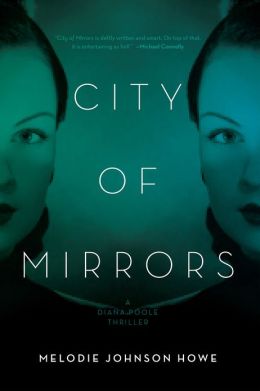
The current feature at the Page 69 Test: City of Mirrors: A Diana Poole Thriller by Melodie Johnson Howe.

About the book, from the publisher:
Running out of money, Diana Poole is forced to go back to the only work she knows: acting. Her much-loved husband and movie-star mother have died, and now Diana is over thirty-five. In Hollywood that means she might as well be dead. Still, a few key people remember her talent, and she lands a role in a new movie. But an actress should never get her hopes up, especially when she discovers the female lead’s murdered body. Raised in her mother’s shadow, Diana knows people in “the business”will go to dangerous lengths to protect their images. When her own life and career are threatened, Diana decides to fight back and find the killer. But unmasking the surprising murderer isn’t that easy, especially when she uncovers what’s real—and unreal—in her own life.
Learn more about the book and author at Melodie Johnson Howe's website.

The Page 69 Test: City of Mirrors.

--Marshal Zeringue

Five top bookish retreats to American cities

At The Barnes & Noble Book Blog Dell Villa tagged five top literary escapes to American cities, including:
Midnight in the Garden of Good and Evil, by John Berendt.

In a grand southern mansion, in a town where everyone knows everyone, shots ring out in the early morning mist of May 2, 1981. This book, based on actual events surrounding a complex murder case in Savannah, awoke in me a deeply suppressed desire to visit the Deep South, and an admittedly more natural urge to linger over a mint julep. Your journey within these pages is full of twists, turns, drawls, deceptions, and a bit of voodoo; similar to the Fiji trip I’ve only ever taken in my overactive imagination, this was a sojourn I never wanted to end.
Read about another book on the list.

--Marshal Zeringue

Tuesday, August 27, 2013

Review: Charles Gati (ed.), "Zbig: The Strategy and Statecraft of Zbigniew Brzezinski"

Ray Taras, Fulbright Distinguished Chair in European Studies at the University of Warsaw, reviews Charles Gati (ed.), Zbig: The Strategy and Statecraft of Zbigniew Brzezinski (Johns Hopkins University Press, 2013):
It’s almost become an iron law. For every book about international politics authored by Zbigniew Brzezinski, there is a corresponding book about Henry Kissinger. Depending on how we count, since his debut in 1956 as Carl Friedrich’s co-author on Totalitarian Dictatorship and Autocracy, Brzezinski has published 17-18 books. Including autobiographies, there are at least as many book-length studies about Kissinger. What is truly rare is, then, a biography of President Jimmy Carter’s National Security Advisor. Senior East European scholar Charles Gati’s new edited book justifiably sees itself as “the first comprehensive account of Zbigniew Brzezinski’s complementary roles as author, academic, policy maker, and critic.”

It is facile and redundant to go much further in a Brzezinski-Kissinger comparison. That is the subject of the first chapter by Justin Vaïsse, recently-appointed director of the policy planning staff of the French Ministry of Foreign Affairs who will hopefully have time to complete the next Brzezinski biography, based on his personal papers. He insists that the two statesmen have maintained good relations for the past three decades. But the supposedly sole derogatory Kissinger comment Vaïsse could find is a 1976 bombshell: “Brzezinski is a total whore. He’s been on every side of every argument” (p.21). Two years earlier Zbig, in his own inimitable way, had been as devastating in his terse summary of Kissinger’s approach as Richard Nixon’s security advisor: “fascination with enemies and ennui with friends” (p.19). That is, supposedly Chinese and Russian enemies and Western European friends.

Gati’s book has a simple but effective structure. Vaïsse’s chapter fits in Part I, “From the Ivy League.” Two other chapters here deal with Brzezinski’s usually overlooked softening tone on totalitarianism as a concept, and with his underappreciated pragmatism on member states of the Soviet bloc. “Our strategic and historical goal should not be the absorption of what was once called Eastern Europe into what is still called Western Europe;” rather, the objective should be “the progressive emergence of a truly independent, culturally authentic, perhaps de facto neutral Central Europe,” he wrote in a 1988 article (p.55). This was the prevailing sentiment at the breakthrough talks of the Polish Round Table held within a year.

This cautious tactic was overtaken by the fast-paced events that broke the back of the Soviet bloc by the end of 1989. In October of that year Zbig himself had developed a more sober assessment of Eastern Europe’s future. Speaking at a conference in the Soviet Foreign Ministry, he rhetorically asked “whether the Soviet Union will retain a presence in Europe” (p. 153). Some two years later there was not just no Soviet presence but no Soviet Union.

The second Part of the book, titled “To the National Security Council,” is made up of contributions by cohorts and policy analysts providing original insights on and thick descriptions of Zbig’s years at the NSC. Anecdotes abound such as about “his exuberant Russophobia as illustrated by his anti-Soviet antics on the Great Wall” in 1978 (p.93). The Chinese subsequently nicknamed him The Polar Bear Tamer. In turn his scholarly colleagues in communist studies “judged him brilliant and erratic – brilliant all the time, right about half the time” (p.96).

“The Policy Advocate,” the third Part, begins with a chapter by Patrick Vaughn, author of a Brzezinski biography which appeared in Polish in 2010. He recounts an alleged report by KGB agents indicating that Brzezinski had orchestrated fellow Pole Karol Woytyła’s selection as Pope in 1978 as part of “a backdoor plot in the Vatican with the aim of destabilizing Poland and the Warsaw Pact alliance” (p.127). The Polish term mitoman, or pseudologia fantastica as it can be rendered into “English,” may capture the exaggerated character of this conspiracy theory.

Brzezinski’s circumscribed criticism of the 1991 US military intervention in Iraq, then his scorching attack on the 2003 invasion, gives rise to the charming subtitle of James Mann’s chapter, “The Makings of a Dove.” Perhaps it represented hyperbole directed at two Republican administrations, but it was becoming apparent that Brzezinski no longer needed to be a cold war warrior, much less a shooting war one. In an interview with Deutsche Welle in August 2013, he cautioned against Western intervention in Syria following reports of the use of chemical weapons against civilians: “Given the contemporary reality of what I have called in my writings ‘Global Political Awakening,’ a policy of force based primarily on Western and in some cases former colonial powers does not seem to me a very promising avenue to an eventual solution to the regional problem.” Zbig had indeed become a dove for the long haul.

Part IV is called “Portraits” and includes “A Self-Assessment” based on Gati’s interview with Zbig. An especially germane comment from him comes at the very end. We know that he has a manifestly Polish identity. To someone like me who went to the same high school in Montreal as he did, his formative years spent in Canada also give definition to his identity. Zbig recalls how, in his first years in the US – he enrolled as a doctoral student at Harvard in 1950 – “I said to myself, why change my name?” He had concluded that “America is the only country where someone called ‘Zbigniew Brzezinski’ can make a name for himself without changing his name” (p.234).

This biography tells us a lot not just about Zbig but about America’s own checkered history in Brzezinski’s lifetime.--Ray Taras
Visit Ray Taras's website. His 2012 books are Xenophobia and Islamophobia in Europe (Edinburgh University Press); (editor) Challenging multiculturalism: European models of diversity Edinburgh University Press); and (editor) Russia's identity in international relations: images, perceptions, misperceptions (Routledge).

--Marshal Zeringue

Five top dangerous mentors in fiction

Megan Abbott's latest novel is Dare Me.

Dare Me was named: One of Entertainment Weekly's Best Books of 2012, one of Salon's Ultimate Book Guide Choices for 2012, one of The Millions's Best Books of 2012, and NBC's The Today Show's Holiday Book Picks: Gillian Flynn's selection.

One of Abbott's five most dangerous mentors in fiction, as told to The Daily Beast:
The Portrait of a Lady
by Henry James

When Isabel Archer first meets Madame Merle, she is lured as if by a siren song to the sound of the older woman playing a piano sonata. Fatefully, James’s heroine places herself eagerly “under [the] influence” of the enigmatic and hypnotic woman who will eventually engineer Isabel’s catastrophic marriage. The scene in which Isabel learns of her mentor’s betrayal is heartbreaking. “What have you done with me?” she asks, horrified. In reply, Madame Merle slowly rises, “stroking her muff, but not removing her eyes from Isabel’s face. ‘Everything,’ she answered.”
Read about another novel on the list.

The Portrait of a Lady is among Susan Cheever's six favorite Massachusetts books and the six best books named by Elizabeth Edwards; it is also one of Tina Brown's five best books on reputation.

--Marshal Zeringue

Pg. 99: William J. Turkel's "Spark from the Deep"

The current feature at the Page 99 Test: Spark from the Deep: How Shocking Experiments with Strongly Electric Fish Powered Scientific Discovery by William J. Turkel.

About the book, from the publisher:
Spark from the Deep tells the story of how human beings came to understand and use electricity by studying the evolved mechanisms of strongly electric fish. These animals have the ability to shock potential prey or would-be predators with high-powered electrical discharges.

William J. Turkel asks completely fresh questions about the evolutionary, environmental, and historical aspects of people's interest in electric fish. Stimulated by painful encounters with electric catfish, torpedos, and electric eels, people learned to harness the power of electric shock for medical therapies and eventually developed technologies to store, transmit, and control electricity. Now we look to these fish as an inspiration for engineering new sensors, computer interfaces, autonomous undersea robots, and energy-efficient batteries.
Learn more about Spark from the Deep at the Johns Hopkins University Press website and William J. Turkel's website.

The Page 99 Test: Spark from the Deep.

--Marshal Zeringue

What is Steve Yarbrough reading?

The current featured contributor at Writers Read: Steve Yarbrough, author of The Realm of Last Chances.

His entry begins:
Right now, I'm on something of a Hungarian fiction binge. Presently I am reading Peter Nadas's ambitious and challenging Parallel Stories. This comes on the heels of a Gyula Krudy collection from NYRB titled The Adventures of Sindbad. I have another Krudy novel on-deck, Sunflower, again from NYRB. The impetus for all of this is that some years ago, I became infatuated, like one of the characters in my own new novel The Realm of Last Chances, with the work of...[read on]
About The Realm of Last Chances, from the publisher:
In a captivating departure from the Deep South setting of his previous fiction, Steve Yarbrough now gives us a richly nuanced portrait of a marriage being reinvented in a small town in the Northeast, in his most surprising and compelling novel yet.

When Kristin Stevens loses her administrative job in California’s university system, she and her husband, Cal, relocate to Massachusetts. Kristin takes a position at a smaller, less prestigious college outside Boston and promptly becomes entangled in its delicate, overheated politics. Cal, whose musical talent is nothing more than a consuming avocation, spends his days alone, fixing up their new home. And as they settle into their early fifties, the two seem to exist in separate spheres entirely. At the same time, their younger neighbor Matt Drinnan watches his ex-wife take up with another man in his hometown, with only himself to blame. He and Kristin, both facing an acute sense of isolation, gravitate toward each other, at first in hope of a platonic confidant but then, inevitably, of something more. The Realm of Last Chances provides us with a subtle, moving exploration of relationships, loneliness and our convoluted attempts to reach out to one another.
Learn more about the book and author at Steve Yarbrough's website.

Writers Read: Steve Yarbrough.

--Marshal Zeringue

Pg. 69: Carol Snow's "Bubble World"

Today's feature at the Page 69 Test: Bubble World by Carol Snow.

About the book, from the publisher:
Freesia’s life is perfect. She lives on the beautiful tropical island of Agalinas, surrounded by idyllic weather, fancy dress shops, and peacocks who sing her favorite song to wake her up in the morning. She has so many outfits she could wear a different one every day for a year and not run out.

Lately things on the island may have been a bit flippy: sudden blackouts, students disappearing, even Freesia’s reflection looking slightly . . . off. But in Freesia’s experience, it’s better not to think about things like that too much.

Unfortunately for her, these signs are more than random blips in the universe. Freesia’s perfect bubble is about to pop.
Learn more about the book and author at Carol Snow's website.

Carol Snow is the author of Snap and Switch, an ALA Quick Pick for Reluctant Young Adult Readers. She had also written five novels for adults, including Just Like Me, Only Better and What Came First.

My Book, The Movie: Just Like Me, Only Better.

My Book, The Movie: What Came First.

The Page 69 Test: Bubble World.

--Marshal Zeringue
David Rich's "Middle Man," the movie

The current feature at My Book, The Movie: Middle Man by David Rich.

The entry begins:
Want to have some fun? Spend a little time trying to cast Maya: the daughter of the man claiming to be the King of Kurdistan; she is dark, voluptuous, mysterious, wry, witty, focused and determined.

For inspiration I spent a little time staring at photos of the astoundingly beautiful and talented Isabelle Adjani. If you have never seen her in One Deadly Summer, drop what you’re doing. She’s too old now for the part now, but once upon a time…

There are probably Persian actresses who would fit the part, but I am not familiar with them. French actresses are often popular around the world so I searched there and Bérénice Marlohe (Skyfall) stopped me right away. If you want to know what Maya looks like (and you do) check her out. And I would be remiss if I did not mention – in any blog post on any topic - Eva Green. I’m going to work my way through Italian and Greek actresses next.

Johnny Bannion is a bald headed Welshman, a one eyed charmer and con artist extraordinaire. He is Dan, Rollie’s father, times ten. Anthony...[read on]
Learn more about the book and author at David Rich's website and blog.

Writers Read: David Rich (September 2012).

My Book, The Movie: Caravan of Thieves.

My Book, The Movie: Middle Man.

--Marshal Zeringue

Monday, August 26, 2013

Five books that are like country and western songs

At The Barnes & Noble Book Blog Nicole Hill suggested five books that, like country and western songs, tell "stories of agony and ecstasy, soaring highs and mighty powerful lows, heartache and hard living," including:
As I Lay Dying, by William Faulkner

Faulkner’s roundtable of misery hits all the same sour notes as the best singers to grace the stage of the Grand Ole Opry. In this saddest of road-trip stories, the Bundren family embarks on an odyssey to bury matriarch Addie. It’s darkly comic, with the trauma of his mother’s death confusing young Vardaman into uttering one of the book’s most memorable lines: “My mother is a fish.” It’s a defeatist kind of humor—there is irony in the bleakness—in the same vein as all of Nashville’s deprecating barroom bawls (“And as the door behind you closes, the only thing I know to say, it’s been a good year for the roses.”) You could try your hand at tackling Absalom, Absalom!, but wouldn’t you ruther have some bananas with the Bundrens?

Mama died, and Anse can’t stand it/Mama died, we think she planned it/Mama died, she ain’t here no more/Mama died, and Cash is a Jesus metaphor
Read about another novel on the list.

As I Lay Dying is on Laura Frost's list of the ten best modernist books (in English), Helen Humphreys's top ten list of books on grieving, John Mullan's list of ten of the best teeth in literature, Jon McGregor's list of the top ten dead bodies in literature, Roy Blount Jr.'s list of five favorite books of Southern humor, and James Franco's six best books list.

The “My mother is a fish.” chapter in As I Lay Dying is among the ten most notorious parts of famous books according to Gabe Habash.

--Marshal Zeringue

What is Tracy Guzeman reading?

The current featured contributor at Writers Read: Tracy Guzeman, author of The Gravity of Birds.

Her entry begins:
After working on a long project (first novel) and starting another (second novel), I’m drawn to the crisp borders of the short story. Right now I’m reading Andrea Barrett’s new collection, Archangel, and Rebecca Lee’s Bobcat and Other Stories. I am an ardent Andrea Barrett fan; I confess to semi-stalking her at a writing conference where my efforts were rewarded when I found myself standing in back of her in the coffee line. In both her novels and story collections, her characters are people I’m fascinated by: individuals with a passion for defining the unknown and explaining the unfathomable, by setting ablaze the precise boundaries of science and illuminating its cold, dark corners. Science writers, x-ray technicians, geneticists… what happens when their elegant theorems are transmogrified into messy human behavior? I can never wait to...[read on]
About The Gravity of Birds, from the publisher:
How do you find someone who wants to be lost?

Sisters Natalie and Alice Kessler were close, until adolescence wrenched them apart. Natalie is headstrong, manipulative—and beautiful; Alice is a dreamer who loves books and birds. During their family’s summer holiday at the lake, Alice falls under the thrall of a struggling young painter, Thomas Bayber, in whom she finds a kindred spirit. Natalie, however, remains strangely unmoved, sitting for a family portrait with surprising indifference. But by the end of the summer, three lives are shattered.

Decades later, Bayber, now a reclusive, world-renowned artist, unveils a never-before-seen work, Kessler Sisters—a provocative painting depicting the young Thomas, Natalie, and Alice. Bayber asks Dennis Finch, an art history professor, and Stephen Jameson, an eccentric young art authenticator, to sell the painting for him. That task becomes more complicated when the artist requires that they first locate Natalie and Alice, who seem to have vanished. And Finch finds himself wondering why Thomas is suddenly so intent on resurrecting the past.

In The Gravity of Birds histories and memories refuse to stay buried; in the end only the excavation of the past will enable its survivors to love again.
Learn more about the book and author at Tracy Guzeman's website and blog.

Writers Read: Tracy Guzeman.

--Marshal Zeringue

Five top books with Western perspectives of Asia

Ian Buruma is the Luce Professor of Democracy, Human Rights, and Journalism at Bard College. His books include The China Lover, Murder in Amsterdam, Occidentalism, God's Dust, Behind the Mask, The Wages of Guilt, Bad Elements, Taming the Gods, and the forthcoming Year Zero: A History of 1945.

With Alec Ash of Five Books, Buruma tagged five top books with Western perspectives of Asia, including:
The next country on our tour is Japan, with Donald Richie’s The Inland Sea.

Donald Richie, who died earlier this year, was a great friend and mentor of mine. He first arrived in Japan in 1947, when Japan was still occupied by the United States, and he stayed there, as a journalist and a writer, more or less until his death. He introduced Japanese cinema to the West through his books.

The Inland Sea, which was written in the sixties, is his love poem to Japan as he viewed it – which is quite romantically. It’s about a trip he makes around the Inland Sea, a very beautiful part of Japan filled with small islands. The landscape is extraordinary. He travels there just as Japan is modernising very fast – the cities are transformed as the old Japan disappears, as is happening in China now. So he goes to the part of Japan which to him is the least spoilt. It shows his love for a certain idea of Japan that’s disappearing – which is always the romantic view. Much of literature consists of describing a vanishing or a vanished world.

What are the communities he spends time with?

Many of them are small fishing villages, where people still have a very rural, traditional way of life. Even though he’s describing reality, he infuses it with a kind of poetry. It’s as much a product of his own romantic imagination as it is of life in Japanese fishing villages in the 1960s.
Read about another book Buruma tagged at Five Books.

--Marshal Zeringue

Pg. 69: Bill Crider's "Compound Murder"

The current feature at the Page 69 Test: Compound Murder by Bill Crider.

About the book, from the publisher:
Small-town Texas sheriff Dan Rhodes is in for another puzzling mystery in this next in the entertaining, award-winning series

Before classes start one morning, the body of English instructor Earl Wellington is found outside the building of the community college. Wellington was clearly involved in a struggle with someone and has died as a result. Sheriff Dan Rhodes pursues and arrests Ike Terrell, a student who was fleeing the campus. Ike's father is Able Terrell, a survivalist who has withdrawn from society and lives in a gated compound. He’s not happy that his son has chosen to attend the college, and he's even less happy with the arrest.

Rhodes discovers that Wellington and Ike had had a confrontation over a paper that Wellington insisted Ike plagiarized. Wellington also had had a confrontation with the dean and was generally disliked by the students. As the number of suspects increases, it’s up to Rhodes to solve the murder while also dealing with an amusing but frustrating staff, a professor who wants to be a cop, and all the other normal occurrences that can wreak havoc in a small town.

Bill Crider's Compound Murder is an enjoyable police procedural filled with surprises, chuckles, and a quirky cast that will captivate mystery readers.
Learn more about the book and author at Bill Crider's website and blog.

Read the Page 69 Test entries for Crider's A Mammoth Murder, Murder Among the OWLS, Of All Sad Words, Murder in Four Parts, Murder in the Air, The Wild Hog Murders, and Murder of a Beauty Shop Queen.

Learn about Crider's choice of actors to portray Dan Rhodes on the big screen.

Writers Read: Bill Crider (August 2012).

Writers Read: Bill Crider.

The Page 69 Test: Compound Murder.

--Marshal Zeringue

Pg. 99: Anthony Gierzynski's (with Kathryn Eddy) "Harry Potter and the Millennials"

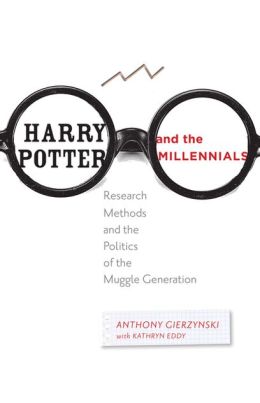
The current feature at the Page 99 Test: Harry Potter and the Millennials: Research Methods and the Politics of the Muggle Generation by Anthony Gierzynski with Kathryn Eddy.

About the book, from the publisher:
Without a doubt, the Harry Potter series has had a powerful effect on the Millennial Generation. Millions of children grew up immersed in the world of the boy wizard—reading the books, dressing up in costume to attend midnight book release parties, watching the movies, even creating and competing in Quidditch tournaments. Beyond what we know of the popularity of the series, however, nothing has been published on the question of the Harry Potter effect on the politics of its young readers—now voting adults.

Looking to engage his students in exploring the connections between political opinion and popular culture, Anthony Gierzynski conducted a national survey of more than 1,100 college students. Harry Potter and the Millennials tells the fascinating story of how the team designed the study and gathered results, what conclusions can and cannot be drawn about Millennial politics, and the challenges social scientists face in studying political science, sociology, and mass communication.
Learn more about the book and authors at the official Harry Potter and the Millennials website.

The Page 99 Test: Harry Potter and the Millennials.

--Marshal Zeringue

Sunday, August 25, 2013

What is Todd Ritter reading?

The current featured contributor at Writers Read: Todd Ritter, author of Devil's Night.

His entry begins:
I’ve been working on a historical mystery, so this summer is all about nonfiction for me. Not for research purposes, although there has been a bit of that, but to get a feel for how nonfiction writers use historical detail to enhance their stories.

Right now, my nonfiction book of choice is The Boys in the Boat: Nine Americans and Their Epic Quest for Gold at the 1936 Berlin Olympics by Daniel James Brown. It’s an excellent example of a writer using telling details — clothing, weather, headlines — to really immerse readers into the world of the story. Brown doesn’t drown the reader in facts, figures and exhaustive descriptions, like some authors do. Instead, he lets the story flow, using ...[read on]
About Devil's Night, from the publisher:
Two things Perry Hollow Police Chief Kat Campbell never thought she would do again: Enter a burning building, and lay eyes on Henry Goll, the man who was trapped inside with her the last time she was in one. So Kat's on high alert when, barely a year after the dust settled around the Grim Reaper killings, both happen on the same day.

She's jolted awake at 1a.m. by a desperate phone call telling her Perry Hollow’s one and only museum—home to all the town’s historical artifacts—has been set on fire. Arriving at the scene, Kat catches just a glimpse of Henry's face among the crowd before she's rushed into the charred building, only to find the museum curator dead…bludgeoned, not burned. Kat has lived through some tense moments and seen some gruesome crimes, but the next twenty-four hours will be the most dangerous of her life as she and Henry seek out a killer and the motivation behind these terrifying crimes.

Todd Ritter returns to the beloved town of Perry Hollow, Pennsylvania with Devil's Night, his most poignant, cleverly plotted novel yet.
Learn more about the book and author at Todd Ritter's website.

Writers Read: Todd Ritter (October 2010).

The Page 69 Test: Todd Ritter's Death Notice.

My Book, The Movie: Death Notice.

Writers Read: Todd Ritter (October 2011).

Writers Read: Todd Ritter.

--Marshal Zeringue

Three of Iran's supreme leader's favorite novels

Ali Khamenei is Iran’s Supreme Leader.

The Iranian journalist and writer Akbar Ganji has an essay in the current Foreign Affairs (Sept/Oct 2013),  "Who Is Ali Khamenei?".

"As a young man, Khamenei loved novels," Ganji writes. "He read such Iranian writers as Muhammad Ali Jamalzadah, Sadeq Chubak, and Sadeq Hedayat but came to feel that they paled before classic Western writers from France, Russia, and the United Kingdom."

One of Khamenei's favorite Western novels according to Ganji:
Victor Hugo’s Les Misérables

"In my opinion, Victor Hugo’s Les Misérables is the best novel that has been written in history. I have not read all the novels written throughout history, no doubt, but I have read many that relate to the events of various centuries.... [But] Les Misérables is a miracle in the world of novel writing.... I have said over and over again, go read Les Misérables once. This Les Misérables is a book of sociology, a book of history, a book of criticism, a divine book, a book of love and feeling."
--Khamenei, to some officials of Iran’s state-run television network in 2004
Learn about two more of Khamenei's favorite Western novels.

Read Akbar Ganji's essay, "Who Is Ali Khamenei?" at Foreign Affairs and view Fareed Zakaria's commentary on the subject at CNN's Global Public Square website. Zakaria notes:
The books Khamenei likes are all critiques of Western society, for the way it has treated the poor or African Americans or native Americans. He does not, incidentally, seem to recognize the strength of a culture that criticizes itself – all these critiques of the West are by Westerners, who often gain great fame for these efforts.
--Marshal Zeringue

Anita Hughes's "Lake Como," the movie

The current feature at My Book, The Movie: Lake Como by Anita Hughes.

The entry begins:
The minute I started writing Lake Como, I began visualizing it as a movie - it is hard not to when the setting is one of the most picturesque lakes in the world!

Hallie is a young San Francisco interior designer and I see her as a vibrant and beautiful blonde - possibly Blake Lively. Hallie's mother, Francesca designs wedding cakes and she is one of those women who looks elegant in jeans and Keds with flour on her fingers. I see her as Ashley Judd or Andie MacDowell with a bob.

Hallie's grandmother - the San Francisco society matriarch Constance Playfair would be a lovely older actress with beautiful skin and exquisite fashion sense - perhaps...[read on]
Learn more about the book and author at Anita Hughes's website.

Writers Read: Anita Hughes (July 2012).

My Book, The Movie: Market Street.

My Book, The Movie: Lake Como.

--Marshal Zeringue

Seven top novels about the horrors of adolescence

Janice Clark is a writer and designer living in Chicago. She grew up in Mystic, Connecticut, land of whaling and pizza. She received her MFA from New York University.

Clark's new novel is The Rathbones.

For Publishers Weekly she named seven of her favorite coming-of-age novels. One title on the list:
Great Expectations by Charles Dickens

Pip’s journey from blacksmith’s boy to gentleman comes full circle when he learns to value not the trappings of wealth and class but the quiet strength of Joe at the forge and the nobility of the convict Magwitch, truer than that of any of the ruling class in Dickens’ novel. Pip learns to trust his own conscience and reverts to the kind nature of his boyhood, before Miss Havisham lured him into her spidery realm.
Read about another book on Clark's list.

Great Expectations appears on Amy Wilkinson's list of five books Kate Middleton should have read while waiting to give birth, Kate Clanchy's top ten list of novels that reflect the real qualities of adolescence, Joseph Olshan's list of six favorite books, John Mullan's lists of ten of the best clocks in literature, ten of the best appropriate deaths in literature, ten of the best castles in literature, ten of the best Hamlets, ten of the best card games in literature, and ten best list of fights in fiction. It also made Tony Parsons' list of the top ten troubled males in fiction, David Nicholls' top ten list of literary tear jerkers, and numbers among Kurt Anderson's five most essential books. The novel is #1 on Melissa Katsoulis' list of "twenty-five films that made it from the book shelf to the box office with credibility intact."

Read an 1861 review of "Great Expectations".

--Marshal Zeringue