Sunday, October 03, 2010

Pg. 69: Trish MacGregor's "Esperanza"

The current feature at the Page 69 Test: Esperanza by Trish J. MacGregor.

About the book, from the publisher:
Tess Livingston met Ian Ritter at a roadside stop high in the Andes, waiting for a bus to the mysterious town of Esperanza.

Tess is an FBI agent who remembers being on the track of a group of international counterfeiters. But she doesn’t remember booking a trip to Esperanza. Ian is a journalist who was planning to vacation to the Galapagos Islands. He, too, isn’t quite sure why he has a ticket to Esperanza.

Their meeting will change their lives forever. For they have been brought together because they hold the key in a mystical war between the kind spirits of the dead who guard humanity, and the hungry ghosts who exist only to possess living human bodies, and return however briefly to life.

In the midst of this war, Tess and Ian will find a love that can transcend time, and a cause that not even death will overcome.
Visit Trish J. MacGregor's website and blog.

Writers Read: Trish J. MacGregor.

The Page 69 Test: Esperanza.

--Marshal Zeringue

Saturday, October 02, 2010

Pg. 99: Claudia Card's "Confronting Evils"

The current feature at the Page 99 Test: Confronting Evils: Terrorism, Torture, Genocide by Claudia Card.

About the book, from the publisher:
In this new contribution to philosophical ethics, Claudia Card revisits the theory of evil developed in her earlier book The Atrocity Paradigm (2002), and expands it to consider collectively perpetrated and collectively suffered atrocities. Redefining evil as a secular concept and focusing on the inexcusability – rather than the culpability – of atrocities, Card examines the tension between responding to evils and preserving humanitarian values. This stimulating and often provocative book contends that understanding the evils in terrorism, torture and genocide enables us to recognise similar evils in everyday life: daily life under oppressive regimes and in racist environments; violence against women, including in the home; violence and executions in prisons; hate crimes; and violence against animals. Card analyses torture, terrorism and genocide in the light of recent atrocities, considering whether there can be moral justifications for terrorism and torture, and providing conceptual tools to distinguish genocide from non-genocidal mass slaughter.
Read an excerpt from Confronting Evils, and learn more about the book at the Cambridge University Press website.

Claudia Card is the Emma Goldman Professor of Philosophy at the University of Wisconsin - Madison.

The Page 99 Test: Confronting Evils.

--Marshal Zeringue

Five best: international crime fiction

Geoffrey O'Brien is a poet, editor, and cultural historian. He is editor in chief for the Library of America. His nonfiction books include The Fall of the House of Walworth, Hardboiled America, Dreamtime, The Times Square Story, Red Sky Café, and Sonata for Jukebox.

For the Wall Street Journal, he named a five best list of international crime fiction.

One novel on his list:
The Oxford Murders by Guillermo Martínez, 2005

Set among mathematicians in an Oxford that seems, at first, as comfortingly abstract as a calculus equation, this Argentinian novel is a puzzle mystery that pays homage to that very old school of mystery-writing that thrived on mystification and decipherment: G. K. Chesterton, the creator of Father Brown, is appropriately invoked at one crucial point (along with such other high-level game-players as Gödel, Wittgenstein, and Lewis Carroll, not to mention an ancient contingent of Gnostics and Pythagoreans). The gaming in "The Oxford Murders" runs deep, but the book plays eminently fair with its mélange of serial murders, logical paradoxes and ominous encrypted messages. Most remarkable is the level of emotion stirred as the strands of convoluted speculation finally converge. While the novel is steeped in the most primordial pleasures of detective fiction, Guillermo Martínez found some brilliant new uses for those old devices.
Read about another book on the list.

--Marshal Zeringue

What is Anna Elliott reading?

This weekend's featured contributor at Writers Read: Anna Elliott, author of the Twilight of Avalon Trilogy from Simon & Schuster's Touchstone imprint. The trilogy comprises Twilight of Avalon, Dark Moon of Avalon, and the upcoming Sunrise of Avalon.

Her entry begins:
What I read tends to depend on where I am in my own writing process. When I'm in the midst of drafting my own Celtic fantasy books or short stories, I tend to read books that are as different as possible from what I'm writing. Reading a book too similar in tone or period or style to my own work can influence my own voice a bit, or limit my own imagination. So since I've been writing a few free short stories set in the world of Arthurian Britain, I've been reading mostly contemporary fiction these last few months. One of my absolute favorites that I recently finished was Backseat Saints, by Joshilyn Jackson. It's the story of Rose Mae Lolley, a fierce and fiery woman who after years trapped in an abusive marriage finally determines to break free. Joshilyn Jackson's writing is just gorgeous--lush and rich and lyrical and poignant. And with flashes of humor that...[read on]
Among the early praise for Dark Moon of Avalon:
"Elliott brings the Arthurian world to rich life, creating a Britain both familiar and distinctly alien to fans of medieval romances."
--Publishers Weekly

"Passion, conflict, danger and magic combine for an irresistible love story which will keep you turning the pages!"
--Michelle Moran, author of Nefertiti & Cleopatra's Daughter
Read the prologue to Dark Moon of Avalon, and watch the video trailer.

Learn more about the book and author at Anna Elliott's website and blog.

The Page 69 Test: Dark Moon of Avalon.

Writers Read: Anna Elliott.

--Marshal Zeringue

Friday, October 01, 2010

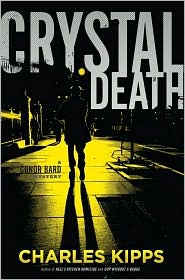
Pg. 69: Charles Kipps's "Crystal Death"

The current feature at the Page 69 Test: Crystal Death by Charles Kipps.

About the book, from the publisher:
Conor Bard—the fortysomething-year-old homicide detective who doesn't always play by the rules—is working on the streets of New York City's Diamond District when he becomes involved in a deadly game of international intrigue.

Crystal Death begins as Detective Conor Bard is called off the stage of the Rhythm Bar, where his rock band is performing, to investigate the murder of a beautiful young Israeli diamond dealer in midtown Manhattan. Bard quickly learns that a priceless red diamond (yes, there are red diamonds) is missing and that the South African government is determined to find it.

The list of murder suspects grows quickly as Conor Bard and his new partner, Rosita Rubio, struggle to unravel the conflicting information they uncover.

Could the cold, calculating inspector from Johannesburg actually be the killer? Is he inserting himself into the investigation to cover his tracks? Or perhaps the lovesick jeweler, whose persistent advances were met with indifference by the victim, faced one rejection too many? Other suspects include an Indian diamond cutter who may or may not be linked to the red diamond; a billionaire collector from Abu Dhabi who will go to any lengths to own rare gems; a ruthless international smuggler; and a stunning Indian businesswoman whom Conor Bard falls for, of course.

Crystal Death gives readers a look inside the international diamond trade and paints an unsentimental, accurate picture of the life of a New York City detective. Fans of Hell's Kitchen Homicide will welcome this second installment in the Conor Bard mystery series. The characters are genuine, the streets are real, and Kipps's TV pedigree is evident once again in the fast pace and gritty reality of the story.
Watch the video for Crystal Death, and learn more about the book and author at Charles Kipps's website.

The Page 69 Test: Hell’s Kitchen Homicide.

The Page 69 Test: Crystal Death.

--Marshal Zeringue

Best and worst childbirth scenes in sci-fi & fantasy

At io9, Charlie Jane Anders and Kelly Faircloth developed a list of the best and worst childbirth scenes in science fiction and fantasy.

One novel--from a collection that includes mostly television shows and movies--among the best scenes:
Dune by Frank Herbert:

The birth of Alia Atreides is awesomely aware, because her mother drinks the Water Of Life while pregnant. As a result, she's born a fully fledged Bene Gesserit Reverend Mother — in spite of some people who want to get rid of her before she's born. She's already as intelligent as an adult, which makes her trip ex utero strange and unique and totally mystical.
Read about another novel on the list.

Dune is also on John Mullan's list of ten of the best deserts in literature.

--Marshal Zeringue

Pg. 99: Shane McCorristine's "Spectres of the Self"

Today's feature at the Page 99 Test: Spectres of the Self: Thinking about Ghosts and Ghost-Seeing in England, 1750–1920 by Shane McCorristine.

About the book, from the publisher:
Spectres of the Self is a fascinating study of the rich cultures surrounding the experience of seeing ghosts in England from the Reformation to the twentieth century. Shane McCorristine examines a vast range of primary and secondary sources, showing how ghosts, apparitions, and hallucinations were imagined, experienced, and debated from the pages of fiction to the case reports of the Society for Psychical Research. By analysing a broad range of themes from telepathy and ghost-hunting to the notion of dreaming while awake and the question of why ghosts wore clothes, Dr McCorristine reveals the sheer variety of ideas of ghost seeing in English society and culture. He shows how the issue of ghosts remained dynamic despite the advance of science and secularism and argues that the ghost ultimately represented a spectre of the self, a symbol of the psychological hauntedness of modern experience.
Read an excerpt from Spectres of the Self, and learn more about the book at the Cambridge University press website.

The Page 99 Test: Spectres of the Self.

--Marshal Zeringue

Thursday, September 30, 2010

Meredith Cole's Lydia McKenzie novels, the movie

Now showing at My Book, The Movie: Posed for Murder and Dead in the Water by Meredith Cole.

The entry begins:
Since I started my career as a filmmaker and screenwriter, people often ask me when my books will be made into films or a television show. It seems natural to other people that I would imagine my stories as both novels and films from the very beginning. But I don’t. When I set out to write something new, I choose at some point whether a story is destined for the screen or for the pages of a book. And then I write it (or direct it). And then I’m done.

I wouldn’t say “no” if someone bought up the film rights and gave Lydia a new life in a different medium. There are probably things I would find painful (they might exaggerate her vintage clothes or goofiness), and others I would find enlightening (I wrote that?). But it would be an interesting experience nonetheless.

When someone first asked me who I saw playing Lydia, one actress popped into my head...[read on]
Meredith Cole started her career as a screenwriter and filmmaker. She was the winner of the St. Martin’s Press/Malice Domestic competition. Posed for Murder (2009) was nominated for an Agatha Award for Best First Mystery Novel. Dead in the Water (2010) continues the adventures of photographer Lydia McKenzie in Williamsburg, Brooklyn.

Cole teaches writing at the University of Virginia.

Learn more about the book and author at Meredith Cole's website.

My Book, The Movie: Meredith Cole's Lydia McKenzie novels.

--Marshal Zeringue

Pg. 69: Anna Elliott's "Dark Moon of Avalon"

The current feature at the Page 69 Test: Dark Moon of Avalon by Anna Elliott.

About the book, from the publisher:
She is a healer, a storyteller, and a warrior. She has fought to preserve Britain's throne. Now she faces her greatest challenge in turning bitter enemies into allies, saving the life of the man she loves ... and mending her own wounded heart.

The young former High Queen, Isolde, and her friend and protector, Trystan, are reunited in a new and dangerous quest to keep the usurper, Lord Marche, and his Saxon allies from the throne of Britain. Using Isolde's cunning wit and talent for healing and Trystan's strength and bravery, they must act as diplomats, persuading the rulers of the smaller kingdoms, from Ireland to Cornwall, that their allegiance to the High King is needed to keep Britain from a despot's hands.

Their admissions of love hang in the air, but neither wants to put the other at risk by openly declaring a deeper alliance. When their situation is at its most desperate, Trystan and Isolde must finally confront their true feelings toward each other, in time for a battle that will test the strength of their will and their love.

Steeped in the magic and lore of Arthurian legend, Elliott paints a moving portrait of a timeless romance, fraught with danger, yet with the power to inspire heroism and transcend even the darkest age.
Read the prologue to Dark Moon of Avalon, and watch the video trailer.

Learn more about the book and author at Anna Elliott's website and blog.

The Page 69 Test: Dark Moon of Avalon.

--Marshal Zeringue

Top 10 books on the ancient world

Annabel Lyon is a Vancouver fiction writer and teacher. Her books include Oxygen (stories), The Best Thing for You (novellas), All-Season Edie (juvenile novel), and The Golden Mean, her first novel for adults.

At the Guardian, she named her top ten books on the ancient world.

One book on the list:
The Centaur by John Updike (1963)

An anxious teenage boy and his depressive schoolteacher father in small-town Pennsylvania shift and shimmer in and out of Greek myths: the father becomes the tragic centaur Chiron, while the son becomes Prometheus. It's a magical feat, pulled off with Updike's signature wit, painterly vision, and keen eye for beauty in the tiniest of details.
Read about another book on the list.

The Centaur also appears among Dave Boling's five best examples of how to structure a novel.

--Marshal Zeringue

What is Patricia Gussin reading?

The current featured contributor at Writers Read: Patricia Gussin, author of And Then There Was One, The Test, Twisted Justice, and Shadow of Death.

Her entry begins:
The books I write are thrillers, but thrillers are not necessarily the book I read. Right now I’m re-reading The Burning Shore by Wilbur Smith. This was the title that turned me onto this astounding author. He brings high tension adventure, bigger than life characters, compelling plots, and a family sage theme.

Speaking of family saga, I love Barbara Bradford. A Woman of Substance is right next to me and read excerpts frequently to keep me on inspired. I love family themes because they evoke...[read on]
About And Then There Was One:
One is the loneliest number. Nine years ago, Katie and Scott Monroe were blessed beyond their wildest dreams with identical triplets, Sammie, Alex, and Jackie. Three beautiful daughters and two adoring parents formed the picture-perfect party of five. But this tight-knit family unravels when the three little girls go to see a movie, but only one emerges from the darkness of the theater. How could Sammie and Alex vanish without a trace? Plunged into the abyss of a parent’s worst fear, Katie and Scott hang by a thread—waiting, worrying, not knowing, and confronting the terrifying realization that the kidnapping may not have been a random act. Who took Sammie and Alex? Why? Where are they? When will they be found? And what if they’re never found, or not found alive? When Jackie, the remaining triplet, crumbles under the weight of grief and survivor’s guilt, Katie and Scott struggle to hold out hope and hold on to what remains of their family. Until—or unless—Sammie and Alex are found safe, this picture-perfect family can’t be put back together again.
Visit Patricia Gussin's website.

The Page 69 Test: Shadow of Death.

My Book, The Movie: Twisted Justice.

The Page 69 Test: The Test.

My Book, The Movie: The Test.

Writers Read: Patricia Gussin.

--Marshal Zeringue

Wednesday, September 29, 2010

Pg. 99: Daniel K. Williams' "God’s Own Party"

The current feature at the Page 99 Test: God's Own Party: The Making of the Christian Right by Daniel Williams.

About the book, from the publisher:
When the Christian Right burst onto the scene in the late 1970s, many political observers were shocked. But, God's Own Party demonstrates, they shouldn't have been. The Christian Right goes back much farther than most journalists, political scientists, and historians realize. Relying on extensive archival and primary source research, Daniel K. Williams presents the first comprehensive history of the Christian Right, uncovering how evangelicals came to see the Republican Party as the vehicle through which they could reclaim America as a Christian nation.

The conventional wisdom has been that the Christian Right arose in response to Roe v. Wade and the liberal government policies of the 1970s. Williams shows that the movement's roots run much deeper, dating to the 1920s, when fundamentalists launched a campaign to restore the influence of conservative Protestantism on American society. He describes how evangelicals linked this program to a political agenda-resulting in initiatives against evolution and Catholic political power, as well as the national crusade against communism. Williams chronicles Billy Graham's alliance with the Eisenhower White House, Richard Nixon's manipulation of the evangelical vote, and the political activities of Jerry Falwell, Pat Robertson, and others, culminating in the presidency of George W. Bush. Though the Christian Right has frequently been declared dead, Williams shows, it has come back stronger every time. Today, no Republican presidential candidate can hope to win the party's nomination without its support.

A fascinating and much-needed account of a key force in American politics, God's Own Party is the only full-scale analysis of the electoral shifts, cultural changes, and political activists at the movement's core-showing how the Christian Right redefined politics as we know it.
Learn more about God's Own Party at the Oxford University Press website.

Daniel K. Williams is an assistant professor of history at the University of West Georgia.

The Page 99 Test: God's Own Party.

--Marshal Zeringue

Pg. 69: Justin Peacock's "Blind Man's Alley"

The current feature at the Page 69 Test: Blind Man's Alley by Justin Peacock.
About the book, from the publisher:
From the author of the Edgar Award–nominated legal thriller A Cure for Night, an ambitious and compulsively readable novel set in the cutthroat world of New York real estate.

A concrete floor three hundred feet up in the Aurora Tower condo development in SoHo has collapsed, hurling three workers to their deaths. The developer, Roth Properties (owned by the famously abrasive Simon Roth), faces a vast tangle of legal problems, including allegations of mob connections. Roth’s longtime lawyers, the elite midtown law firm of Blake and Wolcott, is assigned the task of cleaning up the mess. Much of the work lands on the plate of smart, cynical, and sea­soned associate Duncan Riley; as a result, he falls into the pow­erful orbit of Leah Roth, the beautiful daughter of Simon Roth and the designated inheritor of his real estate empire.

Meanwhile, Riley pursues a seemingly small pro bono case in which he attempts to forestall the eviction of Rafael Nazario and his grandmother from public housing in the wake of a pot bust. One night Rafael is picked up and charged with the mur­der of the private security cop who caught him, a murder that took place in another controversial “mixed income” housing development being built by ... Roth Properties. Duncan Riley is now walking the knife edge of legal ethics and personal morality.

Blind Man’s Alley is a suspenseful and kaleidoscopic journey through a world where the only rule is self- preservation. The New York Times Book Review said of A Cure for Night that “[Peacock] heads toward Scott Turow country ... he’s got a good chance to make partner.” This taut, topical, and socially alert thriller delivers on that promise.
Read an excerpt from Blind Man’s Alley, and learn more about the book and author at Justin Peacock's website.
The Page 69 Test: A Cure for Night.
The Page 69 Test: Blind Man's Alley.
--Marshal Zeringue

Five great books about obscure presidents

At the Christian Science Monitor, Randy Dotinga named five great books about obscure presidents.

One title on the list:
The Harding Affair: Love and Espionage during the Great War by James David Robenalt (2009)

He's best remembered today for the Teapot Dome scandal and his White House canoodling with a woman who was not his wife.

But Warren Harding's philandering had begun years before his brief stint as president. In fact, the man who looked like a senator straight from central casting had a long and tumultuous affair with a friend of this wife (who was both formidable and scandal-plagued herself.)

The mistress turned out to have troublesome sympathies toward Germany. And that was the least of it.

The president's love letters remain, and they reveal the inner life of a man of stunning – and misdirected – passion. If only he'd devoted that same energy to effectively running the country.
Read about another book on the list.

--Marshal Zeringue

Tuesday, September 28, 2010

What is Wendy Orr reading?

The current featured contributor at Writers Read: Wendy Orr, author, mostly of books for children and young adults, including Nim's Island (the book that the film was based on), Nim at Sea, Peeling the Onion, Ark in the Park, Spook's Shack, Mokie and BIk, and The Princess and Her Panther.

Her entry begins:
On the flight home from Vancouver to Melbourne, I should have been reading The Cardturner by Louis Sachar. That was my gift voucher book from The Red Balloon Bookshop in Minneapolis (I never did figure out why I needed more gifts when they’d just thrown me a party, but who ever looked a gift book in the mouth?).

I hope that was the attitude of whoever next sat in my seat from Vancouver to Los Angeles, because, tucked into the seat pocket with the emergency instructions, they would have found a nice new hardback copy of The Cardturner. I do hope they enjoyed the surprise of it, as well as the book. (Maybe they could write the next blog!)

So, five minutes before boarding that last 15 hour leg, I finished going through all the hand luggage, realised that I truly was bookless, and bolted to the bookstore. There was no leisure for browsing for a new author. Barbara...[read on]
Among the early praise for The Princess and Her Panther:
"A warm and cozy tale of sisterly joy and sweet imagination."
--Kirkus Reviews

"Children will recognize the thrill of confronting fears when you know that cozy comforts are right there when you need them."
--Booklist

"Imagination is at the heart of this book as two sisters set out to camp in their backyard...This is a clever twist on the usual camping story and the fears that accompany it."
--School Library Journal
Visit Wendy Orr's blog.

Writers Read: Wendy Orr.

--Marshal Zeringue

Pg. 99: Jon Cohen's "Almost Chimpanzee"

The current feature at the Page 99 Test: Almost Chimpanzee: Searching for What Makes Us Human, in Rainforests, Labs, Sanctuaries, and Zoos by Jon Cohen.

About the book, from the publisher:
The captivating story of how a band of scientists has redrawn the genetic and behavioral lines that separate humans from our nearest cousins

In the fall of 2005, a band of researchers cracked the code of the chimpanzee genome and provided a startling new window into the differences between humans and our closest primate cousins. For the past several years, acclaimed Science reporter Jon Cohen has been following the DNA hunt, as well as eye-opening new studies in ape communication, human evolution, disease, diet, and more.

In Almost Chimpanzee, Cohen invites us on a captivating scientific journey, taking us behind the scenes in cutting-edge genetics labs, rain forests in Uganda, sanctuaries in Iowa, experimental enclaves in Japan, even the Detroit Zoo. Along the way, he ferries fresh chimp sperm for a time-sensitive analysis, gets greeted by pant-hoots and chimp feces, and investigates an audacious attempt to breed a humanzee. Cohen offers a fresh and often frankly humorous insider's tour of the latest research, which promises to lead to everything from insights about the unique ways our bodies work to shedding light on stubborn human-only problems, ranging from infertility and asthma to speech disorders.

And in the end, Cohen explains why it's time to move on from Jane Goodall's plea that we focus on how the two species are alike and turns to examining why our differences matter in vital ways—for understanding humans and for increasing the chances to save the endangered chimpanzee.
Read an excerpt from Almost Chimpanzee, and learn more about the book and author at Jon Cohen's website.

Jon Cohen is the author of Shots in the Dark and Coming to Term. He is a correspondent at the internationally renowned Science magazine and has also written for The Atlantic, The New Yorker, The New York Times Magazine, The Washington Post, Discover, Smithsonian, and Slate.

The Page 99 Test: Almost Chimpanzee.

--Marshal Zeringue

Ten must-read novels of the fall

At The Daily Beast, Janice Kaplan named the ten must-read novels of the fall.

One book on the list:
Our Kind of Traitor by John le Carre

Most thrillers are quick page-turners, but the masterful John le Carre expects readers to do some work, too. In his latest, Our Kind of Traitor, a money-laundering Russian connects with an English couple on a tennis vacation and the British Secret Service wants to know why. As in the real world of spies, motives aren’t always clear and the ending doesn’t neatly tie up all the ends. As one character thinks, “Half-truths. Quarter-truths. What the world really knows about itself, it doesn’t dare say.”
Read about another novel on the list.

Learn about John le Carré's best books.

--Marshal Zeringue

Pg. 69: Ken Scholes' "Antiphon"

Today's feature at the Page 69 Test: Antiphon by Ken Scholes.

About the book, from the publisher:
Nothing is as it seems to be.

The ancient past is not dead. The hand of the Wizard Kings still reaches out to challenge the Androfrancine Order, to control the magick and technology that they sought to understand and claim for their own.

Nebios, the boy who watched the destruction of the city of Windwir, now runs the vast deserts of the world, far from his beloved Marsh Queen. He is being hunted by strange women warriors, while his dreams are invaded by warnings from his dead father.

Jin Li Tam, queen of the Ninefold Forest, guards her son as best she can against both murderous threats, and the usurper queen and her evangelists. They bring a message: Jakob is the child of promise of their Gospel, and the Crimson Empress is on her way.

And in hidden places, the remnants of the Androfrancine order formulate their response to the song pouring out of a silver crescent that was found in the wastes.
Learn more about the author and his work at Ken Scholes's website and blog.

The Page 69 Test: Lamentation.

The Page 69 Test: Antiphon.

--Marshal Zeringue

Cherish D'Angelo's "Lancelot's Lady," the movie

Now showing at My Book, The Movie: Lancelot's Lady by Cherish D'Angelo.

The entry begins:
Lancelot's Lady was the first novel I've written where actors and actresses didn't immediately come to mind. I'd completed the novel before even imagining who would play the roles--a first for me as I usually have a strong image as I write. In fact, it was a struggle at first to think of who should play my unsuspecting lovers, Rhianna and Jonathan. But now that I've thought of two names, I can't get them out of my head. I can see their scenes in my mind--intense, conflicting, passionate, super Hot with a capital H, and even humorous at times.

The actress who would be perfect as Rhianna McLeod, a young mid-twenties palliative care nurse who has hidden herself away because of a horrible past, is Canadian actress Rachel McAdams.

Rhianna is a fiery redhead, beautiful and easily flustered. She has a temper and a wicked sense of humor when provoked. I think Rachel could pull that off very easily and she'll look great as a redhead. When I think of her in...[read on]
Learn more about Lancelot's Lady and Cherish D'Angelo (aka Cheryl Kaye Tardif) at the official website and author's blog.

My Book, The Movie: Lancelot's Lady.

--Marshal Zeringue

Monday, September 27, 2010

Pg. 99: Joseph Mazur's "What’s Luck Got to Do with It?"

The current feature at the Page 99 Test: What's Luck Got to Do with It?: The History, Mathematics, and Psychology of the Gambler's Illusion by Joseph Mazur.

About the book, from the publisher:
Why do so many gamblers risk it all when they know the odds of winning are against them? Why do they believe dice are "hot" in a winning streak? Why do we expect heads on a coin toss after several flips have turned up tails? What's Luck Got to Do with It? takes a lively and eye-opening look at the mathematics, history, and psychology of gambling to reveal the most widely held misconceptions about luck. It exposes the hazards of feeling lucky, and uses the mathematics of predictable outcomes to show when our chances of winning are actually good.

Mathematician Joseph Mazur traces the history of gambling from the earliest known archaeological evidence of dice playing among Neolithic peoples to the first systematic mathematical studies of games of chance during the Renaissance, from government-administered lotteries to the glittering seductions of grand casinos, and on to the global economic crisis brought on by financiers' trillion-dollar bets. Using plenty of engaging anecdotes, Mazur explains the mathematics behind gambling--including the laws of probability, statistics, betting against expectations, and the law of large numbers--and describes the psychological and emotional factors that entice people to put their faith in winning that ever-elusive jackpot despite its mathematical improbability.

As entertaining as it is informative, What's Luck Got to Do with It? demonstrates the pervasive nature of our belief in luck and the deceptive psychology of winning and losing.
Read an excerpt from What’s Luck Got to Do with It?, and learn more about the book at the Princeton University Press website.

Visit Joseph Mazur's website and read about his five best books on gambling.

The Page 99 Test: What's Luck Got to Do with It?.

--Marshal Zeringue