Wednesday, October 11, 2023

Q&A with Kim DeRose

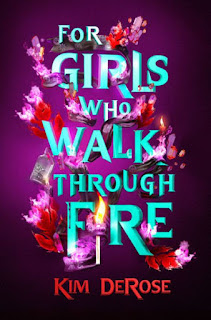
From my Q&A with Kim DeRose, author of For Girls Who Walk through Fire:
How much work does your title do to take readers into the story?

I think my title, For Girls Who Walk Through Fire, does a very good job at taking readers to the core of the story. These girls have been through something, they have walked through fire. And it simultaneously does a good job of alluding to the witches and witchcraft featured in the story because, as we know, so many women were labeled witches and burned at the stake. And yet the teen witches in my novel aren’t about to adhere to that narrative, these witches are fighting back. What I also love about the title is that it’s as much about my characters as it is about the readers. In fact, the book is partially dedicated to...[read on]
Visit Kim DeRose's website.

Q&A with Kim DeRose.

--Marshal Zeringue

The ten best histories of women in WWII

Lena Andrews is the author of Valiant Women: The Extraordinary American Servicewomen Who Helped Win World War II, and a military analyst at the Central Intelligence Agency. A native of Boston, Massachusetts, she received her Ph.D. in political science from the Massachusetts Institute of Technology, specializing in international relations and security studies. She has spent more than a decade in foreign policy, and her work has appeared on MSNBC, PBS, CNN, Today, People, and TIME, among many other outlets.

At Publishers Weekly Andrews tagged ten of the best histories of women in WWII, including:
The Girls Who Stepped Out of Line: Untold Stories of the Women Who Changed the Course of World War II by Mari Eder

There are many reasons to love Eder’s contribution to our understanding of women’s participation in WWII, but one of them is the sensibility that she brings to the topic as a retired Army major general. Not only does Eder provide readers with a comprehensive survey of the many ways in which women contributed to winning the war, but her ability to understand and appreciate their experiences comes through on every page.
Read about another entry on the list.

--Marshal Zeringue

Tuesday, October 10, 2023

Pg. 99: Stefan Schöberlein's "Writing the Brain"

Featured at the Page 99 Test: Writing the Brain: Material Minds and Literature, 1800-1880 by Stefan Schöberlein.

About the book, from the publisher:
In the nineteenth century, American and British culture experienced an explosion of interest in writings about the brain. The years between 1800 and 1880 are often described as the emergence of modern neuroscience, with new areas of the brain being discovered and named. Naming was quickly followed by a drive to hypothesize functioning, a process that suggested thinking itself may be a mere physiological act. In Writing the Brain, Stefan Schöberlein tracks how literature encountered such novel, scientific theories of cognition-and how it, in turn, shaped scientific thinking.

Before the era of modern psychology, a heterogeneous group of alienists, self-help gurus, and anatomists proposed that the structure of the brain could be used to explain how the mind worked. Suddenly, nineteenth-century readers and writers had to contend with the idea that qualities once ascribed to disembodied souls may arise from a mere lump of cranial matter. In a period when scientists and literary writers frequently published in the same periodicals, the ensuing debate over the material mind was a public one. Writing the Brain demonstrates, by examining several canonical works and textual rediscoveries, that these exchanges not only influenced how poets and novelists fictionalized the mind but also how scientists thought and talked about their discoveries. From George Combe to Charles Dickens, from Emily Dickinson to Pliny Earle, from Benjamin Rush to Alfred Tennyson, 1800s debated what it means to have or, rather, be a brain.
Visit Stefan Schöberlein's website.

The Page 99 Test: Writing the Brain.

--Marshal Zeringue

Seven novels that explore consent and coercion

Amanda Montei is the author of Touched Out: Motherhood, Misogyny, Consent, & Control, as well as the memoir Two Memoirs and a collection of prose, The Failure Age.

Her work has been featured at The New York Times, The Guardian, ELLE, TIME, and in numerous literary journals. She was a 2020 Best American Essays notable.

At Lit Hub Montei tagged "seven novels that deal with questions of consent and coercion" and which "offer new ways of understanding what it’s like to live in a culture of male control, showing how narrative can be a tool for expanding the language we have to describe women’s pain, as well as for resistance." One title on the list:
Miriam Toews, Women Talking

Toews’ novel opens with a note about “the wild female imagination”—something men weaponize to silence women when they come forward about abuse, but also a weapon that women themselves can wield to survive in a world disavows their reality. I love how this book circles around the limited options women feel they have available in the face of violence—as if the only choices are to fight or flee—and how it highlights the power of community and public speech to move beyond those limits.
Read about another entry on the list.

Women Talking is among Anjanette Delgado's seven books for when your life has radically changed.

--Marshal Zeringue

Pg. 69: Luanne G. Smith's "The Witch's Lens"

Featured at the Page 69 Test: The Witch's Lens: A Novel (The Order of the Seven Stars) by Luanne G. Smith.

About the book, from the publisher:
As World War I rages, there are evils―both living and dead―that only a witch can see in a spellbinding novel by the Amazon Charts and Washington Post bestselling author of The Raven Spell.

With her husband off fighting at World War I’s eastern front, Petra Kurková embraces her fleeting freedom, roaming the city at night with her camera. A born witch, she’s discovered that she can capture the souls of the dead on film. Her supernatural skills don’t go unnoticed by the enigmatic Josef Svoboda. He’s recruiting a team of sorcerers to infiltrate the front lines, where the bloodshed of combat has resurrected foul creatures. Petra’s unique abilities will be needed against the most dangerous enemies of all―those ever present, undead, and unseen.

Deep in the cursed Carpathian Mountains, the ragtag team meets with an emissary of an ancient organization founded to maintain balance between worlds. Photographing the escalating horrors is beyond anything Petra imagined. So are the secrets among her fellow witches. But Petra can’t turn back. Not before she discovers her husband’s fate and the myriad ways her magic is manifesting. To defeat an occult foe, Petra must release the power she’s been concealing for so long, or risk damning a war-torn world to ashes.
Visit Luanne G. Smith's website.

Q&A with Luanne G. Smith.

The Page 69 Test: The Raven Spell.

The Page 69 Test: The Raven Song.

The Page 69 Test: The Witch's Lens.

--Marshal Zeringue

Monday, October 09, 2023

Pg. 99: Timothy Recuber's "The Digital Departed"

Featured at the Page 99 Test: The Digital Departed: How We Face Death, Commemorate Life, and Chase Virtual Immortality by Timothy Recuber.

About the book, from the publisher:
A fascinating exploration of the social meaning of digital death

From blogs written by terminally ill authors to online notes left by those considering suicide, technology has become a medium for the dead and the dying to cope with the anxiety of death. Services like artificial intelligence chatbots, mind-uploading, and postmortem blog posts offer individuals the ability to cultivate their legacies in a bid for digital immortality. The Digital Departed explores the posthumous internet world from the perspective of both the living and the dead.

Timothy Recuber traces how communication beyond death evolved over time. Historically, the methods of mourning have been characterized by unequal access to power and privilege. However, the internet offers more agency to the dead, allowing users accessibility and creativity in curating how they want to be remembered.

Based on hundreds of blog posts, suicide notes, Twitter hashtags, and videos, Recuber examines the ways we die online, and the digital texts we leave behind. Combining these data with interviews, surveys, analysis of news coverage, and a historical overview of the relationship between death and communication technology going back to pre-history, The Digital Departed explains what it means to live and die on the internet today. In this thought-provoking and uniquely troubling work, Recuber shows that although we might pass away, our digital souls live on, online, in a kind of purgatory of their own.
Visit Timothy Recuber's website.

The Page 99 Test: The Digital Departed.

--Marshal Zeringue

Paul Vidich's "Beirut Station," the movie

Featured at My Book, The Movie: Beirut Station: Two Lives of a Spy: A Novel by Paul Vidich.

The entry begins:
Beirut Station is set in Lebanon and evokes the crossroads of that Lebanon has always been – first as a Roman outpost, part of the Ottoman Empire until the end of World War I, and then French until it earned its independence. It has always had a mix of Europe and the Middle East and its characters, in any film, need to reflect that.

Analise Assad, the non-official cover CIA case officer, should be played by Zineb Triki, the French Moroccan actress from The Bureau, who played the part of Nadia El Mansour.

Corbin, the journalist in the novel, is a handsome man with an honest face and a duplicitous mind, and I would cast...[read on]
Visit Paul Vidich's website.

Q&A with Paul Vidich.

My Book, The Movie: The Mercenary.

The Page 69 Test: The Mercenary.

Writers Read: Paul Vidich (January 2022).

The Page 69 Test: The Matchmaker: A Spy in Berlin.

Writers Read: Paul Vidich.

My Book, The Movie: Beirut Station.

--Marshal Zeringue

Six stories featuring ghosts with unfinished business

Meredith R. Lyons grew up in New Orleans, collecting two degrees from Louisiana State University before running away to Chicago to be an actor. In between plays, she got her black belt and made martial arts and yoga her full-time day job. She fought in the Chicago Golden Gloves, ran the Chicago Marathon, and competed for team U.S.A. in the savate world championships in Paris. In spite of doing each of these things twice, she couldn’t stay warm and relocated to Nashville. She owns several swords, but lives a non-violent life, saving all swashbuckling for the page, knitting scarves, gardening, visiting coffee shops, and cuddling with her husband and two panther-sized cats. Ghost Tamer is her first novel.

[Q&A with Meredith R. Lyons; 12 Yoga Questions with Meredith R. Lyons]

At CrimeReads Lyons tagged a "collection of unfinished business stories both long and short, creepy and slightly campy," including:
How to Sell a Haunted House by Grady Hendrix

Extra creep factor for haunted puppets, dolls, and yes, even taxidermy creatures. Main character Louise Joyner has a difficult relationship with her brother Mark, but they have to work together to get their recently deceased parents’ house sold, although the house may have other ideas. You’ll have to trust me that unfinished business abounds so that I don’t spoil the read for you. It’s best to go in without knowing too much.
Read about another entry on the list.

--Marshal Zeringue

Sunday, October 08, 2023

Pg. 99: Russ Castronovo's "American Insecurity and the Origins of Vulnerability"

Featured at the Page 99 Test: American Insecurity and the Origins of Vulnerability by Russ Castronovo.

About the book, from the publisher:
An incisive critique that examines the origins of contemporary American ideas about surveillance, terrorism, and white supremacy

For more than three centuries, Americans have pursued strategies of security that routinely make them feel vulnerable, unsafe, and insecure. American Insecurity and the Origins of Vulnerability probes this paradox by examining American attachments to the terror of the sublime, the fear of uncertainty, and the anxieties produced by unending racial threat.

Challenging conventional approaches that leave questions of security to policy experts, Russ Castronovo turns to literature, philosophy, and political theory to show how security provides an organizing principle for collective life in ways that both enhance freedom and limit it. His incisive critique ranges from frontier violence and white racial anxiety to insurgent Black print culture and other forms of early American terror, uncovering the hidden logic of insecurity that structures modern approaches to national defense, counterterrorism, cybersecurity, surveillance, and privacy. Drawing on examples from fiction, journalism, tracts, and pamphlets, Castronovo uncovers the deep affective attachments that Americans have had since the founding to the sources of fear and insecurity that make them feel unsafe.

Timely and urgent, American Insecurity and the Origins of Vulnerability sheds critical light on how and why the fundamental political desire for security promotes unease alongside assurance and fixates on risk and danger while clamoring for safety.
Learn more about American Insecurity and the Origins of Vulnerability at the Princeton University Press website.

My Book, The Movie: Propaganda 1776.

The Page 99 Test: American Insecurity and the Origins of Vulnerability.

--Marshal Zeringue

Five new witchy books for Friday the 13th

The 13th of October 2023 falls on Friday. To mark the occasion the staff at Publishers Weekly tagged five new witchy titles, including:
The Bone Roots by Gabriela Houston

For this dark fairy tale, Houston (The Second Bell) spins a lush narrative that gets lost in its own fecund detail. There’s a folkloric simplicity to the premise: two women go to a tree blessed by a goddess—one a noble hoping for a child, the other a witch who has promised to help. They find twin babies hanging from a branch like fruit. Fast-forward 15 years, and wealthy Sladyana believes that her goddess-given daughter has been stolen from her by supernatural forces. Though she takes in a nonspeaking orphan, fostering the child cannot fill the void. Meanwhile Kada, the witch, raises a not-quite-human daughter of her own whom she ferociously guards, fearing exposure of the child’s uncanny nature. Threat appears in the form of a marauding blue-eyed fox, alongside a glossary’s worth of other monstrous beings that Kada overcomes or commands in succession—all while navigating the complex dynamics of family and village. This is a tapestry of a book, wonderfully woven but thin. The Slavic mythology it draws from brings the benefit of novelty, but the fairy tale elements don’t quite come together to lend emotive meaning to Houston’s decorative prose. Fans of fabulist literature hoping for depth should look elsewhere, but readers seeking pure story, lovingly told, will find plenty to savor.
Read about another entry on the list.

--Marshal Zeringue

Saturday, October 07, 2023

Pg. 99: Asher D. Cutter's "Evolving Tomorrow"

Featured at the Page 99 Test: Evolving Tomorrow: Genetic Engineering and the Evolutionary Future of the Anthropocene by Asher D. Cutter.

About the book, from the publisher:
The Anthropocene defines the here-and-now time period on Earth of indelible (and possibly irreversible) human disturbance to the natural world, from habitat destruction and mass extinction to global climate change. To ameliorate and repair the damage that threatens the world's dwindling resources and our very existence, humanity is enacting massive interventions to fuse modern technologies with long established natural processes. Advances in genetic engineering have put us on the cusp of directly shaping the DNA of every living organism (including ourselves), as well as determining the evolution of completely novel species. The author invites the reader to explore how humans have manipulated the ancient forces of evolution and the future possibilities of genetic engineering for conservation and rewilding, de-extinction, and even the creation of viable populations of entirely new species. To entertain such possibilities of synthetic biology, he forces us to wrestle with the threats and ethical conundrums that surround the unintended consequences, as well as the values that humanity places on authenticity in nature. In so doing, this accessible and thought-provoking book explores the potential future of life on planet Earth.
Learn more about Evolving Tomorrow at the Oxford University Press website.

The Page 99 Test: Evolving Tomorrow.

--Marshal Zeringue

Pg. 69: A.J. Banner's "Dreaming of Water"

Featured at the Page 69 Test: Dreaming of Water: A Novel by A. J. Banner.

About the book, from the publisher:
A woman’s investigation into her past reveals family secrets and lies in this novel of discovery, redemption, and the mutability of memory by the bestselling author of The Good Neighbor and In Another Light.

Astrid Johansen swore she would never return to Heron Bay, Washington. In that idyllic coastal town, her little sister, Nina, drowned in a reflecting pool under Astrid’s watch seventeen years ago. Though guilt has kept her away, Astrid can’t ignore her aunt Maude’s urgent plea to come back. Maude claims to have found a letter that will change everything about the past.

When Astrid arrives in Heron Bay, she finds Maude unconscious, perhaps the victim of an attack. As Maude lingers in a coma, Astrid uncovers alarming evidence that Nina’s drowning that tragic night was no accident. But in a town rife with secrets, and in a family still fractured by grief, who knows the truth?

Astrid’s investigation leads her down a trail of dark memories, lies, and betrayals that will shatter her perception of everyone she thought she knew―even herself.
Visit A.J. Banner's website.

The Page 69 Test: After Nightfall.

Writers Read: A.J. Banner (September 2018).

The Page 69 Test: Dreaming of Water.

--Marshal Zeringue

Seven novels that defined the Obama era

Andrew Ridker was born in Boston, Massachusetts in 1991. His second novel, Hope, is now out from Viking.

[Q&A with Andrew Ridker].

His debut novel, The Altruists, was a New York Times Editors’ Choice, a Paris Review staff pick, an Amazon Editors’ Pick, and the People Book of the Week. It won the Friends of American Writers Award and was longlisted for the Prix du Meilleur livre étranger and the Yasnaya Polyana Literary Prize.

Ridker is the editor of Privacy Policy: The Anthology of Surveillance Poetics and his writing has appeared in The New York Times, Esquire, Le Monde, Bookforum, The Paris Review Daily, Guernica, Boston Review, and elsewhere. A graduate of the Iowa Writers' Workshop, Ridker lives in Brooklyn, New York.

At Electric Lit he tagged seven novels that capture the cultural moment of Obama’s America, including:
The Underground Railroad by Colson Whitehead

The historical novel, once considered fusty and stale, was gut-renovated in the 2010s. During Obama’s two terms, novelists (and especially Black novelists) turned history (and especially Black history) on its head in a series of formally inventive books. James McBride’s National Book Award-winning The Good Lord Bird was a comedic reimagining of the life of John Brown and his raid on Harper’s Ferry. Marlon James’s Booker Prize-winning A Brief History of Seven Killings was a polyphonic telling of (among many other things) a real-life assassination attempt on the life of Bob Marley. And then there’s Colson Whitehead’s The Underground Railroad, which won pretty much every prize there is. To focus on the premise underpinning Whitehead’s novel—what if the Underground Railroad was, in fact, a functioning railroad?—is to miss his even more audacious thematic gambits, collapsing centuries of oppression into one phantasmagoric journey.
Read about another entry on the list.

The Underground Railroad is among Andrea Wulf's top ten books about unlikely revolutionaries, Chris Mooney's six intelligent, page-turning, genre-bending classics, Rachel Eve Moulton's top ten literary thrillers, Nathan Englander’s ten desert island books, Greg Mitchell's top ten escapes in literature, and President Obama's summer 2016 reading list.

--Marshal Zeringue

Friday, October 06, 2023

Pg. 99: Robert W. Rix's "The Vanished Settlers of Greenland"

Featured at the Page 99 Test: The Vanished Settlers of Greenland: In Search of a Legend and Its Legacy by Robert W. Rix.

About the book, from the publisher:
For four hundred years, Norse settlers battled to make southern Greenland a new, sustainable home. They strove against gales and winter cold, food shortages and in the end a shifting climate. The remnants they left behind speak of their determination to wrest an existence at the foot of this vast, icy and challenging wilderness. Yet finally, seemingly suddenly, they vanished; and their mysterious disappearance in the fifteenth century has posed a riddle to scholars ever since. What happened to the lost Viking colonists? For centuries people assumed their descendants could still be living, so expeditions went to find them: to no avail. Robert Rix tells the gripping story of the missing pioneers, placing their poignant history in the context of cultural discourse and imperial politics. Ranging across fiction, poetry, navigation, reception and tales of exploration, he expertly delves into one of the most contested questions in the annals of colonization.
Learn more about The Vanished Settlers of Greenland at the Cambridge University Press website.

The Page 99 Test: The Vanished Settlers of Greenland.

--Marshal Zeringue

What is Paul Vidich reading?

Featured at Writers Read: Paul Vidich, author of Beirut Station: Two Lives of a Spy: A Novel.

His entry begins:
I read a lot of spy fiction, but I alternate novels with non-fiction written by men and women who worked in the CIA and who provide an insider’s view of that world. All the books go through a CIA vetting process to be certain that potentially compromising information does fall into the hands of the opposition, which makes it difficult sometimes for these authors to provide a credible account of their years in spy work.

I just picked up The Recruiter, by Douglas London, a fascinating insider’s look at his life as a senior intelligence officer who recruited foreign assets for the CIA for over 25 years. The narrative spent four months being reviewed by agency censors, which London describes in his forward, but the redacted portions don’t detract from his fascinating account. And, as he is quick to point out, many of the redactions have nothing to do with hiding secrets, and a lot to do with the agency removing material that would...[read on]
About Beirut Station: Two Lives of a Spy, from the publisher:
A stunning new espionage novel by a master of the genre, Beirut Station follows a young female CIA officer whose mission to assassinate a high-level, Hezbollah terrorist reveals a dark truth that puts her life at risk.

Lebanon, 2006.

The Israel-Hezbollah war is tearing Beirut apart: bombs are raining down, residents are scrambling to evacuate, and the country is on the brink of chaos.

In the midst of this turmoil, the CIA and Mossad are targeting a reclusive Hezbollah terrorist, Najib Qassem. Najib is believed to be planning the assassination of Secretary of State Condoleezza Rice, who is coming to Beirut in ten days to broker a cease-fire. The spy agencies are running out of time to eliminate the threat.

They turn to a young Lebanese-American CIA agent. Analise comes up with the perfect plan: she has befriended Qassem's grandson as his English tutor, and will use this friendship to locate the terrorist and take him out. As the plan is put into action, though, Analise begins to suspect that Mossad has a motive of its own: exploiting the war’s chaos to eliminate a generation of Lebanese political leaders.

She alerts the agency but their response is for her to drop it. Analise is now the target and there is no one she can trust: not the CIA, not Mossad, and not the Lebanese government. And the one person she might have to trust—a reporter for the New York Times—might not be who he says he is...

A tightly-wound international thriller, Beirut Station is Paul Vidich's best novel to date.
Visit Paul Vidich's website.

Q&A with Paul Vidich.

My Book, The Movie: The Mercenary.

The Page 69 Test: The Mercenary.

Writers Read: Paul Vidich (January 2022).

The Page 69 Test: The Matchmaker: A Spy in Berlin.

Writers Read: Paul Vidich.

--Marshal Zeringue

Nine top crime novels featuring found families

Lori Rader-Day is the Edgar® Award-nominated and Agatha, Anthony, and Mary Higgins Clark award-winning author of The Death of Us, Death at Greenway, The Lucky One, Under a Dark Sky, The Day I Died, Little Pretty Things, and The Black Hour. She lives in Chicago, where she is co-chair of the mystery readers’ festival Midwest Mystery Conference (fka Murder and Mayhem in Chicago) and served as 2019-2020 national president of Sisters in Crime. She teaches creative writing for Northwestern University’s School of Professional Studies.

[Q&A with Lori Rader-Day]

At CrimeReads Rader-Day tagged nine crime novels featuring characters who choose who they include at their crowded tables. One title on the list:
The Lost Ones by Sheena Kamal

A biracial product of the foster system, transient, and scarred by a violent past, Nora is no help to anyone, including the mutt, Whisper, she barely claims as her own. But when the daughter she gave up for adoption as an infant goes missing, she has to save the kid from… everything. And rely on everyone. There are two more books in the series, if you fall in love.
Read about another entry on the list.

The Lost Ones is among Jeff Abbott's five top adoption thrillers and Lisa Levy's ten top titles in mother-daughter noir.

The Page 69 Test: The Lost Ones.

--Marshal Zeringue

Thursday, October 05, 2023

Pg. 99: Lisa Herzog's "Citizen Knowledge"

Featured at the Page 99 Test: Citizen Knowledge: Markets, Experts, and the Infrastructure of Democracy by Lisa Herzog.

About the book, from the publisher:
Many democratic societies currently struggle with issues around knowledge: fake news, distrust of experts, a fear of technocratic tendencies. In Citizen Knowledge, Lisa Herzog discusses how knowledge, understood in a broad sense, should be dealt with in societies that combine a democratic political system with a capitalist economic system. How do citizens learn about politics? How do new scientific insights make their way into politics? What role can markets play in processing decentralized knowledge?

Herzog takes on the perspective of "democratic institutionalism," which focuses on the institutions that enable an inclusive and stable democratic life. She argues that the fraught relation between democracy and capitalism gets out of balance if too much knowledge is treated according to the logic of markets rather than democracy. Complex societies need different mechanisms for dealing with knowledge, among which markets, democratic deliberation, and expert communities are central. Citizen Knowledge emphasizes the responsibility of bearers of knowledge and the need to support institutions that promote active and informed citizenship. Through this lens, Herzog develops the vision of an egalitarian society that considers the use of knowledge in society not a matter of markets, but of shared democratic responsibility, supported by epistemic infrastructures. As such, Herzog's argument contributes to political epistemology, a new subdiscipline of philosophy, with a specific focus on the interrelation between economic and political processes.

Citizen Knowledge draws from both the history of ideas and systematic arguments about the nature of knowledge to propose reforms for a more unified and flourishing democratic system.
Learn more about Citizen Knowledge at the Oxford University Press website.

The Page 99 Test: Inventing the Market.

The Page 99 Test: Citizen Knowledge.

--Marshal Zeringue

Top ten grudge holders in fiction

Sarah Bernstein is from Montreal, Canada, and lives in Scotland. Her writing has appeared in Granta among other publications.

Her first novel, The Coming Bad Days, was published in 2021. In 2023 she was named as one of Granta’s Best of Young British Novelists.

Bernstein's new novel is Study for Obedience.

At the Guardian she tagged ten books in which
the grudge holder’s ongoing refusal to forgive, the insistence on the unforgivable nature of the wrong committed, amount ... to a refusal to accept the condition of the world as it is – a refusal that is the basic precondition for a new and changed world.
One title on the list:
Sing, Unburied, Sing by Jesmyn Ward

While not the sole focus of the story, ghosts abound in Ward’s novel, as alive as the living. They appear to the central characters including Jojo, the son of the family at the centre of the book, and they even narrate their own stories. In Sing, Unburied, Sing, the ghosts represent a spectral reappearance of the violent history of the US, and their presence alongside the living suggests the continuing legacies of enslavement.
Read about another entry on the list.

Sing, Unburied, Sing is among James Yorkston's top ten road novels, Stacey Swann's seven novels about very dysfunctional families, Una Mannion’s top ten books about children fending for themselves, Sahar Mustafah's seven novels about grieving a family member and LitHub's ten books we'll be reading in ten years.

--Marshal Zeringue

Wednesday, October 04, 2023

Pg. 99: Sara Byala's "Bottled"

Featured at the Page 99 Test: Bottled: How Coca-Cola Became African by Sara Byala.

About the book, from the publisher:
Travel to virtually any African country and you are likely to find a Coca-Cola, often a cold one at that. Bottled asks how this carbonated drink became ubiquitous across the continent, and what this reveals about the realities of globalisation, development and capitalism.

Bottled is the first assessment of the social, commercial and environmental impact of one of the planet's biggest brands and largest corporations, in Africa. Sara Byala charts the company's century-long involvement in everything from recycling and education to the anti-apartheid struggle, showing that Africans have harnessed Coca-Cola in varied expressions of modernity and self-determination: this is not a story of American capitalism running amok, but rather of a company becoming African, bending to consumer power in ways big and small.

In late capitalism, everyone's fates are bound together. A beverage in Atlanta and a beverage in Johannesburg pull us all towards the same end narrative. This story matters for more than just the local reasons, enhancing our understanding of our globalised, integrated world. Drawing on fieldwork and research in company archives, Byala asks a question for our time: does Coca-Cola's generative work offset the human and planetary costs associated with its growth in the twenty-first century?
Visit Sara Byala's website.

The Page 99 Test: Bottled.

--Marshal Zeringue

Gwen Florio's "Best Be Prepared," the movie

Featured at My Book, The Movie: Best Be Prepared by Gwen Florio.

The entry begins:
I didn’t have to think twice when asked who might play the lead in Best Be Prepared, the fourth in my series featuring protagonist Nora Best.

Hands down, it’s Reese Witherspoon.

First – and this is no small thing – she's age-appropriate. (OK, almost. Witherspoon is 47; Nora Best is 50. Close enough.)

When starting this series, I deliberately chose an older woman as a way to highlight the unexpected freedom many women find in middle age. Nora herself is childless, but many women in that age range are empty nesters, relieved of the most time-consuming aspects of parenting. One of the things I enjoy about writing this series is watching Nora discover that freedom and the new agency that comes with it.

Witherspoon also manages the nifty trick of...[read on]
Visit Gwen Florio's website.

Coffee with a Canine: Gwen Florio & Nell.

My Book, the Movie: Silent Hearts.

Writers Read: Gwen Florio (August 2018).

The Page 69 Test: Silent Hearts.

My Book, The Movie: Best Laid Plans.

The Page 69 Test: Best Laid Plans.

Q&A with Gwen Florio.

My Book, The Movie: The Truth of it All.

The Page 69 Test: The Truth of it All.

The Page 69 Test: Best Be Prepared.

My Book, The Movie: Best Be Prepared.

--Marshal Zeringue

Seven books about falling into debt

Raul Palma is a second-generation Cuban American born and raised in Miami. His short story collection In This World of Ultraviolet Light won the 2021 Don Belton Prize.

His writing has appeared in Alaska Quarterly Review, The Greensboro Review, Hayden’s Ferry Review, and elsewhere. He teaches fiction at Ithaca College, where he is the associate dean of faculty in Ithaca College’s School of Humanities and Sciences.

A Haunting in Hialeah Gardens is Palma's debut novel.

At Electric Lit he tagged seven stories about the pressure of owing money. One title on the list:
Super Sad True Love Story by Gary Shteyngart

In this hilarious satire, Gary Shteyngart offers a dystopic portrait of the United States in the “zero hour” of their economy, as Chinese ships enter New York Harbor to collect on US debts. Framed by an unlikely love story, we follow Lenny Abramov, 39-years old, a man nostalgic for simpler times—like when books were bound and made of paper. We also follow his partner Eunice Park, 24-years old—a young woman consumed by technology. They gravitate to one another for companionship and security; however, in a society brimming with security, surveillance, and creditors, they struggle to really connect and build a life together. This is a smart book that takes the logic of US dependency on technology and credit to its final conclusions.
Read about another entry on the list.

Super Sad True Love Story appears on Olivia Sudjic’s list of five of the best books to explain how we behave in the digital world, Leslie Berlin's top ten list of books about high-tech, Corey J. White's list of five books about the collapse of New York City, Ginni Chen's list of seven books that belong on your social media–obsessed friend’s shelf, Molly Schoemann-McCann's list of five of the best--and more familiar--tropes in fiction, Charlie Jane Anders's lists of ten great science fiction novels, published since 2000, that raise huge, important questions and ten satirical novels that could teach you to survive the future, and Nicholas Carr's list of five notable books on the impact of the Information Age.

--Marshal Zeringue

Tuesday, October 03, 2023

Pg. 99: William S. Cossen's "Making Catholic America"

Featured at the Page 99 Test: Making Catholic America: Religious Nationalism in the Gilded Age and Progressive Era by William S. Cossen.

About the book, from the publisher:
In Making Catholic America, William S. Cossen shows how Catholic men and women worked to prove themselves to be model American citizens in the decades between the Civil War and the Great Depression. Far from being outsiders in American history, Catholics took command of public life in the early twentieth century, claiming leadership in the growing American nation. They produced their own version of American history and claimed the power to remake the nation in their own image, arguing that they were the country's most faithful supporters of freedom and liberty and that their church had birthed American independence. Making Catholic America offers a new interpretation of American life in the Gilded Age and Progressive Era, demonstrating the surprising success of an often-embattled religious group in securing for itself a place in the national community and in profoundly altering what it meant to be an American in the modern world.
Visit William S. Cossen's website.

The Page 99 Test: Making Catholic America.

--Marshal Zeringue

Pg. 69: Gwen Florio's "Best Be Prepared"

Featured at the Page 69 Test: Best Be Prepared by Gwen Florio.

About the book, from the publisher:
A tense small town mystery that packs a big punch starring Nora Best.

Nora Best is enjoying the quiet life . . . finally. She's parked up the Airstream on a quiet stretch of beach and is now a seventh-grade teacher in a small peninsula town in the Pacific Northwest. Her biggest worry is keeping up with her quick-witted bunch of students. No drama. No danger. And most importantly – no one turning up dead.

Until they do, that is . . .

When a local environmental activist – and dad to one of her most troublesome students – is killed, Nora once again finds herself in the thick of an investigation that threatens her new-found peace. She soon uncovers that Ward's death is most likely linked to the building of the school's emergency tsunami tower – a project financed by Ward's ex-wife's new husband . . . and one that is testing the town's loyalty.

With emotions, and gossip, running high, in a community where everyone knows everyone else's secrets, Nora is in a race against time to get answers before fall storms slam their vulnerable Pacific Coast peninsula putting everyone's lives in danger!
Visit Gwen Florio's website.

Coffee with a Canine: Gwen Florio & Nell.

My Book, the Movie: Silent Hearts.

Writers Read: Gwen Florio (August 2018).

The Page 69 Test: Silent Hearts.

My Book, The Movie: Best Laid Plans.

The Page 69 Test: Best Laid Plans.

Q&A with Gwen Florio.

My Book, The Movie: The Truth of it All.

The Page 69 Test: The Truth of it All.

The Page 69 Test: Best Be Prepared.

--Marshal Zeringue

Five top books about India’s 1947 Partition

Shilpi Suneja is the author of House of Caravans. Born in India, her work has been nominated for a Pushcart Prize and published in Guernica, McSweeney’s, Cognoscenti, and the Michigan Quarterly Review. Her writing has been supported by a National Endowment for the Arts literature fellowship, a Massachusetts Cultural Council fellowship, a Grub Street Novel Incubator Scholarship, and she was the Desai fellow at the Jack Jones Literary Arts Retreat. She holds an MA in English from New York Universityand an MFA in creative writing from Boston University, where she was awarded the Saul Bellow Prize.

At Lit Hub Suneja tagged five books to help with our "understanding of [the Indian] Partition [of 1947]—as a trauma narrative, and as a living thing regenerating itself over and over with each generation." One title on the list:
Yasmin Khan, The Great Partition: The Making of India and Pakistan

Khan has an engaging way of writing history, and this book causes your jaw to drop several times. Here’s the opening, for example: “South Asians learned that the British Indian empire would be partitioned on 3 June 1947” (a mere two months before Independence!) And another: “They heard about it on the radio, from relations and friends, by reading newspaper and, later, through government pamphlets.” And another: “perhaps hundreds of thousands, didn’t hear the news for many weeks.”

Khan offers a comprehensive overview of the incidents preceding and following the decision to divide the lands, folding in the insouciance, inefficacy, intractability, and haphazardness of the leaders and the crisis upon crisis that the millions were subjected to from moment to moment. The minutia of details she has assembled are astounding: the caravans of millions on foot and what they carried, the state of the refugee camps on both sides of the border and their rations. Khan also analyzes what Partition means to the subcontinent now, and how its legacy continues to fire up right-wing ideologies on both sides of the border.
Read about another entry on the list.

Also see Anjali Enjeti's seven books about the Partition of India & Pakistan.

--Marshal Zeringue

Monday, October 02, 2023

Pg. 99: Steve Tibble's "Templars: The Knights Who Made Britain"

Featured at the Page 99 Test: Templars: The Knights Who Made Britain by Steve Tibble.

About the book, from the publisher:
A gripping account of the Knights Templar, challenging received wisdom to show how these devout medieval knights played a profound role in making modern Britain

The Knights Templar have an enduring reputation—but not one they would recognize. Originally established in the twelfth century to protect pilgrims, the Order is remembered today for heresy, fanaticism, and even satanism.

In this bold new interpretation, Steve Tibble sets out to correct the record. The Templars, famous for their battles on Christendom’s eastern front, were in fact dedicated peace-mongers at home. They influenced royal strategy and policy, created financial structures, and brokered international peace treaties—primarily to ensure that men, money, and material could be transferred more readily to the east.

Charting the rise of the Order under Henry I through to its violent suppression following the fall of Acre, Tibble argues that these medieval knights were essential to the emergence of an early English state. Revealing the true legacy of the British Templars, he shows how a small group helped shape medieval Britain while simultaneously fighting in the name of the Christian Middle East.
Visit Steve Tibble's website.

The Page 99 Test: Templars.

--Marshal Zeringue

Q&A with Christina McDonald

From my Q&A with Christina McDonald, author of These Still Black Waters:
How much work does your title do to take readers into the story?

Book titles are always a work in progress. I rarely know what it will be right away because I need to explore my characters, my themes, my plot.

My agent suggested we change the original title I had for These Still Black Waters as she thought it gave too much away. We brainstormed a number of ideas together and both loved These Still Black Waters, as the town of Black Lake (where the story is set) and the theme of the black waters that so many secrets lie beneath is very central to the story.

And then that first plot point, when the reader learns that a body has been found floating in Black Lake on a still, hot summer day, it really encapsulates the feel, the aura, even the...[read on]
Visit Christina McDonald's website.

The Page 69 Test: The Night Olivia Fell.

Writers Read: Christina McDonald (February 2019).

The Page 69 Test: These Still Black Waters.

Q&A with Christina McDonald.

--Marshal Zeringue

Seven top books about witches and badass covens

Kim DeRose writes dark, magical stories about strong, magical girls.

She grew up in Santa Barbara, California, where she spent childhood summers reading books and writing stories (which she was convinced her local bookstore would publish). She now lives in New York City, where she spends all seasons reading books and writing stories.
DeRose earned her MFA in film directing from UCLA, and currently works in digital media.

When she’s not reading or writing she can be found listening to podcasts on long walks, drinking endless cups of coffee, and spending time with her family.

For Girls Who Walk Through Fire is her debut novel.

At CrimeReads DeRose tagged seven books for those who "can’t get enough of witches and adore badass covens," including:
The Rules of Magic by Alice Hoffman

Magic. Heartbreak. A Greenwich village apothecary. There is zero way I could create a list of badass covens and not include the Owens sisters. And while Gillian and Sally Owens from Practical Magic, with their sisterly bond and fierce protection of one another, are absolutely worthy of being on this list, it’s Aunt Jet and Aunt Frances I’ve always gravitated toward. This book is their story. Set in 1960’s New York City (think Patti Smith’s Just Kids), it follows a teenage Frances and Jet, and their charismatic brother, Vincent, as they discover the family curse first set in motion by Salem-witch ancestor, Maria Owens, and learn to own their extraordinary powers. If you love this prequel to Practical Magic, I have good news for you: there are a total of 4 books in this series (and counting? Pretty please, Ms. Hoffman?).
Read about another entry on the list.

The Rules of Magic is among Lydia Kang's eight spine-chilling titles about occult mysteries.

--Marshal Zeringue

Sunday, October 01, 2023

Pg. 99: Russell Neuman's "Evolutionary Intelligence"

Featured at the Page 99 Test: Evolutionary Intelligence: How Technology Will Make Us Smarter by W. Russell Neuman.

About the book, from the publisher:
A surprising vision of how human intelligence will coevolve with digital technology and revolutionize how we think and behave.

It is natural for us to fear artificial intelligence. But does Siri really want to kill us? Perhaps we are falling into the trap of projecting human traits onto the machines we might build. In Evolutionary Intelligence, Neuman offers a surprisingly positive vision in which computational intelligence compensates for the well-recognized limits of human judgment, improves decision making, and actually increases our agency. In artful, accessible, and adventurous prose, Neuman takes the reader on an exciting, fast-paced ride, all the while making a convincing case about a revolution in computationally augmented human intelligence.

Neuman argues that, just as the wheel made us mobile and machines made us stronger, the migration of artificial intelligence from room-sized computers to laptops to our watches, smart glasses, and even smart contact lenses will transform day-to-day human decision making. If intelligence is the capacity to match means with ends, then augmented intelligence can offer the ability to adapt to changing environments as we face the ultimate challenge of long-term survival.

Tapping into a global interest in technology’s potential impacts on society, economics, and culture, Evolutionary Intelligence demonstrates that our future depends on our ability to computationally compensate for the limitations of a human cognitive system that has only recently graduated from hunting and gathering.
Learn more about Evolutionary Intelligence at the The MIT Press website.

The Page 99 Test: Evolutionary Intelligence.

--Marshal Zeringue

Pg. 69: Christina McDonald's "These Still Black Waters"

Featured at the Page 69 Test: These Still Black Waters (Jess Lambert) by Christina McDonald.

About the book, from the publisher:
Two women struggle toward a dark truth as a killer avenges the sins of the past in a twisting novel of suspense by the USA Today bestselling author of Do No Harm, Behind Every Lie, and The Night Olivia Fell.

After a violent home invasion, Neve Maguire returns with her daughter to Black Lake, her childhood summer home, hoping for a fresh start. But when the body of a woman is found floating among the reeds in the lake behind her house, she fears she has made a horrible mistake.

Neve is hiding secrets, though. Detective Jess Lambert can tell. Recently back after her own personal tragedy, Jess knows what it’s like to live with skeletons in your closet, and she’s sure Neve has a few of her own.

When another woman’s body is found, Jess and Neve are forced to confront a horrible truth. Because one thing is clear: the darkness of the past is waiting. And the secrets of Black Lake are only just beginning to surface.
Visit Christina McDonald's website.

The Page 69 Test: The Night Olivia Fell.

Writers Read: Christina McDonald (February 2019).

The Page 69 Test: These Still Black Waters.

--Marshal Zeringue

Eight top fictional dinner parties gone wrong

Lee Kelly is the author of City of Savages, a Publishers Weekly “Best of Spring 2015” pick and a VOYA Magazine “Perfect Ten” selection, A Criminal Magic, which was optioned and developed for a television series by Warner Bros., The Antiquity Affair, co-written with Jennifer Thorne (2023), With Regrets (Fall 2023) and The Starlets (forthcoming, Fall 2024).

Her short fiction and essays have appeared in Gingerbread House, Orca, and Tor.com, among other publications, and she holds her MFA degree from the Vermont College of Fine Arts. An entertainment lawyer by trade, Kelly has practiced law in Los Angeles and New York. She currently lives with her husband and two children in New Jersey, where you’ll find them engaged in one adventure or another.

At Electric Lit she tagged "eight of my favorite recent novels featuring a dangerous dinner, with the term 'danger' encompassing quite a variety of threats and menacing situations." One title on the list:
Here and Now and Then by Mike Chen

The dinners featured in this mind-bending, heart-wrenching sci-fi novel dangerously defy the laws of time and space itself. Kin Stewart, a time-traveling agent from 2142, has been secretly marooned in the 1990s. Kin’s given up on being rescued, and has started a new life; he’s now an IT expert with a teenage daughter. When Kin’s rescue team arrives eighteen years too late, Kin becomes torn between two different timelines and realities—hosting dinner parties with his wife in 2142 while simultaneously trying to preserve his relationship with his daughter across the centuries. His attempts threaten to corrupt the entire time-space continuum, and potentially destroy history itself.
Read about another entry on the list.

Here and Now and Then is among Catriona Silvey's five SF&F character pairs with ever-changing relationships and Fran Wilde’s five books that prove portal narratives & time travel are connected.

My Book, The Movie: Here and Now and Then.

--Marshal Zeringue