Saturday, April 09, 2011

Pg. 69: Brett Battles's "The Silenced"

This weekend's feature at the Page 69 Test: The Silenced by Brett Battles.

About the book, from the publisher:
Professional “cleaner” Jonathan Quinn has a new client and an odd job: find and remove the remains of a body hidden twenty years ago inside the walls of a London building, before the building is demolished.

But Quinn and his team are being watched. Suddenly caught in the cross fire between two dangerous rivals, Quinn must unravel the identity of the body and why it still poses so great a threat even in death. Because a plot stretching from the former Soviet Union to Hong Kong, from Paris to London, from Los Angeles to Maine, is rapidly falling apart. And Quinn hasn’t been hired just to tie up loose ends—he is one.
Learn more about the book and author at Brett Battles' website and blog.

Read: Tim Hallinan interviews Brett Battles.

The Page 69 Test: The Cleaner.

The Page 69 Test: The Deceived.

The Page 69 Test: Shadow of Betrayal.

The Page 69 Test: The Silenced.

--Marshal Zeringue

Friday, April 08, 2011

What is Rosalind Brackenbury reading?

The current featured contributor at Writers Read: Rosalind Brackenbury, author of Becoming George Sand.

Her entry begins:
I'm reading David Grossman's To The End Of The Land and can hardly put it down. It's so delicately and accurately observant of people's lives and thoughts, as well as bringing in the outside world and its threats and dangers. It's about an Israeli woman, Ora, whose son is in the IDF, in action, and about her relationships with the two men who are fathers to her two sons. I was particularly moved by the account of her going with her Arab driver, Sami, to take her son back to the army base, and her belated realization of how terrifying this journey must be for Sami, as he is the only Arab for miles around. Ora is emotional, irrational, insensitive, self-obsessed, flawed - a real...[read on]
About Becoming George Sand, from the publisher:

Maria Jameson is having an affair—a passionate, lifechanging affair. She asks: Is it possible to love two men at once? Must this new romance mean an end to love with her husband?

For answers, she reaches across the centuries to George Sand, the maverick French novelist who took many lovers. Immersing herself in the life of this revolutionary woman, Maria struggles with the choices women make and wonders if women in the nineteenth century might have been more free, in some ways, than their twenty-first-century counterparts.

Here, Rosalind Brackenbury creates a beautiful portrait of the ways in which women are connected across history. Two narratives delicately intertwine—following George through her affair with Frederic Chopin, following Maria through her affair with an Irish professor—and bring us a novel that explores the personal and the historical, the demands of self and the mysteries of the heart. Sharply insightful, Becoming George Sand asks how we make our lives feel vibrant while still acknowledging the gifts of our pasts, and challenges our understanding of love in all its forms—sparkling and new, mature, rekindled, and renewed.
Learn more about the book and author at Rosalind Brackenbury's website.

The Page 69 Test: Becoming George Sand.

Writers Read: Rosalind Brackenbury.

--Marshal Zeringue

Ben Kane's The Forgotten Legion trilogy, the movie

Now showing at My Book, The Movie: The Forgotten Legion trilogy by Ben Kane.

The entry begins:
I have to confess that I very much wrote The Forgotten Legion with a movie in mind. With a backdrop of the collapse of the Roman Republic and the rise of Julius Caesar to power, and with a panoramic sweep from Rome to the Middle East and Afghanistan, it provides the perfect settings for a wonderful blockbuster 'sword and sandal' epic in the style of Spartacus or the more recent Gladiator. The book is full of scenes in gladiator schools, and vicious fights in the arena. It moves on to Parthia (modern day Iran), and one of the greatest defeats ever suffered by Rome - at Carrhae, where the general Crassus lost 20,000 men killed in one day. 10,000 legionaries were taken prisoner and marched to modern day Afghanistan, where they were lost to history. A great setting for a movie, in my opinion. Crassus was killed at the end of the battle, but with a movie in mind, I gave him the brutal end suffered by a Roman governor in the area some years previously: having molten gold poured down his throat. Argh!

My ideal director would without doubt be...[read on]
Learn more about the book and author at Ben Kane's website and blog.

Writers Read: Ben Kane.

My Book, The Movie: The Forgotten Legion trilogy.

--Marshal Zeringue

Reading list: depression

At the Independent Alice-Azania Jarvis came up with a reading list on depression.

The novel on the list:
The Bell Jar

Sylvia Plath's classic roman à clef, The Bell Jar tells the tale of a magazine intern who finds herself falling into an ever-deepening state of despondency. It is a feeling, she says, not unlike being trapped "under a bell jar". After a string of suicide attempts, Esther is institutionalised. As the book ends, it remains unclear if she will ever return to life outside.
Read about the memoir on the list.

The Bell Jar is #2 on one list of the top 10 most depressing books.

Esther Greenwood of The Bell Jar appears among Will Davis' top ten literary teenagers.

The Bell Jar's first sentence--“It was a queer, sultry summer, the summer they electrocuted the Rosenbergs, and I didn’t know what I was doing in New York.”--is Ali Smith's favorite opening line of a novel.

--Marshal Zeringue

Thursday, April 07, 2011

What is John Darnton reading?

The current featured contributor at Writers Read: John Darnton, author of Almost a Family: A Memoir.

His entry begins:
Latest book was Flaubert's Sentimental Education, which I read for a book group (otherwise I probably would never have picked it up). It's a slow start and it's hard to sympathize with the main character -- almost all the characters, in fact -- but over some 460 pages, the satire takes a back seat and the story, about obsessive love, kicks in. By the...[read on]
About Almost a Family, from the publisher:
From the Pulitzer Prize–winning journalist and best-selling author: a beautifully crafted memoir of his lifelong chase after his father’s shadow.

John was eleven months old when his father, Barney Darnton—a war correspondent for The New York Times—was killed in World War II, but his absence left a more profound imprint on the family than any living father could have. John’s mother, a well-known Times reporter and editor, tried to keep alive the dream of raising her two sons in ideal surroundings. When that proved impossible, she collapsed emotionally and physically. But along the way she created such a powerful myth of the father-hero who gave his life for his family, country, and the fourth estate that John followed his footsteps into the same newsroom.

Decades after his father’s death, John and his brother, the historian Robert Darnton, began digging into the past to uncover the truth about their parents. To discover who the real-life Barney Darnton was—and in part who he himself is—John delves into turn-of-the-century farm life in Michigan, the anything-goes Jazz Age in Greenwich Village, the lives of hard-drinking war correspondents in the Pacific theater, and the fearful loneliness of the McCarthy years in Washington, D.C. He ends his quest on a beach in Papua New Guinea, where he learns about his father’s last moments from an aged villager who never forgot what he saw sixty-five years earlier.
Learn more about the author and his work at John Darnton's website.

The Page 99 Test: Almost a Family.

Writers Read: John Darnton.

--Marshal Zeringue

Five books to help aspiring creative writers

Andrew Cowan is a Senior Lecturer in Creative Writing and Convenor of the MA in Creative Writing (Prose Fiction) at the University of East Anglia. He is a graduate of the MA and was for some years the Royal Literary Fund Writing Fellow at UEA. He is the author of four novels: Pig, which won several literary prizes including the Sunday Times Young Writer of the Year Award and was longlisted for the Booker Prize, Common Ground, Crustaceans, and most recently What I Know, which received an Arts Council Writer’s Award. His Creative Writing guidebook is The Art of Writing Fiction.

To Daisy Banks of FiveBooks, Cowan recommended a handful of books to help aspiring writers, including:
On Becoming a Novelist
by John Gardner

Your next book, John Gardner’s On Becoming a Novelist, is described as comfort food for the aspiring novelist.

This is another one of the classics. He was quite a successful novelist in the States, but possibly an even more successful teacher of creative writing. The short story writer and poet Raymond Carver, for instance, was one of his students. And he died young in a motorcycle accident when he was 49. There are two classic works by him. One is this book, On Becoming a Novelist, and the other is The Art of Fiction: Notes on Craft for Young Writers. They were both put together from his teaching notes after he died.

On Becoming a Novelist is the more succinct and, I think, is the better of the two. He talks about automatic writing and the idea, just like Dorothea Brande, of the artist being comprised of two people. But his key idea is the notion of the vivid and continuous dream. He suggests that when we read a novel we submit to the logic of that novel in the same way as we might submit to the logic of a dream – we sink into it, and clearly the events that occur could not exist outside the imagination.

What makes student writing in particular go wrong is when it draws attention to itself, either through bad writing or over-elaborate writing. He suggests that these faults in the aspirant writer alert the reader to the fact that they are reading a fiction and it is a bit like giving someone who is dreaming a nudge. It jolts them out of the dream. So he proposes that the student writer should try to create a dream state in the reader that is vivid and appeals to all the senses and is continuous. What you mustn’t do is alert the reader to the fact that they are reading a fiction.

It is a very good piece of advice for writers starting out but it is ultimately very limiting. It rules out all the great works of modernism and post-modernism, anything which is linguistically experimental. It rules out anything which draws attention to the words as words on a page. It’s a piece of advice which really applies to the writing of realist fiction, but is a very good place from which to begin.

And then people can move on.

Yes.
Read about another book Cowan recommends.

--Marshal Zeringue

Pg. 99: Martin Kihn's "Bad Dog"

The current feature at the Page 99 Test: Bad Dog by Martin Kihn.

About the book, from the publisher:
(A true story.)

Meet Hola. She’s a nightmare, but it’s not her fault if she tackles strangers and chews on furniture, or if she runs after buses and fried chicken containers and drug dealers. No one ever told her not to. Worse yet, she scares her family. Hola may be the most beautiful Bernese mountain dog in the world, but she’s never been trained. At least not by anyone who knew what he was doing.

Hola’s supposed master, Marty, is a high-functioning alcoholic. A TV writer turned management consultant, Marty’s in debt and out of shape; he’s about to lose his job, and one day he emerges from a haze of peach-flavored vodka to find he’s on the verge of losing his wife, Gloria, too, if he can’t get his life—and his dog—under control.

Desperately trying to save his marriage, Marty throws himself headlong into the world of competitive dog training. Unfortunately, he knows even less than Hola, the only dog ever to be expelled from her puppy preschool twice. Somehow, together, they need to get through the American Kennel Club’s rigorous Canine Good Citizen test. Of course, Hola first needs to learn how to sit.

It won’t be easy. It certainly won’t be pretty. But maybe, just maybe, there will be cheesecake.
Learn more about Bad Dog: A Love Story at Martin Kihn's website and the Bad Dog Facebook page.

Read--Coffee with a Canine: Martin Kihn and Hola.

The Page 99 Test: Bad Dog.

--Marshal Zeringue

Pg. 69: Robert Sawyer's "WWW: Wonder"

The current feature at the Page 69 Test: WWW: Wonder by Robert Sawyer.

About the book, from the publisher:
"A writer of boundless confidence and bold scientific extrapolation" (New York Times) concludes his mindbending trilogy.

Webmind-the vast consciousness that spontaneously emerged from the infrastructure of the World Wide Web-has proven its worth to humanity by aiding in everything from curing cancer to easing international tensions. But the brass at the Pentagon see Webmind as a threat that needs to be eliminated.

Caitlin Decter-the once-blind sixteen-year-old math genius who discovered, and bonded with, Webmind-wants desperately to protect her friend. And if she doesn't act, everything-Webmind included-may come crashing down.
Learn more about the book and author at Robert J. Sawyer's website and blog.

The Page 69 Test: WWW: Wake.

The Page 69 Test: WWW: Watch.

The Page 69 Test:: WWW: Wonder.

--Marshal Zeringue

Wednesday, April 06, 2011

What is Stephen Anable reading?

Today's featured contributor at Writers Read: Stephen Anable, author of A Pinchbeck Bride.

His entry begins:
Right now I’m reading The Wives of Henry VIII by Antonia Fraser. I had never known Henry VIII was basically a crowned serial killer who’d executed his wife Anne Boleyn on what he knew were trumped-up charges (I’d always thought she’d done something to tick him off…). I enjoyed Fraser’s classic biography, Mary Queen of Scots, so thought I’d give this a try. I like history from a remote period because it has nothing to do with (my) writing.

And, since you asked, I’m...[read on]
About A Pinchbeck Bride, from the publisher:
A young woman in Victorian finery is found strangled in Mingo House, a morbid brownstone and museum, a nineteenth-century time capsule in Boston’s Back Bay. Dubbed the “Victorian Girl” by the media everywhere, she becomes the eye of a hurricane of publicity and speculation—and a darkness reaching back to the Mingoes’ roots in England and to the builders of the mansion, a Civil War arms dealer and his séance-holding wife. Boston comic Mark Winslow and the other trustees of Mingo House are divided as to whether the place is sustainable as a museum. Trustee chairman Rudy Schmitz, the brash entrepreneur, seems convinced that the porous roof and escalating rain damage will doom the place. Nadia Gulbenkian, the last of the old guard trustees, is accusing Rudy of engineering the museum’s demise. Software executive Jon Kim and a dubious collector of saints’ bones and art are pursuing their own clandestine agendas. Mingo House itself seems cursed, for its origins in bullets and cannonballs and the family’s reputation as regicides in the execution of King Charles I. A number of people believe its walls conceal treasure, a stolen royal monstrance, and are willing to do anything to retrieve it. In this sequel to "The Fisher Boy," pierced college students clash with flawed Brahmin bluebloods, and the Gothic with the high-tech. As the deaths and threats multiply, one question resounds: which will survive this summer of rain, of deluge—Mingo House or its terrified staff?
Visit Stephen Anable's website.

Writers Read: Stephen Anable.

--Marshal Zeringue

Five best books about evil

Adam Haslett is the author of You Are Not A Stranger Here, a short story collection, which was a finalist for a Pulitzer Prize and a National Book Award, and won the PEN/Winship Award. His work has appeared in The New Yorker, The Nation, Zoetrope, and Best American Short Stories as well as National Public Radio’s Selected Shorts.

His debut novel Union Atlantic was published last year.

With Daisy Banks at FiveBooks, Haslett recommended five books on evil, including:
Out of Eden: Adam and Eve and the Problem of Evil
Paul W. Kahn

Tell me about your first choice, Out of Eden: Adam and Eve and the Problem of Evil by Paul W Kahn.

The question concerning the nature of evil is a longstanding one but I would go so far as to say that in this profound book, the philosopher Paul Kahn has gone a very long way in answering it. He argues that in our secular age we have given reason such a dominant place in our understanding of modern politics that we can only understand evil acts by individuals or nations as deficits of rationality. If the Hutus were simply rational, they wouldn’t have killed the Tutsis, and so forth. Thus, our response to what we see as evil takes an essentially pedagogical form. We first try therapy to increase the malefactor’s rational capacity, and when that fails, we turn to legal punishment. But this leaves us with no conceptual framework for distinguishing between the simply bad act and the evil one. In short, secularism has no explanation of evil.

Kahn, who, over his last several books, has been working to articulate what he calls a political theology of modernity, fills that void with his own compelling explanation of the existential origin of evil: evil is the refusal to acknowledge and confront our own mortality. The murderer is the person who tries to avoid the inevitability of his own death by taking the power of life into his hands. Such an avoidance and its resulting violence is not limited to physical abuse or attacks. There is evil inside marriages and families whenever one person tries to crush another mentally in order to ward off a sense of his or her own entrapment in a dying body, ‘a wasting asset’, as Kahn calls it, ‘pregnant with non-being’. Thus, evil and love exist always in close proximity.

Modern politics tries to cabin love and evil as the realm of private life and psychopathology, respectively. But what Kahn shows brilliantly is how quixotic this effort is, because popular sovereigns, just like kings and emperors, still demand allegiance and the sacrifice of their citizens in war if necessary to sustain the state. And ultimately these are not rational choices but acts of love for country that often result in what others regard as acts of evil visited upon them.

It’s difficult to do the book justice in such a short space because it not only raises but brilliantly explores some of the deepest issues of human meaning and political life.
Read about another book on the list.

The Page 69 Test: Adam Haslett's Union Atlantic.

The Page 69 Test: Paul W. Kahn's Out of Eden.

--Marshal Zeringue

John Vorhaus's "The Albuquerque Turkey," the movie

Now showing at My Book, The Movie: The Albuquerque Turkey by John Vorhaus.

The entry begins:
People who read my novels frequently say, “Man, that reads like a screenplay.” This is not surprising, since I come to novels from a long history in writing for television and film, not to mention 20 years of worldwide travel, teaching and training writers to do these things. That said, I have to confess that I never see actors in my characters as I write. Part of this is selfishness on my part: my characters are my characters; they’re not Brad Pitt and they’re not Amy Adams. Part of it is also a function of how I write. I listen carefully to my characters and try to capture their voices, rather than impose my own. So when I’m writing Radar Hoverlander (the con artist protagonist of The Albuquerque Turkey and The California Roll) it’s rather important that I hear his voice, not Brad Pitt’s (and certainly not Amy Adams’).

But okay, the novels are done now, and my agent is shopping the film rights, so why shouldn’t I indulge in a little happy fantasy about who might bring these characters to life on the screen? With that in mind, here’s my dream cast, with a little character description to illuminate each choice.

Radar Hoverlander. He’s a world-class con artist, and he deserves to be played by someone who’s that smart, that clever, that glib. Edward...[read on]
Learn more about the book and author at John Vorhaus's website and blog.

Vorhaus is also the author of The Comic Toolbox: How to Be Funny Even if You’re Not. An avid poker player, he has written several books on that subject, including the bestselling Killer Poker series and the poker-world novel Under the Gun. A veteran creative consultant, he has taught writing in twenty-four countries on four continents, most recently running the writing staff of the Russian version of Married ... with Children.

The Page 69 Test: The Albuquerque Turkey.

Writers Read: John Vorhaus.

My Book, The Movie: The Albuquerque Turkey.

--Marshal Zeringue

Tuesday, April 05, 2011

What is Carolyn Korsmeyer reading?

The current featured contributor at Writers Read: Carolyn Korsmeyer, author of Savoring Disgust: The Foul and the Fair in Aesthetics.

Her entry begins:
I have the habit, possibly not a good one, of reading several books at the same time. At the moment I am reading – or more accurately perusing – Mark Twain’s Autobiography, too hefty to be comfortable for long stretches of time but wonderful to pick up now and then. Twain is as pithy and amusing when writing letters or diary entries as he is when crafting fiction.

By my fireplace, resting on top of Twain, is...[read on]
About Savoring Disgust, from the publisher:
Disgust is among the strongest of aversions, characterized by involuntary physical recoil and even nausea. Yet paradoxically, disgusting objects can sometimes exert a grisly allure, and this emotion can constitute a positive, appreciative aesthetic response when exploited by works of art -- a phenomenon labelled here "aesthetic disgust." While the reactive, visceral quality of disgust contributes to its misleading reputation as a relatively "primitive" response mechanism, it is this feature that also gives it a particular aesthetic power when manifest in art.

Most treatments of disgust mistakenly interpret it as only an extreme response, thereby neglecting the many subtle ways that it operates aesthetically. This study calls attention to the diversity and depth of its uses, analyzing the emotion in detail and considering the enormous variety of aesthetic forms it can assume in works of art and --unexpectedly-- even in foods.

In the process of articulating a positive role for disgust, this book examines the nature of aesthetic apprehension and argues for the distinctive mode of cognition that disgust affords -- an intimate apprehension of physical mortality. Despite some commonalities attached to the meaning of disgust, this emotion assumes many aesthetic forms: it can be funny, profound, witty, ironic, unsettling, sorrowful, or gross. To demonstrate this diversity, several chapters review examples of disgust as it is aroused by art. The book ends by investigating to what extent disgust can be discovered in art that is also considered beautiful.
Learn more about Savoring Disgust at the Oxford University Press website.

Carolyn Korsmeyer is Professor of Philosophy at the University at Buffalo. She is the author of numerous works in philosophy, especially aesthetics and philosophy of art, including Making Sense of Taste: Food and Philosophy (1999) and Gender and Aesthetics: An Introduction (2004). She is a past president of the American Society for Aesthetics.

The Page 99 Test: Savoring Disgust.

Writers Read: Carolyn Korsmeyer.

--Marshal Zeringue

Pg. 99: John Darnton's "Almost a Family"

The current feature at the Page 99 Test: Almost a Family: A Memoir by John Darnton.

About the book, from the publisher:
From the Pulitzer Prize–winning journalist and best-selling author: a beautifully crafted memoir of his lifelong chase after his father’s shadow.

John was eleven months old when his father, Barney Darnton—a war correspondent for The New York Times—was killed in World War II, but his absence left a more profound imprint on the family than any living father could have. John’s mother, a well-known Times reporter and editor, tried to keep alive the dream of raising her two sons in ideal surroundings. When that proved impossible, she collapsed emotionally and physically. But along the way she created such a powerful myth of the father-hero who gave his life for his family, country, and the fourth estate that John followed his footsteps into the same newsroom.

Decades after his father’s death, John and his brother, the historian Robert Darnton, began digging into the past to uncover the truth about their parents. To discover who the real-life Barney Darnton was—and in part who he himself is—John delves into turn-of-the-century farm life in Michigan, the anything-goes Jazz Age in Greenwich Village, the lives of hard-drinking war correspondents in the Pacific theater, and the fearful loneliness of the McCarthy years in Washington, D.C. He ends his quest on a beach in Papua New Guinea, where he learns about his father’s last moments from an aged villager who never forgot what he saw sixty-five years earlier.
Learn more about the author and his work at John Darnton's website.

The Page 99 Test: Darnton's novel, Black and White and Dead All Over.

The Page 99 Test: Almost a Family.

--Marshal Zeringue

Five best books on the modern male who won't grow up

Kay S. Hymowitz, author of Manning Up: How the Rise of Women Has Turned Men Into Boys, named a five best list of books on the won't-grow-up modern male for the Wall Street Journal.

One title on her list:
Indecision
by Benjamin Kunkel (2005)

The listless 28-year-old hero of Benjamin Kunkel's "Indecision" is Dwight Wilmerding, the 21st-century literary descendant of Holden Caulfield. Unlike Holden, though, Dwight, who suffers from abulia, a disease characterized by a lack of will or initiative, is too sweetly vague to engage in a critique of the "phony" world around him. He can barely rouse himself to have sex with his girlfriend, much less tell her that he is going to Ecuador to meet up with a crush from prep school. Dwight knows that his indecisiveness makes him a sociological cliché, which is precisely what makes this slacker anti-hero both funny and endearing—at least in the first half of the novel. Less successful is the second half, which recounts Dwight's drug-infused, South American journey toward belief and political engagement. Irony on irony, the author's heart just isn't in it.
Read about another book on the list.

Indecision made Brian DeLeeuw's list of the five best debut novels of the past decade.

--Marshal Zeringue

Pg. 69: Mark Russinovich's "Zero Day"

Today's feature at the Page 69 Test: Zero Day by Mark Russinovich.

About the book, from the publisher:
An airliner’s controls abruptly fail mid-flight over the Atlantic. An oil tanker runs aground in Japan when its navigational system suddenly stops dead. Hospitals everywhere have to abandon their computer databases when patients die after being administered incorrect dosages of their medicine. In the Midwest, a nuclear power plant nearly becomes the next Chernobyl when its cooling systems malfunction.

At first, these random computer failures seem like unrelated events. But Jeff Aiken, a former government analyst who quit in disgust after witnessing the gross errors that led up to 9/11, thinks otherwise. Jeff fears a more serious attack targeting the United States computer infrastructure is already under way. And as other menacing computer malfunctions pop up around the world, some with deadly results, he realizes that there isn’t much time if he hopes to prevent an international catastrophe.

Written by a global authority on cyber security, Zero Day presents a chilling “what if” scenario that, in a world completely reliant on technology, is more than possible today---it’s a cataclysmic disaster just waiting to happen.
Read an excerpt from the novel, and learn more about the book and author at the Zero Day website and blog.

The Page 69 Test: Zero Day.

--Marshal Zeringue

Monday, April 04, 2011

What is Jim Krusoe reading?

Today's featured contributor at Writers Read: Jim Krusoe, author of Toward You.

His entry begins:
About ten or so years ago I read a short fictional excerpt in Granta magazine that impressed me so much I kept waiting for it to appear as a book. Well, it has, and though it’s a short book, Javier Marias’s Bad Nature: With Elvis in Mexico does not disappoint. Marias has been a favorite writer of mine for some years now—especially his mid-career work—which seems to combine maximum elegance with breakneck daring, and Bad Nature exemplifies this seeming oxymoron more than most, especially the daring part.

The narrator of the story is a guy who accompanies Elvis during his stay in Mexico while he films Fun in Acapulco. (I should add here that another movie of The King’s, Blue Hawaii, was responsible for my starting to smoke. The film was so intensely unbearable that I went out to the lobby—I’d come with friends so it was impossible to leave—and, rather than kill myself on the spot, I bought a pack of Salems. They were my first cigarettes ever.) In any case, Marias’s Elvis exits fairly early, and the rest of the piece is like...[read on]
Among the early praise for Toward You:
"Krusoe's surrealistically skewed, oddly affecting novel blurs the borders between life and the afterlife, what's real and what's imagined, to highly entertaining effect. . . A seriously strange, funny and affecting novel about imagining another life while being stuck in this one."
Kirkus Reviews

“It's a funny, quirky, darkly fascinating tale told with the skill of a wordsmith and the soul of a poet.”
Foreword
Read reviews and excerpts from Toward You, and learn more about the novel at the publisher's website.

The Page 69 Test: Girl Factory.

The Page 69 Test: Erased.

The Page 69 Test: Toward You.

Writers Read: Jim Krusoe.

--Marshal Zeringue

Brad Parks's "Eyes of the Innocent," the movie

Now showing at My Book, The Movie: Eyes of the Innocent by Brad Parks.

The entry begins:
Ah, yes. The question readers love to ask, the question authors struggle to answer: If my book becomes a film, who should play the lead roles?

Without a doubt, Tom Hanks should play the male lead and Julia Roberts should play the female lead. Why? Because they’re the biggest box office draws in the world right now, and if everyone saw the movie then they’d rush out to buy the book and…

Oh, what, you mean who should play them realistically?

Well, that’s a different question. And since I’m going to assume Angelina Jolie and Brad Pitt are also unavailable – too many darn kids to chase – I’m going to go with...[read on]
Learn more about the book and author at the official Brad Parks website and Facebook presence.

Read "The Story Behind the Story: Eyes of the Innocent, by Brad Parks" at The Rap Sheet.

The Page 69 Test: Faces of the Gone.

The Page 69 Test: Eyes of the Innocent.

Writers Read: Brad Parks.

My Book, The Movie: Eyes of the Innocent.

--Marshal Zeringue

Jonathan Kellerman's 6 favorite books

Jonathan Kellerman, author of the Alex Delaware novels, named his six favorite books for The Week magazine.

One title on the list:
The Count of Monte Cristo by Alexandre Dumas

Dumas’s masterpiece has everything: adventure, intrigue, romance, suspense, pathos, redemption. I read it when I was 9 years old. Wondering what it took to create something so wonderful set me on the path to becoming a writer.
Read about another book on the list.

The Count of Monte Cristo is on John Mullan's list of ten of the best valets in literature.

Also see Kellerman's top 10 LA noir novels.

--Marshal Zeringue

Pg. 99: Carolyn Korsmeyer's "Savoring Disgust"

Today's feature at the Page 99 Test: Savoring Disgust: The Foul and the Fair in Aesthetics by Carolyn Korsmeyer.

About the book, from the publisher:
Disgust is among the strongest of aversions, characterized by involuntary physical recoil and even nausea. Yet paradoxically, disgusting objects can sometimes exert a grisly allure, and this emotion can constitute a positive, appreciative aesthetic response when exploited by works of art -- a phenomenon labelled here "aesthetic disgust." While the reactive, visceral quality of disgust contributes to its misleading reputation as a relatively "primitive" response mechanism, it is this feature that also gives it a particular aesthetic power when manifest in art.

Most treatments of disgust mistakenly interpret it as only an extreme response, thereby neglecting the many subtle ways that it operates aesthetically. This study calls attention to the diversity and depth of its uses, analyzing the emotion in detail and considering the enormous variety of aesthetic forms it can assume in works of art and --unexpectedly-- even in foods.

In the process of articulating a positive role for disgust, this book examines the nature of aesthetic apprehension and argues for the distinctive mode of cognition that disgust affords -- an intimate apprehension of physical mortality. Despite some commonalities attached to the meaning of disgust, this emotion assumes many aesthetic forms: it can be funny, profound, witty, ironic, unsettling, sorrowful, or gross. To demonstrate this diversity, several chapters review examples of disgust as it is aroused by art. The book ends by investigating to what extent disgust can be discovered in art that is also considered beautiful.
Learn more about Savoring Disgust at the Oxford University Press website.

Korsmeyer is Professor of Philosophy at the University at Buffalo. She is the author of numerous works in philosophy, especially aesthetics and philosophy of art, including Making Sense of Taste: Food and Philosophy (1999) and Gender and Aesthetics: An Introduction (2004). She is a past president of the American Society for Aesthetics.

The Page 99 Test: Savoring Disgust.

--Marshal Zeringue

Sunday, April 03, 2011

What is Ben Kane reading?

Today's featured contributor at Writers Read: Ben Kane, author of The Forgotten Legion trilogy: The Forgotten Legion, The Silver Eagle, and The Road to Rome.

His entry begins:
I've been lucky recently, and managed to read several novels back to back. Normally, thanks to my writing and a young family, I manage one novel perhaps every 4 months. One of the recent treasures I've read is The Blade Itself, the first book of a wonderful trilogy by Joe Abercrombie. I've not read much fantasy since I was a boy, but this came so highly recommended by friends and on Amazon threads that I went for it. I wasn't disappointed either. Written from the standpoint of half a dozen or more characters, Abercrombie's writing is fast-paced, gritty and full of black humor. The fact that one of the main characters is a thoughtful torturer (with a tiny amount of remaining conscience) might give you....[read on]
Among the praise for The Road to Rome:
"Strong characters hack and slash their way through this Roman sword and sandal epic, the third book in Kane's ancient Rome series (after The Silver Eagle). Former slaves Romulus and Fabiola are twin brother and sister, and now he is a Roman legionnaire serving in Caesar's army, and she is Brutus's lover. Fabiola is consumed with hatred of Caesar for past crimes against her family, and while she begins a risky plot to kill the emperor, Romulus and his friend Tarquinius engage in brutal combat in Egypt and North Africa. When the twins and Tarquinius are finally reunited in Rome, violence, bloodshed, and the threat of betrayal stalk them every day, with Romulus shocked at his sister's plan to kill the man he serves, and Tarquinius divining a tragedy on the Ides of March. Kane is a natural storyteller, merging suspense and intrigue with graphic battlefield scenes and historical color into a ripping story that will please series fans and new converts alike."
--Publishers Weekly
Learn more about the book and author at Ben Kane's website and blog.

Writers Read: Ben Kane.

--Marshal Zeringue

Pg. 69: Jesse Bullington's "The Enterprise of Death"

The current feature at the Page 69 Test: The Enterprise of Death by Jesse Bullington.

About the book, from the publisher:
As the witch-pyres of the Spanish Inquisition blanket Renaissance Europe in a moral haze, a young African slave finds herself the unwilling apprentice of an ancient necromancer. Unfortunately, quitting his company proves even more hazardous than remaining his pupil when she is afflicted with a terrible curse. Yet salvation may lie in a mysterious tome her tutor has hidden somewhere on the war-torn continent.

She sets out on a seemingly impossible journey to find the book, never suspecting her fate is tied to three strangers: the artist Niklaus Manuel Deutsch, the alchemist Dr. Paracelsus, and a gun-slinging Dutch mercenary. As Manuel paints her macabre story on canvas, plank, and church wall, the young apprentice becomes increasingly aware that death might be the least of her concerns.
Read an excerpt from The Enterprise of Death, and learn more about the book and author at Jesse Bullington's website and blog.

The Page 69 Test: The Sad Tale of the Brothers Grossbart.

The Page 69 Test: The Enterprise of Death.

--Marshal Zeringue

Ten of the best teeth in literature

At the Guardian, John Mullan named ten of the best teeth in literature.

One entry on the list:
As I Lay Dying by William Faulkner

Anse cares more about the forthcoming purchase of new false teeth than anything else. When his wife Addie dies, he is determined to get her body to her hometown of Jefferson so that he can also get those teeth. He succeeds, and manages to find a new wife, too.
Read about another book on the list.

As I Lay Dying
is on Jon McGregor's list of the top ten dead bodies in literature, Roy Blount Jr.'s list of five favorite books of Southern humor, and James Franco's six best books list.

--Marshal Zeringue

Saturday, April 02, 2011

What is Larry D. Sweazy reading?

Today's featured contributor at Writers Read: Larry D. Sweazy, author of The Badger's Revenge, the third book in his Josiah Wolfe, Texas Ranger series of novels.

The entry begins:
I’m just finishing up reading The Sweetness at the Bottom of the Pie by Alan Bradley. A couple of things grabbed me about this stunning novel right off, beyond the fact that it is a compelling read. It is a first novel, and the author was 70 years old when it sold. Simply put, it’s never too late to make your dream come true. Bradley obviously didn’t let his age stop him. The narrator, 11 year old Flavia de Luce, is written in first person. I thought it was a brave choice for a 70 year old male writer to tackle the voice of an 11 year old girl, but Bradley pulls it off seamlessly. Of course, Charles Portis pulled off nearly same thing with True Grit, but this is different, and...[read on]
Among the praise for Sweazy's Josiah Wolfe, Texas Ranger series:
"Larry D. Sweazy's Josiah Wolfe books promise to stand among the great western series."
--Loren D. Estleman

"Larry D. Sweazy writes a lively blend of mystery, action, and historical realism."
--John D. Nesbitt

"Larry D. Sweazy could well be a new star in the world of western fiction."
--Western Fiction Review

"[Sweazy's] a natural storyteller, born to the task."
--Roundup magazine
Watch the trailer for The Badger’s Revenge, and learn more about the book and author at Larry D. Sweazy's website and blog.

The Page 69 Test: The Badger’s Revenge by Larry D. Sweazy.

Read--Coffee with a Canine: Larry D. Sweazy and Brodi and Sunny.

Writers Read: Larry D. Sweazy.

--Marshal Zeringue

Pg. 99: Jay Sexton's "The Monroe Doctrine"

This weekend's feature at the Page 99 Test: The Monroe Doctrine: Empire and Nation in Nineteenth-Century America by Jay Sexton.

About the book, from the publisher:
President James Monroe’s 1823 message to Congress declaring opposition to European colonization in the Western Hemisphere became the cornerstone of nineteenth-century American statecraft. Monroe’s message proclaimed anticolonial principles, yet it rapidly became the myth and means for subsequent generations of politicians to pursue expansionist foreign policies. Time and again, debates on the key issues of nineteenth- and early-twentieth-century foreign relations—expansion in the 1840s, Civil War diplomacy, the imperialism of 1898, entrance into World War I, and the establishment of the League of Nations—were framed in relation to the Monroe Doctrine.

Covering more than a century of history, this engaging book explores the varying conceptions of the doctrine as its meaning evolved in relation to the needs of an expanding American empire. In Jay Sexton’s adroit hands, the Monroe Doctrine provides a new lens from which to view the paradox at the center of American diplomatic history: the nation’s interdependent traditions of anticolonialism and imperialism.
Learn more about The Monroe Doctrine at the publisher's website. Visit Jay Sexton's University of Oxford faculty webpage.

The Page 99 Test: The Monroe Doctrine.

--Marshal Zeringue

The ten best photobooks

For the Independent, Samuel Muston named a list of the ten best photobooks.

One title on the list:
America by Car, by Lee Friedlander

Friedlander used his car as a photographic device when he set off to cross the US, using his rear and sideview mirrors as a picture frame to record the country's odd and eccentric roadside world.
Read about another book on the list.

Also see John Buckle's ten best photography books.

--Marshal Zeringue

Friday, April 01, 2011

Saundra Mitchell's "The Vespertine," the movie

Now showing at My Book, The Movie: The Vespertine by Saundra Mitchell.

The entry begins:
Even though I'm a screenwriter, when I write books, I rarely have a real-life cast in mind. The characters are themselves in my mind. They do what they want, they look how they look, and fantasy casting is an act of "Well, she's close enough, I think!"

This wasn't the case with my latest novel, The Vespertine.

Though I had the idea (a girl who can see the future only at sunset) for a while, it was just a concept. One line; there was no story or setting, or even actual characters to be had.

While watching a recent adaptation of Wuthering Heights, I found myself fascinated by Burn Gorman's performance as Hindley. People don't tend to remember Hindley- after all, it's Wuthering Heights. It's all about Catherine and Heathcliff, and their conjoined disaster of a relationship.

But Burn Gorman's Hindley, drunken, dissolute and still angry, really excited me. It was a trembling, furious performance and during one scene (I think, just after he loses the family manse to Heathcliff,) I thought, "Man, that's a guy who would lock his sister in the attic and leave her there to die."

Which is exactly how The Vespertine begins- August van den Broek locking his seemingly mad sister in the attic. So plainly, in my head, August is played by Burn Gorman.

His sister, the protagonist, sprang up fully-formed as played by...[read on]
Visit the official website for The Vespertine, and learn more about the book and author at Saundra Mitchell's website and blog.

Writers Read: Saundra Mitchell.

My Book, The Movie: The Vespertine.

--Marshal Zeringue

What is John Vorhaus reading?

Today's featured contributor at Writers Read: John Vorhaus, author of The Albuquerque Turkey.

His entry begins:
Since my next novel is set in 1969, I was excited to see how a master like Thomas Pynchon handled the task, and so picked up his noirish new novel, Inherent Vice, which follows the stoned adventures of detective Larry “Doc” Sportello through the drugs-and-corruption underworld of a semi-fictitious, late ‘60s Los Angeles. Having grown up in LA in the late ‘60s, I was interested to see where Pynchon’s research had yielded verisimilitude, and where he cut a corner or two in the name of good storytelling.

This is a challenge I’m facing every day in my current work, a coming-of-age tale set in Milwaukee in 1969. Of course I wasn’t there then, and Internet resources on the subject are scarcer than you might expect. Nor is it entirely necessary that I adhere strictly to ‘60s reality, since my protagonist is only fifteen years old, and his first-person narrative yields only the evidence available to a fifteen-year-old’s eyes. In this sense, I made a conscious decision to “cheat the research.” Had I selected a third person narrator, I would have been much more responsible for a full and accurate portrayal of the era – and the fact is, I hate research like a cat hates baths, for the simple reason that when I’m researching I’m not writing, and I’d rather be writing, full stop.

Interestingly, I detect a similar cheat in Inherent Vice. By...[read on]
Among the early praise for The Albuquerque Turkey:
"Pleasantly preposterous...What Radar (and Vorhaus) understand is that every emotional attachment can be exploited for the sake of a scam... A lighthearted caper with...psychological insight."
--Kirkus Reviews

"Clever and glib and fine entertainment."
--Booklist

"Entertaining...Vorhaus keeps things moving briskly, and Elmore Leonard and Carl Hiaasen fans should be pleased."
--Publishers Weekly

"An intriguing and utterly enjoyable novel... the story is inherently cinematic and one can almost see the film version unspool."
--Denver Post
Learn more about the book and author at John Vorhaus's website and blog.

Vorhaus is also the author of The Comic Toolbox: How to Be Funny Even if You’re Not. An avid poker player, he has written several books on that subject, including the bestselling Killer Poker series and the poker-world novel Under the Gun. A veteran creative consultant, he has taught writing in twenty-four countries on four continents, most recently running the writing staff of the Russian version of Married ... with Children.

The Page 69 Test: The Albuquerque Turkey.

Writers Read: John Vorhaus.

--Marshal Zeringue

Reading list on Scientology

In March 2011 at the Independent, Gillian Orr came up with a brief reading list about Scientology.

One title on the list:
Dianetics by L Ron Hubbard

Last week marked the 100th anniversary of the birth of Scientology founder L Ron Hubbard, whose Dianetics remains the canonical text of the controversial religion and is referred to as "Book One" by followers. Published in 1950, he started the movement with his assertion that we have a "reactive mind" that underlies and enslaves mankind and which we need to remove in order to be happy.
Read about the novel on the list.

--Marshal Zeringue

Coffee with a canine: Larry Sweazy & Brodi and Sunny

This weekend's featured trio at Coffee with a Canine: Larry D. Sweazy and Brodi and Sunny.

Sweazy, on Brodi's proudest moment:
A few years before Sunny came along, and it was just Brodi, he proved himself greatly. Along with hunting lions, ridgebacks are known as really good watchdogs. Now, Brodi has always slept downstairs…at his own choice. He could have slept anywhere he wanted to. One night, at two in the morning, Brodi came up the stairs, stopped at the landing, and barked. He had never done that before, and I woke up instantly. He barked again. Just once. And I got out of bed. By the time I made it to the landing, he had already went back down the stairs, and was standing beside the front door, staring out the side glass window. I asked him what the problem was and he didn’t acknowledge me, he just kept staring out into the darkness. So I stood there with him, and sure enough about two minutes later, two guys edged alongside a vacant house across the street, and broke into the garage. I called up to my wife, and told her to call 911. She did, and police caught the guys. So, how Brodi knew what was going on across the street, and was smart enough to wake up still amazes me. He’s never done anything like that since, but...[read on]
About Sweazy's latest novel, The Badger's Revenge, from the publisher:
Tracking an Indian raiding party, Texas Ranger Josiah Wolfe and his compatriots run afoul of a notorious gang leader known as the Badger. As they are led to where the Badger is waiting, Josiah knows that time is running out. But luckily, Texas Rangers are hard men to kill.
Watch the trailer for The Badger’s Revenge, and learn more about the book and author at Larry D. Sweazy's website and blog.

The Page 69 Test: The Badger’s Revenge by Larry D. Sweazy.

Read--Coffee with a Canine: Larry D. Sweazy and Brodi and Sunny.

--Marshal Zeringue

Pg. 69: Trilby Kent's "Stones for My Father"

The current feature at the Page 69 Test: Stones for My Father by Trilby Kent.

About the book, from the publisher:
Corlie Roux’s farm life in South Africa is not easy: the Transvaal is beautiful, but it is also a harsh place where the heat can be so intense that the very raindrops sizzle. When her beloved father dies, she is left with a mother who is as devoted to her sons as she is cruel to her daughter. Despite this, Corlie finds solace in her friend, Sipho, and in Africa itself and in the stories she conjures for her brothers.

But Corlie’s world is about to vanish: the British are invading and driving Boer families like hers from their farms. Some escape into the bush to fight the enemy. The unlucky ones are rounded up and sent to internment camps.

Will Corlie’s resilience and devotion to her country sustain her through the suffering and squalor she finds in the camp at Kroonstad? That may depend on a soldier from faraway Canada and on inner resources Corlie never dreamed she had….
Read more about Stones for My Father at the publisher's website, and visit Trilby Kent's Red Room Writer Profile.

Kent studied History at Oxford University and Social Anthropology at the LSE. She has written for the Canadian and British national press and in 2010 was shortlisted in the Guardian's International Development Journalism Competition. She is the author of two novels for children (published in Canada and the U.S.) and one for adults (published in the U.K.) and is working on a PhD. She lives in London, England.

The Page 69 Test: Stones for My Father.

--Marshal Zeringue

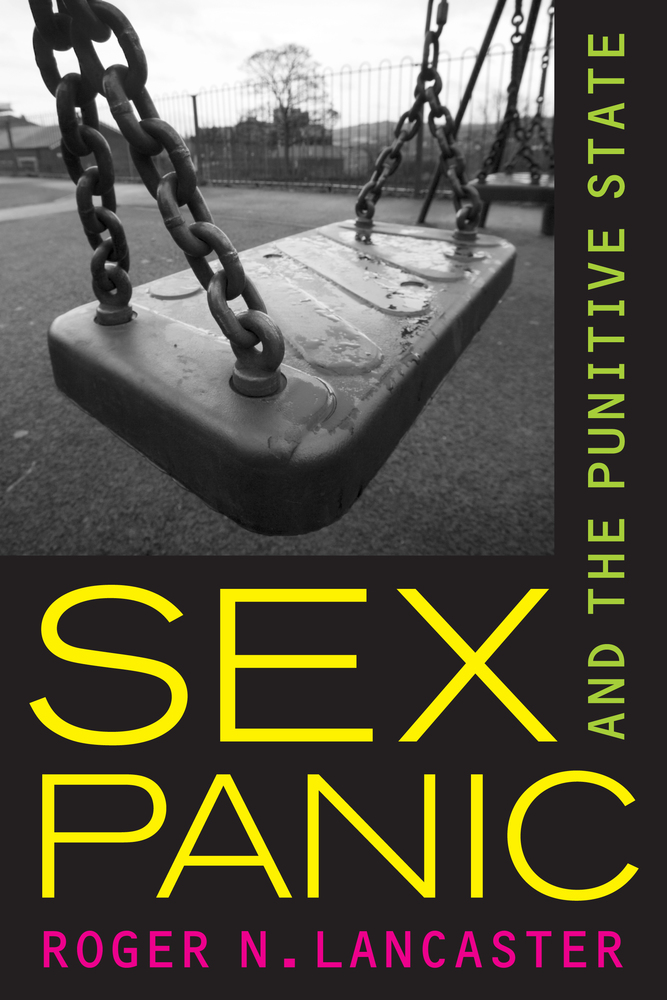
Pg. 99: Roger Lancaster's "Sex Panic and the Punitive State"

Today's feature at the Page 99 Test: Sex Panic and the Punitive State by Roger N. Lancaster.

About the book, from the publisher:
One evening, while watching the news, Roger N. Lancaster was startled by a report that a friend, a gay male school teacher, had been arrested for a sexually based crime. The resulting hysteria threatened to ruin the life of an innocent man. In this passionate and provocative book, Lancaster blends astute analysis, robust polemic, ethnography, and personal narrative to delve into the complicated relationship between sexuality and punishment in our society. Drawing on classical social science, critical legal studies, and queer theory, he tracks the rise of a modern suburban culture of fear and develops new insights into the punitive logic that has put down deep roots in everyday American life.
Read an excerpt from Sex Panic and the Punitive State, and learn more about the book at the University of California Press website.

Roger N. Lancaster is Professor of Anthropology and Cultural Studies at George Mason University and is the author of several books, including Life Is Hard and The Trouble with Nature.

The Page 99 Test: Sex Panic and the Punitive State.

--Marshal Zeringue