Friday, March 19, 2010

Lorraine Adams' best books

Lorraine Adams was educated at Princeton University and was a graduate fellow at Columbia University, where she received a master’s degree in literature. A staff writer for the Washington Post for 11 years, she won a Pulitzer Prize for investigative reporting. Her new novel is The Room and the Chair.

Adams named her six best books for The Week magazine. One book on her list:
Half of a Yellow Sun by Chimamanda Ngozi Adichie

Nigeria’s Biafran civil war is the subject of Adichie’s 2006 novel, a patient and intimate portrait of lives disrupted by atrocity and armed conflict. I was impressed by its poise: Adichie demonstrates just how convincingly a woman can write about war.
Read about another book on Adams' list.

Learn about the book that changed Chimamanda Ngozi Adichie's life.

See Chimamanda Ngozi Adichie's list of her favorite contemporary short-story collections.

--Marshal Zeringue

Thursday, March 18, 2010

Pg. 69: Adam Haslett's "Union Atlantic"

The current feature at the Page 69 Test: Union Atlantic by Adam Haslett.

About the book, from the publisher:
The eagerly anticipated debut novel from the author of the Pulitzer Prize finalist You Are Not a Stranger Here: a deeply affecting portrait of the modern gilded age, the first decade of the twenty-first century.

At the heart of Union Atlantic lies a test of wills between a young banker, Doug Fanning, and a retired schoolteacher, Charlotte Graves, whose two dogs have begun to speak to her. When Doug builds an ostentatious mansion on land that Charlotte's grandfather donated to the town of Finden, Massachusetts, she determines to oust him in court. As a senior manager of Union Atlantic bank, a major financial conglomerate, Doug is embroiled in the company's struggle to remain afloat. It is Charlotte's brother, Henry Graves, the president of the New York Federal Reserve, who must keep a watchful eye on Union Atlantic and the entire financial system. Drawn into Doug and Charlotte's intensifying conflict is Nate Fuller, a troubled high-school senior who unwittingly stirs powerful emotions in each of them.

Irresistibly complex, imaginative, and witty, Union Atlantic is a singular work of fiction that is sure to be read and reread long after it causes a sensation this spring.
Read an excerpt from Union Atlantic, and learn more about the book and author at Adam Haslett's website.

Adam Haslett is the author of You Are Not A Stranger Here, a short story collection, which was a finalist for a Pulitzer Prize and a National Book Award, and won the PEN/Winship Award. His work has appeared in The New Yorker, The Nation, Zoetrope, and Best American Short Stories as well as National Public Radio’s Selected Shorts.

The Page 69 Test: Union Atlantic.

--Marshal Zeringue

Top 10 wicked clerics

Paul Murray's first novel, An Evening of Long Goodbyes, was shortlisted for the Whitbread prize in 2003. The Irish writer has just published his second novel, Skippy Dies.

For the Guardian, he named a ten best list of the worst fictional clergymen.

One cleric on the list:
William Collins in Pride and Prejudice by Jane Austen

Mr Collins is one of Austen's most brilliant creations, and his proposal to Elizabeth Bennet is a comic tour de force. After setting out his reasons — good example to his flock; vague sense of altruism; really though because his patroness, Lady Catherine de Bourgh, has told him to — he assures Elizabeth of the violence of his affections. When she refuses him, he refuses, in turn, to believe her, pointing out that this is probably the only chance she will get. Two days later, he proposes to, and is accepted by, her more calculating friend Charlotte.
Read about another cleric on the list.

Pride and Prejudice also appears on John Mullan's list of ten great novels with terrible original titles, Luke Leitch's top ten list of the most successful literary sequels ever, and is one of the top ten works of literature according to Norman Mailer. Richard Price has never read it, but it is the book Mary Gordon cares most about sharing with her children.

The Page 99 Test: Jane Austen's Pride and Prejudice.

--Marshal Zeringue

Pg. 99: Japonica Brown-Saracino's "A Neighborhood That Never Changes"

The current feature at the Page 99 Test: A Neighborhood That Never Changes: Gentrification, Social Preservation, and the Search for Authenticity by Japonica Brown-Saracino.

About the book, from the publisher:
Newcomers to older neighborhoods are usually perceived as destructive, tearing down everything that made the place special and attractive. But as A Neighborhood That Never Changes demonstrates, many gentrifiers seek to preserve the authentic local flavor of their new homes, rather than ruthlessly remake them. Drawing on ethnographic research in four distinct communities—the Chicago neighborhoods of Andersonville and Argyle and the New England towns of Provincetown and Dresden—Japonica Brown-Saracino paints a colorful portrait of how residents new and old, from wealthy gay homeowners to Portuguese fishermen, think about gentrification.

The new breed of gentrifiers, Brown-Saracino finds, exhibits an acute self-consciousness about their role in the process and works to minimize gentrification’s risks for certain longtime residents. In an era of rapid change, they cherish the unique and fragile, whether a dilapidated house, a two-hundred-year-old landscape, or the presence of people deeply rooted in the place they live. Contesting many long-standing assumptions about gentrification, Brown-Saracino’s absorbing study reveals the unexpected ways beliefs about authenticity, place, and change play out in the social, political, and economic lives of very different neighborhoods.
Learn more about A Neighborhood That Never Changes at the University of Chicago Press website.

Japonica Brown-Saracino is Assistant Professor of Sociology at Loyola University Chicago. In August she will join the faculty of Boston University. She is the author of articles on gentrification, culture, and ethnography and is the editor of a forthcoming book, The Gentrification Debates (Routledge 2010).

The Page 99 Test: A Neighborhood That Never Changes.

--Marshal Zeringue

Wednesday, March 17, 2010

What is Dexter Palmer reading?

The current featured contributor at Writers Read: Dexter Palmer, author of The Dream of Perpetual Motion.

His entry begins:
Recently I finished The Bascombe Novels by Richard Ford, a collection of three novels that includes The Sportswriter, Independence Day, and The Lay of the Land. I picked it up because I’m trying to read fiction that’s outside my comfort zone—when it comes to late-twentieth-century writing I tend to prefer postmodernist comedies like Thomas Pynchon’s novels, and I wanted a change of pace. I really enjoyed Ford’s trilogy, perhaps even more than I liked John Updike’s similar project with the character of Rabbit Angstrom—taken together, the three novels are a master class in dynamic character development. Over time the character of Frank Bascombe, sportswriter turned real-estate agent, comes to seem almost like a real person, due to all the carefully chosen details that Ford uses to depict Bascombe’s habits and thoughts, as well as the endearingly meandering interior monologues that capture Bascombe’s attempts to...[read on]
Among the early praise for The Dream of Perpetual Motion:
“Palmer’s dazzling debut explodes with energy and invention on every page.”
Publishers Weekly (starred review)

“An intoxicatingly ambitious debut novel that somehow seems to encapsulate everything the author believes about everything…. A novel of ideas that holds together like a dream.”
Kirkus (starred review)

“[A] gorgeously surreal first novel… part farce, part act of willed convergence—an attempt to blur the lines between our reality and the fantastic imagined world.”
—Matthew Shaer, Bookforum

“Tender and sui generis: a steampunk The Tempest with the grim and rippling beauty of a fairy tale. Dexter Palmer is an ambitious writer, with vast reach toward the exploration of big ideas, among them what it means to create, the limits of the human body, and the uses and inadequacies of language. The marvelous kicker being, of course, that he has the moxie to do so in prose that sings.”
—Lauren Groff, New York Times bestselling author of The Monsters of Templeton

“A strange, passionate, enthralling first novel, a novel which is itself a kind of perpetual motion machine—constantly turning, giving off more energy than it receives, its movement at once beautiful and counterintuitive.”
—Kevin Brockmeier, New York Times bestselling author of The Brief History of the Dead
Writers Read: Dexter Palmer.

--Marshal Zeringue

Top ten books on Percy Bysshe Shelley

In 2005 Julian Roach named a top list of books about Percy Bysshe Shelley for the Guardian.

One title on the list:
Shelley: The Pursuit, by Richard Holmes

Thirty years and more now since the last definitive, indispensable - and so forth - biography of Shelley appeared. In the ordinary succession of things, you'd expect a big new book from someone, somewhere, would by now have been brought to market with much trumpeting as the new definitive, indispensible and so forth bees-knees job. Don't go down to Waterstone's with the sleeping bag to wait for it: Richard Holmes is likely to be the only serious claimant to the title for at least as long again as he has been already. The acknowledged legislator. His colon may be entirely ignored.
Read about another book on the list.

--Marshal Zeringue

Coffee with a canine: Carrie Jones & Tala

Today's featured couple at Coffee with a Canine: Carrie Jones & Tala.

Jones, on how she and Tala were united:
We met in Western Maine. She was rolling around on the grass, drooling. It was love at first...[read on]
Carrie Jones graduated from Vermont College’s MFA program for writing. She has edited newspapers and poetry journals and has won awards from the Maine Press Association and also been awarded the Martin Dibner Fellowship as well as a Maine Literary Award.

Her books include Girl, Hero, Love (and Other Uses for Duct Tape), Tips on Having a Gay (Ex) Boyfriend, and Need.

Visit
Carrie Jones' website and LiveJournal.

Read--Coffee with a Canine: Carrie Jones & Tala.

--Marshal Zeringue

Pg. 69: Nancy Martin's "Our Lady of Immaculate Deception"

Today's feature at the Page 69 Test: Our Lady of Immaculate Deception by Nancy Martin.

About the book, from the publisher:
Big truck, big dog, big hair. Bad attitude.

Roxy Abruzzo, bestseller Nancy Martin’s latest creation, is a loud-mouthed, sexy, independent-minded niece of a Pittsburgh Mafia boss trying to go (mostly) straight. She’d like to stay completely out of her uncle Carmine’s shady business dealings, though he's trying to reel her in. She'd like to concentrate on the architectural salvage business she runs mostly on the up and up for a tidy profit. She'd like to keep her rebellious teenage daughter on the straight and narrow. But Roxy knows where all the good intentions in the world usually lead, and when she can’t help herself from tucking away an ancient Greek statue that's not really hers, she pays for it by getting caught up in the chaos surrounding the sordid murder of the statue’s former owner, heir to a billion-dollar Pittsburgh steel fortune.

Of course, she has plenty of help getting in and out of trouble, including her sidekick “Nooch” Santonucci, too dumb to say no to whatever Roxy wants to do and strong enough to do it; her widowed aunt Loretta, a lawyer whose big hair and short skirts are as big a help to her in court as her brains; and Patrick Flynn, ex-marine, professional chef, and former high school flame, fresh from Afghanistan to torture Roxy, just like old times.

With her wicked sense of humor and a devilishly clever new series premise, author of the beloved Blackbird Sisters mysteries Nancy Martin has crafted another mystery destined to be a bestseller.
Read an excerpt from Our Lady of Immaculate Deception, and visit Nancy Martin's website and blog.

Nancy Martin is the author of nearly 50 pop fiction novels including the Blackbird Sisters Mystery Series. She serves on the board of Sisters in Crime and received the 2009 Romantic Times magazine Lifetime Achievement award for mystery writing. Our Lady of Immaculate Deception has received starred reviews from Publishers Weekly and Library Journal. One blurb calls the book “a good time in a bad neighborhood.”

The Page 69 Test: Our Lady of Immaculate Deception.

--Marshal Zeringue

Tuesday, March 16, 2010

Pg. 99: Timothy Stanley's "Kennedy vs. Carter"

The current feature at the Page 99 Test: Kennedy vs. Carter: The 1980 Battle for the Democratic Party’s Soul by Timothy Stanley.

About the book, from the publisher:
The late Edward Kennedy’s liberal credentials were unimpeachable, and perhaps never as much on display as when he challenged incumbent Jimmy Carter for the presidency. Most accounts of modern U.S. politics view Ronald Reagan’s landslide election in 1980 as a conservative realignment of the American public—and Kennedy’s defeat in the Democratic primaries as the last hurrah of New Deal liberalism. Now an astute observer of the American scene reexamines those primary battles to contend that Kennedy’s insurgent campaign was more popular than historians have presumed and was defeated only by historical accident and not by its perceived radicalism.

Timothy Stanley takes a new look at how Jimmy Carter alienated his own supporters, why Ted Kennedy ran against him, what the Kennedy campaign has to say about America in the 1970s, and whether or not the 1980 election really was a turning point in electoral history. He tells the story of a struggle for the soul for a party bitterly divided over how to respond to economic decline, cultural upheaval, and humiliation overseas. And in the telling, he offers both a comprehensive narrative of the primaries and a joint biography of the two men who struggled for their party’s leadership.

Stanley’s comprehensive research draws on more than a dozen archives as well as interviews with nearly thirty key historical players—including George McGovern, Walter Mondale, Gary Hart, and Mike Dukakis—and also makes creative use of polling data to recreate the ebb and flow of the election season. What emerges is not only the story of a campaign but also a revisionist history of a misunderstood decade—one most often defined by religious reawakening, chronic inflation, and the tax revolt that revived Republican fortunes. Yet Kennedy’s crusade to rebuild the ailing New Deal coalition of ethnic minorities, blue-collar conservatives, and firebrand liberals was popular enough to suggest that Americans were neither liberal nor conservative but, instead, anxious, angry, and desperate for leadership from any direction.

Kennedy vs. Carter provides a unique analysis of how support shifted from Carter to Reagan right up to election day, with Reagan elected largely because he was not the unpopular incumbent. By showing how Kennedy was a far more popular politician than orthodox historiography has suggested, Stanley argues for a more nuanced understanding of what really determines political outcomes and a greater appreciation for the enduring popularity of American liberalism.
Learn more about Kennedy vs. Carter at the publisher's website.

Timothy Stanley is Leverhulme Research Fellow, Royal Holloway College, University of London, and coauthor of The End of Politics: Triangulation, Realignment and the Battle for the Centre Ground.

The Page 99 Test: Kennedy vs. Carter.

--Marshal Zeringue

Craig McDonald's "Print the Legend," the movie

Now showing at My Book, The Movie: Print the Legend by Craig McDonald.

The entry begins:
Like many novelists, I’ve had my intoxicating near-brushes with film adaptation.

Based solely on its description in a Publishers Lunch announcement, my debut novel, Head Games, attracted quite a bit of film interest. My own secret choice to play my continuing character Hector Lassiter in that novel, bizarrely enough, asked my publisher for a look at the novel. My vision of Hector Lassiter almost came to me.

Like most novelists who get Hollywood nibbles, my chance to have my first-choice actor portray my ongoing character didn’t bite firmly enough to be reeled in.

Print the Legend, my third novel, again features crime novelist Hector Lassiter, who is popularly known as the “man who lives what he writes and writes what he lives.”

Print the Legend explores the death of Ernest Hemingway in Ketchum, Idaho, in the summer of 1961, and raises questions regarding the possibility that Hem’s death was something other than an act of suicide. The novel also explores J. Edgar Hoover’s crazed and too-often destructive surveillance of key American writers, including not just Hemingway, but Carl Sandburg, John Steinbeck, William Faulkner and Dorothy Parker, among many others.

Hector Lassiter has centered two previous novels, both of which dropped Hector on to famous film sets: Head Games found Hector visiting the set of Orson WellesTouch of Evil. Toros & Torsos placed Hector on the set of The Lady From Shanghai. Because my novels tend to spread over decades and to dart in and out of time, they present certain challenges in casting. In Toros & Toros, we variously encounter 35-, 37-, 47-, 59- and 61-year-old Hector.

Print the Legend, on the other hand, is set largely in the mid-to-late 1960s. Hector’s age ranges from 65 to 72 through this novel. I’ve long established that Hector bears a strong resemblance to actor...[read on]
Read more about Print the Legend, and learn more about the author and his work at Craig McDonald's website and blog.

Read "The Story Behind the Story: Print the Legend, by Craig McDonald," at The Rap Sheet.

The Page 69 Test: Toros & Torsos.

The Page 69 Test: Head Games.

The Page 69 Test: Print the Legend.

My Book, The Movie: Print the Legend.

--Marshal Zeringue

Five best books about Ireland

Frank Delaney's novel Venetia Kelly's Traveling Show was recently published by Random House.

For the Wall Street Journal he named a five best list of books on Ireland. One title on the list:
Ulysses
by James Joyce
1922

Try it again—be patient, and this time you'll finish. And this time "Ulysses" will repay the effort. Inside these nearly 300,000 words, written by the great, semi-blind Modernist, lies a spiritual trove. Joyce's tenet—in the particular lies the universal—captures two beliefs that could power the world: that there is no such thing as a person too unimportant for art's focus; and that love of fellow man, with its attendant forgiveness, does indeed conquer all. Reading about the urban peregrinations of the unaudacious Leopold Bloom on a single June day in 1904, you will encounter the English language in its widest variety, from the street patois of Edwardian Dublin to sentences and paragraphs as classically beautiful and vivacious as Mozart's notes.
Read about another book on Delaney's list.

Ulysses also made John Mullan's lists of the ten of the best parodies, ten of the best visits to the lavatory, and ten of the best vegetables in literature. Unsurprisingly, it appears on Frank Delaney's top ten list of Irish novels.

--Marshal Zeringue

Monday, March 15, 2010

What is Malena Watrous reading?

The current featured contributor at Writers Read: Malena Watrous, author of the newly released If You Follow Me.

Part of her entry:
Another great novel that I read most recently was one that I reviewed for the San Francisco Chronicle: The Gin Closet, by Leslie Jamison. This is a novel about a young woman who discovers that she has an aunt she never knew existed, a sort of prodigal daughter who ran away to the desert of Nevada, where she has been living in squalor in a trailer, after working most of her adult life as a prostitute. The setup is extreme, but the characters are heartbreakingly real. Jamison’s novel alternates between the first person voices of the niece and the aunt, very different but equally strong and compelling. Flannery O’Connor famously wrote that the end of a story should be at once surprising and inevitable, and Jamison somehow manages to achieve this neat effect on the sentence level. While I was definitely drawn in by the bigger story, and wanted to find out what was going to happen to these two troubled women, I savored the novel for its sentences and actually...[read on]
Malena Watrous attended Barnard College, where she majored in English. After teaching English in rural Japan for two years she attended the University of Iowa Writers’ Workshop on a Truman Capote Fellowship. In 2002, she was the recipient of a Wallace Stegner Fellowship at Stanford University, followed by a Jones Lectureship. She now works for Stanford as a head instructor in the Online Writer’s Workshop. Her stories and essays have appeared in The Alaska Quarterly Review, The Believer, GlimmerTrain, The Massachussetts Review, Salon.com, StoryQuarterly, TriQuarterly, and elsewhere. She contributes regular book reviews to the San Francisco Chronicle and the New York Times.

If You Follow Me is at once a coming-of-age, fish-out-of-water tale, a dark comedy of manners, and a strange kind of love story. It won a Michener-Copernicus award, and sections have been awarded a Glimmertrain Fiction Open award and runner-up in the Faulkner/Pirate’s Alley Contest.

Read early praise for the novel.

Browse inside If You Follow Me, and learn more about the book and author at the official Malena Watrous website and blog.

Writers Read: Malena Watrous.

--Marshal Zeringue

Pg. 69: Howard Frank Mosher's "Walking to Gatlinburg"

The current feature at the Page 69 Test: Walking to Gatlinburg by Howard Frank Mosher.

About the book, from the publisher:
A stunning and lyrical Civil War thriller, Walking to Gatlinburg is a spellbinding story of survival, wilderness adventure, mystery, and love in the time of war.

Morgan Kinneson is both hunter and hunted. The sharp-shooting 17-year-old from Kingdom County, Vermont, is determined to track down his brother Pilgrim, a doctor who has gone missing from the Union Army. But first Morgan must elude a group of murderous escaped convicts in pursuit of a mysterious stone that has fallen into his possession.

It’s 1864, and the country is in the grip of the bloodiest war in American history. Meanwhile, the Kinneson family has been quietly conducting passengers on the Underground Railroad from Vermont to the Canadian border. One snowy afternoon Morgan leaves an elderly fugitive named Jesse Moses in a mountainside cabin for a few hours so that he can track a moose to feed his family. In his absence, Jesse is murdered, and thus begins Morgan’s unforgettable trek south through an apocalyptic landscape of war and mayhem.

Along the way, Morgan encounters a fantastical array of characters, including a weeping elephant, a pacifist gunsmith, a woman who lives in a tree, a blind cobbler, and a beautiful and intriguing slave girl named Slidell who is the key to unlocking the mystery of the secret stone. At the same time, he wrestles with the choices that will ultimately define him – how to reconcile the laws of nature with religious faith, how to temper justice with mercy. Magical and wonderfully strange, Walking to Gatlinburg is both a thriller of the highest order and a heartbreaking odyssey into the heart of American darkness.
Read an excerpt from Walking to Gatlinburg.

Howard Frank Mosher is promoting Walking to Gatlinburg on a 100-city book tour titled “Transforming History into Fiction: the Story of a Born Liar.” Check the itinerary on his website and follow updates on his blog.

The Page 69 Test: Walking to Gatlinburg.

--Marshal Zeringue

Lynda Bellingham's six best books

Lynda Bellingham is best-known for roles in All Creatures Great And Small and At Home With The Braithwaites. Her memoir Lost And Found: My Story is out now in Britain.

She told the Daily Express about her six best books. One title on the list:
The Girl with the Dragon Tattoo
by Stieg Larsson

Compulsive reading. The heroine is such an unlikely one – a computer hacker with tattoos and piercings – as is the hero Blomqvist, an investigative journalist who falls into this tale of corruption and murder in a family. It gives such a flavour of Sweden, too.
Read about another book on Bellingham's list.

The Girl with the Dragon Tattoo made Camilla Läckberg's top ten list of Swedish crime novels.

--Marshal Zeringue

Coffee with a canine: Beth Solheim and Andrea & Angus

Today's featured trio at Coffee with a Canine: Beth Solheim and Andrea & Angus.

Solheim, on whether Angus would get along with Belly LaGossa, a dog character in her Sadie Witt Mystery Series:
Belly Lagossa is the Witt sister’s canine of questionable heritage. Actually, Belly doesn’t belong to the sisters. He belongs to the neighbor. Belly doesn’t know that, though, and has taken up residence with a regal flair in Cabin 14. He dines off hand-painted china, samples questionable culinary offerings, and sleeps on a satin pillow. He also sees dead people. Ever wonder why dogs run along with their nose to the ground? Could Belly be on the trail of a crosser?

Belly has long legs, a stubby nose, a rotund body covered in brown spots, and a cropped-off tail with four elongated hairs growing out of a bald portion of its tip. Even though his physique resembles a cement truck, he has a weasel’s knack at sneaking into locations at the wrong time. Specifically, the mortuary next door. He also has only one testicle.

Angus and Belly would be fast friends, and most likely vie for...[read on]
Like the main character in her Sadie Witt mystery series, Beth Solheim was born with a healthy dose of imagination and a hankering to solve a puzzle. She learned her reverence for reading from her mother, who was never without a book in her hand.

By day, Solheim works in Human Resources. By night she morphs into a writer who frequents lake resorts and mortuaries and hosts a ghost or two in her humorous paranormal mysteries.

The first book in her cozy mystery series
Sadie Witt Mysteries, At Witt's End, is now available in paperback. The second in the series, titled Outwitted, will be released in 2011.

Raised and still living in Northern Minnesota, she resides in lake country with her husband.


Visit
Beth Solheim's website and blog.

Read--Coffee with a Canine: Beth Solheim and Andrea & Angus.

--Marshal Zeringue

Pg. 99: Elizabeth Rose's "The Promise of Preschool"

Today's feature at the Page 99 Test: The Promise of Preschool: From Head Start to Universal Pre-Kindergarten by Elizabeth Rose.

About the book, from the publisher:
The past 45 years have seen the emergence of education for young children as a national issue, spurred by the initiation of the Head Start program in the 1960s, efforts to create a child care system in the 1970s, and the campaign to reform K-12 schooling in the 1980s. Today, the push to make preschool the beginning of public education for all children has gained support in many parts of the country and promises to put early education policy on the national agenda. Yet questions still remain about the best ways to shape policy that will fulfill the promise of preschool.

In The Promise of Preschool, Elizabeth Rose traces the history of decisions on early education made by presidents from Lyndon Johnson to George W. Bush, by other lawmakers, and by experts, advocates, activists, and others. Using this historical context as a lens, the book shows how the past shapes today's preschool debate and provides meaningful perspective on the policy questions that need to be addressed as we move forward: Should we provide preschool to all children, or just to the neediest? Should it be run by public schools, or incorporate private child care providers? How do we most effectively ensure educational quality and success?

The Promise of Preschool is a balanced, in-depth investigation into these and other important questions and demonstrates how an understanding of the past can stimulate valuable debate about the care and education of young children today.
Learn more about the book and author at the official The Promise of Preschool website and the Oxford University Press webpage.

The Page 99 Test: The Promise of Preschool.

--Marshal Zeringue

Sunday, March 14, 2010

Ten of the best men writing as women in literature

At the Guardian, John Mullan named a list of ten of the best men writing as women in literature.

One book on the list:
Kazuo Ishiguro

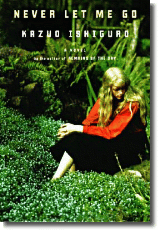
In Never Let Me Go, Kathy H looks back on her upbringing at a liberal yet oddly oppressive English boarding school. Much space is given to her recollection of her awakening sexuality. At first you might think this is awkwardly done because the author is male, but then you realise there's another, darker reason...
Read about another book on the list.

Mullan has previously commented more extensively on Never Let Me Go.

Never Let Me Go is one of the (London) Times 100 best books of the last decade.

--Marshal Zeringue

Pg. 69: Walter Greatshell's "Xombies: Apocalypticon"

The current feature at the Page 69 Test: Xombies: Apocalypticon by Walter Greatshell.

About the book, from the publisher:
Survivors of a cataclysmic zombie-making plague leave a temporary safety of a refitted nuclear sub to scavenge for food and supplies on land. But they soon find themselves facing new terrors on the surface and mutiny below.
Learn more about the book and author at Walter Greatshell's website and blog.

My Book, The Movie: Xombies: Apocalypse Blues.

The Page 69 Test: Xombies: Apocalypticon.

--Marshal Zeringue

Saturday, March 13, 2010

Five best novels on Hollywood

Jane Ciabattari is the author of the critically acclaimed short-story collection, Stealing the Fire.

For The Daily Beast, she named a five best list of novels on Hollywood. One title on the list:
Children of Light
by Robert Stone

Welcome to Heebiejeebieville. Cross-addicted star-crossed lovers converge on a film set in Mexico in the late 1970s, before Hollywood embraced 12-step programs.

Walter, a fortyish actor turned script writer, is an unwelcome guest to the set; he arrives drunk, bearing cocaine and Quaaludes. Louisiana-born actress Lu Anne has gone off her meds; she thinks they damage her work in the starring role. She is hallucinating “Long Friends” and offering her “secret eyes” to the camera. The film being shot? Get this: Walter’s adapation of the feminist classic The Awakening by Kate Chopin, in which Edna commits suicide by walking into the water. Lu Anne is basing her mood on Walter’s notes, which have Edna dying for “life more abundant.” “She has come beyond despair to a kind of exaltation.”

Among those watching from the sidelines: the Drogues, a father-son director duo focused on getting the work no matter what (“She has a way of being crazy that photographs well,” the elder Drogue says); Lowndes, a New York-based journalist who falls off the wagon out of lust for Lu Anne, and Billy Bly, a bisexual stunt man who serves as her emotional anchor.

Stone’s dialogue is sharp, his eye for corruption, spoilage, and backbiting acute, as in this comment Walter makes to Lu Anne: “Funny about last night. You’re with Lowndes, you go off with me. You’re with me, you go off with Bly. Lots of La Ronde, entrances and exits, bedrooms and closed doors and nobody really gets any. Very Hollywood.”

With Children of Light, Stone freeze-frames a Hollywood era in crystalline prose.

P.S. “High Wire,” a short story in Stone’s new collection, Fun with Trouble, reprises the plotline: an alcoholic Hollywood screenwriter is addicted to a bipolar actress.
Read about another novel on the list.

Also see Whit Stillman's five best list of books about Hollywood and Robert Osborne's five best list of books about Hollywood.

--Marshal Zeringue

Pg. 99: Paul Thagard's "The Brain and the Meaning of Life"

This weekend's feature at the Page 99 Test: The Brain and the Meaning of Life by Paul Thagard.

About the book, from the publisher:
Why is life worth living? What makes actions right or wrong? What is reality and how do we know it? The Brain and the Meaning of Life draws on research in philosophy, psychology, and neuroscience to answer some of the most pressing questions about life's nature and value. Paul Thagard argues that evidence requires the abandonment of many traditional ideas about the soul, free will, and immortality, and shows how brain science matters for fundamental issues about reality, morality, and the meaning of life. The ongoing Brain Revolution reveals how love, work, and play provide good reasons for living.

Defending the superiority of evidence-based reasoning over religious faith and philosophical thought experiments, Thagard argues that minds are brains and that reality is what science can discover. Brains come to know reality through a combination of perception and reasoning. Just as important, our brains evaluate aspects of reality through emotions that can produce both good and bad decisions. Our cognitive and emotional abilities allow us to understand reality, decide effectively, act morally, and pursue the vital needs of love, work, and play. Wisdom consists of knowing what matters, why it matters, and how to achieve it.

The Brain and the Meaning of Life shows how brain science helps to answer questions about the nature of mind and reality, while alleviating anxiety about the difficulty of life in a vast universe. The book integrates decades of multidisciplinary research, but its clear explanations and humor make it accessible to the general reader.
Read an excerpt from The Brain and the Meaning of Life, and learn more about the book at the Princeton University Press website.

Visit Paul Thagard's University of Waterloo faculty webpage and blog for Psychology Today.

The Page 99 Test: The Brain and the Meaning of Life.

--Marshal Zeringue

What is Christopher Norment reading?

This weekend's featured contributor to Writers Read: Christopher Norment, author of Return to Warden's Grove: Science, Desire, and the Lives of Sparrows.

His entry begins:
I’ve just finished American Rust, by Phillipp Meyer, which is one of the best novels I’ve read in the last year. It’s a powerful story about moral choices, and human determination to persist in the face of failure and despair. American Rust is set in the coal and manufacturing country of southwestern Pennsylvania, a once-prosperous region facing desperate economic times. Meyer does a wonderful job of describing the decaying towns of the Monongahela Valley, and the contrasting beauty of a natural landscape exploding into spring. What he’s best at, though, is giving voice to the emotions and experiences of a diverse range of characters, from two twenty-year-old men, to a middle-aged mother, and the local chief of police. Meyer uses a stream of consciousness style to depict how the minds of his main characters work, and he captures the haphazard, disjointed, and ambivalent essence of this process. American Rust is great fiction because it...[read on]
Christopher Norment is a professor of environmental science and biology at SUNY College at Brockport, where he specializes in the breeding biology and ecology of migratory birds.

In addition to numerous scientific articles, he is the author of In the North of Our Lives and Return to Warden's Grove: Science, Desire, and the Lives of Sparrows.

Among the praise for Return to Warden's Grove:
“[T]his book is a joy--an adventure story, incredibly lyrical writing about the far North, a commentary on how we live our lives and what most of us must give up in order to live conventionally. It is a dream song, a love poem, a meditation on life--and I feel it ranks among the best nature writing I have ever read--from Thoreau to Muir to Matthiesson. You will be entranced.”
Jerald Winakur, author of Memory Lessons: A Doctor's Story

“Norment’s cabin, like Thoreau’s, opens into the widest prospects of hearts and minds. Return to Warden’s Grove is a story of fortitude, love of truth, and a wandering, wondering heart. The picture appears gradually, humbly, in the repeated daily acts of minute observational and intellectual honesty from which science is built. He is willing to feel and question everything. What good is science? How much of science secretly draws from intuition, heart, and that mysterious connectedness to the natural world that no one can explain, or explain away? And how can a person really be at home anywhere? I don’t know of another work that better engages these foundational questions.”
David Oates, essayist and poet
Visit Chris Norment's faculty webpage where you will find links to excerpts and reviews of his books.

Writers Read: Christopher Norment.

--Marshal Zeringue

Friday, March 12, 2010

Kristina Springer's "The Espressologist," the movie

Now showing at My Book, The Movie: The Espressologist by Kristina Springer.

The entry begins:
I’ve always thought The Espressologist would make a super cute movie—as I wrote it, it kind of played out as a movie in my head. Though I have to say that I didn’t think of specific actors while writing.

Since, however, I’ve assembled my dream cast list: As the sweet and funny Jane: Selena Gomez from Wizards of Waverly Place. As the adorable and kinda goofy Cam: Cory Monteith from Glee. As best friend Em...[read on]
Read an excerpt from The Espressologist.

Learn more about Kristina Springer and her books at her website and blog, and become a Facebook fan of The Espressologist.

Writers Read: Kristina Springer.

The Page 69 Test: The Espressologist.

My Book, The Movie: The Espressologist.

--Marshal Zeringue

Five favorite books of Appalachia

Katie Pickard Fawcett, who grew up in the hills of eastern Kentucky, is the author of a newly released novel for young readers, To Come and Go Like Magic; it's about 12 year-old Chili Mahoney, who has never been outside of her small Appalachian town.

She named her five favorite books of Appalachia for C.M. Mayo's "Madam Mayo" blog. One book on the list:
Shiloh and Other Stories by Bobbie Ann Mason

Miss Mason's Kentucky people are caught in the great flood of change that first hit the area in the 1970s. They juggle the old and the new, trying to hold onto rural traditions while coping with shopping malls, TV evangelists, and women's lib. Mason's women learn to cook strange new dishes, sign up for college courses for the first time, or take up a musical instrument. In one story a preacher's wife gets hooked on video games; in another a bus driver dreams of being a New-Wave disc jockey. The dialogue, details, and insight in this collection give a rich and authentic portrait of a place, a time, and a people.
Read about another book on the list.

Visit Katie Pickard Fawcett's blog, Kite Dreams.

--Marshal Zeringue

Pg. 69: Thomas Kaufman's "Drink the Tea"

The current feature at the Page 69 Test: Drink the Tea by Thomas Kaufman.

About the book, from the publisher:
Willis Gidney is a born liar and rip-off artist, an expert at the scam. Growing up without parents or a home, by age twelve he is a successful young man, running his own small empire, until he meets Shadrack Davies. That’s Captain Shadrack Davies, of the D.C. Police. Davies wants to reform Gidney and becomes his foster father. Though he tries not to, Gidney learns a small amount of ethics from Shad---just enough to bother a kid from the streets for the rest of his life.

Now Gidney is a PI, walking those same streets. So it's no surprise that when his closest friend, jazz saxophonist Steps Jackson, asks Gidney to find his missing daughter, Gidney is compelled to say yes---even though she's been missing for twenty-five years. He finds a woman who may be the girl’s mother--and within hours she turns up dead. The police accuse Gidney of the murder and throw him in jail.

Maybe Gidney should quit while he’s behind. But when his investigation puts him up against a ruthless multinational corporation, a two-faced congressman, and a young woman desperate to conceal her past, Gidney has no time left for second thoughts. In fact, he may have no time left at all.

Thomas Kaufman is a winner of the PWA Best First Private Eye Novel Competition. His debut novel, Drink the Tea, which boasts an original PI and an engaging cast of characters, adds a fresh perspective to the genre.
View the trailer for Drink the Tea, and learn more about the book and author at Thomas Kaufman's website and blog.

Thomas Kaufman is an award-winning motion picture director and cameraman. He has twice won the Gordon Parks Award for Cinematography, and an Emmy for his documentary about deaf children, See What I'm Saying.

The Page 69 Test: Drink the Tea.

--Marshal Zeringue

Thursday, March 11, 2010

Pg. 99: Charles Kupchan's "How Enemies Become Friends"

The current feature at the Page 99 Test: How Enemies Become Friends: The Sources of Stable Peace by Charles A. Kupchan.

About the book, from the publisher:
Is the world destined to suffer endless cycles of conflict and war? Can rival nations become partners and establish a lasting and stable peace? How Enemies Become Friends provides a bold and innovative account of how nations escape geopolitical competition and replace hostility with friendship. Through compelling analysis and rich historical examples that span the globe and range from the thirteenth century through the present, foreign policy expert Charles Kupchan explores how adversaries can transform enmity into amity--and he exposes prevalent myths about the causes of peace.

Kupchan contends that diplomatic engagement with rivals, far from being appeasement, is critical to rapprochement between adversaries. Diplomacy, not economic interdependence, is the currency of peace; concessions and strategic accommodation promote the mutual trust needed to build an international society. The nature of regimes matters much less than commonly thought: countries, including the United States, should deal with other states based on their foreign policy behavior rather than on whether they are democracies. Kupchan demonstrates that similar social orders and similar ethnicities, races, or religions help nations achieve stable peace. He considers many historical successes and failures, including the onset of friendship between the United States and Great Britain in the early twentieth century, the Concert of Europe, which preserved peace after 1815 but collapsed following revolutions in 1848, and the remarkably close partnership of the Soviet Union and China in the 1950s, which descended into open rivalry by the 1960s.

In a world where conflict among nations seems inescapable, How Enemies Become Friends offers critical insights for building lasting peace.
Read an excerpt from How Enemies Become Friends, and learn more about the book at the Princeton University Press website.

Charles A. Kupchan is professor of international affairs at Georgetown University and senior fellow at the Council on Foreign Relations. He served on the National Security Council during the Clinton presidency and is the author of The End of the American Era (Knopf).

The Page 99 Test: How Enemies Become Friends.

--Marshal Zeringue

Seven best fiction books about WASPs

Tad Friend, author of Cheerful Money, named a "7 Best Novels About WASPs" list for Flashlight Worthy.

One book on the list:
Revolutionary Road
by Richard Yates

About the bleakest book you'll ever read, yet its bleakness is vivid and hypnotic. Wasps playacting and posing in the mirror to see how they stack up against their own dreams (not well). The first great novel about misery in the suburbs, and a template for the TV show "Mad Men."
Read about another novel on the list.

Revolutionary Road also appears on Laura Dave's list of books that improve on re-reading.

--Marshal Zeringue

What is Gardner McFall reading?

The current featured contributor at Writers Read: Gardner McFall, author of new works including an opera libretto for an opera commissioned by Seattle Opera (music by Daron Hagen, story by Stephen Wadsworth), entitled Amelia, and a new book of poems, Russian Tortoise.

Her entry begins:
I've been reading On Kindness (FSG, 2009) by Adam Phillips and Barbara Taylor, a very readable, thought-provoking 114 page essay on the history of kindness and its place in our culture today. Written by a psychoanalyst and an historian, the book shows that while kindness has historically been essential to the Western idea of the Good Life, we are ambivalent about it in our own age of self-interest. The authors remind us of the reasons we need to embrace kindness for our children and ourselves since it is the key to our community and humanity. They draw on fascinating sources, without ever being...[read on]
Gardner McFall is the author of a book of poems, The Pilot's Daughter, and two children's books: Jonathan's Cloud and Naming the Animals.

She is the editor of Made With Words, a prose miscellany by May Swenson and has written the Introduction and Notes for Kenneth Grahame's The Wind in the Willows. She received her Ph.D. from New York University, her M.A. from Johns Hopkins University, and her B.A. from Wheaton College. McFall teaches at Hunter College.

Among the early praise for Russian Tortoise:
The poems in Gardner McFall's Russian Tortoise are informed by a sense of fragility and loss. In this they may be said to be elegiac in tone. But these elegies are concerned not so much with lamenting the dead than with using the example the dead have provided to celebrate lives of common beauty and to do justice to the odd, the wayward, and the broken. The result is a wise and moving book.
—Carl Dennis

I have admired Gardner McFall's work since I first read The Pilot's Daughter—her first and important book, with its poignant poems exploring the love and grief of a daughter who lost her father to the conflict in Vietnam. I have long waited for her next book, and now, happily, here it is, filled with the rich, wise, and beautiful poems of maturity. Gardner McFall's poems tell us much we need to know about full vision, blocked vision, and the partial vision of being human.
—Jan Heller Levi

Their patient gravity enlivened by sly flickers of humour, the best poems in Gardner McFall's second collection turn an attentive gaze on creatures (the eponymous tortoise; a house cat; a water buffalo) whose significance feels totemic.... Many of these poems have an undertow of sorrow and loss, the more effective because of their restraint.
—Rachel Hadas, The Times Literary Supplement
Writers Read: Gardner McFall.

--Marshal Zeringue

Wednesday, March 10, 2010

Pg. 69: Mario Acevedo's "Werewolf Smackdown"

The current feature at the Page 69 Test: Werewolf Smackdown by Mario Acevedo.

About the book, from the publisher:
Felix Gomez, Latino vampire detective extraordinaire, tackles a dangerous werewolf cabal in the fifth installment in Mario Acevedo's satirical supernatural series

A sure-to-be-bloody civil war is brewing between rival werewolf factions, and P.I . Felix Gomez will do anything he can to make sure it doesn't explode into a vicious battle that engulfs all creatures, living and dead.

Between that, the sudden reappearance of an ex-girlfriend, and a gang of other vampires trying to take off his head, this is one rumble even a fanged detective extraordinaire may not be able to handle.
Read an excerpt from Werewolf Smackdown, and learn more about the author and his work at Mario Acevedo's website and blog.

Watch the video trailer for Werewolf Smackdown.

The Page 69 Test: The Nymphos of Rocky Flats.

The Page 69 Test: The Undead Kama Sutra.

The Page 99 Test: Jailbait Zombie.

The Page 69 Test: Werewolf Smackdown.

--Marshal Zeringue

Top ten talkative novels

Frederic Raphael is probably best known as the author of Glittering Prizes and its sequel Fame and Fortune. This month, he publishes a third volume in this series, Final Demands. He also collaborated on Stanley Kubrick's final film, Eyes Wide Shut. "Dialogue in a novel is like stained glass, the surrounding prose is there to frame and support it," he tells the Guardian in the prefatory remarks to his top ten list of talkative novels.

One novel on the list:
Appointment in Samarra by John O'Hara

O'Hara was a keen observer, above all of the Pennsylvania Dutch inhabitants of the town he called Gibbsville (a permeable disguise for his birthplace, Pottsville). He could mimic local speech and vocabulary so that the reader can overhear it. The story of the life and death of Julian English is a masterpiece of erotic suggestion and narrative economy.
Read about another book on the list.

Appointment in Samarra is one of Tom Wolfe's five most important books.

--Marshal Zeringue

Pg. 99: Columba Peoples’ "Justifying Ballistic Missile Defence"

Today's feature at the Page 99 Test: Justifying Ballistic Missile Defence: Technology, Security and Culture by Columba Peoples.

About the book, from the publisher:
Technology is championed as the solution to modern security problems, but also blamed as their cause. This book assesses the way in which these two views collide in the debate over ballistic missile defense: a complex, costly and controversial system intended to defend the United States from nuclear missile attacks. Columba Peoples shows how, in the face of strong scientific and strategic critique, advocates of missile defense seek to justify its development by reference to broader culturally embedded perceptions of the promises and perils of technological development. Unpacking the assumptions behind the justification of missile defense initiatives, both past and present, this book illustrates how common-sense understandings of technology are combined and used to legitimate this controversial and costly defense program. In doing so it engages fundamental debates over understandings of technological development, human agency and the relationship between technology and security.
Read an excerpt from Justifying Ballistic Missile Defence, and learn more about the book at the Cambridge University Press website.

Columba Peoples is Lecturer in International Relations in the Department of Politics at the University of Bristol.

The Page 99 Test: Justifying Ballistic Missile Defence.

--Marshal Zeringue

Tuesday, March 09, 2010

John McFetridge's "Let It Ride," the movie

Now showing at My Book, The Movie: Let It Ride by John McFetridge.

The entry begins:
Yes, I do cast my books in my head as I write them. My casting ideas don’t always make sense, sometimes I cast actors thirty or forty years younger than they are now, sometimes they aren’t even alive.

But I’ve worked a little in the movies and TV so when I’m writing a book I sometimes like to have things that I could never get on screen. I recently worked as a writer on the TV show, The Bridge, which will air on CTV in Canada starting March 5th and has been picked up by CBS in the USA (and 70 other countries), but no air date has been set. For that show we had six regular characters for each episode and six guest stars. We had two main standing sets and each episode shot three days in the studio and three days on locations. There was also some amount of night and day scenes that I never really understood.

So, Let It Ride has a lot of characters and a lot of locations. Some of the characters have been in my previous books and some are new to this one.

Of the new characters, the main one is Vernard ‘Get’ McGetty, a drug dealer from Detroit who joined the army and met some Canadians in Afghanistan shipping back huge amounts of dope. Get stayed in touch and in Let It Ride he comes to Toronto to make some deals. There are a lot of guys who could play the part. In my head it was a younger...[read on]
View the trailer for Let It Ride, and learn more about the author and his work at John McFetridge's website and blog.

McFetridge lives in Toronto and works as a staff writer for the TV cop show The Bridge, airing on CBS this fall. He is the author of the crime novels Dirty Sweet and Everybody Knows This Is Nowhere. See McFetridge's Author Snapshot at January Magazine.

The Page 69 Test: Dirty Sweet.

The Page 69 Test: Everybody Knows This Is Nowhere.

Writers Read: John McFetridge.

The Page 69 Test: Let It Ride.

My Book, The Movie: Let It Ride.

--Marshal Zeringue