Wednesday, April 24, 2013

Free books: "Pieces of Light"

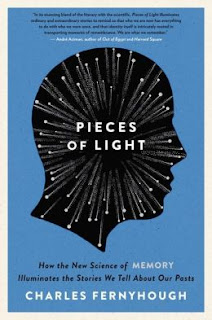
Harper and the Campaign for the American Reader are giving away three copies (one each to three different winners) of Pieces of Light: How the New Science of Memory Illuminates the Stories We Tell About Our Pasts by Charles Fernyhough.

HOW TO ENTER: (1) send an email to this address:

(2) In the subject line, type Pieces of Light.
(3) Include your name (or alias or whatever you wish to be called if I email you to tell you you've won the book) in the body of the email.

[I will not sell or share your email address; nor will I be in touch with you unless it is to tell you you have won the book.  I promise.]

Contest closes on Friday, April 26th.

Only one entry per person, please.

Winner must have a US mailing address.

Read more about Pieces of Light at the publisher's website.

Visit Charles Fernyhough's website.

--Marshal Zeringue

Coffee with a canine: Katie Preston Toepfer & Violet and Mr. Darcy

photo credit: Kristy Toepfer Photography
The current featured trio at Coffee with a Canine: Katie Preston Toepfer & Violet and Mr. Darcy.

The author, on how her dogs got their names:
Violet is a little flower, so Violet is the perfect name for her. She gets V, Bubba, Bubbalish, Noosh, Lish, Bubalicious.

Mr Darcy is truly a gentleman, so the name suits. He gets Mr D, Doogan, Darcy Doogan, Little Man and D....[read on]
About Katie Preston Toepfer's new book, Wedding Dogs: A Celebration of Holy Muttrimony:
Wedding Dogs captures man’s best friend at 75 weddings—dogs as the best man, maid of honor, ring bearer, or another member of the wedding party! Decked out in little doggy tuxedos or sporting a wreath of roses around their necks, these pooches share in the wedding couple’s big day.

Each photograph is accompanied by a brief essay telling the dog’s (and the couple’s) story. A perfect wedding, bridal shower, or groom’s gift, Wedding Dogs shares the joy of the moment when dogs join in the celebration of their owners’ most special day.
Visit the Wedding Dogs website, Facebook page, and Twitter perch.

Read--Coffee with a Canine: Katie Preston Toepfer & Violet and Mr. Darcy.

--Marshal Zeringue

Ten top books set in Barcelona

Malcolm Burgess is the publisher of Oxygen Books' City-Lit series, featuring writing on cities including Berlin, Paris, London, Amsterdam, Venice and Dublin.

For the Guardian, in 2011 he named ten of the best books set in Barcelona, including:
Jimmy Burns, Barça: A People's Passion, 2000

The story of Barça, the city's legendary football club founded in 1898, is also the epic story of Barcelona and Catalan nationalism.

"The English … watch the heaving, whirling mass of foreign humanity around them, a vortex that allows for no dissent, that relegates the token hundred-odd Real Madrid fans to the most isolated heights of the Camp Nou … the hum of the crowd is overwhelming, its fanaticism disquieting."
Camp Nou
Read about another book on the list.

--Marshal Zeringue

Tuesday, April 23, 2013

Pg. 69: Patricia Bracewell's "Shadow on the Crown"

The current feature at the Page 69 Test: Shadow on the Crown by Patricia Bracewell.

About the book, from the publisher:
A rich tale of power and forbidden love revolving around a young medieval queen

In 1002, fifteen­-year-old Emma of Normandy crosses the Narrow Sea to wed the much older King Athelred of England, whom she meets for the first time at the church door. Thrust into an unfamiliar and treacherous court, with a husband who mistrusts her, stepsons who resent her and a bewitching rival who covets her crown, Emma must defend herself against her enemies and secure her status as queen by bearing a son.

Determined to outmaneuver her adversaries, Emma forges alliances with influential men at court and wins the affection of the English people. But her growing love for a man who is not her husband and the imminent threat of a Viking invasion jeopardize both her crown and her life.

Based on real events recorded in the Anglo-Saxon Chronicle, Shadow on the Crown introduces readers to a fascinating, overlooked period of history and an unforgettable heroine whose quest to find her place in the world will resonate with modern readers.
Learn more about the book and author at Patricia Bracewell's website and blog.

The Page 69 Test: Shadow on the Crown.

--Marshal Zeringue

What is Barbara J. King reading?

The current featured contributor at Writers Read: Barbara J. King, author of How Animals Grieve.

Her entry begins:
I’ve just finished reading two grief memoirs. In The Guardians: Elegy For a Friend, Sarah Manguso conveys, in a narrative of fragments and patches, the searing loss of her friend Harris. It was so sudden: Harris walked out (was allowed to walk out) of a psychiatric hospital and later that day jumped in front of a train. Sometimes, the fragments and patches flow along; occasionally one stops my heart. Manguso tells of the habit she fell into after Harris’s death: “I pictured my parents dead, my husband, my best friends, my relatives, everyone I knew, one by one. I started grieving good and early, so that when...[read on]
About How Animals Grieve, from the publisher:
From the time of our earliest childhood encounters with animals, we casually ascribe familiar emotions to them. But scientists have long cautioned against such anthropomorphizing, arguing that it limits our ability to truly comprehend the lives of other creatures. Recently, however, things have begun to shift in the other direction, and anthropologist Barbara J. King is at the forefront of that movement, arguing strenuously that we can—and should—attend to animal emotions. With How Animals Grieve, she draws our attention to the specific case of grief, and relates story after story—from fieldsites, farms, homes, and more—of animals mourning lost companions, mates, or friends.

King tells of elephants surrounding their matriarch as she weakens and dies, and, in the following days, attending to her corpse as if holding a vigil. A housecat loses her sister, from whom she's never before been parted, and spends weeks pacing the apartment, wailing plaintively. A baboon loses her daughter to a predator and sinks into grief. In each case, King uses her anthropological training to interpret and try to explain what we see—to help us understand this animal grief properly, as something neither the same as nor wholly different from the human experience of loss.

The resulting book is both daring and down-to-earth, strikingly ambitious even as it’s careful to acknowledge the limits of our understanding. Through the moving stories she chronicles and analyzes so beautifully, King brings us closer to the animals with whom we share a planet, and helps us see our own experiences, attachments, and emotions as part of a larger web of life, death, love, and loss.
Barbara J. King is Professor of Anthropology at the College of William and Mary and author of Evolving God: A Provocative View on the Origins of Religion.

The Page 69 Test: Evolving God.

My Book, The Movie: Evolving God.

Writers Read: Barbara J. King (July 2007).

Writers Read: Barbara J. King.

--Marshal Zeringue

Pg. 99: Thomas O. McGarity's "Freedom to Harm"

The current feature at the Page 99 Test: Freedom to Harm: The Lasting Legacy of the Laissez Faire Revival by Thomas O. McGarity.

About the book, from the publisher:
How much economic freedom is a good thing?

This book tells the story of how the business community, and the trade associations and think tanks that it created, launched three powerful assaults during the last quarter of the twentieth century on the federal regulatory system and the state civil justice system to accomplish a revival of the laissez faire political economy that dominated Gilded Age America. Although the consequences of these assaults became painfully apparent in a confluence of crises during the early twenty-first century, the patch-and-repair fixes that Congress and the Obama administration put into place did little to change the underlying laissez faire ideology and practice that continues to dominate the American political economy. In anticipation of the next confluence of crises, Thomas McGarity offers suggestions for more comprehensive governmental protections for consumers, workers, and the environment.
Learn more about Freedom to Harm at the Yale University Press website.

Thomas O. McGarity holds the Joe R. and Teresa Lozano Long Endowed Chair in Administrative Law at the University of Texas at Austin School of Law.

The Page 99 Test: Bending Science: How Special Interests Corrupt Public Health Research by Thomas O. McGarity & Wendy E. Wagner.

The Page 99 Test: Freedom to Harm.

--Marshal Zeringue

Ten of the best Shakespeare characters

Today is Shakespeare's birthday. For the Guardian, in 2012 Robert McCrum came up with a list of the ten best Shakespeare characters, including:
Lady Macbeth: Macbeth

Macbeth and his wife enjoy one of the darkest psycho-sexual relationships ever seen on the English stage. Lady Macbeth’s fiendish manipulation of her husband into acts of horrific violence makes her a supreme archetype. The play has the vertiginous momentum of a thriller and often works best when performed without a break. In that fatal trajectory, when Macbeth “sups full of horrors”, audiences see how his lust for power has been provoked by his wife’s sexual thrall. He has some of the great speeches, but she holds the play’s imaginative dynamo in her fascinating and demonic heart
Read about another Shakespeare character on the list.

Also see: Matt Haig's top 10 novels influenced by Shakespeare.

--Marshal Zeringue

Susan Bordo's "The Creation of Anne Boleyn," the movie

Now showing at My Book, The Movie: The Creation of Anne Boleyn: A New Look at England's Most Notorious Queen by Susan Bordo.

The entry begins:
You might think it would be a daunting task to pick out actors to play characters who have been cast, often memorably, many times before. But actually, it’s an opportunity that I have fantasized about. It is well known to Tudor scholars but virtually no one else that the BBC, Hollywood, and Showtime have rarely made choices that remotely resembled—either physically or in their “essence”—the central players in the drama of Henry VIII and ill-fated Anne Boleyn. Charles Laughton  caricatured dynamic, quixotic Henry as a chicken-tossing buffoon; at the other end of the spectrum, Jonathan Rhys Meyers, in the Showtime production, refused to get fat (“Jonny would never have allowed us to make him appear grotesque,” the show’s creator Michael Hirst told me.) Anne has usually been played, from Merle Oberon to Natalie Dormer, by actresses who are way too conventionally gorgeous to convey the not-exactly-beautiful but striking je ne sais quoi that Anne was said to embody. Most annoying, Katherine of Aragon has, with one exception (Annette Crosbie in the 1970 BBC The Six Wives of Henry VIII) been played by dark-complected, dark-haired actresses. Katherine had golden hair and fair skin—but she was Spanish, and ethnic stereotyping has prevailed over historical fact.

My book is neither fiction nor a full-blown biography, so it’s unlikely to be made into a movie. However, if some creative screenwriter was to do for it what Sofia Coppola did for Caroline Weber’s The Queen of Fashion: What Marie Antoinette Wore to the Revolution and turn a cultural study into movie art, here is my dream cast:

For Henry, Russell...[read on]
Learn more about the book and author at the official The Creation of Anne Boleyn website.

My Book, The Movie: The Creation of Anne Boleyn.

--Marshal Zeringue

Monday, April 22, 2013

Free book: "What My Mother Gave Me"

Algonquin Books and the Campaign for the American Reader are giving away a copy of What My Mother Gave Me: Thirty-one Women on the Gifts That Mattered Most by Elizabeth Benedict.

HOW TO ENTER: (1) send an email to this address:

(2) In the subject line, type What My Mother Gave Me.

(3) Include your name (or alias or whatever you wish to be called if I email you to tell you you've won the book) in the body of the email.

[I will not sell or share your email address; nor will I be in touch with you unless it is to tell you you have won the book.  I promise.]

Contest closes on Friday, May 17th.

Only one entry per person, please.

Winner must have a US mailing address.

Learn more about the book and author at Elizabeth Benedict's website and the What My Mother Gave Me Facebook page.

--Marshal Zeringue

What is Alan Brennert reading?

The current featured contributor at Writers Read: Alan Brennert, author of Palisades Park.

His entry begins:
I read a lot of nonfiction as research for my books, but when I want to read nonfiction for pleasure I am never disappointed by the work of Marion Meade. Her most recent book is Lonelyhearts: The Screwball World of Nathanael West and Eileen McKenney, which as a longtime fan of West’s work I devoured in several sittings. I think it’s the best biography of West I’ve read, and McKenney’s life (she inspired her sister’s book and play My Sister Eileen) is...[read on]
About Palisades Park, from the publisher:
Growing up in the 1930s, there is no more magical place than Palisades Amusement Park in New Jersey—especially for seven-year-old Antoinette, who horrifies her mother by insisting on the unladylike nickname Toni, and her brother, Jack. Toni helps her parents, Eddie and Adele Stopka, at the stand where they sell homemade French fries amid the roar of the Cyclone roller coaster. There is also the lure of the world’s biggest salt-water pool, complete with divers whose astonishing stunts inspire Toni, despite her mother's insistence that girls can't be high divers.

But a family of dreamers doesn't always share the same dreams, and then the world intrudes: There's the Great Depression, and Pearl Harbor, which hits home in ways that will split the family apart; and perils like fire and race riots in the park. Both Eddie and Jack face the dangers of war, while Adele has ambitions of her own—and Toni is determined to take on a very different kind of danger in impossible feats as a high diver. Yet they are all drawn back to each other—and to Palisades Park—until the park closes forever in 1971.

Evocative and moving, with the trademark brilliance at transforming historical events into irresistible fiction that made Alan Brennert’s Moloka'i and Honolulu into reading group favorites, Palisades Park takes us back to a time when life seemed simpler—except, of course, it wasn't.
Learn more about the book and author at Alan Brennert's website.

Writers Read: Alan Brennert.

--Marshal Zeringue

Pg. 99: Eran Shalev's "American Zion"

The current feature at the Page 99 Test: American Zion: The Old Testament as a Political Text from the Revolution to the Civil War by Eran Shalev.

About the book, from the publisher:
The Bible has always been an integral part of American political culture. Yet in the years before the Civil War, it was the Old Testament, not the New Testament, that pervaded political rhetoric. From Revolutionary times through about 1830, numerous American politicians, commentators, ministers, and laymen depicted their young nation as a new, God-chosen Israel and relied on the Old Testament for political guidance.

In this original book, historian Eran Shalev closely examines how this powerful predilection for Old Testament narratives and rhetoric in early America shaped a wide range of debates and cultural discussions—from republican ideology, constitutional interpretation, southern slavery, and more generally the meaning of American nationalism to speculations on the origins of American Indians and to the emergence of Mormonism. Shalev argues that the effort to shape the United States as a biblical nation reflected conflicting attitudes within the culture—proudly boastful on the one hand but uncertain about its abilities and ultimate destiny on the other. With great nuance, American Zion explores for the first time the meaning and lasting effects of the idea of the United States as a new Israel and sheds new light on our understanding of the nation’s origins and culture during the founding and antebellum decades.
Learn more about the book and author at Eran Shalev's website.

The Page 99 Test: American Zion.

--Marshal Zeringue

Five notable books on growing up in the Anthropocene

"The essential idea behind [the term "Anthropocene"]," writes Caspar Henderson, author of The Book of Barely Imagined Beings, "is that the impact of humanity as a whole on the Earth system – notably through destruction of natural habitats and a rapid increase in atmospheric concentrations of greenhouse gases – is now so great as to mark a new epoch in the history of life."

At The Browser, Henderson tagged five top books on growing up in the Anthropocene, including:
The Techno-Human Condition by Braden Allenby and Daniel Sarewitz

Henderson: Climate change is likely to be a huge challenge in this century and beyond, but it's unlikely to be the only one. Some challenges may come as a surprise but among those we think we can see coming are how we will feed nine to twelve billion humans, how we will keep a lid on deadly conflict and how we will increase the likelihood that what is most valuable and marvelous in the rest of the living world thrives.

Responses and debate often focus on how science and technology can “save” us. Sure, there will be no solutions without advances in science and technology. Equally surely, science and technology alone almost never provide a solution. Technical advances usually bring unforeseen consequences. More importantly, poor political and social choices can lead to terrible outcomes.

There is a large and serious literature emerging on how to “manage” the planet in the Anthropocene. Books for non-specialists include Mark Lynas's The God Species and Al Gore's The Future. There is also a growing array of writers and thinkers who are sceptical of the very idea of planetary management, often accusing the “managers” of overly simplistic analysis and recommendations. I recommend Allenby and Sarewitz's book not because it is especially critical of, say, geo-engineering – in fact their first target is transhumanism – but because it can help the reader to think more clearly about the actual complexity and inherent unpredictably of the situation in which we find ourselves. They are not suggesting that we should cease to act rationally or ethically, just that we understand more fully our ignorance about most complex systems, not least the human context for science and technology and our frequent inability to control them. We need, they say, to “add a degree of psychological and institutional flexibility that acknowledges and dignifies our ignorance and limits. Rehabilitate humility.” This is, if you like, about thinking slow as well as thinking fast about the planet, and there is nothing here that a good and wise scientist would disagree with. Ken Caldeira, a climate scientist who has looked carefully into geo-engineering, stresses the uncertainties – and, by the way, emphasizes that other options such as reducing emissions are likely to be cheaper and more effective. The late Carl Woese, one of the most eminent biologists of recent times, argued that our first priority should be “not to engineer nature but to listen to its harmonies.”

Science and technology are key to our future but even more important are the ethical and political challenges we have to overcome if we are truly to grow up in the Anthropocene. If Jared Diamond was right in Collapse, societies disintegrate when those in charge cease to think about the interests of the people as a whole. This looks like one of the clear and present dangers facing us today. To find the resources to fight the necessary battles we need to find strength inside ourselves. This means allowing plenty of room for the inner child to play. Music, the arts and the sciences, which are making discoveries of surpassing beauty almost daily, can help us find plenty of space, amidst all the uncertainty, for wonder and celebration.
Read about another book Henderson tagged at The Browser.

--Marshal Zeringue

Coffee with a canine: Sam Stall & Trudy

The current featured duo at Coffee with a Canine: Sam Stall & Trudy.

The author, on how he and Trudy were united:
I was visiting our veterinarian to pick up pills for one of our (now deceased) dogs when I noticed a picture of a puppy propped up near the cash register. One of the lab techs had found her tied to a cinderblock in an abandoned house, starving and covered with fleas. My wife and I met the little dog, who (at the time) was small enough to hold in one hand. The lab tech said the vet staff believed her to be a Chihuahua/Terrier mix, and that she "probably wouldn't get much bigger than 10 pounds." We fell in love with her and took her home, but as the weeks passed -- and Trudy got bigger and bigger -- we realized the only way she could possibly have any Chihuahua in her is if she ate one. She topped out at about 70 pounds, and appears to be some sort of German Shepherd/Pit Bull mix. But she's sweet as...[read on]
About Stall's (co-author) recently released book, Wedding Dogs: A Celebration of Holy Muttrimony:
Wedding Dogs captures man’s best friend at 75 weddings—dogs as the best man, maid of honor, ring bearer, or another member of the wedding party! Decked out in little doggy tuxedos or sporting a wreath of roses around their necks, these pooches share in the wedding couple’s big day.

Each photograph is accompanied by a brief essay telling the dog’s (and the couple’s) story. A perfect wedding, bridal shower, or groom’s gift, Wedding Dogs shares the joy of the moment when dogs join in the celebration of their owners’ most special day.
Visit Sam Stall's website.

Read--Coffee with a Canine: Sam Stall & Trudy.

--Marshal Zeringue

Pg. 69: Amy Brill's "The Movement of Stars"

The current feature at the Page 69 Test: The Movement of Stars: A Novel by Amy Brill.

About the book, from the publisher:
A love story set in 1845 Nantucket, between a female astronomer and the unusual man who understands her dreams.

It is 1845, and Hannah Gardner Price has lived all twenty-four years of her life according to the principles of the Nantucket Quaker community in which she was raised, where simplicity and restraint are valued above all, and a woman’s path is expected to lead to marriage and motherhood. But up on the rooftop each night, Hannah pursues a very different—and elusive—goal: discovering a comet and thereby winning a gold medal awarded by the King of Denmark, something unheard of for a woman.

And then she meets Isaac Martin, a young, dark-skinned whaler from the Azores who, like herself, has ambitions beyond his expected station in life. Drawn to his intellectual curiosity and honest manner, Hannah agrees to take Isaac on as a student. But when their shared interest in the stars develops into something deeper, Hannah’s standing in the community begins to unravel, challenging her most fundamental beliefs about work and love, and ultimately changing the course of her life forever.

Inspired by the work of Maria Mitchell, the first professional female astronomer in America, The Movement of Stars is a richly drawn portrait of desire and ambition in the face of adversity.
Learn more about the book and author at Amy Brill's website.

The Page 69 Test: The Movement of Stars.

--Marshal Zeringue

Sunday, April 21, 2013

Five top autobiographical books putatively devoted to other subjects

Sarah Manguso's memoir is The Guardians: An Elegy for a Friend.

One of her five favorite examples of autobiographical writing putatively devoted to other subjects, as told to The Daily Beast:
My Brother
by Jamaica Kincaid

In examining the circumstances of her brother’s death of AIDS, Kincaid is forced also to reconsider her loathing for her mother, her avoidance of Antigua (her birthplace), and her various old guilts. No matter how early or how completely she believed she’d escaped the members of her birth family, they shape her fate—and she shapes theirs.
Read about another book on the list.

--Marshal Zeringue

What is Peter Rock reading?

The current featured contributor at Writers Read: Peter Rock, author of The Shelter Cycle.

His entry begins:
Rather than dream up some titles that would impress people, I’ll just ‘fess up to some of the books on my bedside table, ones I’ve been reading in the last week:

My Education, by Susan Choi

This is a great and terrifying novel. I believe it comes out in July, but I got an early copy because Susan’s an old friend of mine. In fact, we had a two-person independent study about our writing when we were college students. And then we hung out all the time when she was a graduate student at Cornell and this novel is loosely based on those years, so it was eerie. More eerie, though, was how amazing Susan’s prose is. No one writes better sentences and keeps them moving, looping, twisting. What’s so amazing here is the tension is created not only by what will happen next but the mystery of how the graduate school heroine—prone to bad choices and behavior, often quite immature—is going to become the sophisticated narrator who...[read on]
About The Shelter Cycle, from the publisher:
An American original, Peter Rock brings our strangest beliefs to vivid and sympathetic life in this haunting novel inspired by true events.

The Shelter Cycle tells the story of two children, Francine and Colville, who grew up in the Church Universal and Triumphant, a religion that predicted the world could end in the late 1980s. While their parents built underground shelters to withstand the impending Soviet missile strike, Francine and Colville played in the Montana wilderness, where invisible spirits watched over them. When the prophesized apocalypse did not occur, the sect’s members resurfaced and the children were forced to grow up in a world they believed might no longer exist.

Twenty years later, Francine and Colville are reunited while searching for an abducted girl. Haunted by memories and inculcated beliefs, they must confront the Church’s teachings. If all the things they were raised to believe were misguided, why then do they suddenly feel so true?
Learn more about the book and author at Peter Rock's website.

The Page 69 Test: My Abandonment.

The Page 69 Test: The Shelter Cycle.

Writers Read: Peter Rock.

--Marshal Zeringue

Pg. 99: David Igler's "The Great Ocean"

The current feature at the Page 99 Test: The Great Ocean: Pacific Worlds from Captain Cook to the Gold Rush by David Igler.

About the book, from the publisher:
The Pacific of the early eighteenth century was not a single ocean but a vast and varied waterscape, a place of baffling complexity, with 25,000 islands and seemingly endless continental shorelines. But with the voyages of Captain James Cook, global attention turned to the Pacific, and European and American dreams of scientific exploration, trade, and empire grew dramatically. By the time of the California gold rush, the Pacific's many shores were fully integrated into world markets-and world consciousness.

The Great Ocean draws on hundreds of documented voyages--some painstakingly recorded by participants, some only known by archeological remains or indigenous memory--as a window into the commercial, cultural, and ecological upheavals following Cook's exploits, focusing in particular on the eastern Pacific in the decades between the 1770s and the 1840s. Beginning with the expansion of trade as seen via the travels of William Shaler, captain of the American Brig Lelia Byrd, historian David Igler uncovers a world where voyagers, traders, hunters, and native peoples met one another in episodes often marked by violence and tragedy. Igler describes how indigenous communities struggled against introduced diseases that cut through the heart of their communities; how the ordeal of Russian Timofei Tarakanov typified the common practice of taking hostages and prisoners; how Mary Brewster witnessed first-hand the bloody "great hunt" that decimated otters, seals, and whales; how Adelbert von Chamisso scoured the region, carefully compiling his notes on natural history; and how James Dwight Dana rivaled Charles Darwin in his pursuit of knowledge on a global scale.

These stories--and the historical themes that tie them together--offer a fresh perspective on the oceanic worlds of the eastern Pacific. Ambitious and broadly conceived, The Great Ocean is the first book to weave together American, oceanic, and world history in a path-breaking portrait of the Pacific world.
Learn more about The Great Ocean at the Oxford University Press website.

The Page 99 Test: The Great Ocean.

--Marshal Zeringue

James M. Tabor's "Frozen Solid," the movie

Now showing at My Book, The Movie: Frozen Solid by James M. Tabor.

The entry begins:
Is there an author who hasn’t peopled his novels (secretly, guiltily) with stars from the silver screen? I do it secretly, guiltily, and frequently, though also fearfully, as if I could possibly be jinxing the whole thing by even thinking such self-aggrandizing bushwah.

But here! The chance to do so as an official response to an official offering from my gracious host Marshal. No guilt, no jinx, no fear. Let’s get right to it, then. The heroine in my current series of novels is Hallie Leland, 31, a Ph.D. microbiologist, born and raised in Virginia. She has fine hair cut very short, so blond it looks almost white in certain lights. She has an angular face in which dark-turquoise eyes are slightly misaligned— left higher than right—stands five-ten and weighs 130 pounds or so. She’s very fit, a restless type A, easily bored, an adrenalin junky and can be sharp as a switchblade.

Now, god knows I love Scarlett Johansson in everything she’s done, but (lack of height and excess of bosom aside) she just doesn’t do sharp well. Dewy-eyed, as in Lost in Translation, and beautifully vulnerable, or vulnerably beautiful, in Girl with the Pearl Earring, yes. Sharp, no. Neither, really, do Naomi Watts or Ali Larter, which is a shame because both have Hallie’s look.

The key to Hallie Leland is compressed frustration. You know how irritating it can be when you step out for a nice, brisk walk (or ski, run, scuba dive, bike ride, shopping trip—fill in from your experience) and then constantly have to wait for a companion (husband, wife, lover, friend, co-worker—fill in, again) to catch up? Consider doing that year after year since, say, elementary school. That’s been Hallie’s experience. It hasn’t made her conceited or rude, but she’s one of those people who have a finger or toe that’s always tapping. I think the actress who’s showed the potential ... to capture that aspect of Hallie Leland is...[read on]
Learn more about the book and author at James M. Tabor's website.

Writers Read: James M. Tabor.

My Book, The Movie: Frozen Solid.

--Marshal Zeringue

Saturday, April 20, 2013

What is Steven Nadler reading?

The current featured contributor at Writers Read: Steven Nadler, author of The Philosopher, the Priest, and the Painter: A Portrait of Descartes.

His entry begins:
I just finished reading The Vatican Diaries, by John Thavis. I've long been fascinated by and curious about what goes on in the Vatican, and in the Catholic Church generally, and Thavis (a journalist who has been covering Vatican affairs for a while) provides a real insider's view of the machinations, personalities, ceremonies, and missteps of...[read on]
About The Philosopher, the Priest, and the Painter, from the publisher:
In the Louvre museum hangs a portrait of a middle-aged man with long dark hair, a mustache, and heavy-lidded eyes, and he is dressed in the starched white collar and black coat of the typical Dutch burgher. The painting is now the iconic image of René Descartes, the great seventeenth-century French philosopher. And the painter of the work? The Dutch master Frans Hals--or so it was long believed, until the work was downgraded to a copy of an original. But where, then, is the authentic version located, and who painted it? Is the man in the painting--and in its original--really Descartes?

A unique combination of philosophy, biography, and art history, The Philosopher, the Priest, and the Painter investigates the remarkable individuals and circumstances behind a small portrait. Through this image--and the intersecting lives of a brilliant philosopher, a Catholic priest, and a gifted painter--Steven Nadler opens up a fascinating portal into Descartes's life and times, skillfully presenting an accessible introduction to Descartes's philosophical and scientific ideas, and an illuminating tour of the volatile political and religious environment of the Dutch Golden Age. As Nadler shows, Descartes's innovative ideas about the world, about human nature and knowledge, and about philosophy itself, stirred great controversy. Philosophical and theological critics vigorously opposed his views, and civil and ecclesiastic authorities condemned his writings. Nevertheless, Descartes's thought came to dominate the philosophical world of the period, and can rightly be called the philosophy of the seventeenth century.

Shedding light on a well-known image, The Philosopher, the Priest, and the Painter offers an engaging exploration of a celebrated philosopher's world and work
Learn more about the book and author at Steven Nadler's website.

The Page 99 Test: The Best of All Possible Worlds.

The Page 99 Test: A Book Forged in Hell.

Writers Read: Steven Nadler.

--Marshal Zeringue

Pg. 99: Thomas Doherty's "Hollywood and Hitler, 1933-1939"

The current feature at the Page 99 Test: Hollywood and Hitler, 1933-1939 by Thomas Doherty.

About the book, from the publisher:
The abundance of WWII-era documentaries and the huge cache of archival footage that has emerged since 1945 make it seem as if cinematic images of the Nazis were always as vivid and plentiful as they are today. Yet between 1933 and 1939, representations of the Nazis and the full meaning of Nazism came slowly to Hollywood, growing more distinct and ominous only as the decade wore on.

Recapturing what ordinary Americans saw on the screen during the emerging Nazi threat, Thomas Doherty reclaims forgotten films, such as Hitler’s Reign of Terror (1934), a pioneering anti-Nazi docu-drama by Cornelius Vanderbilt, Jr.; I Was a Captive of Nazi Germany (1936), a sensational true tale of “a Hollywood girl in Naziland!”; and Professor Mamlock (1938), an anti-Nazi film made by German refugees living in the Soviet Union. Doherty also recounts how the disproportionately Jewish backgrounds of the executives of the studios and the workers on the payroll shaded reactions to what was never simply a business decision. His history features a cast of charismatic personalities: Carl Laemmle, the German Jewish founder of Universal Pictures, whose production of All Quiet on the Western Front (1930) enraged the nascent Nazi movement; Georg Gyssling, the Nazi counsel in Los Angeles, who read the Hollywood trade press as avidly as any studio mogul; Vittorio Mussolini, son of the fascist dictator and aspiring motion picture impresario; Leni Riefenstahl, the Valkyrie goddess of the Third Reich who came to America to peddle distribution rights for Olympia (1938); screenwriters Donald Ogden Stewart and Dorothy Parker, founders of the Hollywood Anti-Nazi League; and Harry and Jack Warner of Warner Bros., who yoked anti-Nazism to patriotic Americanism and finally broke the embargo against anti-Nazi cinema with Confessions of a Nazi Spy (1939). As Europe hurtled toward war, a proxy battle was waged in Hollywood over how to conduct business with the Nazis; over whether to address or ignore Nazism in Hollywood feature films; and over how to cover Hitler and his victims in the newsreels. Should Hollywood lie low, or stand tall and sound the alarm?
Learn more about Hollywood and Hitler, 1933-1939 at the Columbia University Press website.

The Page 99 Test: Hollywood and Hitler, 1933-1939.

--Marshal Zeringue