Wednesday, April 21, 2010

Top ten absurd classics

Michael Foley was born in Derry, Northern Ireland, but since 1972 he has lived in London, working as a Lecturer in Information Technology. He has published four novels, four collections of poetry and a collection of translations from French poetry, which have earned impressive reviews from the Guardian, New Statesman and New York Times. The Age of Absurdity is his first non-fiction book.

For the Guardian, he named a top ten list of books that best express the absurdity of the human condition. One title on the list:
The Third Policeman by Flann O'Brien

This is another vision of life as absurd repetition – but eerie, nightmarish, totally black. In the key scene Sergeant Pluck and Policeman MacCruiskeen take the narrator on a visit to eternity (up an Irish country lane and deep underground) and tell him he can order whatever he wants. After some thought the narrator requests, and is given, 50 cubes of gold, a bottle of whiskey, precious stones to the value of £200,000, some bananas, a fountain pen and writing materials, a serge suit of blue with silk lining and a weapon capable of exterminating all adversaries. But as he is about to enter the lift on the way out he is informed that he must exit with the same weight as he came in. Obliged to abandon his treasures, he weeps silent bitter tears – excruciatingly funny and also strangely moving.
Read about another book on the list.

Flann O'Brien is on Max McGuinness' list of four of the greatest alternative Irish writers.

--Marshal Zeringue

Pg. 69: Fernanda Eberstadt's "Rat"

The current feature at the Page 69 Test: Rat by Fernanda Eberstadt.

About the book, from the publisher:
Of The Furies, Fernanda Eberstadt’s last novel, Alexandra Jacobs wrote in the New York Observer that it “veers pretty close to genius ... Eberstadt is an expert, sensual, and at times truly breathtaking conjurer of New York City.” With Rat, Eberstadt has found a new setting she knows well, the South of France, and the story she tells is original, powerful, and heartrending—about a child’s search for a father she has never known.

Rat is fifteen-year-old Celia Bonnet, who lives with her unmarried mother, Vanessa, a free-spirited local beauty, in a farmhouse compound with other single-parent families in the Pyrénées Orientales, a gorgeous but forlorn Mediterranean no-man’s-land just north of the Spanish Catalan border. Rat is the result of a one-night encounter between Vanessa and Gillem, the son of a London model from the 1960s, who used to spend summers in the area and whom Rat has never spoken to or met. But when Vanessa’s current boyfriend starts preying on Morgan, the orphaned nine-year-old who is Rat’s adopted brother, she decides to take Morgan and run away to her father in London. As the novel unfolds, the two children undertake a difficult journey to find the man who might finally explain to Rat who she is and where she belongs.

This is an enthralling novel with a luminous sense of place—both physical and emotional—and, at its core, a bold, engaging young heroine for our times.
Learn more about the book and author at Fernanda Eberstadt's website.

The Page 69 Test: Rat.

--Marshal Zeringue

Tuesday, April 20, 2010

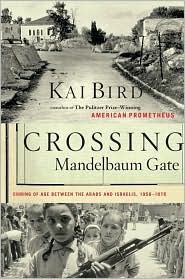
Pg. 99: Kai Bird's "Crossing Mandelbaum Gate"

The current feature at the Page 99 Test: Crossing Mandelbaum Gate: Coming of Age Between the Arabs and Israelis, 1956-1978 by Kai Bird.

About the book, from the publisher:
PULITZER PRIZE WINNER KAI BIRD’S fascinating memoir of his early years spent in Israel, Jordan, Egypt, Saudi Arabia, and Lebanon provides an original and illuminating perspective into the Arab-Israeli conflict.

Weeks before the Suez War of 1956, four-year-old Kai Bird, son of a garrulous, charming American Foreign Service officer, moved to Jerusalem with his family. They settled in a small house, where young Kai could hear church bells and the Muslim call to prayer and watch as donkeys and camels competed with cars for space on the narrow streets. Each day on his way to school, Kai was driven through Mandelbaum Gate, where armed soldiers guarded the line separating Israeli-controlled West Jerusalem from Arab-controlled East. He had a front-seat view to both sides of a divided city—and the roots of the widening conflict between Arabs and Israelis.

Bird would spend much of his life crossing such lines—as a child in Jerusalem, Saudi Arabia, and Egypt, and later, as a young man in Lebanon. Crossing Mandelbaum Gate is his compelling personal history of growing up an American in the midst of three major wars and three turbulent decades in the Middle East. The Zelig-like Bird brings readers into such conflicts as the Suez War, the Six Day War of 1967, and the Black September hijackings in 1970 that triggered the Jordanian civil war. Bird vividly portrays such emblematic figures as the erudite George Antonius, author of The Arab Awakening; Jordan’s King Hussein; the Palestinian hijacker Leila Khaled; Salem bin Laden, Osama’s older brother and a family friend; Saudi King Faisal; President Nasser of Egypt; and Hillel Kook, the forgotten rescuer of more than 100,000 Jews during World War II.

Bird, his parents sympathetic to Palestinian self-determination and his wife the daughter of two Holocaust survivors, has written a masterful and highly accessible book—at once a vivid chronicle of a life spent between cultures as well as a consummate history of a region in turmoil. It is an indispensable addition to the literature on the modern Middle East.
Browse inside Crossing Mandelbaum Gate, and learn more about the book and author at Kai Bird's website.

The Page 99 Test: Crossing Mandelbaum Gate.

--Marshal Zeringue

Six best stoner novels

Sam Munson, author of The November Criminals, named the six best stoner novels for The Daily Beast.

One book on the list:
The Savage Detectives
by Roberto Bolaño

This is the book that established Bolaño's international reputation and its main narrative thread concerns a search undertaken by two young exiles for a poet they admire. These two searchers, Ulises Lima and Arturo Belano (an alter ego who pops up from time to time in Bolaño's work), fund their activities, as well as an avant-garde literary magazine, by selling high-quality weed—with the euphonious name Acapulco Gold—to Mexico city's students and artists. The magazine's title? Lee Harvey Oswald.
Read about another novel on the list.

The Savage Detectives appears on Benjamin Obler's top ten list of fictional coffee scenes; it is one of Edmund White's five most important books.

--Marshal Zeringue

What is Philip Graham reading?

The current featured contributor at Writers Read: Philip Graham, author of The Moon, Come to Earth.

His entry begins:
I was about to start this brief essay with the sentence, “Perhaps the best of the books that I’ve read recently is . . .”

But then I glanced at the small pile of books I want to recommend, and realized that they’re all pretty terrific, and that each offers a certain pleasure that the others do not, which reminded me that I usually don’t much care for saying what my favorite books are because the list is so long—hundreds upon hundreds of books have found a niche inside me, have established a welcome internal presence that has enriched my life.

So, here are four such books that I’ve come across lately.

I first began reading The Weather Fifteen Years Ago, (Ariadne Press, 2009) by the Austrian novelist Wolf Haas, because the idea of the book is so striking: an author named Wolf Haas is interviewed, by an unnamed book reviewer, about his novel, The Weather Fifteen Years Ago, an exchange which takes up the entire 242 pages of the book. You never actually get to read the novel, just the interview about it; or, more accurately, the novel is the interview.

And it’s an entirely successful experiment. The back and forth banter between the reviewer and author, their varying interpretations here and there of what happens in the novel, the author’s inside stories about the inspiration behind certain scenes, enabled me to easily fill in the blank spaces about Vittorio Kowalski, a man who is so...[read on]
Philip Graham is the author of six books, including the story collection The Art of the Knock, the novel How to Read an Unwritten Language, a memoir of Africa, Parallel Worlds, and, most recently, an expanded collection of his McSweeney's dispatches from Lisbon, The Moon, Come to Earth. A co-founder and the current fiction editor of the literary/arts magazine Ninth Letter, he teaches at the University of Illinois, Urbana-Champaign, and the low residency MFA program at the Vermont College of Fine Arts.

Among the praise for The Moon, Come to Earth:
Philip Graham’s The Moon, Come to Earth [is] a fascinating blend of travel writing and family memoir set in Lisbon. I love the way the book refuses to limit itself to one mode or the other, and how Graham’s various turns and twists eventually combine to make a whole much greater than the sum of the parts. He is also just a clear, enjoyable, funny writer.
--Dinty Moore
Read an excerpt from The Moon, Come to Earth, and learn more about the author and his work at Philip Graham's website. Also see his recent essay at The Millions, "Every Day I Open a Book," which is about Graham's developing love of books when young.

Writers Read: Philip Graham.

--Marshal Zeringue

Monday, April 19, 2010

Carol Snow's "Just Like Me, Only Better," the movie

Now showing at My Book, The Movie: Just Like Me, Only Better by Carol Snow.

The entry begins:
Just Like Me, Only Better tells the story of a struggling suburban single mother and substitute teacher (yes, I overdid on the s’s) named Veronica Czaplicki who gets hired to be a celebrity double for an imploding young Hollywood starlet named Haley Rush. In her job, Veronica must deal with Haley’s controlling manager, Jay Sharpie. Fake dates with Haley’s ex, B-list hunk Brady Ellis, sweeten the deal. And so, on to the casting.

Veronica/Haley: Since Veronica and Haley are supposed to look so much alike, one actress could play both roles, but I’ve always found that technique distracting. Parent Trap, anyone? I’d encourage the studio to cast two similar-looking actresses. The studio would completely ignore my advice and do whatever the hell they please.

Publishers Weekly described Haley as a cross between Lindsay Lohan and...[read on]
Carol Snow, a former contributor to Salon.com, lives in California with her family where she writes books for teens as well as for adults.

Learn more about the book and author at Carol Snow's website.

My Book, The Movie: Just Like Me, Only Better.

--Marshal Zeringue

Ten of the best breakfasts in literature

For the Guardian, John Mullan named ten of the best breakfasts in literature.

One breakfast on the list:
Jane Eyre, by Charlotte Brontë

On Jane's first morning at Lowood School, the pupils are served basins of something hot, which "sent forth an odour far from inviting". "I devoured a spoonful or two of my portion without thinking of its taste ... burnt porridge is almost as bad as rotten potatoes; famine itself soon sickens over it".
Read about another breakfast on the list.

Jane Eyre also made the Guardian's top 10 lists of "outsider books" and "romantic fiction;" it appears on Jessica Duchen's top ten list of literary Gypsies, and on John Mullan's lists of ten of the best weddings in literature and ten of the best smokes in fiction.

The Page 99 Test: Jane Eyre.

--Marshal Zeringue

Pg. 69: Michael White's "Beautiful Assassin"

The current feature at the Page 69 Test: Beautiful Assassin by Michael C. White.

About the book, from the publisher:
A breathtaking tale of love, loyalty, and intrigue set in the early days of World War II from the acclaimed New York Times Notable Book author of Soul Catcher, which USA Today hailed as "a marvelous historical novel"

World War II threatens to engulf the globe. The beleaguered Soviets, struggling to hold back the rising German tide, face despair and defeat daily. Yet just as all seems lost, a fearless female sniper named Tat'yana Levchenko gains fame in the Battle of Sevastopol with her remarkable composure and stunning skill. Offering hope in her nation's darkest moments, she becomes a Soviet hero, and word of her beauty and prowess eventually reaches Washington, D.C. Soon, First Lady Eleanor Roosevelt invites Tat'yana to visit America and tour the country with her.

For the Soviets, Tat'yana's newfound friendship with the wife of the most powerful man in the world is an opportunity to garner public support for a much-needed second front in the war—but it's also a chance to gather information about President Roosevelt's plans. Surrounded by those who would exploit her position, Tat'yana becomes a pawn in a battle for information, and she is forced to question the motivations of everyone she knows, including the American captain who has been assigned as her translator. But as quickly as she rises to fame, Tat'yana vanishes. Did she defect? Was she silenced—and if so, by whom? Decades later, a clever journalist will discover Tat'yana's story ... and reveal the truth.

In Beautiful Assassin, Michael White delivers a heartrending story of war, betrayal, and a mother's love that can never be extinguished. Lyrical, evocative, and powerfully moving, this is a tale you will not soon forget.
Browse inside Beautiful Assassin, and learn more about the book and author at Michael C. White's website and blog.

The Page 69 Test: Beautiful Assassin.

--Marshal Zeringue

Pg. 99: Robert Whitaker's "Anatomy of an Epidemic"

The current feature at the Page 99 Test: Anatomy of an Epidemic: Magic Bullets, Psychiatric Drugs, and the Astonishing Rise of Mental Illness in America by Robert Whitaker.

About the book, from the publisher:
In this astonishing and startling book, award-winning science and history writer Robert Whitaker investigates a medical mystery: Why has the number of disabled mentally ill in the United States tripled over the past two decades? Every day, 1,100 adults and children are added to the government disability rolls because they have become newly disabled by mental illness, with this epidemic spreading most rapidly among our nation’s children. What is going on?

Anatomy of an Epidemic challenges readers to think through that question themselves. First, Whitaker investigates what is known today about the biological causes of mental disorders. Do psychiatric medications fix “chemical imbalances” in the brain, or do they, in fact, create them? Researchers spent decades studying that question, and by the late 1980s, they had their answer. Readers will be startled—and dismayed—to discover what was reported in the scientific journals.

Then comes the scientific query at the heart of this book: During the past fifty years, when investigators looked at how psychiatric drugs affected long-term outcomes, what did they find? Did they discover that the drugs help people stay well? Function better? Enjoy good physical health? Or did they find that these medications, for some paradoxical reason, increase the likelihood that people will become chronically ill, less able to function well, more prone to physical illness?

This is the first book to look at the merits of psychiatric medications through the prism of long-term results. Are long-term recovery rates higher for medicated or unmedicated schizophrenia patients? Does taking an antidepressant decrease or increase the risk that a depressed person will become disabled by the disorder? Do bipolar patients fare better today than they did forty years ago, or much worse? When the National Institute of Mental Health (NIMH) studied the long-term outcomes of children with ADHD, did they determine that stimulants provide any benefit?

By the end of this review of the outcomes literature, readers are certain to have a haunting question of their own: Why have the results from these long-term studies—all of which point to the same startling conclusion—been kept from the public?

In this compelling history, Whitaker also tells the personal stories of children and adults swept up in this epidemic. Finally, he reports on innovative programs of psychiatric care in Europe and the United States that are producing good long-term outcomes. Our nation has been hit by an epidemic of disabling mental illness, and yet, as Anatomy of an Epidemic reveals, the medical blueprints for curbing that epidemic have already been drawn up.
Read an excerpt from Anatomy of an Epidemic, and learn more about the author and his work at Robert Whitaker's website.

Robert Whitaker is the award-winning author of The Mapmaker’s Wife, Mad in America, and On the Laps of Gods.

The Page 99 Test: On the Laps of Gods.

The Page 99 Test: Anatomy of an Epidemic.

--Marshal Zeringue

Sunday, April 18, 2010

What is Marshall Jon Fisher reading?

The current featured contributor at Writers Read: Marshall Jon Fisher, author of A Terrible Splendor: Three Extraordinary Men, a World Poised for War, and the Greatest Tennis Match Ever Played.

His entry begins:
In preparation for a writing project that takes place just after World War One, I’ve been reading a lot of books either written then or which take place then. One of the best is the Regeneration trilogy by Pat Barker. I had already read volume one, Regeneration, a couple of years ago, so I just read The Eye in the Door and am now in the middle of The Ghost Road. All three novels feature William Rivers, a real-life psychiatrist who spent the war treating traumatized veterans back in London. His most famous patient-- a main character in the first volume and a secondary one in the others—was the poet...[read on]
Among the praise for A Terrible Splendor:
“Marshall Jon Fisher has gotten hold of some mighty themes: war and peace, love and death, sports and savagery. …As the match enters its final set, all the narrative pieces lock together, and A Terrible Splendor becomes as engrossing as the contest it portrays.”
--Washington Post

“Fisher…offers richly detailed portraits as the story moves from one nail-biting set to the next against a backdrop of improbably high personal and political stakes.”
--Boston Globe

“…rich and rewarding…. Mr. Fisher brings a sharp eye for detail. He vividly sketches the anything-goes atmosphere of Weimar Berlin….”
--Wall Street Journal
Marshall Jon Fisher’s work has appeared in The Atlantic, Harper’s, and other magazines. His essay "Memoria ex Machina" was featured in Best American Essays 2003. He has written several books with his father, David E. Fisher, including Tube: The Invention of Television. A Terrible Splendor is now available in paperback.

Visit Marshall Jon Fisher's website.

Writers Read: Marshall Jon Fisher.

--Marshal Zeringue

Five best books about blasphemy

Diarmaid MacCulloch is Professor of the History of the Church and Fellow of St. Cross College in the University of Oxford. His latest book is Christianity: The First Three Thousand Years.

For the Wall Street Journal he named a five best list of books about blasphemy. One title on the list:
The Satanic Verses
by Salman Rushdie

In 1989, just when it seemed that blasphemy had toddled off to bed with a nice cup of hot chocolate, along came the biggest blasphemy row yet, the first to cause a global rumpus. This time the outrage was Muslim, and it was not about some grave work of theology or philosophy but about a novel. Drawing on India's entanglement with imperial Britain, Salman Rushdie meditated on the subject by relating the dreams of a handful of expatriate Indian Muslim actors. One motif in the novel was the existence of allegedly suppressed Quranic texts, "satanic verses," allowing the worship of pagan gods as well as Allah. Iran's Grand Ayatollah Khomeini apparently thought he found a parody of himself in "The Satanic Verses." Now, if you send up Billy Graham, he may be a little upset; the ayatollah wouldn't let it go. More surprisingly, countless Sunni Muslims, who would have otherwise treated the Shiite leader's pronouncements with contempt, agreed. The British had given Rushdie a Whitbread prize for fiction; Margaret Thatcher gave him a bodyguard. Funny old world.
Read about another book on the list.

The Satanic Verses
is one of Atul Gawande's favorite books and one of Karl O. Knausgaard's top ten angel books.

--Marshal Zeringue

Pg. 69: Vanora Bennett's "The Queen's Lover"

The current feature at the Page 69 Test: The Queen's Lover by Vanora Bennett.

About the book, from the publisher:
Catherine de Valois, daughter of the French king Charles VI, is born into troubled times. Though she is brought up in a royal court, it is a stormy and unstable environment. Before she is out of her teens, Catherine is married off to England's Henry V as part of a treaty honoring his victory over France. She is terrified at the idea of being married to a man who is a foreigner, an enemy, and a rough soldier, and is forced to leave her home for England.

Within two years she is widowed, and mother to the future King of England and France—even though her brother has laid claim to the French crown for himself. Caught between warring factions of her own family and under threat by the powerful lords of the English court, she must find a way to keep her infant son safe. In Owain Tudor, a childhood friend for whom Catherine has long had affection and who now controls the Royal household, Catherine finds both strength and kinship. As their friendship turns to love, however, she risks not only her life and that of her son but the uneasy balance of power in England and France that will be forever changed.

History comes alive in this lyrical and moving true story of one woman's courage and the inception of one of the most famous royal lineages of all time.
Browse inside The Queen’s Lover, and learn more about the author and her work at Vanora Bennett's website.

Bennett is the author of two works of nonfiction, Crying Wolf: The Return of War to Chechnya and The Taste of Dreams: An Obsession with Russia and Caviar, and the novels Portrait of an Unknown Woman and Figures in Silk.

The Page 69 Test: Figures in Silk.

The Page 69 Test: The Queen's Lover.

--Marshal Zeringue

Saturday, April 17, 2010

Bill McKibben's best books

Activist and writer Bill McKibben is the award-winning author of The End of Nature and The Age of Missing Information. His new book, Eaarth, argues that our planet already has been irrevocably remade by human activity.

He named his six favorite books for The Week magazine. One title on the list:
Plan B by Lester Brown

In case you’ve ever wondered if civilization can keep going on its present course, this book by our most prominent eco-statistician will prove that the answer is no—and that, instead, there’s a wealth of real possibilities for change to a more sustainable and more human course.
Read about another book on McKibben's list.

The Page 69 Test: Bill McKibben's Deep Economy.

Visit Bill McKibben's official website.

--Marshal Zeringue

Pg. 99: Jonathan Balcombe's "Second Nature"

This weekend's feature at the Page 99 Test: Second Nature: The Inner Lives of Animals by Jonathan Balcombe.

About the book, from the publisher:
For centuries we believed that humans were the only ones that mattered. The idea that animals had feelings was either dismissed or considered heresy. Today, that’s all changing. New scientific studies of animal behavior reveal perceptions, intelligences, awareness and social skills that would have been deemed fantasy a generation ago. The implications make our troubled relationship to animals one of the most pressing moral issues of our time.

Jonathan Balcombe, animal behaviorist and author of the critically acclaimed Pleasurable Kingdom, draws on the latest research, observational studies and personal anecdotes to reveal the full gamut of animal experience—from emotions, to problem solving, to moral judgment. Balcombe challenges the widely held idea that nature is red in tooth and claw, highlighting animal traits we have disregarded until now: their nuanced understanding of social dynamics, their consideration for others, and their strong tendency to avoid violent conflict. Did you know that dogs recognize unfairness and that rats practice random acts of kindness? Did you know that chimpanzees can trounce humans in short-term memory games? Or that fishes distinguish good guys from cheaters, and that birds are susceptible to mood swings such as depression and optimism?

With vivid stories and entertaining anecdotes, Balcombe gives the human pedestal a strong shake while opening the door into the inner lives of the animals themselves.
Learn more about the book and author at Jonathan Balcombe's website and blog.

The Page 99 Test: Second Nature.

--Marshal Zeringue

Friday, April 16, 2010

What is Anna Mitchael reading?

The current featured contributor at Writers Read: Anna Mitchael, author of Just Don’t Call Me Ma’am, a memoir that details her twentysomething experience living and working in cities across the country.

Her entry begins:
The real answer to your question? Right now I read lots of things I’d rather not spend so much of my time examining…like ingredient lists on the back of oatmeal boxes to make sure there’s no MSG (or other chemicals and additives I shouldn’t eat while pregnant) included, and pregnancy books with long, exaggerated lists of ALL THE THINGS THAT COULD GO WRONG IN PREGNANCY – SO BE PREPARED, and it also seems like every time I am in a public restroom I find myself reading the ‘It’s advised not to drink while you are pregnant’ sign for the eight bajillionth time.

Yeah, I already got that memo but thanks for reminding me of it a-gain. And come to think of it, the reason I feel like taking this sign off the wall and ripping it to shreds could be due to the fact that I haven’t had a glass of wine in eight months. ‘Attention restaurant patrons, if everyone could just ignore the pregnant lady in the bathroom who’s relieving stress in the only way that’s left to her and continue with your meal it would be much appreciated.’ (Let’s face it, once your unhealthy additives, caffeine and alcohol are gone – all you’re really left with is destruction of property).

The other real answer to your question is that in between my sign-shredding, and time spent promoting my new book, Just Don’t Call Me Ma’am, I’ve been stealing minutes here and there to read Committed by Elizabeth Gilbert. Yes, I know...[read on]
Among the early praise for Just Don’t Call Me Ma’am:
“Worlds away from her small-town roots, Anna Mitchael spent most of her twenties pretending she wasn’t from the South. In this engaging memoir, a reluctant belle finds peace in her past and reminds all of us that it’s not only okay to bloom where you’re planted, but sometimes it’s the very best decision you can make.”
—Celia Rivenbark, author of Belle Weather: Mostly Sunny With A Chance of Scattered Hissy Fits

“Mitchael’s twentysomething survival story will strike a nerve with young women who can’t wait to ditch their home states and parents’ values, along with their pastel sweaters, in favor of the black uniform of big city life. She encounters inevitable heartbreaks and hilarious awkward moments, but her progress toward self-acceptance is at the heart of her tale. Her analysis of “cohabitation crime” is not to be missed! Patient parents and grandmothers can take heart that their wisdom is not perpetually ignored.”
—Prudence Mackintosh, Texas grandmother and author of the Sneaker trilogy: Thundering Sneakers, Retreads, and Sneaking Out
A reformed nomad, Anna Mitchael has now returned home to Texas. She will tolerate y’all but reserves the right to raise hell when anyone calls her ma’am. You can read the daily chronicles of her life (with a side of extra-spicy jalapenos, please) at her website and blog.

Writers Read: Anna Mitchael.

--Marshal Zeringue

Best books for lovers of Thoreau's "Walden"

At Flashlight Worthy, Will Howarth, co-author of Deep Creek, named a list of books that echo [Henry David Thoreau's] "fierce love for exploring personal freedom" and "emulate the place-centered nonfiction he invented in Walden."

One title on the list:
The Snow Leopard
by Peter Matthiessen

Into the Himalayas with a writer and a biologist, both seeking the rarest of big cats, for different reasons. In that high-altitude Nirvana, Matthiessen learns he must also find peace within his home and family, back in America.
Read about the other books on Howarth's list.

The Snow Leopard also appears on Don George's top ten list of travel books of the 20th century.

--Marshal Zeringue

Pg. 69: Stephanie Cowell's "Claude & Camille"

The current feature at the Page 69 Test: Claude & Camille by Stephanie Cowell.

About the book, from the publisher:
Sometimes he dreamt he held her; that he would turn in bed and she would be there. But she was gone and he was old. Nearly seventy. Only cool paint met his fingers. “Ma très chère...” Darkness started to fall, dimming the paintings. He felt the crumpled letter in his pocket. “I loved you so,” he said. “I never would have had it turn out as it did. You were with all of us when we began, you gave us courage. These gardens at Giverny are for you but I’m old and you’re forever young and will never see them....”

In the mid-nineteenth century, a young man named Claude Monet decided that he would rather endure a difficult life painting landscapes than take over his father’s nautical supplies business in a French seaside town. Against his father’s will, and with nothing but a dream and an insatiable urge to create a new style of art that repudiated the Classical Realism of the time, he set off for Paris.

But once there he is confronted with obstacles: an art world that refused to validate his style, extreme poverty, and a war that led him away from his home and friends. But there were bright spots as well: his deep, enduring friendships with men named Renoir, Cézanne, Pissarro, Manet – a group that together would come to be known as the Impressionists, and that supported each other through the difficult years. But even more illuminating was his lifelong love, Camille Doncieux, a beautiful, upper-class Parisian girl who threw away her privileged life to be by the side of the defiant painter and embrace the lively Bohemian life of their time.

His muse, his best friend, his passionate lover, and the mother to his two children, Camille stayed with Monet—and believed in his work—even as they lived in wretched rooms, were sometimes kicked out of those, and often suffered the indignities of destitution. She comforted him during his frequent emotional torments, even when he would leave her for long periods to go off on his own to paint in the countryside.

But Camille had her own demons – secrets that Monet could never penetrate, including one that when eventually revealed would pain him so deeply that he would never fully recover from its impact. For though Camille never once stopped loving the painter with her entire being, she was not immune to the loneliness that often came with being his partner.

A vividly-rendered portrait of both the rise of Impressionism and of the artist at the center of the movement, Claude and Camille is above all a love story of the highest romantic order.
Read an excerpt from Claude & Camille, and learn more about the book and author at Stephanie Cowell's website and blog.

The Page 69 Test: Claude & Camille.

--Marshal Zeringue

Coffee with a canine: Lisa Peet & Dorrie

This weekend's featured couple at Coffee with a Canine: Lisa Peet & Dorrie.

Peet, on how she and Dorrie were united:
In October, 2005 I was still deep in mourning over my beloved Jack Russell Milo, who had died suddenly in July. I was in no emotional shape to adopt a new dog, but for some reason I found myself on Petfinder.com one day and I saw that face—it was like she spoke to me. She was advertised as a local dog and we were all set to go meet her, but it turned out she was in Little Rock, Arkansas. If we were willing to adopt her sight unseen they would truck her up.

What can I say? As far as I was concerned, her sweet puppy face told me everything I needed to know. And likewise, although we were supposed to have a home visit to verify our suitability as dog owners, that month it poured nonstop and the rescue organization woman kept having to cancel. Eventually I ended up meeting her in a midtown bar after work, where I showed her photos of the late Milo—everyone always called him the happiest dog they’d ever met, and it showed—and we had a few drinks, cried over him, and ended up tipsy at PetSmart, buying a dog bed. I passed my inspection.

A couple of weeks later...[read on]
Lisa Peet is a writer, editor, artist, specialty baker, and the proprietor of the literary blog Like Fire.

Read--Coffee with a Canine: Lisa Peet & Dorrie.

--Marshal Zeringue

Thursday, April 15, 2010

Pg. 99: Maurice Berger's "For All The World To See"

The current feature at the Page 99 Test: For All the World to See: Visual Culture and the Struggle for Civil Rights by Maurice Berger.

About the book, from the publisher:
In 1955, shortly after Emmett Till was murdered by white supremacists in Mississippi, his grieving mother distributed to the press a gruesome photograph of his mutilated corpse. Asked why she would do this, she explained that by witnessing with their own eyes the brutality of segregation and racism, Americans would be more likely to support the cause of racial justice. “Let the world see what I’ve seen,” was her reply. The publication of the photograph inspired a generation of activists to join the civil rights movement.

Despite this extraordinary episode, the story of visual culture’s role in the modern civil rights movement is rarely included in its history. This is the first comprehensive examination of the ways images mattered in the struggle, and it investigates a broad range of media including photography, television, film, magazines, newspapers, and advertising.

These images were ever present and diverse: the startling footage of southern white aggression and black suffering that appeared night after night on television news programs; the photographs of black achievers and martyrs in Negro periodicals; the humble snapshot, no less powerful in its ability to edify and motivate. In each case, the war against racism was waged through pictures—millions of points of light, millions of potent weapons that forever changed a nation. Through vivid storytelling and incisive analysis, this powerful book allows us to see and understand the crucial role that visual culture played in forever changing a nation.
Read more about For All the World to See at the Yale University Press website.

Maurice Berger is Senior Research Scholar at the Center for Art, Design, and Visual Culture, University of Maryland, Baltimore County, and Senior Fellow at the Vera List Center for Art and Politics of The New School. He is the author of the critically acclaimed White Lies: Race and the Myths of Whiteness, which was named as a finalist for the 2000 Horace Mann Bond Book Award.

The Page 99 Test: For All the World to See.

--Marshal Zeringue

Michael Lewis' favorite books

Michael Lewis is the bestselling author of Liar’s Poker, The Blind Side, and a new chronicle of the financial crisis, The Big Short: Inside the Doomsday Machine.

One of his favorite books of all time, as told to The Daily Beast:
Lucky Jim
by Kingsley Amis

It's set just after the Second World War, but it remains a timeless portrait of academic life. You can't help but wonder how much less Kingsley Amis might have achieved if he had been able to control his drinking.
Read about another book on Lewis' list.

Lucky Jim also appears among Roger Rosenblatt's five best satires of academic life.

Read more about Lewis' most important books.

The Page 69 Test: The Blind Side.

--Marshal Zeringue