Friday, December 21, 2012

Free book: "The Cove" by Ron Rash

Ecco and the Campaign for the American Reader are giving away a paperback copy of The Cove by Ron Rash.

HOW TO ENTER: Visit the Campaign for the American Reader Facebook page, scroll down, and "like" the post for The Cove.

Contest closes on Monday, December 31st. Winner must have a US mailing address. Good luck!

Learn more about The Cove at the HarperCollins website.

--Marshal Zeringue

What is Aaron Elkins reading?

The current featured contributor at Writers Read: Aaron Elkins, author of Dying on the Vine.

His entry begins:
When people ask me that question, they are usually surprised to learn that I read almost no mystery fiction. Actually, I never was much of a mystery fan (with a few towering exceptions, Conan Doyle above all), but in the last couple of decades I've cut back to almost nothing. The thing is, when I read fiction, I'm not really looking to be enlightened or to be made more aware of what's happening in the world, or of what is "true," or to have my consciousness raised. When I open a novel, what I want is to have my consciousness lowered. I want to forget the world for a while and float away on the story and the words. I can't do this any more with mysteries. The authorly devices jump out at me now: the hooks, the red herrings, the planted clues, the sneaky plotting. In other words, the structure gets in the way of the substance. Seeing and analyzing how other people do it is probably instructive for me as a writer, but for me as a reader it's a killer. It turns reading into a hard slog, something closer to chore than to pleasure.

But there are other novelists that I do enjoy, and these are generally master wordsmiths as opposed to master plotters or deep thinkers. Patrick O'Brian's series about Aubrey and Maturin (the first is Master and Commander) is a good example. They are all set at the time of the Napoleonic Wars, not a period in which I'm much interested, but the magic of the words carries me away, even when I'm ploughing through a full page or more of nautical jargon about the meaning of which I'm clueless. These books are witty, too, which doesn't...[read on]
About the book, from the publisher:
It was the unwavering custom of Pietro Cubbiddu, patriarch of Tuscany’s Villa Antica wine empire, to take a solitary month-long sabbatical at the end of the early grape harvest, leaving the winery in the trusted hands of his three sons. His wife, Nola, would drive him to an isolated mountain cabin in the Apennines and return for him a month later, bringing him back to his family and business.

So it went for almost a decade—until the year came when neither of them returned. Months later, a hiker in the Apennines stumbles on their skeletal remains. The carabinieri investigate and release their findings: they are dealing with a murder-suicide. The evidence makes it clear that Pietro Cubbiddu shot and killed his wife and then himself. The likely motive: his discovery that Nola had been having an affair.

Not long afterwards, Gideon Oliver and his wife, Julie, are in Tuscany visiting their friends, the Cubbiddu offspring. The renowned Skeleton Detective is asked to reexamine the bones. When he does, he reluctantly concludes that the carabinieri, competent though they may be, have gotten almost everything wrong. Whatever it was that happened in the mountains, a murder-suicide it was not.

Soon Gideon finds himself in a morass of family antipathies, conflicts, and mistrust, to say nothing of the local carabinieri’s resentment. And when yet another Cubbiddu relation meets an unlikely end, it becomes bone-chillingly clear that the killer is far from finished…
Learn more about the book and author at Aaron J. Elkins's website.

My Book, The Movie: Aaron Elkins' "Gideon Oliver" novels.

Writers Read: Aaron Elkins.

--Marshal Zeringue

Howard Andrew Jones's "The Bones of the Old Ones," the movie

Now showing at My Book, The Movie: The Bones of the Old Ones by Howard Andrew Jones.

The entry begins:
I’d like to say that I was torn over which great Persian and Arabian actors would be cast as the scholarly Dabir and stalwart Captain Asim, because Hollywood had so many great Persian and Arabian actors on call to choose from. But then that would be an even more fantastic world than the one Dabir and Asim are adventuring in during their 8th century exploits. Should I be so lucky as to actually see my characters on screen someday, I hope that some charismatic unknowns of middle-eastern heritage will be cast, rather than some Anglos in brown face.

Directors, though… given the...[read on]
Learn more about the book and author at Howard Andrew Jones's website.

Writers Read: Howard Andrew Jones.

The Page 69 Test: The Bones of the Old Ones.

My Book, The Movie: The Bones of the Old Ones.

--Marshal Zeringue

Top ten fiction debuts of 2012

Steve Donoghue named his ten best fiction debuts of 2012, including:
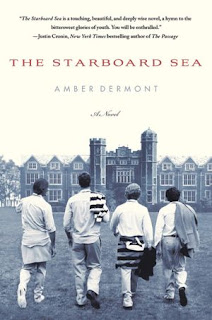
The Starboard Sea by Amber Dermont

The opening of Dermont’s East Coast prep school novel is almost lazily deceptive in both tone and scope, lulling the reader with slangy first-person narration into what steadily becomes a gripping, emotionally intense story about friendship and betrayal, with a surprising and very pleasing amount of heft.
Read about another book on the list.

Learn more about The Starboard Sea, and visit Amber Dermont's Facebook page.

The Page 69 Test: The Starboard Sea.

--Marshal Zeringue

Thursday, December 20, 2012

Pg. 99: Marc Myers's "Why Jazz Happened"

The current feature at the Page 99 Test: Why Jazz Happened by Marc Myers.

About the book, from the publisher:
Why Jazz Happened is the first comprehensive social history of jazz. It provides an intimate and compelling look at the many forces that shaped this most American of art forms and the many influences that gave rise to jazz’s post-war styles. Rich with the voices of musicians, producers, promoters, and others on the scene during the decades following World War II, this book views jazz’s evolution through the prism of technological advances, social transformations, changes in the law, economic trends, and much more.

In an absorbing narrative enlivened by the commentary of key personalities, Marc Myers describes the myriad of events and trends that affected the music's evolution, among them, the American Federation of Musicians strike in the early 1940s, changes in radio and concert-promotion, the introduction of the long-playing record, the suburbanization of Los Angeles, the Civil Rights movement, the “British invasion” and the rise of electronic instruments. This groundbreaking book deepens our appreciation of this music by identifying many of the developments outside of jazz itself that contributed most to its texture, complexity, and growth.
Read more about Why Jazz Happened at the book’s official site, and visit JazzWax.com.

Writers Read: Marc Myers.

The Page 99 Test: Why Jazz Happened.

--Marshal Zeringue

Three books to read before the end of the world

Ben H. Winters is the author of several novels, including the New York Times bestseller Sense and Sensibility and Sea Monsters, and the middle-grade novel The Secret Life of Ms. Finkleman, an Edgar Award nominee and a Bank Street College Best Children’s Book of 2011. Winters’ other books include the science-fiction Tolstoy parody Android Karenina, the Finkleman sequel The Mystery of the Missing Everything, and the supernatural thriller Bedbugs, which has been optioned for the screen by Warner Brothers. Winters also wrote the book and lyrics for three musicals for young audiences: The Midnight Ride of Paul Revere, A (Tooth) Fairy Tale, and Uncle Pirate, based on the award-winning children’s book by Douglas Rees.

His latest novel is The Last Policeman.

For NPR, Winters named three books to read before the end of the world. One book to make the grade:
On The Beach
by Nevil Shute

Standing tall among classics of Cold War nuclear-paranoia literature is this deeply felt portrait of an ensemble of heroes in southern Australia, waiting for the radiation cloud unleashed by a nuclear exchange to reach their shores. Stubbornly, heroically, they cling to their humanity — to politeness and small talk, to hunting and fishing and car racing, to family and friends and the possibility of love. The moral center is Cmdr. Dwight Towers, an American submarine captain — and now the de facto admiral of the U.S. Navy — who refuses to abandon his post, and refuses even a sexual liaison out of fealty to his wife, back home in Connecticut and certainly dead.
Read about another book on the list.

On the Beach is among Sloane Crosley's five depressing beach reads and Michael Evans's top six books on nuclear war.

Visit the official Ben H. Winters website.

My Book, The Movie: The Last Policeman.

The Page 69 Test: The Last Policeman.

--Marshal Zeringue

What is Jennifer Mather Saul reading?

The current featured contributor at Writers Read: Jennifer Mather Saul, author of Lying, Misleading, and What is Said: An Exploration in Philosophy of Language and in Ethics.

Her entry begins:
Sadly, being Head of Department doesn't leave me much time at all to read books. Most of the book reading I do these days is reading aloud to my 7-year-old son. He has a taste for the oldies, the really oldies, so it's been (simplified versions of) the Odyssey and Gilgamesh. Watching his reaction makes it clear there's a reason these have stood the test of time. He also has a love of Enid Blyton, a very familiar children's writer for the British, but totally unknown to Americans. As an American ex-pat mother of a child born and raised in the UK, it's a new discovery. Lots of other lefty parents...[read on]
About Lying, Misleading, and What is Said, from the publisher:
Many people (both philosophers and not) find it very natural to think that deceiving someone in a way that avoids lying--by merely misleading--is morally preferable to simply lying. Others think that this preference is deeply misguided. But all sides agree that there is a distinction. In Lying, Misleading, and What is Said, Jennifer Saul undertakes a close examination of the lying/misleading distinction. Saul begins by using this very intuitive distinction to shed new light on entrenched debates in philosophy of language over notions like what is said. Next, she tackles the puzzling but widespread moral preference for misleading over lying, and arrives at a new view regarding the moral significance of the distinction. Finally, Saul draws her conclusions together to examine a range of historically important and interesting cases, from a consideration of modern politicians to the early Jesuits.
Learn more about Lying, Misleading, and What is Said at the Oxford University Press website.

Jennifer Saul is Professor of Philosophy at the University of Sheffield. She works in Philosophy of Language, Feminist Philosophy and Philosophy of Psychology. She is also the author of Simple Sentences, Substitution, and Intuitions and Feminism: Issues and Arguments.

Writers Read: Jennifer Mather Saul.

--Marshal Zeringue

Top ten adventure classics

Charlie Fletcher is the author of the internationally acclaimed Stoneheart trilogy. He also writes for film, television and as a newspaper columnist.

He named ten favorite adventure classics for the Guardian, including:
To Kill a Mockingbird by Harper Lee

As a teenager I fell in love with Scout Finch at first read and have felt that way ever since. The book actually made me a bit less of a jerk because it provoked and seduced me into seeing the world through other people's eyes – the first time I remember a story doing that to me. As a father I often wish I could be more like Atticus Finch, an ambition I fail miserably to come close to achieving. You can't read this book and not be outraged by injustice and prejudice, nor can you fail to understand both sides of the court-case it swings around. If Tintin was my gateway into children's books, this was the portal into adult reading. It made me grow up.
Read about two more novels on the list.

To Kill a Mockingbird made Sheila Bair's 6 favorite books list, Kathryn Erskine's top ten list of first person narratives, Julia Donaldson's six best books list, TIME magazine's top 10 list of books you were forced to read in school, John Mullan's list of ten of the best lawyers in literature, John Cusack's list of books that made a difference to him, Lisa Scottoline's top ten list of books about justice, and Luke Leitch's list of ten literary one-hit wonders. It is one of Sanjeev Bhaskar's six best books and one of Alexandra Styron's five best stories of fathers and daughters.

--Marshal Zeringue

Pg. 69: Ann Purser's "Found Guilty at Five"

The current feature at the Page 69 Test: Found Guilty at Five by Ann Purser.

About the book, from the publisher:
She’s had her hands full sorting out both clues and clutter in the village of Long Farnden. But a mother’s work is never done, and Lois Meade is discovering detective work is both dirty and dangerous...

A wedding is always a happy occasion, even if Lois Meade must remind herself she isn’t losing a daughter, but gaining a policeman. Luckily, her new son-in-law is in the Tresham force—and the nephew of her friend and collaborator Inspector Cowgill—so Lois has another link to the law at her disposal.

But sleuthing suddenly seems a little too close to home when her youngest son invites a mysterious young woman, Akiko, as a guest. Lois isn’t the only one who wonders why she refuses to talk about herself or her past. And when a thief waltzes off in the night with the young woman’s cello, Lois wastes no time in enlisting the inspector to help find the valuable instrument.

Before Lois can take note of the whereabouts of the vanishing cello, Akiko goes missing. The discovery that this could be another in a string of murderous musical thefts means Lois must pull out all the stops to find the girl and protect her son—before the music stops permanently...
Learn more about the book and author at Ann Purser's website.

The Page 69 Test: Found Guilty at Five.

--Marshal Zeringue

Wednesday, December 19, 2012

Best books of 2012: The New Yorker

Some of The New Yorker's contributors volunteered their favorite books from 2012.

Malcolm Gladwell's picks:
I loved Mischa Hiller’s “Shake Off.” I picked it up entirely by accident. I’d never heard of Hiller before, and the book absolutely blew me away. The only thriller this year that even came close was Chris Pavone’s “The Expats,” but Hiller’s novel has the benefit of mining every trope of the thriller genre while being absolutely original at the same time. I will read anything by Hiller from now on.
Read about the other books New Yorker contributors tagged.

The Page 69 Test: Shake Off.

My Book, The Movie: Shake Off.

The Page 69 Test: The Expats.

Read--Coffee with a Canine: Chris Pavone & Charlie Brown.

--Marshal Zeringue

Pg. 99: Amy J. Binder and Kate Wood's "Becoming Right"

Today's feature at the Page 99 Test: Becoming Right: How Campuses Shape Young Conservatives by Amy J. Binder and Kate Wood.

About the book, from the publisher:
Conservative pundits allege that the pervasive liberalism of America's colleges and universities has detrimental effects on undergraduates, most particularly right-leaning ones. Yet not enough attention has actually been paid to young conservatives to test these claims--until now.

In Becoming Right, Amy Binder and Kate Wood carefully explore who conservative students are, and how their beliefs and political activism relate to their university experiences. Which parts of conservatism do these students identify with? How do their political identities evolve on campus? And what do their educational experiences portend for their own futures--and for the future of American conservatism?

Becoming Right demonstrates the power that campus culture has in developing students' conservative political styles and shows that young conservatives are made, not born. Focusing on two universities--"Eastern Elite" and "Western Public"--Binder and Wood discover that what is acceptable, or even celebrated, political speech and action on one campus might be unthinkable on another. Right-leaning students quickly learn the styles of conservatism that are appropriate for their schools. Though they might be expected to simply plug into the national conservative narrative--via media from Fox News to Facebook--college conservatives actually enact their politics in starkly different ways.

Rich in interviews and insight, Becoming Right illustrates that the diverse conservative movement evolving among today's college students holds important implications for the direction of American politics.
Learn more about Becoming Right at the Princeton University Press website.

Amy J. Binder is associate professor of sociology at the University of California, San Diego. She is the author of Contentious Curricula: Afrocentrism and Creationism in American Public Schools. Kate Wood is a doctoral candidate in the department of sociology at the University of California, San Diego.

The Page 99 Test: Becoming Right.

--Marshal Zeringue

Free book: "Part Wild"

Scribner and the Campaign for the American Reader are giving away a copy of Part Wild: One Woman's Journey with a Creature Caught Between the Worlds of Wolves and Dogs by Ceiridwen Terrill.

HOW TO ENTER: Visit the Campaign for the American Reader Facebook page, scroll down, and "like" the post for Part Wild.

Contest closes on Monday, January 14th. Winner must have a US mailing address. Good luck!

Visit Ceiridwen Terrill's website.

Read more about Part Wild: One Woman's Journey with a Creature Caught Between the Worlds of Wolves and Dogs.

Read--Coffee with a Canine: Ceiridwen Terrill and Argos.

--Marshal Zeringue

What is Patricia Fara reading?

The current featured contributor at Writers Read: Patricia Fara, author of Erasmus Darwin: Sex, Science and Serendipity.

Her entry begins:
Can it just be coincidence? The last two books I’ve read were recommended to me by different friends yet appeared within a year of one another – and both are historical novels that reflect on national identity. Part of an answer comes from the first of my authors, JG Farrell, who published The Siege of Krishnapur in1973. ‘I preferred to use the past,’ he explained, because ‘people have already made up their minds what they think about the present. About the past they are more susceptible to clarity of vision.’

Drawing on true events and diary memoirs from the Indian Mutiny of 1857, Farrell explores the gradual disintegration of a stranded British community, starving to death yet determined to stave off attacks by Indian troops they have themselves trained. In these strained circumstances, apparently trivial questions assume an overwhelming importance because – like the notorious pig fat for greasing cartridges that eventually drove subordinated Muslims to rebel – they represent crucially important social divisions. Should an English unmarried mother sleep in the ballroom with the ladies, or should she be relegated to the Eurasian quarters? Should the few remaining items of food be distributed equally, or should they be auctioned off to the richest bidder? Should survivors endanger their own lives by burying fallen friends in the Christian graveyard, or should the bodies be tossed over the walls to be picked over by scavengers already bloated from this unprecedented harvest? As the weeks plod by, some...[read on]
About Erasmus Darwin, from the publisher:
Dr Erasmus Darwin seemed an innocuous Midlands physician, a respectable stalwart of eighteenth-century society. But there was another side to him.

Botanist, inventor, Lunar inventor and popular poet, Darwin was internationally renowned for breathtakingly long poems explaining his theories about sex and science. Yet he become a target for the political classes, the victim of a sustained and vitriolic character assassination by London's most savage satirists.

Intrigued, prize-winning historian Patricia Fara set out to investigate why Darwin had provoked such fierce intellectual and political reaction. Inviting her readers to accompany her, she embarked on what turned out to be a circuitous and serendipitous journey.

Her research led her to discover a man who possessed, according to Samuel Taylor Coleridge, 'perhaps a greater range of knowledge than any other man in Europe.' His evolutionary ideas influenced his grandson Charles, were banned by the Vatican, and scandalized his reactionary critics. But for modern readers, he shines out as an impassioned Enlightenment reformer who championed the abolition of slavery, the education of women, and the optimistic ideals of the French Revolution.

As she tracks down her quarry, Patricia Fara uncovers a ferment of dangerous ideas that terrified the establishment, inspired the Romantics, and laid the ground for Victorian battles between faith and science.
Read more about Erasmus Darwin: Sex, Science and Serendipity at the Oxford University Press website.

Writers Read: Patricia Fara.

--Marshal Zeringue

Six top letter collections

R. Blakeslee Gilpin is the author of John Brown Still Lives! America’s Long Reckoning with Violence, Equality, and Change, winner of the C. Vann Woodward Prize for the best dissertation in Southern history. His writing has appeared in The Boston Globe, The American Scholar, and the New York Times. An assistant professor at the University of South Carolina, Gilpin specializes in the history, literature, and culture of the American South

With Rose Styron, he edited the Selected Letters of William Styron.

One of Gilpin's favorite collections of correspondences, as told to The Daily Beast:
Letters to Olga
By Vaclav Havel

Letters, inevitably, alternate between the sublime and the superficial, the moving and the meaningless. When Rose Styron and I started work on her late husband William Styron’s letters, she turned me on to Havel during the many, many mornings we waded through my daily transcriptions and notations of Bill’s work. Havel was allowed by Czechoslovakian prison authorities to write one heavily censored letter a week to his wife, Olga. This correspondence blends the maddeningly mundane and the philosophically insightful. Havel’s letters, a source of hope and structure for him, also show how the form itself is always at once spontaneous and personal as well as composed and packaged.
Read about another entry on the list.

Also see: Frederic Raphael's five best books of notable correspondence by eminent men.

--Marshal Zeringue

Laura DiSilverio's "Swift Run," the movie

Now showing at My Book, The Movie: Swift Run by Laura DiSilverio.

The entry begins:
When I think about casting a Swift Investigations movie, I am somewhat hampered by my lack of knowledge of the upcoming crop of actors. The actors who most easily come to mind are those who were on the silver screen back when I saw fifty movies a year ... before I had children. So, if I fall back on casting so-and-so “back when he was young,” you’ll understand why.

The two main characters in the series are Charlotte “Charlie” Swift, a 37-year-old former Air Force investigator who drinks too much Pepsi and likes to work alone, and Georgia “Gigi” Goldman, a mid-fifties divorcee and former socialite who turns to investigating after her husband Les embezzles from all his companies and runs off to Costa Rica with his personal trainer, leaving Gigi with nothing but the house, the Hummer and half-interest in Swift Investigations, a business not doing well enough to bother stealing from.

I see Charlie as a younger Holly Hunter as she played Grace in the TV series Saving Grace. Charlie’s petite, dark-haired, and abrasive, doesn’t suffer fools well, and calls it like it is—frequently rudely. If forced to pick someone currently age appropriate, I’d go with...[read on]
Learn more about the books and author at Laura DiSilverio's website and Facebook page.

Writers Read: Laura DiSilverio (December 2011).

My Book, The Movie: Swift Run.

--Marshal Zeringue

Tuesday, December 18, 2012

25 best books of 2012 -- Seattle Times

Seattle Times reviewers chose their favorite reads of the year. One title to make the list:
“Trapeze” by Simon Mawer (Other Press).

In a perfect combination of intrigue, romance, betrayal and incredible bravery, Mawer seamlessly combines fact and fiction to portray the life of one woman tapped by British Special Operations in 1941 to undertake deep-cover missions, commando training and a parachute jump into France, where she has a “fifty-fifty chance of survival.” — Valerie Ryan
Read about another novel on the list.

Learn more about the book and author at Simon Mawer's website.

The Page 69 Test: Trapeze.

My Book, The Movie: Trapeze.

--Marshal Zeringue

Pg. 99: Melinda Pash's "In the Shadow of the Greatest Generation"

The current feature at the Page 99 Test: In the Shadow of the Greatest Generation: The Americans Who Fought the Korean War by Melinda L. Pash.

About the book, from the publisher:
In the Shadow of the Greatest Generation traces the shared experiences of Korean War veterans from their childhoods in the Great Depression and World War II through military induction and training, the war, and efforts in more recent decades to organize and gain wider recognition of their service.

Largely overshadowed by World War II’s “greatest generation” and the more vocal veterans of the Vietnam era, Korean War veterans remain relatively invisible in the narratives of both war and its aftermath. Yet, just as the beaches of Normandy and the jungles of Vietnam worked profound changes on conflict participants, the Korean Peninsula chipped away at the beliefs, physical and mental well-being, and fortitude of Americans completing wartime tours of duty there. Upon returning home, Korean War veterans struggled with home front attitudes toward the war, faced employment and family dilemmas, and wrestled with readjustment. Not unlike other wars, Korea proved a formative and defining influence on the men and women stationed in theater, on their loved ones, and in some measure on American culture. In the Shadow of the Greatest Generation not only gives voice to those Americans who served in the “forgotten war” but chronicles the larger personal and collective consequences of waging war the American way.
View the trailer for In the Shadow of the Greatest Generation, and learn more about the book at the New York University Press website.

Melinda L. Pash received her Ph.D. in history from the University of Tennessee in 2005 and teaches at Fayetteville Technical Community College in Fayetteville, North Carolina.

Writers Read: Melinda L. Pash.

The Page 99 Test: In the Shadow of the Greatest Generation.

--Marshal Zeringue

What Magnus Fiskesjö reading?

The current featured contributor at Writers Read: Magnus Fiskesjö, author of China Before China: Johan Gunnar Andersson, Ding Wenjiang, and the Discovery of China's Prehistory (with Chen Xingcan) and The Thanksgiving Turkey Pardon, The Death of Teddy's Bear, and the Sovereign Exception of Guantanamo.

The entry begins:
Some time ago, almost by accident, I came across a book at the Brooklyn Museum shop entitled Hieronymus Bosch, Garden of Earthly Delights by Hans Belting (Munich and New York: Prestel, 2002).

It is an amazing book. It is by Hans Belting, an outstanding German scholar of art, but I was not yet very familiar with his work at the time. I am not an art historian really, but an anthropologist, and bought the book simply because I knew of Hieronymus Bosch (1450-1516) as a tremendously fascinating and also enigmatic painter.

Already as a kid, growing up in Sweden, I remember seeing reproductions in books about Bosch's paintings, including this most famous and strange painting which is the focus of Belting's book, The Garden of Earthly Delights. I remember at a young age marveling at the crowded scenes in these amazing paintings, overflowing with mysterious figures, clearly chock full of significance, but not easy to understand. As a slightly older teenage backpack traveller, I once even saw the original painting, which is a triptych on display in Madrid's Museo del Prado.

When I saw the book on the shelf, I knew...[read on]
Learn more about Magnus Fiskesjö at his Cornell faculty webpage.

Magnus Fiskesjö is an Associate Professor in the Department of Anthropology at Cornell University.

Writers Read: Magnus Fiskesjö.

--Marshal Zeringue

Five best books about animals, domesticated and otherwise

Janet Malcolm's most recent book is Iphigenia in Forest Hills: Anatomy of a Murder Trial.

She named five top books about animals, domesticated and otherwise, for the Wall Street Journal. One title on the list:
Born Free
by Joy Adamson (1960)

The relationship between Joy and George Adamson and Elsa the lioness is as improbable as the relationship between Rose Bavistock and Omar the bandersnatch. But "Born Free" is not a fantasy—the book's photographs support its status as nonfiction. They show the 300-pound animal romping, cuddling and trustfully sleeping with her owners for all the world like a member of the species Felis catus rather than of Panthera leo. George Adamson, the senior game warden of a wildlife preserve in Kenya, came upon three motherless newborn lion cubs and brought them back to camp to nurse with diluted canned milk in improvised baby bottles. The cubs survived, and two were eventually sent to a zoo. Elsa, the runt of the litter, remained with the Adamsons, becoming an incomparably charming and affectionate pet. The latter part of the book is devoted to the Adamsons' efforts to teach Elsa to be a wild lioness and to release her into her native habitat. The reader is left wondering whether this painful—on both sides—separation for the sake of a notion about what is "natural" was such a good idea.
Read about another book on the list.

Born Free is one of Lauren St. John's top ten animal stories.

--Marshal Zeringue

Pg. 69: Magnus Flyte's "City of Dark Magic"

The current feature at the Page 69 Test: City of Dark Magic: A Novel by Magnus Flyte.

About the book, from the publisher:
Once a city of enormous wealth and culture, Prague was home to emperors, alchemists, astronomers, and, as it’s whispered, hell portals. When music student Sarah Weston lands a summer job at Prague Castle cataloging Beethoven’s manuscripts, she has no idea how dangerous her life is about to become. Prague is a threshold, Sarah is warned, and it is steeped in blood.

Soon after Sarah arrives, strange things begin to happen. She learns that her mentor, who was working at the castle, may not have committed suicide after all. Could his cryptic notes be warnings? As Sarah parses his clues about Beethoven’s “Immortal Beloved,” she manages to get arrested, to have tantric sex in a public fountain, and to discover a time-warping drug. She also catches the attention of a four-hundred-year-old dwarf, the handsome Prince Max, and a powerful U.S. senator with secrets she will do anything to hide.

City of Dark Magic could be called a rom-com paranormal suspense novel—or it could simply be called one of the most entertaining novels of the year.
Learn more about the book and author at Magnus Flyte's website.

The Page 69 Test: City of Dark Magic.

--Marshal Zeringue