Monday, November 27, 2006

Design your own book covers

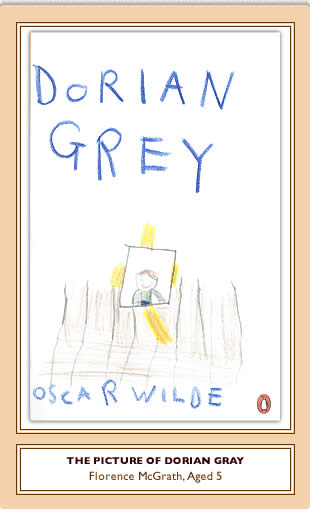
The latest bookselling stunt from the Penguin people: design your own book cover.

Helen Conford, Senior Commissioning Editor at The Penguin Press, on the Penguin blog:
The tag line is 'Books by the Greats, Covers by You', and throughout the rush to design the (back) covers, get the right paper, and tell people about them, we've had a really great time. The covers are art-quality paper, and from internal Penguin efforts we know that they hold ink, paint, pencil and glue (see the first efforts here). Each one comes shrink-wrapped so the paper doesn't get dirty, and I hope people might give them as gifts. They're went round Penguin earlier in the week and we've starting an online gallery that will launch with staff efforts at the end of November (no doubt we'll talk about this here). All of the books talk about the gallery on the back cover, because we want anyone and everyone to send in pictures of their own covers so we can put them up too.
I'm not sure--and do not care--if this gimmick will migrate to America. Maybe I would feel different about it if I could draw as well as, say, Florence McGrath, age 5.

Thanks to Friend of the Blog Cary Federman for bringing this news to my attention.

--Marshal Zeringue

Marty Peretz on Tom Wolfe

Marty Peretz, blogging at The New Republic, sends out a valentine to Tom Wolfe:
I am one of those who believes that Tom Wolfe is among the most penetrating and understandably literate social observers and social commentators of the age. Actually, you have to go back to Thorstein Veblen to read someone so evocative of the realities--sometimes grim, sometimes silly--amidst which we live. And as for a readability comparison you may have to go back to the English novelists of the nineteenth century. It's not only The Bonfire of the Vanities, which, in its day, touched on matters that were taboo, is correct society. It's also his occasional journalism, a journalism that does evoke someone else, H.L. Mencken. [click here to read the rest of Peretz's item]
Not exactly the way I would put it.

Every wonder if there was any relation between Marty Peretz and the Meretz Party? I did...and managed to get an amused Emily Yoffe to look into it.

--Marshal Zeringue

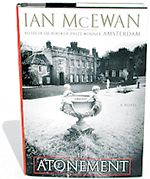
A source for "Atonement"

Ian McEwan has been accused to plagiarizing parts of Atonement from the work of Lucilla Andrews, a romance novelist who had first-hand experience in the hospital wards they both wrote about.

There is a brief account of the accusations here on the Guardian's books blog.

McEwan himself answers the charges in an interesting essay in the Guardian's pages.

The London Times has an account of the story and includes the following excerpts for comparison:

Excerpts from Atonement (Ian McEwan)

“. . . she had already dabbed gentian violet on ringworm, aquaflavine emulsion on a cut, and painted lead lotion on a bruise . . .”

“. . . practising blanket baths on life-size models — Mrs Mackintosh, Lady Chase, and baby George whose blandly impaired physique allowed him to double as a baby girl.”

“These bandages are so tight. Will you loosen them for me a little . . .There’s a good girl . . . go and wash the blood from your face. We don’t want the other patients upset.”

Excerpts from No Time For Romance (Lucilla Andrews)

“Our ‘nursing’ seldom involved more than dabbing gentian violet on ringworm, aquaflavine emulsion on cuts and scratches, lead lotion on bruises and sprains.”

“. . . the life-size dolls on which decades of young Nightingale nurses had learnt to blanket bath. Mrs Mackintosh, Lady Chase and George, a baby boy of convenient physique to allow him to double as a baby girl.”

“Go and wash that blood off your face and neck . . . It’ll upset the patients.”

--Marshal Zeringue

Sunday, November 26, 2006

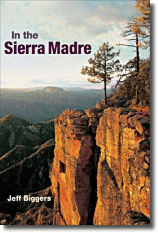
Pg. 69: "In the Sierra Madre"

Jeff Biggers has worked as a writer, educator, radio correspondent, and community organizer across the United States, Europe, India and Mexico.

I asked him to apply the "page 69 test" to his new book, In the Sierra Madre. Here is what he reported:
My new book, In the Sierra Madre, is a blend of memoir, history and storytelling, based on our one-year sojourn among the still very traditional indigenous Raramuri in Mexico's famed Copper Canyon; it follows in the footsteps of various travelers, adventurers and misfits that have trundled into the legendary range in search of some illusory treasure. Page 69 recounts one of those great moments of hypocrisy for travelers and traveling writers, when we're quick to point the finger of change and become outraged by the crush of modernity, forgetting that we are not only part of this change, but have been changed ourselves in the process. American writers and journalists like myself always seem to be in a hurry to write the requiem for native peoples; the Raramuri, as we learn as we turn the page, may have changed their dress, but they have learned to adopt and adapt to tremendous outside pressures as well as anyone. In fact, they're thriving. Page 70 turns the question to me, only a generation away from a land-based backwoods culture: What remains vital in my heritage? What have I lost?
Thanks to Jeff for the input.

Among the praise for In the Sierra Madre:
" ... numerous unforgettable characters, and situations that only a traveler of this ilk could manage. Biggers writes a decidedly adventurous narrative, but he is no adventurer. He is the quintessential observer, with the eye and voice of a poet."
--
San Antonio Express-News

“Jeff Biggers has the keenest eye in the business, and he has a fine, luminous voice to tell you what he has seen. This is a welcome addition to western and Mexican letters. Biggers manages to write like a poet, a historian, a naturalist and an adventurer. His pages are burnished and alive, and I admire his work. You need to read this one soon.”
--Luis Urrea, author of
The Hummingbird’s Daughter and The Devil's Highway

Click here for a Q&A about the book.

Read Jeff's short story "The Last Adriatic Grizzly" here.

Jeff Biggers won a Lowell Thomas Award for Travel Journalism and his coedited volume No Lonesome Road: Selected Prose and Poems, by Don West, won an American Book Award. He is also the author of The United States of Appalachia: How Southern Mountaineers Brought Independence, Culture and Enlightenment to America.

Previous "page 69 tests":
Jeff Broadwater, George Mason, Forgotten Founder
Alicia Steimberg, Andrea Labinger (trans.), The Rainforest
Michael Grunwald, The Swamp
Darrin McMahon, Happiness: A History
Leo Braudy, From Chivalry to Terrorism
David Nasaw, Andrew Carnegie
Leah Hager Cohen, Train Go Sorry
Chris Grabenstein, Slay Ride
David Helvarg, Blue Frontier
Marina Warner, Phantasmagoria
Bill Crider, A Mammoth Murder
Robert W. Bennett, Taming the Electoral College
Nicholas Stern et al, Stern Review Report
Kerry Emanuel, Divine Wind
Adam Langer, The Washington Story
Michael Scott Moore, Too Much of Nothing
Frank Schaeffer, Baby Jack
Wyn Cooper, Postcards from the Interior
Ivan Goncharov, Oblomov
Maureen Ogle, Ambitious Brew
Cass Sunstein, Infotopia
Paul W. Kahn, Out of Eden
Paul Lewis, Cracking Up
Pagan Kennedy, Confessions of a Memory Eater
David Greenberg, Nixon's Shadow
Duane Swierczynski, The Wheelman
George Levine, Darwin Loves You
John Barlow, Intoxicated
Alicia Steimberg, The Rainforest
Alan Wolfe, Does American Democracy Still Work?
John Dickerson, On Her Trail
Marcus Sakey, The Blade Itself
Randy Boyagoda, Governor of the Northern Province
John Gittings, The Changing Face of China
Rachel Kadish, Tolstoy Lied
Eric Rauchway, Blessed Among Nations
Tim Brookes, Guitar and other books
Ruth Padel, Tigers in Red Weather
William Haywood Henderson, Augusta Locke
Jed Horne, Breach of Faith
Robert Greer, The Fourth Perspective
David Plotz, The Genius Factory
Michael Allen Dymmoch, White Tiger
Patrick Thaddeus Jackson, Civilizing the Enemy
Tom Lutz, Doing Nothing
Libby Fischer Hellmann, A Shot To Die For
Nelson Algren, The Man With the Golden Arm
Bob Harris, Prisoner of Trebekistan
Elaine Flinn, Deadly Collection
Louise Welsh, The Bullet Trick
Gregg Hurwitz, Last Shot
Martha Powers, Death Angel
N.M. Kelby, Whale Season
Mario Acevedo, The Nymphos of Rocky Flats
Dominic Smith, The Mercury Visions of Louis Daguerre
Simon Blackburn, Lust
Linda L. Richards, Calculated Loss
Kevin Guilfoile, Cast of Shadows
Ronlyn Domingue, The Mercy of Thin Air
Shari Caudron, Who Are You People?
Marisha Pessl, Special Topics in Calamity Physics
John Sutherland, How to Read a Novel
Steven Miles, Oath Betrayed
Alan Brown, Audrey Hepburn's Neck
Richard Dawkins, The Ancestor's Tale

--Marshal Zeringue
Christmas in nonfiction

Jeremy Seal came up with a brief list of books on Christmas in nonfiction for the London Times.

The list includes:
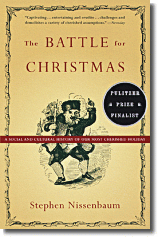
The Battle for Christmas by Stephen Nissenbaum

Captivating social history of the emergence of Christmas celebrations in America.

The Xmas Files by Patrick Harding

Quirky exploration of our Yuletide traditions.

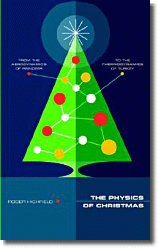
Can Reindeer Fly?: The Science of Christmas by Roger Highfield

Rituals and icons, from hallucogenic toadstools to the Bethlehem star, through light-hearted scientific eyes.
Click here to read about the other titles on Seal's list.

Among other books, Jeremy Seal is the author of Nicholas: The Epic Journey from Saint to Santa Claus.

--Marshal Zeringue

Guardian: books of the year

The Guardian is running a hearty collection of opinion from writers and other opinionated characters about their favorite books of the year.

John Banville, Lionel Shriver, Tim Parks, Edmund White, Hanif Kureishi, Malcolm Gladwell, Beryl Bainbridge, Simon Schama, Siri Hustvedt, Jan Morris, William Boyd, Alain de Botton, David Lodge, and Ian Rankin are but a few of those volunteering thier picks of the year.

Click here, here, and here to see what they and others read and enjoyed this year.

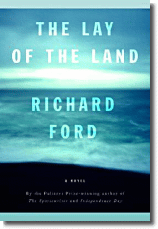
I was glad to see that a few reader-writers shared my high opinion of Roth's Everyman, Updike's Terrorist, McCarthy's The Road, and Peter Carey's Theft. Also, it heartened me to see several recommenders praise Richard Ford's The Lay of the Land since I had been looking forward to it but noticed some diminished enthusiasm for the book recently.

--Marshal Zeringue

Saturday, November 25, 2006

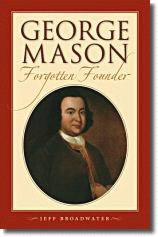
Pg. 69: "George Mason, Forgotten Founder"

George Mason, Forgotten Founder is the third book by Jeff Broadwater, an associate professor of history at Barton College in Wilson, North Carolina.

I asked Jeff to apply the "page 69 test" to George Mason; he reported that the book-browser would not be well served by turning to page 69 to his book:
I'm not sure page 69 works as a good sample of my book. There is a reference on page 69 to a Charles Broadwater. It might give someone the impression the book focuses on one of my relatives, which would be misleading since there are only a couple of other references to him and I don't even know if we are related.
Good thing we have this series. Forget page 69; here is what the author says you should expect from George Mason, Forgotten Founder:
George Mason is an obscure figure to most Americans today, known if at all for lending his name to a burgeoning state university near the nation’s capital. But in eighteenth-century Virginia, he rivaled George Washington and surpassed Thomas Jefferson in his political influence. Before the American Revolution began, Mason made a name for himself as the author of the Fairfax Resolves, a classic statement of the Patriot position in the imperial crisis with Great Britain. Mason’s fame grew during the Revolution. In 1776, he wrote most of the Virginia Declaration of Rights, which was widely hailed as the first modern bill of rights, and Mason’s language and ideas soon reappeared in the Declaration of Independence and in the first ten amendments to the United States Constitution.

Mason, however, shunned the spotlight. His disliked politics, and he did not hesitate to take controversial positions, including, most notably, his refusal, as a delegate to the Philadelphia convention of 1787, to sign the Constitution. In fact, Mason ended his political career as an unreconstructed Anti-Federalist, convinced that the new national government was destined to become the plaything of the moneyed interests. To later generations, Mason seemed to be on the wrong side of history, and as so often happens to “losers,” he has been all but forgotten.

George Mason, Forgotten Founder tries to make the case for his importance and for his complexity, but above all else, a fear of the almost inevitable abuse of power haunted Mason. That fear, I think, went to the core of the revolutionary experience. He was no aberration, and better understanding his career, I think, helps us better understand the origins of the American republic.
Thanks to Jeff for the input.

George Mason, Forgotten Founder has received a number of excellent reviews and endorsements, including:
“George Mason was irascible, opinionated, and essential to the evolution of American political theory. He inspired Jefferson’s Declaration of Independence and Madison’s Bill of Rights. Virginians know him, but most of the rest of the country doesn’t. Jeff Broadwater’s elegant and insightful study will remedy this neglect, and none too soon.”--H. W. Brands, University of Texas at Austin

"It seems to me that George Mason was the most respected founder in his own time who is virtually invisible in our time. This book goes a long way toward closing that gap and providing an answer to why the university that bears his name has chosen well."--Joseph J. Ellis, author of Founding Brothers: The Revolutionary Generation
Jonathan Yardley of the Washington Post wrote:
Broadwater ... writes clear, unadorned prose and has an admirable ability to explain complex intellectual matters in terms the lay reader can understand.... [T]his is an exemplary biography: sympathetic but dispassionate, thorough but not cluttered, convincing in its interpretations and arguments. It leaves no doubt that Mason deserves to be returned to the esteem and reputation he enjoyed during his lifetime, but in no way is it hagiography.
Click here for Richard Brookhiser's Wall Street Journal review.

Jeff Broadwater's previous books are Eisenhower and the Anti-Communist Crusade and Adlai Stevenson and American Politics: The Odyssey of a Cold War Liberal.

Previous "page 69 tests":
Alicia Steimberg, Andrea Labinger (trans.), The Rainforest
Michael Grunwald, The Swamp
Darrin McMahon, Happiness: A History
Leo Braudy, From Chivalry to Terrorism
David Nasaw, Andrew Carnegie
Leah Hager Cohen, Train Go Sorry
Chris Grabenstein, Slay Ride
David Helvarg, Blue Frontier
Marina Warner, Phantasmagoria
Bill Crider, A Mammoth Murder
Robert W. Bennett, Taming the Electoral College
Nicholas Stern et al, Stern Review Report
Kerry Emanuel, Divine Wind
Adam Langer, The Washington Story
Michael Scott Moore, Too Much of Nothing
Frank Schaeffer, Baby Jack
Wyn Cooper, Postcards from the Interior
Ivan Goncharov, Oblomov
Maureen Ogle, Ambitious Brew
Cass Sunstein, Infotopia
Paul W. Kahn, Out of Eden
Paul Lewis, Cracking Up
Pagan Kennedy, Confessions of a Memory Eater
David Greenberg, Nixon's Shadow
Duane Swierczynski, The Wheelman
George Levine, Darwin Loves You
John Barlow, Intoxicated
Alicia Steimberg, The Rainforest
Alan Wolfe, Does American Democracy Still Work?
John Dickerson, On Her Trail
Marcus Sakey, The Blade Itself
Randy Boyagoda, Governor of the Northern Province
John Gittings, The Changing Face of China
Rachel Kadish, Tolstoy Lied
Eric Rauchway, Blessed Among Nations
Tim Brookes, Guitar and other books
Ruth Padel, Tigers in Red Weather
William Haywood Henderson, Augusta Locke
Jed Horne, Breach of Faith
Robert Greer, The Fourth Perspective
David Plotz, The Genius Factory
Michael Allen Dymmoch, White Tiger
Patrick Thaddeus Jackson, Civilizing the Enemy
Tom Lutz, Doing Nothing
Libby Fischer Hellmann, A Shot To Die For
Nelson Algren, The Man With the Golden Arm
Bob Harris, Prisoner of Trebekistan
Elaine Flinn, Deadly Collection
Louise Welsh, The Bullet Trick
Gregg Hurwitz, Last Shot
Martha Powers, Death Angel
N.M. Kelby, Whale Season
Mario Acevedo, The Nymphos of Rocky Flats
Dominic Smith, The Mercury Visions of Louis Daguerre
Simon Blackburn, Lust
Linda L. Richards, Calculated Loss
Kevin Guilfoile, Cast of Shadows
Ronlyn Domingue, The Mercy of Thin Air
Shari Caudron, Who Are You People?
Marisha Pessl, Special Topics in Calamity Physics
John Sutherland, How to Read a Novel
Steven Miles, Oath Betrayed
Alan Brown, Audrey Hepburn's Neck
Richard Dawkins, The Ancestor's Tale

--Marshal Zeringue
Is James Bond a misogynist?

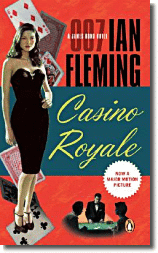
I take on Casino Royale, the book and the new film, in an item over at Spot-on:

How do we judge if James Bond is a misogynist? And if he is one, should that spoil the Ian Fleming novels and the big popcorn movies that feature the character?

My answer to the latter question: Probably not. Fleming and the moviemakers created entertainment, not social commentary....

But Bond as an artifact, not as entertainment, is another story.

So, is James Bond a misogynist? Click here to find out.

--Marshal Zeringue

The best books on public relations

Michael Kempner, president and CEO of MWW Group public relations, named the five best books on public relations for Opinion Journal.

Three of his titles are nonfiction. Here are the two novels, both endorsed by Friend of the Blog KvdW:
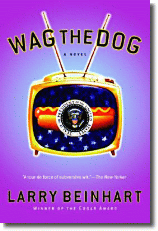
American Hero by Larry Beinhart
Retitled Wag the Dog: A Novel after the movie it inspired became a hit, American Hero was based on a real war (Desert Storm) and a real president (George H.W. Bush). The release of the 1997 movie "Wag the Dog," starring Dustin Hoffman and Robert De Niro, coincided with a real scandal: the President Clinton-Monica Lewinsky affair. But regardless of historical context, the novel and the movie posed the same question: How far will a president go to extricate himself from the white-hot spotlight of media scrutiny and public outrage? Answer: all the way. By creating a fake war with the help of Hollywood, the White House PR machine manages to manipulate the public with frightening ease.
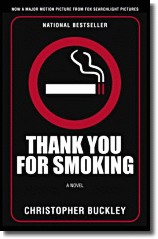
Thank You for Smoking by Christopher Buckley
This fine satirical novel concerns Nick Naylor, a spokesman for Big Tobacco who does a brilliant job of defending not only tobacco companies but also those who partake in the dangerous habit of using their products. Naylor skewers the media, bureaucrats and health officials with such ferocity and acumen that, amazingly, he somehow gets the reader to sympathize with Big Tobacco's plight. But because he's so good at his job, he becomes a target of both the FBI and, it appears, a zealous group of anti-tobacco terrorists, all of which puts him in the way of some richly entertaining mayhem. Christopher Buckley clearly understands the central principle of spin: However bad the trouble you're in, you can generally make the other side look worse.

Click here to read about the nonfiction titles on Kempner's list.
--Marshal Zeringue

Pg. 69: "The Rainforest" (trans.)

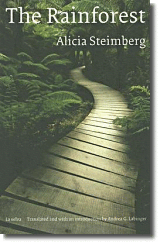
Last month the blog featured a "page 69" item on Alicia Steimberg's The Rainforest.

Given my interest in and respect for the work that translators do, I thought it would be interesting to see how the translator, Andrea G. Labinger, saw page 69 of the novel. Here's what Andrea reported:
Yes, this page provides a representative glimpse of the novel in its entirety. We hear the voice of Cecilia, the first-person narrator, describing a typical conflict – if anything can be called “typical” in the life of this dysfunctional dyad – with her drug-addicted son, Federico, and with her own conscience. Cecilia is torn between acquiescing to Federico’s demands for money so that he can start up his own business (a chimera, as she well knows) and setting the “limits” the therapists have recommended, boundaries that Cecilia would like to establish but is afraid to impose on this troubled, violent son whom she dearly loves. Cecilia also poses an existential question here that clearly reflects her intelligence and introspection: “What if I were a clown, an actress, a teller of horror stories? What if none of this ever really happened?”
Many thanks to Andrea for her input.

If you missed the link, click here for the author Alicia Steimberg's take on The Rainforest.

Andrea Labinger has translated much prose fiction from Spanish, including Steimberg’s Musicians and Watchmakers and Call Me Magdalena, Carlos Cerda’s To Die in Berlin and An Empty House, and the writing of Sabina Berman, Mempo Giardinelli, and Ana María Shua. Her latest translations include The Rainforest and “Casablanca” by Edgar Brau, published in Casablanca and Other Stories.

Labinger's translation of Steimberg's Cuando digo Magdalena was a finalist in the PEN USA Literary Competition, 2002.

She is Professor of Spanish, at California's University of La Verne.

Previous "page 69 tests":
Michael Grunwald, The Swamp
Darrin McMahon, Happiness: A History
Leo Braudy, From Chivalry to Terrorism
David Nasaw, Andrew Carnegie
Leah Hager Cohen, Train Go Sorry
Chris Grabenstein, Slay Ride
David Helvarg, Blue Frontier
Marina Warner, Phantasmagoria
Bill Crider, A Mammoth Murder
Robert W. Bennett, Taming the Electoral College
Nicholas Stern et al, Stern Review Report
Kerry Emanuel, Divine Wind
Adam Langer, The Washington Story
Michael Scott Moore, Too Much of Nothing
Frank Schaeffer, Baby Jack
Wyn Cooper, Postcards from the Interior
Ivan Goncharov, Oblomov
Maureen Ogle, Ambitious Brew
Cass Sunstein, Infotopia
Paul W. Kahn, Out of Eden
Paul Lewis, Cracking Up
Pagan Kennedy, Confessions of a Memory Eater
David Greenberg, Nixon's Shadow
Duane Swierczynski, The Wheelman
George Levine, Darwin Loves You
John Barlow, Intoxicated
Alicia Steimberg, The Rainforest
Alan Wolfe, Does American Democracy Still Work?
John Dickerson, On Her Trail
Marcus Sakey, The Blade Itself
Randy Boyagoda, Governor of the Northern Province
John Gittings, The Changing Face of China
Rachel Kadish, Tolstoy Lied
Eric Rauchway, Blessed Among Nations
Tim Brookes, Guitar and other books
Ruth Padel, Tigers in Red Weather
William Haywood Henderson, Augusta Locke
Jed Horne, Breach of Faith
Robert Greer, The Fourth Perspective
David Plotz, The Genius Factory
Michael Allen Dymmoch, White Tiger
Patrick Thaddeus Jackson, Civilizing the Enemy
Tom Lutz, Doing Nothing
Libby Fischer Hellmann, A Shot To Die For
Nelson Algren, The Man With the Golden Arm
Bob Harris, Prisoner of Trebekistan
Elaine Flinn, Deadly Collection
Louise Welsh, The Bullet Trick
Gregg Hurwitz, Last Shot
Martha Powers, Death Angel
N.M. Kelby, Whale Season
Mario Acevedo, The Nymphos of Rocky Flats
Dominic Smith, The Mercury Visions of Louis Daguerre
Simon Blackburn, Lust
Linda L. Richards, Calculated Loss
Kevin Guilfoile, Cast of Shadows
Ronlyn Domingue, The Mercy of Thin Air
Shari Caudron, Who Are You People?
Marisha Pessl, Special Topics in Calamity Physics
John Sutherland, How to Read a Novel
Steven Miles, Oath Betrayed
Alan Brown, Audrey Hepburn's Neck
Richard Dawkins, The Ancestor's Tale

--Marshal Zeringue

Friday, November 24, 2006

Q & A with Tracy Chevalier

Sarah Kinson interviewed the writer Tracy Chevalier for the Guardian's books blog.

Among the questions Chevalier answered:
What was your favourite book as a child?

When you were growing up did you have books in your home?

Was there someone that got you interested in reading books?

What made you want to write when you were starting out?

What makes you write now?

How do you write?

What advice would you give to new writers?

What good advice was given to you when you were starting out?
The answer to that last one:
Rose Tremain, who was my tutor at [the University of East Anglia] where I did an MA in creative writing, said do all the research but then put the notebook away and just write the story. Try not to let the research take over the story or get in the way of the story.
Click here to read the entire interview.

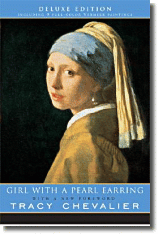
Tracy Chevalier is the author of Girl With a Pearl Earring, Falling Angels, The Lady and the Unicorn, and the forthcoming Burning Bright, a novel about William Blake.

--Marshal Zeringue

Pg. 69: "The Swamp"

Michael Grunwald is a reporter for the Washington Post. He has won the George Polk Award for national reporting, the Worth Bingham Award for investigative reporting, and numerous other awards, including the Society of Environmental Journalists award for his reporting on the Everglades.

He is the author of The Swamp: The Everglades, Florida, and the Politics of Paradise.

I asked Mike to apply the "page 69 test" to his book; here is what he reported:
The Swamp is a narrative history of the Florida Everglades, the saga of man and nature in America’s last frontier. The Everglades was once reviled as a pestilential wasteland; now it’s revered as an ecological treasure. For years, Americans dreamed of draining it; now we’ve launched the largest environmental project in history to try to restore it.

Page 69 is part of The Swamp’s most unusual chapter, the story of a generation when nothing really happened to the Everglades. Wait! Don’t click away! There were fascinating reasons why nothing happened, and a fascinating Florida character making sure nothing happened. His name was David Levy Yulee, and he’s celebrated as the father of Florida statehood and America’s first Jewish senator. The history books don’t mention that he was also a rapacious hypocrite, or that he accidentally helped preserve the Everglades.

If there was a typical path to power in 19th-century America, Yulee’s wasn’t it. His grandfather was the grand vizier of Morocco before getting burned alive in a palace revolt; his father was a West Indies lumber baron before creating a utopian colony for persecuted Jews in North Florida. David made his name as a fiery populist, opposed “from the very innermost depths of my soul” to “the frauds and oppressions of CORPORATE PRIVILEGE.” His big idea was to use federal land grants to finance a cross-Florida railroad that would attract development and immigration to the peninsula. And at a time when Abraham Lincoln was demanding 2.6 million acres in grants for the Illinois Central, he insisted that Florida’s railroad must be state-owned, to avoid the “impositions and exactions which a private chartered monopoly would impose.” His case for a state-owned railroad carried Florida into the Union, and Yulee into the Senate.

But then he got a better idea: A Yulee-owned railroad. He chartered the Florida Railroad, and used his office to snag land grants, surveys, contracts, and rights-of-way for his line. And in 1848, he scuttled legislation that would have given the Everglades to Florida, as long as the land grant was “sacredly and exclusively” used for drainage.

This was shocking. Wetlands were still considered wastelands, and the first U.S. government report on the Everglades had just described it as a God-forsaken hellhole, “suitable only for the haunt of noxious vermin, or the resort of pestilential reptiles.” The report had also suggested that draining the swamp would create a balmy paradise, transforming a worthless wilderness into a productive hub for farming, logging and “the making of salt by solar evaporation,” extending civilization from sea to shining sea.

So why did Yulee block this Manifest Destiny project? He thought Congress should give Florida all its swampland, not just the Everglades. And he wanted Florida to give that swampland to railroads—one in particular—not drainage companies.

Thanks to Yulee, that’s exactly what happened. He got Congress to give Florida 20 million acres of wetlands, and he got Florida to set up a fund that used those wetlands to finance railroads. The plan worked brilliantly, except that Yulee’s railroad was completed just as the Civil War was starting. At the top of page 69, Yulee is filing lawsuits and writing letters to try to stop Robert E. Lee from seizing his rails, arguing that the war was not enough of an emergency to suspend property rights: “I humbly trust I may not be wanting at any time in necessary & dutiful sacrifice & contribution to the great cause in which all citizens are engaged. But I have not the right to make myself free with the property of others.” By page’s end, the Civil War was over, Florida’s railroads were bankrupt, and Yulee—after serving time for treason—was joining forces with Reconstruction-era carpetbaggers to loot what was left of the state wetland fund: “Florida nearly gave itself away completely before the wild run skidded to a halt.”

It’s an ugly story, and it gives a sense of the greed, opportunism, and constant desperation for immigration and development that have been the constant themes of Florida history. But by keeping Florida’s wetlands away from drainage companies, Yulee helped save the Everglades for posterity, and helped postpone immigration and development for another generation. In the 1880 census, South Florida’s population was a grand total of 257. So much for farming, logging, and “the making of salt by solar evaporation.”

The larger point of page 69—and my book—is about unintended consequences. Yulee’s bad intentions helped save the Everglades. In later generations, the good intentions of progressives who wanted to drain the swamp for the benefit of humanity helped destroy the Everglades. In every chapter of The Swamp, you’ll find someone proclaiming something with absolute certainty that turns out to be absolutely wrong.

That 1848 report, for example, declared that $500,000 would “beyond question” be enough to drain the entire Everglades. Ultimately, America would spend more than $1 billion on that effort, which fortunately wasn’t enough to finish the job. Now we’re spending $11 billion to try to undo our mistakes. But it’s still not at all clear whether we’ll do the job right. Our attitudes towards nature have changed, but our hubris hasn’t.
Many thanks to Mike for the input.

Click here to read an excerpt from The Swamp. There is another excerpt here, accompanied by some beautiful B&W photographs.

For access to a long list of positive reviews, click here.

Click here to watch an E&E News clip of Grunwald talking about The Swamp, the Army Corps of Engineers, and Hurricane Katrina.

Terry Gross interviewed Mike on Fresh Air: click here to listen to their conversation.

There is a Q & A with US News and World Report here, and another with the Daily Kos here. Click here for Emily Gertz's Grist interview with Mike.

The Arthur Marshall Foundation works to develop, promote and deliver education and public outreach programs that are central to the restoration of the Everglades. Click here to learn more about their work.

In addition to his usual reporting, Mike writes the informative and entertaining weekly "Zeitgeist Checklist" that appears in the Washington Post and Slate.

Previous "page 69 tests":
Darrin McMahon, Happiness: A History
Leo Braudy, From Chivalry to Terrorism
David Nasaw, Andrew Carnegie
Leah Hager Cohen, Train Go Sorry
Chris Grabenstein, Slay Ride
David Helvarg, Blue Frontier
Marina Warner, Phantasmagoria
Bill Crider, A Mammoth Murder
Robert W. Bennett, Taming the Electoral College
Nicholas Stern et al, Stern Review Report
Kerry Emanuel, Divine Wind
Adam Langer, The Washington Story
Michael Scott Moore, Too Much of Nothing
Frank Schaeffer, Baby Jack
Wyn Cooper, Postcards from the Interior
Ivan Goncharov, Oblomov
Maureen Ogle, Ambitious Brew
Cass Sunstein, Infotopia
Paul W. Kahn, Out of Eden
Paul Lewis, Cracking Up
Pagan Kennedy, Confessions of a Memory Eater
David Greenberg, Nixon's Shadow
Duane Swierczynski, The Wheelman
George Levine, Darwin Loves You
John Barlow, Intoxicated
Alicia Steimberg, The Rainforest
Alan Wolfe, Does American Democracy Still Work?
John Dickerson, On Her Trail
Marcus Sakey, The Blade Itself
Randy Boyagoda, Governor of the Northern Province
John Gittings, The Changing Face of China
Rachel Kadish, Tolstoy Lied
Eric Rauchway, Blessed Among Nations
Tim Brookes, Guitar and other books
Ruth Padel, Tigers in Red Weather
William Haywood Henderson, Augusta Locke
Jed Horne, Breach of Faith
Robert Greer, The Fourth Perspective
David Plotz, The Genius Factory
Michael Allen Dymmoch, White Tiger
Patrick Thaddeus Jackson, Civilizing the Enemy
Tom Lutz, Doing Nothing
Libby Fischer Hellmann, A Shot To Die For
Nelson Algren, The Man With the Golden Arm
Bob Harris, Prisoner of Trebekistan
Elaine Flinn, Deadly Collection
Louise Welsh, The Bullet Trick
Gregg Hurwitz, Last Shot
Martha Powers, Death Angel
N.M. Kelby, Whale Season
Mario Acevedo, The Nymphos of Rocky Flats
Dominic Smith, The Mercury Visions of Louis Daguerre
Simon Blackburn, Lust
Linda L. Richards, Calculated Loss
Kevin Guilfoile, Cast of Shadows
Ronlyn Domingue, The Mercy of Thin Air
Shari Caudron, Who Are You People?
Marisha Pessl, Special Topics in Calamity Physics
John Sutherland, How to Read a Novel
Steven Miles, Oath Betrayed
Alan Brown, Audrey Hepburn's Neck
Richard Dawkins, The Ancestor's Tale

--Marshal Zeringue

Jane Smiley's reading list

Earlier on the blog I ran a series of items based on the Guardian's excerpts from Jane Smiley's Thirteen Ways of Looking at the Novel: see here, here, here, here, here, here, here, here, here, here, here, and here.

Now she has worked up a short list of engaging books for The Week magazine.

Here is half of her list:
Arthur and George by Julian Barnes

A substantial, readable, and often graceful account of an incident in the life of Sir Arthur Conan Doyle in which the creator of Sherlock Holmes put his own deductive powers to the test.

Tennyson’s Gift by Lynne Truss (a novella included in The Lynne Truss Treasury)

Truss is a truly hilarious writer. This evocation of Tennyson, Lewis Carroll, and other late Victorians is smart, funny, and wicked. Reading the collected works of Lynne Truss actually promotes mental health, physical well-being, and the development of a good sense of humor.

Moral Disorder by Margaret Atwood

There’s no science fiction—and much wisdom—in this superbly written new collection of stories.
Click here to read about the other three titles.

Jane Smiley is the Pulitzer Prize–winning author of A Thousand Acres and Good Faith. Ten Days in the Hills, her 12th novel, will be published in February.

--Marshal Zeringue

Thursday, November 23, 2006

A quiz on the great American novel

While they may be consuming more Marmite than turkey in Britain today, the Guardian neverthless has seen fit to honor (honour?) Thanksgiving with a quiz about the great American novel.

Of course, I failed miserably--6 correct out of a possible 11--but I'm well pleased (chuffed?) that only one of my six correct answers was a blind guess. And I had no doubt about this answer:
The first sentence of Herman Melville's Moby-Dick is "Call me Ishmael." What's the second?

__ Come now with me to your insular city of the Manhattoes, belted round by wharves as Indian isles by coral reefs - commerce surrounds it with her surf.

__ The name will do as well as any other for a tale the like of mine.

__ Some years ago - never mind how long precisely - having little or no money in my purse, and nothing particular to interest me on shore, I thought I would sail about a little and see the watery part of the world.

__ Call me anything you like, just call me.
Click here to take the quiz.

--Marshal Zeringue

Arab literature and political Islam

What accounts for the reluctance of so many Arab writers to deal with political Islam in their work?

Mona Naggar took up the question in an article that originally appeared in German in the Neue Zürcher Zeitung and is now available in translation at signandsight.

One reason: "the classic rivalry between intellectuals and the Islamicist movement. Followers of Islamicism see intellectuals and people working in the cultural sector as anti-religious advocates of secularism."

Another factor: "Political developments in the Middle East since 2001 only serve to complicate matters. Clear words against any supporters of political Islam are all too quickly interpreted as a pro-Western stance."

There are of course exceptions:
Supporters for political Islam do appear now and then in 20th century Arab literature. For instance there is Abdalmunim, the grandson of patriarch Ahmad Abdalgawad in Sugar Street. This third volume of Naguib Mahfouz' Cairo Trilogy spans the time from 1935 to 1944. Abdalmunim is an active member of the Muslim Brotherhood, and his brother Ahmad is a communist. At the end of the book, both are arrested for their political activities.
Click here to read Naggar's article.

--Marshal Zeringue

"Oblomov" review

Keith Garebian penned an excellent review of Ivan Goncharov's Oblomov for the Globe & Mail:

Just as Dickens's readers know what it is to be a Scrooge or Shakespeare's audiences know what it is to be a Shylock or a Hamlet, Russians know the many connotations of the name Oblomov, some of which are indolence, inertia, apathy and indifference to change. Peggy Guggenheim called Samuel Beckett (one of her lovers) an Oblomov because of his lack of zest for life. Lenin used the name to ridicule his political opponents who were opposed to dialectical change.

Yet, most North Americans don't know who Oblomov is because he appears as the eponymous character in a classic Russian novel, a fiction that took its author, Ivan Goncharov, 10 years to write (1849-1859) and that took 55 years to reach the English public, despite the author's reputation in his homeland for critical realism about patriarchal and conservative petty nobility. [click here to read the rest of the review]

The scholar Galya Diment wrote a fine "page 69" treatment of the novel; click here to read it.

--Marshal Zeringue

Wednesday, November 22, 2006

What is Wendie Malick reading?

The actor Wendie Malick--who you may recognize from Frasier, CSI, or her Golden Globe-winning role in Just Shoot Me!--recently talked to the Christian Science Monitor about what she was listening to and viewing for entertainment.

And reading:
Beside scripts? I read the Sunday New York Times Magazine and The Week in Review [section of the paper]. And I try to get through the puzzle. Beyond that, I read The New Yorker, and I have been picking through Thomas Ricks's book, Fiasco [about the Iraq war], which I'm finding fascinating. I want to read Barack Obama's book - The Audacity of Hope is such a great title. I've also been reading On Desire by William Irvine. It's that great question: What is a successful life? Are we, in fact, getting closer to real satisfaction ... or are we on this roller coaster? I loved Joan Didion's last book [The Year of Magical Thinking]. Her language is so gorgeous. I try to stay with her, where I wouldn't with everyone.
Click here to read about what Malick is watching and listening to.

--Marshal Zeringue

Pg. 69: "Happiness: A History"

Darrin M. McMahon is Ben Weider Associate Professor of History at Florida State University and author of Enemies of the Enlightenment: The French Counter-Enlightenment and the Making of Modernity (2001), and Happiness: A History (2006).

I asked Darrin to apply the "page 69 test" to his latest book; this is what he reported:
Happiness: A History, as the title suggests, is a book about the history of happiness. I see happiness above all as an alluring idea that has exercised a particularly strong hold on the Western imagination. Rather than try to define what happiness is once and for all—or give advice about how to get it!—I look at the way different periods have imagined happiness though the ages and how these changing conceptions bear on our own contemporary quest for this elusive end.

Page 69 falls at the very beginning of Chapter Two. In the Introduction and Chapter One I introduced the “tragic” understanding of happiness—common to many early cultures—that sees happiness primarily as a function of fortune or the benevolence of the gods. (We retain something of this link in the word “happiness” itself, whose root is “hap,” meaning luck or fortune). I also discussed how the Greeks, beginning with Socrates, challenged that idea, developing an understanding of happiness as the reward for living a virtuous life.

The bulk of Chapter Two is devoted to how Christianity both rejected and adapted these earlier notions. But I also talk about some of the earthier Roman conceptions of happiness against which Christians rebelled. Page 69 features a picture of a Roman coin with the Emperor Vespasian on one side and the goddess Felicitas (Felicity) on the other—a common pairing. Holding a horn of plenty, Felicitas represents bounty, and so symbolizes perfectly the popular Roman conception that to be happy is to be prosperous, and to be “poor” (miser) is to be miserable. The previous page shows an amusing picture of a great Roman phallus, with the straightforward inscription: Hic habitat felicitas. “Here dwells felicity!” Needless to say, Christians would have a field day with all this.

So page 69 is only a snapshot in a long-developing sequence. But in so far as it presents notions of happiness—happiness as pleasure and prosperity, happiness as good living, and ultimately happiness as spiritual fulfillment—that continue to be part of our modern understanding, the page is representative of the book as a whole. For my greatest concern in this book is to show how our past pursuits continue to shape those of the present.
Thanks to Darrin for the input.

There is an excerpt available from the publisher (sorry, no direct link: it involves a little searching), or you may click here.

Before last New Years Eve, Darrin previewed a theme from his book in an essay titled, "In Pursuit of Unhappiness." Click here to read it.

Curious about what the writers of the Declaration of Independence meant by the "pursuit of happiness" but can't wait to get your hands on McMahon's book? Click here for a quick lesson.

Happiness: A History earned fine reviews from a number of publications including the Economist and, by Jim Holt, in the New York Times.

Diane Rehm interviewed Darrin about the book; click here to listen to their conversation. Michael Krasny also conducted an interview: click here to listen to it.

Click here to learn more about Enemies of Enlightenment.

Darrin M. McMahon is a regular contributor to The New Republic's Open University blog, where he is joined by previous "page 69" contributors Cass Sunstein (Infotopia), David Greenberg (Nixon's Shadow), Alan Wolfe (Does American Democracy Still Work?), Eric Rauchway (Blessed Among Nations), and others.

Previous "page 69 tests":
Leo Braudy, From Chivalry to Terrorism
David Nasaw, Andrew Carnegie
Leah Hager Cohen, Train Go Sorry
Chris Grabenstein, Slay Ride
David Helvarg, Blue Frontier
Marina Warner, Phantasmagoria
Bill Crider, A Mammoth Murder
Robert W. Bennett, Taming the Electoral College
Nicholas Stern et al, Stern Review Report
Kerry Emanuel, Divine Wind
Adam Langer, The Washington Story
Michael Scott Moore, Too Much of Nothing
Frank Schaeffer, Baby Jack
Wyn Cooper, Postcards from the Interior
Ivan Goncharov, Oblomov
Maureen Ogle, Ambitious Brew
Cass Sunstein, Infotopia
Paul W. Kahn, Out of Eden
Paul Lewis, Cracking Up
Pagan Kennedy, Confessions of a Memory Eater
David Greenberg, Nixon's Shadow
Duane Swierczynski, The Wheelman
George Levine, Darwin Loves You
John Barlow, Intoxicated
Alicia Steimberg, The Rainforest
Alan Wolfe, Does American Democracy Still Work?
John Dickerson, On Her Trail
Marcus Sakey, The Blade Itself
Randy Boyagoda, Governor of the Northern Province
John Gittings, The Changing Face of China
Rachel Kadish, Tolstoy Lied
Eric Rauchway, Blessed Among Nations
Tim Brookes, Guitar and other books
Ruth Padel, Tigers in Red Weather
William Haywood Henderson, Augusta Locke
Jed Horne, Breach of Faith
Robert Greer, The Fourth Perspective
David Plotz, The Genius Factory
Michael Allen Dymmoch, White Tiger
Patrick Thaddeus Jackson, Civilizing the Enemy
Tom Lutz, Doing Nothing
Libby Fischer Hellmann, A Shot To Die For
Nelson Algren, The Man With the Golden Arm
Bob Harris, Prisoner of Trebekistan
Elaine Flinn, Deadly Collection
Louise Welsh, The Bullet Trick
Gregg Hurwitz, Last Shot
Martha Powers, Death Angel
N.M. Kelby, Whale Season
Mario Acevedo, The Nymphos of Rocky Flats
Dominic Smith, The Mercury Visions of Louis Daguerre
Simon Blackburn, Lust
Linda L. Richards, Calculated Loss
Kevin Guilfoile, Cast of Shadows
Ronlyn Domingue, The Mercy of Thin Air
Shari Caudron, Who Are You People?
Marisha Pessl, Special Topics in Calamity Physics
John Sutherland, How to Read a Novel
Steven Miles, Oath Betrayed
Alan Brown, Audrey Hepburn's Neck
Richard Dawkins, The Ancestor's Tale

--Marshal Zeringue