Tuesday, October 26, 2021

Pg. 99: Jessica Pierce & Marc Bekoff's "A Dog’s World"

Featured at the Page 99 Test: A Dog's World: Imagining the Lives of Dogs in a World without Humans by Jessica Pierce and Marc Bekoff.

About the book, from the publisher:
What would happen to dogs if humans simply disappeared? Would dogs be able to survive on their own without us? A Dog’s World imagines a posthuman future for dogs, revealing how dogs would survive—and possibly even thrive—and explaining how this new and revolutionary perspective can guide how we interact with dogs now.

Drawing on biology, ecology, and the latest findings on the lives and behavior of dogs and their wild relatives, Jessica Pierce and Marc Bekoff—two of today’s most innovative thinkers about dogs—explore who dogs might become without direct human intervention into breeding, arranged playdates at the dog park, regular feedings, and veterinary care. Pierce and Bekoff show how dogs are quick learners who are highly adaptable and opportunistic, and they offer compelling evidence that dogs already do survive on their own—and could do so in a world without us.

Challenging the notion that dogs would be helpless without their human counterparts, A Dog’s World enables us to understand these independent and remarkably intelligent animals on their own terms.
The Page 99 Test: Wild Justice.

The Page 99 Test: A Dog's World.

--Marshal Zeringue

Twelve of the spookiest books

The staff at USA Today tagged "the spookiest, most spine-tingling books [they]'ve ever read," including:
Occultation by Laird Barron

The horror story is a form versatile enough to accomplish many things, but its basic root purpose is to scare the reader. And Barron writes some scary stories. The highlight of his second volume of short fiction, a novella titled "–30–," brings the creepy with both claws. Two researchers work at a remote outpost in an unforgiving wilderness when nature stops acting natural. If bugs are your phobia, this story will crawl straight into your nightmare closet. "–30–" starts slowly, softly, with disembodied whispers, strange sounds, midnight knocks at the door, then gradually, steadily cranks up the paranoia to a climactic pitch of mindless terror. Barron can even make a sunset unsettling: "He limped across a plain that stretched beneath a wide, carnivorous sky."
–Jonathan Briggs
Read about another entry on the list.

--Marshal Zeringue

Monday, October 25, 2021

Seven top crime and suspense novels set on the river

Rebecca Hodge is an author of fiction, a veterinarian, and a clinical research scientist who lives and writes in North Carolina. Fiction writing is the space where her creative side comes out to play, and her writing centers on characters who discover that life is not a spectator sport. She has three grown sons, two crazy dogs, and one patient husband. When not writing on the back porch or brewing yet another mug of tea, she loves hiking, travel, and (of course) curling up with a good book.

[The Page 69 Test: Over the Falls; Coffee with a Canine: Rebecca Hodge & Tess and Kalen]

Hodge's new novel is Over the Falls.

At CrimeReads she tagged seven top crime and suspense novels set on the river, including:
The River – Peter Heller

A leisurely canoe trip on the Maskwa River in Canada takes on extra urgency for two paddlers when a wildfire begins making its way through the forest. One night, the men overhear a man and woman arguing—and the next day, they discover the man is paddling alone. As the two search for answers, this story becomes a taut saga of wilderness survival.
Read about another entry on the list.

--Marshal Zeringue

Pg. 99: Jules Stewart's "Policing the Big Apple"

Featured at the Page 99 Test: Policing the Big Apple: The Story of the NYPD by Jules Stewart.

About the book, from the publisher:
As debates about defunding US police forces continue, this book offers an enlightening historical overview of one of the largest metropolitan contingents: the New York City Police Department.

The NYPD is America’s largest and most celebrated law enforcement agency. This book examines the history of policing in New York City, from colonial days and the formation of the NYPD at the turn of the twentieth century, through 1930s battles with the Mafia to the Zero Tolerance of the 1990s. Jules Stewart explores political influence, corruption, reform, and community relations through stories of the NYPD’s commissioners and the visions they had for the force and the city, as well as at the level of cops on the beat.

This book is an indispensable chronicle for anyone interested in policing and the history of New York.
Visit Jules Stewart's website.

The Page 99 Test: Policing the Big Apple.

--Marshal Zeringue

Q&A with Margaret Verble

From my Q&A with Margaret Verble, author of When Two Feathers Fell from the Sky:
What non-literary inspirations have influenced your writing?

Certainly, the greatest influence on my writing was the fact that I grew up watching a treaty being broken. When I was young, in Oklahoma the Army Corp of Engineers was stealing the Arkansas River bed from the Cherokees in trucks carrying valuable sand and gravel right down the very section line I portray in Maud’s Line. It was an outrageous theft that went on for several years and it infuriated me. Those trucks ran me to the side of the road more than once and I had to watch the old Indians in my family stomach that theft when I knew they had been stolen from again and again.

Another influence that pertains directly to When Two Feathers Fell From the Sky is the fact that my mother was a fourth grade teacher and the fourth grade was where children in Nashville were first introduced to its history. Which, believe me, consisted of a lot of stories of murderous Indians – who were Cherokees – attacking poor innocent white people for no apparent reason. That, too, infuriated me, both on my own behalf and on my mother’s, who had to teach that nonsense year after year. She...[read on]
Visit Margaret Verble's website.

My Book, The Movie: Maud's Line.

Writers Read: Margaret Verble (March 2019).

The Page 69 Test: When Two Feathers Fell from the Sky.

Q&A with Margaret Verble.

--Marshal Zeringue

Sunday, October 24, 2021

Five top dark and disturbing reads

James Han Mattson was born in Seoul, Korea and raised in North Dakota. A graduate of the Iowa Writers’ Workshop, he has received grants from the Copernicus Society of America and Humanities North Dakota. He has been a featured storyteller on The Moth, and has taught at the University of Iowa, the University of Cape Town, the University of Maryland, the George Washington University, Murray State University, and the University of California – Berkeley. In 2009, he moved to Korea and reunited with his birth family after 30 years of separation.

He is the author of two novels: The Lost Prayers of Ricky Graves (2017) and Reprieve (2021). He is currently the fiction editor of Hyphen Magazine.

At the Waterstones blog he tagged five favorite dark and disturbing reads, including:
The Changeling by Victor LaValle

This book delivers on so many fronts. It’s deeply disturbing and profoundly moving, exploring issues of family and parenthood while barreling through a world of intense supernatural menace. There are very few authors who can blend the magical with the real so effortlessly, but LaValle is one of them, and this is him in top form.
Read about another entry on the list.

The Changeling is among A.K. Larkwood's five tense books that blend sci-fi and horror, Leah Schnelbach's ten sci-fi and fantasy must-reads from the 2010s, T. Marie Vandelly's top ten suspenseful horror novels featuring domestic terrors and C.J. Tudor's six thrillers featuring missing, mistaken, or "changed" children.

--Marshal Zeringue

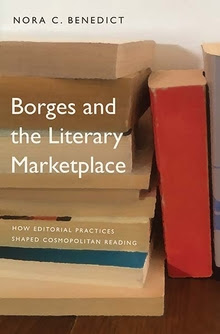
Pg. 99: Nora C. Benedict's "Borges and the Literary Marketplace"

Featured at the Page 99 Test: Borges and the Literary Marketplace: How Editorial Practices Shaped Cosmopolitan Reading by Nora C. Benedict.

About the book, from the publisher:
A fascinating history of Jorge Luis Borges’s efforts to revolutionize and revitalize literature in Latin America

Jorge Luis Borges (1899–1986) stands out as one of the most widely regarded and inventive authors in world literature. Yet the details of his employment history throughout the early part of the twentieth century, which foreground his efforts to develop a worldly reading public, have received scant critical attention. From librarian and cataloguer to editor and publisher, this writer emerges as entrenched in the physical minutiae and social implications of the international book world.

Drawing on years of archival research coupled with bibliographical analysis, this book explains how Borges’s more general involvement in the publishing industry influenced not only his formation as a writer, but also global book markets and reading practices in world literature. In this way it tells the story of Borges’s profound efforts to revolutionize and revitalize literature in Latin America through his varying jobs in the publishing industry.
Visit Nora C. Benedict's website.

The Page 99 Test: Borges and the Literary Marketplace.

--Marshal Zeringue

Saturday, October 23, 2021

What is David R. Slayton reading?

Featured at Writers Read: David R. Slayton, author of Trailer Park Trickster.

His entry begins:
The pandemic has me reading a lot of comfort reads. I’ve been revisiting Gail Carriger’s Parasol Protectorate and Terry Pratchett’s books, especially the ones with Granny Weatherwax like Witches Abroad. It’s not all light stuff though.

Tough times make me crave escape, and great characters are especially welcome. I’ve been diving into C.S. Poe’s Magic and Steam series and Gregory Ashe’s gritty detective novels. They’ve been collaborating lately and I recommend A Friend in the Dark. They do such an amazing job of making New York feel like...[read on]
About Trailer Park Trickster, from the publisher:
They are my harvest, and I will reap them all.

Returning to Guthrie, Oklahoma, for the funeral of his mysterious and beloved aunt Sue, Adam Binder once again finds himself in the path of deadly magic when a dark druid begins to prey on members of Adam’s family. It all seems linked to the death of Adam’s father many years ago—a man who may have somehow survived as a warlock.

Watched by the police, separated from the man who may be the love of his life, compelled to seek the truth about his connection to the druid, Adam learns more about his family and its troubled history than he ever bargained for, and finally comes face-to-face with the warlock he has vowed to stop.

Meanwhile, beyond the Veil of the mortal world, Argent the Queen of Swords and Vic the Reaper undertake a dangerous journey to a secret meeting of the Council of Races . . . where the sea elves are calling for the destruction of humanity.
Visit David R. Slayton's website.

My Book, The Movie: Trailer Park Trickster.

The Page 69 Test: Trailer Park Trickster.

Writers Read: David R. Slayton.

--Marshal Zeringue

Eight memoirs of women hiking in the wilderness

Annabel Abbs is an award-winning author and journalist. She writes regularly for a wide range of newspapers and magazines and lives in London, with her husband and four children. Her novels, The Joyce Girl and Frieda, were published to great acclaim.

Abbs's newest novel is Miss Eliza's English Kitchen: A Novel of Victorian Cookery and Friendship.

Her first foray into memoir and her first solo-authored non-fiction book is Windswept: Walking in the Footsteps of Remarkable Women.

At Electric Lit she tagged eight books about women walking in nature. One title on the list:
I Belong Here: A Journey Along the Backbone of Britain by Anita Sethi

After a traumatic incident in which she was racially abused, Sethi sets out to walk one of England’s wildest, most remote trails: the Pennine Way. On this journey of reclamation, she reflects on issues of belonging and identity, eloquently linking the outer landscape to her inner emotional topography. In the wilderness, she experiences the kindness of strangers, the space to wonder, and the therapeutic properties of untamed nature.
Read about another entry on the list.

--Marshal Zeringue

Friday, October 22, 2021

Pg. 69: Jessica Vitalis's "The Wolf's Curse"

Featured at the Page 69 Test: The Wolf's Curse by Jessica Vitalis.

About the book, from the publisher:
Gauge’s life has been cursed since the day he cried Wolf and was accused of witchcraft. The Great White Wolf brings only death, Gauge’s superstitious village believes. If Gauge can see the Wolf, then he must be in league with it.

So instead of playing with friends in the streets or becoming his grandpapa’s partner in the carpentry shop, Gauge must hide and pretend he doesn’t exist. But then the Wolf comes for his grandpapa. And for the first time, Gauge is left all alone, with a bounty on his head and the Wolf at his heels.

A young feather collector named Roux offers Gauge assistance, and he is eager for the help. But soon the two—both recently orphaned—are questioning everything they have ever believed about their village, about the Wolf, and about death itself.

Narrated by the sly, crafty Wolf, Jessica Vitalis’s debut novel is a vivid and literary tale about family, friendship, belonging, and grief. The Wolf’s Curse will captivate readers of Laurel Snyder’s Orphan Island and Molly Knox Ostertag’s The Witch Boy.
Visit Jessica Vitalis's website.

Q&A with Jessica Vitalis.

The Page 69 Test: The Wolf's Curse.

--Marshal Zeringue

Pg. 99: Paul Freedman's "Why Food Matters"

Featured at the Page 99 Test: Why Food Matters by Paul Freedman.

About the book, from the publisher:
From the author of Ten Restaurants That Changed America, an exploration of food’s cultural importance and its crucial role throughout human history

Why does food matter? Historically, food has not always been considered a serious subject on par with, for instance, a performance art like opera or a humanities discipline like philosophy. Necessity, ubiquity, and repetition contribute to the apparent banality of food, but these attributes don’t capture food’s emotional and cultural range, from the quotidian to the exquisite.

In this short, passionate book, Paul Freedman makes the case for food’s vital importance, stressing its crucial role in the evolution of human identity and human civilizations. Freedman presents a highly readable and illuminating account of food’s unique role in our lives, a way of expressing community and celebration, but also divisive with regard to race, cultural difference, gender, and geography. This wide-ranging book is a must-read for food lovers and all those interested in how cultures and identities are formed and maintained.
Learn more about Why Food Matters at the Yale University Press website.

The Page 99 Test: Why Food Matters.

--Marshal Zeringue

Eight noir novels featuring saps and suckers

Gregory Galloway is the author of the novels The 39 Deaths of Adam Strand and the Alex Award-winning As Simple As Snow. His short stories have appeared in the Rush Hour and Taking Aim anthologies. He is a graduate of the Iowa Writers’ Workshop.

Galloway's new novel is Just Thieves.

At CrimeReads Galloway tagged eight "favorite noirs of characters in the wrong place, at the wrong time, with the wrong idea, thinking everything will be alright," including:
Ride the Pink Horse, by Dorothy B. Hughes

It’s hard to pick a Dorothy B. Hughes novel that doesn’t have a character who gets into more and more trouble with every page. She likes to sink her characters way in over their heads and see how they’ll make out. Whether it’s Sailor, who’s out to blackmail his old boss, a US Senator, and outwit the cop who may or may not be after him (Ride the Pink Horse, 1946); or Dix Steele, who thinks he can outsmart everyone, including his best friend Brub, a detective looking for a serial killer (In a Lonely Place, 1947); or doctor Hugh Denismore, who has to try and clear himself of the murder of a hitchhiker he’d picked up earlier (The Expendable Man, 1963), as external forces tighten around him.
Read about another entry on the list.

--Marshal Zeringue

Thursday, October 21, 2021

Bethany Ball's "The Pessimists," the movie

Featured at My Book, The Movie: The Pessimists by Bethany Ball.

The entry begins:
My first choice for Virginia Powers, my main protagonist, is Uma Thurman. I wanted to explore an idea of fading American middle-aged beauty. I’m a little ashamed of the fact that this beauty is very cisgender, blonde, and white. I know it’s changing. But I’ve experienced having a close friend who was blonde and tall and walking down the street with them and feeling utterly invisible. I always wondered what it would feel like to have all eyes on you, to be a “ten” and then to watch as that sort of beauty faded or was actually, as in Virginia’s case, taken away to some extent. My mother would never buy me a Barbie doll because, as she said, she was quite certain I wouldn’t look anything like one. The American or maybe even world obsession with the tall beautiful white blonde is a strong one and my character Virginia has been sort of drifting along on the power of that myth.

Rachel is a transplant from New York City to the suburbs and she was in part inspired, at least physically, by a woman I went to high school with who I see from time to time in New York City...[read on]
Visit Bethany Ball's website.

The Page 69 Test: What To Do About The Solomons.

Q&A with Bethany Ball.

My Book, The Movie: The Pessimists.

--Marshal Zeringue

Pg. 99: José Vergara's "All Future Plunges to the Past"

Featured at the Page 99 Test: All Future Plunges to the Past: James Joyce in Russian Literature by José Vergara.

About the book, from the publisher:
All Future Plunges to the Past explores how Russian writers from the mid-1920s on have read and responded to Joyce's work. Through contextually rich close readings, José Vergara uncovers the many roles Joyce has occupied in Russia over the last century, demonstrating how the writers Yury Olesha, Vladimir Nabokov, Andrei Bitov, Sasha Sokolov, and Mikhail Shishkin draw from Joyce's texts, particularly Ulysses and Finnegans Wake, to address the volatile questions of lineages in their respective Soviet, émigré, and post-Soviet contexts. Interviews with contemporary Russian writers, critics, and readers of Joyce extend the conversation to the present day, showing how the debates regarding the Irish writer's place in the Russian pantheon are no less settled one hundred years after Ulysses.

The creative reworkings, or "translations," of Joycean themes, ideas, characters, plots, and styles made by the five writers Vergara examines speak to shifting cultural norms, understandings of intertextuality, and the polarity between Russia and the West. Vergara illuminates how Russian writers have used Joyce's ideas as a critical lens to shape, prod, and constantly redefine their own place in literary history.

All Future Plunges to the Past offers one overarching approach to the general narrative of Joyce's reception in Russian literature. While each of the writers examined responded to Joyce in an individual manner, the sum of their methods reveals common concerns. This subject raises the issue of cultural values and, more importantly, how they changed throughout the twentieth century in the Soviet Union, Russian emigration, and the post-Soviet Russian environment.
Visit José Vergara's website.

The Page 99 Test: All Future Plunges to the Past.

--Marshal Zeringue

Top ten true crime novels

After a peripatetic childhood in Glasgow, Paris, London, Invergordon, Bergen and Perth, Denise Mina left school early. Working in a number of dead end jobs, all of them badly, before studying at night school to get into Glasgow University Law School.

Mira went on to study for a PhD at Strathclyde, misusing her student grant to write her first novel. This was Garnethill, published in 1998, which won the Crime Writers Association John Creasy Dagger for Best First Crime Novel.

She has since published more than a dozen novels. Her new novella is Rizzio, based on the true story of a brutal murder in 1566, in the court of Mary, Queen of Scots.

At the Guardian Mina tagged ten top true crime novels, including:
The Executioner’s Song by Norman Mailer

A fat book by an important man who hated women. I resented and enjoyed this Pulitzer prize-winning book about Gary Gilmore, published 13 years after In Cold Blood. It is very readable and set the conventions of the genre for a long time. It begins with a history of the geography and culture of the area, Gilmore’s family background, his early life and then moves onto his crimes and the consequences. If you like fat books by important men, you’ll love this.
Read about another entry on the list.

The Executioner's Song also appears among the six books that most influenced Emily St. John Mandel as a writer, J. Michael Lennon's ten best Mailer books, Ron Hansen's five best literary tales of real-life crimes and Sarah Weinman's seven best true crime books; it is one of five books that made a difference to Josh Brolin.

--Marshal Zeringue

Wednesday, October 20, 2021

Third reading: D.W. Buffa on "The Decline and Fall of the Roman Empire"

D.W. Buffa was a criminal defense attorney for 10 years and his Joseph Antonelli novels reflect that experience. The New York Times called The Defense "an accomplished first novel" which "leaves you wanting to go back to the beginning and read it over again." The Judgment was nominated for the Edgar Award for best novel of the year. The latest Joseph Antonelli novel is The Privilege.

Buffa writes a monthly review for the Campaign for the American Reader that we're calling "Third Reading." Buffa explains. "I was reading something and realized that it was probably the third time that I knew it well enough to write something about it. The first is when I read it when I was in college or in my twenties, the second, however many years later, when I wanted to see if it was as good as I remembered, and the third when I knew I was going to have to write about it."

Buffa's "Third Reading" of Gibbon’s The Decline and Fall of the Roman Empire begins:
When someone suggested that Thomas Jefferson had borrowed some of the language of John Locke’s Second Treatise on Government in his draft of the Declaration of Independence, Jefferson replied, in what remains the classic defense against a charge of plagiarism, that his responsibility had been “to be correct, not original.” Lincoln thought the Declaration not just correct, but should become our “civic religion,” taught to children so early that it would become a permanent part of their character. Mention the year l776, we immediately think of the Declaration, but 1776 was also the year in which two of the most important books ever written were published, both of them, like the Declaration, connected with the American experiment.

Adam Smith’s The Wealth of Nations, demonstrated, once and for all, that the desire for acquisition, if left free of governmental, or religious, restriction would lead to a constant increase in the wealth of the community. Edward Gibbon’s The Decline and Fall of the Roman Empire demonstrated how the greatest empire the world has ever seen was destroyed by a religion that taught that the only thing important was not what happened here...[read on]
About Buffa's new novel Neumann’s Last Concert, from the publisher:
Neumann’s Last Concert is a story about music and war and the search for what led to the greatest evil in modern history. It is the story of an American boy, Wilfred Malone, who lost his father in the early days of the Second World War and a German refugee, Isaac Neumann, the greatest concert pianist of his age when he lived in Berlin, but who now lives, anonymous and alone, in a single rented room in a small town a few miles from San Francisco.

Wilfred has a genius for the piano, “a keen curiosity not yet corrupted by vanity” and “a memory that forgot nothing essential.” Neumann, alone in his room, is constantly writing, an endless labyrinth of questions and answers, driving him farther and farther back into the past, searching for the causes, searching for the meaning, of what happened in Germany, trying to understand what had led him, a German Jew, to stay in Germany when he could have left but instead continued to perform right up to the night that during his last concert they took his wife away.

Neumann’s Last Concert is a novel about the great catastrophe of the 20th century and the way in which music, great music, preserves both the hope of human decency amidst the carnage of human insanity and the possibility of what human beings might still accomplish.
Visit D.W. Buffa's website.

Third reading: The Great Gatsby. 

Third reading: Brave New World.

Third reading: Lord Jim.

Third reading: Death in the Afternoon.

Third Reading: Parade's End.

Third Reading: The Idiot.

Third Reading: The Decline and Fall of the Roman Empire.

--Marshal Zeringue

Pg. 99: Diane Coyle's "Cogs and Monsters"

Featured at the Page 99 Test: Cogs and Monsters: What Economics Is, and What It Should Be by Diane Coyle.

About the book, from the publisher:
Digital technology, big data, big tech, machine learning, and AI are revolutionizing both the tools of economics and the phenomena it seeks to measure, understand, and shape. In Cogs and Monsters, Diane Coyle explores the enormous problems—but also opportunities—facing economics today if it is to respond effectively to these dizzying changes and help policymakers solve the world’s crises, from pandemic recovery and inequality to slow growth and the climate emergency.

Mainstream economics, Coyle says, still assumes people are “cogs”—self-interested, calculating, independent agents interacting in defined contexts. But the digital economy is much more characterized by “monsters”—untethered, snowballing, and socially influenced unknowns. What is worse, by treating people as cogs, economics is creating its own monsters, leaving itself without the tools to understand the new problems it faces. In response, Coyle asks whether economic individualism is still valid in the digital economy, whether we need to measure growth and progress in new ways, and whether economics can ever be objective, since it influences what it analyzes. Just as important, the discipline needs to correct its striking lack of diversity and inclusion if it is to be able to offer new solutions to new problems.

Filled with original insights, Cogs and Monsters offers a road map for how economics can adapt to the rewiring of society, including by digital technologies, and realize its potential to play a hugely positive role in the twenty-first century.
Visit The Enlightened Economist blog.

The Page 69 Test: Diane Coyle's The Soulful Science.

The Page 99 Test: The Economics of Enough.

The Page 99 Test: Cogs and Monsters.

--Marshal Zeringue

Eight top books about living in Los Angeles

María Amparo Escandón is the author of the #1 L.A. Times bestseller Esperanza’s Box of Saints and González & Daughter Trucking Co. Named a writer to watch by both Newsweek and the L.A. Times, she was born in Mexico City and has lived in Los Angeles for nearly four decades.

Escandón's new novel is L.A. Weather.

At Electric Lit she tagged eight favorite books about living in Los Angeles, including:
Malibu Rising by Taylor Jenkins Reid

Malibu Rising is a novel that captures the glamour, the empty façades, and the excesses of a celebrity-oriented surfing family. Malibu is part of the L.A. scene: a mix of money, sport, beach culture, and make-believe in approximately equal parts. Jenkins Reid focuses on the events of a single day when four siblings, children of a famous crooner, are throwing the end of summer party that every partygoer wants to attend. Hundreds show up and the party catalyzes the individual and family tensions until excess turns into mayhem and disaster. The four siblings are surfers and one can gather that the waves and their consequences are a proxy for lives lived on the edge: on the edge of financial, existential and emotional disaster, when the beauty of catching the perfect wave can be followed by a tumble into the angry ocean.
Read about another entry on the list.

--Marshal Zeringue

Tuesday, October 19, 2021

Q&A with Jessica Vitalis

From my Q&A with Jessica Vitalis, author of The Wolf's Curse:
How much work does your title do to take readers into the story?

The working title for this story was “Death” until very late in the process; not because I thought it was a great title, but because it’s a Grim Reaper retelling and I thought of the story as my “death” book as I was drafting. It wasn’t until I started thinking about querying that I landed on The Wolf’s Curse as the title. I love the ambiguity in that readers can’t be sure if the title means that the wolf is cursed or if the wolf is the one doing the cursing. (You’ll have to read the book to find out!)

What's in a name?

I think names are...[read on]
Visit Jessica Vitalis's website.

Q&A with Jessica Vitalis.

--Marshal Zeringue

Pg. 99: Martin Williams's "When the Sahara Was Green"

Featured at the Page 99 Test: When the Sahara Was Green: How Our Greatest Desert Came to Be by Martin Williams.

About the book, from the publisher:
The Sahara is the largest hot desert in the world, equal in size to China or the United States. Yet, this arid expanse was once a verdant, pleasant land, fed by rivers and lakes. The Sahara sustained abundant plant and animal life, such as Nile perch, turtles, crocodiles, and hippos, and attracted prehistoric hunters and herders. What transformed this land of lakes into a sea of sands? When the Sahara Was Green describes the remarkable history of Earth’s greatest desert—including why its climate changed, the impact this had on human populations, and how scientists uncovered the evidence for these extraordinary events.

From the Sahara’s origins as savanna woodland and grassland to its current arid incarnation, Martin Williams takes us on a vivid journey through time. He describes how the desert’s ancient rocks were first fashioned, how dinosaurs roamed freely across the land, and how it was later covered in tall trees. Along the way, Williams addresses many questions: Why was the Sahara previously much wetter, and will it be so again? Did humans contribute to its desertification? What was the impact of extreme climatic episodes—such as prolonged droughts—upon the Sahara’s geology, ecology, and inhabitants? Williams also shows how plants, animals, and humans have adapted to the Sahara and what lessons we might learn for living in harmony with the harshest, driest conditions in an ever-changing global environment.

A valuable look at how an iconic region has changed over millions of years, When the Sahara Was Green reveals the desert’s surprising past to reflect on its present, as well as its possible future.
Visit Martin Williams's website.

The Page 99 Test: When the Sahara Was Green.

--Marshal Zeringue