Wednesday, November 24, 2021

Q&A with Melissa Payne

From my Q&A with Melissa Payne, author of The Night of Many Endings:
How much work does your title do to take readers into the story?

I put the majority of my creative energy into creating, developing and writing the story. Finding the kind of title that hooks potential new readers and also accurately reflects the nuances of the story is an art form in and of itself. So I love working with a team when brainstorming a new title.

In my new book, The Night of Many Endings, the story centers around five characters and how a night stuck in a library changes them in one way or another. It’s about perceptions and stereotypes and how we can never really know someone until we learn their story. While in many ways this story is about new beginnings, it’s also about letting go of the past and allowing others in and to do that sometimes we must let our story...[read on]
Visit Melissa Payne's website.

Coffee with a Canine: Melissa Payne & Max.

My Book, The Movie: The Secrets of Lost Stones.

The Page 69 Test: The Secrets of Lost Stones.

Q&A with Melissa Payne.

--Marshal Zeringue

Twenty-five top Thanksgiving books for adults and kids

At Oprah Daily DeAnna Janes and Elena Nicolaou tagged twenty-five of the best Thanksgiving books to celebrate the holiday, including:
Still Life: A Chief Inspector Gamache Novel by Louise Penny

”Miss Jane Neal met her maker in the early morning mist of Thanksgiving Sunday. It was pretty much a surprise all round," Still Life begins, the first of Louise Penny's Inspector Gamache mysteries. While not necessarily about Thanksgiving, Still Life is set during that very specific time of year, when the holiday spirit is in the air—and in this book, so is danger.
Read about another entry on the list.

The Page 69 Test: Still Life.

--Marshal Zeringue

Tuesday, November 23, 2021

Pg. 99: Fay A. Yarbrough's "Choctaw Confederates"

Featured at the Page 99 Test: Choctaw Confederates: The American Civil War in Indian Country by Fay A. Yarbrough.

About the book, from the publisher:
When the Choctaw Nation was forcibly resettled in Indian Territory in present-day Oklahoma in the 1830s, it was joined by enslaved Black people—the tribe had owned enslaved Blacks since the 1720s. By the eve of the Civil War, 14 percent of the Choctaw Nation consisted of enslaved Blacks. Avid supporters of the Confederate States of America, the Nation passed a measure requiring all whites living in its territory to swear allegiance to the Confederacy and deemed any criticism of it or its army treasonous and punishable by death. Choctaws also raised an infantry force and a cavalry to fight alongside Confederate forces.

In Choctaw Confederates, Fay A. Yarbrough reveals that, while sovereignty and states’ rights mattered to Choctaw leaders, the survival of slavery also determined the Nation’s support of the Confederacy. Mining service records for approximately 3,000 members of the First Choctaw and Chickasaw Mounted Rifles, Yarbrough examines the experiences of Choctaw soldiers and notes that although their enthusiasm waned as the war persisted, military service allowed them to embrace traditional masculine roles that were disappearing in a changing political and economic landscape. By drawing parallels between the Choctaw Nation and the Confederate states, Yarbrough looks beyond the traditional binary of the Union and Confederacy and reconsiders the historical relationship between Native populations and slavery.
Learn more about Choctaw Confederates at the University of North Carolina Press website.

The Page 99 Test: Choctaw Confederates.

--Marshal Zeringue

Five top novels for learning how to write crime fiction

Thomas Perry is the bestselling author of over twenty-nine novels, including the critically acclaimed Jane Whitefield series, Forty Thieves, and The Butcher’s Boy, which won the Edgar Award. He lives in Southern California.

Perry's latest Jane Whitefield novel is The Left-Handed Twin.

[The Page 69 Test: Silence; The Page 99 Test: Nightlife; The Page 69/99 Test: Fidelity; The Page 69/99 Test: Runner; The Page 69 Test: Strip;  The Page 69 Test: The Informant; The Page 69 Test: The Boyfriend; The Page 69 Test: A String of Beads; The Page 69 Test: Forty Thieves; The Page 69 Test: The Old Man; The Page 69 Test: The Bomb Maker; The Page 69 Test: The Burglar; The Page 69 Test: A Small Town; The Page 69 Test: Eddie's Boy; The Page 69 Test: The Left-Handed Twin; Q&A with Thomas Perry]

At Shepherd Perry tagged five of the best novels for learning how to write crime fiction, including:
Thirteen Hours: A Benny Griessel Novel by Deon Meyer, K. L. Seegers

I picked Thirteen Hours partly because it’s a good sample of the work of a major writer born, raised, and living in a part of the world different from ours. This book is probably the most suspenseful novel I’ve read in recent years, and it’s the novel I recommend to people who ask me how to write suspenseful books. Meyer is South African and writes in Afrikaans. It features Meyer’s great character Benny Griessel. The action is an American tourist running for her life from the people who killed her friend, and it’s one desperate chase that takes thirteen hours.
Read about another entry on the list.

--Marshal Zeringue

Monday, November 22, 2021

Five sagas about alternate timelines and parallel universes

Charles Stross has won three Hugo Awards and been nominated twelve times. He has also won the Locus Award for Best Novel, the Locus Award for Best Novella, and has been shortlisted for the Arthur C. Clarke and Nebula Awards. His latest book is Invisible Sun.

One of the author's five favorite sagas about alternate timelines and parallel universes, as shared at Tor.com:
The Invisible Library series by Genevieve Cogman

Genevieve Cogman’s Invisible Library series (starting with the titular The Invisible Library, first published in the UK in 2014) mirrors [Roger Zelazny's] The Chronicles of Amber’s setting while using it for drastically different ends. There is Chaos (characterized by the malign and capricious Fae) and there is Order (oppressively maintained by Dragons), and the worlds between total chaos and total order exist in a spectrum of states. Holding itself apart from the endless cold war between the fae and the dragons is the Library, which exists outside of space and time: a liminal space curated by the Librarians, who harvest unique-throughout-the-multiverse works of fiction. Our protagonist Irene is a sensible lady in sensible shoes—the better for running with whatever book she has acquired (read: stolen) for the Library. She is assigned to a branch office in an unstable, chaos-adjacent steampunk London (there are airships, famous detectives, werewolves, and clockwork crocodiles), where it gradually becomes apparent that a struggle for control of the multiverse is under way and the Library is in danger of being sucked in. Great fun, and an example of the form updated for the present.
Read about another entry on the list.

--Marshal Zeringue

Pg. 99: Anima Adjepong's "Afropolitan Projects"

Featured at the Page 99 Test: Afropolitan Projects: Redefining Blackness, Sexualities, and Culture from Houston to Accra by Anima Adjepong.

About the book, from the publisher:
Beyond simplistic binaries of "the dark continent" or "Africa Rising," Africans at home and abroad articulate their identities through their quotidian practices and cultural politics. Amongst the privileged classes, these articulations can be characterized as Afropolitan projects--cultural, political, and aesthetic expressions of global belonging rooted in African ideals. This ethnographic study examines the Afropolitan projects of Ghanaians living in two cosmopolitan cities: Houston, Texas, and Accra, Ghana. Anima Adjepong's focus shifts between the cities, exploring contests around national and pan-African cultural politics, race, class, sexuality, and religion. Focusing particularly on queer sexuality, Adjepong offers unique insight into the contemporary sexual politics of the Afropolitan class. The book expands and complicates existing research by providing an in-depth transnational case study that not only addresses questions of cosmopolitanism, class, and racial identity but also considers how gender and sexuality inform the racialized identities of Africans in the United States and in Ghana. Bringing an understudied cohort of class-privileged Africans to the forefront, Adjepong offers a more fully realized understanding of the diversity of African lives.
Visit Anima Adjepong's website.

The Page 99 Test: Afropolitan Projects.

--Marshal Zeringue

Pg. 69: Cat Rambo's "You Sexy Thing"

Featured at the Page 69 Test: You Sexy Thing by Cat Rambo.

About the book, from the publisher:
Just when they thought they were out…

TwiceFar station is at the edge of the known universe, and that’s just how Niko Larson, former Admiral in the Grand Military of the Hive Mind, likes it.

Retired and finally free of the continual war of conquest, Niko and the remnants of her former unit are content to spend the rest of their days working at the restaurant they built together, The Last Chance.

But, some wars can’t ever be escaped, and unlike the Hive Mind, some enemies aren’t content to let old soldiers go. Niko and her crew are forced onto a sentient ship convinced that it is being stolen and must survive the machinations of a sadistic pirate king if they even hope to keep the dream of The Last Chance alive.
Visit Cat Rambo's website.

Q&A with Cat Rambo.

My Book, The Movie: You Sexy Thing.

The Page 69 Test: You Sexy Thing.

--Marshal Zeringue

Sunday, November 21, 2021

Seven top intergenerational novels about family lore

Maria Kuznetsova was born in Kiev, Ukraine, and moved to the United States as a child. Her first novel, Oksana, Behave!, was published in 2019. She lives in Auburn, Alabama, with her husband and daughter, where she is an assistant professor of creative writing at Auburn University. She is also a fiction editor at The Bare Life Review, a journal of immigrant and refugee literature.

Kuznetsova's newest novel is Something Unbelievable.

[Q&A with Maria Kuznetsova; The Page 69 Test: Something Unbelievable]

At Electric Lit the author tagged seven books about the burdens and blessings of ancestral legacy, including:
The Nesting Dolls by Alina Adams

The Nesting Dolls chronicles the lives of several generations of courageous women in one Russian Jewish family. The novel begins with Zoe, an American-born child of Soviet heritage preparing for her great-grandparents’ anniversary party. It transitions to the story of her great-grandmother Alyssa’s own mother, who was in a Soviet gulag in the 1930s, where she found herself in a surprising romantic entanglement after her husband was allowed to leave. Present-day Zoe is trying to find herself in her career and is torn in her affections between the more suitable man and the one her heart really wants; as Zoe makes her decision, it’s obvious that her great-great grandmother’s story of heartbreak and survival resonated with her.
Read about another entry on the list.

My Book, The Movie: The Nesting Dolls.

The Page 69 Test: The Nesting Dolls.

--Marshal Zeringue

Pg. 99: Deborah Gordon's "No Standard Oil"

Featured at the Page 99 Test: No Standard Oil: Managing Abundant Petroleum in a Warming World by Deborah Gordon.

About the book, from the publisher:
In No Standard Oil, environmental policy expert Deborah Gordon examines the widely varying climate impacts of global oils and gases, and proposes solutions to cut greenhouse gas emissions in this sector while making sustainable progress in transitioning to a carbon-free energy future.

The next decade will be decisive in the fight against climate change. It will be impossible to hold the planet to a 1.5o C temperature rise without controlling methane and CO2 emissions from the oil and gas sector. Contrary to popular belief, the world will not run out of these resources anytime soon. Consumers will continue to demand these abundant resources to fuel their cars, heat their homes, and produce everyday goods like shampoo, pajamas, and paint. But it is becoming more environmentally damaging to supply energy using technologies like fracking oil and liquefying gas. Policymakers, financial investors, environmental advocates, and citizens need to understand what oil and gas are doing to our climate to inform decision-making.

In No Standard Oil, Deborah Gordon shows that no two oils or gases are environmentally alike. Each has a distinct, quantifiable climate impact. While all oils and gases pollute, some are much worse for the climate than others. In clear, accessible language, Gordon explains the results of the Oil Climate Index Plus Gas (OCI+), an innovative, open source model that estimates global oil and gas emissions. Gordon identifies the oils and gases from every region of the globe-along with the specific production, processing, and refining activities-that are the most harmful to the planet, and proposes innovative solutions to reduce their climate footprints.

Global climate stabilization cannot afford to wait for oil and gas to run out. No Standard Oil shows how we can take immediate, practical steps to cut greenhouse gas emissions in the crucial oil and gas sector while making sustainable progress in transitioning to a carbon-free energy future.
Learn more about No Standard Oil at the Oxford University Press website.

The Page 99 Test: Two Billion Cars.

The Page 99 Test: No Standard Oil.

--Marshal Zeringue

Saturday, November 20, 2021

Five top SFF books where magic has a steep cost

Roseanne A. Brown is an immigrant from the West African nation of Ghana and a graduate of the University of Maryland, where she completed the Jimenez-Porter Writers’ House program. Her work has been featured by Voice of America, among other outlets.

Her novels are A Song of Wraiths and Ruin and A Psalm of Storms and Silence.

At Tor.com Brown tagged five favorite SFF books where magic has a steep cost, including:
The Belles by Dhonielle Clayton

On the surface, the world of The Belles is a decadent, whimsical delight where balloons deliver your mail, tiny teacup animals dance in your palm, and everyone is beautiful. As the creators of beauty, the titular Belles are the most powerful beings in this world, but below their glittering façade lies a sinister reality that questions what it really means to live in a society where beauty is king. Clayton deftly peels back the layers of her magic to show how even the most beautiful of societies are often built on the subjugation of others. The beauty the Belles create is revealed to be a form of control upon the population, and overusing their powers leads to bodily mutilation, disfiguration, and even death. Plus, despite the privilege their position affords them, a gilded cage is still a cage, and the Belles learn that all the power in the world means nothing if you aren’t free to make choices about your own life.
Read about another entry on the list.

--Marshal Zeringue

Lisa Gray's "Lonely Hearts," the movie

Featured at My Book, The Movie: Lonely Hearts (Jessica Shaw, 4) by Lisa Gray.

The entry begins:
I often receive emails from readers—or see reviews on Amazon—saying they think the Jessica Shaw series would be perfect for the big screen or as a TV series. And, when Bad Memory was longlisted for the McIlvanney Prize, one of the judges described it as the one most likely to be adapted by Netflix. I couldn’t agree more!

Jessica Shaw is a private investigator who specializes in finding missing people. In Lonely Hearts, she’s hired by Christine Ryan to find her one-time best friend, Veronica Lowe. Veronica was a member of the Lonely Hearts Club, a pen pal service for women who want to write to men in prison. She vanished years earlier after having a child with Death Row inmate and notorious serial killer, Travis Dean Ford. Ford’s widow, Jordana—who was also a member of the Lonely Hearts Club—has been found murdered in the same way as his victims. Christine fears Veronica and her daughter could be next, leading to a race against time for Jessica to find them before the killer does.

Jessica Shaw: I've always had one actress in mind who I think would be perfect as my private eye main character—Kristen Stewart. I don’t mean the brunette high school student of the Twilight movies; I mean Kristen as she is now. With her short, peroxide blonde hair and cool, punky style, she’s exactly how I imagine Jessica would look. I think Kristen would capture Jessica’s personality pretty well too. Her...[read on]
Visit Lisa Gray's website.

The Page 69 Test: Lonely Hearts.

My Book, The Movie: Lonely Hearts.

--Marshal Zeringue

Third reading: D.W. Buffa on "The Scarlet Letter"

D.W. Buffa's recent novel is The Privilege, the ninth legal thriller involving the defense attorney Joseph Antonelli. The tenth, Lunatic Carnival, will be published in the spring. He has also just published Neumann's Last Concert, the fourth novel in a series that attempts to trace the movement of western thought from ancient Athens, in Helen; the end of the Roman Empire, in Julian's Laughter; the Renaissance, in The Autobiography of Niccolo Machiavelli; and, finally, America in the Twentieth Century.

Buffa writes a monthly review for the Campaign for the American Reader that we're calling "Third Reading." Buffa explains. "I was reading something and realized that it was probably the third time that I knew it well enough to write something about it. The first is when I read it when I was in college or in my twenties, the second, however many years later, when I wanted to see if it was as good as I remembered, and the third when I knew I was going to have to write about it."

Buffa's "Third Reading" of Nathaniel Hawthorne's The Scarlet Letter begins:
The uninstructed reader, that is to say, all of us raised in the age of television and celebrity, may wonder on first reading The Scarlet Letter how adultery, however much some might think it wrong, could have been made a crime, and not just a minor crime, but an offense punishable by death. The reason for our confusion is that while we were taught that the English colonists who first settled New England came to escape religious persecution, we were not told that they came to practice a religious persecution of their own.

The Puritans who founded Salem braved the hazards of a three month voyage across the Atlantic, and then braved life in an uncharted wilderness, because they knew, knew with every fiber of their being, that everything they did, everything they had to do, was commanded by God. These were people, Hawthorne tells us, “among whom religion and law were so thoroughly interfused, that the mildest and the severest acts of public discipline were alike made venerable and awful.” That was why they were waiting outside the jail for Hester Prynne, convicted of adultery, to be taken to the scaffold. That was why the women in the crowd were...[read on]
About Buffa's new novel Neumann’s Last Concert, from the publisher:
Neumann’s Last Concert is a story about music and war and the search for what led to the greatest evil in modern history. It is the story of an American boy, Wilfred Malone, who lost his father in the early days of the Second World War and a German refugee, Isaac Neumann, the greatest concert pianist of his age when he lived in Berlin, but who now lives, anonymous and alone, in a single rented room in a small town a few miles from San Francisco.

Wilfred has a genius for the piano, “a keen curiosity not yet corrupted by vanity” and “a memory that forgot nothing essential.” Neumann, alone in his room, is constantly writing, an endless labyrinth of questions and answers, driving him farther and farther back into the past, searching for the causes, searching for the meaning, of what happened in Germany, trying to understand what had led him, a German Jew, to stay in Germany when he could have left but instead continued to perform right up to the night that during his last concert they took his wife away.

Neumann’s Last Concert is a novel about the great catastrophe of the 20th century and the way in which music, great music, preserves both the hope of human decency amidst the carnage of human insanity and the possibility of what human beings might still accomplish.
Visit D.W. Buffa's website.

Third reading: The Great Gatsby. 

Third reading: Brave New World.

Third reading: Lord Jim.

Third reading: Death in the Afternoon.

Third Reading: Parade's End.

Third Reading: The Idiot.

Third Reading: The Decline and Fall of the Roman Empire.

Third Reading: The Scarlet Letter.

--Marshal Zeringue

Friday, November 19, 2021

Five of the best espionage thrillers

Philip Kaplan had a 27-year career as a diplomat in the U.S. Foreign Service, including being U.S. minister, deputy chief of mission and Charge d’Affaires, to the U.S. Embassy in Manila, Philippines during the tumultuous overthrow of Ferdinand Marcos. Now retired from the State Department, Kaplan is currently a partner in Berliner, Corcoran & Rowe LLP’s Washington, D.C law office, where his practice is focused on public and private international law. He lives in Washington, DC.

Kaplan is the author of the suspenseful thriller, Night in Tehran.

At CrimeReads he tagged five "remarkable novels that pose similar choices as to how fictional characters (but in fact real people) confront challenges on missions in foreign countries and the impact these missions could have domestically and even globally." One title on the list:
Christopher’s Ghosts, by former CIA officer Charles McCarry

Christopher’s Ghosts, by former CIA officer Charles McCarry, is a two-part novel. Part One is set in a 1939 Berlin. The Christophers are a mixed American and German family being monitored by the Nazis because they are sympathetic to Jews. Paul Christopher is a sixteen-year-old who falls in love with Rima, who has Jewish grandparents. This means that under German law Rima is a Jew. Rima is tormented and killed by an SS Officer named Major Stutzer. Part Two flashes twenty years to the future, in post-war Germany. Paul has joined the CIA. One winter night, in a grey European city, he sees Major Stutzer. The chase commences with Paul following Major Stutzer into East Berlin, which was his childhood neighborhood. It is now controlled by Soviet Russia. Paul is finally faced with his old nemesis and is challenged to rise to the occasion. McCarry shows how ordinary people can become brutal secret policemen, and how dealing with them requires skill, courage, and patient determination.
Read about another entry on the list.

--Marshal Zeringue

Pg. 99: Mathias Clasen's "A Very Nervous Person's Guide to Horror Movies"

Featured at the Page 99 Test: A Very Nervous Person's Guide to Horror Movies by Mathias Clasen.

About the book, from the publisher:
Why your worst nightmares about watching horror movies are unfounded

Films about chainsaw killers, demonic possession, and ghostly intruders make some of us scream with joy. But while horror fans are attracted to movies designed to scare us, others shudder already at the thought of the sweat-drenched nightmares that terrifying movies often trigger. The fear of sleepless nights and the widespread beliefs that horror movies can have negative psychological effects and display immorality make some of us very, very nervous about them. But should we be concerned?

In this book, horror-expert Mathias Clasen delves into the psychological science of horror cinema to bust some of the worst myths and correct the biggest misunderstandings surrounding the genre. In short and highly readable chapters peppered with vivid anecdotes and examples, he addresses the nervous person's most pressing questions: What are the effects of horror films on our mental and physical health? Why do they often cause nightmares? Aren't horror movies immoral and a bad influence on children and adolescents? Shouldn't we be concerned about what the current popularity of horror movies says about society and its values? While media psychologists have demonstrated that horror films indeed have the potential to harm us, Clasen reveals that the scientific evidence also contains a second story that is often overlooked: horror movies can also help us confront and manage fear and often foster prosocial values.
Learn more about A Very Nervous Person's Guide to Horror Movies at the Oxford University Press website and follow Mathias Clasen on Twitter.

The Page 99 Test: A Very Nervous Person's Guide to Horror Movies.

--Marshal Zeringue

Q&A with Joy Castro

From my Q&A with Joy Castro, author of Flight Risk: A Novel:
How much work does your title do to take readers into the story?

A good deal, I think. Flight Risk implies someone on the verge of leaving, someone a bit unstable, someone unsatisfied with current conditions, someone who cannot be predicted, who cannot be controlled by the promise of what's on offer--and Isabel Morales, my heroine, is all these things. Flight Risk also connotes someone valuable--someone that a company, for example, wishes to retain, but may not be able to. (Will their counteroffer be sufficient?) In Isabel's case, this has everything to do with the life she's currently living and the wealthy husband who doesn't want to lose her--but who knows very little about her past.

What's in a name?

Isabel's surname, Morales, suggests not only...[read on]
Visit Joy Castro’s website and Twitter perch.

The Page 69 Test: Hell or High Water.

Writers Read: Joy Castro (July 2012).

Writers Read: Joy Castro (July 2013).

The Page 69 Test: Nearer Home.

Q&A with Joy Castro.

--Marshal Zeringue

Thursday, November 18, 2021

Top ten books about Calcutta

Abir Mukherjee is the bestselling author of the award-winning Wyndham & Banerjee series of crime novels set in 1920s Colonial India. He is a two-time winner of the CWA Historical Dagger and has won the Wilbur Smith Award for Adventure Writing. His books have also been shortlisted for the CWA Gold Dagger and the HWA Gold Crown. His novels, A Rising Man and Smoke and Ashes were both selected as Waterstones Thriller of the Month. Smoke and Ashes was also chosen as one of The Times' Best Crime and Thriller novels since 1945.

The newest Wyndham & Banerjee novel is The Shadows of Men.

At the Guardian Mukherjee tagged ten top books about Calcutta, including:
The Namesake by Jhumpa Lahiri

The story of the Ganguli family, their emigration from tradition-bound life in Calcutta and their fraught transformation into Americans. Soon after their arranged marriage, Ashoke and Ashima Ganguli settle together in Cambridge, Massachusetts. Ashoke adapts far less warily than his wife, who pines for her family in Calcutta. When their son is born, the task of naming him betrays the vexed results of bringing old ways to a new world. Named for the Russian writer by his Indian parents in memory of a catastrophe years before, Gogol Ganguli suffers the burden of his heritage as well as his odd name. Lahiri brings great empathy to Gogol as he stumbles along the first-generation path, dealing with the clash of cultures, conflicts of assimilation and the tangled ties between generations.
Read about another entry on the list.

The Namesake is among Maura Roosevelt's five juicy, complicated, and otherwise strange family tales and Amanda Bullock's twelve best dates in fiction.

--Marshal Zeringue

Pg. 99: Mary E. Stuckey's "Deplorable"

Featured at the Page 99 Test: Deplorable: The Worst Presidential Campaigns from Jefferson to Trump by Mary E. Stuckey.

About the book, from the publisher:
Political campaigns in the United States, especially those for the presidency, can be nasty—very nasty. And while we would like to believe that the 2020 election was an aberration, insults, invective, and yes, even violence have characterized US electoral politics since the republic’s early days. By examining the political discourse around nine particularly deplorable elections, Mary E. Stuckey seeks to explain why.

From the contest that pitted Thomas Jefferson against John Adams in 1800 through 2020’s vicious, chaotic matchup between Donald Trump and Joe Biden, Stuckey documents the cycle of despicable discourse in presidential campaigns. Looking beyond the character and the ideology of the candidates, Stuckey explores the broader political, economic, and cultural milieus in which each took place. In doing so, she reveals the conditions that exacerbate and enable our worst political instincts, producing discourses that incite factions, target members of the polity, encourage undemocratic policy, and actively work against the national democratic project.

Keenly analytical and compulsively readable, Deplorable provides context for the 2016 and 2020 elections, revealing them as part of a cyclical—and perhaps downward-spiraling—pattern in American politics. Deplorable offers more than a comparison of the worst of our elections. It helps us understand these shameful and disappointing moments in our political history, leaving one important question: Can we avoid them in the future?
Learn more about Deplorable at the Penn State University Press website.

The Page 99 Test: Deplorable.

--Marshal Zeringue

Cat Rambo's "You Sexy Thing," the movie

Featured at My Book, The Movie: You Sexy Thing by Cat Rambo.

The entry begins:
If they were making a movie of my book the most important casting wouldn’t be a face, but a voice.

That’s because the title character, You Sexy Thing, is an intelligent bio-ship. It’s just learning about self-awareness, and these weird things called emotions, and all sorts of things. That’s a result of its interactions with the crew of mercenaries-turned-restaurateurs that have stolen it, and that’s something else that the ship feels the need to sort out, because it’s not really sure it wants to be stolen.

So I want a voice full of charm and unwarranted bravado, the cocky kid who knows it all -- but will cheerfully admit it when they don’t. To me, that’s Ryan Reynolds, though maybe a little higher pitched to show how comparatively young the ship is.

It’s an ensemble cast, so plenty of other actors will be needed. Most of the other characters are aliens so again faces may not be as important as the voices. Dabry needs a deep solemnity about himself that also doesn’t take things too seriously. Maybe Andre Braugher for him, if he’s up to the challenge of playing a purple-skinned, four-armed sergeant-turned-chef.

Skidoo is a Tlellan, a composite alien made of...[read on]
Visit Cat Rambo's website.

Q&A with Cat Rambo.

My Book, The Movie: You Sexy Thing.

--Marshal Zeringue

Wednesday, November 17, 2021

Five top SFF books about warring families

Chloe Gong is the New York Times bestselling author of These Violent Delights and its sequel Our Violent Ends.

At Tor.com she tagged "five books that investigate what is and isn’t enough to stir a quarrel between families," including:
Jade City by Fonda Lee

In a setting where our main cast of characters belongs to one of two major warring families, this adult fantasy is a prime example of intergenerational familial feuds. What does it feel like to be born with an allegiance to something? What is it like to want something else, but knowing that it would go against everything you were raised to believe by the people you trust most? With edge-of-your-seat fight scenes and dynamic, complicated sibling relationships, the story hauls the Kauls through a war that will determine their very world, and there is simply no looking away. All good violence is dosed with some good ol’ Godfather-esque threats, and maybe, just maybe, the most intense violence comes from those we thought wouldn’t hurt us.
Read about another entry on the list.

Jade City is among Mike Chen's five recent titles featuring superpowered characters, David R. Slayton's ten favorite urban fantasies that break new ground, Emily Temple's top six epic fantasy series for fans of Game of Thrones and R.F. Kuang's five top East Asian SFF novels by East Asian authors.

The Page 69 Test: Jade City.

--Marshal Zeringue

Pg. 99: Grant T. Harward's "Romania’s Holy War"

Featured at the Page 99 Test: Romania's Holy War: Soldiers, Motivation, and the Holocaust by Grant T. Harward.

About the book, from the publisher:
Romania's Holy War rights the widespread myth that Romania was a reluctant member of the Axis during World War II. In correcting this fallacy, Grant T. Harward shows that, of an estimated 300,000 Jews who perished in Romania and Romanian-occupied Ukraine, more than 64,000 were, in fact, killed by Romanian soldiers. Moreover, the Romanian Army conducted a brutal campaign in German-occupied Ukraine, resulting in the deaths of thousands of Soviet prisoners of war, partisans, and civilians. Investigating why Romanian soldiers fought and committed such atrocities, Harward argues that strong ideology—a cocktail of nationalism, religion, antisemitism, and anticommunism—undergirded their motivation.

Romania's Holy War draws on official military records, wartime periodicals, soldiers' diaries and memoirs, subsequent war crimes investigations, and recent interviews with veterans to tell the full story. Harward integrates the Holocaust into the narrative of military operations to show that most soldiers fully supported the wartime dictator, General Ion Antonescu, and his regime's holy war against "Judeo-Bolshevism." The army perpetrated mass reprisals, targeting Jews in liberated Romanian territory; supported the deportation and concentration of Jews in camps or ghettos in Romanian-occupied Soviet territory; and played a key supporting role in SS efforts to exterminate Jews in German-occupied Soviet territory.

Harward proves that Romania became Nazi Germany's most important ally in the war against the USSR because its soldiers were highly motivated, thus overturning much of what we thought we knew about this theater of war. Romania's Holy War provides the first complete history of why Romanian soldiers fought on the Eastern Front.
Follow Grant T. Harward on Twitter.

The Page 99 Test: Romania's Holy War.

--Marshal Zeringue

Pg. 69: Lisa Gray's "Lonely Hearts"

Featured at the Page 69 Test: Lonely Hearts (Jessica Shaw, 4) by Lisa Gray.

About the book, from the publisher:
She found love on Death Row with her prison pen pal. She’s been missing ever since. Can Jessica Shaw track her down?

A missing persons case should be pretty straightforward for private investigator Jessica Shaw. After all, it’s what she does best. But this latest case proves to be anything but straightforward.

Christine Ryan is desperate to find her childhood friend Veronica Lowe. Veronica disappeared more than fifteen years ago, not long after having a child with a Death Row inmate, notorious serial killer Travis Dean Ford. When Ford’s widow, Jordana, is murdered in the same way as his victims, Christine fears Veronica and her daughter will be next. If they’re even still alive…

Discovering that both Veronica and Jordana were members of the Lonely Hearts Club, a pen pal service for women who want to write to men in prison, Jessica realizes she needs to find Veronica before the killer does. But as Jessica follows the leads it begins to feel like someone is following her. Travis has been dead for years, so who is hunting the Lonely Hearts?
Visit Lisa Gray's website.

The Page 69 Test: Lonely Hearts.

--Marshal Zeringue

Tuesday, November 16, 2021

Q&A with Cat Rambo

From my Q&A with Cat Rambo, author of You Sexy Thing:
Photo Credit: On Focus Photography
How much work does your title do to take readers into the story?

The title first emerged as what we call a “working title,” a placeholder. It’s the name of the ship the crew steals, an intelligent ship that isn’t sure it wants to be stolen. But over the course of time, it became the title in my head. Tor marketing, my editor, and I went back and forth about that a bit -- they’d propose something that I wouldn’t like, and I’d send back my suggestions, like Ancillary Restaurant and Food Cart at the End of the Universe, neither of which flew for some reason. Finally they just told me Marketing had decided to “lean into it.” I’m still unsure what that means, but for me, it does convey the fast and funny flavor of the book.

What's in a name?

Character names (and place and technology and all names, really) for me are often...[read on]
Visit Cat Rambo's website.

Q&A with Cat Rambo.

--Marshal Zeringue

Pg. 99: D. G. Hart's "Benjamin Franklin: Cultural Protestant"

Featured at the Page 99 Test: Benjamin Franklin: Cultural Protestant by D. G. Hart.

About the book, from the publisher:
Benjamin Franklin grew up in a devout Protestant family with limited prospects for wealth and fame. By hard work, limitless curiosity, native intelligence, and luck (what he called "providence"), Franklin became one of Philadelphia's most prominent leaders, a world recognized scientist, and the United States' leading diplomat during the War for Independence. Along the way, Franklin embodied the Protestant ethics and cultural habits he learned and observed as a youth in Puritan Boston. Benjamin Franklin: Cultural Protestant follows Franklin's remarkable career through the lens of the trends and innovations that the Protestant Reformation started (both directly and indirectly) almost two centuries earlier. His work as a printer, civic reformer, institution builder, scientist, inventer, writer, self-help dispenser, politician, and statesmen was deeply rooted in the culture and outlook that Protestantism nurtured. Through its alternatives to medieval church and society, Protestants built societies and instilled habits of character and mind that allowed figures such as Franklin to build the life that he did. Through it all, Franklin could not assent to all of Protestantism's doctrines or observe its worship, but for most of his life he acknowledged his debt to his creator, revelled in the natural world guided by providence, and conducted himself in a way (imperfectly) to merit divine approval. In this biography, D. G. Hart recognizes Franklin as a cultural or non-observant Protestant, someone who thought of himself as a Presbyterian, ordered his life as other Protestants did, sometimes went to worship services, read his Bible, and prayed, but could not go all the way and join a church.
Learn more about Benjamin Franklin: Cultural Protestant at the Oxford University Press website.

The Page 99 Test: Benjamin Franklin: Cultural Protestant.

--Marshal Zeringue

Eight top defiant books by women

Amy Butcher is an award-winning essayist and author of Mothertrucker, a book that interrogates the realities of female fear, abusive relationships, and America’s quiet epidemic of intimate partner violence set against the geography of remote, northern Alaska.

At Lit Hub she tagged eight favorite defiant books by women, including:
Chanel Miller, Know My Name

I am with you, Chanel Miller writes to all the girls and women who have been dismissed, who have been doubted and deserted and silenced by an American criminal justice system designed to protect its perpetrators and the patriarchal society that birthed them. Once known only as Jane Doe in the sentencing of Stanford swimmer rapist Brock Turner, Miller’s startlingly vulnerable and intimate memoir grew from a victim impact statement read by over eleven million people in the span of four short days. Know My Name exposes a culture designed to extend protections primarily to offenders, punish society’s most vulnerable, and allow an epidemic of sexual assault continue to thrive and prosper. An unthinkably intelligent, important book.
Read about another entry on the list.

--Marshal Zeringue

Monday, November 15, 2021

Pg. 69: Thomas Perry's "The Left-Handed Twin"

Featured at the Page 69 Test: The Left-Handed Twin: A Jane Whitefield Novel by Thomas Perry.

About the book, from the publisher:
Rescue artist Jane Whitefield leads a deadly crime syndicate on a wild chase through the Northeast

Jane Whitefield helps people disappear. Fearing for their lives, fleeing dangerous situations, her clients come to her when they need to vanish completely—to assume a new identity and establish a new life somewhere they won’t be found. And when people are desperate enough to need her services, they come to the old house in rural western New York where Jane was raised to begin their escape.

It’s there that, one spring night, Jane finds a young woman fresh from LA with a whole lot of trouble behind her. After she cheated on her boyfriend, he dragged her to the home of the offending man and made her watch as he killed him. She testified against the boyfriend, but a bribed jury acquitted him, and now he’s free and trying to find and kill her.

Jane agrees to help, and it soon becomes clear that outsmarting the murderous boyfriend is not beyond Jane’s skills. But the boyfriend has some new friends: members of a Russian organized crime brotherhood. When they learn that Sara is traveling with a tall, dark-haired woman who disappears people, the Russians become increasingly interested in helping the boyfriend find the duo. They’ve heard rumors that such a woman existed—and believe that, if forcibly extracted, the knowledge she has of past clients could be worth millions.

Thus begins a bloodthirsty chase that winds through the cities of the northeast before finally plunging into Maine’s Hundred Mile Wilderness. But in a pursuit where nothing can be trusted, one thing is certain: only one party—Jane or her pursuers—will emerge alive.
Learn more about the book and author at Thomas Perry's website and Facebook page.

The Page 69 Test: Silence.

The Page 99 Test: Nightlife.

The Page 69/99 Test: Fidelity.

The Page 69/99 Test: Runner.

The Page 69 Test: Strip.

The Page 69 Test: The Informant.

The Page 69 Test: The Boyfriend.

The Page 69 Test: A String of Beads.

The Page 69 Test: Forty Thieves.

The Page 69 Test: The Old Man.

The Page 69 Test: The Bomb Maker.

The Page 69 Test: The Burglar.

The Page 69 Test: A Small Town.

Writers Read: Thomas Perry (December 2019).

Q&A with Thomas Perry.

The Page 69 Test: Eddie's Boy.

The Page 69 Test: The Left-Handed Twin.

--Marshal Zeringue

Pg. 99: Robert Lyman's "A War of Empires"

Featured at the Page 99 Test: A War of Empires: Japan, India, Burma & Britain: 1941-45 by Robert Lyman.

About the book, from the publisher:
In 1941 and 1942 the British and Indian Armies were brutally defeated and Japan reigned supreme in its newly conquered territories throughout Asia. But change was coming. New commanders were appointed, significant training together with restructuring took place, and new tactics were developed. A War of Empires by acclaimed historian Robert Lyman expertly retells these coordinated efforts and describes how a new volunteer Indian Army, rising from the ashes of defeat, would ferociously fight to turn the tide of war.

But victory did not come immediately. It wasn't until March 1944, when the Japanese staged their famed 'March on Delhi', that the years of rebuilding reaped their reward and after bitter fighting, the Japanese were finally defeated at Kohima and Imphal. This was followed by a series of extraordinary victories culminating in Mandalay in May 1945 and the collapse of all Japanese forces in Burma. The Indian Army's contribution has been consistently forgotten and ignored by many Western historians, Robert Lyman proves how vital this hard-fought campaign was in securing Allied victory in the east, defeating Japanese militarism and ultimately redrawing the map of the region with an independent India, free from the shackles of empire, all but guaranteed.
Visit Robert Lyman's website.

The Page 99 Test: Under a Darkening Sky.

The Page 99 Test: A War of Empires.

--Marshal Zeringue

Seven top novels about only children

Kate McIntyre is an assistant professor of creative writing at Worcester Polytechnic Institute. Her story collection, Mad Prairie, is the winner of the 2020 Flannery O’Connor Award, selected by Roxane Gay, and was published by UGA Press in September 2021. Her fiction and essays have appeared in journals including Denver Quarterly, the Cincinnati Review, Copper Nickel, and the Cimarron Review, and she is a recipient of residencies at Hambidge, Playa, and the Spring Creek Project. She has a Notable Essay in Best American Essays 2014 and a Special Mention in the 2016 Pushcart Prize anthology. Previously the managing editor of the Missouri Review, she is now managing editor of the Worcester Review, a publication of the Worcester County Poetry Association.

At Electric Lit McIntyre tagged seven novels about "main characters with no siblings, but plenty of problems," including:
Where’d You Go, Bernadette by Maria Semple

Bee, the 13-year-old only child who narrates Maria Semple’s Where’d You Go, Bernadette, is brilliant, which is no surprise considering her parents. Her father, an engineer at Microsoft, delivered the “fourth most-watched TED talk” of all time about a tiny wearable device he invented that lets users move objects with their minds. Her mother, Bernadette, won a Macarthur award for her work in sustainable architecture but now lives a reclusive, phobic existence in the family home, a decaying girls’ school she had planned to renovate. Blackberry brambles poke through the floors, and Seattle’s rains penetrate the roof. After a failed intervention, Bernadette disappears, and Bee determines to locate her.

Just as Bernadette combined readymade materials like salvaged steel beams, trimmings from landscaping, and discarded doorknobs in her buildings, Bee presents her narrative as an assemblage of gossipy emails from parents at the private school Bee attends, meeting notes, press releases, letters, and magazine articles. Where’d You Go Bernadette moves propulsively due to the mystery at its heart, suggested in the title: Where is Bee’s mother? Is she alive or dead? Bee is convinced she knows the answer, and we readers fly through the pages to see if she is right.
Read about another entry on the list.

Where’d You Go, Bernadette is among Francesca Segal's seven best books to prepare for motherhood, Kelly Simmons's six books to read with your teen or twentyish daughter, Jeff Somers's top five novels whose main characters are shut-ins and five books that use cultural anthropology to brilliant effect and top five novels featuring runaway parents, Heidi Fiedler's thirty-three books to read with your mother, the Star-Tribune's eight top funny books for dire times, Chrissie Gruebel's seven great books for people who love Modern Family, Charlotte Runcie's ten best bad mothers in literature, Joel Cunningham's seven notable epistolary novels and Chrissie Gruebel's five top books for readers inspired by Nora Ephron.

--Marshal Zeringue

Sunday, November 14, 2021

Five top SFF books about road trips

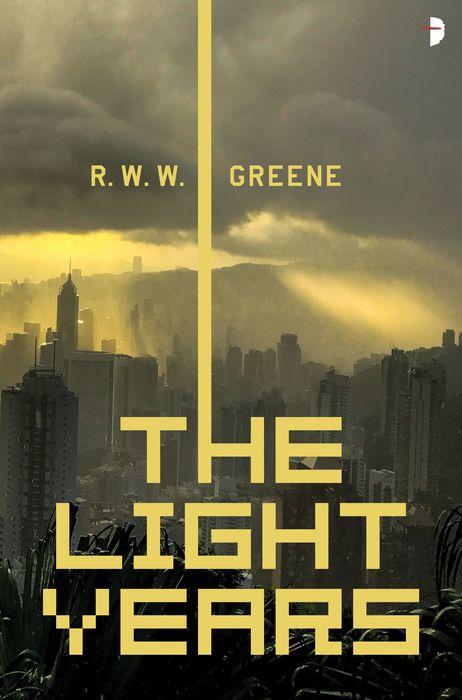
R.W.W. Greene is a New Hampshire USA writer with an MA in Fine Arts, which he exorcises in dive bars and coffee shops. He is a frequent panelist at the Boskone Science Fiction and Fantasy Convention in Boston, and his work has been in Stupefying Stories, Daily Science Fiction, New Myths, and Jersey Devil Press, among others. Greene is a past board member of the New Hampshire Writers’ Project. He keeps bees, collects typewriters, and lives with writer/artist spouse Brenda and two cats.

Greene's novels The Light Years (2020) and Twenty-Five to Life (2021) are published by Angry Robot.

At Tor.com he tagged five favorite SFF books about road trips, including:
American Gods by Neil Gaiman

The mysterious Mr. Wednesday has an agenda, but his driver Shadow, an ex-con mourning a dead wife, is just along for the ride… at first. Dig around on the Internet and you can find itineraries and maps made so you can recreate Shadow’s own fumbling journey into godhood, starting with the House on the Rock in Wisconsin to Cairo, Illinois to Lebanon, Kansas to the World Tree near Blacksburg, Virginia to Rock City, Georgia. Be careful, the road is full of ancient conmen, sensitive deities, and leprechauns looking for a fight.
Read about another entry on the list.

American Gods is among Eleanor Rosamund Barraclough's top ten books about the Vikings, Jeff Somers's ten sci-fi & fantasy books that take on norse mythology and ten top SFF stories lousy with giant spiders, Josh Ritter's six favorite books that invoke the supernatural, and John T. Ottinger's top 12 science fiction and fantasy novels and stories that are uniquely American.

--Marshal Zeringue

Pg. 99: Jon Stewart's "Hegel's Century"

Featured at the Page 99 Test: Hegel's Century: Alienation and Recognition in a Time of Revolution by Jon Stewart.

About the book, from the publisher:
The remarkable lectures that Hegel gave in Berlin in the 1820s generated an exciting intellectual atmosphere which lasted for decades. From the 1830s, many students flocked to Berlin to study with people who had studied with Hegel, and both his original students, such as Feuerbach and Bauer, and later arrivals including Kierkegaard, Engels, Bakunin, and Marx, evolved into leading nineteenth-century thinkers. Jon Stewart's panoramic study of Hegel's deep influence upon the nineteenth century in turn reveals what that century contributed to the wider history of philosophy. It shows how Hegel's notions of 'alienation' and 'recognition' became the central motifs for the era's thinking; how these concepts spilled over into other fields – like religion, politics, literature, and drama; and how they created a cultural phenomenon so rich and pervasive that it can truly be called 'Hegel's century.' This book is required reading for historians of ideas as well as of philosophy.
Learn more about Hegel's Century at the Cambridge University Press website.

The Page 99 Test: Hegel's Century.

--Marshal Zeringue

Saturday, November 13, 2021

Five books featuring dysfunctional families

Patricia Dunn is the author of young adult novel Rebels By Accident (2014). This Italian American, Bronx-raised rebel has traveled the world. These days, she can be found on her living room couch working on her next novel or meeting with aspiring and established writers.

Dunn's new novel, Last Stop on the 6, is her first novel for adults.

At Lit Hub she tagged five favorite books that feature dysfunctional families, including:
Barbara Solomon Josselsohn, The Last Dreamer

In this charming whirlwind novel, Iliana decides to return to her previous career as a journalist after years of being a stay-at-home mom. She isn’t welcomed back with open arms, and she hits the proverbial rock bottom. After the kids and husband go to bed, she turns on the TV to a rerun of a show that kept her company and gave her joy during her rocky adolescence. Iliana tracks down the show’s former star, her first crush. When he wrongly assumes she’s a journalist for the New York Times, she doesn’t correct him. The secrets that eventually jeopardize her marriage, and the fabric of her family, begin to unravel.
Read about the other entries on the list.

--Marshal Zeringue