Wednesday, November 09, 2011

What is Tricia Fields reading?

The current featured contributor at Writers Read: Tricia Fields, author of The Territory.

Her entry begins:
In my free time I almost always read fiction, so researching for a new mystery forces me out of my rut. I’ve read some fascinating nonfiction that I wouldn’t typically pick up. A great example – I just finished an excellent book by Tom Zoellner called Uranium: War, Energy, and the Rock that Shaped the World. Jon Stewart, from The Daily Show, called it “crazy fascinating,” which is actually a really accurate description of the book.

I grew up in the seventies, in the midst of the Cold War era, when we still thought there was a real chance we’d get vaporized in a nuclear holocaust before graduating high school. The potential for good and evil, all packed into a mineral found inside the earth’s crust, fascinates me. Uranium has the power to end life on earth, and can also bring heat and power to millions – but at a cost. The contradictions are captivating, and that’s what led me to feature uranium in the mystery I’m currently writing.

It was Zoellner’s book that provided me...[read on]
About The Territory, from the publisher:
At the end of State Road 170 and just past a ghost town lies Artemis, population 2,500. The townspeople had sought out this remote corner of Western Texas in hopes of living lives of solitude and independence. None of them realized that their small town would become a hot spot for Mexican drug runners, whose turf battles have turned both sides of the Rio Grande into a war zone. Still, many of the locals would rather take the law into their own hands than get help from police chief Josie Gray, even when they're up against a cartel's private army.

After arresting one of the cartel's hit men and killing another, Josie finds her life at risk for doing a job that many people would rather see her quit. And when the town's self-appointed protector of the Second Amendment is murdered and his cache of weapons disappears, it's clear that she doesn't have to pick sides in this war. She's battling them both.

Set in a desert landscape as beautiful as it is dangerous, The Territory captures the current border issues from the eyes of a tough, compelling heroine and richly evokes the American Southwest.
Visit Tricia Fields's website and blog.

The Page 69 Test: The Territory.

Writers Read: Tricia Fields.

--Marshal Zeringue

Ten of the best cathedrals in literature

At the Guardian, John Mullan named ten of the best cathedrals in literature.

One novel on the list:
Notre Dame de Paris by Victor Hugo

The cathedral is the central character in Hugo's huge historical novel. All his characters gravitate to it. Quasimodo is the bell-ringer and swings down on a rope from the towers of the Cathedral to rescue the Gypsy girl Esmerelda from the gallows. They seek sanctuary in the great church, but violence and death pursue them there.
Read about another cathedral on the list.

The Hunchback of Notre Dame appears among Jessica Duchen's top ten literary Gypsies and John Mullan's list of ten of the best bells in literature.

--Marshal Zeringue

Pg. 99: Gershom Gorenberg's "The Unmaking of Israel"

The current feature at the Page 99 Test: The Unmaking of Israel by Gershom Gorenberg.

About the book, from the publisher:
In this penetrating and provocative look at the state of contemporary Israel, acclaimed Israeli historian and journalist Gershom Gorenberg reveals how the nation’s policies are undermining its democracy and existence as a Jewish state, and explains what must be done to bring it back from the brink. Refuting shrill defenses of Israel and equally strident attacks, Gorenberg shows that the Jewish state is, in fact, unique among countries born in the postcolonial era: It began as a parliamentary democracy and has remained one. An activist judiciary has established civil rights. Despite discrimination against its Arab minority, Israel has given a political voice to everyone within its borders.

Yet shortsighted policies, unintended consequences, and the refusal to heed warnings now threaten those accomplishments. By keeping the territories it occupied in the Six-Day War, Israel has crippled its democracy and the rule of law. The unholy ties between state, settlement, and synagogue have promoted a new brand of extremism, transforming Judaism from a humanistic to a militant faith. And the religious right is rapidly gaining power within the Israeli army, with possibly catastrophic consequences.

In order to save itself, Gorenberg argues, Israel must end the occupation, separate state from religion, and create a new civil Israeli identity that can be shared by Jews and Arabs. Based on groundbreaking historical research—including documents released through the author’s Israeli Supreme Court challenge to military secrecy—and on a quarter century of experience reporting in the region, The Unmaking of Israel is a brilliant, deeply personal critique by a progressive Israeli, and a plea for realizing the nation’s potential.
Learn more about The Unmaking of Israel and the author at the HarperCollins website and the South Jerusalem blog.

Gershom Gorenberg is an Israeli historian and journalist. His previous books are The Accidental Empire: Israel and the Birth of the Settlements, 1967-1977 and The End of Days: Fundamentalism and the Struggle for the Temple Mount.

The Page 99 Test: The Unmaking of Israel.

--Marshal Zeringue

Stephen Beachy's "boneyard," the movie

Now showing at My Book, The Movie: boneyard by Stephen Beachy.

The entry begins:
If they make boneyard into a movie, Justin Bieber would probably have to play the disturbed Amish boy at its center, Jake Yoder. He looks like a disturbed Amish boy, doesn't he? He doesn't really look like Jake, who has darker hair and bluer eyes and inappropriate affect, but we could work around that. I'm also a character in my book, and so is the editor, Judith Owsley Brown - we write battling footnotes that interpret Jake Yoder's text. Judith would definitely have to be played by...[read on]
Learn more about the book and author at Stephen Beachy's website; view the boneyard trailer.

Stephen Beachy is the author of the novels The Whistling Song and Distortion, as well as the twinned novellas Some Phantom/No Time Flat. His writing has appeared in BOMB, The New York Times Magazine, Chicago Review, Best Gay American Fiction, New York magazine and elsewhere. Raised by an ex-Amish father in Iowa, he now lives in California and teaches at the University of San Francisco.

My Book, The Movie: boneyard.

--Marshal Zeringue

Tuesday, November 08, 2011

What is Phillip DePoy reading?

Today's featured contributor at Writers Read: Phillip DePoy, author of A Corpse’s Nightmare.

The entry begins:
I’ve just finished re-reading, for the seventh or eighth time, Creative Mythology, the fourth volume of Joseph Campbell’s Masks of God. This time I was mostly interested in the early roots of the Tristan and Iseult stories, and how that love triangle (King Mark, the sort of mystical healer Iseult, and the knight Tristan) compared with the later versions of the King Arthur, Lancelot, Guinevere triangle. As it turns out, the Tristan saga is almost entirely pre-Christian, deeply disturbed, and a much more confusing (there are two Tristans, and one is a dwarf; there are three Iseults, and they all mean business.) This turned out to be research for...[read on]
About A Corpse’s Nightmare, from the publisher:
Fever Devilin is killed by an intruder. He doesn’t stay dead - thanks to an emergency medical team - but he does slip into a months-long coma. When he comes out of it, there are two things he now knows: that he’s been dreaming about the legendary Paris 20's café scene and that his would-be killer was after a blue tin box, containing a photo of what Fever believes to be an angel. As Fever struggles to recover, out there is a would-be killer who must be found while there's still time.
Learn more about the book and author at Phillip DePoy's website.

The Page 69 Test: The Drifter's Wheel.

The Page 69 Test: A Corpse's Nightmare.

Writers Read: Phillip DePoy.

--Marshal Zeringue

Top 10 scary short stories

Chris Priestley is the author of the Tales of Terror series which won the Dracula Society's Children of the Night Award for best book with a Gothic horror theme.

His most recent books are Mister Creecher and The Dead of Winter.

Priestly is also an illustrator, painter and cartoonist.

For the Guardian, he named a top ten list of scary short stories. One title on the list:
"Fever Dream" by Ray Bradbury

This is a deliciously creepy story by the master of the uncanny tale, Ray Bradbury. Like all the best short stories, the premise is a simple one: a boy on his sick bed feels that his body is being taken over by more than a mere disease. But he can't make the adults believe that, of course. They think he's making a fuss. And then, suddenly, he feels much better. Don't read this if you are going down with a cold.
Read about another story on the list.

--Marshal Zeringue

Pg. 99: Jonathan Hansen's "Guantánamo: An American History"

The current feature at the Page 99 Test: Guantánamo: An American History by Jonathan M. Hansen.

About the book, from the publisher:
An on-the-ground history of American empire

Say the word “Guantánamo” and orange jumpsuits, chain-link fences, torture, and indefinite detention come to mind. To critics the world over, Guantánamo Bay, Cuba, is a striking symbol of American hypocrisy. But the prison isn’t the whole story. For more than two centuries, Guantánamo has been at the center of American imperial ambition, first as an object of desire then as a convenient staging ground.

In Guantánamo: An American History, Jonathan M. Hansen presents the first complete account of this fascinating place. The U.S. presence at Guantánamo predates even the nation itself, as the bay figured centrally in the imperial expansion plans of colonist and British sailor Lawrence Washington—half brother of the future president George. As the young United States rose in power, Thomas Jefferson and his followers envisioned a vast “empire of liberty,” which hinged on U.S. control of the Gulf of Mexico and the Caribbean Sea. Politically and geographically, Guantánamo Bay was the key to this strategy. So when Cubans took up arms against their Spanish rulers in 1898, America swooped in to ensure that Guantánamo would end up firmly in its control.

Over the next century, the American navy turned the bay into an idyllic modern Mayberry—complete with bungalows, cul-de-sacs, and country clubs—which base residents still enjoy. In many ways, Guantánamo remains more quintessentially American than America itself: a distillation of the idealism and arrogance that has characterized U.S. national identity and foreign policy from the very beginning.

Despite the Obama administration’s repeated efforts to shutter the notorious prison, the naval base is in no danger of closing anytime soon. Places like Guantánamo, which fall between the clear borders of law and sovereignty, continue to serve a purpose regardless of which leaders—left, right, or center—hold the reins of power.
Learn more about Guantánamo: An American History at the publisher's website.

Jonathan M. Hansen is a historian at Harvard University, and the author of The Lost Promise of Patriotism: Debating American Identity, 1890–1920.

The Page 99 Test: Guantánamo: An American History.

--Marshal Zeringue

Pg. 69: Reed Farrel Coleman's "Gun Church"

The current feature at the Page 69 Test: Gun Church by Reed Farrel Coleman.

About Gun Church:
Kip Weiler is a former literary wunderkind who’s fallen on hard times. He teaches creative writing at a rural community college and saves his class from a gun-toting student. He gets a second fifteen minutes of fame and something much more important: the urge to write again. Only things don’t go so well for Kip when he realizes he isn’t quite as in control of his life as he thinks he is.
Learn more about the book and author at Reed Farrel Coleman's website.

The Page 69 Test: Gun Church.

--Marshal Zeringue

Monday, November 07, 2011

What is D.E. Meredith reading?

The current featured contributor at Writers Read: D.E. Meredith, author of The Devil's Ribbon.

Her entry begins:
I’ve just finished Mixed Blood by Roger Smith. Normally I hate hard boiled crime but this blew me away. Roger Smith doesn’t put a foot wrong. There’s too much crime out there that‘s derivative with all that box ticking stuff but Smith creates a world that’s completely unique. There are elements of Coetzee (The Heart of the Country) with smatterings of Cormac McCarthy (I’m thinking, Blood Meridian) but structurally, it works like a seriously superior airport thriller. Incredibly fast and furious, it hooks you in from page one by the jugular and rushes you through to the end with lots of shock tactics along the way (big ones, not for the squeamish), laugh out loud humour, pathos, skin tingling dialogue. Especially from the diabolical Afrikaner Sheriff, Rudi Barnard and yet, despite the charging narrative, Smith’s tight control on his story never misses a beat. We get moments where he stops and shows you the beauty of Cape Town in gorgeously ...[read on]
About The Devil's Ribbon, from the publisher:
A trail of beribboned murders. A ticking bomb. A city about to explode.

July, 1858: London swelters under the oppressive heat of the hottest summer on record, and trouble is brewing. Forensic scientist Professor Adolphus Hatton and his trusty assistant, Albert Roumande, have a morgue full of cholera victims. The dead are all Irish, the poorest of London’s poor. They came in their thousands ten years ago, forced into the London slums by the terrible famine. Now they live segregated from the rest of Victorian society, a race apart in this heaving city who are at once everywhere and nowhere. But they are a close knit people, and deeply politicised. From the docks in Limehouse to the taverns of St Giles, Fenian groups are talking of violence and of liberation.

When a series of violent murders threatens to cause tensions to boil over, Scotland Yard calls on Hatton and Roumande to help investigate. The seemingly unconnected victims, who hail from all strata of society, are linked by the same macabre calling card: a bright Fenian green ribbon placed strategically about their corpses. While Hatton’s search for clues leads him into the spell of a blindingly beautiful woman, a widow of one of the slain, rumblings of a bombing campaign led by an agitator priest and his gang of would-be terrorists build throughout the slums. As the orchestra of veiled motives, divided loyalties, and violent retribution reaches a crescendo, Hatton’s skills are tested to the limit. With Roumande, he must race across London to an island with a shipwreck and a secret on a nail-biting race against time in this gripping, elegantly executed Victorian mystery in the tradition of The Dante Club and The Somnambulist.
Learn more about the book and author at Denise Meredith's website.

The Page 69 Test: The Devil's Ribbon.

My Book, The Movie: The Devil's Ribbon.

Writers Read: D.E. Meredith.

--Marshal Zeringue

Five best eyewitness battlefield accounts

Max Hastings's latest book is Inferno: The World at War, 1939-1945.

One of his five best eyewitness accounts from the battlefield, as told to the Wall Street Journal:
Lady Under Fire on the Western Front
Edited by Andrew and Nicola Hallam (2010)

This work offers an unusual perspective on World War I, delivered through the letters of 25-year-old Lady Dorothie Feilding, who served as an ambulance driver in Belgium and France between 1914 and 1917. Although Feilding deplored the conflict's horrors, she relished the opportunity to join the select few in her generation of privileged European girls who were freed from the dreary confinement of the social round at home. "It's topping being up near things & so jolly interesting," Feilding writes. She was understandably reluctant to brave German fire to recover German wounded: "I don't mind running risks for our men or the French but I'm blithered if I'm going to have holes put in me by a bally Teuton while I pick up their men." The proof of her courage is that she became the first woman ever to receive Britain's Military Medal.
Read about another entry on the list.

--Marshal Zeringue

Alan Lazar's "Roam," the movie

Now showing at My Book, The Movie: Roam by Alan Lazar.

The entry begins:
The hero of Roam is a dog, half-beagle and half-poodle. So, no conventional movie stars need apply. In Marley and Me, I believe the dog was an incredible composite of fourteen real dogs and some CGI. If Roam is a live-action film I guess it would be something similar. Alternatively Roam might be a fully animated film. I’m a huge fan of pretty much all the Pixar movies, and I’d love for Roam to be made over there. Up and Toy Story 3 both got my tear ducts pumping. They handle dramatic subject matter with such a beautiful touch.

If Roam is live action, we’d need to cast the main human character, a beautiful concert pianist named Katey. She’s the original owner, or Great Love, of Nelson, our hero dog. The agent selling the movie rights asked for a couple of names for Katey, and I came up with Natalie Portman, Scarlett Johansson, Anne...[read on]
Learn more about the book and author at Alan Lazar's website.

My Book, The Movie: Roam.

--Marshal Zeringue

Pg. 99: Dean Falk's "The Fossil Chronicles"

The current feature at the Page 99 Test: The Fossil Chronicles: How Two Controversial Discoveries Changed Our View of Human Evolution by Dean Falk.

About the book, from the publisher:
Two discoveries of early human relatives, one in 1924 and one in 2003, radically changed scientific thinking about our origins. Dean Falk, a pioneer in the field of human brain evolution, offers this fast-paced insider’s account of these discoveries, the behind-the-scenes politics embroiling the scientists who found and analyzed them, and the academic and religious controversies they generated. The first is the Taung child, a two-million-year-old skull from South Africa that led anatomist Raymond Dart to argue that this creature had walked upright and that Africa held the key to the fossil ancestry of our species. The second find consisted of the partial skeleton of a three-and-a-half-foot-tall woman, nicknamed Hobbit, from Flores Island, Indonesia. She is thought by scientists to belong to a new, recently extinct species of human, but her story is still unfolding. Falk, who has studied the brain casts of both Taung and Hobbit, reveals new evidence crucial to interpreting both discoveries and proposes surprising connections between this pair of extraordinary specimens.
Learn more about The Fossil Chronicles at the University of California Press website.

Dean Falk is a Senior Scholar at the School for Advanced Research in Santa Fe, New Mexico. Her previous books include Finding Our Tongues: Mothers, Infants, and the Origin of Language and Braindance, Revised and Expanded Edition: New Discoveries about Human Origins and Brain Evolution.

The Page 99 Test: Finding Our Tongues.

The Page 99 Test: The Fossil Chronicles.

--Marshal Zeringue

Sunday, November 06, 2011

Ten of the best men dressed as women

At the Guardian, John Mullan named ten of the best men dressed as women in literature.

One book on his list:
Jane Eyre by Charlotte Brontë

In a sequence usually omitted in film adaptations, Mr Rochester dresses as an old Gypsy woman and turns up at his own dinner party to read the fortunes of the guests. Even Jane does not recognise him, until he suddenly throws off his disguise.
Read about another novel on the list.

Jane Eyre also made Megan Abbott's top ten list of novels of teenage friendship, a list of Bettany Hughes's six best books, the Guardian's top 10 lists of "outsider books" and "romantic fiction;" it appears on Lorraine Kelly's six best books list, Esther Freud's top ten list of love stories, and Jessica Duchen's top ten list of literary Gypsies, and on John Mullan's lists of ten of the best weddings in literature, ten of the best locked rooms in literature, ten of the best pianos in literature, ten of the best breakfasts in literature, ten of the best smokes in fiction, and ten of the best cases of blindness in literature. It is one of Kate Kellaway's ten best love stories in fiction.

The Page 99 Test: Jane Eyre.

--Marshal Zeringue

Pg. 69: Tricia Fields's "The Territory"

The current feature at the Page 69 Test: The Territory by Tricia Fields.

About the book, from the publisher:
At the end of State Road 170 and just past a ghost town lies Artemis, population 2,500. The townspeople had sought out this remote corner of Western Texas in hopes of living lives of solitude and independence. None of them realized that their small town would become a hot spot for Mexican drug runners, whose turf battles have turned both sides of the Rio Grande into a war zone. Still, many of the locals would rather take the law into their own hands than get help from police chief Josie Gray, even when they're up against a cartel's private army.

After arresting one of the cartel's hit men and killing another, Josie finds her life at risk for doing a job that many people would rather see her quit. And when the town's self-appointed protector of the Second Amendment is murdered and his cache of weapons disappears, it's clear that she doesn't have to pick sides in this war. She's battling them both.

Set in a desert landscape as beautiful as it is dangerous, The Territory captures the current border issues from the eyes of a tough, compelling heroine and richly evokes the American Southwest.
Learn more about the book and author at Tricia Fields's website and blog.

The Page 69 Test: The Territory.

--Marshal Zeringue

What is Jack McDevitt reading?

The current featured contributor at Writers Read: Jack McDevitt, author of Firebird.

His entry begins:
I’ve just finished Jack Miles’s God: A Biography. Miles, a former Jesuit, attempts to analyze God as a purely literary character, and of course the protagonist of the Old Testament. I’ll confess I’d thought I knew the Old Testament pretty well, but some aspects of the book are, to put it mildly, unsettling. We get a portrait of a Being with absolute power who is unpredictable, and may not always be sure what He’s doing.

Another thoroughly enjoyable book was Steven Weinberg’s Dreams of a Final Theory. Weinberg may be the only physicist who...[read on]
About Firebird, from the publisher:
Forty-one years ago the renowned physicist Chris Robin vanished. Before his disappearance, his fringe science theories about the existence of endless alternate universes had earned him both admirers and enemies.

Alex Benedict and Chase Kolpath discover that Robin had several interstellar yachts flown far outside the planetary system where they too vanished. And following Robin's trail into the unknown puts Benedict and Kolpath in danger...
Learn more about the book and author at Jack McDevitt's website.

Writers Read: Jack McDevitt (February 2009).

The Page 69 Test: Firebird.

Writers Read: Jack McDevitt.

--Marshal Zeringue
Saturday, November 05, 2011

Howard Jacobson's 5 favorite literary heroines

Howard Jacobson's novels include The Finkler Question, which last year won Britain's Man Booker Prize.

One of his five favorite literary heroines, as told to The Week magazine:
Persuasion by Jane Austen

I suffer from heroine addiction. The novels that moved me most as a young man were always about women in whom the desire to be treated justly, to be acknowledged, and to find fulfillment in love burns like a fire, and they remain my favorites to this day. Jane Austen possesses the power to make you feel as you read that nothing else matters in the world but the happiness of her heroines. Anne Elliot's happiness hangs by a thread in Persuasion, and the reader knows no peace until it is secured.
Read about another book on the list.

Persuasion is among Jacobson's top ten novels of sexual jealousy, Elizabeth Buchan's top ten books guaranteed to give comfort during the ending of a relationship, and appears on John Mullan's list of ten of the best concerts in literature.

The Page 99 Test: Persuasion.

Also see Howard Jacobson's list of the five best novels on failure.

--Marshal Zeringue

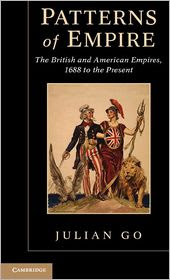
Pg. 99: Julian Go's "Patterns of Empire"

The current feature at the Page 99 Test: The British and American Empires, 1688 to the Present by Julian Go.

About the book, from the publisher:
Patterns of Empire comprehensively examines the two most powerful empires in modern history: the United States and Britain. Challenging the popular theory that the American empire is unique, Patterns of Empire shows how the policies, practices, forms, and historical dynamics of the American empire repeat those of the British, leading up to the present climate of economic decline, treacherous intervention in the Middle East, and overextended imperial confidence. A critical exercise in revisionist history and comparative social science, this book also offers a challenging theory of empire that recognizes the agency of non-Western peoples, the impact of global fields, and the limits of imperial power.
Learn more about Patterns of Empire: The British and American Empires, 1688 to the Present at the Cambridge University Press website.

The Page 99 Test: Patterns of Empire.

--Marshal Zeringue

D.E. Meredith's "The Devil's Ribbon," the movie

Now showing at My Book, The Movie: The Devil's Ribbon by Denise Meredith.

The entry begins:
Professor Adolphus Hatton. Ed Norton is the right look to play Hatton in that he’s svelte, pale, in need of a good meal and a good woman – I’m thinking Ed Norton in The Painted Veil not The Incredible Hulk. Norton projects a keen intellect and the fastidiousness of an over-achiever. He has an intensity about him which is right for Hatton and I can imagine him doing that “Repressed English Gent” bit brilliantly when he first meets Sorcha. Norton has a strong moral compass, a great sense of right and wrong and this quality is key to Adolphus Hatton. Norton would also capture that troubled side of Hatton, the non-believer, the cutting edge scientist, someone who is pushing up against convention.

Albert Roumande. Javier Bardem is quintessential Roumande, but...[read on]
Learn more about the book and author at Denise Meredith's website.

The Page 69 Test: The Devil's Ribbon.

My Book, The Movie: The Devil's Ribbon.

--Marshal Zeringue

Friday, November 04, 2011

The 10 best graphic novels

For The Observer, Rachel Cooke came up with a list of the ten best graphic novels, including:
Blankets
Craig Thompson (2003)

Blankets is extremely long – a mammoth 592 pages – but it’s a thing of huge power and grace. Thompson grew up in chilly, flat Wisconsin, in an evangelical Christian family, and his book is variously about faith (keeping it, losing it), sibling rivalry, being a misfit, and the isolation of the countryside. Most of all, though, it’s about what it feels like to fall in love for the very first time (at a Bible camp our hero meets Raina, beautiful and interesting but burdened with siblings she must care for following the divorce of her parents). Quaint, meditative and sometimes dreamy, Blankets will take you straight back to your first kiss
Read about another entry on the list.

Also see Lev Grossman's top ten graphic novels list, Danny Fingeroth's top 10 list of graphic novels, and Malorie Blackman's top ten list of graphic novels for teenagers.

--Marshal Zeringue

Pg 69: Phillip DePoy's "A Corpse’s Nightmare"

The current feature at the Page 69 Test: A Corpse's Nightmare by Phillip Depoy.

About the book, from the publisher:
Fever Devilin is killed by an intruder. He doesn’t stay dead - thanks to an emergency medical team - but he does slip into a months-long coma. When he comes out of it, there are two things he now knows: that he’s been dreaming about the legendary Paris 20's café scene and that his would-be killer was after a blue tin box, containing a photo of what Fever believes to be an angel. As Fever struggles to recover, out there is a would-be killer who must be found while there's still time.
Learn more about the book and author at Phillip DePoy's website.

The Page 69 Test: The Drifter's Wheel.

The Page 69 Test: A Corpse's Nightmare.

--Marshal Zeringue

What is Sara Grant reading?

The current featured contributor at Writers Read: Sara Grant, author of Dark Parties.

Part of her entry:
I’ve only recently discovered that I *heart* Libba Bray. I read Going Bovine and Beauty Queens this year. She’s crazy brilliant. The books are wild and imaginative and layered. As soon as I finished them, I wanted to go back and read them again because there was simply too much to appreciate in one reading.

I’m sometime lucky enough to purloin an advance copy of some books. I spent one glorious day reading 15 Days Without a Head by Dave Cousins cover to cover. Dave’s book doesn’t come out until January in the UK. Dave and I are in the EDGE, a group of UK-based writers who focus on teen fiction. This is his first novel and it’s stunning. If you like edgy teen fiction, check out our site for other EDGE books and also our edgy reading list.

I’m currently reading...[read on]
About Dark Parties, from the publisher:
Sixteen-year-old Neva has been trapped since birth. She was born and raised under the Protectosphere, in an isolated nation ruled by fear, lies, and xenophobia. A shield "protects" them from the outside world, but also locks the citizens inside. But there's nothing left on the outside, ever since the world collapsed from violent warfare. Or so the government says...

Neva and her best friend Sanna believe the government is lying and stage a "dark party" to recruit members for their underground rebellion. But as Neva begins to uncover the truth, she realizes she must question everything she's ever known, including the people she loves the most.
Learn more about the book and author at Sara Grant's website and Facebook page.

My Book, The Movie: Dark Parties.

Writers Read: Sara Grant.

--Marshal Zeringue

Thursday, November 03, 2011

Pg. 99: Mia Bloom's "Bombshell: Women and Terrorism"

The current feature at the Page 99 Test: Bombshell: Women and Terrorism by Mia Bloom.

About the book, from the publisher:
Between 1985 and 2008, female suicide bombers committed more than 230 attacks—about a quarter of all such acts. Women have become the ideal stealth weapon for terrorist groups. They are less likely to be suspected or searched and as a result have been used to strike at the heart of coalition troops in Iraq and Afghanistan. This alarming tactic has been highly effective, garnering extra media attention and helping to recruit more numbers to the terrorists' cause. Yet, as Mia Bloom explains in Bombshell: Women and Terrorism, female involvement in terrorism is not confined to suicide bombing and not limited to the Middle East.

From Northern Ireland to Sri Lanka, women have been engaged in all manner of terrorist activities, from generating propaganda to blowing up targets. What drives women to participate in terrorist activities? Bloom—a scholar of both international studies and women's studies—blends scrupulous research with psychological insight to unearth affecting stories from women who were formerly terrorists. She moves beyond gender stereotypes to examine the conditions that really influence female violence, arguing that while women terrorists can be just as bloodthirsty as their male counterparts, their motivations tend to be more intricate and multilayered. Through compelling case studies she demonstrates that though some of these women volunteer as martyrs, many more have been coerced by physical threats or other means of social control.

As evidenced by the March 2011 release of Al Qaeda's magazine Al Shamikha, dubbed the jihadi Cosmo, it is clear that women are the future of even the most conservative terrorist organizations. Bombshell is a groundbreaking book that reveals the inner workings of a shocking, unfamiliar world.
Learn more about Bombshell at the University of Pennsylvania Press website.

Mia Bloom is Associate Professor of International Studies and Women’s Studies at Penn State. She is a leading expert on suicide terrorism and is the author of Dying to Kill: The Allure of Suicide Terror (2005). In addition to her research on terrorism, Bloom conducts research on ethnic conflict, the strategic use of rape in war, and child soldiers.

The Page 99 Test: Bombshell.

--Marshal Zeringue

Top 10 wilderness books

Philip Connors was born in Iowa and grew up on a farm in southwest Minnesota. He attended the University of Montana, and then worked for several years at the Wall Street Journal, mostly as an editor on the Leisure & Arts page. In 2002, he left the paper for a seasonal job with the U.S. Forest Service in New Mexico. His writing has appeared in n+1, Harper's, the London Review of Books, The Nation, and elsewhere. His "Diary of a Fire Lookout," which first appeared in the Paris Review, was selected for inclusion in Best American Nonrequired Reading 2009 and became the basis for his first book, Fire Season: Field Notes from a Wilderness Lookout.

"Wilderness in its purest sense may be gone," Connors wrote in the Guardian, "but wild remnants remain, and many of my favourite books in the genre celebrate a particular place (often in America), cherishing what is native and mourning what's been lost."

One of his top ten wilderness books:
Housekeeping by Marilynne Robinson

While not a "wilderness book" per se, this novel makes the outdoor world of the northern Rockies as much a character as the unforgettable sisters at its heart, whose hometown "was chastened by an outsized landscape and extravagant weather, and chastened again by an awareness that the whole of human history had occurred elsewhere."
Read about another novel on the list.

Housekeeping is among Kate Walbert's best books and Aryn Kyle's favorite books.

--Marshal Zeringue

Pg. 69: Jack McDevitt's "Firebird"

Today's feature at the Page 69 Test: Firebird by Jack McDevitt.

About the book, from the publisher:
Forty-one years ago the renowned physicist Chris Robin vanished. Before his disappearance, his fringe science theories about the existence of endless alternate universes had earned him both admirers and enemies.

Alex Benedict and Chase Kolpath discover that Robin had several interstellar yachts flown far outside the planetary system where they too vanished. And following Robin's trail into the unknown puts Benedict and Kolpath in danger...
Learn more about the book and author at Jack McDevitt's website.

Writers Read: Jack McDevitt (February 2009).

The Page 69 Test: Firebird.

--Marshal Zeringue

Tyler McMahon's "How the Mistakes Were Made," the movie

Now showing at My Book, The Movie: How the Mistakes Were Made by Tyler McMahon.

The entry begins:
How the Mistakes Were Made is primarily the story of Laura Loss—a veteran punk rocker who is now blamed for the demise of the grunge band that she helped to form. The book is kind of a fake memoir, which tells Laura’s side of the story. In a sense, it is her defense. The casting for Laura’s part would be the most crucial. Visually speaking, she’s pale, with dark hair and a cynical intensity.

A great writer and filmmaker named J. Reuben Appelman produced a trailer for the book. Early in the process, he asked me what Hollywood actress she most resembled. Without hesitation, I told him that I pictured her as a mid-90’s Winona Ryder. He ended up casting the amazing Abisha Uhl—lead singer of the band Sick of Sarah—in the trailer and she did an amazing job. If someone were to make a movie of it today, certainly Natalie...[read on]
View the trailer for How the Mistakes Were Made, and learn more about the book and author at Tyler McMahon's website.

My Book, The Movie: How the Mistakes Were Made.

--Marshal Zeringue

Wednesday, November 02, 2011

Chuck Klosterman's 5 favorite books

Chuck Klosterman is the author of several books, including Sex, Drugs and Cocoa Puffs, Killing Yourself to Live, and Downtown Owl.

One of his five favorite books, as told to The Daily Beast:
MVP
by James Boice

This is a roman à clef about Kobe Bryant. In 50 years, somebody is going to stumble across this novel and be blown away—and not just by the writing (which is excellent), but by the fact that it was published in 2007.
Read about another book on the list.

--Marshal Zeringue

Pg. 99: Barron Lerner's "One for the Road: Drunk Driving Since 1900"

Today's feature at the Page 99 Test: One for the Road: Drunk Driving since 1900 by Barron H. Lerner.

About the book, from the publisher:
Don't drink and drive. It's a deceptively simple rule, but one that is all too often ignored. And while efforts to eliminate drunk driving have been around as long as automobiles, every movement to keep drunks from driving has hit some alarming bumps in the road.

Barron H. Lerner narrates the two strong—and vocal—sides to this debate in the United States: those who argue vehemently against drunk driving, and those who believe the problem is exaggerated and overregulated. A public health professor and historian of medicine, Lerner asks why these opposing views exist, examining drunk driving in the context of American beliefs about alcoholism, driving, individualism, and civil liberties.

Angry and bereaved activist leaders and advocacy groups like Mothers Against Drunk Driving campaign passionately for education and legislation, but even as people continue to be killed, many Americans remain unwilling to take stronger steps to address the problem. Lerner attributes this attitude to Americans' love of drinking and love of driving, an inadequate public transportation system, the strength of the alcohol lobby, and the enduring backlash against Prohibition. The stories of people killed and maimed by drunk drivers are heartrending, and the country's routine rejection of reasonable strategies for ending drunk driving is frustratingly inexplicable.

This book is a fascinating study of the culture of drunk driving, grassroots and professional efforts to stop it, and a public that has consistently challenged and tested the limits of individual freedom. Why, despite decades and decades of warnings, do people still choose to drive while intoxicated? One for the Road provides crucial historical lessons for understanding the old epidemic of drunk driving and the new epidemic of distracted driving.
Learn more about One for the Road at the Johns Hopkins University Press website.

The Page 99 Test: One for the Road.

--Marshal Zeringue

The 50 best cookbooks

At the Independent, Kate Watson-Smyth tagged the fifty tastiest titles for your table.

One entry on the list:
Ready for Dessert by David Lebovitz

Pastry chef and blogger David Lebovitz, who spent 12 years at Chez Panisse, has gathered together 170 recipes for bakers of all abilities. The photos alone will inspire you, not to mention the names - champagne gelée with kumquats and anise-orange ice-cream profiteroles with chocolate sauce for starters.
Read about another cookbook on the list.

Also see: Kate Colquhoun's top 10 unusual cookbooks; the ten best children's cookbooks; the 10 best cookbooks of 2009; and Alton Brown's five best cookbooks.

--Marshal Zeringue

What is Rebecca Coleman reading?

Today's featured contributor to Writers Read: Rebecca Coleman, author of The Kingdom of Childhood.

Her entry begins:
I just finished reading Everything Happens Today by Jesse Browner, and I must accompany this with a confession: I picked it up because it got a starred review in the issue of Shelf Awareness where my book received high praise but no star. I mused, "hmm, what's he got that I don't?" so I read the book and thought, "oh, this." It's kind of an updated variation on The Catcher in the Rye, with a protagonist, Wes, who is so well-meaning and snarky and heartfelt and conflicted, all at once. Each of the characters is wonderfully evoked, flawed and lovable and three-dimensional. By the end I was...[read on]
About The Kingdom of Childhood, from the publisher:
The Kingdom of Childhood is the story of a boy and a woman: sixteen-year-old Zach Patterson, uprooted and struggling to reconcile his knowledge of his mother's extramarital affair, and Judy McFarland, a kindergarten teacher watching her family unravel before her eyes. Thrown together to organize a fundraiser for their failing private school and bonded by loneliness, they begin an affair that at first thrills, then corrupts each of them. Judy sees in Zach the elements of a young man she loved as a child, but what Zach does not realize is that their relationship is—for Judy—only the latest in a lifetime of disturbing secrets.

Rebecca Coleman's manuscript for The Kingdom of Childhood was a semifinalist in the 2010 Amazon Breakthrough Novel Competition. An emotionally tense, chilling work of fiction set in the controversial Waldorf school community, it is equal parts enchanting and unsettling and is sure to be a much-discussed and much-debated novel.
Learn more about the book and author at Rebecca Coleman's website and blog.

The Page 69 Test: The Kingdom of Childhood.

Writers Read: Rebecca Coleman.

--Marshal Zeringue

Tuesday, November 01, 2011

Pg. 69: Denise Meredith's "The Devil's Ribbon"

The current feature at the Page 69 Test: The Devil's Ribbon by Denise Meredith.

About the book, from the publisher:
A trail of beribboned murders. A ticking bomb. A city about to explode.

July, 1858: London swelters under the oppressive heat of the hottest summer on record, and trouble is brewing. Forensic scientist Professor Adolphus Hatton and his trusty assistant, Albert Roumande, have a morgue full of cholera victims. The dead are all Irish, the poorest of London’s poor. They came in their thousands ten years ago, forced into the London slums by the terrible famine. Now they live segregated from the rest of Victorian society, a race apart in this heaving city who are at once everywhere and nowhere. But they are a close knit people, and deeply politicised. From the docks in Limehouse to the taverns of St Giles, Fenian groups are talking of violence and of liberation.

When a series of violent murders threatens to cause tensions to boil over, Scotland Yard calls on Hatton and Roumande to help investigate. The seemingly unconnected victims, who hail from all strata of society, are linked by the same macabre calling card: a bright Fenian green ribbon placed strategically about their corpses. While Hatton’s search for clues leads him into the spell of a blindingly beautiful woman, a widow of one of the slain, rumblings of a bombing campaign led by an agitator priest and his gang of would-be terrorists build throughout the slums. As the orchestra of veiled motives, divided loyalties, and violent retribution reaches a crescendo, Hatton’s skills are tested to the limit. With Roumande, he must race across London to an island with a shipwreck and a secret on a nail-biting race against time in this gripping, elegantly executed Victorian mystery in the tradition of The Dante Club and The Somnambulist.
Learn more about the book and author at Denise Meredith's website.

The Page 69 Test: The Devil's Ribbon.

--Marshal Zeringue

Five must-reads by & about Nabokov

Maxim D. Shrayer's publications on Nabokov include The World of Nabokov’s Stories and Nabokov: Themes and Variations (in Russian). His recent books are the literary memoir Waiting for America: A Story of Emigration and the collection of stories Yom Kippur in Amsterdam.

One of his five must-reads by--and about--the Russian-American writer Vladimir Nabokov, from Shrayer's 2010 dialogue with Anna Blundy at The Browser:
Pnin
by Vladimir Nabokov

Now, Pnin.

I deliberately chose Glory over The Gift, but I have to get the American years in. There is Lolita in the back of everybody’s mind, of course, and 95 per cent of the students who take my undergraduate course are doing it because of Lolita. But I’m choosing Pnin instead for two reasons. Firstly, Lolita looms so large that I don’t have to choose it, but, secondly, because Pnin is the immigrant of Nabokov’s American novels. The main character is a Russian professor at an American college, and the novel is to a large extent about Russian culture misunderstood by Westerners. But it is also a truncated love story with a moral dilemma. Pnin himself is not Jewish but Mira, once Pnin’s beloved, is Jewish, and she died in Buchenwald. The story is punctuated by the tension of his trying to forget and being incapable of unremembering. Nabokov was one of the very first American writers to write extensively about the Shoah in a work of fiction. Nabokov wrote Pnin in the 1950s and parts of it were published in the New Yorker, so it is astounding how far ahead of his literary contemporaries Nabokov was in his thinking about the Shoah and how it might be remembered and memorialised.

Is it autobiographical?

Slightly. Not in any direct way, but insofar as Pnin is a Russian intellectual in America in the post-war period, and also in the main character’s connection with a female Jewish identity. Nabokov’s wife, Véra Nabokov (born Slonim), was Jewish. So, yes, Nabokov is mulling over themes he mulled over throughout his life – here he does not reference his life so much as his thinking. Pnin is a novel about Holocaust memory and the kinds of things that other European émigré intellectuals – Adorno, Arendt – were thinking about at the time. Yet Nabokov creates a perfect work of art, a work that succeeds on aesthetic grounds but does not distract the reader from the various political, intellectual and philosophical battles of his novel.

Pnin has survivor’s guilt, though he is not guilty. He keeps seeing and imagining how Mira died in Buchenwald. Then Pnin doesn’t get the tenure he was after, at which point Nabokov pulls a trick that he pulls again and again – putting himself into the story. A great Russian émigré called ‘Vladimir Vladimirovich’ arrives to take over, in the way he may well have done at Cornell in reality, and he offers Pnin the chance to stay on. Pnin doesn’t want to exist in a world where the authorial presence is so close and so in charge, so Nabokov releases Pnin. Pnin departs, but his legend lives on. Nabokov ends his novel with Pnin’s disappearance and also with a joke that takes us back to the beginning.
Read about another entry on the list.

Pnin also appears on Matthew Kaminski's list of his five favorite novels about immigrants in America and John Mullan's list of ten of the best breakages in literature.

--Marshal Zeringue

Interview: Gerald Elias

Writer and professor Ray Taras interviewed novelist Gerald Elias about his new book, Death and the Maiden.

One exchange from the interview:
Taras: What literary purpose is served by making Jacobus blind, in addition to his being both a crank and a legend in the classical music world?

Elias: When I created the Jacobus character I had two things in mind by making him blind. The first idea was pragmatic; the second, metaphorical.

As is pretty common knowledge, when someone loses one of his senses, very often the slack is taken up by the others. In Jacobus's case, his sense of hearing, already finely-honed as a superior musician, becomes absolutely super-acute. Combined with his highly analytic mind, he can draw conclusions, whether about music, personalities, or solving mysteries, by calling upon his non-visual senses.

The metaphorical aspect of having him blind has to do with his renunciation of the classical music world. He believes that external pressures imposed upon the performance of great music compromises its artistic integrity. Though the "show biz" factors are not necessarily visual, Jacobus's blindness enables him to understand music as it was intended, as a purely aural experience. In a way his blindness enables him to...[read on]
Learn more about the book and author at Gerald Elias' website.

Interview: Gerald Elias (October 2009).

The Page 69 Test: Devil's Trill.

Writers Read: Gerald Elias.

The Page 69 Test: Danse Macabre.

My Book, The Movie: Devil's Trill and Danse Macabre.

The Page 69 Test: Death and the Maiden.

Interview: Gerald Elias.

--Marshal Zeringue

Pg. 99: John Perry's "The Pretenses of Loyalty"

The current feature at the Page 99 Test: The Pretenses of Loyalty: Locke, Liberal Theory, and American Political Theology by John Perry.

About the book, from the publisher:
In the face of ongoing religious conflicts and unending culture wars, what are we to make of liberalism's promise that it alone can arbitrate between church and state? In this wide-ranging study, John Perry examines the roots of our thinking on religion and politics, placing the early-modern founders of liberalism in conversation with today's theologians and political philosophers.

From the story of Antigone to debates about homosexuality and bans on religious attire, it is clear that liberalism's promise to solve all theo-political conflict is a false hope. The philosophy connecting John Locke to John Rawls seeks a world free of tragic dilemmas, where there can be no Antigones. Perry rejects this as an illusion. Disputes like the culture wars cannot be adequately comprehended as border encroachments presided over by an impartial judge. Instead, theo-political conflict must be considered a contest of loyalties within each citizen and believer. Drawing on critics of Rawls ranging from Michael Sandel to Stanley Hauerwas, Perry identifies what he calls a 'turn to loyalty' by those who recognize the inadequacy of our usual thinking on the public place of religion. The Pretenses of Loyalty offers groundbreaking analysis of the overlooked early work of Locke, where liberalism's founder himself opposed toleration.

Perry discovers that Locke made a turn to loyalty analogous to that of today's communitarian critics. Liberal toleration is thus more sophisticated, more theologically subtle, and ultimately more problematic than has been supposed. It demands not only governmental neutrality (as Rawls believed) but also a reworked political theology. Yet this must remain under suspicion for Christians because it places religion in the service of the state. Perry concludes by suggesting where we might turn next, looking beyond our usual boundaries to possibilities obscured by the liberalism we have inherited.
Learn more about The Pretenses of Loyalty at the Oxford University Press website.

The Page 99 Test: The Pretenses of Loyalty.

--Marshal Zeringue

Sara Grant's "Dark Parties," the movie

Now showing at My Book, The Movie: Dark Parties by Sara Grant.

The entry begins:
It wouldn’t be easy to make Dark Parties into a movie. Dark Parties is set in a society that has closed itself off under an electrified dome for hundreds of years. Its citizens are growing to look more and more alike. They don’t look identical but have a family resemblance. Neva, my main character, explains it like this: “I see myself around every corner — every minute — like living in a maze of mirrors.”

For that reason, I didn’t really picture the actors who might play the leading roles. When I’m developing a story, I sometimes have a notebook with pictures for each of my main characters. I didn’t do this with Dark Parties. I focused more on the identity marks that the characters create for themselves. Neva has a snowflake tattoo in the valley between her stomach and hip. Neva’s best friend Sanna carves an ‘S’ on her cheek. One character always wears red, pointy-toed boots.

Having said that...it is nice to dream of a red carpet walk...

My first casting call would be to Kevin...[read on]
Learn more about the book and author at Sara Grant's website and Facebook page.

My Book, The Movie: Dark Parties.

--Marshal Zeringue