Wednesday, December 21, 2016

What is Dominic Janes reading?

Featured at Writers Read: Dominic Janes, author of Oscar Wilde Prefigured: Queer Fashioning and British Caricature, 1750-1900.

His entry begins:
I'm reading Simon Goldhill’s A Very Queer Family Indeed: Sex, Religion, and the Bensons in Victorian Britain. The patriarch of the family, Edward White Benson, presided over a household in which not only all of his children, but also his wife, were involved in various ways in aspects of same-sex desire. From the sharing of beds to the publication of coded novels the members of the Benson family wrestled with the complexities of emotional and sexual desires that were widely reviled and misunderstood at the time. This situation was made all the more difficult by Edward Benson’s job. From 1883 to 1896 he was archbishop of Canterbury and, therefore, one of the most prominent and respectable subjects of Queen Victoria at a time when...[read on]
About Oscar Wilde Prefigured, from the publisher:
“I do not say you are it, but you look it, and you pose at it, which is just as bad,” Lord Queensbury challenged Oscar Wilde in the courtroom—which erupted in laughter—accusing Wilde of posing as a sodomite. What was so terrible about posing as a sodomite, and why was Queensbury’s horror greeted with such amusement? In Oscar Wilde Prefigured, Dominic Janes suggests that what divided the two sides in this case was not so much the question of whether Wilde was or was not a sodomite, but whether or not it mattered that people could appear to be sodomites. For many, intimations of sodomy were simply a part of the amusing spectacle of sophisticated life.

Oscar Wilde Prefigured is a study of the prehistory of this “queer moment” in 1895. Janes explores the complex ways in which men who desired sex with men in Britain had expressed such interests through clothing, style, and deportment since the mid-eighteenth century. He supplements the well-established narrative of the inscription of sodomitical acts into a homosexual label and identity at the end of the nineteenth century by teasing out the means by which same-sex desires could be signaled through visual display in Georgian and Victorian Britain. Wilde, it turns out, is not the starting point for public queer figuration. He is the pivot by which Georgian figures and twentieth-century camp stereotypes meet. Drawing on the mutually reinforcing phenomena of dandyism and caricature of alleged effeminates, Janes examines a wide range of images drawn from theater, fashion, and the popular press to reveal new dimensions of identity politics, gender performance, and queer culture.
Learn more about Oscar Wilde Prefigured at the University of Chicago Press.

Writers Read: Dominic Janes.

--Marshal Zeringue

Pg. 69: Eileen Rendahl's "Cover Me in Darkness"

Featured at the Page 69 Test: Cover Me in Darkness: A Mystery by Eileen Rendahl.

About the book, from the publisher:
Amanda Sinclair has to fight harder than most for everything she has after fleeing the cult that left her brother dead at her mother’s hand. Amanda works a quiet job in quality control for a small cosmetics company, trying to leave her past behind her—until she learns that her mother has committed suicide in the mental ward where she’s been locked away for the past ten years.

At first, Amanda believes that her mother killed herself, but when she looks through the personal belongings left behind, it seems her death may be related to the upcoming parole hearing for cult leader Patrick Collier. Teaming up with her mother’s psychologist, Amanda starts to peel away the layers of secrets that she’s built between herself and her own past, and what she finds is a truth that’s almost too big to believe.
Visit Eileen Rendahl's website.

The Page 69 Test: Cover Me in Darkness.

--Marshal Zeringue

Ten top literary detective novels

One entry on Christopher Charles's list of the top ten literary detective novels, as shared at The Strand Magazine:
The Pledge, Friedrich Dürrenmatt

The body of this novel takes the form of a story narrated by a retired detective to an author of crime fiction. The detective’s goal is to demonstrate how far-fetched most crime novels are. Setting aside the meta-commentary on the genre, the story itself is a compelling account of a detective whose obsession with a case leads him into increasingly murky moral terrain. The spare, straightforward prose contrasts nicely with the narrator’s spiraling mental state (the Joel Agee translation is excellent).
Read about another entry on the list.

--Marshal Zeringue

Cathy Ace's "The Corpse with the Ruby Lips," the movie

Featured at My Book, The Movie: The Corpse with the Ruby Lips by Cathy Ace.

The entry begins:
When I began writing the character of Cait Morgan I have to admit I didn’t model her on any Hollywood actresses, because I wanted her to be a “real-sized” middle-aged woman…and there aren’t a lot of them on our screens. Cait was born and raised in Wales and is thoroughly Welsh in every respect, despite the fact she’s been living in Canada for more than a decade. I’ve never heard a convincing Welsh accent from a non-Welsh person, so I’m going to hope Catherine Zeta Jones (who’s from the same place in Wales as me – and Cait – the wonderful city of Swansea) is prepared to pile on the pounds (Cait’s 180lbs – give or take ten pounds or so) and take the part. Hey - with all that extra weight and her fabulous acting abilities she might stand a chance of winning another Oscar!

Casting Bud Anderson is an easier job, because I did, in fact, have an actor’s face in mind when I was writing the...[read on]
Visit Cathy Ace's website, Facebook page, and Twitter perch.

My Book, The Movie: The Corpse with the Ruby Lips.

--Marshal Zeringue

Tuesday, December 20, 2016

Pg. 99: Laura Alice Watt's "The Paradox of Preservation"

Featured at the Page 99 Test: The Paradox of Preservation: Wilderness and Working Landscapes at Point Reyes National Seashore by Laura Alice Watt.

About the book, from the publisher:
Point Reyes National Seashore has a long history as a working landscape, with dairy and beef ranching, fishing, and oyster farming; yet, since 1962 it has also been managed as a National Seashore. The Paradox of Preservation chronicles how national ideals about what a park “ought to be” have developed over time and what happens when these ideals are implemented by the National Park Service (NPS) in its efforts to preserve places that are also lived-in landscapes. Using the conflict surrounding the closure of the Drakes Bay Oyster Company, Laura Alice Watt examines how NPS management policies and processes for land use and protection do not always reflect the needs and values of local residents. Instead, the resulting landscapes produced by the NPS represent a series of compromises between use and protection—and between the area’s historic pastoral character and a newer vision of wilderness. A fascinating and deeply researched book, The Paradox of Preservation will appeal to those studying environmental history, conservation, public lands, and cultural landscape management, and to those looking to learn more about the history of this dynamic California coastal region.
Learn more about The Paradox of Preservation at the University of California Press website.

The Page 99 Test: The Paradox of Preservation.

--Marshal Zeringue

What is K.B. Wagers reading?

Featured at Writers Read: K.B. Wagers, author of After the Crown.

Her entry begins:
I haven’t had a lot of opportunity to read this year, so rather than focus on my pitiful recently read list I pulled in some books that are at the top of my list to add to two books I read and loved in 2016.

Hamilton: The Revolution, also known as the Hamiltome, by Lin-Manuel Miranda and Jeremy McCarter

I just finished reading this the other day and it’s such a fantastic companion for anyone who’s obsessed with the Broadway musical. With fantastic pictures and insight into LMM’s process as well as a timeline that follows the show from its birth to its appearance on Broadway, the Hamiltome gives you...[read on]
About After the Crown, from the publisher:
The adrenaline-fueled, Star Wars-style sequel to Behind the Throne, a new space adventure series from author K.B. Wagers.

Former gunrunner-turned-Empress Hail Bristol was dragged back to her home planet to fill her rightful position in the palace. With her sisters and parents murdered, the Indranan empire is on the brink of war. Hail must quickly make alliances with nearby worlds if she has any hope of surviving her rule.

When peace talks turn violent and Hail realizes she's been betrayed, she must rely on her old gunrunning ways to get out of trouble. With help from an old boss and some surprising new allies, she must risk everything to save her world.
Visit K.B. Wagers's website.

The Page 69 Test: After the Crown.

Writers Read: K.B. Wagers.

--Marshal Zeringue

Five top books inspired by Beethoven's Fifth

Matthew Guerrieri is a musician living in Massachusetts, and the author of The First Four Notes: Beethoven's Fifth and the Human Imagination. At Publishers Weekly, he tagged "five novels, both famous and forgotten, that make Beethoven and/or his most recognizable piece a crucial character," including:
Invisible Man by Ralph Ellison

...Beethoven's Fifth only makes a cameo appearance in Ellison's novel, but it's a charged one. Literally: the electroshock apparatus that the unnamed protagonist finds himself strapped into warms up with a Beethovenian cadence—“three short and one long buzz, repeated again and again in varying volume”. And, in its own crackling, polystylistic rhythms, Invisible Man might be the most musical American novel ever written. Ellison too had a musical background, as both a jazz trumpeter and a serious student aspiring to the compositional heights of Beethoven and Wagner. His writing shows it, a tough and lyrical mix of dancing syncopations, brilliant arias, and deep harmonies. Now so often encountered in English classes or literature seminars, the novel has acquired some of the weighty baggage of greatness that the Fifth has been so long encumbered with; but, like the Fifth, if you can trick yourself into forgetting its canonic stature, Invisible Man still jabs with force and energy, an almost promiscuously dazzling performance.
Read about another entry on the list.

Invisible Man comes in second on the list of the 100 best last lines from novels; it appears among Bruna Lobato's ten must-read classics by African American authors, Peter Dimock's top ten books that rewrite history, five novels that explore the dark side in New York City, Peter Forbes's top ten books on color, Joyce Hackett's top ten musical novels, Sam Munson's six best stoner novels, and John Mullan's list of ten of the best nameless protagonists in literature.

--Marshal Zeringue

Pg. 69: Elizabeth Gunn's "Denny’s Law"

Featured at the Page 69 Test: Denny's Law: A Sarah Burke police procedural by Elizabeth Gunn.

About the book, from the publisher:
A murder leads Sarah Burke to investigate a money-laundering ring with connections extending far beyond Tucson – but does the key to solving the case lie closer to home than she realises?

The murder of a man seen fighting in a house during a Fourth of July street parade plunges Sarah Burke's whole household – her fragile mother Aggie, shrewd and ever-helpful live-in boyfriend Will and even her hard-charging niece, Denny – into her latest case.

The investigation leads to a money-laundering ring with international connections, and Sarah and her smart, hard-working crew of detectives must follow the puzzle, set against the backdrop of Tucson's unique character – an ancient, beautiful valley with a polyglot ethnic community and a bilingual, modern city – without knowing where it might take them. Could the answers lie closer to home than she realises?
Visit Elizabeth Gunn's website.

My Book, The Movie: Denny's Law.

The Page 69 Test: Denny's Law.

--Marshal Zeringue

Monday, December 19, 2016

What is Peter Godfrey-Smith reading?

Featured at Writers Read: Peter Godfrey-Smith, author of Other Minds: The Octopus, the Sea, and the Deep Origins of Consciousness.

His entry begins:
Around the election I read political books – Vance's Hillbilly Elegy just before it, and Worth’s A Rage for Order just after. Worth's is a tremendously sad and very important book.

I am now finishing Mark Lilla’s The Shipwrecked Mind and also John Kaag’s American Philosophy: A Love Story.

After those, I will...[read on]
About Other Minds: The Octopus, the Sea, and the Deep Origins of Consciousness, from the publisher:
Although mammals and birds are widely regarded as the smartest creatures on earth, it has lately become clear that a very distant branch of the tree of life has also sprouted higher intelligence: the cephalopods, consisting of the squid, the cuttlefish, and above all the octopus. In captivity, octopuses have been known to identify individual human keepers, raid neighboring tanks for food, turn off lightbulbs by spouting jets of water, plug drains, and make daring escapes. How is it that a creature with such gifts evolved through an evolutionary lineage so radically distant from our own? What does it mean that evolution built minds not once but at least twice? The octopus is the closest we will come to meeting an intelligent alien. What can we learn from the encounter?

In Other Minds, Peter Godfrey-Smith, a distinguished philosopher of science and a skilled scuba diver, tells a bold new story of how subjective experience crept into being—how nature became aware of itself. As Godfrey-Smith stresses, it is a story that largely occurs in the ocean, where animals first appeared. Tracking the mind’s fitful development, Godfrey-Smith shows how unruly clumps of seaborne cells began living together and became capable of sensing, acting, and signaling. As these primitive organisms became more entangled with others, they grew more complicated. The first nervous systems evolved, probably in ancient relatives of jellyfish; later on, the cephalopods, which began as inconspicuous mollusks, abandoned their shells and rose above the ocean floor, searching for prey and acquiring the greater intelligence needed to do so. Taking an independent route, mammals and birds later began their own evolutionary journeys.

But what kind of intelligence do cephalopods possess? Drawing on the latest scientific research and his own scuba-diving adventures, Godfrey-Smith probes the many mysteries that surround the lineage. How did the octopus, a solitary creature with little social life, become so smart? What is it like to have eight tentacles that are so packed with neurons that they virtually “think for themselves”? What happens when some octopuses abandon their hermit-like ways and congregate, as they do in a unique location off the coast of Australia?

By tracing the question of inner life back to its roots and comparing human beings with our most remarkable animal relatives, Godfrey-Smith casts crucial new light on the octopus mind—and on our own.
Visit Peter Godfrey-Smith's website.

The Page 99 Test: Philosophy of Biology.

Writers Read: Peter Godfrey-Smith.

--Marshal Zeringue

Five notable books totally unlike their adaptations

Jeff Somers is the author of the Avery Cates series, The Ustari Cycle, Lifers, and Chum (among many other books) and numerous short stories.

At the B&N Reads blog he tagged "five adaptations that appear to be based on alternate universe versions of their source material," including:
I Am Legend, by Richard Matheson

A classic novel about a plague that transforms most of humanity into what are essentially vampires, I Am Legend is infamous for the faithlessness of its adaptations: first, an Italian production in 1964 that Matheson had his name removed from, then 1971’s The Omega Man starring Charlton Heston, which removes much of the storyline from the novel. Then things got super weird when the 2007 film version starring Will Smith was released. It was essentially a remake of The Omega Man, making it a poor adaptation twice-removed. The one thing tying all the film versions together is a complete disposal of the meaning behind the title: the philosophical concept that the main character, by dint of being one of the last uninfected humans, has become the stuff of campfire stories—a legend—as a supernatural killer of vampires.
Read about another entry on the list.

I Am Legend is among Jonathan Hatfull's ten best vampire novels ever, Jennifer Griffith Delgado's top eleven mind-blowing surprise endings in science fiction and fantasy literature and Kevin Jackson's top ten vampire novels.

--Marshal Zeringue

Pg. 99: Avery Kolers's "A Moral Theory of Solidarity"

Featured at the Page 99 Test: A Moral Theory of Solidarity by Avery Kolers.

About the book, from the publisher:
Accounts of solidarity typically defend it in teleological or loyalty terms, justifying it by invoking its goal of promoting justice or its expression of support for a shared community. Such solidarity seems to be a moral option rather than an obligation. In contrast, A Moral Theory of Solidarity develops a deontological theory grounded in equity. With extended reflection on the Spanish conquest of the Americas and the US Civil Rights movement, Kolers defines solidarity as political action on others' terms. Unlike mere alliances and coalitions, solidarity involves a disposition to defer to others' judgment about the best course of action. Such deference overrides individual conscience. Yet such deference is dangerous; a core challenge is then to determine when deference becomes appropriate.

Kolers defends deference to those who suffer gravest inequity. Such deference constitutes equitable treatment, in three senses: it is Kantian equity, expressing each person's equal status; it is Aristotelian equity, correcting general rules for particular cases; and deference is 'being an equitable person,' sharing others' fate rather than seizing advantages that they are denied. Treating others equitably is a perfect duty; hence solidarity with victims of inequity is a perfect duty. Further, since equity is valuable in itself, irrespective of any other goal it might promote, such solidarity is intrinsically valuable, not merely instrumentally valuable. Solidarity is then not about promoting justice, but about treating people justly.

A Moral Theory of Solidarity engages carefully with recent work on equity in the Kantian and Aristotelian traditions, as well as the demandingness of moral duties, collective action, and unjust benefits, and is a major contribution to a field of growing interest.
Learn more about A Moral Theory of Solidarity at the Oxford University Press website.

The Page 99 Test: A Moral Theory of Solidarity.

--Marshal Zeringue

T.C. LoTempio's "Crime and Catnip," the movie

Featured at My Book, The Movie: Crime and Catnip by T.C. LoTempio.

The entry begins:
When I first got the idea for the Nick and Nora mystery series, it was on a cold afternoon in February. I was bundled up on my couch and I saw Turner Classics had on one of my favorite movies, The Thin Man. I had had a discussion with my literary agent earlier that day about steering away from writing paranormals and veering into cozy mystery territory. As I was watching The Thin Man, my twenty pound tuxedo cat, Rocco, jumped up on my lap. All of which got me to thinking: What if Nick Charles died and came back as a cat? And thus the Nick and Nora mysteries were born. Nora Charles is an ex-investigative reporter who returns to her hometown of Cruz, California to run her dead mother’s sandwich shop. She can’t stay away from mysteries, though, and takes a part time job on an online crime magazine. She’s just starting to dig into her first story: the mysterious drowning of a local socialite – when she makes the acquaintance of her furry partner, Nick the cat.

I think every author dreams of having their books made into movies, and I confess I pictured very specific individuals when I was writing the series: Nora is definitely, without question, Emma...[read on]
Visit T.C. LoTempio's website.

My Book, The Movie: Crime and Catnip.

--Marshal Zeringue

Sunday, December 18, 2016

Five books that changed Reece Hirsch's life

Reece Hirsch is the Thriller Award-nominated author of four thrillers that draw upon his background as a privacy attorney, the latest of which is Surveillance.

One of five books that changed Hirsch's life, as shared at Crimespree Magazine:
Marathon Man by William Goldman.

I remember Marathon Man as the book that activated every reading pleasure center in my brain in telling its story of an average guy who becomes enmeshed in an adventure involving espionage, deadly assassins and fugitive ex-Nazis. Like most thriller writers, I try to write books that you can’t put down, and this is my template for that kind of high-adrenaline storytelling. Is it safe? No, it is not safe.
Read about another entry on the list.

Marathon Man is on Harlan Coben's six best books list, Jeff Somers's list of "five characters that are basically superheroes, despite appearing in books that aren’t in any way speculative fiction," Paul McEuen's six favorite books list and Howard Gordon's list of the five best thriller plots with terror themes.

--Marshal Zeringue

Pg. 69: J. Sydney Jones's "The Edit"

Featured at the Page 69 Test: The Edit by J. Sydney Jones.

About the book, from the publisher:
An ex-Nazi on the run will do whatever it takes to keep his vicious past from being exposed in this chilling novel of suspense

On the coast of Central America, an aging man sits down to pen his memoirs. He begins with his childhood in Vienna, just after World War I, when his family lived in respectable poverty and his greatest pleasure was being rocked to sleep in the lap of his beloved babysitter. It would be a sweet tale if the author could withhold what comes later . . . but he intends to tell every horrifying detail of the truth. He’s a war criminal, a veteran of the elite Nazi brigade known as the SS, and he’ll write proudly of every atrocity he can recall.

Distracting him from his work is inquisitive American journalist Kate O’Brien, who has come in search of a story. When Kate accidentally stumbles upon the old man's pages, he has no choice but to act, kidnapping her and locking her in his basement. His latest crime threatening to expose him, the proud Nazi will come face to face with the horrors of his past and the blackness of his soul.

Impeccably researched and chillingly believable, The Edit is a truly unique novel of suspense written by J. Sydney Jones, author of Ruin Value, a groundbreaking mystery set in the shadow of the Nuremberg Trials. This time, Jones takes the reader into a truly horrifying place: deep within the mind of a Nazi.
Learn more about the book and author at J. Sydney Jones's website and blog.

The Page 69 Test: The Empty Mirror.

The Page 69 Test: Requiem in Vienna.

The Page 69 Test: The Silence.

The Page 69 Test: The Edit.

--Marshal Zeringue

What is Alex Beam reading?

Featured at Writers Read: Alex Beam, author of The Feud: Vladimir Nabokov, Edmund Wilson, and the End of a Beautiful Friendship.

His entry begins:
I'm currently reading Maria Semple's Today Will be Different, hoping that it will be as flat-out fantastic as Where'd You Go, Bernadette? I'm about half way through, and I'm not quite sure yet. Semple is a...[read on]
About The Feud, from the publisher:
The Feud is the deliciously ironic (and sad) tale of how two literary giants destroyed their friendship in a fit of mutual pique and egomania.

In 1940, Edmund Wilson was the undisputed big dog of American letters. Vladimir Nabokov was a near-penniless Russian exile seeking asylum in the States. Wilson became a mentor to Nabokov, introducing him to every editor of note, assigning him book reviews for The New Republic, engineering a Guggenheim Fellowship. Their intimate friendship blossomed over a shared interest in all things Russian, ruffled a bit by political disagreements. But then came the worldwide best-selling novel Lolita, and the tables were turned. Suddenly Nabokov was the big (and very rich) dog. The feud finally erupted in full when Nabokov published his hugely footnoted and virtually unreadable literal translation of Pushkin’s famously untranslatable verse novel, Eugene Onegin. Wilson attacked his friend’s translation with hammer and tongs in The New York Review of Books. Nabokov counterattacked. Back and forth the increasingly aggressive letters flew, until the narcissism of small differences reduced their friendship to ashes.

Alex Beam has fashioned this clash of literary titans into a delightful and irresistible book—a comic contretemps of a very high order and a poignant demonstration of the fragility of even the deepest of friendships.
Visit Alex Beam's website and Twitter perch.

My Book, The Movie: Gracefully Insane.

The Page 69 Test: Gracefully Insane.

The Page 99 Test: Great Idea at the Time.

The Page 99 Test: American Crucifixion.

My Book, The Movie: The Feud.

Writers Read: Alex Beam.

--Marshal Zeringue

Eight of the best holiday coloring books

At the BN Kids blog Jen Harper tagged eight great holiday coloring books, including:
Santa’s Big Big Book to Color, by Golden Books

Even the youngest revelers can get in on the festive coloring with Santa’s Big Big Book to Color by Golden Books. Some of the images even have a touch of color already filled in to get budding artists started on their work. Jolly pictures include Santa Claus with his sack of presents, gingerbread houses, stockings, reindeer, and more.
Read about another entry on the list.

--Marshal Zeringue

Saturday, December 17, 2016

What is R.M. Meluch reading?

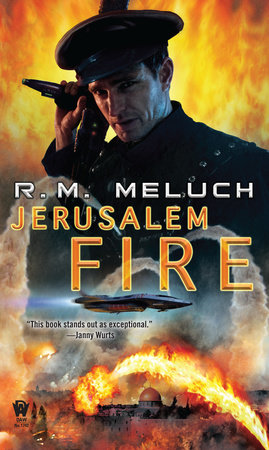
Featured at Writers Read: R.M. Meluch, author of Jerusalem Fire.

Her entry begins:
Right now, I'm reading Terry Prachett. He makes me laugh my ass off, and his is such a singular voice I don't need to worry about subconscious...[read on]
About Jerusalem Fire, from the publisher:
Does Jerusalem Stand?

It was the question all human star travelers asked one another. The ancient city of Jerusalem, holy to three human religions, had become the touchstone for anyone not yet absorbed into the Na’id Empire, under its twin banner of Galactic Dominion/Human Supremacy.

Iry—

A planet out of myth, whose very existence could bring down an empire.

Alihahd—

The captain was a notorious rebel runner. To most of the known galaxy hewas a legend without a face, to the rest, a face without a name. He was called Alihahd. “He left.” It was the word Na’id enforcers heard when they demanded to know where the rebel had gone—always one step ahead—as if he knew his enemy very well. Hero, villain, coward. Three times a legend on both sides of the same war.
Visit R.M. Meluch's website.

My Book, The Movie: Jerusalem Fire.

Coffee with a Canine: Rebecca Meluch & Jeremiah.

Writers Read: R.M. Meluch.

--Marshal Zeringue

Gene Wilder's six all-time favorite books

Gene Wilder starred in several modern classic movies, including Young Frankenstein and Willy Wonka & the Chocolate Factory. In 2005 he published a memoir, Kiss Me Like a Stranger: My Search for Love and Art, and shared his favorite books in the pages of The Week magazine. One title on the list:
Tender Is the Night by F. Scott Fitzgerald

Primarily a psychological tangle, this story is about a doctor who helps a seriously neurotic young woman, and they fall in love and marry. He ends up a wreck and she ends up quite sane and normal. It's very moving.
Read about another book on the list.

Tender is the Night is among DBC Pierre's top ten books writers should read, Olivia Laing's ten best books & stories on drinking and booze and Joni Rendon and Shannon McKenna Schmidt's top nine works inspired by writers’ love lives.

--Marshal Zeringue

Pg. 99: Heath Brown's "Immigrants and Electoral Politics"

Featured at the Page 99 Test: Immigrants and Electoral Politics: Nonprofit Organizing in a Time of Demographic Change by Heath Brown.

About the book, from the publisher:
In Immigrants and Electoral Politics, Heath Brown shows why nonprofit electoral participation has emerged in relationship to new threats to immigrants, on one hand, and immigrant integration into U.S. society during a time of demographic change, on the other. Immigrants across the United States tend to register and vote at low rates, thereby limiting the political power of many of their communities. In an attempt to boost electoral participation through mobilization, some nonprofits adopt multifaceted political strategies including registering new voters, holding candidate forums, and phone banking to increase immigrant voter turnout. Other nonprofits opt to barely participate at all in electoral politics, preferring to advance the immigrant community by providing exclusively social services.

Brown interviewed dozens of nonprofit leaders and surveyed hundreds of organizations. To capture the breadth of the immigrant experience, Brown selected organizations operating in traditional centers of immigration as well as new gateways for immigrants across the South: Florida, Illinois, Michigan, New Jersey, New York, and, North Carolina. The stories that emerge from his research include incredible successes in mobilizing immigrant communities, including organizations that registered sixty thousand new immigrant voters in New York. They also reveal efforts to suppress nonprofit voter mobilization in Florida and describe the organizational response to hate crimes directed at immigrants in Illinois.
Learn more about Immigrants and Electoral Politics at the Cornell University Press website.

The Page 99 Test: Immigrants and Electoral Politics.

--Marshal Zeringue

Five top romance novels for the holidays

At B&N Reads Tara Sonin tagged five top romance novels that invoke the holiday spirit, including:
Mistletoe, Mischief, and the Marquis, by Amelia Grey

The Marquis of Wythberry is not one to succumb to the Christmas spirit—or to temptation, but Lillian Prim may be the end of that, for she is threatening him with both. But he refuses to give in to her charms, for she is the sister of his best friend, and to fall for her would betray his moral code. Lillian sees the Marquis’ stoic demeanor for what it is; an opportunity for her to bring mischief and mayhem into their Christmastide celebrations…and maybe a stolen kiss or two.
Read about another entry on the list.

--Marshal Zeringue