Wednesday, January 25, 2012

Stephanie Deutsch's "You Need a Schoolhouse," the movie

Now showing at My Book, The Movie: You Need a Schoolhouse: Booker T. Washington, Julius Rosenwald, and the Building of Schools for the Segregated South by Stephanie Deutsch.

The entry begins:
When my friend Tony Rizzoli asked me what Julius Rosenwald looked like I gave a rather flip response. I said, “kind of nebbishy.” But even as these words were leaving my mouth I realized they were incorrect. In his later years Rosenwald actually looked like Tony – thin, not much hair, angular face, friendly, open expression. Twenty five years ago, Tony’s performance in Larry Shue’s play The Foreigner was one of funniest things I’ve ever seen on stage. The sense of humor that lurks behind Tony’s own intelligent eyes was, I realized, a feature in Rosenwald as well. The millionaire president of Sears, Roebuck turned race conscious philanthropist could seem a rather wooden figure on the printed page. But Tony would save him from such a fate by showing his more energetic, playful, humorous side. I had long since decided that Booker T. Washington’s role would go to a rather more prominent actor -- either Morgan...[read on]
Learn more about the book and author at Stephanie Deutsch's website and blog.

My Book, The Movie: You Need a Schoolhouse.

--Marshal Zeringue

What is Matt Bondurant reading?

The current featured contributor at Writers Read: Matt Bondurant, author of The Wettest County in the World and The Night Swimmer.

His entry begins:
I’m currently reading Out of Africa by Isak Dinesen, which is one of those great books that has long been on my list and I’ve finally gotten around to it. What is surprising to me is the gorgeous prose; I had assumed I would get plenty of rich scenes of Africa but Dinesen’s gifts go far beyond simple landscapes or even dramatic encounters with wildlife. It is a real meditation on solitude, destiny, culture, and so many other things, written in an often understated but always fresh, lyrical and compelling style. I could...[read on]
About The Night Swimmer, from the publisher:
The Night Swimmer, Matt Bondurant’s utterly riveting modern gothic novel of marriage and belonging, confirms his gift for storytelling that transports and enthralls.

In a small town on the southern coast of Ireland, an isolated place only frequented by fishermen and the occasional group of bird-watchers, Fred and Elly Bulkington, newly arrived from Vermont having won a pub in a contest, encounter a wild, strange land shaped by the pounding storms of the North Atlantic, as well as the native resistance to strangers. As Fred revels in the life of a new pubowner, Elly takes the ferry out to a nearby island where anyone not born there is called a “blow-in.” To the disbelief of the locals, Elly devotes herself to open-water swimming, pushing herself to the limit and crossing unseen boundaries that drive her into the heart of the island’s troubles—the mysterious tragedy that shrouds its inhabitants and the dangerous feud between an enigmatic farmer and a powerful clan that has no use for outsiders.

The poignant unraveling of a marriage, the fierce beauty of the natural world, the mysterious power of Irish lore, and the gripping story of strangers in a strange land rife with intrigue and violence—The Night Swimmer is a novel of myriad enchantments by a writer of extraordinary talent.
Learn more about the author and his work at Matt Bondurant's website.

The Page 69 Test: The Wettest County in the World.

Writers Read: Matt Bondurant.

--Marshal Zeringue

Five top books on mountaineering

One title on the Barnes & Noble Review's list of five top books about mountaineering:
The Ledge
by Jim Davidson and Kevin Vaughan

Davidson and his friend Mike Price were coming down Washington State's Mount Rainier when the pair fell 80 feet into a crevasse. The fall killed Price and left Davidson badly injured, stranded on the ledge that gives this harrowing book its title. Against all odds, he crawled to safety. But the joy of making it back was tempered by the loss of his close friend, and Davidson chronicles his conflicted emotions in this story of adventure, grief, and perseverance.
Read about another book on the list.

Also see Andy Cave's top ten books on Alpinism.

--Marshal Zeringue

Pg. 69: Colin Cotterill's "Slash and Burn"

The current feature at the Page 69 Test: Slash and Burn (Dr. Siri Paiboun Series #8) by Colin Cotterill.

About the book, from the publisher:
Dr. Siri might finally be allowed to retire (again). Although he loves his two morgue assistants, he's tired of being Laos's national coroner, a job he never wanted in the first place. Plus, he's pushing 80, and wants to spend some time with his wife before his untimely death (which has been predicted by the local transvestite fortune teller).

But retirement is not in the cards for Dr. Siri after all. He's dragged into one last job for the Lao government: supervising an excavation for the remains of U.S. fighter pilot who went down in the remote northern Lao jungle ten years earlier. The presence of American soldiers in Laos is a hot-button issue for both the Americans and the Lao involved, and the search party includes high-level politicians and scientists. But one member of the party is found dead, setting off a chain of accidents Dr. Siri suspects aren't completely accidental. Everyone is trapped in a cabin in the jungle, and the bodies are starting to pile up. Can Dr. Siri get to the bottom of the MIA pilot's mysterious story before the transvestite fortune teller's prediction comes true?
Learn more about the book and author at Colin Cotterill's website.

The Page 69 Test: Anarchy and Old Dogs.

My Book, The Movie: Curse of the Pogo Stick.

The Page 69 Test: Killed at the Whim of a Hat.

My Book, The Movie: Killed at the Whim of a Hat.

Writers Read: Colin Cotterill.

The Page 69 Test: Slash and Burn.

--Marshal Zeringue

Tuesday, January 24, 2012

Pg. 99: Hendrik Hartog's "Someday All This Will Be Yours"

The current feature at the Page 99 Test: Someday All This Will Be Yours: A History of Inheritance and Old Age by Hendrik Hartog.

About the book, from the publisher:
We all hope that we will be cared for as we age. But the details of that care, for caretaker and recipient alike, raise some of life’s most vexing questions. From the mid-nineteenth to the mid-twentieth century, as an explosive economy and shifting social opportunities drew the young away from home, the elderly used promises of inheritance to keep children at their side. Hendrik Hartog tells the riveting, heartbreaking stories of how families fought over the work of care and its compensation.

Someday All This Will Be Yours narrates the legal and emotional strategies mobilized by older people, and explores the ambivalences of family members as they struggled with expectations of love and duty. Court cases offer an extraordinary glimpse of the mundane, painful, and intimate predicaments of family life. They reveal what it meant to be old without the pensions, Social Security, and nursing homes that now do much of the work of serving the elderly. From demented grandparents to fickle fathers, from litigious sons to grateful daughters, Hartog guides us into a world of disputed promises and broken hearts, and helps us feel the terrible tangle of love and commitments and money.

From one of the bedrocks of the human condition—the tension between the infirmities of the elderly and the longings of the young—emerges a pioneering work of exploration into the darker recesses of family life. Ultimately, Hartog forces us to reflect on what we owe and are owed as members of a family.
Learn more about Someday All This Will Be Yours at the Harvard University Press website.

The Page 99 Test: Someday All This Will Be Yours.

--Marshal Zeringue

Five notable science fiction classics

Adam Roberts received his MA (English and Classics Jt-Hons) from Aberdeen University and his PhD (Robert Browning and the Classics) from Cambridge University. He has worked in the English Department at Royal Holloway, University of London, since 1991, and he is currently Professor of Nineteenth Century Literature.

His books include The History of Science Fiction as well as numerous science fiction novels, eight parodies, two novellas, a collection of short stories and various other things.

One of five top science fiction classics he discussed with Alec Ash at The Browser:
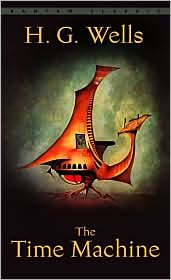
The Time Machine
by HG Wells

[One book] on your list is 1895’s The Time Machine by HG Wells.

This is the novel that inaugurated time travel as a sub-genre. Wells picked up the up-to-date (in the 1890s) scientific speculation about time being a fourth dimension, and ran with it, imagining a machine that could take a man backwards and forwards through time. Wells’s time traveller – we are not given his name – goes from late Victorian times to the year 802,701, where he finds that humanity has by a process of divergent evolution degenerated into two species – the infantile, hedonist Eloi and the subterranean, monstrous Morlocks who prey upon them.

It is a short novel, almost a novella, but it is smoothly and evocatively written, and it manages to open a chink in the reader’s mind that gives a her dizzying, thrilling glimpse down the vertiginous perspectives of long time. My favourite moment comes near the end, after the time traveller has left the Eloi and Morlocks behind him (as it were) and travelled more than 30 million years into the far distant future. He finds himself on a desolate beach, seemingly lifeless but for green slime on the rocks, the sun grown to massive proportions, and witnesses an eclipse:

“The darkness grew apace; a cold wind began to blow in freshening gusts from the east, and the showering white flakes in the air increased in number. From the edge of the sea came a ripple and whisper. Beyond these lifeless sounds the world was silent. Silent? It would be hard to convey the stillness of it. All the sounds of man, the bleating of sheep, the cries of birds, the hum of insects, the stir that makes the background of our lives—all that was over. As the darkness thickened, the eddying flakes grew more abundant, dancing before my eyes; and the cold of the air more intense. At last, one by one, swiftly, one after the other, the white peaks of the distant hills vanished into blackness. The breeze rose to a moaning wind. I saw the black central shadow of the eclipse sweeping towards me. In another moment the pale stars alone were visible. All else was rayless obscurity. The sky was absolutely black.”

Time viewed from the perspective of the sublime. It still makes the hairs stir on the back of my neck.

Tell us more, if you will, about what makes Wells’s sci-fi so unique.

Wells is the first genius of science fiction, and the genre informs his choice of core metaphor. We see it in pretty much all his short fiction – in an ordinary, contemporary environment we come across a device, object or circumstance which opens vistas to strange new worlds. In the short story “The Door in the Wall”, the protagonist finds a mysterious green door that permits him to leave the grimy reality of 19th century London and enter “a world with a different quality, a warmer, more penetrating and mellower light with a faint, clear gladness in its air”. And there are many subsequent stories that employ the same device. In “The Remarkable Case of Davidson’s Eyes”, a malfunctioning scientific experiment replaces the protagonist’s ordinary vision with vision of the exact opposite point of the globe. In “The Crystal Egg”, the object of the story’s title gives its possessor, a London junk-shop owner, unexpected visual access to a scene on Mars, with Martian house and flying Martians.

That last story epitomises the way this sort of tale operates. Wells draws a clear distinction between the shabby, lower middle class existence of the shopkeeper who owns the crystal egg and the fantastic, exotic world opened up by the egg itself. This contrast is integral to the functioning of the story. As Wells said in 1934 in Experiment in Autobiography, with reference to The Time Machine, “I had realised that the more impossible the story I had to tell, the more ordinary must be the setting”. In “The Crystal Egg” the egg is, in fact, science fiction itself. It is the thing that gives us fantastic, other-worldly visions. By setting a seedy junk shop against the exotic Martian palace, the story balances the genre of late-century “realist” fiction – of the sort that Wells also wrote but which is more strongly associated with writers such as [George] Gissing and [Arnold] Bennett – with the sparkling possibilities of SF itself.
This is the key to The Time Machine. Instead of reading the tale as an allegorical coding of contemporary class circumstances, we can read it as deliberate mediation of the generic representation of those circumstances (realism) and the escape from such quotidian, everyday representation (the time machine itself, or science fiction). It is of course possible to say, as critics have done, that the time machine is a mechanism by which the author can represent, for instance, Darwinian time. The time machine is like a clock, a car, a weapon and all the various things that critics have read into the tale built around it. But the time machine is a literary device. The time machine is science fiction.
Read about another entry on the list.

The Time Machine is among David Lodge's top ten H.G. Wells books and Linda Buckley-Archer's top ten time-travelling stories.

--Marshal Zeringue

John Lescroart's "The Hunter," the movie

Now showing at My Book, The Movie: The Hunter by John Lescroart.

The entry begins:
The Hunter is my third Wyatt Hunt novel, and I’d love to have Taylor Kitsch (the Tim Riggins character from Friday Night Lights) take on the role of Wyatt. He would be perfect. In fact...[read on]
Learn more about the book and its author at John Lescroart's website.

Writers Read: John Lescroart.

The Page 69 Test: The Hunter.

My Book, The Movie: The Hunter.

--Marshal Zeringue

What is Jesse Browner reading?

The current featured contributor at Writers Read: Jesse Browner, author of Everything Happens Today.

His entry begins:
It is difficult to credit, or to explain, just why so many masterpieces were written in Hungary in the early part of the twentieth century. Perhaps it has something to do with the rich loam created by a decaying empire. In any case, whenever I tell anyone about my thing for mid-century Middle-European literature, they always have another obscure favorite for me to add to my list: Sándor Márai’s Embers, Miklós Bánffy’s They Were Counted, and most especially Dezsö Kosztolányi’s Skylark.

Most recent of these (for me) is Antal Szerb’s 1937 novel Journey by Moonlight. I’m not sure where I heard this, but apparently all Hungarians grow up reading Journey by Moonlight, which...[read on]
Among the praise for Everything Happens Today:
“A deeply compassionate novel by a very fine writer."
--Joe O’Neill, author of Netherland

"This is magic. This is hope... Browner has crafted a stupendous, thought-provoking, devilishly delicious novel that reads like Zen koan meets Portrait of the Artist as a Young Man with some modern 'english' that sets the plate spinning."
--Library Journal (starred review)

"In this 60th anniversary year of the quintessential novel of New York teen angst, Catcher in the Rye, Jesse Browner's Everything Happens Today updates Holden Caulfield and perhaps even bests Salinger with a funnier, kinder and wiser tale."
--Shelf Awareness (starred review)

"Each of the characters is wonderfully evoked, flawed and lovable and three-dimensional. By the end I was counting on Browner to get me out of this novel in one piece emotionally. That's how you know a book was worth the money."
--Rebecca Coleman, author of The Kingdom of Childhood
Learn more about the book and author at Jesse Browner's website.

Writers Read: Jesse Browner.

--Marshal Zeringue

Monday, January 23, 2012

Five notable books on the gods of Olympus

One title on the Barnes & Noble Review's list of five books on the Olympians:
The Iliad
by Homer, translated by Richmond Lattimore

The gods and goddesses of Greek mythology are at their most destructive in Homer's bloody epic. While the focus is on the rage of the human hero Achilles, the meddling deities are both spectactors and manipulators of the battle between Trojans and Acheans -- and sometimes they even join in. For a more personal relationship between an individual and his divine patron, follow this with The Odyssey, in which "gray-eyed" Athena helps Odysseus survive his perilous journey back to Ithaca.
Read about a contemporary novel on the list.

The Iliad also appears on Madeline Miller's list of ten favorite classical works, Bettany Hughes's six best books list, James Anderson Winn's five best list of works of war poetry, and John Mullan's lists of ten of the best funerals in literature and ten of the best examples of ekphrasis. It is one of Karl Marlantes's top ten war stories.

--Marshal Zeringue

Pg. 69: Hillary Jordan's "When She Woke"

The current feature at the Page 69 Test: When She Woke by Hillary Jordan.

About the book, from the publisher:
Hannah Payne’s life has been devoted to church and family, but after her arrest, she awakens to a nightmare: she is lying on a table in a bare room, covered only by a paper gown, with cameras broadcasting her every move to millions at home, for whom observing new Chromes—criminals whose skin color has been genetically altered to match the class of their crime—is a new and sinister form of entertainment. Hannah is a Red; her crime is murder. The victim, according to the State of Texas, was her unborn child, and Hannah is determined to protect the identity of the father, a public figure with whom she’s shared a fierce and forbidden love.

When She Woke is a fable about a stigmatized woman struggling to navigate an America of a not-too-distant future—where the line between church and state has been eradicated and convicted felons are no longer imprisoned and rehabilitated but chromed and released back into the population to survive as best they can. In seeking a path to safety in an alien and hostile world, Hannah unknowingly embarks on a path of self-discovery that forces her to question the values she once held true and the righteousness of a country that politicizes faith.
Learn more about the author and her work at Hillary Jordan's website and blog.

The Page 69 Test: Mudbound.

My Book, The Movie: Mudbound.

The Page 69 Test: When She Woke.

--Marshal Zeringue

Pg. 99: A. W. Moore's "The Evolution of Modern Metaphysics"

The current feature at the Page 99 Test: The Evolution of Modern Metaphysics: Making Sense of Things by A. W. Moore.

About the book, from the publisher:
This book is concerned with the history of metaphysics since Descartes. Taking as its definition of metaphysics 'the most general attempt to make sense of things', it charts the evolution of this enterprise through various competing conceptions of its possibility, scope, and limits. The book is divided into three parts, dealing respectively with the early modern period, the late modern period in the analytic tradition, and the late modern period in non-analytic traditions. In its unusually wide range, A. W. Moore's study refutes the tired old cliché that there is some unbridgeable gulf between analytic philosophy and philosophy of other kinds. It also advances its own distinctive and compelling conception of what metaphysics is and why it matters. Moore explores how metaphysics can help us to cope with continually changing demands on our humanity by making sense of things in ways that are radically new.
Learn more about The Evolution of Modern Metaphysics at the Cambridge University Press website.

The Page 99 Test: The Evolution of Modern Metaphysics.

--Marshal Zeringue

Sunday, January 22, 2012

Sandra Balzo's "Triple Shot," the movie

Now showing at My Book, The Movie: Triple Shot by Sandra Balzo.

The entry begins:
Uncommon Grounds, the first Maggy Thorsen coffeehouse mystery, was published in 2004. Since then, I've written six more, the most recent being the just-released Triple Shot.

Over the course of my series, Maggy has weathered countless storms (including a "thunder-snow" that destroyed her shop), the loss of business partners in very different ways and, of course, the obligatory deaths of a dozen friends and neighbors. I have put the poor woman through the proverbial wringer.

What I haven't done, though, is describe her. And I didn't realize it until just now.

Sheesh.

I suppose since Maggy was my earliest fictional creation--and a first-person one, at that--I saw her as my alter ego. And who describes themselves in dialogue? ("Hi honey, I--your petite, red-haired wife, with the scar on my left knee--am home!")

Accidental omission or not, I admit I'm intrigued by the idea of readers deciding for themselves what Maggy looks like. But ... how do you cast a movie centering around a character even the author knows inside, but not out?

Well, what facts do we have? Maggy, in her mid-forties, quit a public relations job to open a gourmet coffeehouse with two friends, but only after her husband left home--and Maggy--the day their son went off to college. She loves red wine, craves caffeine and, on occasion, runs a mile or two.

Maggy's funny, cynical and very, very human. Not everyone's cup of tea--or, more to the point, coffee. The woman's a non-cozy hero in a cozy series. She has hard edges and, even now in Book Seven, they haven't been smoothed over.

So cast a comedic leading lady in the role, say Sandra Bullock or Julia...[read on]
Learn more about the book and author at Sandra Balzo's website.

My Book, The Movie: Triple Shot.

--Marshal Zeringue

Five books on secret agents featured in series

Jeffrey T. Richelson is the author of several books on intelligence, including Defusing Armageddon: Inside NEST, America's Secret Nuclear Bomb Squad and Spying on the Bomb. He is currently a Senior Fellow with the National Security Archive.

In 2008 he named a five best list of books on secret agents featured in series for the Wall Street Journal, including:
The Quiller Memorandum
by Adam Hall

The name is Quiller, just Quiller: not a first name, not a last name, just a code name. The British agent was introduced with "The Quiller Memorandum" and went on to appear in 18 more novels by Adam Hall, one of several pen-names employed by novelist Elleston Trevor. Among the pleasures of the series is the fully realized world of The Bureau, Quiller's secretive employer. But it is Quiller who holds our interest and never lets go. In contrast to James Bond, Quiller does not have a license to kill -- nor does he want one. He doesn't even carry a gun. In "Memorandum," he is sent to Berlin to meet with Pol, his director in the field. Quiller is a "ferret" who burrows into enemy organizations and then neutralizes them. In this case, Pol wants him to penetrate a secret neo-Nazi organization in Berlin. In the 1960s, the loose ends of the Third Reich still presented thriller writers -- and their rapt readers -- with compelling sources of villainy.
Read about another book on the list.

--Marshal Zeringue

What is Rick Mofina reading?

The current featured contributor at Writers Read: Rick Mofina, author of The Burning Edge.

His entry begins:
Right now I am reading True Grit by Charles Portis. I confess that my introduction to the story came through the John Wayne movie when I was probably about the same age as the heroine, 14-year-old Mattie Ross. Mattie's quest is justice for the murder of her father by Tom Chaney, a former hired hand. She hires crusty U.S. Marshal Rooster Cogburn to help her pursue the killer. I loved the story and began looking into the book. Having learned that the tale, as written by Portis, is actually told through Mattie's recollection as an old woman, intrigued me. I had always...[read on]
About The Burning Edge, from the publisher:
Single mother Lisa Palmer has barely recovered from the sudden death of her husband when she is drawn into a new nightmare. On her way home from upstate New York, Lisa stops at a service center minutes before an armored car heist. Four men are executed before her eyes -- one of them an off-duty FBI agent Lisa tried to help. Now Lisa is the FBI's secret witness and the key to finding the fugitive killers.
Learn more about the book and author at Rick Mofina's website.

The Page 69 Test: Every Fear.

My Book, The Movie: A Perfect Grave.

The Page 69 Test: Six Seconds.

The Page 69 Test: Vengeance Road.

Writers Read: Rick Mofina (September 2010).

My Book, The Movie: The Panic Zone.

Writers Read: Rick Mofina.

--Marshal Zeringue

Saturday, January 21, 2012

Pg. 69: John Lescroart's "The Hunter"

The current feature at the Page 69 Test: The Hunter by John Lescroart.

About the book, from the publisher:
New York Times bestseller John Lescroart delivers a dark, intimate thriller about the price we put on family and the terrible costs of seeking the truth.

Raised by loving adoptive parents, San Francisco private investigator Wyatt Hunt never had an interest in finding his birth family-until he gets a chilling text message from an unknown number: "How did ur mother die?"

The answer is murder, and urged on by curiosity and the mysterious texter, Hunt takes on a case he never knew existed, one that has lain unsolved for decades. His family's dark past unfurls in dead ends. Child Protective Services, who suspected but could never prove that Hunt was being neglected, is uninformed; his birth father, twice tried but never convicted of the murder, is in hiding; Evie, his mother's drug-addicted religious fanatic of a friend, is untraceable. And who is the texter, and how are they connected to Hunt?

Yet in the present, time is running out. The texter, who insists the killer is out there, refuses to be identified. The cat-and-mouse game leads Hunt across the country and eventually to places far more exotic-and far more dangerous. As the chase escalates, so does the threat, for the killer has a secret that can only be trusted to the grave. Thriller master John Lescroart weaves a shocking, suspenseful tale about the skeletons inside family closets ... and the mortal danger outside the front door.
Learn more about the book and its author at John Lescroart's website.

Writers Read: John Lescroart.

The Page 69 Test: The Hunter.

--Marshal Zeringue

Five notable books on the art of living

Roman Krznaric is a cultural thinker and founding faculty member of The School of Life in London, which offers instruction and inspiration on the important questions of everyday life. He advises organizations including Oxfam and the United Nations on using empathy and conversation to create social change, and has been named by the Observer as one of Britain’s leading lifestyle philosophers.

One of five notable books on the art of living he discussed with Alec Ash at The Browser:
Walden
by Henry David Thoreau

Well, let’s draw on it now, beginning with Thoreau’s Walden. Will you briefly introduce the book to our readers?

Well, in 1845 the American naturalist Henry David Thoreau went out to live in the woods of western Massachusetts. He lived two years there, and a few years later he wrote a book about his experiences called Walden; or, Life in the Woods. It’s an account of how he went about the practicalities of simple living. It’s about how he built his house – a log cabin – with his own hands, grew his own food and lived a subsistence lifestyle. And it’s about what he did when he was there, like observing nature and swimming in Walden Pond.

I think Thoreau was one of the great masters of the art of simple living. Of course, he didn’t live in complete isolation. Every few days he walked into the town of Concord, to read the papers and have a chat with his mum. He was very open about that. But he wrote extremely eloquently about the advantages of paring down life to its essentials – of doing more than getting caught up in the commercialisation and industrialisation that was going on around him.

Which is a lesson as relevant to our lives today as it was in the 19th century.

Even more relevant now, I think. In the era of climate change, there’s increasingly a move to cut back on our carbon emissions. Thoreau would have totally fitted into that. He would have looked around today and said: If you want to live carbon-lite, a less high-consumption lifestyle, you’ll see plenty of ideas in my book for turning away from material culture – not depriving yourself, but embracing the beauties of nature and of free time, the ultimate luxury.

Thoreau’s experience in Walden taught him that he could live extremely cheaply and he didn’t have to work very much. In fact, he said that he could work as a part-time surveyor for about six or seven weeks and have enough to live on at Walden Pond for a year.

He also talks about not striving purely for ambition’s sake. What does that say about our modern obsession with bettering our material situation?

Thoreau was always sceptical of what people called “civilisation” – accumulating material goods, moving into a bigger house. He viewed those things as burdens. He saw that having a massive mortgage was just going to tie you down and limit your freedom. Somewhat romantically, he thought you’d be much better off living in a wigwam, like the indigenous native Americans.

Thoreau famously said: “A man is rich in proportion to the number of things he can afford to let alone.” That was a message that he very much wanted to spread, at least through his own example. He saw the stress faced by farmers around him, who were trying to pay off their mortgages and improve the material quality of their lives. And he thought that it was much more luxurious and enjoyable to sit in the doorway of his cabin and listen to the birds sing, than to try to earn enough money to buy a new sofa.

Yet surely he doesn’t mean we should all follow his example, and give it all up to build ourselves cabins in the woods alongside his?

Thoreau was an extraordinarily realistic person. I don’t think he actually thought that everyone should live in the woods. What he was really saying was that wherever we live – even in urban society – we can simplify our lives. And that way, in purely practical terms, we probably don’t have to work as hard to support our lifestyle. And if you don’t have to work as much, you have more free time. Free time, for him, was the ultimate freedom.

I think he would say to us now: Even if you are living in a high-rise flat in Paris or Berlin or New York, if you simplify your life then you can learn that it may be more enjoyable to take a walk in the park than to drive an expensive car around. That’s something that everyone can do without having to go and live in the woods. So Thoreau has a very realistic message for us, especially now that a third of people feel time-stressed or time-poor. What they really want is the freedom to not be tied down to jobs they don’t want to do or debts they wish they didn’t have.

My favourite quote is near the end, when he writes: “If a man does not keep pace with his companion, perhaps it is because he hears a different drummer.”

That’s right, and I think that idea of walking to the beat of your own drummer is a vital lesson for the art of living. What he’s saying there is that we don’t need to conform; in a way we need to break the rules. There have always been inspiring figures in history who have done that, and Thoreau is one of them. Mary Wollstonecraft is another – she became an author in an age [the 18th century] when no women did so, went to revolutionary France, had a child out of wedlock and so on. She was walking to the beat of her own drummer, and I find that personally inspiring.

From everyday things like rejecting the culture of watching TV for three hours a day and locking your TV in the cupboard, to maybe leaving your well-paid job to do something which embodies your values more, we need to walk to the beat of our own drummer if we want to live a more experimental and adventurous life.
Read about another book on the list.

Walden is on Brad Leithauser's five best list of dispatches from the natural world.

--Marshal Zeringue

Pg. 99: Paul M. Barrett's "Glock"

This weekend's feature at the Page 99 Test: Glock: The Rise of America's Gun by Paul M. Barrett.

About the book, from the publisher:
Based on fifteen years of research, Glock is the riveting story of the weapon that has become known as American’s gun. Today the Glock pistol has been embraced by two-thirds of all U.S. police departments, glamorized in countless Hollywood movies, and featured as a ubiquitous presence on prime-time TV. It has been rhapsodized by hip-hop artists, and coveted by cops and crooks alike.

Created in 1982 by Gaston Glock, an obscure Austrian curtain-rod manufacturer, and swiftly adopted by the Austrian army, the Glock pistol, with its lightweight plastic frame and large-capacity spring-action magazine, arrived in America at a fortuitous time. Law enforcement agencies had concluded that their agents and officers, armed with standard six-round revolvers, were getting "outgunned" by drug dealers with semi-automatic pistols. They needed a new gun.

When Karl Water, a firearm salesman based in the U.S. first saw a Glock in 1984, his reaction was, “Jeez, that’s ugly.” But the advantages of the pistol soon became apparent. The standard semi-automatic Glock could fire as many as 17 bullets from its magazine without reloading (one equipped with an extended thirty-three cartridge magazine was used in Tucson to shoot Gabrielle Giffords and 19 others). It was built with only 36 parts that were interchangeable with those of other models. You could drop it underwater, toss it from a helicopter, or leave it out in the snow, and it would still fire. It was reliable, accurate, lightweight, and cheaper to produce than Smith and Wesson’s revolver. Made in part of hardened plastic, it was even rumored (incorrectly) to be invisible to airport security screening.

Filled with corporate intrigue, political maneuvering, Hollywood glitz, bloody shoot-outs—and an attempt on Gaston Glock’s life by a former lieutenant—Glock is at once the inside account of how Glock the company went about marketing its pistol to police agencies and later the public, as well as a compelling chronicle of the evolution of gun culture in America.
Visit the official Glock: The Rise of America's Gun website.

Writers Read: Paul M. Barrett.

Read--Coffee with a Canine: Paul M. Barrett & Beau.

The Page 99 Test: Glock.

--Marshal Zeringue

Five best: French noir fiction

R.J. Ellory's novels include the bestselling A Quiet Belief in Angels, which was the Strand Magazine's Thriller of the Year, nominated for the Barry Award, and a finalist for the SIBA Award. His novel, A Simple Act of Violence, won the Theakston's Crime Novel of the Year Award.

He named his five best French noir novels for the Wall Street Journal.

One book on the list:
The Stranger
by Albert Camus (1942)

The brilliance of Camus in this book is to make us feel something for a man who feels nothing. The French-Algerian writer—a World War II Resistance fighter, a philosopher, a journalist—once advised: "Always go too far, because that's where you'll find the truth." Yet in "The Stranger" he gives us Meursault, an unremarkable man who drifts in and out of situations, never seeming to connect with the people or circumstances he describes, even when he is drawn into the sordid melodrama of a neighbor's romantic life. On a hot afternoon on an Algerian beach, Meursault encounters a man who has been part of that dispute and shoots him—leaving us wondering whether Meursault has perpetrated this act of violence simply to see if he would feel something. He has gone too far, but we're not sure what truth he has found. His arrest, his trial, his conviction—they play out with Meursault observing them as though they were happening to someone else. Unsettling, disturbing and unforgettable.
Read about another novel on the list.

--Marshal Zeringue

Friday, January 20, 2012

Top 10 popular mathematics books

LinkIan Stewart is Emeritus Professor of Mathematics at the University of Warwick. His many books include From Here to Infinity, Nature’s Numbers, Does God Play Dice?, The Problems of Mathematics, Letters to a Young Mathematician, and Why Beauty Is Truth. His writing has appeared in New Scientist, Discover, Scientific American, and many newspapers in the U.K. and U.S.

His new book is In Pursuit of the Unknown: 17 Equations That Changed the World.

One of Stewart's top ten popular mathematics books, as told to the Guardian:
The Colossal Book of Mathematics by Martin Gardner

In his long-running Mathematical Games column in Scientific American, Gardner – a journalist with no mathematical training – created the field of recreational mathematics. On the surface his columns were about puzzles and games, but they all concealed mathematical principles, some simple, some surprisingly deep. He combined a playful and clear approach to his subject with a well-developed taste for what was mathematically significant. The book consists of numerous selections from his columns, classified according to the mathematical area involved. Learn how to make a hexaflexagon and why playing Brussels sprouts is a waste of time.
Read about another book on the list.

The Page 99 Test: Ian Stewart's Why Beauty Is Truth.

--Marshal Zeringue

What is Randy Rawls reading?

The current featured contributor at Writers Read: Randy Rawls, author of the Ace Edwards, Dallas PI series.

His entry begins:
I have to open with the fact that I am an avid reader. I always have a book near me, ready to open—home (of course), doctor's office, bank, post office, etc. Of course, that's easy because I read on a Kindle. I've had one since early in the K-life and am now using a K-3. I suspect there is a Kindle Fire in my future.

I have my favorite authors from the NY publishers, but don't read as many of those as I used to. Publisher-greed has caused me to look to them much less than once upon a time. Some of those are John Hart, Robert Crais, Harlan Coben, PJ Parrish, C.J. Box, Michael Connelly, and many others. However, paying more than $9.99 for an ebook goes against my sense of fairness. In my opinion, the big publishers are simply gauging the public.

So, what I love to do is find a new author, one who has not gotten the NY treatment. I used to search a lot of books by people I'd never heard of, looking for a good read. Recently, after being burned many times by badly written stories that are not ready to be published, I've quit looking at self-epub'd unless I happen to know the author, or someone I trust recommends it. Too much dreck out there to sort through. And before I start getting the blistering emails, I know there are some worthwhile, even good, books being self-epub'd. But honestly, I don't have the patience to dig through the pile to find them.

So with those standards in mind, I look at small publishers and their authors. One of those I found is Tom Lewis. He is published by a small press in North Carolina. My last read of his is Fifty Years to Midnight. Tom has taken the typical "can't go home again" story and transitioned it into one with more twists and turns than...[read on]
About Thorn on Roses, from the publisher:
Tom Jeffries has good reasons not to trust the justice system. It failed his sister and could fail his best friend, who lost his stepdaughter to a gang rape. Tom launches a vendetta to find and destroy the Thorns on Roses gang, proclaiming them not fit to live. As Tom methodically stalks the gang, eliminating them one by one, the police make slow progress, closing the gap between them and Tom.

Further complications arise in the form of Abby Archer, a lawyer assigned to "help" Tom. She quickly becomes a nuisance that will not go away. But, in spite of their aggravation with one another, proximity turns animosity into respect, then into...
Visit the official Randy Rawls website.

Writers Read: Randy Rawls.

--Marshal Zeringue