Saturday, November 13, 2021

Pg. 69: Lesley Kara's "The Dare"

Featured at the Page 69 Test: The Dare: A Novel by Lesley Kara.

About the book, from the publisher:
She thought she had put all the questions to rest. But someone from her past wants answers. From the bestselling author of The Rumor and Who Did You Tell? comes The Dare, an electrifying novel of suspense.

At the time it was exciting. A game of dare, but one that had motive and justification. Children can be so judgmental, can’t they? I can still hear her cry as she toppled forward, the dull thud of her body as it landed on the pavement.

Lizzie and Alice are the best of friends, as close as can be. Until the day when they’re out playing by the train tracks and a childish spat triggers Lizzie’s epilepsy. When she comes to, she finds an unimaginable horror: Alice has been killed. Lizzie is devastated, and as she tries to cope with her grief, she is shocked to find herself alienated from Alice’s friends and relatives, who are convinced Lizzie and “the dare” somehow had a role in her friend’s death.

I knew that whatever she wanted me to do, I’d do it. Like that first, dreadful dare.

Years later, Lizzie has tried to move on. She’s engaged to a wonderful man and is starting a new life in London. But someone from her past isn’t willing to forgive and forget. And they’ll do anything to pry answers from her. Even if Lizzie doesn’t know them herself.
Visit Lesley Kara's website.

Q&A with Lesley Kara.

The Page 69 Test: The Dare.

--Marshal Zeringue

Friday, November 12, 2021

Eight thrillers & mysteries with underlying supernatural elements

C. J. Cooke is an award-winning poet and novelist published in twenty-three languages. She teaches creative writing at the University of Glasgow, where she also researches the impact of motherhood on women’s writing and creative writing interventions for mental health.

Cooke's newest novel is The Lighthouse Witches.

At CrimeReads she tagged eight thrillers and mysteries that "combine the supernatural with the real in believable ways," including:
Tana French’s The Secret Place

One of my favorite writers, French deploys the supernatural lightly in her fifth installment of Dublin Murder Squad In this clever psychological suspense, two detectives are called to solve a murder in the grounds of an exclusive boarding school, and their prime suspects are a group of smart-mouthed teenage girls. Without giving too much away, the supernatural here is less a narrative thread than it is an intriguing framework through which to unpick the dynamics of friendship, or the ties between a group of bored, dramatic, and privileged teenage girls.
Read about another entry on the list.

The Secret Place is among Cambria Brockman's five thrillers featuring a small group of friends, Adele Parks's eight crime novels featuring intense female friendship, Kristen Lepionka's ten top female detectives in fiction, the B&N Reads editors' five favorite fun, fearless femmes fatales in fiction, and Kelly Anderson's seven amazing female friendships in fiction.

--Marshal Zeringue

Pg. 99: Jonathan Tran's "Asian Americans and the Spirit of Racial Capitalism"

Featured at the Page 99 Test: Asian Americans and the Spirit of Racial Capitalism by Jonathan Tran.

About the book, from the publisher:
Any serious consideration of Asian American life forces us to reframe the way we talk about racism and antiracism. There are two contemporary approaches to antiracist theory and practice. The first emphasizes racial identity to the exclusion of political economy, making racialized life in America illegible. This approach's prevalence, in the academy and beyond, now rises to the level of established doctrine. The second approach views racial identity as the function of a particular political economy--what is called “racial capitalism>--and therefore analytically subordinates racial identity to political economy.

Jonathan Tran develops arguments in favor of this second approach. He does so by means of an extended analysis of two case studies: a Chinese migrant settlement in the Mississippi Delta (1868-1969) and the Redeemer Community Church in the Bayview/Hunters Point section of San Francisco (1969-present). While his analysis is focused on particular groups and persons, he uses it to examine more broadly racial capitalism's processes and commitments at the sites of their structural and systemic unfolding. In pursuing a research agenda that pushes beyond the narrow confines of racial identity, Tran reaches back to trusted modes of analysis that have been obscured by the prevailing antiracist orthodoxy and proposes reframing antiracism in terms of a theologically salient account of political economy.
Visit Jonathan Tran's website.

The Page 99 Test: Asian Americans and the Spirit of Racial Capitalism.

--Marshal Zeringue

Aaron Philip Clark's "Under Color of Law," the movie

Featured at My Book, The Movie: Under Color of Law (Trevor Finnegan, 1) by Aaron Philip Clark.

The entry begins:
Under Color of Law centers on rookie LAPD detective Trevor “Finn” Finnegan, who’s tasked to investigate the murder of Black LAPD recruit Brandon Soledad. As pressure mounts to solve the crime and avoid a PR nightmare, Finn scours the underbelly of a volatile city where power, violence, and race intersect. But it’s Finn’s past as a beat cop that may hold the key to solving Brandon’s murder. The price? The end of Finn’s career…or his life.

As the 2021 Book Pipeline Adaptation contest winner, I’ve given more thought to casting over the last few days. In addition to a cash prize, I’ll be working with a production company to develop Under Color of Law for the big or small screen. Here’s my ideal casting and director for the soon-to-be adaptation.

Trevor “Finn” Finnegan: Kendrick Sampson (Insecure, 2016-2021). Trevor is analytical and highly reflective. The first-person POV allows access to Trevor’s interior in the novel; however, that wouldn’t translate well for a film or TV series. Therefore, the actor would need to convey intelligence, strength, and vulnerability while also being menacing when necessary. Sampson not only embodies these traits but exudes command presence which is necessary when playing a believable cop.

Sarada Rao: Taylour Paige (Zola, 2021). Sarada is Trevor’s long-time friend, who he cares very deeply for. They are forever bonded by a traumatic event in their young lives which drives Trevor to become a police officer. After...[read on]
Visit Aaron Philip Clark's website.

My Book, The Movie: Under Color of Law.

--Marshal Zeringue

Thursday, November 11, 2021

Q&A with Lori Rader-Day

From my Q&A with Lori Rader-Day, author of Death at Greenway: A Novel:
How much work does your title do to take readers into the story?

So much work! I had a slightly different title for it, but my publisher suggested this one because it was shorter. It also sounds like an Agatha Christie novel, doesn’t it? It’s not, but because Death at Greenway is set at Agatha Christie’s house and features cameos from the author, it makes sense to strike that tone. The word Greenway absolutely had to be in the title; that was advice given to me by Sophie Hannah, who writes the Poirot continuation novels for the Christie estate.

What's in a name?

There are two Bridget Kellys in Death at Greenway. When the second Bridget arrives on the scene...[read on]
Visit Lori Rader-Day's website.

Q&A with Lori Rader-Day.

--Marshal Zeringue

Pg. 99: Sandro Galea's "The Contagion Next Time"

Featured at the Page 99 Test: The Contagion Next Time by Sandro Galea.

About the book, from the publisher:
How can we create a healthier world and prevent the crisis next time?

In a few short months, COVID-19 devastated the world and, in particular, the United States. It infected millions, killed hundreds of thousands, and effectively made the earth stand still.

Yet America was already in poor health before COVID-19 appeared. Racism, marginalization, socioeconomic inequality--our failure to address these forces left us vulnerable to COVID-19 and the ensuing global health crisis it became. Had we tackled these challenges twenty years ago, after the outbreak of SARS, perhaps COVID-19 could have been quickly contained. Instead, we allowed our systems to deteriorate.

Following on the themes of his award-winning publication Well, Sandro Galea's The Contagion Next Time articulates the foundational forces shaping health in our society and how we can strengthen them to prevent the next outbreak from becoming a pandemic. Because while no one could have predicted that a pandemic would strike when it did, we did know that a pandemic would strike, sooner or later. We're still not ready for the next pandemic. But we can be--we must be.

In lyrical prose, The Contagion Next Time challenges all of us to tackle the deep-rooted obstacles preventing us from becoming a truly vibrant and equitable nation, reminding us of what we've seemed to have forgotten: that our health is a public good worth protecting.
Visit Sandro Galea's website.

The Page 99 Test: The Contagion Next Time.

--Marshal Zeringue

Top ten epics

Stephanie Sy-Quia was born in Berkeley, CA, in 1995 and grew up near Paris. She is a freelance broadcaster and writer (specialising in literary criticism) with a BA in English Language and Literature from Oxford University. She is a Ledbury Emerging Poetry Critic and has twice been shortlisted for the FT Bodley Head Essay Prize. Her writing has appeared in The FT Weekend Magazine, The Guardian, The TLS, The Economist, and others. She lives in London.

Her first book, Amnion -- "a form of anti- or counter-epic: it is an attempt to honour a fractured family history and give it its due weight," Sy-Quia writes --is published by Granta Poetry.

At the Guardian Sy-Quia tagged ten of her favorite epics, including:
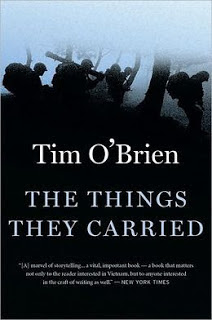
The Things They Carried by Tim O’Brien

The Iliad is the story of a great victory, which marked the beginning of ancient Greece’s golden age of dominion over the Mediterranean. But how can you write about defeat from the position of already being the dominant power? Tim O’Brien’s collection of autofictional interlinked short stories concerning the Vietnam war does just this. When your nation has lost its authority in the world, one path ahead is to adopt an unreliable narrator, to question the valorisation of war, the meaning of bravery, and the very concept of a hero.
Read about another entry on the list.

The Things They Carried is among Emily Temple's ten books that defined the 1990s, Emily Fridlund's six top books about self-deception, Janine di Giovanni's top ten books of war reportage, The American Scholar editors' eleven best sentences in literature, Simon Mawer's five top war novels, Olen Steinhauer's six favorite books, and is one of Roger “R.J.” Ellory's five favorite human dramas. Melinda L. Pash, author of In the Shadow of the Greatest Generation: The Americans Who Fought the Korean War, says The Things They Carried changed her life.

--Marshal Zeringue

Wednesday, November 10, 2021

Pg. 69: Alison Gaylin's "The Collective"

Featured at the Page 69 Test: The Collective: A Novel by Alison Gaylin.

About the book, from the publisher:
Just how far will a grieving mother go to right a tragic wrong?

Camille Gardener is a grieving—and angry—mother who, five years after her daughter’s death, is still obsessed with the privileged young man she believes to be responsible.

When her rash actions draw the attention of a secret group of women—the collective— Camille is drawn into a dark web where these mothers share their wildly different stories of loss as well as their desire for justice in a world where privilege denies accountability. Fueled by mutual rage, the collective members devise and act out retribution fantasies via precise, anonymous, highly coordinated revenge killings.

As Camille struggles to comprehend whether this is a role-playing exercise or terrifying reality, she must decide if these women are truly avenging angels or monsters. Becoming more deeply enmeshed in the group, Camille learns truths about the collective—and about herself—that she may not be able to survive.
Learn more about the book and author at Alison Gaylin's website.

The Page 69 Test: Into the Dark.

The Page 69 Test: What Remains of Me.

The Page 69 Test: If I Die Tonight.

The Page 69 Test: The Collective.

--Marshal Zeringue

Pg. 99: Brendan Borrell's "The First Shots"

Featured at the Page 99 Test: The First Shots: The Epic Rivalries and Heroic Science Behind the Race to the Coronavirus Vaccine by Brendan Borrell.

About the book, from the publisher:
The full inside story of the high-stakes, global race for the lifesaving vaccine to end the pandemic

Heroic science. Chaotic politics. Billionaire entrepreneurs. Award-winning journalist Brendan Borrell brings the defining story of our times alive through compulsively readable, first-time reporting on the players leading the fight against a vicious virus. The First Shots, soon to be the subject of an HBO limited series with superstar director and producer Adam McKay (Succession, Vice, The Big Short), draws on exclusive, high-level access to weave together the intense vaccine-race conflicts among hard-driving, heroic scientists and the epic rivalries among Washington power players that shaped 18 months of fear, resolve, and triumph.

From infectious disease expert Michael Callahan, an American doctor secretly on the ground in Wuhan in January 2020 to gauge the terrifying ravages of Disease X; to Robert (Dr. Bob) Kadlec, one of Operation Warp Speed’s architects, whose audacious plans for the American people run straight into the buzz saw of the Trump White House factions; to Stéphane Bancel of upstart Moderna Therapeutics going toe-to-toe with pharma behemoth Pfizer, The First Shots lays bare, in a way we have not seen, the full stunning story behind the medical science “moon shot” of our lifetimes.
Visit Brendan Borrell's website.

The Page 99 Test: The First Shots.

--Marshal Zeringue

Seven top books about immigrants encountering the American South

Blake Sanz, originally from Louisiana, has recently been chosen by Brandon Taylor as the winner of the Iowa Short Fiction Award for 2021. His collection of stories, The Boundaries of Their Dwelling, was published in October 2021 by the University of Iowa Press. He teaches writing at the University of Denver.

At Electric Lit Sanz tagged "seven of [his] favorite books about immigrant and first-generation encounters in the U.S. South," including:
Transcendent Kingdom by Yaa Gyasi

They’re not analogs, but there’s something of Faulkner’s Quentin Compson in Gifty, Yaa Gyasi’s Stanford grad student in neuroscience whose Ghanaian-Alabaman family has been beset by a host of tragedies. Gifty’s brother has died from addiction to opiates, and her mother has attempted suicide and remains depressed beyond functioning. But more than anyone in the Compson family, Gifty feels like someone to root for. Why? Perhaps it’s her earnest struggles to balance dedication to neuroscience and her Evangelical faith. The book includes beautiful passages where we see Gifty praying, and later rejecting that faith, given what she’s learned of its inherent racism as practiced in Alabama. It also includes much of Gifty’s disdain for her grad school colleagues, avowed atheists who seem so removed from anything like a soulful life.
Read about another entry on the list.

--Marshal Zeringue

Tuesday, November 09, 2021

Pg. 99: Emelia Quinn's "Reading Veganism"

Featured at the Page 99 Test: Reading Veganism: The Monstrous Vegan, 1818 to Present by Emelia Quinn.

About the book, from the publisher:
Reading Veganism: The Monstrous Vegan, 1818 to Present focuses on the iteration of the trope 'the monstrous vegan' across two hundred years of Anglophone literature. Explicating, through such monsters, veganism's relation to utopian longing and challenge to the conceptual category of the 'human,' the book explores ways in which ethical identities can be written, represented, and transmitted.

Reading Veganism proposes that we can recognise and identify the monstrous vegan in relation to four key traits. First, monstrous vegans do not eat animals, an abstinence that generates a seemingly inexplicable anxiety in those who encounter them. Second, they are hybrid assemblages of human and nonhuman animal parts, destabilising existing taxonomical classifications. Third, monstrous vegans are sired outside of heterosexual reproduction, the product of male acts of creation. And finally, monstrous vegans are intimately connected to acts of writing and literary creation. The principle contention of the book is that understandings of veganism, as identity and practice, are limited without a consideration of multiplicity, provisionality, failure, and insufficiency within vegan definition and lived practice. Veganism's association with positivity, in its drive for health and purity, is countered by a necessary and productive negativity generated by a recognition of the horrors of the modern world. Vegan monsters rehearse the key paradoxes involved in the writing of vegan identity.
Learn more about Reading Veganism at the Oxford University Press website.

The Page 99 Test: Reading Veganism.

--Marshal Zeringue

Six top Midwestern mysteries

Nicole Baart is the mother of five children from four different countries. The cofounder of a nonprofit organization, One Body One Hope, she lives in a small town in Iowa. Her novels including You Were Always Mine, Little Broken Things, The Beautiful Daughters, and the newly released Everything We Didn’t Say.

At CrimeReads Baart tagged six top "mysteries set in and written by fantastic Midwestern authors," including:
This Is How I Lied by Heather Gudenkauf

Heather Gudenkauf is a household name in the Midwest and rightfully so. Her mysteries have been holding us in thrall for well over a decade, beginning with her commanding debut The Weight of Silence. Her most recent offering, This Is How I Lied, continues in her tradition of marrying authentic, lovable characters and complicated, small town settings with twisty mysteries that pack a memorable punch. A twenty-five year old mystery and a cast of shady characters keep the pages flying by until the explosive—and unexpected—conclusion.
Read about another entry on the list.

The Page 69 Test: This Is How I Lied.

--Marshal Zeringue

Monday, November 08, 2021

Pg. 69: Tara Laskowski's "The Mother Next Door"

Featured at the Page 69 Test: The Mother Next Door: A Novel of Suspense by Tara Laskowski.

About the book, from the publisher:
GOOD MOTHERS…
Never show their feelings.
Never spill their secrets.
Never admit to murder.

The annual Halloween block party is the pinnacle of the year on idyllic suburban cul-de-sac Ivy Woods Drive. An influential group of neighborhood moms—known as the Ivy Five—plans the event for months.

Except the Ivy Five has been four for a long time.

When a new mother moves to town, eager to fit in, the moms see it as an opportunity to make the group whole again. This year’s block party should be the best yet... until the women start receiving anonymous messages threatening to expose the quiet neighborhood’s dark past—and the lengths they’ve gone to hide it.

As secrets seep out and the threats intensify, the Ivy Five must sort the loyal from the disloyal, the good from the bad. They’ll do anything to protect their families. But when a twisted plot is revealed, with dangerous consequences, their steady foundation begins to crumble, leaving only one certainty: after this year’s block party, Ivy Woods Drive will never be the same.

From award-winning author Tara Laskowski, The Mother Next Door is an atmospheric novel of domestic suspense in which the strive for perfection ends in murder…
Visit Tara Laskowski's website.

The Page 69 Test: The Mother Next Door.

--Marshal Zeringue

Five books to help you battle fake news

Nina Jankowicz is an internationally-recognized expert on disinformation and democratization. Her debut book, How to Lose the Information War, was named a New Statesman 2020 book of the year; The New Yorker called it “a persuasive new book on disinformation as a geopolitical strategy.”

At Lit Hub she tagged "five books that will enhance and expand your understanding of the tools of disinformation, its adjacent harms, and the future of the threat in a way that the morning news can’t." One title on the list:
Sheera Frenkel and Cecilia Kang, An Ugly Truth

Frenkel and Kang, intrepid New York Times reporters with deep sourcing inside Facebook, take readers deep “inside Facebook’s battle for domination,” revealing never-before-published anecdotes about the goings-on inside the company. In the midst of Facebook whistleblower Frances Haugen’s recent revelations and in the face of looming government regulation, An Ugly Truth is a must-read if you’re eager to understand what motivates Facebook and why it remains a marketplace for disinformation.
Read about another entry on the list.

--Marshal Zeringue

Pg. 99: Andrew Demshuk's "Three Cities After Hitler"

Featured at the Page 99 Test: Three Cities After Hitler: Redemptive Reconstruction Across Cold War Borders by Andrew Demshuk.

About the book, from the publisher:
Three Cities after Hitler compares how three prewar German cities shared decades of postwar development under three competing post-Nazi regimes: Frankfurt in capitalist West Germany, Leipzig in communist East Germany, and Wrocław (formerly Breslau) in communist Poland. Each city was rebuilt according to two intertwined modern trends. First, certain local edifices were chosen to be resurrected as “sacred sites” to redeem the national story after Nazism. Second, these tokens of a reimagined past were staged against the hegemony of modernist architecture and planning, which wiped out much of whatever was left of the urban landscape that had survived the war. All three cities thus emerged with simplified architectural narratives, whose historically layered complexities only survived in fragments where this twofold “redemptive reconstruction” after Nazism had proven less vigorous, sometimes because local citizens took action to save and appropriate them. Transcending both the Iron Curtain and freshly homogenized nation-states, three cities under three rival regimes shared a surprisingly common history before, during, and after Hitler—in terms of both top-down planning policies and residents’ spontaneous efforts to make home out of their city as its shape shifted around them.
Learn more about Three Cities After Hitler at the University of Pittsburgh Press website.

The Page 99 Test: The Lost German East.

The Page 99 Test: Demolition on Karl Marx Square.

The Page 99 Test: Bowling for Communism.

The Page 99 Test: Three Cities After Hitler.

--Marshal Zeringue

Sunday, November 07, 2021

Five books for readers who crave more vampires

Linden A. Lewis is a queer writer and world wanderer currently living in Madrid with a couple of American cats who have little kitty passports. Tall and tattooed, and the author of The First Sister and The Second Rebel, Linden exists only because society has stopped burning witches.

At Tor.com they tagged five "new vampire books that absolutely deserve to be added to the Bram Stoker canon," including:
Vampires Never Get Old: Tales with Fresh Bite edited by Natalie C. Parker and Zoraida Córdova

This is one of those books that gives you a lot of bang for your buck. Natalie C. Parker and Zoraida Córdova have put together a brilliant anthology of vampire stories, including such authors as Rebecca Roanhorse, Mark Oshiro, Tessa Gratton, and V.E. Schwab, among others. With a list like that, how can you go wrong? And Schwab’s sapphic story “First Kill” is currently slated to appear as an eight-episode series on Netflix soon.
Read about another entry on the list.

--Marshal Zeringue

Tessa Harris's "Beneath A Starless Sky," the movie

Featured at My Book, The Movie: Beneath a Starless Sky by Tessa Harris.

The entry begins:
With an original title like The Woman Who Danced with Fred Astaire of course I always hoped – and still do - that my novel will make it to the big screen.

It’s a sweeping tale, that blends fact with fiction, and which stretches from Germany in 1930 to Portugal in 1940, taking in America, France and England in between. Chapters are set in Hollywood, on the Cote d’Azur, London and in English country houses, so, it’s certainly got lots of scope for glamorous locations.

The story centers around Lilli Sternberg, a Jewish dancer, who wants to escape her increasingly oppressive life in Munich and become a Hollywood film star. When her romance with a dashing young Army officer, Marco Zeiller, is brought to an abrupt end, she leaves her family and heads to America to seek fame and fortune. Achieving her dream of dancing with Fred Astaire, she is introduced to high society and befriends Prince Edward and his mistress, Wallis Simpson. But a cruel twist of fate puts an end to Lilli’s career and the prince and Mrs Simpson, both Nazi sympathisers, have other plans for her. The book was inspired by true events and culminates in a real plot to kidnap the former king of England and make him Germany’s puppet ruler.

In writing the book I owe a debt of gratitude to a real-life Hollywood legend, Leslie Caron. I’d already started to write the story when, as a journalist, I was fortunate enough to interview Ms Caron when she came to England on a book tour. She actually partnered Fred Astaire in the classic films Daddy Long Legs and Something’s Gotta Give. Her own story – a poor ballet student in Paris who becomes a Hollywood star - contained uncanny echoes of the one I was already writing. It gave me fresh impetus.

As for my cast list, Lilli Sternberg would be played by Lily Collins. She’s a dark and exotic beauty who...[read on]
Visit Tessa Harris's Facebook page and Twitter perch.

My Book, The Movie: The Devil's Breath.

The Page 69 Test: The Lazarus Curse.

My Book, The Movie: The Sixth Victim.

The Page 69 Test: The Angel Makers.

My Book, The Movie: Beneath a Starless Sky.

--Marshal Zeringue

Saturday, November 06, 2021

Seven novels by or about folk musicians

Henry Adam Svec is the author of American Folk Music as Tactical Media, a scholarly monograph, and Life Is Like Canadian Football and Other Authentic Folk Songs, a novel. His writing has also appeared in Noisey, MOTHERBOARD, C Magazine, The New Quarterly, and elsewhere. He holds a PhD in media studies from the University of Western Ontario, and currently teaches at the University of Waterloo in Canada.

At Electric Lit Svec tagged seven novels that honor grassroots musical traditions. One title on the list:
Their Eyes Were Watching God by Zora Neale Hurston

Zora Neale Hurston was less a musician per se than a folklore and music collector, and author. However, she incorporated music into some of her literary projects in the 1930s. She displays a folklorist’s attention to speech and myth in the writing of her most celebrated book, Their Eyes Were Watching God. The novel centers on a young Black woman in Florida who seeks to find her way in love, through a sequence of uniquely challenging partnerships, on her own terms. The evocative imagery of the narrator, and the no less memorable rhetorical power of the characters, make Hurston’s 1937 novel an entrancing work to this day.
Read about another entry on the list.

Their Eyes Were Watching God also appears among Micheline Aharonian Marcom's eight epic quest stories, Michael Zapata's ten books that were almost lost to history, Yann Martel's five favorite books, and Benjamin Obler's top ten fictional coffee scenes in literature.

--Marshal Zeringue

Pg. 99: Michael Lenox & Rebecca Duff's "The Decarbonization Imperative"

Featured at the Page 99 Test: The Decarbonization Imperative: Transforming the Global Economy by 2050 by Michael Lenox and Rebecca Duff.

About the book, from the publisher:
Time is of the essence. Climate change looms as a malignant force that will reshape our economy and society for generations to come. If we are going to avoid the worst effects of climate change, we are going to need to effectively "decarbonize" the global economy by 2050.

This doesn't mean a modest, or even a drastic, improvement in fuel efficiency standards for automobiles. It means 100 percent of the cars on the road being battery-powered or powered by some other non-carbon-emitting powertrain. It means 100 percent of our global electricity needs being met by renewables and other non-carbon-emitting sources such as nuclear power. It means electrifying the global industrials sector and replacing carbon-intensive chemical processes with green alternatives, eliminating scope-one emissions—emissions in production—across all industries, particularly steel, cement, petrochemicals, which are the backbone of the global economy. It means sustainable farming while still feeding a growing global population.

Responding to the existential threat of climate change, Michael Lenox and Rebecca Duff propose a radical reconfiguration of the industries contributing the most, and most harmfully, to this planetary crisis. Disruptive innovation and a particular calibration of industry dynamics will be key to this change. The authors analyze precisely what this might look like for specific sectors of the world economy—ranging from agriculture to industrials and building, energy, and transportation—and examine the possible challenges and obstacles to introducing a paradigm shift in each one. With regards to existent business practices and products, how much and what kind of transformation can be achieved? The authors assert that markets are critical to achieving the needed change, and that they operate within a larger scale of institutional rules and norms. Lenox and Duff conclude with an analysis of policy interventions and strategies that could move us toward clean tech and decarbonization by 2050.
Learn more about The Decarbonization Imperative at the Stanford University Press website.

The Page 99 Test: The Decarbonization Imperative.

--Marshal Zeringue

Friday, November 05, 2021

Pg. 69: Kerry Anne King's "Other People's Things"

Featured at the Page 69 Test: Other People's Things: A Novel by Kerry Anne King.

About the book, from the publisher:
From the Amazon Charts bestselling author of Whisper Me This comes a witty, magical story about improbable connections, difficult gifts, and the unexpected events that heal us and bring us together.

Jailbird. Klepto. Spectacular failure to launch. Nicole Wood’s sticky fingers have earned her many names, but it’s not that she’s stealing―some objects just need to be moved elsewhere, and the universe has chosen her to do it. Still, being a relocator of objects isn’t easy. With her marriage on the rocks, no real-world skills, and the threat of prison hanging over her head, Nicole is determined to change her ways.

Things seem to be looking up, thanks to a godsent job with her sister’s housecleaning business―until she encounters a seemingly harmless paperback that insists on moving from one client’s home to another’s. Nicole hopes no one will notice, but the action stirs up long-hidden secrets and triggers a series of fateful events that threatens to destroy the life she’s creating and hurt those closest to her. She’ll need to embrace her unwieldy gift and take a chance on love in order to unravel the mystery and fix what’s gone wrong.
Visit Kerry Anne King's website.

The Page 69 Test: Everything You Are.

The Page 69 Test: A Borrowed Life.

Writers Read: Kerry Anne King.

The Page 69 Test: Other People's Things.

--Marshal Zeringue

Six of the best books featuring father-daughter relationships

Kimi Cunningham Grant is the author of three books. Silver Like Dust is a memoir chronicling her Japanese-American grandparents and their internment during World War II. Her second book, Fallen Mountains, is a literary mystery set in a small town in Pennsylvania, where fracking has just begun. The newly released These Silent Woods is her third book.

At CrimeReads she tagged six favorite books featuring father-daughter relationships, including:
When Ghosts Come Home by Wiley Cash

Winston, the quiet, humble sheriff who finds himself in the midst of investigating a murder and a plane crash, just as he’s about to lose a bid for reelection, is at the heart of this book. His daughter, Colleen, reels from a major loss of her own, and, as she struggles to regain her footing, heads back to her parents’ home in North Carolina. I especially loved the backstory of these two. From childhood, through adolescence, and into adulthood, Winston tries hard to connect with and support his daughter.
Read about another entry on the list.

--Marshal Zeringue

Thursday, November 04, 2021

Pg. 99: Michael S. Neiberg's "When France Fell"

Featured at the Page 99 Test: When France Fell: The Vichy Crisis and the Fate of the Anglo-American Alliance by Michael S. Neiberg.

About the book, from the publisher:
Shocked by the fall of France in 1940, panicked U.S. leaders rushed to back the Vichy government—a fateful decision that nearly destroyed the Anglo–American alliance.

According to U.S. Secretary of War Henry Stimson, the “most shocking single event” of World War II was not the Japanese attack on Pearl Harbor, but rather the fall of France in spring 1940. Michael Neiberg offers a dramatic history of the American response—a policy marked by panic and moral ineptitude, which placed the United States in league with fascism and nearly ruined the alliance with Britain.

The successful Nazi invasion of France destabilized American planners’ strategic assumptions. At home, the result was huge increases in defense spending, the advent of peacetime military conscription, and domestic spying to weed out potential fifth columnists. Abroad, the United States decided to work with Vichy France despite its pro-Nazi tendencies. The U.S.–Vichy partnership, intended to buy time and temper the flames of war in Europe, severely strained Anglo–American relations. American leaders naively believed that they could woo men like Philippe Pétain, preventing France from becoming a formal German ally. The British, however, understood that Vichy was subservient to Nazi Germany and instead supported resistance figures such as Charles de Gaulle. After the war, the choice to back Vichy tainted U.S.–French relations for decades.

Our collective memory of World War II as a period of American strength overlooks the desperation and faulty decision making that drove US policy from 1940 to 1943. Tracing the key diplomatic and strategic moves of these formative years, When France Fell gives us a more nuanced and complete understanding of the war and of the global position the United States would occupy afterward.
Learn more about When France Fell at the Harvard University Press website.

The Page 99 Test: Dance of the Furies.

The Page 99 Test: The Blood of Free Men.

The Page 99 Test: Potsdam.

The Page 99 Test: When France Fell.

--Marshal Zeringue

Top ten postmodern books

Stuart Jeffries is a journalist and author. He was for many years on the staff of the Guardian, working as subeditor, TV critic, Friday Review editor and Paris correspondent. He now works as a freelance writer, mostly for the Guardian, Spectator, Financial Times and the London Review of Books.

Jeffries's latest book is Everything, All the Time, Everywhere: How We Became Postmodern.

"[P]ostmodernism," Jeffries writes, is "the slippery successor to modernism which seems to be an expression of neoliberal economics as much as it is an effort to dismantle cultural hierarchies."

At the Guardian he tagged ten top postmodern books. One title on the list:
The Satanic Verses by Salman Rushdie

The storm that resulted from this book’s publication typified the clash of civilisations Samuel Huntington would later argue was arising in the aftermath of the cold war. On the one side, a pre-modern Islamic faithful believing in the absolute truth of the Qur’an. On the other, a sophisticated godless novelist apparently betraying his heritage and sneering at the Muslim sanctities. Even if you’re not convinced that The Satanic Verses is postmodern, then you will I hope admit that the episode of Larry David’s Curb Your Enthusiasm about the affair is pure po-mo. There Larry produces a Broadway musical called Fatwa! that, before passing through countless veils of irony and pastiche, culminates in Rushdie and Ayatollah Khomeini duetting about their clashing worldviews.
Read about another entry on the list.

The Satanic Verses is among Monique Alice's seven books for readers who love Haruki Murakami, Felicity Capon and Catherine Scott's twenty top famously banned books, Seth Satterlee's top six famously banned books, Diarmaid MacCulloch's five best books about blasphemy, Atul Gawande's favorite books, and Karl O. Knausgaard's top ten angel books.

--Marshal Zeringue

Wednesday, November 03, 2021

Pg. 69: William Boyle's "Shoot the Moonlight Out"

Featured at the Page 69 Test: Shoot the Moonlight Out: A Novel by William Boyle.

About the book, from the publisher:
A haunting crime story about the broken characters inhabiting yesterday's Brooklyn, this is the new novel from modern master of neo-noir William Boyle.

An explosive crime drama, Shoot the Moonlight Out evokes a mystical Brooklyn where the sidewalks are cracked, where Virgin Mary statues tilt in fenced front yards, and where smudges of moonlight reflect in puddles even on the blackest nights.

Southern Brooklyn, July 1996. Fire hydrants are open and spraying water on the sizzling blacktop. Punk kids have to make their own fun. Bobby Santovasco and his pal Zeke like to throw rocks at cars getting off the Belt Parkway. They think it’s dumb and harmless until it’s too late to think otherwise. Then there’s Jack Cornacchia, a widower who lives with his high school age daughter Amelia and reads meters for Con Ed but also has a secret life as a vigilante, righting neighborhood wrongs through acts of violence. A simple mission to strong-arm a Bay Ridge con man, Max Berry, leads him to cross paths with a tragedy that hits close to home.

Fast forward five years: June 2001. The summer before New York City and the world changed for good. Charlie French is a low-level gangster-wannabe trying to make a name for himself. When he stumbles onto a bowling alley locker stuffed with a bag full of cash, he brings it to his only pal, Max Berry, for safekeeping while he cleans up the mess surrounding it. Bobby Santovasco—with no real future mapped out and the big sin of his past shining brightly in his rearview mirror—has taken a job working as an errand boy for Max Berry. On a recruiting run for Max’s Ponzi scheme, Bobby meets Francesca Clarke, born in the neighborhood but an outsider nonetheless. They hit it off. Bobby gets the idea to knock off Max’s safe so he and Francesca can escape Brooklyn forever. Little does he know what Charlie French has stashed there.

Meanwhile, Bobby’s former stepsister, Lily Murphy, is back home in the neighborhood after college, teaching a writing class in the basement of St. Mary's church. She's also being stalked by her college boyfriend. One of her students is Jack Cornacchia. When she opens up to him about her stalker, Jack decides to take matters into his own hands.

A riveting portrait of lives crashing together at the turn of the century, Shoot the Moonlight Out is tragic and tender and funny and strange. A sense of loss is palpable—what has been lost and what will be lost—and Boyle’s characters face down old ghosts with grim determination, as ripples of consequence radiate in dangerous directions.
Visit William Boyle's website.

My Book, The Movie: Gravesend and The Lonely Witness.

The Page 69 Test: Gravesend and The Lonely Witness.

Writers Read: William Boyle.

The Page 69 Test: City of Margins.

My Book, The Movie: City of Margins.

Q&A with William Boyle.

The Page 69 Test: Shoot the Moonlight Out.

--Marshal Zeringue

Pg. 99: Meghan R. Henning's "Hell Hath No Fury"

Featured at the Page 99 Test: Hell Hath No Fury: Gender, Disability, and the Invention of Damned Bodies in Early Christian Literature by Meghan R. Henning.

About the book, from the publisher:
The first major book to examine ancient Christian literature on hell through the lenses of gender and disability studies

Throughout the Christian tradition, descriptions of hell’s fiery torments have shaped contemporary notions of the afterlife, divine justice, and physical suffering. But rarely do we consider the roots of such conceptions, which originate in a group of understudied ancient texts: the early Christian apocalypses.

In this pioneering study, Meghan Henning illuminates how the bodies that populate hell in early Christian literature—largely those of women, enslaved persons, and individuals with disabilities—are punished after death in spaces that mirror real carceral spaces, effectually criminalizing those bodies on earth. Contextualizing the apocalypses alongside ancient medical texts, inscriptions, philosophy, and patristic writings, this book demonstrates the ways that Christian depictions of hell intensified and preserved ancient notions of gender and bodily normativity that continue to inform Christian identity.
Learn more about Hell Hath No Fury at the Yale University Press website.

The Page 99 Test: Hell Hath No Fury.

--Marshal Zeringue

Five African-inspired YA fantasy novels

Lauren Blackwood is a Jamaican American New Yorker living in Virginia who writes Romance-heavy Fantasy for most ages. When not writing, she's a physical therapist assistant and violinist who really doesn't know how to settle on one career field.

Her debut YA novel, Within These Wicked Walls, is a NYT/Indie Bestseller and the Reese’s Book Club Fall 2021 YA Pick.

At Tor.com Blackwood tagged "a Fantasy Starter Set into the beauty and power of Africa and it’s many cultures." One title on the list:
Beasts of Prey by Ayana Gray

Koffi works at Night Zoo, striving to pay off her family’s debt by caring for strange and magical creatures. Ekon is set to follow in his father’s footsteps and become an elite warrior, known as a Son of the Six. But, one fateful night, Koffi discovers she has a power that isn’t supposed to exist, and at the same time Ekon’s final warrior test is ruined. Now, despite hating each other, the only way they’ll both get what they want is to hunt a vicious monster through a dangerous and magical jungle. However, they soon wonder if they’re doing the hunting, or if they’re being hunted. Beasts of Prey is a fun, fantasy adventure which Ayana herself refers to as having “Pan-African” influence—so not only one country or region, but flavors of the continent in the broad sense as well as the diaspora.
Read about another entry on the list.

--Marshal Zeringue

Tuesday, November 02, 2021

What is Kerry Anne King reading?

Featured at Writers Read: Kerry Anne King, author of Other People's Things: A Novel.

Her entry begins:
I love to read across genres (including cereal boxes if that’s what happens to be in front of me) so it’s no big surprise that Other People’s Things borrows from all of my favorite genres: psychological suspense, mystery, fantasy, magical realism, and literary fiction! I’ve been reading a lot lately so all I’m going to give you only the short list of books I’ve recently adores.

I finally read Anxious People by Fredrik Backman, a book that lit me up with surprise and delight. He writes about people with incredible insight and compassion and humor, for one thing. For another, every time I thought I knew where the story was going it took a detour into the wonderfully unexpected. Absolute brilliance.

And then I stumbled over my new favorite mystery series...[read on]
About Other People's Things, from the publisher:
From the Amazon Charts bestselling author of Whisper Me This comes a witty, magical story about improbable connections, difficult gifts, and the unexpected events that heal us and bring us together.

Jailbird. Klepto. Spectacular failure to launch. Nicole Wood’s sticky fingers have earned her many names, but it’s not that she’s stealing―some objects just need to be moved elsewhere, and the universe has chosen her to do it. Still, being a relocator of objects isn’t easy. With her marriage on the rocks, no real-world skills, and the threat of prison hanging over her head, Nicole is determined to change her ways.

Things seem to be looking up, thanks to a godsent job with her sister’s housecleaning business―until she encounters a seemingly harmless paperback that insists on moving from one client’s home to another’s. Nicole hopes no one will notice, but the action stirs up long-hidden secrets and triggers a series of fateful events that threatens to destroy the life she’s creating and hurt those closest to her. She’ll need to embrace her unwieldy gift and take a chance on love in order to unravel the mystery and fix what’s gone wrong.
Visit Kerry Anne King's website.

Writers Read: Kerry Anne King (October 2019).

The Page 69 Test: Everything You Are.

The Page 69 Test: A Borrowed Life.

Writers Read: Kerry Anne King.

--Marshal Zeringue

Ten top books about alienated women in their 20s

Alexandria Juarez is a Chicanx lesbian writer, editor, and pop culture enthusiast from Southern California. A recent graduate of the BFA Writing Program at Pratt Institute, they are currently an assistant editor for Electric Literature.

At Electric Lit Juarez tagged ten novels "that capture the uneasiness of young womanhood in a patriarchal society," including:
Mona at Sea by Elizabeth Gonzalez James

When I read the description for this book, I realized, “I have never had an original experience in my life.” Mona, a 23-year-old Chicana, graduates college during a recession only to find herself jobless, and back in her dysfunctional parent’s house. On top of that, (thankfully unlike my life), Mona becomes the subject of a viral meme, “Sad Millenial,” after a reporter captures her reaction to losing the finance job she had lined up. Because of this, she mopes around Tucson, smoking weed in an existential funk, until her mom encourages her to join a support group for job seekers.
Read about another entry on the list.

--Marshal Zeringue

Pg. 99: Robert Cohen & Sonia E. Murrow's "Rethinking America's Past"

Featured at the Page 99 Test: Rethinking America's Past: Howard Zinn's A People's History of the United States in the Classroom and Beyond by Robert Cohen and Sonia E. Murrow.

About the book, from the publisher:
No introductory work of American history has had more influence over the past forty years than Howard Zinn's A People's History of the United States, which since its publication in 1980 has sold more than three million copies. Zinn's iconoclastic critique of American militarism, racism, and capitalism has drawn bitter criticism from the Right, most recently from President Donald Trump, who at his White House Conference on American History in 2020 denounced Zinn as a Left propagandist and accused teachers aligned with Zinn of indoctrinating students to hate America and be ashamed of its history.

Rethinking America's Past is the first work to use archival and classroom evidence to assess the impact that Zinn's classic work has had on historical teaching and learning and on American culture. This evidence refutes Trump's charges, showing that rather than indoctrinating students, Zinn's book has been used by teachers to have students debate and rethink conventional versions of American history. Rethinking America's Past also explores the ways Zinn's work fostered deeper, more critical renderings of the American past in movies and on stage and television and traces the origins and assesses the strengths and weaknesses of A People's History in light of more recent historical scholarship.
Learn more about Rethinking America's Pastat the University of Georgia Press website.

The Page 99 Test: Rethinking America's Past.

--Marshal Zeringue

Monday, November 01, 2021

Pg. 69: Carly Heath's "The Reckless Kind"

Featured at the Page 69 Test: The Reckless Kind by Carly Heath.

About the book, from the publisher:
A genre-defying debut, this queer historical YA centers a wild and reckless trio who fly in the face of small town tradition—full of compassion, love, and determination to live the lives of their choosing.

It’s 1904 on an island just west of Norway, and Asta Hedstrom doesn’t want to marry her odious betrothed, Nils. But her mother believes she should be grateful for the possibility of any domestic future given her single-sided deafness, unconventional appearance, and even stranger notions. Asta would rather spend her life performing in the village theater with her fellow outcasts: her best friend Gunnar Fuglestad and his secret boyfriend, wealthy Erlend Fournier.

But the situation takes a dire turn when Nils lashes out in jealousy—gravely injuring Gunnar. Shunning marriage for good, Asta moves with Gunnar and Erlend to their secluded cabin above town. With few ties left to their families, they have one shot at gaining enough kroner to secure their way of life: win the village’s annual horse race.

Despite Gunnar’s increasing misgivings, Asta and Erlend intend to prove this unheard-of arrangement will succeed. Asta trains as a blacksmith; Erlend cares for recovering Gunnar. But as race day approaches, the villagers’ hateful ignorance only grows stronger. With this year’s competition proving dangerous for the trio, Asta and Erlend soon find they face another equally deadly peril: the possibility of losing Gunnar, and their found family, forever.
Visit Carly Heath's website.

The Page 69 Test: The Reckless Kind.

--Marshal Zeringue

Nine top YA survival thrillers

Rektok Ross is the pen name of Liani Kotcher, a trial attorney turned award-winning young adult author and book blogger. An avid reader since childhood, Kotcher writes exactly the kind of books she loves to escape into herself: exciting thrillers with strong female leads, swoon-worthy love interests, and life-changing moments. She graduated from the University of Florida School of Journalism and obtained her juris doctorate at the University of Miami School of Law. Originally from South Florida, she currently splits her time between San Francisco and Los Angeles with her husband, stepkids, and her dogs.

Ross's debut YA survival thriller is Ski Weekend.

At CrimeReads she tagged nine favorite YA survival thrillers, including:
No Exit by Taylor Adams

Although this one may technically be categorized as New Adult/Adult, college kids feel close enough in age to fit under the YA umbrella and I would be remiss not to include one of the most intense, gripping road trip thrillers you will ever read. On the way home to see her sick mother, college student Darby Thorne is stranded by a blizzard at a Colorado highway rest stop in the middle of nowhere. Unfortunately, she finds herself forced to spend the night in the rest stop with four complete strangers, which seems bad enough but only gets worse after she stumbles across a horrifying discovery. A kidnapped little girl is locked inside one of the parked cars! Full of shocking twists and turns, this book will have you on the edge of your seat, unable to put it down until you reach the shocking conclusion.
Read about another entry on the list.

No Exit is among Sophia LeFevre's six top isolated, snowy thrillers.

The Page 69 Test: No Exit.

--Marshal Zeringue

Steph Mullin & Nicole Mabry's "The Family Tree," the movie

Featured at My Book, The Movie: The Family Tree by Steph Mullin and Nicole Mabry.

The entry begins:
The Family Tree centers around Liz Catalano who finds out from a 23andMe kit that she’s adopted. But during her journey to find her biological family, the FBI get a familial hit on her DNA to the notorious Tri-State Killer, who’s been abducting and murdering pairs of women for over 40 years. When the FBI show up on Liz’s doorstep and inform her she’s related to a serial killer, she must now decide if it’s safe to continue getting to know the few biological relatives she’s already tracked down or if she’s walking into the den of a killer. Nicole works in television and both Steph and Nicole come from visual backgrounds, so when we were writing The Family Tree, we both saw it as a movie in our heads. The idea of casting our novel was exciting for us. Because of how complex the story is, we have several lead characters beyond Liz. Andie, who is Liz’s cousin and roommate, Cris and Rosie, who are Liz’s biological great Aunt and Uncle who she was able to track down, and Mickey, the bartender at the bar next to Liz and Andie’s apartment in Greenpoint Brooklyn, who becomes Liz’s sounding board during her struggles in re-discovering her self-identity. For these characters, here is who we’d see playing the roles.

Liz Catalano: Selena Gomez. Liz finds out from her test that she’s not Italian, like the rest of her adoptive family, but is actually mostly Mexican. Selena would play a fantastic Liz, hunting down the serial killer lurking in her family tree and trying to find out…[read on]
Visit the authors' website.

The Page 69 Test: The Family Tree.

My Book, The Movie: The Family Tree.

--Marshal Zeringue