Friday, May 10, 2019

What is Kristy Woodson Harvey reading?

Featured at Writers Read: Kristy Woodson Harvey, author of The Southern Side of Paradise.

Her entry begins:
I am currently reading I’m Fine and Neither Are You by Camille Pagán. It is an insightful and very timely book about a woman whose best friend dies suddenly—of an accidental opioid overdose. In the aftermath of her friend Jenny’s death, Penelope begins to question everything: her career, her marriage, and her relationships with her brother and father. Instead of burying her head in the sand, she decides to face her troubles head on. She and her husband Sanjay make a pact to...[read on]
About The Southern Side of Paradise, from the publisher:
From internationally bestselling author and “rising star of Southern fiction” (Mary Alice Monroe, New York Times bestselling author) Kristy Woodson Harvey comes the third novel in her Peachtree Bluff series, in which a secret threatens the tight-knit bond between a trio of sisters and their mother.

With the man of her dreams back in her life and all three of her daughters happy, Ansley Murphy should be content. But she can’t help but feel like it’s all a little too good to be true.

Meanwhile, youngest daughter and actress Emerson, who is recently engaged and has just landed the role of a lifetime, seemingly has the world by the tail. Only, something she can’t quite put her finger on is worrying her—and it has nothing to do with her recent health scare.

When two new women arrive in Peachtree Bluff—one who has the potential to wreck Ansley’s happiness and one who could tear Emerson’s world apart—everything is put in perspective. And after secrets that were never meant to be told come to light, the powerful bond between the Murphy sisters and their mother comes crumbling down, testing their devotion to each other and forcing them to evaluate the meaning of family.

With Kristy Woodson Harvey’s signature charm, wit, and heart, The Southern Side of Paradise is another masterful Peachtree Bluff novel that proves she is a “Southern writer with staying power” (Booklist).
Visit Kristy Woodson Harvey's website.

My Book, The Movie: Dear Carolina.

The Page 69 Test: Dear Carolina.

The Page 69 Test: The Southern Side of Paradise.

Writers Read: Kristy Woodson Harvey.

--Marshal Zeringue

Pg. 99: Emma Maggie Solberg's "Virgin Whore"

Featured at the Page 99 Test: Virgin Whore by Emma Maggie Solberg.

About the book, from the publisher:
In Virgin Whore, Emma Maggie Solberg uncovers a surprisingly prevalent theme in late English medieval literature and culture: the celebration of the Virgin Mary’s sexuality. Although history is narrated as a progressive loss of innocence, the Madonna has grown purer with each passing century. Looking to a period before the idea of her purity and virginity had ossified, Solberg uncovers depictions and interpretations of Mary, discernible in jokes and insults, icons and rituals, prayers and revelations, allegories and typologies—and in late medieval vernacular biblical drama.

More unmistakable than any cultural artifact from late medieval England, these biblical plays do not exclusively interpret Mary and her virginity as fragile. In a collection of plays known as the N-Town manuscript, Mary is represented not only as virgin and mother but as virgin and promiscuous adulteress, dallying with the Trinity, the archangel Gabriel, and mortals in kaleidoscopic erotic combinations. Mary’s "virginity" signifies invulnerability rather than fragility, redemption rather than renunciation, and merciful license rather than ascetic discipline. Taking the ancient slander that Mary conceived Jesus in sin as cause for joyful laughter, the N-Town plays make a virtue of those accusations: through bawdy yet divine comedy, she redeems and exalts the crime.

By revealing the presence of this promiscuous Virgin in early English drama and late medieval literature and culture—in dirty jokes told by Boccaccio and Chaucer, Malory’s Arthurian romances, and the double entendres of the allegorical Mystic Hunt of the Unicorn—Solberg provides a new understanding of Marian traditions.
Learn more about Virgin Whore at the Cornell University Press website.

The Page 99 Test: Virgin Whore.

--Marshal Zeringue

Thursday, May 09, 2019

Seven top books about the darker side of small towns & suburbia

Marybeth Mayhew Whalen is the author of Only Ever Her, as well as When We Were Worthy, The Things We Wish Were True, and five previous novels.

At CrimeReads she tagged seven favorite books about the darker side of small towns and suburbia, including:
The Girl Who Stopped Swimming by Joshilyn Jackson

Laurel Gray Hawthorne needs to make things pretty, whether she’s helping her mother make sure the literal family skeleton stays in the closet or turning scraps of fabric into nationally-acclaimed art quilts. Her estranged sister Thalia, an impoverished actress with a capital A, is her polar opposite, priding herself on exposing the lurid truth lurking behind middle-class niceties. While Laurel’s life seems neatly on track—a passionate marriage, a treasured daughter, and a lovely home in suburban Victorianna—everything she holds dear is suddenly thrown into question the night she is visited by the ghost of a her 13-year old neighbor, Molly Dufresne. The ghost leads Laurel to the real Molly floating lifelessly in the Hawthorne’s backyard pool. Molly’s death is inexplicable—an unseemly mystery that Laurel knows no one in her whitewashed neighborhood is up to solving. Only her wayward, unpredictable sister is right for the task, but calling in a favor from Thalia is like walking straight into a frying pan protected only by Crisco. Enlisting Thalia’s help, Laurel sets out on a life-altering journey that triggers startling revelations about her family’s guarded past, the true state of her marriage, and the girl who stopped swimming.
Read about another entry on the list.

The Page 69 Test: The Girl Who Stopped Swimming.

My Book, The Movie: The Girl Who Stopped Swimming.

--Marshal Zeringue

Timothy Jay Smith's "The Fourth Courier," the movie

Featured at My Book, The Movie: The Fourth Courier: A Novel by Timothy Jay Smith.

The entry begins:
The sense of scene is crucial to my writing. It’s how I think about a story. Before I start new work, I always have the opening and closing scenes in my head, and then I figure out what I need to get from start to finish.

I think it comes from growing up in a house where the television was never turned off. My sisters and I were even allowed to watch TV while doing homework if we kept our grades up. Sometimes I joke that canned laughter was the soundtrack of my childhood. I haven’t owned a television for many years, but growing up with it exposed me to telling stories in scenes, and it’s why my readers often say they can see my stories as they read them.

For me, it’s not difficult to go between prose and screenplays. In fact, I use the process of adapting a novel to the screen as an editing tool. It helps me sharpen the novel’s dialogue and tighten the story.

It’s harder for me to cast my screenplays than to write them. (Thankfully there are casting directors.) Fresh Voices International had this to say about my adaptation of Cooper’s Promise:

“Cooper Chance is a complex character in the vein of classical leading men. If Humphrey Bogart were alive today, he’d be attracted to this role.”

I’m using that as inspiration for suggesting a classic all-star cast for The Fourth Courier:

Cary Grant as FBI Special Agent James (Jay) Porter, an altogether likable guy who’s whipsawed by a nasty custody battle for his two sons back home while fighting bad guys in Poland to avert a nuclear disaster.

Sidney Poitier as his sidekick, Kurt Crawford, a black gay CIA agent who uses both his...[read on]
Visit Timothy Jay Smith's website.

Writers Read: Timothy Jay Smith.

My Book, The Movie: The Fourth Courier.

--Marshal Zeringue

Pg. 69: Jack McDevitt's "Octavia Gone"

Featured at the Page 69 Test: Octavia Gone by Jack McDevitt.

About the book, from the publisher:
After being lost in space for eleven years, Gabe finally makes his triumphant return to reunite with Alex and Chase and retrieve a possibly alien artifact—which may lead them to solve the greatest archaeological mystery of their careers, in the eighth installment of the Alex Benedict series.

After his return from space, Gabe is trying to find a new life for himself after being presumed dead—just as Alex and Chase are trying to relearn how to live and work without him. But when a seemingly alien artifact goes missing from Gabe’s old collection, it grants the group a chance to dive into solving the mystery of its origins as a team, once again.

When a lead on the artifact is tied to a dead pilot’s sole unrecorded trip, another clue seems to lead to one of the greatest lingering mysteries of the age: the infamous disappearance of a team of scientists aboard a space station orbiting a black hole—the Amelia Earhart of their time. With any luck, Alex, Chase, and Gabe may be on the trail of the greatest archaeological discovery of their careers…

In Octavia Gone, Nebula Award winner McDevitt, who Stephen King has called “the logical heir to Isaac Asimov and Arthur C. Clarke,” has created another terrific science fiction mystery in his beloved Alex Benedict series.
Learn more about the book and author at Jack McDevitt's website.

The Page 69 Test: Firebird.

The Page 69 Test: Thunderbird.

My Book, The Movie: Thunderbird.

My Book, The Movie: Octavia Gone.

The Page 69 Test: Octavia Gone.

--Marshal Zeringue

Wednesday, May 08, 2019

Ten top end-of-the-world novels

Jim Al-Khalili OBE is an academic, author, and broadcaster. He is a leading theoretical physicist based at the University of Surrey, where he teaches and carries out research in quantum mechanics. He has written a number of popular science books, including Pathfinders: The Golden Age of Arabic Science. He has presented several television and radio documentaries, including the BAFTA-nominated Chemistry: A Volatile History and The Secret Life of Chaos.

Sunfall, Al-Khalili's debut novel, draws on cutting-edge science and set in a near-future full of dazzling technologies.

At the Guardian the author tagged ten top end-of-the-world novels, including:

Quantum Night by Robert J Sawyer

This is a wonderfully imaginative mix of psychology, quantum mechanics and the meaning of human consciousness. It is based on the “quantum mind” idea developed by the physicist Roger Penrose in the late 80s. The theory is not taken very seriously now by scientists, but is great sci-fi thriller fodder.
Read about another entry on the list.

The Page 69 Test: Quantum Night.

--Marshal Zeringue
Pg. 99: Daniel Kennefick's "No Shadow of a Doubt"

Featured at the Page 99 Test: No Shadow of a Doubt: The 1919 Eclipse That Confirmed Einstein's Theory of Relativity by Daniel Kennefick.

About the book, from the publisher:
On their 100th anniversary, the story of the extraordinary scientific expeditions that ushered in the era of relativity

In 1919, British scientists led extraordinary expeditions to Brazil and Africa to test Albert Einstein’s revolutionary new theory of general relativity in what became the century’s most celebrated scientific experiment. The result ushered in a new era and made Einstein a global celebrity by confirming his dramatic prediction that the path of light rays would be bent by gravity. Today, Einstein’s theory is scientific fact. Yet the effort to “weigh light” by measuring the gravitational deflection of starlight during the May 29, 1919, solar eclipse has become clouded by myth and skepticism. Could Arthur Eddington and Frank Dyson have gotten the results they claimed? Did the pacifist Eddington falsify evidence to foster peace after a horrific war by validating the theory of a German antiwar campaigner? In No Shadow of a Doubt, Daniel Kennefick provides definitive answers by offering the most comprehensive and authoritative account of how expedition scientists overcame war, bad weather, and equipment problems to make the experiment a triumphant success.

The reader follows Eddington on his voyage to Africa through his letters home, and delves with Dyson into how the complex experiment was accomplished, through his notes. Other characters include Howard Grubb, the brilliant Irishman who made the instruments; William Campbell, the American astronomer who confirmed the result; and Erwin Findlay-Freundlich, the German whose attempts to perform the test in Crimea were foiled by clouds and his arrest.

By chronicling the expeditions and their enormous impact in greater detail than ever before, No Shadow of a Doubt reveals a story that is even richer and more exciting than previously known.
Learn more about No Shadow of a Doubt at the Princeton University Press website.

My Book, The Movie: No Shadow of a Doubt.

The Page 99 Test: No Shadow of a Doubt.

--Marshal Zeringue

What is Timothy Jay Smith reading?

Featured at Writers Read: Timothy Jay Smith, author of The Fourth Courier: A Novel.

His entry begins:
The Fourth Courier, my novel set in Poland, was only released a few weeks ago, but I’m already well into my research for a new novel. Set in Istanbul, it’s the story of a gay Syrian refugee who gets recruited by the CIA to go deep undercover to carry out a dangerous mission. I know Istanbul less well than other locations in my novels, so I’m working my way through a small library of books set there.

In fiction, I like to read the kind of books that I write, and the two novels I just finished were relatively fast-paced stories, but not all action, which had depth and could even be accused of verging on literary. They were Joseph Kanon’s Istanbul Passage and Mohsin Hamid’s Exit West. Also like my own work, both stories were set against the backdrop of a bigger picture issue, so they were enlightening at the same time.

With scenes of Jews hunkered down on rickety ships destined for Israel, Kanon describes the chaos that ensued for...[read on]
About The Fourth Courier, from the publisher:
It is 1992 in Warsaw, Poland, and the communist era has just ended. A series of grisly murders suddenly becomes an international case when it's feared that the victims may have been couriers smuggling nuclear material out of the defunct Soviet Union. The FBI sends an agent to help with the investigation. When he learns that a Russian physicist who designed a portable atomic bomb has disappeared, the race is on to find him—and the bomb—before it ends up in the wrong hands.

Smith’s depiction of post-cold war Poland is gloomily atmospheric and murky in a world where nothing is quite as it seems. Suspenseful, thrilling, and smart, The Fourth Courier brings together a straight white FBI agent and gay black CIA officer as they team up to uncover a gruesome plot involving murder, radioactive contraband, narcissistic government leaders, and unconscionable greed.
Visit Timothy Jay Smith's website.

Writers Read: Timothy Jay Smith.

--Marshal Zeringue

Twenty of the greatest ever romance novels

At The Oprah Magazine McKenzie Jean-Philippe tagged the twenty greatest ever romance novels. One title on the list:
The Rosie Project by Graeme Simsion

International bestselling book, The Rosie Project, is narrated by main character Don Tillman, a socially awkward genetics professor who's determined to find a wife. With the help of the "Wife Project," a 16-page scientific survey, he finds Rosie, an unlikely match who eventually wins his heart.
Read about another entry on the list.

The Rosie Project is among Martha Greengrass's ten books for fans of Gail Honeyman's debut novel Eleanor Oliphant is Completely Fine, Jemma Forte's top ten books about love, and Bill Gates's nine favorite books.

My Book, The Movie: The Rosie Project.

The Page 69 Test: The Rosie Project.

--Marshal Zeringue

Tuesday, May 07, 2019

Pg. 69: Kristy Woodson Harvey's "The Southern Side of Paradise"

Featured at the Page 69 Test: The Southern Side of Paradise by Kristy Woodson Harvey.

About the book, from the publisher:
From internationally bestselling author and “rising star of Southern fiction” (Mary Alice Monroe, New York Times bestselling author) Kristy Woodson Harvey comes the third novel in her Peachtree Bluff series, in which a secret threatens the tight-knit bond between a trio of sisters and their mother.

With the man of her dreams back in her life and all three of her daughters happy, Ansley Murphy should be content. But she can’t help but feel like it’s all a little too good to be true.

Meanwhile, youngest daughter and actress Emerson, who is recently engaged and has just landed the role of a lifetime, seemingly has the world by the tail. Only, something she can’t quite put her finger on is worrying her—and it has nothing to do with her recent health scare.

When two new women arrive in Peachtree Bluff—one who has the potential to wreck Ansley’s happiness and one who could tear Emerson’s world apart—everything is put in perspective. And after secrets that were never meant to be told come to light, the powerful bond between the Murphy sisters and their mother comes crumbling down, testing their devotion to each other and forcing them to evaluate the meaning of family.

With Kristy Woodson Harvey’s signature charm, wit, and heart, The Southern Side of Paradise is another masterful Peachtree Bluff novel that proves she is a “Southern writer with staying power” (Booklist).
Visit Kristy Woodson Harvey's website.

My Book, The Movie: Dear Carolina.

The Page 69 Test: Dear Carolina.

The Page 69 Test: The Southern Side of Paradise.

--Marshal Zeringue

Seven books about the real J. Robert Oppenheimer

Aaron Tucker is the author of the novel Y: Oppenheimer, Horseman of Los Alamos as well as two books of poetry, Irresponsible Mediums: The Chess Games of Marcel Duchamp and punchlines, and two scholarly cinema studies monographs, Virtual Weaponry: The Militarized Internet in Hollywood War Films and Interfacing with the Internet in Popular Cinema.

At LitHub Tucker tagged seven books about J. Robert Oppenheimer, director of the Manhattan Project. One title on the list:
Jennet Conant, 109 East Palace: Robert Oppenheimer and the Secret City of Los Alamos

This book is an intimate recounting of the Manhattan Project and Los Alamos, primarily through Dorthy McKibbin, the woman responsible for settling the scientists when they first arrived in Santa Fe before they left for Los Alamos. A close confidant of the scientist, the exploration of McKibbin’s biography alongside that of Oppenheimer’s, and their intertwined histories, grants this book unique insight into the magnetic pull that New Mexico had on both of them. It is reportedly in the process of being made into a major motion picture.
Read about another entry on the list.

--Marshal Zeringue

Jack McDevitt's "Octavia Gone," the movie

Featured at My Book, The Movie: Octavia Gone by Jack McDevitt.

The entry begins:
My favorite lead characters in TV dramas both appeared in the same series, JAG, and I guess that indicates how well the chemistry worked. David James Elliott and Catherine Bell portrayed naval officers working for the Judge Advocates Office where they had to settle legal issues, which often meant unraveling mysteries and complications. I’d have chosen...[read on]
Learn more about the book and author at Jack McDevitt's website.

The Page 69 Test: Firebird.

The Page 69 Test: Thunderbird.

My Book, The Movie: Thunderbird.

My Book, The Movie: Octavia Gone.

--Marshal Zeringue

Six top books on rural life

Tim Pears's novels include In the Place of Fallen Leaves (winner of the Hawthornden Prize and the Ruth Hadden Memorial Award), In a Land of Plenty (made into a ten-part BBC series), Landed (shortlisted for the IMPAC Dublin Literary Award 2012 and the Royal Society of Literature Ondaatje Prize 2011, winner of the MJA Open Book Awards 2011) and the West Country Trilogy.

At the Guardian, Pears tagged six of the best books on rural life, including:
Might the past lie longer in the country than the city, hidden but still toxic? The Memory of the Forest by Charles T Powers is set in a Polish village during the dismantling of communism. A young man’s body is found in a forest. The murdered victim’s friend, Leszek, decides to investigate. He uncovers the corruption and profiteering of bureaucrats and the paranoid suspicion created within a community by party informers. He follows the trail as it continues further into the past: the German occupation, Polish antisemitism, the villagers’ complicity in the disappearance of Jews. In a work of moral and lyrical intensity, the past rises out of hidden graves to shame the present.
Read about another entry on the list.

--Marshal Zeringue

Monday, May 06, 2019

Pg. 69: Liv Constantine's "The Last Time I Saw You"

Featured at the Page 69 Test: The Last Time I Saw You: A Novel by Liv Constantine.

About the book, from he publisher:
Dr. Kate English has it all. Not only is she the heiress to a large fortune; she has a gorgeous husband and daughter, a high-flying career, and a beautiful home anyone would envy.

But all that changes the night Kate’s mother, Lily, is found dead, brutally murdered in her own home. Heartbroken and distraught, Kate reaches out to her estranged best friend, Blaire Barrington, who rushes to her side for the funeral, where the years of distance between them are forgotten in a moment.

That evening, Kate’s grief turns to horror when she receives an anonymous text: You think you’re sad now, just wait. By the time I’m finished with you, you’ll wish you had been buried today. More than ever, Kate needs her old friend’s help.

Once Blaire decides to take the investigation into her own hands, it becomes clear that all is not as it seems in Baltimore high society. As infidelity, lies, and betrayals come to light, and tensions rise to a boiling point, she begins to alienate Kate’s friends and relatives with her relentless, accusatory questions, as she tries to find Lily’s killer. The murderer could be anyone—friend, neighbor, loved one. But whoever it is, it’s clear that Kate is next on their list...

In The Last Time I Saw You, Liv Constantine takes the lightning pace of The Last Mrs. Parrish and raises the stakes, creating an exquisitely tension-filled and absorbing tale of psychological suspense in which innocent lives—and one woman’s sanity—hang in the balance.
Visit Liv Constantine's website.

Coffee with a Canine: Valerie Constantine & Zorba.

Coffee with a Canine: Lynne Constantine & Greyson.

The Page 69 Test: The Last Mrs. Parrish.

The Page 69 Test: The Last Time I Saw You.

--Marshal Zeringue

Twelve top books in which history matters

At the B&N Reads blog Ross Johnson tagged twelve essential history books, including:
Frederick Douglass: Prophet of Freedom, by David W. Blight

He lived one of the most consequential of all American lives in a deeply turbulent time, even when large swaths of his country didn’t see him as a citizen, or even as a human being, for most of it. Frederick Douglass escaped from slavery and traveled the country to tell his own story of the institution’s brutality and horror, galvanizing the abolition movement and doing as much to end the institution of legal slavery as any single figure in American history. David W. Blight’s new, comprehensive biography takes a fresh look at Douglass’ life and times, incorporating new research and material from previously unavailable sources to create the most complete picture of the life of the activist, orator, and author.
Read about another entry on the list.

--Marshal Zeringue

Pg. 99: Sarah Knott's "Mother Is A Verb"

Featured at the Page 99 Test: Mother Is a Verb: An Unconventional History by Sarah Knott.

About the book, from the publisher:
Welcome to a work of history unlike any other.

Mothering is as old as human existence. But how has this most essential experience changed over time and cultures? What is the history of maternity—the history of pregnancy, birth, the encounter with an infant? Can one capture the historical trail of mothers? How?

In Mother Is a Verb, the historian Sarah Knott creates a genre all her own in order to craft a new kind of historical interpretation. Blending memoir and history and building from anecdote, her book brings the past and the present viscerally alive. It is at once intimate and expansive, lyrical and precise.

As a history, Mother Is a Verb draws on the terrain of Britain and North America from the seventeenth century to the close of the twentieth. Knott searches among a range of past societies, from those of Cree and Ojibwe women to tenant farmers in Appalachia; from enslaved people on South Carolina rice plantations to tenement dwellers in New York City and London’s East End. She pores over diaries, letters, court records, medical manuals, items of clothing. And she explores and documents her own experiences.

As a memoir, Mother Is a Verb becomes a method of asking new questions and probing lost pasts in order to historicize the smallest, even the most mundane of human experiences. Is there a history to interruption, to the sound of an infant’s cry, to sleeplessness? Knott finds answers not through the telling of grand narratives, but through the painstaking accumulation of a trellis of anecdotes. And all the while, we can feel the child on her hip.
See Sarah Knott's five best books about motherhood.

The Page 99 Test: Mother Is a Verb.

--Marshal Zeringue

What is Kristin Fields reading?

Featured at Writers Read: Kristin Fields, author of A Lily in the Light.

Her entry begins:
I’m deep into writing my next book, which is set in Queens/the 1960s during the height of drug culture. My main character, thirteen year old Gia, really loves nature and wildlife, and is particularly interested in the ecosystems surrounding Jamaica Bay where she lives, so I’ve been reading a lot about heroin, marshes, and historical reference books on Queens at the time.

I often find that the fiction I’m reading reflects what I’m trying to capture in my writing. Mystic River by Dennis Lehane has crept onto my nightstand, as has...[read on]
About A Lily in the Light, from the publisher:
A harrowing debut novel of a tragic disappearance and one sister’s journey through the trauma that has shaped her life.

For eleven-year-old Esme, ballet is everything—until her four-year-old sister, Lily, vanishes without a trace and nothing is certain anymore. People Esme has known her whole life suddenly become suspects, each new one hitting closer to home than the last.

Unable to cope, Esme escapes the nightmare that is her new reality when she receives an invitation to join an elite ballet academy in San Francisco. Desperate to leave behind her chaotic, broken family and the mystery surrounding Lily’s disappearance, Esme accepts.

Eight years later, Esme is up for her big break: her first principal role in Paris. But a call from her older sister shatters the protective world she has built for herself, forcing her to revisit the tragedy she’s run from for so long. Will her family finally have the answers they’ve been waiting for? And can Esme confront the pain that shaped her childhood, or will the darkness follow her into the spotlight?
Visit Kristin Fields's website.

The Page 69 Test: A Lily in the Light.

Writers Read: Kristin Fields.

--Marshal Zeringue

Sunday, May 05, 2019

Four books that changed Carmel Reilly

Carmel Reilly writes for children and adults. She has worked as an educational writer for almost two decades and is the author of more than 300 titles of fiction and non-fiction for children and young teens. In 2011 she won the Partners in Crime Short Story award and in 2016 she was awarded a Varuna Residental Fellowship to develop her first novel, Life Before. Born in New Zealand, she now lives in Melbourne, Australia.

At the Sydney Morning Herald she tagged four of the books that shaped her love of literature, including:
Case Histories
Kate Atkinson

To be honest when I read this first book in Kate Atkinson’s Jackson Brodie series 15 years ago I didn’t consider it a crime novel. What I loved about it was the way it blended wonderful characterisation with sharp wit, intelligent insight and puzzle-piecing, page-turning momentum. When I analysed it a little more I realised that it was the perfect crossover book — crime, literature and popular fiction all rolled into one.
Read about another entry on the list.

Case Histories is among Fiona Barton's eight best cold-case mysteries and Shirley Henderson's six best books.

--Marshal Zeringue

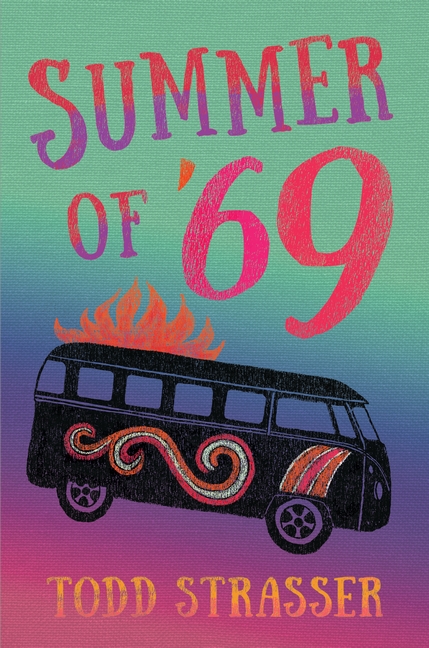
Pg. 69: Todd Strasser's "Summer of '69"

Featured at the Page 69 Test: Summer of '69 by Todd Strasser.

About the book, from the publisher:
With his girlfriend, Robin, away in Canada, eighteen-year-old Lucas Baker’s only plans for the summer are to mellow out with his friends, smoke weed, drop a tab or two, and head out in his microbus for a three-day happening called the Woodstock Music and Art Fair. But life veers dramatically off track when he suddenly finds himself in danger of being drafted and sent to fight in Vietnam. If that isn’t heavy enough, there’s also the free-loving (and undeniably alluring) Tinsley, who seems determined to test Lucas’s resolve to stay faithful to Robin; a frighteningly bad trip at a Led Zeppelin concert; a run-in with an angry motorcycle gang; parents who appear headed for a divorce; and a friend on the front lines in ’Nam who’s in mortal danger of not making it back. As the pressures grow, it’s not long before Lucas finds himself knocked so far down, it’s starting to look like up to him. When tuning in, turning on, and dropping out is no longer enough, what else is there?

Drawing from his teenage years, Todd Strasser’s novel revisits a tumultuous era and takes readers on a psychedelically tinged trip of a lifetime.
Visit Todd Strasser's website.

My Book, The Movie: Summer of '69.

Writers Read: Todd Strasser.

The Page 69 Test: Summer of '69.

--Marshal Zeringue

Thirteen books that every hippie read

Jeff Tamarkin is the author of Got a Revolution! The Turbulent Flight of Jefferson Airplane. He is also the co-author of Shell Shocked: My Life with the Turtles, Flo and Eddie, and Frank Zappa, etc., with Howard Kaylan. At Best Classic Bands he tagged thirteen books that every hippie owned, including:
Zen and the Art of Motorcycle Maintenance

You didn’t need to own (or even know how to ride) a motorcycle to appreciate Robert M. Pirsig’s “fictionalized autobiography” that recounted a 17-day bike journey from Minnesota to California. The book was quite philosophical in its approach and spoke of values and “quality”—it questioned, basically, how we choose to live, what truth is and the “art of rationality,” all under the umbrella of the road trip the author took with his son.
Read about another entry on the list.

Zen and the Art of Motorcycle Maintenance appears on Jeff Somers's list of five top books written by authors in the grip of mental illnessthe Telegraph's critics' list of the fifty best cult books, Michael Palin's six best books list, John Mullan's list of ten of the best motorbikes in literature, and Sebastian Beaumont's top ten list of books about psychological journeys.

--Marshal Zeringue

Saturday, May 04, 2019

What is Caitlin Starling reading?

Featured at Writers Read: Caitlin Starling, author of The Luminous Dead: A Novel.

Her entry begins:
I just finished Kameron Hurley’s (frankly astounding) The Light Brigade. It’s about the horrors of war and capitalism, the malleability of perception, time, and causality, and (ultimately) hope for a better future. It is brutal and incisive and glorious and painful, and I want everybody who is...[read on]
About The Luminous Dead, from the publisher:
A thrilling, atmospheric debut with the intensive drive of The Martian and Gravity and the creeping dread of Annihilation, in which a caver on a foreign planet finds herself on a terrifying psychological and emotional journey for survival.

When Gyre Price lied her way into this expedition, she thought she’d be mapping mineral deposits, and that her biggest problems would be cave collapses and gear malfunctions. She also thought that the fat paycheck—enough to get her off-planet and on the trail of her mother—meant she’d get a skilled surface team, monitoring her suit and environment, keeping her safe. Keeping her sane.

Instead, she got Em.

Em sees nothing wrong with controlling Gyre’s body with drugs or withholding critical information to “ensure the smooth operation” of her expedition. Em knows all about Gyre’s falsified credentials, and has no qualms using them as a leash—and a lash. And Em has secrets, too...

As Gyre descends, little inconsistencies—missing supplies, unexpected changes in the route, and, worst of all, shifts in Em’s motivations—drive her out of her depths. Lost and disoriented, Gyre finds her sense of control giving way to paranoia and anger. On her own in this mysterious, deadly place, surrounded by darkness and the unknown, Gyre must overcome more than just the dangerous terrain and the Tunneler which calls underground its home if she wants to make it out alive—she must confront the ghosts in her own head.

But how come she can’t shake the feeling she’s being followed?
Visit Caitlin Starling's website.

The Page 69 Test: The Luminous Dead.

Writers Read: Caitlin Starling.

--Marshal Zeringue

Pg. 99: John Owen Havard's "Disaffected Parties"

Featured at the Page 99 Test: Disaffected Parties: Political Estrangement and the Making of English Literature, 1760-1830 by John Owen Havard.

About the book, from the publisher:
Disaffected Parties reveals how alienation from politics effected crucial changes to the shape and status of literary form. Recovering the earliest expressions of grumbling, irritability, and cynicism towards politics, this study asks how unsettled partisan legacies converged with more recent discontents to forge a seminal period in the making of English literature, and thereby poses wide-ranging questions about the lines between politics and aesthetics. Reading works including Laurence Sterne's Tristram Shandy, James Boswell's Life of Johnson, the novels of Maria Edgeworth and Jane Austen, and the satirical poetry of Lord Byron in tandem with print culture and partisan activity, this book shows how these writings remained animated by disaffected impulses and recalcitrant energies at odds with available party positions and emerging governmental norms—even as they sought to imagine perspectives that looked beyond the divided political world altogether.

'No one can be more sick of-or indifferent to politics than I am' Lord Byron wrote in 1820. Between the later eighteenth century and the Romantic age, disaffected political attitudes acquired increasingly familiar shapes. Yet this was also a period of ferment in which unrest associated with the global age of revolutions (including a dynamic transatlantic opposition movement) collided with often inchoate assemblages of parties and constituencies. As writers adopted increasingly emphatic removes from the political arena and cultivated familiar stances of cynicism, detachment, and retreat, their estrangement also promised to loop back into political engagement-and to make their works 'parties' all their own.
Learn more about Disaffected Parties at the Oxford University Press website.

The Page 99 Test: Disaffected Parties.

--Marshal Zeringue

Ten books in which the narrator isn't the main character

Juliet Grames's new novel is The Seven or Eight Deaths of Stella Fortuna.

At Publishers Weekly she writes:
Many—maybe even most—of my favorite books are novels narrated by an observer who does not consider themselves the main actor in the story. Think Nick Carraway, Jay Gatsby’s sort-of friend, the perfect mournfully sardonic narrator for one of American literature’s most enduring novels. I love stories told by the supposedly innocent bystander; the less charismatic best friend; the hapless fan or scholar whose own life recedes in the shadow of their subject of adoration.
Grames tagged ten favorite books in which the narrator isn't the main character, including:
Snow Flower and the Secret Fan by Lisa See

This 2005 novel hits heavy on one of my favorite themes: remorse. Its 80-year-old narrator, Lily, reveals how the story of her own long life has been framed by that of her long-lost best friend, Snow Flower, and how she let her obsession with their friendship ruin both their lives.
Read about another entry on the list.

--Marshal Zeringue

Friday, May 03, 2019

Pg. 69: Kristin Fields's "A Lily in the Light"

Featured at the Page 69 Test: A Lily in the Light by Kristin Fields.

About the book, from the publisher:
A harrowing debut novel of a tragic disappearance and one sister’s journey through the trauma that has shaped her life.

For eleven-year-old Esme, ballet is everything—until her four-year-old sister, Lily, vanishes without a trace and nothing is certain anymore. People Esme has known her whole life suddenly become suspects, each new one hitting closer to home than the last.

Unable to cope, Esme escapes the nightmare that is her new reality when she receives an invitation to join an elite ballet academy in San Francisco. Desperate to leave behind her chaotic, broken family and the mystery surrounding Lily’s disappearance, Esme accepts.

Eight years later, Esme is up for her big break: her first principal role in Paris. But a call from her older sister shatters the protective world she has built for herself, forcing her to revisit the tragedy she’s run from for so long. Will her family finally have the answers they’ve been waiting for? And can Esme confront the pain that shaped her childhood, or will the darkness follow her into the spotlight?
Visit Kristin Fields's website.

The Page 69 Test: A Lily in the Light.

--Marshal Zeringue

What is Todd Strasser reading?

Featured at Writers Read: Todd Strasser, author of Summer of '69.

His entry begins:
The Library Book by Susan Orlean. This is a remarkable book about an unremarkable subject, a library. More specifically, the Los Angeles Public Library. Orlean has an uncanny ability to make just about anything she writes about feel fascinating. Her description of the fire that damaged or destroyed nearly a million items is utterly...[read on]
About Summer of '69, from the publisher:
With his girlfriend, Robin, away in Canada, eighteen-year-old Lucas Baker’s only plans for the summer are to mellow out with his friends, smoke weed, drop a tab or two, and head out in his microbus for a three-day happening called the Woodstock Music and Art Fair. But life veers dramatically off track when he suddenly finds himself in danger of being drafted and sent to fight in Vietnam. If that isn’t heavy enough, there’s also the free-loving (and undeniably alluring) Tinsley, who seems determined to test Lucas’s resolve to stay faithful to Robin; a frighteningly bad trip at a Led Zeppelin concert; a run-in with an angry motorcycle gang; parents who appear headed for a divorce; and a friend on the front lines in ’Nam who’s in mortal danger of not making it back. As the pressures grow, it’s not long before Lucas finds himself knocked so far down, it’s starting to look like up to him. When tuning in, turning on, and dropping out is no longer enough, what else is there?

Drawing from his teenage years, Todd Strasser’s novel revisits a tumultuous era and takes readers on a psychedelically tinged trip of a lifetime.
Visit Todd Strasser's website.

My Book, The Movie: Summer of '69.

Writers Read: Todd Strasser.

--Marshal Zeringue

Six of the best fictional vacations

Chip Cheek's new novel is Cape May.

At LitHub he tagged six favorite fictional vacations, including:
Christopher Castellani, Leading Men

Much of the action of Christopher Castellani’s latest novel, which centers on the real-life relationship between Tennessee Williams and Frank Merlo, involves the hijinks of glamorous writers and filmmakers as they gallivant around the Italian Riviera. We follow them to a party thrown by Truman Capote in Portofino; we frolic with them in the Ligurian Sea; we narrowly escape with them from a pack of feral youths; we see one of them, the writer John Horne Burns, succumb to a strange illness and die. Throughout these scenes, a powerful source of tension comes from the fact that we’re getting the story primarily from Frank Merlo’s perspective—the perspective of an average man attached to a legendary playwright, subject to the great man’s whims and mood swings. It’s a glamorous life Frank is leading, a free-flowing, never-ending vacation of sorts, but he’s trapped in it, without any power over its direction, and the consequences reverberate across the decades. This is a sweeping, rapturously beautiful novel.
Read about another entry on the list.

--Marshal Zeringue

Thursday, May 02, 2019

Pg. 99: Anja Shortland's "Kidnap: Inside the Ransom Business"

Featured at the Page 99 Test: Kidnap: Inside the Ransom Business by Anja Shortland.

About the book, from the publisher:
Kidnap for ransom is a lucrative but tricky business. Millions of people live, travel, and work in areas with significant kidnap risks, yet kidnaps of foreign workers, local VIPs, and tourists are surprisingly rare and the vast majority of abductions are peacefully resolved - often for remarkably low ransoms. In fact, the market for hostages is so well ordered that the crime is insurable. This is a puzzle: ransoming a hostage is the world's most precarious trade. What would be the "right" price for your loved one - and can you avoid putting others at risk by paying it? What prevents criminals from maltreating hostages? How do you (safely) pay a ransom? And why would kidnappers release a potential future witness after receiving their money?

Kidnap: Inside the Ransom Business uncovers how a group of insurers at Lloyd's of London have solved these thorny problems for their customers. Based on interviews with industry insiders (from both sides), as well as hostage stakeholders, it uncovers an intricate and powerful private governance system ordering transactions between the legal and the criminal economies.
Learn more about Kidnap: Inside the Ransom Business at the Oxford University Press website.

The Page 99 Test: Kidnap: Inside the Ransom Business.

--Marshal Zeringue

Ten doomed romances of noir

Vincent Zandri is the New York Times and USA Today bestselling author of The Caretaker’s Wife, Orchard Grove, and The Remains.

At CrimeReads he tagged ten affairs that went terribly wrong in true noir fashion. One title on the list:
Best Day Ever by Kaira Rouda

Think you’ve got the perfect marriage? The perfect kids? The perfect life? Those are the questions posed by this novel’s narrator Paul Strom, an uber advertising exec who decides to treat his seemingly adoring wife, Mia, to their best day ever. But they hardly get out of the driveway before things start unravelling. By the time darkness starts to set, you begin to see what a nightmare their marriage really is.
Read about another entry on the list.

--Marshal Zeringue

Pg. 69: Caitlin Starling's "The Luminous Dead"

Featured at the Page 69 Test: The Luminous Dead: A Novel by Caitlin Starling.

About the book, from the publisher:
A thrilling, atmospheric debut with the intensive drive of The Martian and Gravity and the creeping dread of Annihilation, in which a caver on a foreign planet finds herself on a terrifying psychological and emotional journey for survival.

When Gyre Price lied her way into this expedition, she thought she’d be mapping mineral deposits, and that her biggest problems would be cave collapses and gear malfunctions. She also thought that the fat paycheck—enough to get her off-planet and on the trail of her mother—meant she’d get a skilled surface team, monitoring her suit and environment, keeping her safe. Keeping her sane.

Instead, she got Em.

Em sees nothing wrong with controlling Gyre’s body with drugs or withholding critical information to “ensure the smooth operation” of her expedition. Em knows all about Gyre’s falsified credentials, and has no qualms using them as a leash—and a lash. And Em has secrets, too...

As Gyre descends, little inconsistencies—missing supplies, unexpected changes in the route, and, worst of all, shifts in Em’s motivations—drive her out of her depths. Lost and disoriented, Gyre finds her sense of control giving way to paranoia and anger. On her own in this mysterious, deadly place, surrounded by darkness and the unknown, Gyre must overcome more than just the dangerous terrain and the Tunneler which calls underground its home if she wants to make it out alive—she must confront the ghosts in her own head.

But how come she can’t shake the feeling she’s being followed?
Visit Caitlin Starling's website.

The Page 69 Test: The Luminous Dead.

--Marshal Zeringue

Wednesday, May 01, 2019

Top ten books about psychotherapy

Bev Thomas was a clinical psychologist in Britain's NHS for many years. She currently works as an organizational consultant in mental health and other services. She lives in London with her family.

About her new novel, A Good Enough Mother, in a starred review from Publishers Weekly: “[An] exceptional debut... Thomas melds astute psychological insight with powerful storytelling in this moving thriller.”

At the Guardian, Thomas tagged her top ten books about psychotherapy, including:
Regeneration by Pat Barker

Set during the first world war, the role of the conflicted real-life protagonist Dr Rivers is to help shell-shocked soldiers recover enough mental fitness to return to the frontline. While Rivers, in his work with characters such as Siegfried Sassoon and Wilfred Owen, uses his pioneering treatment to contain the feelings associated with trauma, so he changes his own views about the war. An illustration of how the therapist might learn from the client and be transformed by the process.
Read about another entry on the list.

Regeneration is among Daniel Mason's ten top novels about the First World War, Elizabeth Lowry's top ten books about psychiatry, Phil Klay's top ten books about returning from war, Sarah Moss's top ten hospital novels, and Hermione Norris's six best books. The Regeneration Trilogy is on William Skidelsky's list of the 10 best historical novels.

--Marshal Zeringue

Pg. 99: Lindsey N. Kingston's "Fully Human"

Featured at the Page 99 Test: Fully Human: Personhood, Citizenship, and Rights by Lindsey N. Kingston.

About the book, from the publisher:
Citizenship within our current international system signifies being fully human, or being worthy of fundamental human rights. For some vulnerable groups, however, this form of political membership is limited or missing entirely, and they face human rights challenges despite a prevalence of international human rights law. These protection gaps are central to hierarchies of personhood, or inequalities that render some people more "worthy" than others for protections and political membership.

As a remedy, Lindsey N. Kingston proposes the ideal of "functioning citizenship," which requires an active and mutually-beneficial relationship between the state and the individual and necessitates the opening of political space for those who cannot be neatly categorized. It signifies membership in a political community, in which citizens support their government while enjoying the protections and services associated with their privileged legal status. At the same time, an inclusive understanding of functioning citizenship also acknowledges that political membership cannot always be limited by the borders of the state or proven with a passport. Fully Human builds its theory by looking at several hierarchies of personhood, from the stateless to the forcibly displaced, migrants, nomadic peoples, indigenous nations, and "second class" citizens in the United States. It challenges the binary between citizen and noncitizen, arguing that rights are routinely violated in the space between the two. By recognizing these realities, we uncover limitations built into our current international system--but also begin to envision a path toward the realization of human rights norms founded on universality and inalienability. The ideal of functioning citizenship acknowledges the persistent power of the state, yet it does not rely solely on traditional conceptions of citizenship that have proven too flawed and limited for securing true rights protection.
Learn more about Fully Human at the Oxford University Press website.

The Page 99 Test: Fully Human.

--Marshal Zeringue

Five top books to help you think like a visual artist

Myla Goldberg is the bestselling author of Feast Your Eyes, The False Friend, Wickett’s Remedy, and Bee Season, which was a New York Times Notable Book, winner of the Borders New Voices Prize, and a finalist for the Hemingway Foundation/PEN award, the NYPL Young Lions award, and the Barnes & Noble Discover award. It was adapted to film and widely translated. In addition to her novels, she has written an essay collection, a children’s book, and short stories that have appeared in Harper’s.

At LitHub Goldberg tagged five books to help you think like a visual artist, including:
Julio Cortázar, Blow-Up: And Other Stories

Cortazar changed the title of this short story after Antonioni adapted it for his famous movie, which (surprise) bears very little resemblance to what Cortazar wrote. Reading it puts you inside the mind of a photographer—finely attuned to the details of his camera, his environment, and his craft—who has captured something unsettling on film and grapples with what he’s discovered. Spoiler alert: the discovery in the story is more interesting and subtle than the one in the film version, though both versions address an issue of consent once relegated to street photography, which is now relevant to anyone with a cellphone: When is it okay to take someone’s picture?
Read about another entry on the list.

--Marshal Zeringue

What is August Norman reading?

Featured at Writers Read: August Norman, author of Come and Get Me: A Caitlin Bergman Novel.

From his entry:
In the world of crime fiction, I gobbled up Lisa Brackmann’s Black Swan. Readers who love a good thriller, not just plucked from the headlines, but predicted from current events, should get a copy now.

I started with the fifth book in Gwen Florio’s Lola Wicks mystery series, Under the Shadows, and...[read on]
About Come and Get Me, from the publisher:
At Indiana University, someone’s been studying the female student body: their dating customs, nocturnal activities—and how long they can survive in captivity.

When award-winning journalist Caitlin Bergman is invited back to campus to receive an honorary degree, she finds an opportunity for a well-earned victory lap—and a chance to face the trauma that almost destroyed her as an undergrad. But her lap becomes an all-out race when a student begs her to probe an unsolved campus disappearance: Angela Chapman went out one Friday night and never came back.

To find the missing woman, Caitlin must join forces with a local police detective and the department that botched her own case so long ago. But while Caitlin follows the clues behind Angela’s disappearance, someone else is following her…

Unearthing secrets hidden beneath an idyllic Midwestern college town, Caitlin must expose what really happened to Angela—before she herself becomes the newest addition to a twisted collection
Visit August Norman's website.

The Page 69 Test: Come and Get Me.

Writers Read: August Norman.

--Marshal Zeringue