Saturday, June 24, 2006

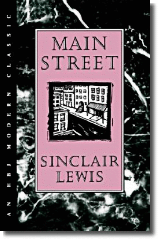
Sinclair Lewis's "Main Street"

The latest installment from Jane Smiley's Thirteen Ways of Looking at the Novel takes up Sinclair Lewis's Main Street; see here, here, here, here, here, here, here, here, and here for previous entries.

It has been a very long time since I--or anyone I know--has read any Lewis, yet Smiley suggests we may soon see some wider general interest in his work.
Sinclair Lewis may be ripe for a revival; his books raise several interesting issues of art and fashion. Main Street is his most famous book, though certain critics prefer Babbitt as a better novel. Main Street was a tremendous bestseller, published when Lewis was 35, and cited by the Nobel Prize committee as a major reason he was given the Nobel in 1930. Main Street is the story of Carol Kennicott, who graduates from a small women's college in the first chapter of the novel with rather vague aspirations to achieve something or reform something. After a reasonably long (but not very enlightening) courtship, she marries small-town doctor Will Kennicott and moves with him to Gopher Prairie, Minnesota (based on Lewis's hometown of Sauk Centre). She is immediately dissatisfied with the town and her life there, and the rather episodic novel traces the simultaneous evolution of her marriage, her life in Gopher Prairie, and the passing of her youth.

The novel is rather like a Bildungs-roman in that it describes the education of a young person through a series of trials, but Carol's is a domestic education, and it is hard to decide whether she grows or is simply overcome. In the end, under some protest, she manages to agree to life in Gopher Prairie, but not quite accept it.

I'm less confident than Smiley that Lewis will find a new audience very soon, mainly for reasons she outlines herself:

He manages to be intelligent and interesting and even hopeful; his characters are well-drawn and lively. But his plots meander and his tone is unclear. His novels aren't well-made wholes, but nor are they shambling stylistic charmers. In their time, they dealt with issues that Americans wanted to read about--small-town life, the mind of the businessman, revivalist religion--but when those issues seemed to fade in importance, so did Lewis's reputation.

Lewis adhered to a strongly felt social theory that was basically leftist, and he wrote at a time when almost all writers were required to declare their allegiance to the right or the left, at least in America. In Main Street, Lewis's loyalties sometimes come across as simply a democratic sensibility, and therefore aesthetically acceptable, and sometimes as an outmoded and false-seeming programme for building the utopia of the future. No novelist can quite escape the social theories of his time, and in fact must be drawn to them, because the novel is social investigation. So to some extend the reputation of every novelist will rise and fall according to how his social theory holds up.

Click here to read the entire Smiley argument.

--Marshal Zeringue

Friday, June 23, 2006

Stephen King's best books of 2005

I just came across "Stephen King's best books of 2005" list. Amazingly, I've not only read seven of the books he names, but at least six of them made my own top ten lists of 2004 and 2005.

His number one pick for 2005 was my number one pick of 2004.

I write that this broad concurrence is amazing not because I would guess that King and I should have strikingly similar taste (or clearly divergent tastes) but because I've compared favorite books lists with people whose taste is somewhat similar and we rarely have much overlap.

Looking forward, will my best books of 2006 list look a lot like Stephen King's?

Perhaps; on the one hand, we both loved this book.

On the other hand, I recently read a book whose cover featured the Stephen King blurb, "One of the best books I've read in a long, long time." (I didn't know of this opinion/blurb when I decided to read the book.) Enjoyable, yes, but it probably will not make my 2006 top ten list.

--Marshal Zeringue

Thursday, June 22, 2006

The Village Voice's best beach books

The Village Voice rounded up a few suggestions for what books one might pack before boarding the jitney for the Hamptons.

Here are only two of the recommendations:
Double Fault By Lionel Shriver

Photographed kissing the phallic statuette she received when We Need to Talk About Kevin won the 2005 Orange Prize, Shriver wore a look of satisfaction so intense as to verge on impropriety. Now Serpent's Tail has reissued Shriver's 1997 Double Fault, an utterly compelling tale of love and envy in which Willy (short for Wilhelmina) and Eric meet on a Riverside Park court, fall in love, and marry without adequately comprehending the damage their changing national rankings will wreak on this union between two deeply competitive professional tennis players. The short span of an athlete's career means that Willy at 23 considers herself already middle-aged, and a devastating knee injury proves impossible to overcome. Fortunately, making one's mark as a novelist is not subject to the same physiological constraints. Jenny Davidson

The Eagle's Throne By Carlos Fuentes Translated by Kristina Cordero

In Fuentes's 15th novel, which takes place in the year 2020, Condoleezza Rice, the U.S. president, has blocked Mexico's access to phone, fax, and e-mail. Delirious and overexcited, the country's most influential men—controlled by seductive women who urge them to be ruthless—are forced to leave a written trail of their indiscretions. In a series of hysterical letters referencing Susan Sontag, Mission Impossible, and Hitler, they all scheme to be the next president. These charmingly sleazy characters take much more pleasure in work than sex: Flirty games and betrayals are mere warm-up for the "prolonged orgasm" of political sway. Rachel Aviv

Those two picks don't tickle your fancy? There are a dozen or so more recommendations from the Voice: click here to read them.

Read about Shriver's Orange Prize--and see her above mentioned kiss--here. And click here to learn about the 2006 winner of the Orange Prize.

About the Orange Prize: Do women really deserve a book prize of their own?

Viv Groskop praised Double Fault--it "is not a novel about tennis or rivalry; it's about love, marriage and the balance of power in relationships"--in the Guardian here.

Earlier this year Deborah Solomon of the New York Times Magazine asked Carlos Fuentes, "How do you explain the public's fascination with [Condi Rice]?" His answer:
She is intelligent. She dresses well. She is capable of nuance. She seems to have something more behind her facade than one would suspect. She has better legs than Bush. And I know what his legs look like because I have seen him falling off a bicycle in shorts.
Yvonne Zipp reviewed The Eagle's Throne here. Tina Rosenberg reviewed it for Slate here.

--Marshal Zeringue
Monica Ali's ten favorite books

Monica Ali, wrote Ron Charles in the Christian Science Monitor in 2003, was

having one of those years that will encourage the fantasies of a million unpublished writers. Several months before her first book was published, Granta magazine included her in this decade's list of the best 20 young authors in England. The appearance of an actual book did nothing to quell that premature enthusiasm. In fact, Brick Lane rose to the British bestseller list ... and was included in the Man Booker Prize shortlist. Its arrival in America looks equally auspicious. But there's a risk of crushing this sensitive novel beneath a press of praise, like inciting a mob to pick fresh raspberries.

British critics have called her the next Zadie Smith, presumably because they're both young, nonwhite females who blasted onto the literary scene with Booker-nominated bestsellers about immigrant culture in London. But Ali displays none of Smith's pyrotechnics or her sprawling scope and scale. Biology aside, a better comparison would be with Anita Brookner, that non-young, blisteringly white matron of British fiction whose quiet incisive novels scrutinize the plight of lonely people.

The genius of Brick Lane lies in Ali's ability to make the peculiar universal while making what's familiar comically odd. Though it's a distinctly interior novel, the larger world resonates all along the edges with discordant strains of political and cultural disruption.

Read more of Ron Charles' review here.

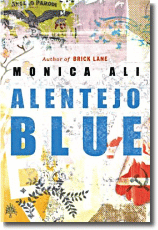
Ali's most recent book is Alentejo Blue (2006).

Sometime back she shared her ten favorite books (on that particular day, anyway) with Barnes and Noble. Here are half of her titles:

Emma by Jane Austen -- A favorite from my school days, and it would always hold its place my heart. Austen's characters are always devastatingly good, and Emma is, for me, her best creation.

A House for Mr Biswas by V. S. Naipaul -- His masterpiece. I love the blend of comedy and tragedy, and every time I read it, I ache afresh for Biswas.

A Confederacy of Dunces by John Kennedy Toole -- The author committed suicide after failing to find a publisher for this book, which went on to win the Pulitzer after his mother persevered in getting the book into print. It is the funniest book I have ever read.

A Gesture Life by Chang-rae Lee -- I picked this up from a bookshop display, knowing nothing about it, and bought it on a whim. I started it on the train on the way home and then read it through the night. Lee's beautiful, understated prose is so finely controlled it makes me want to cry with envy.

Lolita by Vladimir Nabokov -- Scarcely need to explain this one.

Click here to read Ali's other five titles as well as an account of The Bell by Iris Murdoch, the book that Ali says most influenced her life.

--Marshal Zeringue

Wednesday, June 21, 2006

"McSweeney's Recommends"

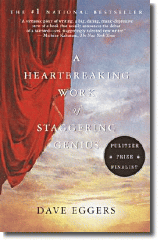
McSweeney's Internet Tendency is an offshoot of a multimedia publishing project started by Dave Eggers, author of You Shall Know Our Velocity and A Heartbreaking Work of Staggering Genius.

There are various features at the site worth checking out, so check it out.

One feature is "McSweeney's Recommends," where they recommend "many different kinds of things, from films to hairstyles, all of which have been researched, tested, and submitted to a month-long stay at a resort for people who appreciate the finer things in life, before finally being voted on in a democratic manner resembling that of our forefathers."

Here are some of the books and writers recently recommended:
"Discovering" a writer who has already published a bunch of books
We recently became acquainted with the work of Eric Kraft, who is highly recommended, but what makes it even better is that he's published like 10 books, none of which we've read, which means we're pretty much guaranteed a bunch of great reads in the coming months. Same thing happened with Steven Millhauser a few years ago.

U.S.! by Chris Bachelder
Mr. Bachelder is a friend, so take this recommendation for what you will, but his new novel, U.S.!, centered around a perpetually reanimating Upton Sinclair, could be the best book we've read this year.

Staring at Sound: The True Story of Oklahoma's Fabulous Flaming Lips by Jim DeRogatis
Really just recommended for fans (or maybe fanatics) of the Lips, but if you are a fan, this book is great fun.

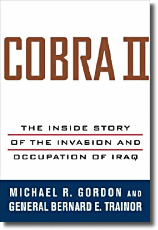
Cobra II by Michael Gordon and General Bernard Trainor
A "contemporary history" of the planning and execution of the Iraq war. Resolutely nonpartisan (the back blurbs for a previous book by the same authors come from Dick Cheney and Clinton cabinet member William Cohen). Basically proves that the fucked-up situation was caused by Donald Rumsfeld and Tommy Franks's piss-poor management and the complicity of Vice President Cheney and President Bush. Also demonstrates that the actual soldiers who see combat are incredibly brave, flexible, and intelligent. If we'd listened to them, the country wouldn't still be in this God-awful mess.

Anything written by Michael Ruhlman
We previously recommended his book Walk on Water, which is about an elite pediatric surgical unit. We've since read more of his books and they're all good. Even when you think you might have no interest in the subject, it turns out you do.

Click here to read chapter one of Dave Eggers' A Heartbreaking Work of Staggering Genius.

--Marshal Zeringue
Dennis Lehane's summer reading

Last month USA Today asked a few writers--including Stephen King, Jodi Picoult, Sophie Kinsella, Andy Borowitz, and others--what they were reading this summer.

Click here to review the entire list.

Here are Dennis Lehane's picks:

Smonk by Tom Franklin: "Franklin writes like an archangel on a crank binge. I've waited three years for his follow-up to Hell at the Breech so I'm pretty geeked up for this one."

Winter's Bone by Daniel Woodrell: "Woodrell is the least-known major writer in the country right now. I don't even know what this novel's about, but I'm going to buy it the day it's published."

Haven't read Lehane's Mystic River yet? Put it on your summer reading list--at the top of your list.

--Marshal Zeringue
Tuesday, June 20, 2006

Fiction and futbol

Today's Boston Globe contains an article by Mark Feeney on soccer on page and screen.

The soccer fan's bible is Nick Hornby's Fever Pitch. (Yes, through the miracle of Hollywood transformation it inspired last year's Red Sox movie.) But the foremost author with a soccer lineage is no less a figure than Vladimir Nabokov , who has a soccer match figure in his novel Glory, and a soccer ball in his novel Pnin. Nabokov came by his soccer the hard way: As an undergraduate at Cambridge, he played goalie for his Trinity College team.

"I was crazy about goal keeping," he wrote in his memoirs, Speak, Memory. The goalie, he declared, "is the lone eagle, the man of mystery, the last defender." He is also an ideal existential symbol, a fact Peter Handke exploited in his novel The Goalie's Anxiety at the Penalty Kick, which Wim Wenders made into a film.

To read the entire article, click here.

To read an excerpt from Fever Pitch, click here.

--Marshal Zeringue
What book would you save for last?

In the season finale of season two of Lost, the character Desmond says he carries around Charles Dickens' Our Mutual Friend because he wants that to be the last book he reads before dying.

As with much else on Lost, there's (apparently) more to that story. But I won't know just what that is until after the DVD comes out. If you are current with the show, click here for a New York Times story that delves into the matter.

The Chicago Tribune asked three of its writers what their last book would be. Charles Storch's choice:
Pale Fire, by Vladimir Nabokov. I was unhorsed in my first sally at this novel many years ago. It has a dual structure: the final poem by Charles Shade, a Robert Frost-like figure; and the long and loony commentary on the poem that follows by Shade's neighbor Charles Kinbote, formerly of the Kingdom of Zembla. But did the same character write both parts? Is Kinbote really the king of Zembla or is he a figment of a third character's imagination? Had I taken more care with the text and paid more respect to Nabokov's intelligence, perhaps I might have had a clue. Maybe I will go out with the answer.
Click here to read the other two selections.

Our Mutual Friend is available for free online: click here or here to read it.

The opening paragraph:
In these times of ours, though concerning the exact year there is no need to be precise, a boat of dirty and disreputable appearance, with two figures in it, floated on the Thames, between Southwark bridge which is of iron, and London Bridge which is of stone, as an autumn evening was closing in.
--Marshal Zeringue
Monday, June 19, 2006

William Golding's last night on earth

On this date thirteen years ago William Golding died. Click here to read a brief account of his life and work.

The writer D.M. Thomas attended a party at the home of William Golding on the night the Nobel laureate died.

The two were not close friends, the cause of death was not scandalous (Golding was eighty-two with a heart condition), and no deep personal secrets or astounding insights about the world were revealed that evening. Golding had taken care of the latter with Lord of the Flies, the theme of which he later said was (if memory serves) , "grief, sheer grief, grief, grief."

I don't know Thomas's work--his best known book is The White Hotel (1981)--but the short article he wrote about his time at the Golding house the night the famous man died is worth reading. Click here to read it.

In the presentation speech for Golding's 1983 Nobel prize, Professor Lars Gyllensten of the Swedish Academy noted that Golding once wrote: "I must say that anyone who moved through those years without understanding that man produces evil as a bee produces honey, must have been blind or wrong in the head."

Yet in his own acceptance speech, Golding spoke differently: "Critics have dug into my books until they could come up with something hopeless. I can't think why. I don't feel hopeless myself.... I am a universal pessimist but a cosmic optimist." He died a decade later.

--Marshal Zeringue
"Sometimes in literature you go on playing long after the game's over..."

On Saturday I exploited Nick Hornby's obsession to link books and soccer. Today, there's a delightful passage from the Berliner Zeitung excerpted and translated at signandsight.com:

Berlin-based Hungarian author Laszlo Darvasi reflects on the Brazilians' love for the irrational element in football and the correlation with writing. "If there's one difference between literature and football, it's that with football, it's clear who's won, and how. Sometimes, it's true, we don't fully understand how the victory came about, but there's always the scoreboard there for orientation. Sometimes in literature you go on playing long after the game's over, and you don't even notice that the grandstands are as empty as a huge forlorn heart. You go on playing even though you've lost ages ago. Or won. In Germany, the novelist Sandor Marai is a player like that. A character of Salman Rushdie's once commented that the most important events of our lives always take place in our absence. Try imagining that in football."
If you read German, click here to read the entire article.

Earlier this year Anja Seeliger, an editor at signandsight.com, was very helpful with the blog's search for German crime thrillers.

Not interested in soccer but love "The Simpsons?" Click here.

--Marshal Zeringue
Sunday, June 18, 2006

Scott Turow's favorite novels set in the legal world

Scott Turow is no stranger to the blog. Earlier this year he recommended a book for our series on what's at stake in the debate over habeas corpus: to see the title and author of his suggestion, click here.

In Opinion Journal this weekend he shared his five favorite modern novels set in the legal world.

Number one:

Anatomy of a Murder by Robert Traver (1958).

This is the ur-book for much contemporary legal fiction. Traver was the pseudonym for John Voelker, who was sitting as a justice of the Michigan Supreme Court when his novel about a murder trial in the iron-ore country of the Upper Peninsula of Michigan took America by storm. An experienced criminal trial lawyer, Voelker took a new approach to writing about the courtroom, eschewing the melodrama of Perry Mason or the portentousness of the classics in which every case was foremost a symbol for Justice. Voelker contented himself with the workaday details of a trial, believing that the law's very atmosphere of restraint would enhance the essential drama. His narrator, Paul Biegler, is a former prosecutor taking on his first defense. Paul's unsympathetic client is U.S. Army Lt. Frederic Manion, the killer of bar owner Barney Quill, who may or may not have raped Manion's sultry wife. The subject matter was torrid in 1958, but the novel's straightforward approach stands up, and the book still echoes on every page with the authority of a world fully known.

Click here to read about his other selections.

Turow's most recent book, Ordinary Heroes (Farrar, Straus and Giroux), was published in November.

Alan Furst wrote of Ordinary Heroes:

Ordinary Heroes is a beautifully wrought, finely achieved reconstruction of an elusive, a clandestine life--a World War II life, as it happens--by Scott Turow at the very top of his form. So, be warned, a book to start on Friday night."
What are Scott Turow's favorite beach books this summer? Click here to find out.

Everyone I know has an opinion on the death penalty, but Turow seems to have thought about the subject more than most and, unlike many people, has changed his mind about it. To read how he came to terms with capital punishment, click here.

--Marshal Zeringue

Saturday, June 17, 2006

Nick Hornby's "Fever Pitch"

(UPDATED 6:17 PM: see bottom of message)

In honor of the 2006 World Cup, an excerpt from Nick Hornby's delightful Fever Pitch:

I have learned things from the game. Much of my knowledge of locations in Britain and Europe comes not from school, but from away games or the sports pages, and hooliganism has given me both a taste for sociology and a degree of fieldwork experience. I have learned the value of investing time and emotion in things I cannot control, and of belonging to a community whose aspirations I share completely and uncritically. And on my first visit to Selhurst Park with my friend Frog, I saw a dead body, still my first, and learned a little bit about, well, life itself.

As we walked towards the railway station after the game, we saw the man lying in the road, partially covered by a raincoat, a purple-and-blue Palace scarf around his neck. Another younger man was crouched over him, and the two of us crossed the road and went to have a look. 'Is he all right?' Frog asked. The man shook his head. 'No. Dead. I was just walking behind him and he keeled over.' He looked dead. He was grey and, as far as we were concerned, unimaginably motionless. We were impressed. Frog sensed a story that would interest not only the fourth year but much of the fifth as well. 'Who done him? Scousers?'

At this point the man lost patience. 'No. He's had a heart attack, you little prats. Now fuck off.' And we did, and that was the end of the incident. But it has never been very far away from me since then, my one and only image of death; it is an image which instructs. The Palace scarf, a banal and homely detail; the timing (after the game, but mid-season), the stranger paying distressed but ultimately detached attention. And, of course, the two idiotic teenagers gawping at a tiny tragedy with unembarrassed fascination, even glee.

It worries me, the prospect of dying in mid-season like that, but of course, in all probability I will die sometime between August and May. We have the naive expectation that when we go, we won't be leaving any loose ends lying around: we will have made our peace with our children, left them happy and stable, and we will have achieved more or less everything that we wanted to with our lives. It's all nonsense, of course, and football fans contemplating their own mortality know that it is all nonsense. There will be hundreds of loose ends. Maybe we will die the night before our team appears at Wembley, or the day after a European Cup first-leg match, or in the middle of a promotion campaign or a relegation battle, and there is every prospect, according to many theories about the afterlife, that we will not be able to discover the eventual outcome. The whole point about death, metaphorically speaking, is that it is almost bound to occur before the major trophies have been awarded. The man lying on the pavement would not, as Frog observed on the way home, discover whether Palace stayed up or not that season; nor that they would continue to bob up and down between the divisions over the next twenty years, that they would change their colours half a dozen times, that they would eventually reach their first FA Cup Final, or that they would end up running around with the legend 'VIRGIN' plastered all over their shirts. That's life, though.

I do not wish to die in mid-season but, on the other hand, I am one of those who would, I think, be happy to have my ashes scattered over the Highbury pitch (although I understand that there are restrictions: too many widows contact the club, and there are fears that the turf would not respond kindly to the contents of urn after urn). It would be nice to think that I could hang around inside the stadium in some form, and watch the first team one Saturday, the reserves the next; I would like to feel that my children and grandchildren will be Arsenal fans and that I could watch with them. It doesn't seem a bad way to spend eternity, and certainly I'd rather be sprinkled over the East Stand than dumped into the Atlantic or left up some mountain.

UPDATE: "The Week in Review" section of tomorrow's New York Times contains an article that suggests that even though some see a "link between national character and the ways nations have coped with defeat, the slim catalog of responses—especially to humiliating losses, or those at the hands of geopolitical rivals—probably says more about how similar people are."
The English, says the novelist Nick Hornby, author of the soccer memoir "Fever Pitch," would rather pin blame on an individual on their own team, either a manager or player (David Beckham in 1998 for committing a silly foul in front of the referee; the goalie David Seaman in 2002 for misjudging Ronaldinho's blooping shot—or was that a pass?). But in an interview Mr. Hornby said, "It's been so long since England have won anything in soccer that it feels as though real contenders come from a parallel universe England can't seem to break their way in to."
--Marshal Zeringue
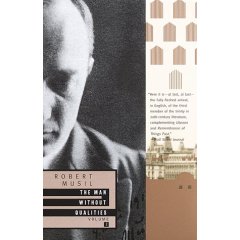
Robert Musil's "The Man without Qualities"

The Man without Qualities by Robert Musil is the subject of the latest installment from Jane Smiley's Thirteen Ways of Looking at the Novel; see here, here, here, here, here, here, here, and here for previous entries.

Smiley writes:
This is one of the most prestigious novels of the 20th century; the sort of book no one has read but everyone has heard of. It is well worth reading, even though it is very long, very slow, and was unfinished at the time of Robert Musil's death. The first volume of The Man without Qualities runs to 365 pages, and the dilemma of the protagonist, Ulrich, is presented only on about page 300. Nevertheless, the writing is so precise and the argument Musil makes about Ulrich and his situation so intricate that it is intellectually and aesthetically involving even before it becomes emotionally so.
To read the rest of Smiley's essay, click here.

--Marshal Zeringue
Friday, June 16, 2006

"Cultural cringe" and Peter Carey's "Theft"

Before I read the new Peter Carey novel I posted an item on his--and Australia's--cultural cringe. Professor Nicholas Birns and "Dutch," the blog's Australia expert, splashed some more light on the subject here and here.

I recently finished Theft--and highly recommend it--and can confirm that it will be read as a major text on the subject of "cultural cringe."

Birns says that The Unusual Life of Tristan Smith is the Carey novel which deals with this subject most explicitly, but I think he said that before reading Theft; he may reconsider.

Now I see that James Wood has taken up the topic in his review of Theft on the London Review of Books. It's a fine review, though it gives away more about the plot than I would have cared to know before reading the book.

Wood writes:
As in [My Life as a Fake], the real subject [of Theft]--Carey’s abiding subject, addressed in novel after novel--is the hoax of Australian identity, and its self-tortured relationship with the rest of the world. The narrator of Illywhacker, Herbert Badgery, is a self-confessed liar and conman who discovers, while in prison, a history of Australia by M.V. Anderson (Carey’s invention). This history, an extract from which is reproduced, seeks to expose the lie of the country’s origins:
Our forefathers were all great liars. They lied about the lands they selected and the cattle they owned. They lied about their backgrounds and the parentage of their wives. However it is their first lie that is the most impressive for being so monumental, i.e. that the continent, at the time of first settlement, was said to be occupied but not cultivated and by that simple device they were able to give the legal owners short shrift and, when they objected, to use the musket or poison flour, and to do so with a clear conscience.
That novel is much consumed with the question of Australian self-hatred. Herbert argues against the Australian ‘cringe’ towards Europe and America, the relationship of ‘a child serving a parent’. But his wife, Phoebe McGrath, rails against the mediocrity of her smalltown Geelong-Bacchus Marsh life, only to reach Sydney, where she starts a literary magazine called Malley’s Urn, a jokey homage to the famous hoax. In My Life as a Fake, the literary hoaxer, Christopher Chubb, ‘came from the dreary lower-middle-class suburbs. I would say he loathed where he came from.’ The motive for his will-to-hoax is laid at the door of this frustrated provincialism--which is to say, at the door of frustrated Australianism.
Then Wood shares this passage from Theft which leapt off the page at me when I read it, primed as I was for explicit references to cultural cringe. It is in the voice of Michael Boone, AKA "Butcher Bones," one of the two narrators, who is an Australian painter, bitterly divorced and much reduced from his once-celebrity reputation.
If you are American you will never understand what it is to be an artist on the edge of the world, to be 36 years old and get an ad in Studio International. And, no, it is in no way like being from Lubbock, Texas, or Grand Forks, North Dakota. If you are Australian you are free to argue that this cringing shit had disappeared by 1981, that history does not count, and that, in any case, we were soon to become the centre of the fucking universe, the flavour of the month, the coalition of the willing etc, but I will tell you, frankly, nothing like this had been conceivable in my lifetime.
Wood adds:
The danger with Carey’s last two books is that the distinction between exploring or dramatising the condition of Australian cultural self-hatred and rather awkwardly embodying it can look thin.... Carey...in this new novel seems, quite explicitly, to find in Butcher’s devotion to his art an analogue of his own creative drive. Like Butcher, Carey is passionately serious about his work, indentured to the highest standards. Yet he is also the son of the secondhand car dealer from Bacchus Marsh, the raw writer who used to delight in telling newspaper interviewers that he had read no books until he was 18, an Australian incapable of false aestheticism or preciousness, devoted to the hygienic stringencies of scepticism and year-round bullshit-detection.
Click here to listen to an interview with Peter Carey.

For more information on Carey and his work, click here.

--Marshal Zeringue
Thursday, June 15, 2006

Donald Hall interview

Donald Hall, the new poet laureate, sat for an interview with The Paris Review. (Actually, he sat for three separate interviews, published as one in 1991.) It's wonderful stuff: click here to read the entire interview.

Hall talks about how he became a poet, how encouragement--and discouragement--shaped his poetry in high school, and offers a brief warts-and-all portrait of Robert Frost, with whom he is sometimes compared.

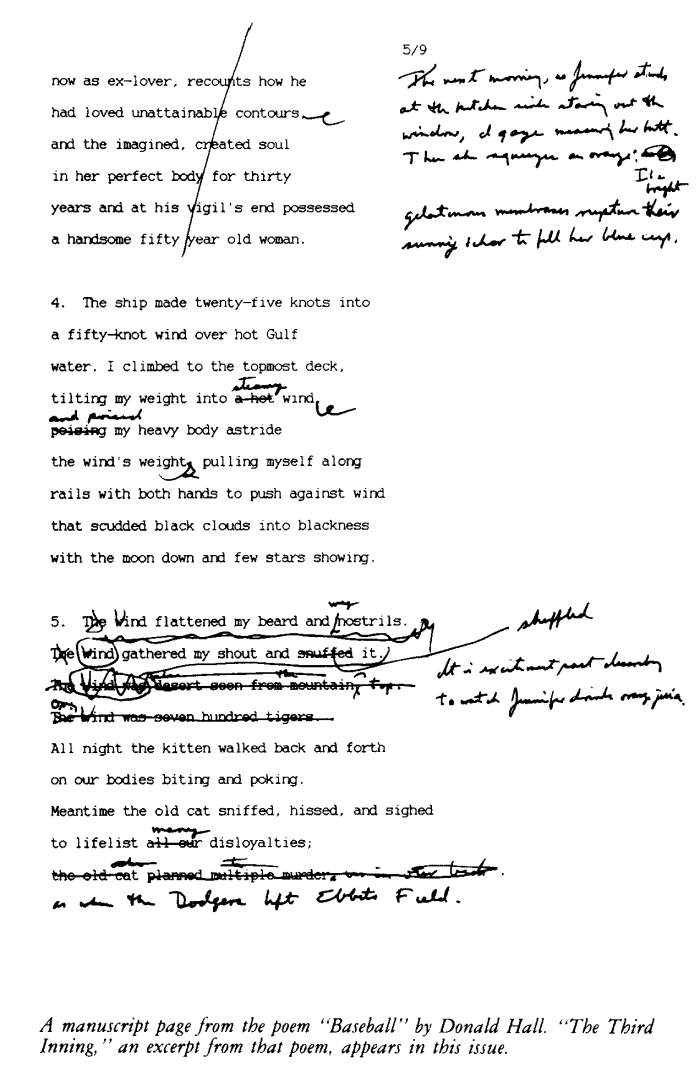
He sometimes writes about baseball and has spent time among professional athletes. "Mostly, athletes are quick-witted and funny,' Hall says, "with maybe a ten-second attention span."

Hall was The Paris Review's first poetry editor (1953–1961), and he talks about his own Paris Review interviews with T.S. Eliot, Ezra Pound ("He spoke with a melody that made him sound like W.C. Fields."), and Marianne Moore.

Once, he says, "I rejected a good poem by Allen Ginsberg, who wrote George Plimpton saying that I wouldn't recognize a poem if it buggered me in broad daylight."

Above left is a manuscript page from Hall's poem "Baseball."

--Marshal Zeringue
John Banville interview

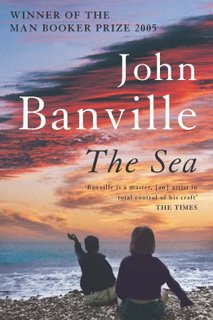
Chris Boyd, an Australian arts and culture critic, garnered some time with John Banville at the recent Sydney Writers Festival. The resulting interviews appear here at the "Sarsaparilla" blog and here at Chris' "The Morning After" blog--and it really doesn't matter which one you read first.

The interviews are as much about literary interviews as about Banville's work and his views on a wide variety of subjects.

One choice Banville comment from the interview: "An awful lot of women write detective fiction, very few women read it!"

What did I think of Banville winning the Man Booker Prize for his The Sea? Click here to find out.

What did Michiko Kakutani think of The Sea? It's "a stilted, claustrophobic and numbingly pretentious tale about an aging widower revisiting his past." I think she's way off-base, but click here to read the rest of her review.

What does "Sarsaparilla" mean? Click here to find out.

Salon has just initiated a series of travel guides devoted to the literature of places, and Banville contributed the section on Ireland. Read it here.

--Marshal Zeringue
Wednesday, June 14, 2006

P.D. James' list of the most riveting crime novels

P. D. James is the author of nineteen books, most of which have been filmed and broadcast on television in the United States and other countries. She spent thirty years in various departments of the British Civil Service, including the Police and Criminal Law Department of Great Britain's Home Office. She has served as a magistrate and as a governor of the BBC. In 2000 she celebrated her eightieth birthday and published her autobiography, Time to Be in Earnest. The recipient of many prizes and honors, she was created Baroness James of Holland Park in 1991. She lives in London and Oxford.

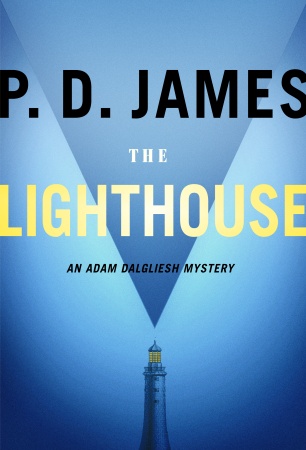
Her most recent novel is The Lighthouse.

Introducing an interview James did with Salon in 1998, Jennifer Reese wrote: "James peers amiably through thick glasses and uses the word 'dear in just about every sentence. But she also writes razor-sharp observations of British society and coolly graphic depictions of dead bodies."

The Wall Street Journal recently asked James to come up with five riveting crime novels.

Number 1 on her list?

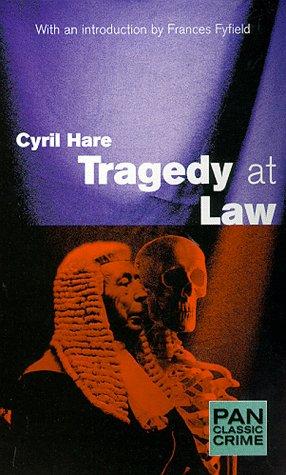
Tragedy at Law by Cyril Hare (Harcourt, Brace, 1943).

For me there is particular charm in books written before or during World War II, not least because I find myself engrossed in that very different world. In Tragedy at Law we travel with a High Court judge, Mr. Justice Barber, as he moves in state from town to town presiding over cases. But someone obviously wishes him dead, and twice he narrowly escapes. The amateur detective is a defending barrister, Francis Pettigrew, once in love with the judge's wife and a man of ability and probity who has never quite achieved success. Author Cyril Hare was himself a judge, and the book provides a fascinating portrayal of the judge in court and of the coterie of people, including barristers, who travel with him. Written with elegance and wit, Tragedy at Law is regarded by many lawyers as the best English detective story set in the legal world.

Click here to read about two through five on her list.

In a brief profile at the Guardian, James said: "The greatest mystery of all is the human heart, and that is the mystery with which all good novelists are concerned."

Do you aspire to write a mystery novel? Click here for eight easy mystery writing lessons from the baroness.

--Marshal Zeringue

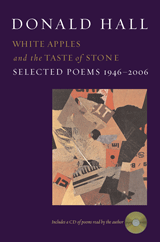
Donald Hall, poet laureate

Donald Hall is the new poet laureate. He succeeds Ted Kooser, who has been the poet laureate since 2004.

Click here to read his poem "Affirmation." Click here to read (or listen to) his poem "Gold."

In a very positive review of Hall's most recent collection of poems, White Apples and the Taste of Stone (2006), Billy Collins wrote:
Hall has long been placed in the Frostian tradition of the plainspoken rural poet. His reliance on simple, concrete diction and the no-nonsense sequence of the declarative sentence gives his poems steadiness and imbues them with a tone of sincere authority. It is a kind of simplicity that succeeds in engaging the reader in the first few lines. "In October of the year," one poem begins, "he counts potatoes dug from the brown field." Another opens: "Looking through boxes/in the attic of my mother's house in Hamden,/I find a model airplane." Many poems are further stabilized by Hall's love of storytelling, a narrative exuberance that produces anecdotal poems as well as longer, more complex weavings.
Click here to read the entire review.

--Marshal Zeringue

Tuesday, June 13, 2006

Science fiction as literature

I recently posted an item on the favorite science fiction books of Ron Moore. That item contained some misinformation and poorly-considered phraseology--mea culpa--that I'll try to make up for at the bottom of this post.

But first, here's an invited essay by John "Dawg" Pickard, an authority on science fiction:

As a co-owner of the Cylon Alliance, which is dedicated to the preservation of classic sci-fi, I’ve been invited to say a few words about Science Fiction, one of the less appreciated forms of literature.

Science Fiction is Literature? Most certainly. You need only read the works of Jules Verne or H.G. Wells, or Robert Heinlein (to name just a few), to find examples of literature that rival the works of any of their most celebrated contemporaries. Complex, exciting, timeless stories that rank–or should rank–as classic literature in their own right.

I know–when someone says “Science Fiction” the first thing people think about (if they don’t think Star Trek or Star Wars) is Attack of the Killer Tomatoes and Plan 9 from Outer Space or Santa Claus vs. The Martians. “Sci-Fi” is just not taken seriously. But Science Fiction holds the distinction of being one of, if not the, most versatile literary genres of all. In Science Fiction, we can examine and comment on human nature, societal ills, the depths man can descend or the heights he can climb. And we can tell those tales and make those statements from a completely unique vantage point. In the hands of a knowledgeable and capable writer, we can visit other worlds, find new life out in the universe–or in some unexplored nook or cranny of our own planet. We can indulge our explorer spirit and find wondrous adventure.

With a good science fiction book, we can ignite our imaginations in a way television or film cannot match.

There are books in the “Science Fiction” section of the library or bookstore that transcend genre and are literature in their own right. Heinlein’s Stranger in a Strange Land is a telling commentary on religion and society that is as valid today as the day he wrote it–all within the tale of a human Martian. H.G. Wells wrote War of the Worlds near the turn of the 20th Century–yet the tale stands up if you read it today, more than 100 years later. His The Time Machine, too. And all three are fun and captivating to read.

So is Arthur C. Clarke’s 2001: A Space Odyssey. Anne McCaffrey’s Dragonriders of Pern series will make you believe in flying, flaming dragons. And Frank Herbert’s Dune books are nothing short of an epic tale that should be compared with classic literature–yet it will keep you up reading long past your bedtime.

And it can be fun reading, too. There are well more than a hundred books set in the Star Trek universe. Dozens in the Star Wars worlds. For a laugh-out-loud read, try Douglas Adams’ Hitchhiker’s Guide to the Galaxy books (which include the volumes The Restaurant at the End of the Universe and So Long, and Thanks for All the Fish).

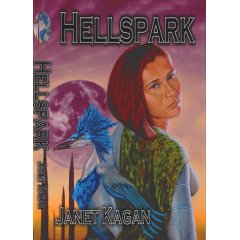
Janet Kagan’s Hellspark is one of my favorites, as is her Star Trek book Uhura’s Song. (The funniest Star Trek book is How Much For Just The Planet by John Ford.) McCaffrey’s Pern books are in my regular re-read rotation. For a real adventure, try The Man Who Never Missed and the following books of the “Matador” series by Steve Perry (who also wrote the excellent Star Wars entry Shadows of the Empire).

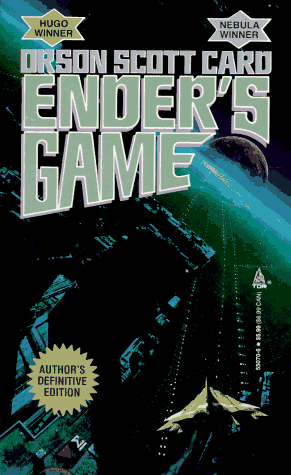
And Orson Scott Card’s Enders Game is a must-read for any science fiction fan.

I could go on, but half the fun of reading science fiction is finding an author or particular kind of science fiction that you enjoy most. Search it out. You won’t regret it.

Many thanks to "Dawg" Pickard for such a rich and informative essay--and for the suggested reading.

"Dawg" also shared with me some of his considerable knowledge on Battlestar Galactica, both the current iteration on the Sci-Fi channel and the original series. He directed me to this page:
From here, you can learn as much as you want to know about how the 1978 series came to be, the problems it faced, why the writing was inconsistent (you simply cannot rush creativity)--all those negative issues people love to point out now. We also have comprehensive information on the revival attempts by Richard Hatch, Glen Larson & Tom Moyer, and the ill-fated and much lamented 2001 DeSanto/Singer project for Fox that was scuttled at the last minute by 9/11 and behind-the-back maneuverings by the studio and Sci-Fi.
There is also information at that site on the new series and the controversy tied to it.

And it is a rich controversy. Follow this link to "Dawg's" personal site where he takes on many of the issues in the debate over the original vs. the re-imagined series. Click on the "Dawg's Bark" button for a number of insightful items.

--Marshal Zeringue
Monday, June 12, 2006

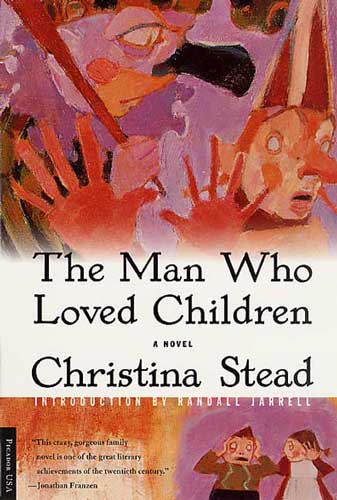
Christina Stead's "The Man Who Loved Children"

The latest excerpt from Jane Smiley's Thirteen Ways of Looking at the Novel--see here, here, here, here, here, here, and here for previous installments--takes on The Man Who Loved Children by Christina Stead.

The novel defies easy summary, so please click here to read Smiley's essay.

And after you do, consider what the poet Randall Jarrell wrote in an introduction to the book: "If all mankind had been reared in orphan asylums for a thousand years, it could learn to have families again by reading The Man Who Loved Children."

What!? I took away from Smiley's account a sense that the family in the novel was so screwed up that it might well have been constitued by people who grew up in very poorly-run orphan asylums.

Jonathan Franzen, author of The Corrections, is an admirer of the novel: "This crazy, gorgeous family novel is one of the great literary achievements of the twentieth century. I carry it in my head the way I carry childhood memories; the scenes are of such precise horror and comedy that I feel I didn't read the book so much as live it."

For a brief biography of Stead click here.

--Marshal Zeringue

Sunday, June 11, 2006

Books on the history and use of English

David Crystal, the author of How Language Works (forthcoming), recently named his favorite books on the history and use of English.

Number 1:

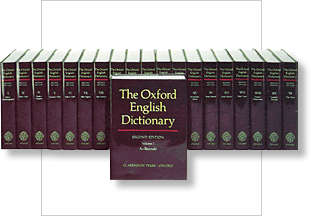
The Oxford English Dictionary (1884).

If I were ever asked which book to take to a desert island, I would opt immediately for the second edition of the unabridged Oxford English Dictionary (1989)--and hope that the island had an electricity supply so that I could download the online version or use the CD. The OED is without a doubt the most comprehensive account of the history of English vocabulary ever compiled. It has gaps and biases, of course--for example, the original editors went through Shakespeare with a tooth-comb, at the expense of some of the other Elizabethan dramatists--but it is still the source I turn to most often whenever I am working on the development of the language. Its process of continual editorial revision provides a voyage of linguistic discovery that, I am happy to say, never comes to an end.

To read Crystal's other selections, click here.

Click here to see a list of the top ten books about the OED.

--Marshal Zeringue
"Thirteen Ways of Looking at the Novel"
I've happily followed the Guardian's excerpts from Jane Smiley's Thirteen Ways of Looking at the Novel. See here, here, here, here, here, here, and here.

Jonathan Bate of the Telegraph has a less generous view of Smiley's book:

Much of Smiley's best fiction is about horses, whereas this non-fiction work is an equine of the pantomime variety. The front half is a series of chapters on the history and techniques of the novel; the back half consists of brief essays on the chosen 100 books.

The problem with the latter is that Smiley seems unable to decide whether they are for the benefit of people who have read the novels and want some critical analysis that brings deeper understanding of their mechanics or whether they are 'tasters' intended to inspire readers to tackle the masterpieces they have not dared venture upon.

He's a little more grateful for the forward-looking part of the book:

the two brief chapters of practical advice for budding novelists are the most valuable thing about the book.

Here is Smiley's advice bound in a nutshell. A command of spelling, punctuation and good grammar must be instinctive rather than struggled for--they are the equivalent of a composer knowing the scales. Solipsism and self-indulgence must be avoided at all costs: better to go out and do some research on the diction that is appropriate to the world-view of each of your characters. Work on the balance between plot and character, action and reflection. Find the right point of view for your story: first-person, third or that lovely technique of writing in a third-person voice but through the eyes of a particular character? Bang out a draft and then get down to some serious revision.

Marjorie Kehe has a more postitive view of the book at the Christian Science Monitor. Click here to read it.

--Marshal Zeringue

Saturday, June 10, 2006

Rudy Giuliani's favorite biographies of leaders


Did Giuliani really begin reading a biography of Churchill at 2:30 a.m. the night after the 9/11 attacks?

So he says.

Gripped as he was by the book, that volume is not even his favorite Churchill biography. That distinction belongs to Churchill: A Study in Greatness by Geoffrey Best, tops on Giuliani's list of his favorite five biographies of political leaders.

Click here to see Giuliani's other selections.

Too busy to read the entire book? The BBC has a brief account by Professor Best of Churchill's World War II leadership here.

--Marshal Zeringue

Friday, June 09, 2006

Fiction that fed Dutch's wanderlust

When he is not advising the blog on Australian cultural issues, Friend of the Blog "Dutch" is a diplomat in the service of a major world power. He is also an inveterate reader.

Those characteristics have conspired to produce a wonderful essay about books that have colored his wanderlust. "Dutch" writes:

The novels of Arthur Upfield probably ignited my biggest bout of wanderlust, in this instance to head out for Australia. It's a fair bet to say that those books changed my life decisively, more so than any other I've read. Though, I couldn't know that at the time and certainly not for anything having to do with the novels themselves.

I dug into them immediately and I still remember the delicious feeling of being transported across thousands of miles and decades of time. I remember so many nights laying on my single mattress on the floor in my graduate student hovel, blissfully transported to outback Australia with Bony, the half-caste detective. The descriptions of the clarity of the piercing cerulean sky and its contrast with the red dirt made me want to see the Land Down Under. His descriptions of the night time sky there as a deep blackness shot through with billions of bright and shiny diamonds made me ache to see that for myself and stare at its immensity.

When I did finally get there it was nothing like an Arthur Upfield mystery, of course, since his were set in the parched and isolated rural Australia of the 1940s and 1950s. I was spending all my time in modern 1990s suburban Canberra and urban Sydney. But that began a whole new love affair of a different kind and on several levels of meaning, too. I still think it's a pretty wonderful place to stare at the sky night or day and to do so many more things closer to earth. I doubt I could ever live in the outback after spending just a short time there, but now I also know I'm probably happier in urban/suburban Australia than anywhere else in the world.

Reading Ian Rankin's Inspector Rebus series has really whetted my appetite to return to Edinburgh for a stroll through New Town. And while I'm sure John Harvey's Nottingham is not a great tourist wonder, I'd pay quite a lot to sit at the Italian espresso stall in the city market and have a coffee and talk with his DI Charlie Resnick.

Patricia Highsmith in her Ripley series creates a wonderful sense of place in the French countryside. The mental pictures her prose created made me long to walk through Tom's scenic village, call in at the tobacconist for the evening papers, share an espresso with Tom (while of course absolutely never turning my back on him). I've never really spent much time in France, but she makes it sound wonderful. I'm not sure I'd feel safe being an overnight guest, but Tom's country estate also seems like a place that would be beautiful to see. I remember thinking how civilized—what an odd word choice to associate with a sociopath, I know—it would be for Tom and me to go through the French doors leading to the slate terrace to sit and have a pre-dinner aperitif while we gazed out at the woods beyond and discussed his collection of Derwatt paintings. The Talented Mr. Ripley is, of course, a wonderful book, but its portrait of Italy is also pretty darn seductive.

Alan Furst ignites a similar wanderlust for me for Paris, in addition to making me wish we had time machines, to go back to the Paris of 1937-1942 era. Of course, we do have them and they are Alan Furst novels!

Reading the great Nick Hornby's High Fidelity made wish I lived around the corner from Championship Vinyl in London, so I could hang out there. I'm sure Barry would have quickly banished me forever though since my musical tastes would have surely offended him.

The reverse of wanderlust, whatever that might be called, happened for me when I visited Buenos Aires. I'd never read any Jorge Luis Borges, but wandering the bohemian and cosmopolitan streets of B.A., hanging out in the cafes in Palermo Viejo and Recolleta, eating the food, admiring the stunning architecture, savoring the quality of everyday life there, meeting the warm and proud Portenos, eavesdropping on their animated conversations, drinking the wine--all of it made me fall in the love with the city and the country and want to read their great master and come to know through his eyes and writing the city he loved so much. Did I mention the food?!

Here's a great Larry Rohter article from the New York Times along those lines.

Alan Judd's Short of Glory made me long to see the world from a perspective as a diplomat. He is such an entertaining (and underappreciated) writer. I remember laughing so hard at certain points in the book that I was crying. The fictional African country he creates, which is supposed to be South Africa I believe, is so real and wonderful and yet heartbreaking that it made me want to set out and see it for myself. The world of a diplomat he creates is equally seductive. Alas, now that I've been doing it for 12 years I realize what a load of crap that was, but there are certain nights when I have captured a bit of Juddian Glory. I remember an especially interesting dinner party where I was sitting with a wonderfully engaging group of dinner companions. The conversation and wine flowed freely and joyously. The laughter from really good stories still echo in my memory.

After reading Alan Judd and then finally making it into the Foreign Service, I thought that every night of my life would be like that great dinner party. Of course, life is not like that and my life as a diplomat is very far removed from that. Ninety-nine percent of our time we are simply bureaucrats, just like any other, only we get Dengue Fever and lots of fun intestinal parasites, the office building where I work is intermittently attacked by mobs of muslim fanatics, and people shoot my colleagues and blow them up in bombings. Even if every night can’t be like an Alan Judd novel, there’s still a mountain of books waiting to open new worlds to me, and that’s a very comforting thought, indeed.
That's a wonderful essay.

I've read many of the books "Dutch" recommends here--at his urging--and can attest to the quality of his recommendations.

Many thanks to "Dutch" for sharing those insights about fiction and travel.

--Marshal Zeringue

Thursday, June 08, 2006

William T. Vollmann's ten favorite books

Looking for a schema with which to evaluate your favorite books? Try William T. Vollmann's.

First, consider his key:
A = Perfect Language
B = Construction of a coherent, alien (to me) world
C = Profound investigation of love
D = Richly complex pattern
E = Revelations about memory vs. loss
F = Political lessons
G = Erotic Beauty

Then plug in the appropriate variable for each book. Two examples from Vollmann's list:

Fyodor Dostoevsky, The Idiot (D, E, G)
Lady Murasaki, The Tale of Gengi (A, B, C, D, E, F, G)
Interesting. Click here to see the remaining eight titles on Vollmann's list as well as a brief interview.

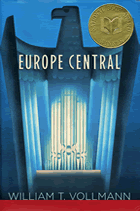
Vollmann's Europe Central won the 2005 National Book Award. Click here to read his acceptance speech.

Daniel Lukes praised Europe Central in the Times Literary Supplement:

Vollmann intends the reading of his works to be an emotionally traumatic experience, and Europe Central is harrowing, in part because of its depressing subject, but also because of the raw and often sadistically insightful way the material is treated. To portray the novel as a thoroughly ominous and doom-laden affair would be unfair, however; Vollmann is still a master storyteller and bravura stylist, and he sustains and constantly reignites interest over the course of this lengthy book. He is well served by his acute eye for emotional impact and the now trademark literary cubism of his style--first-person "collective" narrators, dispassionate reportage, see saw chronology, biographical music criticism, prismic Faulkneresque interior monologue, and more. Overkill is still largely Vollmann's preferred method of literary construction. "Can music attack evil?", Shostakovich asks one of his lovers, while grappling with what will become one of the struggles of his life: how to avoid capitulation to the regime. "Certainly not", she answers. "All it can do is scream." And there is a lot of screaming here.

Thankfully, there are passages of beauty and intensity amid the wintry corpse-laden gloom in Europe Central.

Interested in another take on The Tale of Genji? See Jane Smiley's view here.

--Marshal Zeringue

Wednesday, June 07, 2006

T.H. White's Arthurian cycle

The latest installment in Jane Smiley's series is T.H. White's Arthurian cycle.
T.H. White's The Once and Future King is steeped in learning and literature, and yet it is not quite respectable in the way that the works of, say, Kingsley Amis or Virginia Woolf are. Maybe it has been contaminated in the minds of critics by popularity and Walt Disney animation. Nevertheless, it is a serious work, delightful and witty in many ways and yet very sombre overall.
Click here for a basic synopsis of what develops with King Arthur, Queen Guenever, Sir Lancelot and the rest in these books.

Smiley:

White's novel is intense and rich. The first volume, which tells the story of Arthur's education (he is transformed into several animals and birds), is a treasury of English natural history and increasingly obscure forms of sport, such as falconry and boar hunting. The same is true in the third volume, which tells how Lancelot became the greatest knight. White writes: "Uncle Dap was the only one in the family who took Lancelot seriously, and Lancelot was the only one who was serious about Uncle Dap. It was easy not to be serious about the old fellow, for he was that peculiar creation which ignorant people laugh at a--genuine maestro. His branch of learning was chivalry." And then White shows convincingly what a maestro of chivalry would know and how he would think. White uses the inherent flexibility of prose to deliver a lot of information, not only background information that makes it easy for the modern reader to picture 12th- and 13th- century England, but also good analogues to modern society--jousting as a form of cricket, for example--that work not only to clarify what might be confusing, but also to show the continuity of English life from the Middle Ages to the 20th century.

The Once and Future King is about male society, but White is not a misogynist. His portrait of Guenever is sympathetic and rich. Of particular note is the moment when Lancelot and Guenever first fall in love. They are out hawking, and Guenever makes a mistake in her task of helping Lancelot with his hawk. He rebukes her, and then, when her feelings are hurt, he suddenly recognises that "she had been giving kindness, and he had returned it with unkindness. But the main thing was that she was a real person". The recognition of common humanity is the source of their inconvenient and passionate love.

Interested in King Arthur but hate reading? The History Channel will broadcast "Quest for King Arthur" on June 24th: click here for more details.

For a brief biography of T.H. White, click here.

To read earlier entries in the Smiley series, click here, here, here, here, here, here, and here.

--Marshal Zeringue

Zadie Smith wins the Orange prize

Some weeks ago I asked: Do women deserve a book prize of their own?

The folks at the Orange prize clearly think they do, and Zadie Smith won their award this year for On Beauty.

She had been shortlisted for both of her previous novels, White Teeth in 2001 and The Autograph Man in 2003.

Interested in more facts about Zadie Smith? Click here.

On Beauty was also nominated for the Man Booker Prize last year. It didn't win but, even though I thought it was a fine book, I don't think that was so unfair. And I doubt that anyone will ever say that 2005 was the Booker Prize's "Henry Fonda" year.

--Marshal Zeringue

Tuesday, June 06, 2006

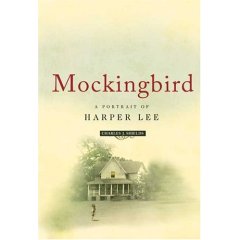
"Mockingbird"

Didn't get enough Harper Lee news with yesterday's post on the Jane Austen of south Alabama?

Then check out the Salon review of Charles Shields' Mockingbird: A Portrait of Harper Lee.

Margot Mifflin writes:
Though [Mockingbird is] ostensibly about the author, whose Alabama family and Southern racial consciousness inspired "To Kill a Mockingbird," it's also about Lee and Capote, childhood friends who grew up to become symbiotic figures, both personally and artistically, during the '60s. Both were precocious children out of step with their peers, whose slippery grip on gender was a social liability. As Shields puts it, "she was too rough for the girls, and he was too soft for the boys." Each had emotionally absent mothers: Capote's was a self-absorbed social climber; Lee's was chronically depressed, though in her more functional youth she'd played piano at Capote's 16-year-old mother's wedding. (To embroider this family quilt, Capote's father came on to Lee when she was a teenager and she responded by punching him in the nose; Capote hated Lee's gossipy mother, and parodied her, at age 10, in a story called "Mrs. Busybody.")
According to this review, a large part of the real value of the biography is the original inquiry into the Lee/Capote relationship.

--Marshal Zeringue

"How Tom Wolfe became dull"

The last two years have not been all that kind to Tom Wolfe. Sure, he sold (literally, many) tons of his latest (2.4 lb.) book. And he had some pretty famous fans.

But he came out on the poor end of this duel. And he wasn't exactly conspicuous in the poll to name "the single best work of American fiction published in the last twenty-five years."

Now Chloë Schama says Wolfe has become dull.
When Tom Wolfe delivered the Jefferson Lecture last month people waited outside for nearly an hour in order to get the best seats possible.
....
But the way he addressed the pressures operating among black people and young people in his lecture was feeble; his barbs were blunt blows compared to his earlier incisiveness. There is, by definition, nothing inventive about a stereotype, and stereotypes were rampant in Wolfe's comments. The famous entertainer has always been somewhat offensive, but now he has grown dull.
Read Schama's entire essay here (free registration required).

Schama may be wrong. Click here to read the lecture for yourself. And click here for a sampling of more positive reactions to the speech.

--Marshal Zeringue

Monday, June 05, 2006

The Jane Austen of south Alabama

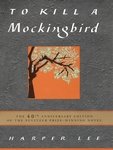
Harper Lee's To Kill A Mockingbird is such a popular favorite that every six months or so some related event summons it forth in pop culture news. Last year it was Harper Lee's supporting role in the Truman Capote/In Cold Blood story which hit the big screen as Capote.

Now it's the release of Mockingbird, the new biography of Harper Lee by Charles J. Shields.

Can this life really sustain a book-length biography?

The Independent's reviewer equivocates:
Harper Lee was at the height of her fame as the bestselling author of To Kill A Mockingbird when, in the early 1960s, a librarian at her old university, an all-girls establishment in Alabama called Huntingdon College, puzzled over why he could find almost no information about her. So he wrote and asked if she wouldn't mind providing some biographical details so she could be appropriately honoured by her alma mater.

Lee's response was oddly revealing. It was quizzical, light-hearted, self-deprecating--and almost completely unhelpful. "I'm afraid a biographical sketch of me will be sketchy indeed," she wrote. "With the exception of M'bird, nothing of any particular interest to anyone has happened to me in my 34 years."
Then:
The sum of our knowledge of Lee is pushed only so much further--barely one-sixth of the book covers the years after 1962 and the release of the Oscar-winning movie of Mockingbird, starring Gregory Peck. But we do get a sense of an unusual, complex woman who never sought fame and quickly decided she did not like it, a woman who relied on a few very close relationships to help her achieve her ambitions and struggled when those relationships faltered.
Harper Lee's last major interview was given to Roy Newquist in March 1964, for his book Counterpoint. Its last line: "All I want to be is the Jane Austen of south Alabama." Click here to read the interview.

Click here to read the New Yorker 's review of Shields' Mockingbird.

Serious Mockingbird enthusiasts and architectural history buffs should track down the Summer 2003 issue of Alabama Heritage (the contents, sadly, not available online) which includes a fascinating article, "The 'Mockingbird' Courthouse," by Delos Hughes.

--Marshal Zeringue

Sunday, June 04, 2006

Ten novels influenced by Shakespeare

Regular visitors to the blog know I'm interested in twice-told tales--stories that owe a strong debt to earlier, usually famous, stories. (See here, here, here, and here.)

Noting that "there's a strong argument that everyone writing in the English language is influenced by Shakespeare" and therefore "a top 10 list of novels influenced by Shakespeare might look identical to a top 10 list of novels full stop," Matt Haig has composed his top 10 list of novels influenced by Shakespeare.

At the top of the list:
1. Gertrude and Claudius by John Updike. There are a lot of nods to the Bard in Updike's work. The Witches of Eastwick clearly drew on the 'weird sisters' in Macbeth, although added more sauce to the cauldron. Gertrude and Claudius is a prelude to Hamlet and draws on the ancient Scandinavian legends that first inspired Shakespeare to flesh out a life for Gertrude. She famously doesn't say much in the original play, but triumphantly emerges here as a warm and clear-headed woman who sees life 'as a miracle daily renewed'.

2. A Thousand Acres by Jane Smiley. Smiley's prize-winning novel transferred the story of King Lear to the American mid-west, with brutal results. If you take on Lear, you've got to be able to rise to the challenge and Smiley doesn't flinch from the dark heart of the story. Indeed, she heads deep into that darkness with the suggestion that Lear sexually abused two of his daughters.
Click here to read about the other eight selections.

--Marshal Zeringue

Saturday, June 03, 2006

The thriller that scared Stephen King

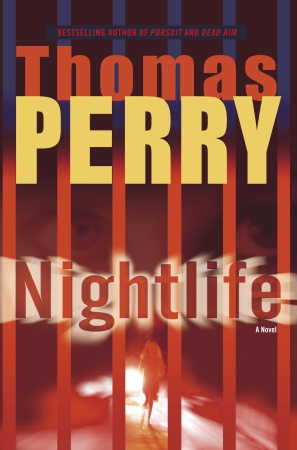
In a featured blurb for Thomas Perry's Nightlife, Stephen King writes: "I can't imagine any reader finishing this and thinking he or she didn't get his money's worth. And it's scary! I say that with deep admiration."

When Stephen King says a book is scary you might think of a once-friendly-St. Bernard-turned-killer or any number of other terrifying, otherworldly forces.

But Nightlife isn't scary like a Stephen King novel: rather, it's scary like Shakespeare is scary, its menace is all too believable in this world of ours.

Nightlife's villain is real and believable, and that makes her psychopathology all the more compelling. Not that this kind of killer lurks on every corner. But two of the things I like about Perry's thrillers are that he develops characters instead of caricatures, and there are very few of those plot moments that make me think, "as if that would happen" or "Why doesn't the killer just [whatever]?" Even excellent thriller writers have to occasionally flirt with improbable actions and incredible coincidences, and there are a couple of times when it seems that Perry will take that way out. But not many.

I usually like my thrillers more rather than less plausible, and Perry delivers.

There is more that I wanted to write about this novel but every day that I've not done so feels like a day that I'm cheating a reader who might enjoy the thriller as much as I did. So click here to read Janet Maslin's review (with which I more or less agree) to find out more about the story.

To read an excerpt from Nightlife, click here.

I have more to write about one of Perry's characters (from a different novel) in the blog's embryonic series on the coolest women in crime fiction written by men, so stay tuned.

--Marshal Zeringue

Friday, June 02, 2006

Kate Atkinson's top ten novels

I've praised Kate Atkinson's Case Histories as my favorite novel of 2004.

And her top 10 novels?
1. The Great Gatsby by F Scott Fitzgerald. Perhaps the best American novel (although see '10') or the best novel about America and the hollowness at the heart of the dream. The closing paragraphs of 'Gatsby' are surely some of the most poignant and powerful ever written.
Click here to learn about her other nine selections.

--Marshal Zeringue

My favorite novel of 2004

My favorite novel of 2004 was Kate Atkinson's Case Histories.

The publisher's summary does not do justice to the book but click here to read it if you must.

Click here to read an excerpt.

Jacqueline Carey wrote a good review of Case Histories for the New York Times:
Three case histories open the book: each presents a crime that suggests an escalating degree of female culpability. In the first, a 3-year-old disappears one summer night as she sleeps in a tent next to one of her older sisters. (Complete innocence.) In the next, a teenager is stabbed as she helps out in her widowed father's law office. (She's not a virgin, so possibly she brought it on herself? Was there a connection between her and her unknown assailant?) In the final crime, a husband is felled by an ax during an argument with his wife. (Complete guilt; inexplicable silence from the accused.) Of course, nothing is as it seems.
Case Histories was favorably reviewed in a number of major publications. In addition to Carey's, another review very much in tune with my assessment is Timothy Peters' at the San Francisco Chronicle.

Atkinson's first novel, Behind the Scenes at the Museum, won the 1995 Whitbread Book of the Year award and earned her many fans. I think Case Histories is far superior to that first novel: if you read Behind the Scenes and were not overwhelmed (as was the case with me), do yourself a favor and give Case Histories a try.

--Marshal Zeringue

Thursday, June 01, 2006

The first rule of Book Club is....

What happens when partisans of The Great Illinois Novel run into supporters of The Great Florida Novel?

Click here for the whole bloody story.

--Marshal Zeringue

"Battlestar Galactica" creator's favorite sci-fi novels

Ron Moore, the creator and executive producer of the Sci Fi Channel's Battlestar Galactica series, lists five of his favorite science fiction books.

Click here to see all five choices. And #1?
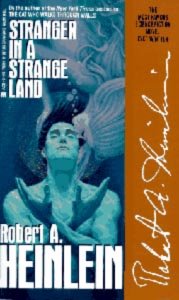
Stranger in a Strange Land by Robert Heinlein (Putnam, 1961). In part a retelling of the Christ story as seen through a science-fiction prism, this sprawling social commentary tells the story of Valentine Michael Smith, a son of human colonists lost in the first manned flight to Mars. Raised by Martians, Michael has been returned to Earth, before whose society, and foibles, he stands uncomprehending. Soon enough, he is a victim. It says something about the complexity and intellectual edge of Stranger in a Strange Land that it remains one of the few science-fiction classics to have escaped adaptation by the movie industry. The book is very much of its time, the 1960s, in the way its central story of Valentine's reintegration into human society challenges organized religion and gender roles. Not to mention its embrace of those swinging '60s themes, free love and group sex. An emblem of this book's influence: the word grok"--Martian for complete, instinctive understanding--has entered the language and a dictionary or two.
Not a sci-fi fan? Neither am I, particularly.

Think Battlestar Galactica is a cheap and cheesy Star Wars knockoff from your youth? Well, so did I when Friend of the Blog Kurt van der Walde recommended the series to me.

Boy, was I wrong.

Salon's Heather Havrilesky sells the show better than I can:
"Battlestar Galactica" is much, much better than you can possibly imagine. The battle scenes are claustrophobic and paranoia-inducing, with the enemy always hidden from view but omnipresent in the imagination, thanks to closely framed, hand-held shots. The power struggles are complicated and nuanced like the ones you find on "The Sopranos." The soundtrack is odd and moody and completely unique as far as TV soundtracks go. The stakes are always high, and there's an incredible amount of action in each episode--you never feel like the characters are just spinning their wheels, or the situations are repeating themselves, as you do with so many other dramas. The show takes a deeply ambivalent approach to religion: The Cylons attack in the name of their god, which makes them a little bit like fundamentalist Christians or Islamic extremists, but the president of the humans also embraces some pretty odd beliefs and so-called ancient prophecies.

What's most remarkable about "Battlestar Galactica" is that it's populated by distraught, fallible characters who fumble around in the dark and make big mistakes, but never lose our sympathies. Many of them aren't likable or even easy to understand, but we're offered some way of seeing the world through their eyes.
--Marshal Zeringue