Wednesday, February 22, 2012

Five notable Hollywood tell-alls

One title on the Barnes & Noble Review's list of five top Hollywood tell-alls:
Wishful Drinking
by Carrie Fisher

Carrie Fisher dispensed with the semi-autobiographical fiction of Postcards from the Edge and embraced the personal memoir whole-heartedly in this candid account of a booze-soaked, drug-addled career. What was it like to grow up the daughter of Debbie Reynolds and Eddie Fisher, Hollywood royalty and terrible parents? How did it feel to hold a PEZ dispenser that resembled her head? And what did she do when she woke up next to a friend in bed one morning, only to realize he was dead? Fisher answers to the best of recollection in this book, based on her one-woman show of the same name.
Read about another book on the list.

--Marshal Zeringue

Tuesday, February 21, 2012

Pg. 69: Kevin Fox's "Until the Next Time"

The current feature at the Page 69 Test: Until the Next Time by Kevin Fox.

About the book, from the publisher:
For Sean Corrigan the past is simply what happened yesterday, until his twenty-first birthday, when he is given a journal left him by his father’s brother Michael—a man he had not known existed. The journal, kept after his uncle fled from New York City to Ireland to escape prosecution for a murder he did not commit, draws Sean into a hunt for the truth about Michael’s fate.

Sean too leaves New York for Ireland, where he is caught up in the lives of people who not only know all about Michael Corrigan but have a score to settle. As his connection to his uncle grows stronger, he realizes that within the tattered journal he carries lies the story of his own life—his past as well as his future—and the key to finding the one woman he is fated to love forever.

With the appeal of The Time Traveler’s Wife and the classic Time and Again, this novel is a romance cloaked in mystery and suspense that takes readers inside the rich heritage of Irish history and faith. Until the Next Time is a remarkable story about time and memory and the way ancient myths affect everything—from what we believe to who we love.
Learn more about the book and author at Kevin Fox's website.

Kevin Fox is a producer and writer for the Fox TV series Lie to Me, and his professional screenwriter credits include the film The Negotiator.

The Page 69 Test: Until the Next Time.

--Marshal Zeringue

Pg. 99: David Schiff's "The Ellington Century"

Today's feature at the Page 99 Test: The Ellington Century by David Schiff.

About the book, from the publisher:
Breaking down walls between genres that are usually discussed separately—classical, jazz, and popular—this highly engaging book offers a compelling new integrated view of twentieth-century music. Placing Duke Ellington (1899–1974) at the center of the story, David Schiff explores music written during the composer’s lifetime in terms of broad ideas such as rhythm, melody, and harmony. He shows how composers and performers across genres shared the common pursuit of representing the rapidly changing conditions of modern life. The Ellington Century demonstrates how Duke Ellington’s music is as vital to musical modernism as anything by Stravinsky, more influential than anything by Schoenberg, and has had a lasting impact on jazz and pop that reaches from Gershwin to contemporary R&B.
Learn more about the book and author at David Schiff's website and the University of California Press.

Schiff is R.P. Wollenberg Professor of Music at Reed College. He is a composer, journalist whose articles have appeared in publications including the New York Times and the Atlantic, and the author of George Gershwin: Rhapsody in Blue and The Music of Elliot Carter.

My Book, the Movie: The Ellington Century.

The Page 99 Test: The Ellington Century.

--Marshal Zeringue

Nevada Barr's 6 favorite books

Nevada Barr is an award-winning novelist and New York Times best-selling author. She has a growing number of Anna Pigeon mysteries to her credit--the latest, The Rope, is set in the Glen Canyon National Recreational Area--as well as numerous other books, short stories, and articles.

One of Barr's six favorite books, as told to The Week magazine:
The Graveyard Book by Neil Gaiman

In growing up, too many of us leave behind our love of the drama, fantasy, romance, and mystery that we devoured as kids. Gaiman gives all that back to us. For that I adore him. This tale of a boy orphaned by murderers and raised by graveyard ghosts is magic.
Read about another book on the list.

Visit Nevada Barr's website and blog.

--Marshal Zeringue

What is Andromeda Romano-Lax reading?

Today's featured contributor at Writers Read: Andromeda Romano-Lax, author of The Detour.

Her entry begins:
I tend toward older classics from the 1910s through 1960s, but lately I’ve been catching a more contemporary—and metaphysical—vibe. The two novels fighting for prime position on my nightstand are The Uncoupling by Meg Wolitzer and The Leftovers by Tom Perrotta.

Both Wolitzer and Perrotta are great at skewering middle-class suburbia, while still granting us the humane pleasure of getting to know sympathetic, complex characters. I bought these books together as a birthday present to myself, thinking the authors shared some stylistic elements, without realizing that...[read on]
About the book, from the publisher:
Ernst Vogler is twenty-four years old in 1938, an employee of the Third Reich's Sonderprojekt, which is carrying out the Führer's designs to collect the great art of Europe. A country on the eve of inevitable war, Germany is an unhappy place for artistic, apolitical Vogler, especially when his mentor disappears without explanation. Before he can learn the reason, Vogler is given an assignment: travel to Italy and collect a famous Classical Roman statue, the Discus Thrower, and get it to the German border, where it will be turned over to Gestapo custody. It is a simple, three-day job.

Things start to go wrong almost immediately. The Italian twin brothers who have been hired to escort Vogler to the border seem to have priorities besides the task at hand - wild romances, perhaps even criminal activities on the side - and Vogler quickly loses control of the assignment. The twins set off on a dangerous detour and Vogler realizes he will be lucky to escape this venture with his life, let alone his job. With nothing left to lose, the young German gives himself over to the Italian adventure, and to the surprising love and losses along the way.
Learn more about the book and author at Andromeda Romano-Lax's website.

Romano-Lax worked as a freelance journalist and travel writer before turning to fiction. Her first novel, The Spanish Bow, was translated into eleven languages and was chosen as a New York Times Editors’ Choice, BookSense pick, and one of Library Journal’s Best Books of the Year.

The Page 69 Test: The Spanish Bow.

The Page 69 Test: The Detour.

Writers Read: Andromeda Romano-Lax.

--Marshal Zeringue

Elly Griffiths’s "The House at Sea’s End," the movie

Now showing at My Book, The Movie: The House at Sea’s End by Elly Griffiths.

The entry begins:
In The House at Sea’s End six bodies are found buried at the foot of a cliff in a remote Norfolk village. Dr Ruth Galloway is called in to investigate and is once more in contact with DCI Harry Nelson, the father of her child. The bodies date from the Second World War but someone is still alive who would kill to protect their secret.

People have said that Ruth is an unusual heroine – she’s overweight, untidy and rather shy. I’d hate her to be played by a skinny glamour model but I can’t think of anyone who’d be quite right. I’d love to see Michael...[read on]
Learn more about the book and author at Elly Griffiths's website.

The Ruth Galloway novels include The Crossing Places and The Janus Stone.

The Page 69 Test: The Crossing Places.

My Book, The Movie: The House at Sea’s End.

--Marshal Zeringue

Monday, February 20, 2012

Pg. 99: Robert J. Sampson’s "Great American City"

Today's feature at the Page 99 Test: Great American City: Chicago and the Enduring Neighborhood Effect by Robert J. Sampson.

About the book, from the publisher:
For over fifty years numerous public intellectuals and social theorists have insisted that community is dead. Some would have us believe that we act solely as individuals choosing our own fates regardless of our surroundings, while other theories place us at the mercy of global forces beyond our control. These two perspectives dominate contemporary views of society, but by rejecting the importance of place they are both deeply flawed. Based on one of the most ambitious studies in the history of social science, Great American City argues that communities still matter because life is decisively shaped by where you live.

To demonstrate the powerfully enduring impact of place, Robert J. Sampson presents here the fruits of over a decade’s research in Chicago combined with his own unique personal observations about life in the city, from Cabrini Green to Trump Tower and Millennium Park to the Robert Taylor Homes. He discovers that neighborhoods influence a remarkably wide variety of social phenomena, including crime, health, civic engagement, home foreclosures, teen births, altruism, leadership networks, and immigration. Even national crises cannot halt the impact of place, Sampson finds, as he analyzes the consequences of the Great Recession and its aftermath, bringing his magisterial study up to the fall of 2010.

Following in the influential tradition of the Chicago School of urban studies but updated for the twenty-first century, Great American City is at once a landmark research project, a commanding argument for a new theory of social life, and the story of an iconic city.
Learn more about Great American City: Chicago and the Enduring Neighborhood Effect at the University of Chicago Press website.

Robert J. Sampson is Henry Ford II Professor of the Social Sciences at Harvard University and Director of the Social Sciences Program at Harvard’s Radcliffe Institute for Advanced Study.

The Page 99 Test: Great American City.

--Marshal Zeringue

Five of the best books on jazz

Nat Hentoff is an American historian, novelist, jazz and country music critic, and writes regularly on jazz and country music for The Wall Street Journal.

He named a five best list of books on jazz for the Journal, including:
Norman Granz: The Man Who Used Jazz for Justice
by Tad Hershorn (2011)

Norman Granz was not a musician, but the producer and promoter's world-wide impact on jazz was historic. He enriched and often revived the careers of many jazz masters, choosing to record only those he believed worthy of posterity. Sales were secondary. And in this country, Granz broke the color line during the Jim Crow years by mandating that there be no audience segregation anywhere for his popular "Jazz at the Philharmonic" tours. Before concerts, he even removed the "Colored" signs. In this first-ever biography of an often brusque and unyielding but thoroughly principled jazz missionary, Tad Hershorn has masterfully researched Granz's vivid career, adding new information about the jazz originals he guided and sometimes sparred with. When a distributor of one of Granz's labels complained that one of his artists sold too few copies, Granz roared that if just 1,500 people wanted to hear the musician, that was enough—and he fired the distributor.
Read about another book on the list.

--Marshal Zeringue

What is Nancy Bilyeau reading?

The current featured contributor at Writers Read: Nancy Bilyeau, author of The Crown.

Her entry begins:
When I traveled to London to do research for my Tudor England thriller series, I extracted a vow from myself not to load up on hardcover books. There would be little room for purchases in my already stuffed suitcase, and mailing them home would be too costly. But that promise was broken in the shop of The Museum of London when I spied Peter Ackroyd's newest book, London Under. Ackroyd's London: The Biography, published in 2000, is one of my favorites, melding the most interesting facts about the city's history with lyrical prose. London Under wouldn't be available in the States for another month or two, and I simply refused to wait; I bought it that day. Slimmer than the earlier book, London Under tells the story...[read on]
About The Crown, from the publisher:
An aristocratic young nun must find a legendary crown in order to save her father—and preserve the Catholic faith from Cromwell’s ruthless terror. The year is 1537...

Joanna Stafford, a Dominican nun, learns that her favorite cousin has been condemned by Henry VIII to be burned at the stake. Defying the sacred rule of enclosure, Joanna leaves the priory to stand at her cousin’s side. Arrested for interfering with the king’s justice, Joanna, along with her father, is sent to the Tower of London.

The ruthless Stephen Gardiner, Bishop of Winchester, takes terrifying steps to force Joanna to agree to spy for him: to save her father’s life she must find an ancient relic—a crown so powerful, it may hold the ability to end the Reformation. Accompanied by two monks, Joanna returns home to Dartford Priory and searches in secret for this long-lost piece of history worn by the Saxon King Athelstan in 937 during the historic battle that first united Britain.

But Dartford Priory has become a dangerous place, and when more than one dead body is uncovered, Joanna departs with a sensitive young monk, Brother Edmund, to search elsewhere for the legendary crown. From royal castles with tapestry-filled rooms to Stonehenge to Malmesbury Abbey, the final resting place of King Athelstan, Joanna and Brother Edmund must hurry to find the crown if they want to keep Joanna’s father alive. At Malmesbury, secrets of the crown are revealed that bring to light the fates of the Black Prince, Richard the Lionhearted, and Katherine of Aragon’s first husband, Arthur. The crown’s intensity and strength are beyond the earthly realm and it must not fall into the wrong hands.

With Cromwell’s troops threatening to shutter her priory, bright and bold Joanna must now decide who she can trust with the secret of the crown so that she may save herself, her family, and her sacred way of life. This provocative story melds heart-stopping suspense with historical detail and brings to life the poignant dramas of women and men at a fascinating and critical moment in England’s past.
Learn more about the book and author at Nancy Bilyeau's website and blog.

Writers Read: Nancy Bilyeau.

--Marshal Zeringue

Pg. 69: Lauren Fox's "Friends Like Us"

Today's feature at the Page 69 Test: Friends Like Us by Lauren Fox.

About the book, from the publisher:
With her critically acclaimed debut novel, Still Life with Husband, Lauren Fox established herself as a wise and achingly funny chronicler of domestic life and was hailed as “a delightful new voice in American fiction, a voice that instantly recalls the wry, knowing prose of Lorrie Moore” (Michiko Kakutani, The New York Times). Fox’s new novel glitters with these pleasures—fearless wordplay, humor, and nuance—and asks us the question at the heart of every friendship: What would you give up for a friend’s happiness?

For Willa Jacobs, seeing her best friend, Jane Weston, is like looking in a mirror on a really good day. Strangers assume they are sisters, a comparison Willa secretly enjoys. They share an apartment, clothing, and groceries, eking out rent with part-time jobs. Willa writes advertising copy, dreaming up inspirational messages for tea bags (“The path to enlightenment is steep” and “Oolong! Farewell!”), while Jane cleans houses and writes poetry about it, rhyming “dust” with “lust,” and “clog of hair” with “fog of despair.” Together Willa and Jane are a fortress of private jokes and shared opinions, with a friendship so close there’s hardly room for anyone else. But when Ben, Willa’s oldest friend, reappears and falls in love with Jane, Willa wonders: Can she let her two best friends find happiness with each other if it means leaving her behind?
Learn more about the book and author at Lauren Fox's website.

The Page 69 Test: Friends Like Us.

--Marshal Zeringue

Sunday, February 19, 2012

Pg. 99: Boaz Atzili's "Good Fences, Bad Neighbors"

Today's feature at the Page 99 Test: Good Fences, Bad Neighbors: Border Fixity and International Conflict by Boaz Atzili.

About the book, from the publisher:
Border fixity—the proscription of foreign conquest and the annexation of homeland territory—has, since World War II, become a powerful norm in world politics. This development has been said to increase stability and peace in international relations. Yet, in a world in which it is unacceptable to challenge international borders by force, sociopolitically weak states remain a significant source of widespread conflict, war, and instability.

In this book, Boaz Atzili argues that the process of state building has long been influenced by external territorial pressures and competition, with the absence of border fixity contributing to the evolution of strong states—and its presence to the survival of weak ones. What results from this norm, he argues, are conditions that make internal conflict and the spillover of interstate war more likely. Using a comparison of historical and contemporary case studies, Atzili sheds light on the relationship between state weakness and conflict. His argument that under some circumstances an international norm that was established to preserve the peace may actually create conditions that are ripe for war is sure to generate debate and shed light on the dynamics of continuing conflict in the twenty-first century.
Learn more about Good Fences, Bad Neighbors at the University of Chicago Press website.

Boaz Atzili is assistant professor in the School of International Service, American University.

The Page 99 Test: Good Fences, Bad Neighbors.

--Marshal Zeringue

Top 10 siblings' stories

Will Eaves was Arts Editor of the Times Literary Supplement from 1995 to 2011 before moving to the University of Warwick, where he is Associate Professor in the Writing Program. His new novel, This Is Paradise, is now out in the UK.

One of his top ten siblings' stories, as told to the Guardian:
Washington Square by Henry James

Like Austen's Persusasion, this is another example of a novel in which the main plot – Catherine Sloper's sad love for a handsome but feckless suitor – comes about, in part, because of resentment between siblings. Catherine's father, Dr Sloper, forbids her match; his sister, Mrs Penniman, is a willing pandar to the couple. The egotistical doctor enjoys inspiring terror in his silly sister. He is quite sure he can intimidate his daughter out of her infatuation in the same way. But he can't.
Read about another title on the list.

Washington Square is one of Frances Kiernan's five best books that helped her understand the ways of New York society.

--Marshal Zeringue

Thomas Robinson & Lanette Ruff's "Out of the Mouths of Babes," the movie

Now showing at My Book, The Movie: Out of the Mouths of Babes: Girl Evangelists in the Flapper Era by Thomas A. Robinson & Lanette Ruff.

The entry begins:
Our book is about girl preachers in the 1920s, the decade that represented one of the most radical changes in the perception of the feminine, with the rude and risqué flapper providing the new image, and girl evangelists standing for traditional manners and morals. This was the age of the child star, and children had a welcoming stage, whether promoting Hollywood or heaven. The most famous of these girl evangelists, Uldine Utley, was actually called “the Garbo of the Pulpit,” and both Utley and Garbo had superstar quality, each on their own stage. At least one movie was made at the time that reflected the clash of cultures experienced during the roaring twenties: Cecil B. deMille’s last silent movie, The Godless Girl.

Any of the sets of a Hollywood movie featuring the 1920s would work just fine in converting our book to a movie. It was the age of Prohibition on the one hand, and of illegal alcohol and speakeasies on the other. It was the age of fiery evangelists, such as Billy Sunday and Aimee Semple McPherson on the one hand, and of Al Capone and Bugs Moran on the other.

Casting for the girl evangelists would open the door for anyone from age three to their twenties, for some of the girls were three when they started and many were well into adulthood before they dropped the “Girl Evangelist” moniker. For the star girl evangelist, Uldine Utley...[read on]
Learn more about the golden age of girl evangelists at Thomas A. Robinson’s website.

My Book, The Movie: Out of the Mouths of Babes.

--Marshal Zeringue

What is Andrea Hiott reading?

Today's featured contributor at Writers Read: Andrea Hiott, author of Thinking Small: The Long, Strange Trip of the Volkswagen Beetle.

Her entry begins:
I’m in New York City at the moment, exploring its crevices and scaling its heights, and my reading list reflects that mood. I’ve recently finished By Nightfall from author Michael Cunningham, for example, which I found on the shelves of my favorite downtown bookshop (St Marks in the East Village). By Nightfall is an uncomfortable narrative of the city and its webs, telling the story of a man who is very “connected”, but whose connections are so practiced that they must be stretched beyond what they can bear if he wants to reawaken to his life.

At St Marks Bookshop (full disclosure: I used to work there) I also discovered...[read on]
About the book, from the publisher:
Sometimes achieving big things requires the ability to think small. This simple concept was the driving force that propelled the Volkswagen Beetle to become an avatar of American-style freedom, a household brand, and a global icon. The VW Bug inspired the ad men of Madison Avenue, beguiled Woodstock Nation, and has recently been re-imagined for the hipster generation. And while today it is surely one of the most recognizable cars in the world, few of us know the compelling details of this car’s story. In Thinking Small, journalist and cultural historian Andrea Hiott retraces the improbable journey of this little car that changed the world.

Andrea Hiott’s wide-ranging narrative stretches from the factory floors of Weimar Germany to the executive suites of today’s automotive innovators, showing how a succession of artists and engineers shepherded the Beetle to market through periods of privation and war, reconstruction and recovery. Henry Ford’s Model T may have revolutionized the American auto industry, but for years Europe remained a place where only the elite drove cars. That all changed with the advent of the Volkswagen, the product of a Nazi initiative to bring driving to the masses. But Hitler’s concept of “the people’s car” would soon take on new meaning. As Germany rebuilt from the rubble of World War II, a whole generation succumbed to the charms of the world’s most huggable automobile.

Indeed, the story of the Volkswagen is a story about people, and Hiott introduces us to the men who believed in it, built it, and sold it: Ferdinand Porsche, the visionary Austrian automobile designer whose futuristic dream of an affordable family vehicle was fatally compromised by his patron Adolf Hitler’s monomaniacal drive toward war; Heinrich Nordhoff, the forward-thinking German industrialist whose management innovations made mass production of the Beetle a reality; and Bill Bernbach, the Jewish American advertising executive whose team of Madison Avenue mavericks dreamed up the legendary ad campaign that transformed the quintessential German compact into an outsize worldwide phenomenon.

Thinking Small is the remarkable story of an automobile and an idea. Hatched in an age of darkness, the Beetle emerged into the light of a new era as a symbol of individuality and personal mobility—a triumph not of the will but of the imagination.
Learn more about Thinking Small at the publisher's website.

The Page 99 Test: Thinking Small: The Long, Strange Trip of the Volkswagen Beetle.

Writers Read: Andrea Hiott.

--Marshal Zeringue

Saturday, February 18, 2012

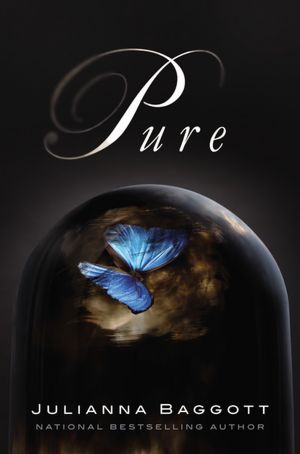
Pg. 69: Julianna Baggott's "Pure"

This weekend's feature at the Page 69 Test: Pure by Julianna Baggott.

About the book, from the publisher:
We know you are here, our brothers and sisters...
Pressia barely remembers the Detonations or much about life during the Before. In her sleeping cabinet behind the rubble of an old barbershop where she lives with her grandfather, she thinks about what is lost-how the world went from amusement parks, movie theaters, birthday parties, fathers and mothers . . . to ash and dust, scars, permanent burns, and fused, damaged bodies. And now, at an age when everyone is required to turn themselves over to the militia to either be trained as a soldier or, if they are too damaged and weak, to be used as live targets, Pressia can no longer pretend to be small. Pressia is on the run.

Burn a Pure and Breathe the Ash...
There are those who escaped the apocalypse unmarked. Pures. They are tucked safely inside the Dome that protects their healthy, superior bodies. Yet Partridge, whose father is one of the most influential men in the Dome, feels isolated and lonely. Different. He thinks about loss-maybe just because his family is broken; his father is emotionally distant; his brother killed himself; and his mother never made it inside their shelter. Or maybe it's his claustrophobia: his feeling that this Dome has become a swaddling of intensely rigid order. So when a slipped phrase suggests his mother might still be alive, Partridge risks his life to leave the Dome to find her.

When Pressia meets Partridge, their worlds shatter all over again.
Learn more about the book and author at Julianna Baggott's website and blog.

The Page 69 Test: Pure.

--Marshal Zeringue

Ten of the best bankers in literature

At the Guardian, John Mullan named ten of the best bankers in literature.

One entry on the list:
Patrick Bateman

We never quite find out what New York investment banker Bateman actually does at work as, in Bret Easton Ellis's American Psycho, he tells us only about what he is wearing, which restaurants he is going to and how beautiful his business card is. And of course the details of his serial killings. But then this is what bankers are really like.
Read about the other bankers on the list.

American Psycho appears on Mullan's list of ten of the best zoos in literature, Richard Gwyn's list of ten books in which things end badly, Nick Brooks' top ten list of literary murderers and Chris Power's list of his six top books on the 1980s. It is a book that Nick Cross "Finished Reading but Wanted My Time Back Afterwards."

--Marshal Zeringue

Pg. 99: Thomas Kohut's "A German Generation"

Today's feature at the Page 99 Test: A German Generation: An Experiential History of the Twentieth Century by Thomas A. Kohut.

About the book, from the publisher:
Germans of the generation born just before the outbreak of World War I lived through a tumultuous and dramatic century. This book tells the story of their lives and, in so doing, offers a new history of twentieth-century Germany, as experienced and made by ordinary human beings.

On the basis of sixty-two oral-history interviews, this book shows how this generation was shaped psychologically by a series of historically engendered losses over the course of the century. In response, this generation turned to the collective to repair the losses it had suffered, most fatefully to the community of the “Volk” during the Third Reich, a racial collective to which this generation was passionately committed and which was at the heart of National Socialism and its popular appeal.
Learn more about A German Generation at the Yale University Press website.

Kohut is the Sue and Edgar Wachenheim III Professor of History at Williams College and author of Wilhelm II and the Germans: A Study in Leadership.

The Page 99 Test: A German Generation.

--Marshal Zeringue

David Schiff's "The Ellington Century," the movie

Now showing at My Book, the Movie: The Ellington Century by David Schiff.

The entry begins:
The Ellington Century is a celebration of Duke Ellington's music, not a biography. The star of a movie version could be Ellington himself since there is lots of film footage going back to 1930 and the short "Black and Tan Fantasy" where Ellington already cut quite an elegant figure playing himself as a young genius.

Ellington appeared...[read on]
Learn more about the book and author at David Schiff's website and the University of California Press.

Schiff is R.P. Wollenberg Professor of Music at Reed College. He is a composer, journalist whose articles have appeared in publications including the New York Times and the Atlantic, and the author of George Gershwin: Rhapsody in Blue and The Music of Elliot Carter.

My Book, the Movie: The Ellington Century.

--Marshal Zeringue

Friday, February 17, 2012

What is Margot Livesey reading?

The current featured contributor at Writers Read: Margot Livesey, author of The Flight of Gemma Hardy.

Her entry begins:
I just read Stewart On'Nan's Emily, Alone which I found entirely absorbing. Here is a novel in which almost nothing happens - a phone call from her daughter is a major event for Emily - and yet I could scarcely bear to put it down. O'Nan does an amazing job of depicting Emily's life as an elderly widow living alone with her dog, listening to classical music and enjoying modest outings with her sister-in-law. Reading these pages, I felt I began to understand what it was like to have ardent thoughts and feeling but mostly be...[read on]
About The Flight of Gemma Hardy, from the publisher:
When her widower father drowns at sea, Gemma Hardy is taken from her native Iceland to Scotland to live with her kind uncle and his family. But the death of her doting guardian leaves Gemma under the care of her resentful aunt, and it soon becomes clear that she is nothing more than an unwelcome guest at Yew House. When she receives a scholarship to a private school, ten-year-old Gemma believes she’s found the perfect solution and eagerly sets out again to a new home. However, at Claypoole she finds herself treated as an unpaid servant.

To Gemma’s delight, the school goes bankrupt, and she takes a job as an au pair on the Orkney Islands. The remote Blackbird Hall belongs to Mr. Sinclair, a London businessman; his eight-year-old niece is Gemma’s charge. Even before their first meeting, Gemma is, like everyone on the island, intrigued by Mr. Sinclair. Rich (by Gemma’s standards), single, flying in from London when he pleases, Hugh Sinclair fills the house with life. An unlikely couple, the two are drawn to each other, but Gemma’s biggest trial is about to begin: a journey of passion and betrayal, redemption and discovery, that will lead her to a life of which she’s never dreamed.

Set in Scotland and Iceland in the 1950s and ’60s, The Flight of Gemma Hardy—a captivating homage to Charlotte Brontë’s Jane Eyre—is a sweeping saga that resurrects the timeless themes of the original but is destined to become a classic all its own.
Learn more about the book and author at Margot Livesey's website and Facebook page.

Writers Read: Margot Livesey (September 2009).

The Page 69 Test: The Flight of Gemma Hardy.

Writers Read: Margot Livesey.

--Marshal Zeringue

Tess Gerritsen's 5 favorite thrillers

Tess Gerritsen is the best-selling author of the Jane Rizzoli crime thrillers.

One of her five favorite thrillers, as told to Daisy Banks at The Browser:
Eye of the Needle by Ken Follett

Next up is the Second World War thriller Eye of the Needle by Ken Follett, about a German spy on the run code-named “the Needle”.

This book was my introduction to the spy thriller. I had read Tinker, Tailor, Soldier, Spy before that. But Eye of the Needle was a thriller as opposed to a spy novel.

What do you think is the difference?

John le Carré is very cerebral. There is an intellectual puzzle of trying to figure out who the characters are. Eye of the Needle was an out-and-out chase thriller. The plot is about whether the English intelligence officer will catch “the Needle” before he completely changes the course of the Second World War. And even though you know how the war ends, Follett manages to keep up this incredible adrenaline all the way through the story because the villain is so brilliant and tenacious.

What makes him such a mesmerising character?

First, he is ruthless. He can get out of almost any scrape. He is like the dark side of James Bond. Another thing Follett does which I found really effective is introduce a heroine who is a completely ordinary housewife with nothing going for her. She is very unhappy, yet she ends up being the one who brings down “the Needle”. That is what I love – a downtrodden character who is not a classic heroine ends up becoming the heroine after all. It’s a wonderful example of an ordinary person doing something extraordinary.
Read about another thriller on the list.

Eye of the Needle is one of Louise Bagshawe's five favorite classic chase novels.

Also see Tess Gerritsen's six favorite books featuring female sleuths.

--Marshal Zeringue