Tuesday, June 30, 2009

What is Nicholas Griffin reading?

The current featured contributor to Writers Read: Nicholas Griffin, author of the historical novels The Requiem Shark, House of Sight and Shadow, and Dizzy City, and the nonfiction work, Caucasus.

His entry begins:
I'm heading toward the end of nine months of research for my next book. That means I've read around 120 books, all non-fiction, as well as several hundred articles. The problem with research is not only that so much of it is dry, most of it is happens to be irrelevant to your own end-result, but even the author doesn't know exactly where he or she is heading at this stage. Among the dross, I read many first rate books, two of which, Nelson Mandela's Long Road to Freedom and Walter Russell Mead's God and Gold stand out.

Writers need patience, but patience itself is put in perspective through Mandela's accomplishments, always pushing outwards, reaching outwards, observing, even when all he had was...[read on]
Learn more about the author and his work at Nicholas Griffin's website.

The Page 99 Test: Dizzy City.

Writers Read: Nicholas Griffin.

--Marshal Zeringue

Pg. 69: James Hayman's "The Cutting"

The current feature at the Page 69 Test: The Cutting by James Hayman.

About the book, from the publisher:
From a formidable new voice in suspense fiction comes an edge-of-the-seat story of a homicide detective on the trail of a killer, who slays with exacting precision, and who harbors a terrifying motive

Detective Sergeant Michael McCabe moved from New York City to Portland, Maine, to escape a dark past: both the ex-wife who’d left him for an investment banker, and the tragic death of his brother, a hero cop gone bad. He sought to raise his young daughter away from the violence of the big city ... so he’s unprepared for the horrific killer he discovers, whose bloody trail may lead to Portland’s social elite.

Early on a September evening, the mutilated body of a pretty teenaged girl, a high school soccer star, is found dumped in a scrap-metal yard. She had been viciously assaulted, but her heart had been cut out of her chest with surgical precision. The very same day a young businesswoman, also a blonde and an athlete, was abducted as she jogged through the streets of the city’s west end. McCabe suspects both crimes are the work of the same man---a killer who’s targeting the young---who is clearly well-versed in complex surgical procedures, and who may have struck before. Just as the investigation is beginning, McCabe’s ex-wife reemerges, suddenly determined to reclaim the daughter she heedlessly abandoned years earlier.

With the help of his straight-talking (and, at times, alluring) partner, Maggie Savage, McCabe begins a race against time to rescue the missing woman and unmask a sadistic killer---before more lives are lost.
Read an excerpt from The Cutting, and learn more about the book and author at James Hayman's website.

The Page 69 Test: The Cutting.

--Marshal Zeringue

Harley the lit blogging corgi

Although Harley doesn't do much of the heavy lifting at Kaye Barley's Meanderings and Muses blog, he certainly is a presence there.

Harley and Kaye are the currently featured duo at Coffee with a Canine.

Kaye introduced the couple:
Harley and I live with my husband Donald in Boone, NC, which is a small town in the Western Carolina mountains. When I'm not working, I'm "Mistress of Meanderings and Muses," a terrific little blog which recently had a virtual party in celebration of welcoming 10,000 visitors. And that's after having been around for less than eight months. I'm pretty proud of that, and over the moon proud of Meanderings and Muses where we host writers and fans from the mystery/crime fiction community as guest bloggers. While most of us have roots in the crime fiction world, our conversations at M&M are all over the place. It's fun and it's interesting, and I hope some of your readers will stop by for a visit. You never know who you'll see there, or what we'll be chatting about.

Harley's full name is Harley Doodle Barley. We added the "Doodle" 'cause he was born on the 4th of July, 2005.
Read more at Coffee with a Canine: Kaye Barley & Harley.

--Marshal Zeringue

Ten of the best marital rows in literature

At the Guardian, John Mullan named ten of the best marital rows in literature.

One dust-up on the list:
Middlemarch, by George Eliot

Lydgate and Rosamond marry in mutual passion, but impecuniousness begins to render the husband "disagreeable" to his wife. Their first row is all the ghastlier for producing no raised voices, just the certainty in Rosamond's mind, when Lydgate talks of pawning her jewels, that if she had known this "she would never have married him".
Read about another marital row on Mullan's list.

Middlemarch also made Mullan's list of ten of the best funerals in literature.

Are you a little unsettled for not having read Middlemarch? So are John Banville and Nick Hornby.

--Marshal Zeringue

Pg. 99: Patrick Manning's "The African Diaspora"

The current feature at the Page 99 Test: The African Diaspora: A History Through Culture by Patrick Manning.

About the book, from the publisher:
Patrick Manning refuses to divide the African diaspora into the experiences of separate regions and nations. Instead, he follows the multiple routes that brought Africans and people of African descent into contact with one another and with Europe, Asia, and the Americas. In weaving these stories together, Manning shows how the waters of the Atlantic Ocean, the Mediterranean Sea, and the Indian Ocean fueled dynamic interactions among black communities and cultures and how these patterns resembled those of a number of connected diasporas concurrently taking shaping across the globe.

Manning begins in 1400 and traces five central themes: the connections that enabled Africans to mutually identify and hold together as a global community; discourses on race; changes in economic circumstance; the character of family life; and the evolution of popular culture. His approach reveals links among seemingly disparate worlds. In the mid-nineteenth century, for example, slavery came under attack in North America, South America, southern Africa, West Africa, the Ottoman Empire, and India, with former slaves rising to positions of political prominence. Yet at the beginning of the twentieth century, the near-elimination of slavery brought new forms of discrimination that removed almost all blacks from government for half a century.

Manning underscores the profound influence that the African diaspora had on world history, demonstrating the inextricable link between black migration and the rise of modernity, especially in regards to the processes of industrialization and urbanization. A remarkably inclusive and far-reaching work, The African Diaspora proves that the advent of modernity cannot be imaginatively or comprehensively engaged without taking the African peoples and the African continent as a whole into account.
Read an excerpt from The African Diaspora, and learn more about the book at the Columbia University Press website.

Learn more about Patrick Manning's research and teaching at his World History Network webpage.

Patrick Manning is Andrew W. Mellon Professor of World History and Director of the World History Center at the University of Pittsburgh and president of the World History Network, a nonprofit corporation fostering research in world history. His books include Slavery and African Life, Migration in World History, and Navigating World History: Historians Create a Global Past.

The Page 99 Test: The African Diaspora.

--Marshal Zeringue

Monday, June 29, 2009

Pg. 69: Binnie Kirshenbaum's "The Scenic Route"

The current feature at the Page 69 Test: The Scenic Route by Binnie Kirshenbaum.

About the book, from the publisher:
Divorced, alone, and unexpectedly unemployed, Sylvia Landsman flees to Italy, where she meets Henry, a wistful, married, middle-aged expatriate. Taking off on a grand tour of Europe bankrolled with his wife's money, Henry and Sylvia follow a circuitous route around the continent—as Sylvia entertains Henry with stories of her peculiar family and her damaged friends, of dead ducks and Alma Mahler. Her narrative is a tapestry of remembrances and regrets...and her secret shame: a small, cowardly sin of omission. Yet when the opportunity arises for Sylvia and Henry to do something small but brave, the refrain "if only" returns to haunt her, leaving Sylvia with one more story of love lived and lost.
Browse inside The Scenic Route, and learn more about the book and author at Binnie Kirshenbaum's website.

Binnie Kirshenbaum is the author of two short story collections and six novels. She is a professor of fiction writing at the Columbia University Graduate School of the Arts and lives in New York City.

The Page 69 Test: The Scenic Route.

--Marshal Zeringue

Ten of the best vegetables in literature

At the Guardian, John Mullan named ten of the best vegetables in literature.

One title on the list:
Gulliver's Travels by Jonathan Swift

At the Grand Academy of Lagado, Gulliver discovers a scientist who "has been eight years upon a project for extracting sunbeams out of cucumbers". His experiments were failing, however, "since this had been a very dear season for cucumbers".
Read about another book on Mullan's list.

Gulliver's Travels
is one of Neil deGrasse Tyson's 5 most important books.

Also see Mullan's list of the ten of the best pieces of fruit in literature and Adam Leith Gollner's top 10 fruit scenes in literature.

--Marshal Zeringue

Sunday, June 28, 2009

Pg. 99: T. Lynn Ocean's "Southern Peril"

The current feature at the Page 99 test: Southern Peril by T. Lynn Ocean.

About the book, from the publisher:
Why is it so hard for Jersey Barnes to retire? When a state supreme judge calls in a favor, she tells herself (again) that this is her last case. She must investigate the judge’s brother, Morgan, and his newly-inherited business. When Jersey realizes the DEA is checking on Morgan, too, she finds herself in the middle of a twenty-year-old mystery and a drug ring investigation. Still checking up on her geriatric father and his trouble-making friends, negotiating the steamy friendship/relationship with her bartender Ox, and dodging the flirtacious sparks flying back and forth with the cute DEA agent, Jersey begins to wonder if retirement is ever in her future. On the heels of the lauded Southern Poison, readers will welcome another hilarious, suspenseful, and sun-soaked adventure from the unforgettable Jersey Barnes.
A freelance writer for more than ten years, T. Lynn Ocean has published in magazines nationwide. She is the author of the novels Fool Me Once, Sweet Home Carolina, Southern Fatality, and Southern Poison.

The Page 69 Test: Southern Fatality.

The Page 69 Test: Southern Poison.

Learn more about the author and her work at T. Lynn Ocean's website.

The Page 99 Test: Southern Peril.

--Marshal Zeringue

What is Esther M. Sternberg reading?

The current featured contributor to Writers Read: Esther M. Sternberg, author of the recently released Healing Spaces: The Science of Place and Well-Being (Harvard University Press, 2009).

Her entry begins:
I generally prefer non-fiction to fiction, and tend to read historical biographies, particularly biographies of accomplished women. Most recently I have read the biography Rosalind Franklin: The Dark Lady of DNA, by Brenda Maddox; the biography Chrysalis: Maria Sibylla Merian and the Secrets of Metamorphosis by Kim Todd; and the biography Jane Austen: A Life by Claire Tomalin. All three of these books not only provide detailed descriptions of the era when these women lived, but also give fascinating insights into the hurdles that they had to overcome in order to accomplish their goals in periods in history when their fields were very much male-dominated. The books are thoughtful in that they reveal character traits in each of these women that helped them make their great contributions despite these challenges and against all odds. The books nonetheless also explore traits that may have hindered them in fully achieving recognition in their own time. The books about scientists (Merian and Franklin) also reveal the history of their particular fields of science, which I find fascinating, in the context of what we know about these fields today.[read on]
Esther M. Sternberg's publications include Healing Spaces and The Balance Within: The Science Connecting Health and Emotions, has done extensive research on brain-immune interactions and the effects of the brain's stress response on health. She was on the faculty at Washington University, St. Louis, prior to joining the National Institutes of Health in 1986.

Read an excerpt from Healing Spaces, and learn more about the book at the Harvard University Press website.

Dr. Sternberg is internationally recognized for her discoveries in brain-immune interactions and the effects of the brain's stress response on health: the science of the mind-body interaction. A dynamic speaker, recognized by her peers as a spokesperson for the field, she translates complex scientific subjects in a highly accessible manner, with a combination of academic credibility, passion for science and compassion as a physician. Learn more about her research, publications, and professional activities at Esther M. Sternberg's website.

Writers Read: Esther M. Sternberg.

--Marshal Zeringue

Pg. 69: Gregg Hurwitz's "Trust No One"

The current feature at the Page 69 Test: Trust No One by Gregg Hurwitz.

About the book, from the publisher:
Over the past two decades, Nick Horrigan has built a quiet, safe life for himself, living as much under the radar as possible. But all of that shatters when, in the middle of the night, a SWAT team bursts into his apartment, grabs him and drags him to a waiting helicopter. A terrorist— someone Nick has never heard of—has seized control of a nuclear reactor, threatening to blow it up. And the only person he’ll talk to is Nick, promising to tell Nick the truth behind the events that shattered his life twenty years ago.

At seventeen years old, Nick Horrigan made a deadly mistake—one that cost his stepfather his life, endangered his mother, and sent him into hiding for years. Now, what Nick discovers in that nuclear plant leaves him with only two choices—to start running again, or to fight and finally uncover the secrets that have held him hostage all these years.

As Nick peels back layer after layer of lies and deception, buffeted between the buried horrors of the past and the deadly intrigues of the present, he finds his own life—and the lives of nearly everyone he loves—at risk. And the only thing guiding him through this deadly labyrinth are his stepfather’s dying words: TRUST NO ONE. Acclaimed for years by both critics and his peers as one of the finest thriller writers today, Gregg Hurwitz has lived up to all the accolades and expectations with Trust No One, an electrifying and compelling novel that will be remembered for years to come.
Read an excerpt from Trust No One and watch the video trailer.

Learn more about the book and author at Gregg Hurwitz's website and blog.

Gregg Hurwitz is the author of several critically acclaimed thrillers, most recently The Crime Writer which was a finalist for the CWA Ian Fleming Steel Dagger and the ITW Best Novel of the Year award.

My Book, The Movie: The Crime Writer.

The Page 69 Test: Trust No One.

--Marshal Zeringue

Five novels about life during the Hapsburg Empire's collapse

Arthur Phillips is the internationally bestselling author of Angelica, The Egyptologist, and Prague, which was a New York Times Notable Book and winner of the Los Angeles Times Art Seidenbaum Award for First Fiction. His latest novel is The Song Is You.

In his Powells.com Q & A, Phillips named "Five Novels That Make You Feel Like You Might Know Something about Life During the Collapse of the Hapsburg Empire."

One book on the list:
The Magic Mountain by Thomas Mann (Not the Hapsburgs, admittedly, but you get the idea.)
Read about all five titles on Phillips' list.

--Marshal Zeringue

Saturday, June 27, 2009

Review: Elina Hirvonen's "When I Forgot"

Ray Taras, who covers contemporary world literature for the blog, reviews Elina Hirvonen's When I Forgot (Tin House Books, 2009):
Dysfunctional people, both Finnish and American, populate this short novel. Set principally in Helsinki, it is a story about the poisonous nature of violence. Fathers return from war to suffer psychotic episodes. They hurt their children and scar them for life. The unmistakable antecedent cause setting off this cycle of pathological behavior is war. In this novel, the theme of war extends from the U.S. invasion of Vietnam to the U.S. occupation of Iraq.

But it is hard to construe this book as anti-American. Rather it is a melancholic narrative of contemporary life in Finland—one without alcohol, humor, or sisu (“spirit”). Thirty years his younger, Elina Hirvonen is as far removed from the playfulness and joie de vivre of an Arto Paasilinna novel as can be imagined.

First-time author Hirvonen is steeped in current affairs. She has worked as filmmaker, magazine editor, freelance journalist, and TV host. Many of her projects are concerned with the subject of migration. She herself has been living in Zambia writing, filming, and teaching. But the focus of When I Forgot is on Anna, a young Finn whose defining relationships are with her mentally-ill brother Joona and her befuddled American lover Ian. She becomes caregiver to one and anchor to the other. As she puts it, “My relationships had been based on two things: tending to someone’s needs, and despair” (p. 84).

A sense of foreboding affects most of the characters in this novel. They are shaped by the political and social events of the day. History makes Hirvonen’s men and women, they do not make history. This is a study of anomie in one affluent society—Finland-- and of aggression in another—the United States.

“Muddling through” is as much as Anna can aspire to. Dwelling on Mrs. Dalloway and on Virginia Woolf suggests other alternatives of escape to Anna. Hirvonen has acknowledged the inspiration she received from reading Michael Cunningham’s The Hours.

Reflecting the novel’s ambiance, the prose is austere: “The evening was warm and thick with longing, but I felt none of it” (p. 160). The glittering lights of Kaivopuisto park along the harbor in Helsinki are a cause for gloom, not joy. Only mad Joona has character, even if it is to lash out at his sister, or morally blackmail her.

Is this an accurate representation of a despondent, anguish-ridden post- 9/11 world, as the book has been billed? It seems a stretch to read that into the narrative. Private life may indeed be structured by public affairs, by the polis. To one degree or another, America may have been traumatized by terrorism and itself resorted to it. Anna’s caregiving slips may produce harrowing consequences. But even under these conditions, individuals have stronger, freer wills than Hirvonen leads the reader to believe.
--Ray Taras
Ray Taras, a visiting scholar at Stanford University, is the author of the recently released Europe Old and New: Transnationalism, Belonging, Xenophobia.

He has reviewed the following fiction for the blog:
Joseph Boyden's Through Black Spruce
Per Petterson's To Siberia
Aravind Adiga's The White Tiger
Per Petterson's Out Stealing Horses
M.G. Vassanji's The Assassin's Song
3 Works by Dorota Masłowska
Andreï Makine's L’amour humain
Michel Houellebecq's The Possibility of an Island
Emmanuel Dongala's Johnny Mad Dog
Amitav Ghosh's The Hungry Tide

Read an excerpt from When I Forgot.

--Marshal Zeringue

Paul Martin Midden's "Toxin," the movie

Now showing at My Book, The Movie: Toxin by Paul Martin Midden.

The entry begins:
Toxin is a book about a senator who gets involved in a plot to alter the United States. Because so many people have been so paranoid about this kind of thing in recent years, it seems like a prime time to make a movie about it.

There are problems, of course: for the most part, senators are boring middle-aged, rich white guys, so it is not often that they figure in novels. Jake Telemark, the protagonist of Toxin, is an unrich, unpedigreed middle-aged guy who just happens to be a senator. He is also an assassin, which makes him interesting.

Who to play Jake? He is a thoughtful guy, capable of reflection, but he is also willing to take action and put plans in motion. A rumpled guy like Phillip Seymour Hoffman or Sean Penn would do well because both of them have the range and complexity to pull this off. If Harrison Ford were fifteen years younger, he would have been ideal.

Now Isadore Hathaway, the love interest and fellow conspirator, needs to be tall, beautiful, bright, and...[read on]
Read more about Toxin at New Books.

Paul Martin Midden is a psychologist who currently serves as Clinical Director of a nationally-recognized treatment center. Absolution, his debut novel, was released in 2007.

My Book, The Movie: Toxin.

--Marshal Zeringue

Five best: books on U.S. history

At the Wall Street Journal, Neal Bascomb, author of Hunting Eichmann: How a Band of Survivors and a Young Spy Agency Chased Down the World’s Most ­Notorious Nazi, named a five best list of books on U.S. history.

One title on his list:
The Children
by David Halberstam
Random House, 1998

In a Montgomery bus station on May 20, 1961, a young man got down on his knees and prayed for the strength to love the racist mob closing in on him. “When he tried to get up, someone kicked him violently in the back, so viciously that three vertebrae on his spine were cracked.” This is one ­visceral scene among scores of others in David Halberstam’s “The Children,” a sweeping portrait of Nashville activists, most of them students, who brought courageous nonviolent protest to the civil-rights struggle in the Deep South. Halberstam covered the movement as a young reporter for the ­Tennessean, and when he wrote this book four decades later, the memory of those students clearly still burned in his heart.
Read about another book on Bascomb's list.

Also see, Gordon Wood's five best list of books on American history.

--Marshal Zeringue

Pg. 99: Chris Knopf's "Hard Stop"

This weekend's feature at the Page 99 Test: Hard Stop by Chris Knopf.

About the book, from Publishers Weekly:
Sam Acquillo, who left his job as head of the Technical Services and Support Division of Con Globe for the humdrum life of a skilled carpenter in the Hamptons, is still a magnet for trouble in Knopf’s rewarding fourth mystery (after 2008’s Head Wounds). George Donovan, Con Globe’s chairman of the board, tries a carrot and stick approach to get Acquillo to find his missing girlfriend, Iku Kinjo, a “brilliant and compelling” consultant. Half of that ploy works, and Acquillo is drawn back into the deadly machinations of corporate intrigue, where the payoff may be wealth or death. Knopf blends familiar elements (cop ally; cop nemesis; bad ex-wife; beautiful, independent girlfriend) in unusually pleasing fashion and adds plenty of original touches as well. Aside from his surprising computer illiteracy, Acquillo is a savvy operator who loves problem solving and has the tenacity of a pit bull. His penchant for intriguing predicaments bodes well for a long and successful series.
Visit Chris Knopf's website to learn more about the Sam Acquillo Hamptons mysteries.

Coffee with a canine: Chris Knopf & Sam.

My Book, The Movie: Two Time.

The Page 99 Test: Hard Stop.

--Marshal Zeringue

Friday, June 26, 2009

Pg. 69: Bridget Asher's "The Pretend Wife"

The current feature at the Page 69 Test: Bridget Asher's The Pretend Wife.

About the book, from the publisher:
What would life be like with the one who got away? From the author of My Husband’s Sweethearts—hailed as “a laugh-and-cry novel”* that’s “whip-smart, tender…an undiluted joy to read”**—comes this bighearted, funny, fiercely perceptive tale about a happily married woman and the little white lie that changed everything.…

For Gwen Merchant, love has always been doled out in little packets—from her father, a marine biologist who buried himself in work after her mother’s death; and from her husband, Peter, who’s always been respectable and safe. But when an old college boyfriend, the irrepressible Elliot Hull, invites himself back into Gwen’s life, she starts to remember a time when love was an ocean.

What does Elliot want? In fact, he has a rather surprising proposition: he wants Gwen to become his wife. His pretend wife. Just for a few days. To accompany him to his family’s lake house for the weekend so that he can fulfill his dying mother’s last wish. Reluctantly Gwen agrees to play along—with her husband Peter’s full support. It’s just one weekend—what harm could come of it?

But as Gwen is drawn into Elliot’s quirky, wonderful family—his astonishingly wise and open mother, his warm and welcoming sister, and his adorable, precocious niece—she starts questioning everything she’s ever expected from love. And as she begins to uncover a few secrets about her own family, it suddenly looks like a pretend relationship just might turn out to be the most real thing she’s ever known.
Read an excerpt from The Pretend Wife, and learn more about the book and author at Bridget Asher's website and blog.

The Page 69 Test: The Pretend Wife.

--Marshal Zeringue

Lisa See: notable books about China

Lisa See's most recent book is Shanghai Girls.

For Powell's, she named several books that "have made me think about China in new ways, pressed me to be more critical (and sometimes more forgiving) of the country, have captured a moment or a subject in a unique way, or have knocked my socks off with the audacity of the subject or the skill of the writer."

One of the titles:
Hungry Ghosts: Mao's Secret Famine by Jasper Becker

To my knowledge, this is the most complete and thorough examination of China's Great Leap Forward, when 30 million people died of starvation caused by Mao's attempt at utopian agricultural policies. It's rare to read a book so well researched, thoughtful, and provocative. I can't stop thinking about it.
Read about another book on See's list.

Also see 2008's best China books and Five Good Short Books on China.

The Page 99 Test: Lisa See's Peony in Love.

--Marshal Zeringue

What is Kevin Kenny reading?

The current featured contributor to Writers Read: Kevin Kenny, author of the newly released Peaceable Kingdom Lost: The Paxton Boys and the Destruction of William Penn’s Holy Experiment.

His entry begins:
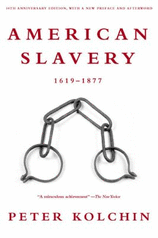
I am currently reading Peter Kolchin’s American Slavery, 1619-1877. A classic in its field, American Slavery was first published in 1993. The current Tenth Anniversary edition comes with a new Preface and Afterword by Kolchin. Accessible to specialists and general readers alike, this elegantly written book covers the period from the beginnings of American slavery through the Civil War and Reconstruction. Kolchin offers a remarkably balanced account of a highly contentious topic, viewing the “peculiar institution” from the perspectives of the slaves, the slave owners, non-slaveowning Southerners, and Northern observers across the political spectrum. He shows how American slavery, far from being a static or monolithic evil, changed over time and spread across space, assuming very different forms in different periods and places. And he interweaves the relevant scholarly controversies into his narrative with a nice, light touch. As the author of Unfree Labor (1990), a study of American slavery and Russian serfdom, Kolchin also excels at placing his subject in comparative contexts, especially Brazil and the Caribbean. He describes American Slavery, 1619-1877 as a “short, interpretive survey” and it is without question the best of its kind.[read on]
Kevin Kenny is Professor of History at Boston College, where he teaches the history of Atlantic migration and popular protest in the eighteenth and nineteenth centuries. In addition to Peaceable Kingdom Lost (Oxford University Press, 2009), he is the author of The American Irish: A History (Longman, 2000), and Making Sense of the Molly Maguires (Oxford University Press, 1998); and contributing editor of New Directions in Irish-American History (University of Wisconsin Press, 2003) and Ireland and the British Empire (Oxford University Press, 2004). He teaches courses on the history of American immigration, race, and ethnicity.

Read more about Peaceable Kingdom Lost at the Oxford University Press website, and see the related essay in the Philadelphia Inquirer, “The ‘holy experiment’ was too good to last,” and his recent entry on OUPblog, Immigrants and Native Americans.”

Learn more about Kevin Kenny's scholarship at his Boston College faculty webpage.

Writers Read: Kevin Kenny.

--Marshal Zeringue

Thursday, June 25, 2009

Pg. 99: Anne Rose's "Psychology and Selfhood in the Segregated South"

The current feature at the Page 99 Test: Psychology and Selfhood in the Segregated South by Anne C. Rose.

About the book, from the publisher:
In the American South at the turn of the twentieth century, the legal segregation of the races and psychological sciences focused on selfhood emerged simultaneously. The two developments presented conflicting views of human nature. American psychiatry and psychology were optimistic about personality growth guided by the new mental sciences. Segregation, in contrast, placed racial traits said to be natural and fixed at the forefront of identity. In a society built on racial differences, raising questions about human potential, as psychology did, was unsettling.

As Anne Rose lays out with sophistication and nuance, the introduction of psychological thinking into the Jim Crow South produced neither a clear victory for racial equality nor a single-minded defense of traditional ways. Instead, professionals of both races treated the mind-set of segregation as a hazardous subject. Psychology and Selfhood in the Segregated South examines the tensions stirred by mental science and restrained by southern custom.

Rose highlights the role of southern black intellectuals who embraced psychological theories as an instrument of reform; their white counterparts, who proved wary of examining the mind; and northerners eager to change the South by means of science. She argues that although psychology and psychiatry took root as academic disciplines, all these practitioners were reluctant to turn the sciences of the mind to the subject of race relations.
Learn more about Psychology and Selfhood in the Segregated South at the publisher's website.

Anne C. Rose is Distinguished Professor of History and Religious Studies at The Pennsylvania State University.

The Page 99 Test: Psychology and Selfhood in the Segregated South.

--Marshal Zeringue

Coffee with a canine: Kristina Riggle & Lucky

The current feature at Coffee with a Canine: Kristina Riggle & Lucky.

Kristina Riggle lives and writes in West Michigan. In addition to her debut novel, Real Life & Liars, she has published short stories in the Cimarron Review, Literary Mama, Espresso Fiction, and elsewhere. She is also a freelance journalist writing primarily for The Grand Rapids Press, and co-editor for fiction at Literary Mama.

Lucky got his name from a work of fiction...and has earned a role in Riggle's next novel:
My son Sam named him. We surprised Sam with the dog; my husband went by himself to go pick the dog up. As soon as Sam saw him, he lit up with pure joy and said, "I'll name him Lucky, hi Lucky!" and that was that. Sam had been reading a bedtime story about a boy with a dog named Lucky. I always liked the name Frodo for a dog, so in my next book, I named a dog Frodo (and also gave Lucky a role in the book, too!).
Browse inside Real Life & Liars, and learn more about the book and author at Kristina Riggle's website.

Writers Read: Kristina Riggle.

The Page 69 Test: Real Life & Liars.

Read--Coffee with a canine: Kristina Riggle & Lucky.

--Marshal Zeringue

Pg. 69: Scott Lasser's "The Year That Follows"

Today's feature at the Page 69 Test: The Year That Follows by Scott Lasser.

About the book, from the publisher:
The story of a woman’s search for her brother’s lost son, orphaned in the wake of his sudden death, drives Scott Lasser’s riveting new novel—a work of stunning economy and momentum about a woman’s quest and a family’s longing for wholeness and completion.

Cat is a single mother living in Detroit when her brother is killed in New York, and she sets off in search of his child. Her search is still under way when she gets a call from her father. Sam is eighty and carrying the weight of a secret he has kept from her all her life. He asks Cat to visit him in California, intending to make his peace.

Cat’s journey—toward her father, and her brother’s infant son—and Sam’s journey toward his daughter, his lost son, and a new relationship to both his future and his past are woven into this superbly realized novel about families and the mysteries and ambiguities that inhere in our most primal relations. The result is a deeply stirring work that explores the complexities of home and heritage, and the bonds that even death is powerless to diminish.
Read an excerpt from The Year That Follows, and learn more about the author and his work at Scott Lasser's website and blog.

Scott Lasser's novels include Battle Creek and All I Could Get. His non-fiction has appeared in magazines ranging from Dealmaker (for which he wrote a regular book column) to The New Yorker.

The Page 69 Test: The Year That Follows.

--Marshal Zeringue

Kim Stanley Robinson's ten favorite Mars novels

Kim Stanley Robinson made his mark as a science-fiction writer with the 1990s Mars Trilogy: Red Mars, Green Mars, and Blue Mars. For the IEEE Spectrum, he named his "10 Favorite Mars Novels.”

One title on the list:
The Martian Chronicles, by Ray Bradbury (1950). By the 1930s, telescopes and radio astronomy made it seem that Mars lacked both water and oxygen, and so the Lowell dream began to die. One of the first and greatest responses to this ”dry Mars” realization was Ray Bradbury’s masterpiece. A series of linked stories, it was the first Mars fiction to suggest that whatever we find on Mars, we will be bringing our old dreams of the place along to haunt us. And the book’s final image will always express another basic Martian truth: We are the Martians we seek.
Read about another book on Kim Stanley Robinson's list.

--Marshal Zeringue

Wednesday, June 24, 2009

What is Alissa Hamilton reading?

The current featured contributor to Writers Read: Alissa Hamilton, author of Squeezed: What You Don't Know About Orange Juice.

Part of her entry:
If you're more in the mood for a thriller, I recommend A Question of Intent: A Great American Battle With a Deadly Industry, by David Kessler, former commissioner of the Food and Drug Administration. Kessler was largely responsible for exposing and cracking down on the tobacco industry. Although the book was published in 2001, it is timely given a recent article co-authored by Kelly Brownell, Yale psychologist and author of Food Fight: The Inside Story of the Food Industry, America's Obesity Crisis, and What We Can Do About it, and Kenneth Warner, tobacco researcher and Dean of the University of Michigan's School of Public Health, about the similarities in the marketing tactics used by the food and tobacco industries.[read on]
Alissa Hamilton holds a Ph.D. from the Yale School of Forestry and Environmental Studies and a J.D. from the University of Toronto Law School. She has been a Graham Research Fellow in International Human Rights at the University of Toronto Faculty of Law. She is currently a 2008-2009 Food and Society Policy Fellow with the Institute for Agriculture and Trade Policy (IATP).

Visit Squeezed's home page at the Yale University Press website, to view reviews, an excerpt, and more.

Check out Alissa Hamilton's blog.

Writers Read: Alissa Hamilton.

--Marshal Zeringue

Pg. 99: Walter Sinnott-Armstrong's "Morality Without God?"

The current feature at the Page 99 Test: Morality Without God? by Walter Sinnott-Armstrong.

About the book, from the publisher:
Some argue that atheism must be false, since without God, no values are possible, and thus "everything is permitted." Walter Sinnott-Armstrong argues that God is not only not essential to morality, but that our moral behavior should be utterly independent of religion. He attacks several core ideas: that atheists are inherently immoral people; that any society will sink into chaos if it is becomes too secular; that without morality, we have no reason to be moral; that absolute moral standards require the existence of God; and that without religion, we simply couldn't know what is wrong and what is right.

Sinnott-Armstrong brings to bear convincing examples and data, as well as a lucid, elegant, and easy to understand writing style. This book should fit well with the debates raging over issues like evolution and intelligent design, atheism, and religion and public life as an example of a pithy, tightly-constructed argument on an issue of great social importance.
Read more about Morality Without God? at the Oxford University Press website.

Visit Walter Sinnott-Armstrong's webpage.

The Page 99 Test: Morality Without God?.

--Marshal Zeringue

Top 10 literary ménages à trois

Ewan Morrison is the author of the novels Distance, Swung, and the soon-to-be-released Ménage as well as the collection of short stories The Last Book You Read. He writes a weekly column for Scotland on Sunday under the name Weegie Bored.

For the Guardian, he named a top ten list of literary ménages à trois.

One book on the list:
Garden of Eden by Ernest Hemingway

The erotic novel that Hemingway suppressed during his own lifetime, and left incomplete on his death, is set in the Cote d'Azur in the 1920s and tells the story of an author, his adventurous wife, and the psycho-sexual games they play while sharing a young woman. It is largely held to be autobiographical.
Read about another book on the list.

--Marshal Zeringue

Pg. 69: Linda Castillo's "Sworn to Silence"

Today's feature at the Page 69 Test: Sworn to Silence by Linda Castillo.

About the book, from the publisher:
Some secrets are too terrible to reveal... Some crimes are too unspeakable to solve...

In the sleepy rural town of Painters Mill, Ohio, the Amish and “English” residents have lived side by side for two centuries. But sixteen years ago, a series of brutal murders shattered the peaceful farming community. In the aftermath of the violence, the town was left with a sense of fragility, a loss of innocence. Kate Burkholder, a young Amish girl, survived the terror of the Slaughterhouse Killer but came away from its brutality with the realization that she no longer belonged with the Amish.

Now, a wealth of experience later, Kate has been asked to return to Painters Mill as Chief of Police. Her Amish roots and big city law enforcement background make her the perfect candidate. She’s certain she’s come to terms with her past—until the first body is discovered in a snowy field. Kate vows to stop the killer before he strikes again. But to do so, she must betray both her family and her Amish past—and expose a dark secret that could destroy her.
Read an excerpt from Sworn to Silence, and learn more about the book and author at Linda Castillo's website.

Linda Castillo is the recipient of numerous writing awards, including the Daphne du Maurier Award of Excellence, the Holt Medallion and a nomination for the Rita.

The Page 69 Test: Sworn to Silence.

--Marshal Zeringue

Tuesday, June 23, 2009

Shattered childhoods: 20 books

One title on AbeBooks' list of 20 books of shattered childhoods:
Mister Pip
Lloyd Jones
(2006)

Thirteen-year-old Matilda sees her South Pacific island wrecked by the violence of a civil war in the 1990s. During the chaos, the island′s only white person begins teaching Charles Dickens’ Great Expectations in the school and, of course, there is a massive disconnection between Victorian England and a small island near Papua New Guinea. The mother-daughter relationship is also vital in this moving novel that won the Commonwealth Writers Prize.
Read about another book on the list. [h/t to escapegrace]

--Marshal Zeringue

Pg. 99: Marc Bekoff & Jessica Pierce's "Wild Justice"

The current feature at the Page 99 Test: Wild Justice: The Moral Lives of Animals by Marc Bekoff and Jessica Pierce.

About the book, from the publisher:
Scientists have long counseled against interpreting animal behavior in terms of human emotions, warning that such anthropomorphizing limits our ability to understand animals as they really are. Yet what are we to make of a female gorilla in a German zoo who spent days mourning the death of her baby? Or a wild female elephant who cared for a younger one after she was injured by a rambunctious teenage male? Or a rat who refused to push a lever for food when he saw that doing so caused another rat to be shocked? Aren’t these clear signs that animals have recognizable emotions and moral intelligence? With Wild Justice Marc Bekoff and Jessica Pierce unequivocally answer yes.

Marrying years of behavioral and cognitive research with compelling and moving anecdotes, Bekoff and Pierce reveal that animals exhibit a broad repertoire of moral behaviors, including fairness, empathy, trust, and reciprocity. Underlying these behaviors is a complex and nuanced range of emotions, backed by a high degree of intelligence and surprising behavioral flexibility. Animals, in short, are incredibly adept social beings, relying on rules of conduct to navigate intricate social networks that are essential to their survival. Ultimately, Bekoff and Pierce draw the astonishing conclusion that there is no moral gap between humans and other species: morality is an evolved trait that we unquestionably share with other social mammals.

Sure to be controversial, Wild Justice offers not just cutting-edge science, but a provocative call to rethink our relationship with—and our responsibilities toward—our fellow animals.
Read an excerpt from Wild Justice, and learn more about the book at the University of Chicago Press website.

Marc Bekoff has published numerous books, including The Emotional Lives of Animals, and has provided expert commentary for many media outlets, including the New York Times, CNN, and the BBC. Jessica Pierce has taught and written about philosophy for many years. She is the author of a number of books, including Morality Play: Case Studies in Ethics.

The Page 99 Test: Wild Justice.

--Marshal Zeringue

Pg. 69: Attica Locke's "Black Water Rising"

The current feature at the Page 69 Test: Black Water Rising by Attica Locke.

About the book, from the publisher:
Writing in the tradition of Dennis Lehane and Greg Iles, Attica Locke, a powerful new voice in American fiction, delivers a brilliant debut thriller that readers will not soon forget.

Jay Porter is hardly the lawyer he set out to be. His most promising client is a low-rent call girl and he runs his fledgling law practice out of a dingy strip mall. But he's long since made peace with not living the American Dream and carefully tucked away his darkest sins: the guns, the FBI file, the trial that nearly destroyed him.

Houston, Texas, 1981. It is here that Jay believes he can make a fresh start. That is, until the night in a boat out on the bayou when he impulsively saves a woman from drowning—and opens a Pandora's box. Her secrets put Jay in danger, ensnaring him in a murder investigation that could cost him his practice, his family, and even his life. But before he can get to the bottom of a tangled mystery that reaches into the upper echelons of Houston's corporate power brokers, Jay must confront the demons of his past.

With pacing that captures the reader from the first scene through an exhilarating climax, Black Water Rising marks the arrival of an electrifying new talent.
Browse inside Black Water Rising, and learn more about the book and author at Attica Locke's website.

Attica Locke is a writer who has worked in both film and television. A graduate of Northwestern University, she has written movie scripts for Paramount, Warner Bros., Disney, Twentieth Century Fox, and Jerry Bruckheimer films, as well as television pilots for HBO, Dreamworks, and Silver Pictures. She is currently at work on an HBO miniseries about the civil rights movement.

The Page 69 Test: Black Water Rising.

--Marshal Zeringue

Monday, June 22, 2009

Henry Perez's "Killing Red," the movie

Now showing at My Book, The Movie: Killing Red by Henry Perez.

The entry begins:
Like a lot of people I know, I developed an obsession for movies at an early age. I studied film, both production and theory, in college, and tend to think of my stories in a visual, cinematic way as I’m writing them.

In writing Killing Red, my debut mystery, I approached the plotting and pacing much like I would a screenplay. I got the action on the page in my first draft, making sure there was nothing there that was unnecessary or that might slow things down. I colored in many of the details in subsequent revisions.

So discussing what it might be like to see my first book turned into a film seems quite natural in a way. Killing Red is the story of Alex Chapa, a Chicago-area newspaper reporter who made a name for himself fifteen years ago when he broke the story of the capture of Kenny Lee Grubb, after a young girl named Annie Sykes escaped and led police to the mass murderer’s home. Now, less than a week before Grubb is to be executed, Chapa is summoned to the prison for one last interview. But instead of the usual death row confessional or final declarations of innocence, Grubb boasts that a copycat has been retracing his steps, and that Annie Sykes, now in her twenties, will be the final victim. Chapa has just a few days to find Annie before someone else does.

The first question authors are usually asked on the subject of their book being turned into a film concerns casting, and I’ve heard some speak candidly about having this actor or that actress in mind when they were creating a character. I...[read on]
Preview Killing Red, and learn more about the book and author at Henry Perez's website and blog.

Henry Perez has worked as a newspaper reporter for more than a decade. Born in Cuba, he immigrated to the U.S. at a young age, and lives in the Chicago area with his wife and children.

My Book, The Movie: Killing Red.

--Marshal Zeringue

What is Caitlin O'Connell reading?

The current featured contributor to Writers Read: Caitlin O'Connell, author of The Elephant’s Secret Sense and the upcoming The Boys Club about male society from the elephant perspective. She is also co-author of a children’s nonfiction science book called The Elephant Scientist. Her essay in the August issue (2009) of The Writer magazine strives to assist the nature writer in “casting words in nature’s best light.”

Her entry begins:
Because I teach a creative writing class for Stanford’s Continuing Studies program, I’m always on the lookout for books to recommend to my students on the craft of writing. Bird by Bird by Anne Lamott was recently recommended and it didn’t take long to see why. Part of my phobia of self-help books is the assumption that they deliver dry facts on how I should behave within the discipline of writing and inevitably make me feel like I’ve somehow failed at my craft if I’m not able to do my daily writing exercises, keep a diary and be religious about outlining prior to writing. Anne Lamott blows those fears out of the water with her wonderful and frank personal narrative about a writer’s struggles, failures and successes, while weaving in motives for trying some concrete, very accessible tools to assist writers in moving forward with their goals. I highly recommend this book to writers, would-be writers, as well as readers looking for a fun personal narrative.[read on]
Read an excerpt from The Elephant’s Secret Sense and learn more about the book at the publisher's website.

The Page 99 Test: The Elephant’s Secret Sense.

Writers Read: Caitlin O'Connell.

--Marshal Zeringue

Ten of the best births in fiction

At the Guardian, John Mullan named ten of the best births in literature.

One title on the list:
Beloved by Toni Morrison

Runaway slave Sethe is trying to make it across the Ohio river to a state where blacks are free. Short of her goal she goes into labour in a field of camomile, sure that she will die. But Amy, a young white girl, helps her to a nearby shed, where she gives birth to Denver.
Read about another birth on Mullan's list.

Beloved also appears on Kit Whitfield's top ten list of genre-defying novels and on top of one list of contenders for the title of the single best work of American fiction published in the last twenty-five years.

--Marshal Zeringue

Pg. 99: Julie Metz's "Perfection"

Today's feature at the Page 99 Test: Perfection: A Memoir of Betrayal and Renewal by Julie Metz.

About the book, from the publisher:
Julie Metz’s life changes forever on one ordinary January afternoon when her husband, Henry, collapses on the kitchen floor and dies in her arms. Suddenly, this mother of a six-year-old is the young widow in a bucolic small town. And this is only the beginning. Seven months after Henry’s death, just when Julie thinks she is emerging from the worst of it, comes the rest of it: She discovers that what had appeared to be the reality of her marriage was but a half-truth. Henry had hidden another life from her.

“He loved you so much.” That’s what everyone keeps telling her. It’s true that he loved Julie and their six-year-old daughter ebulliently and devotedly, but as she starts to pick up the pieces and rebuild her life without Henry in it, she learns that Henry had been unfaithful throughout their twelve years of marriage. The most damaging affair was ongoing—a tumultuous relationship that ended only with Henry’s death. For Julie, the only thing to do was to get at the real truth—to strip away the veneer of “perfection” that was her life and confront each of the women beneath the veneer.

Perfection is the story of Julie Metz’s journey through chaos and transformation as she creates a different life for herself and her young daughter. It is the story of coming to terms with painful truths, of rebuilding both a life and an identity after betrayal and widowhood. It is a story of rebirth and happiness—if not perfection.
Read an excerpt from Perfection, and learn more about the book and author at Julie Metz's website and blog.

The Page 99 Test: Perfection.

--Marshal Zeringue

Sunday, June 21, 2009

Coffee with a canine: Chris Knopf & Sam

Hard Stop, Chris Knopf's fourth and latest Hamptons Mystery novel, is now available from booksellers everywhere.

Kirkus called protagonist Sam Acquillo an "appealing hero" who is complemented by "a colorful entourage that includes endearing Eddie, the anti-Marley dog, mak[ing] for a lively and entertaining mix."

"Eddie, the anti-Marley dog" is more formally known as Eddie van Halen, and he shares certain character traits with Knopf's 9-year-old soft-coated Wheaten terrier, Sam, who is named after Samuel Beckett, another famous Irish existentialist.

Knopf and Sam are featured in the inaugural post of my new blog, Coffee with a Canine.

Learn more about Sam and Chris at Chris Knopf's website.

Read--Coffee with a canine: Chris Knopf & Sam.

--Marshal Zeringue

Pg. 69: Robert Dugoni's "Wrongful Death"

The current feature at the Page 69 Test: Wrongful Death by Robert Dugoni.

About the book, from the publisher:
Just minutes after winning a $1.6 million wrongful-death verdict, attorney David Sloane confronts the one case that threatens to blemish his unbeaten record in the courtroom. Beverly Ford wants Sloane to sue the United States government and military in the mysterious death of her husband, James, a national guardsman killed in Iraq. While a decades-old military doctrine might make Ford's case impossible to win, Sloane, a former soldier himself, is compelled to find justice for the widow and her four children in what is certain to become the biggest challenge of his career.

With little hard evidence to go on, Sloane calls on his friend, reclusive former CIA agent turned private investigator Charles Jenkins, to track down the other men serving with Ford the night he died. Alarmingly, two of the four who returned home alive didn't stay that way for long, and though the mission's wheelchairbound commander now works for a civilian contractor, he refuses to talk. The final -- and youngest -- soldier is also the most elusive, but he's their only shot at discovering the truth -- if Sloane and Jenkins can keep him alive long enough to tell it.

Meanwhile, Sloane isn't the only one on a manhunt. As he propels his case into a federal courtroom, those seeking to hide the truth threaten Sloane's family, forcing his new wife Tina and stepson Jake into hiding, where they become the targets of a relentless killer. Now Sloane must race to uncover what really happened on that fatal mission, not only to bring justice to a family wronged but to keep himself and the people closest to him from becoming the next casualties...
Read an excerpt from Wrongful Death, and learn more about the book and author at Robert Dugoni's website and blog.

Robert Dugoni is the New York Times bestselling author of The Jury Master and Damage Control.

The Page 69 Test: Wrongful Death.

--Marshal Zeringue

Five best books about criminals

Elliott Gorn, who teaches history and American Civilization at Brown ­University, is the author of Dillinger’s Wild Ride: The Year That Made America’s Public Enemy ­Number One. For the Wall Street Journal, he named a five best list of books about criminals.

One book on the list:
Pickpocket’s Tale
by Timothy Gilfoyle
Norton, 2006

Years ago, historian Timothy Gilfoyle found in the archives the crudely written, 99-page memoir of a minor New York crime figure, George Appo. With “A Pickpocket’s Tale,” Gilfoyle builds a story of the urban demimonde around Appo’s own words. Half Irish and half Chinese, his mother dead and his father in prison, Appo grew up in the notorious Five Points section of Lower Manhattan, where he learned the art of the scam and went on to become a “con artist, a trickster extraordinaire.” Appo’s story is an amazing one, set in brothels and opium dens, night courts and prisons. Gilfoyle skillfully depicts this underworld of poverty and brutality, pluck and luck, against the backdrop of opulent Gilded Age New York.
Read about another book on the list.

See Theodore Dalrymple's list of favorite books on the criminal mind.

--Marshal Zeringue

Saturday, June 20, 2009

What is Josh Weil reading?

This weekend's featured contributor at Writers Read: Josh Weil, author of The New Valley, three linked novellas.

According to Maureen Howard, in The New Valley Weil's "rendering of place is strong as Flannery O'Connor's; his engagement with the moral landscape of a sorry corner of the country is sure as Cormac McCarthy's. In their contemplation of the past, Weil's characters--earthy, scrappy, often comic--seek restoration, figuratively and literally. These three fine novellas remind us with wit and energy, that we are all in for repair."

Weil's entry begins:
I've noticed this can happen with short story collections, even the best ones: you pick it up, read a few stories, love them, and then something else gets in a way and you never finish the collection. Unless it's really, really good -- and then you pick it back up, maybe a year later, and dive back into it and think: how did I ever set this down? That's where I'm at right now with Don Waters' collection, Desert Gothic. It's set in America's dry, hot, sun-backed places: mostly around Reno, Nevada. And it pulls off darkness and light, heat and chill, as naturally and as cleanly and as inseparably as the desert landscape does. These are stories about grief and loss and the places in us that are hollowed out by both, but Waters manages to dig around those places with a gentleness that makes me want to exist there a little longer with each story, even if it's difficult, even if it's sad. He has lots of talents, but the main three that are striking me as I dive back into this are these: 1. He sees details most of us would miss, and when he points them out they're the kind of thing that feel so vital we'd have missed the whole point without them. 2. In much the same way, the rhythm of his language feels both fresh and natural to the stories. 3. Finally, and most importantly, he hits on that surprising yet absolutely right feeling near the end of each story: he finds ways to bring the stories together with events that are utterly pleasing. What I mean by that is that they are the perfect events to end the story without ever feeling like the easy way out. It's good stuff.

In the year between reading the beginning of Desert Gothic and going back to it, I read three books that blew me away:...[read on]
Josh Weil received his MFA as a Jersey Fellow at Columbia University. His fiction has appeared in numerous literary journals including Granta, Story Quarterly, and New England Review. The New Valley is his first book.

Visit Josh Weil's website.

Writers Read: Josh Weil.

--Marshal Zeringue

Pg. 99: Kyria Abrahams' "I’m Perfect, You’re Doomed"

This weekend's feature at the Page 99 Test: I'm Perfect, You're Doomed: Tales from a Jehovah's Witness Upbringing by Kyria Abrahams.

About the book, from the publisher:
I'm Perfect, You're Doomed is the story of Kyria Abrahams's coming-of-age as a Jehovah's Witness -- a doorbell-ringing "Pioneer of the Lord." Her childhood was haunted by the knowledge that her neighbors and schoolmates were doomed to die in an imminent fiery apocalypse; that Smurfs were evil; that just about anything you could buy at a yard sale was infested by demons; and that Ouija boards -- even if they were manufactured by Parker Brothers -- were portals to hell. Never mind how popular you are when you hand out the Watchtower instead of candy at Halloween.

When Abrahams turned eighteen, things got even stranger. That's when she found herself married to a man she didn't love, with adultery her only way out. "Disfellowshipped" and exiled from the only world she'd ever known, Abrahams realized that the only people who could save her were the very sinners she had prayed would be smitten by God's wrath.

Raucously funny, deeply unsettling, and written with scorching wit and deep compassion, I'm Perfect, You're Doomed explores the ironic absurdity of growing up believing that nothing matters because everything's about to be destroyed.
Read an excerpt from I’m Perfect, You’re Doomed, and learn more about the book and author at Kyria Abrahams' website and blog.

The Page 99 Test: I'm Perfect, You're Doomed.

--Marshal Zeringue

Poetry books: ten best

For the (London) Independent, director of The Poetry Society Judith Palmer named her ten best poetry books.

One title on the list:
Michael Donaghy: Collected Poems

"And when you lick the sweat along my thigh/Dearest, we renew the gift of tongues". A posthumous gathering-together of intimate and witty poems, told by the charming Chicago-Irishman in a conspiratorial whisper: "Ever been tattooed? It takes a whim of iron".
Read about another book on Palmer's list.

--Marshal Zeringue

Friday, June 19, 2009

Pg. 69: Tom Gabbay's "The Tehran Conviction"

The current feature at the Page 69 Test: The Tehran Conviction by Tom Gabbay.

About the book, from the publisher:
Tom Gabbay plots his most riveting tale yet: Agent Jack Teller had to make an ugly choice in his youth ... and now, decades later, he and the United States must deal with the blowback.

Tehran 1953. Jack Teller, a new recruit to the recently established Central Intelligence Agency, finds himself in Iran posing as a high-level American oil executive as part of Operation Ajax, the agency's first attempt to overthrow the government of a sovereign nation. Torn between loyalty to his country's policies and sympathy for the hopes of a fledgling democracy, Jack must ultimately pick which side he will betray. It is a decision that will affect the future of the Middle East and, eventually, the world.

Twenty-six years later, in 1979, Jack returns to a very different Iran. The country is in the grip of a religious revolution, and the streets of the capital city are filled with daily rantings against The Great Satan. Jack's attempt to save one man from Islamic justice—a man whom he had, at one time, called a friend—leads him into the heart of an emerging struggle between the West and a new and dangerous ideology.

Divided by conflicting loyalties, a young Jack Teller made a fateful choice that would reverberate for decades. In The Tehran Conviction, Tom Gabbay masterfully interweaves politics and suspense in a searing tale of espionage and betrayal that reveals the unexpected costs our decisions hold for us—and for history.
Browse inside The Tehran Conviction, and learn more about the author and his Jack Telller novels at Tom Gabbay's website.

Gabbay is the author of The Berlin Conspiracy and The Lisbon Crossing.

The Page 69 Test: The Lisbon Crossing.

The Page 69 Test: The Tehran Conviction.

--Marshal Zeringue

Ten best apocalypse novels of pre-golden age SF

Joshua Glenn, at io9, named the years 1904-33 SF's Pre-Golden Age (not to be confused with its Pulp Era--i.e., the mid-1920s through the mid-1950s). Then he came up with the era's "ten great novels of the apocalypse."

One book on the list:
Olaf Stapledon, Last and First Men: A Story of the Near and Far Future (1930). In his awe-inspiring, tragicomic first novel, Stapledon, a British philosopher and progressivist, ventriloquizes the future history of humankind as related to him telepathically by one of the Last Men - alien descendants of ours who will inhabit Neptune, where they'll face extinction as the sun burns out, some two billion years hence. So what does fate hold in store for us, the First Men? Well, the post-WWI "passionate will for peace and a united world" won't last long, Stapledon's narrator informs readers. Within a century aerial bombs and poison gas will have laid waste to Europe (including Russia), leaving the Chinese and Americans to compete for global military and economic domination. Eventually, a World State will be founded, and peace and prosperity will reign... until Earth's natural energy sources get used up! At that point, civilization will collapse and the First Men will devolve into superstitious savages living in the shadow of their ancestors' skyscrapers - "though for the most part they were of course by now little more than pyramids of debris overgrown with grass and brushwood" - until, after nearly 100,000 years, they'll re-civilize themselves and discover atomic energy. Which they'll use, "after a bout of insane monkeying with the machinery," to inadvertantly annihilate all but 35 men and women, whose mutated descendants will be the Second Men. This sort of thing goes on, and on, and on, entertainingly and soberingly, for 18 generations of humankind. Multiple apocalypses, and all for the price of one novel! Read more about Last and First Men in the Homo Superior installment of this series.
Read about another book on Glenn's list.

--Marshal Zeringue

What is Simon Van Booy reading?

The current featured contributor to Writers Read: Simon Van Booy, author of The Secret Lives of People in Love and the newly released Love Begins in Winter.

His entry begins:
Lately I have been reading about everything from fashion to Proust, metaphysical investigation to new children's tales. For me, one of the pleasures of reading is pulling from a variety of sources to amalgamate an image of the world and our consciousness of it. Books are ingredients in a recipe that ultimately helps to make up our minds over the course of years of reading. For instance, I have been reading Walt Whitman, whose expansive elegies constitute vast feasts of American life to me. And Guy de Maupaussant, whose delectable stories taste of....[read on]
Visit Simon Van Booy's website.

Writers Read: Simon Van Booy.

--Marshal Zeringue

Thursday, June 18, 2009

Pg. 99: Wednesday Martin's "Stepmonster"

The current feature at the Page 99 Test: Stepmonster: The Surprising Truth About Why Real Stepmothers Think, Feel, and Act the Way We Do by Wednesday Martin.

About the book, from the publisher:
A groundbreaking and truly stepmother-centered way of understanding the tensions that seem to define relations between women and their stepchildren

Half of all women in the United States will live with or marry a man with children. And what woman with stepchildren has not—in order to defuse the often overwhelming challenges of the role—referred to herself as a "stepmonster"?

As Hope Edelman does in her book for motherless daughters, Wednesday Martin’s empowering and original Stepmonster unlocks the emotional mysteries of why stepmothers think and feel and act the way they do. Martin draws upon her own experience as a stepmother, interviews with other stepmothers and stepchildren, and fascinating insights from literature, anthropology, psychology, and evolutionary biology to reveal the little-understood realities of this most demanding role.

Stepmonster illuminates the harrowing process of becoming a stepmother, considers the myths and realities of being married to a man with children, counteracts the cultural notion that stepmothers are solely responsible for the challenges they encounter, identifies the "Five Step-Dilemmas That Create Conflict," and considers the emotional and social challenges men with children face when they remarry.

Finally, in an unexpected twist, Martin shows why the myth of the Wicked Stepmother is our single best tool for understanding who real stepmothers are and how they feel.
Read an excerpt from Stepmonster, and learn more about the book and author at Wednesday Martin's website and blog.

The Page 99 Test: Stepmonster.

--Marshal Zeringue

R. A. Riekki's "U.P.," the movie

Now showing at My Book, The Movie: U.P. by Ron Riekki.

The entry begins:
Tonight I walked my first red carpet. I was supposed to go with a gangsta rapper whose sister won Last Comic Standing, but he cancelled last minute, so I found myself alone at an awards show at Universal being introduced by a handler as “author Ron Riekki. He’s awesome.” I laughed each time a photo was taken. There was some guy with a cane who was supposedly heir to a billion dollar oil fortune and Dean Cain, a.k.a. Superman, talking humbly about his son and then me.

I moved to L.A. because I do have dreams of U.P. being a film. Two reasons why I’ve been confident it could happen are that the book has been Ghost Road Press’s fiction bestseller for fourteen weeks and because a friend whose opinion I respect—Rafael Alvarez (writer for HBO’s The Wire)—put the idea in my head of it being a film. Well, being here helps take things a step closer. Now it’s destiny. I figure Barfly would never have been made if Bukowski lived his life in Opelika, Alabama, so here I am ... afterwards eating free gourmet macaroni and cheese, nursing a recommended Merlot, and chatting with a producer who wanted to hear about the novel. I pitched it was full of strong roles for young actors, where they’d get to play the type of roles they tend to desire, the sort of vibrant character roles you find in Snatch or Pulp Fiction. He took my card. We’ll see.

On the drive home, I thought about this article, the recent red carpet memories showing that things can happen if you make yourself available for them to happen.

The novel’s written in four distinctive voices, four high schoolers trying to survive a brutal Michigan winter and a violent act by a local bully. For Cräig, a metalhead who insists everyone put an umlaut in his name, I imagine...[read on]
Visit Ron Riekki's website.

Writers Read: Ron Riekki.

My Book, The Movie: U.P..

--Marshal Zeringue

Top ten environmental disaster stories

Liz Jensen's latest novel, The Rapture, is an ecological thriller about a psychotic teenage girl who warns of an earth-changing cataclysm. Available now in the U.K., The Rapture arrives in America in August.

Among the early praise for The Rapture:
“In this modern world of religious warfare and global warming, The Rapture is as topical as it is thrilling. Beautifully written, haunting, and thoroughly entertaining. The gripping tension of Lost mixed with the poetic poignancy of The Bell Jar. I simply could not stop turning pages.”
—Matthew Quick, author of the Silver Linings Playbook

"Liz Jensen's exciting thriller often feels as frightening and prophetic as the sixteen-year-old girl at its center. The Rapture is a terrific novel, expertly written, thought-provoking, and deeply unsettling."
—Kevin Guilfoile, author of Cast of Shadows
Jensen named her top 10 environmental disaster stories for the Guardian.

One novel on the list:
The Road by Cormac McCarthy

Post-apocalyptic fiction doesn't come much bleaker, or more finely written, than this. A father and his son must cross a landscape devastated by an unnamed cataclysm, and learn the full horror of what some will do to stay alive. A stern, painful, haunting fable of a world beyond the brink, from one of America's greatest living writers.
Read about another novel on Jensen's list.

Other fans of The Road include Paulette Jiles, Joshua Clark, David Dobbs, Andrew Pyper, Dan Rather, Jim Lehrer, Michael J. Fox, Mark McGurl, and this guy.

--Marshal Zeringue

Pg. 69: Anthony Neil Smith's "Hogdoggin’"

Today's feature at the Page 69 Test: Hogdoggin’ by Anthony Neil Smith.

About the book, from the publisher:
Former Deputy Billy Lafitte is a no-good, crap-for-brains, despicable and dangerous traitor — Special Agent Franklin Rome is sure of it. So sure, in fact, that he’s willing to investigate outside departmental bounds. Willing to blackmail and bribe his fellow lawmen into helping him. Willing to ferret Lafitte out of whatever snake-hole he’s hidden himself in, and do what the too-lax government wouldn’t let him do back in Yellow Medicine county, just months ago…

And Rome’s plan is working. Squeeze a man’s ex-wife, especially an ex-wife as unstable as Ginny Lafitte, and watch her overprotective man appear from thin air to stand by his family. No matter that Rome’s had to bend a few rules in order to make it happen; Billy’s end will justify Rome’s means.

Of course, Rome didn’t count on Billy riding in to save the day on a turquoise motorcycle — with a beard, fifty extra pounds of muscle, and the weight of a man named Steel God at his back. Nor did he think Billy would go and get himself caught up with paint-huffing, knife-wielding rednecks. And Rome certainly never predicted that a broken-hearted, vengeful woman named Colleen would be just as hot for Lafitte’s blood as he is …
Visit Anthony Neil Smith's website and MySpace page.

Anthony Neil Smith is also the editor of Plots With Guns and the author of Pyschosomatic, The Drummer, and Yellow Medicine.

"My Book, The Movie" -- Pyschosomatic.

The Page 69 Test: Yellow Medicine.

The Page 69 Test: Hogdoggin’.

--Marshal Zeringue

Wednesday, June 17, 2009

What is Donna Jo Napoli reading?

The current featured contributor to Writers Read: Donna Jo Napoli, the award-winning author of many distinguished books for young readers, including The King of Mulberry Street, Daughter of Venice, and the newly released Alligator Bayou. She is also a professor of linguistics at Swarthmore College.

Her recent reading includes a book which prompted this revelation:
I'm writing a book set in India in the 1500s -- and modern books, you might think, would not help me in the least. But I think this book does help because of exactly that -- the steeping in a culture that holds onto ancient ways beside the modern. Also, quite incidentally, the book is riddled with misery -- and I love misery.[read on]
Visit Donna Jo Napoli's website.

Writers Read: Donna Jo Napoli.

--Marshal Zeringue

Pg. 99: Michèle Lamont's "How Professors Think"

The current feature at the Page 99 Test: How Professors Think: Inside the Curious World of Academic Judgment by Michèle Lamont.

About the book, from the publisher:
Excellence. Originality. Intelligence. Everyone in academia stresses quality. But what exactly is it, and how do professors identify it?

In the academic evaluation system known as “peer review,” highly respected professors pass judgment, usually confidentially, on the work of others. But only those present in the deliberative chambers know exactly what is said. Michèle Lamont observed deliberations for fellowships and research grants, and interviewed panel members at length. In How Professors Think, she reveals what she discovered about this secretive, powerful, peculiar world.

Anthropologists, political scientists, literary scholars, economists, historians, and philosophers don’t share the same standards. Economists prefer mathematical models, historians favor different kinds of evidence, and philosophers don’t care much if only other philosophers understand them. But when they come together for peer assessment, academics are expected to explain their criteria, respect each other’s expertise, and guard against admiring only work that resembles their own. They must decide: Is the research original and important? Brave, or glib? Timely, or merely trendy? Pro-diversity or interdisciplinary enough?

Judging quality isn’t robotically rational; it’s emotional, cognitive, and social, too. Yet most academics’ self-respect is rooted in their ability to analyze complexity and recognize quality, in order to come to the fairest decisions about that elusive god, “excellence.” In How Professors Think, Lamont aims to illuminate the confidential process of evaluation and to push the gatekeepers to both better understand and perform their role.
Read an excerpt from How Professors Think, and learn more about the book at the Harvard University Press website.

The Page 99 Test: How Professors Think.

--Marshal Zeringue

Top five faked memoirs

Benjamin Radford is a writer, investigator, and managing editor for Skeptical Inquirer science magazine. His Bad Science column appears regularly on LiveScience.

For LiveScience, he named his top five faked memoirs.

One book on the list:
"A Million Little Pieces," by James Frey

The most high-profile Oprah-endorsed fiction parading as memoir, James Frey's best-seller "A Million Little Pieces" told the moving story of a young alcoholic drug abuser who struggles to get clean and sober in a treatment center. The 2003 book was praised by many and heavily promoted in Oprah's book club before being revealed as largely faked. Frey's publishers at first defended the book, but as evidence mounted that much of it had been fabricated, they offered refunds for fiction sold as fact and added disclaimers to later editions.
Read about another title on Radford's list.

Also see Iain Finlayson's critic's chart of the best faked memoirs.

--Marshal Zeringue

Pg. 69: Kristina Riggle's "Real Life & Liars"

The current feature at the Page 69 Test: Real Life & Liars by Kristina Riggle.

About the book, from the publisher:
Sometimes you find happiness where, and when, you least expect it.

For Mirabelle Zielinski's children, happiness always seems to be just out of reach. Her polished oldest daughter, Katya, clings to a stale marriage with a workaholic husband and three spoiled children. Her son, Ivan, so creative, is a down-in-the-dumps songwriter with the worst taste in women. And the "baby," impulsive Irina, who lives life on a whim, is now reluctantly pregnant and hitched to a man who is twice her age. On the weekend of their parents' anniversary party, lies will be revealed, hearts will be broken...but love will also be found. And the biggest shock may come from Mirabelle herself, because she has a secret that will change everything.
Browse inside Real Life & Liars, and learn more about the book and author at Kristina Riggle's website.

Writers Read: Kristina Riggle.

The Page 69 Test: Real Life & Liars.

--Marshal Zeringue

Tuesday, June 16, 2009

What is Pat Shipman reading?

The current featured contributor to Writers Read: Pat Shipman, author of Femme Fatale: Love, Lies, and the Unknown Life of Mata Hari.

Her entry begins:
I am re-reading Pat Barker's trilogy about World War I: Regeneration, The Eye in the Door, and Ghost Road. Not only is the writing beautiful and effective, but Barker's insights into the meaning of war for the soldier, the officer, and the ones left at home is brilliant. Besides, I can think of no two more fascinating people in history than W.H. Rivers, the psychologist and anthropologist, and his patient Siegfried Sassoon, the WWI poet, officer, and war protester. Their interaction in the first book as Rivers treats Sassoon (and others) for "mental illness," which in Sassoon's case is justifiable anguish over the horrors of an ill-defined war, is superb.

For those who...[read on]
Pat Shipman's books include To the Heart of the Nile, The Man Who Found the Missing Link, and Taking Wing, which won the Phi Beta Kappa Prize for science and was a finalist for the Los Angeles Times Book Award and named a New York Times Notable Book for 1998.

Browse inside Femme Fatale, and learn more about the book at the publisher's website.

The Page 99 Test: Femme Fatale.

Writers Read: Pat Shipman.

--Marshal Zeringue

Pg. 99: Lawrence S. Wittner's "Confronting the Bomb"

The current feature at the Page 99 Test: Confronting the Bomb: A Short History of the World Nuclear Disarmament Movement by Lawrence S. Wittner.

About the book, from the publisher:
Confronting the Bomb tells the dramatic, inspiring story of how citizen activism helped curb the nuclear arms race and prevent nuclear war. This abbreviated version of Lawrence Wittner's award-winning trilogy, The Struggle Against the Bomb, shows how a worldwide, grassroots campaign—the largest social movement of modern times—challenged the nuclear priorities of the great powers and, ultimately, thwarted their nuclear ambitions. Based on massive research in the files of peace and disarmament organizations and in formerly top secret government records, extensive interviews with antinuclear activists and government officials, and memoirs and other published materials, Confronting the Bomb opens a unique window on one of the most important issues of the modern era: survival in the nuclear age. It covers the entire period of significant opposition to the bomb, from the final stages of the Second World War up to the present. Along the way, it provides fascinating glimpses of the interaction of key nuclear disarmament activists and policymakers, including Albert Einstein, Harry Truman, Albert Schweitzer, Norman Cousins, Nikita Khrushchev, Bertrand Russell, Andrei Sakharov, Linus Pauling, Dwight Eisenhower, Harold Macmillan, John F. Kennedy, Randy Forsberg, Mikhail Gorbachev, Helen Caldicott, E.P. Thompson, and Ronald Reagan. Overall, however, it is a story of popular mobilization and its effectiveness.
Read the preface to Confronting the Bomb, and learn more about the book at the Stanford University Press website.

Learn more about Lawrence S. Wittner's scholarship and political activity at his faculty webpage and Wikipedia page.

The Page 99 Test: Confronting the Bomb.

--Marshal Zeringue

Monday, June 15, 2009

Monica Ali's best books

Monica Ali’s new novel, In the Kitchen, is set in a five-star London hotel. At The Week, the author of Brick Lane and Alentejo Blue named six favorite earlier works that made the most of similar settings.

One title on her list:
The Shining by Stephen King (Pocket, $15).

A hotel is about as characterful as a building can get, and the Overlook Hotel is an exceptionally strong character. When the place comes, literally, to life, it seems terrifyingly natural that it should.
Read about another title on Ali's list.

--Marshal Zeringue

Pg. 69: Shilpa Agarwal's "Haunting Bombay"

The current feature at the Page 69 Test: Haunting Bombay by Shilpa Agarwal.

About the book, from the publisher:
After her mother's death crossing the border from Pakistan to India during Partition, baby Pinky was taken in by her grandmother, Maji, the matriarch of the powerful Mittal family. Now thirteen-years-old, Pinky lives with her grandmother and her uncle's family in a bungalow on the Malabar Heights in Bombay. While she has never really been accepted by her uncle's family, she has always had Maji's love.

One day, as monsoons engulf the city, Pinky opens a mysteriously bolted door, unleashing the ghost of an infant who drowned shortly before Pinky's arrival and of the nursemaid in whose charge the child was. Three generations of the Mittal family must struggle to come to terms with their secrets amidst hidden shame, forbidden love, and a call for absolute sacrifice.
Watch the Haunting Bombay trailer, and learn more about the book and author at Shilpa Agarwal's website, blog, and Facebook page.

Shilpa Agarwal was born in Bombay and currently lives in Los Angeles. She is a graduate of Duke University and UCLA and has taught at both UCLA and UC Santa Barbara. As an unpublished novel, Haunting Bombay won the 2003 First Words Literary Prize for South Asian Writers. It is her first novel.

The Page 69 Test: Haunting Bombay.

--Marshal Zeringue

Oprah's book club: 11 unputdownable mysteries

Oprah's book club is touting "11 unputdownable mysteries." One title on the list:
Yes, My Darling Daughter
by Margaret Leroy
352 pages; Sarah Crichton/Farrar, Straus and Giroux

Margaret Leroy's eerily lovely novel Yes, My Darling Daughter (Sarah Crichton/Farrar, Straus and Giroux) is one of those rare books you'll sit with till your bones ache. The mystery of why 4-year-old Sylvie longs to return to a house she has never seen, a family she cannot have known, takes this peculiar child, her anxious single mother, and a romantically scruffy psychologist onto the windswept beaches of a tiny coastal Irish village—a setting as enchantingly perilous as childhood itself. — Cathleen Medwick
Read about another Oprah pick.

Mystery maven Linda L. Richards shares a few reflections on the mysterious 11 at The Rap Sheet.

The Page 69 Test: Yes, My Darling Daughter by Margaret Leroy.

--Marshal Zeringue

Sunday, June 14, 2009

Pg. 99: Thomas Maier's "Masters of Sex"

The current feature at the Page 99 Test: Masters of Sex: The Life and Times of William Masters and Virginia Johnson, the Couple Who Taught America How to Love by Thomas Maier.

About the book, from the publisher:
In Masters of Sex, critically acclaimed biographer Thomas Maier offers an unprecedented look at William Masters and Virginia Johnson, their pioneering studies of intimacy, and the sexual revolution they inspired. Masters and Johnson began their secret studies in a small Midwest laboratory, and soon became the nation’s top experts on sex. Over the course of more than forty years, they analyzed and explained the secrets of orgasm, emotional fulfillment, and sexual dysfunction. But they divorced after twenty years amid a clash of success, betrayal, and jealousies. Weaving interviews with the notoriously private William Masters and the ambitious Virginia Johnson, Maier offers a titillating portrait of the legendary couple. Entertaining, revealing, and beautifully told, this groundbreaking book sheds light on the eternal mysteries of desire and intimacy, and their complicated roles in the American psyche.
Preview Masters of Sex, and learn more about the book and author at Thomas Maier's website.

The Page 99 Test: Masters of Sex.

--Marshal Zeringue

What is Joel A. Sutherland reading?

The current featured contributor to Writers Read: Joel A. Sutherland, author of Frozen Blood , which was nominated for the Bram Stoker Award for Superior Achievement in a First Novel.

He's been reading several of the other novels nominated for the award, including:
Michael McCarty and Mark McLaughlin’s Monster Behind the Wheel, a freewheeling road trip to Hell and back. It’s about a young man, Jeremy Carmichael, and his seemingly possessed car that is slowly taking over his life. Jeremy has been plagued by accidents and ill fortune his entire life, and things quickly get a whole lot worse. I’m always a little skeptical about collaborative novels, as they can often be clunky and uneven if the authors’ styles don’t mix well, but I was pleasantly surprised by this one. The tone never wavers from its darkly comic pitch, and aside from a few too many dreamlike sequences that slowed the story down, I found it to be a quick, entertaining read.[read on]
Read an excerpt from Frozen Blood.

Among the praise for Frozen Blood:
"Joel A. Sutherland's Frozen Blood is a killer debut novel. The voices in this story will haunt you long after you close the pages of the book. Different, fascinating!"
--Heather Graham, New York Times Bestselling Author of The Death Dealer

"Frozen Blood is everything a great ghost story should be: surreal, subtle, complex and frightening. Newcomer Joel A. Sutherland nails it on his first try. Bravo."
--Jonathan Maberry, Bram Stoker Award winning author of Patient Zero and Punisher: Naked Kill
Learn more about the author and his work at Joel A. Sutherland's website and blog.

Writers Read: Joel A. Sutherland.

--Marshal Zeringue

Alan Furst's five best spy books

Alan Furst is the author of Night Soldiers (1988), Dark Star (1991), The Polish Officer (1995), The World at Night (1996), Red Gold (1999), Kingdom of Shadows (2000), Blood of Victory (2002), Dark Voyage (2004), The Foreign Correspondent (2006), and The Spies of Warsaw (2008).

For the Wall Street Journal, he named a five best list of spy tales.

One book on his list:
The Miernik Dossier
by Charles McCarry
Saturday Review Press, 1973

With “The Miernik Dossier,” Charles McCarry introduced us to Paul Christopher, the brilliant and sensitive CIA officer who would appear in a series of perhaps more widely known novels, such as “The Secret Lovers” and “Second Sight.” The book itself is the “dossier” in question: the reports and memoranda filed by a quintet of mutually mistrustful espionage agents, including a seductive Hungarian princess and a seemingly hapless Polish scientist, who undertake to drive from Switzerland to the Sudan in a Cadillac. It is a travelogue that bristles with suspicion and deception—but don’t listen to me, listen to a certain highly acclaimed spy novelist who reviewed McCarry’s literary debut: “The level of reality it achieves is high indeed; it is superbly constructed, wholly convincing, and displays insights that are distinctly refreshing. A new and very welcome talent.” Good call, Eric Ambler.
Read about Number One on Furst's list.

Visit Alan Furst's website.

The Page 99 Test: The Foreign Correspondent.

Writers Read: Alan Furst.

Read former MI5 director-general Stella Rimington's five best list of books about spies in Britain and Ben Macintyre's list of top true-life spy stories.

--Marshal Zeringue

Jenny Gardiner's "Sleeping with Ward Cleaver," the movie

Now showing at My Book, The Movie: Sleeping with Ward Cleaver by Jenny Gardiner.

The entry begins:
All authors harbor a sick secret need to have their books made into films. We may not all own up to that, but it's all part of the masochism that is writing--we love to set crazy-high bars that are nigh-impossible to scale. I mean hey, SOMEONE'S books are being turned into films--why not mine? Yet all one needs to do is be in the company of a screenwriter for about ten minutes and all hopes of ever having that movie made into a film are not only dashed, but they're crushed by a steam roller, peeled off the pavement, folded in half and then again, then fed into a wood chipper for good measure. Yes, being hit by lightning is much more likely than having your book made into a movie. And some authors who have gone through the process might even argue it's more pleasurable.

But me? I hold out hope. After all, Sleeping with Ward Cleaver would make an excellent film. And it would be a cheap one to make--no expensive war scenes, no huge chase scenes. Nothing being blown up. No rental of expensive venues. No closing down the streets of a major city. Hell, you could probably film it in my backyard if you want to!

So without further adieu, here are my mindless musings on Sleeping with Ward Cleaver, the movie:

Drew Barrymore, director. I would LOVE LOVE LOVE to have Flower Films (co-owned by Drew Barrymore and Nancy Juvonen) produce Sleeping with Ward Cleaver, the movie. It would be such a coup and they make such kick-ass movies and they know how to make a movie that would draw in women while also appealing to men.

I've flip-flopped a bit on the leads...[read on]
Jenny Gardiner is the author of the award-winning novel Sleeping with Ward Cleaver. Her work has been found in Ladies Home Journal, the Washington Post and on NPR’s Day to Day. She likes to say she honed her fiction writing skills while working as a publicist for a US Senator.

Learn more about the book and author at Jenny Gardiner's website and blog.

The Page 69 Test: Sleeping With Ward Cleaver.

My Book, The Movie: Sleeping with Ward Cleaver.

--Marshal Zeringue

Saturday, June 13, 2009

Pg. 69: Shirley Wells' "Where Petals Fall"

The current feature at the Page 69 Test: Where Petals Fall by Shirley Wells.

About the book, from the publisher:
A woman's body is found in a quarry, wrapped in a shroud. Five years earlier, four women were killed the same way. But the man whom Jill Kennedy and Max Trentham believed to be guilty is dead—or is he?
Learn more about Where Petals Fall and its author at Shirley Wells' website and blog.

Shirley Wells lives in Lancashire, UK. Into the Shadows and A Darker Side, are the first two volumes in the Jill Kennedy and DCI Max Trentham series.

My Book, The Movie: Into the Shadows.

The Page 69 Test: Where Petals Fall.

--Marshal Zeringue

Pg. 99: Susie Boyt's "My Judy Garland Life"

This weekend's feature at the Page 99 Test: My Judy Garland Life by Susie Boyt.

About the book, from the publisher:
An irresistible mixture of memoir, biography, cultural analysis, hero worship and sequin-studded self help that will speak to anyone who's ever nursed an obsession.

Judy Garland has been an important figure in Susie Boyt's life since she was three years old, comforting, inspiring, and at times disturbing her. In this unique book Boyt travels deep into the underworld of hero-worship, examining our understanding of rescue, consolation, love, grief, and fame through the prism of Judy. Her journey takes in a duetting breakfast with Mickey Rooney, a munchkin luncheon, a late-night spree at the Minnesota Judy Garland Museum, and a breathless, semi-sacred encounter with Liza Minnelli.

Layering key episodes from Garland's life with defining moments from her own, Boyt demands with insight and humor, what it means, exactly, to adore someone you don't know. Does hero worship have to be a pursuit that's low in status or can it be performed with pride and style? Are there similarities that lie at the heart of all fans? Chronicling her obsession, Boyt illuminates her own life and perfectly distills why Judy Garland is such a legend.
Read an excerpt from My Judy Garland Life, and learn more about the book and author at Susie Boyt's website.

Susie Boyt's novels include The Normal Man, The Characters of Love, The Last Hope of Girls, and Only Human.

The Page 99 Test: My Judy Garland Life.

--Marshal Zeringue

Ten of the best pieces of fruit in literature

At the Guardian, John Mullan named ten of the best pieces of fruit in literature.

One title on the list:
Paradise Lost by John Milton

The naughty apple is a special temptation because, before the Fall, Adam and Eve appear to be fruitarians. Milton's poem contains some juicy-mouthed descriptions of the luscious fruit in Eden, especially the "Nectarine Fruits which the compliant boughs / Yielded them". "The savourie pulp they chew, and in the rinde, / Still as they thirsted, scoop the brimming stream". Yum.
Read about the other nine pieces of fruit on Mullan's list.

Paradise Lost also appears on Diane Purkiss' critic's chart of books on the English Civil War.

Also see Adam Leith Gollner's top 10 fruit scenes in literature.

--Marshal Zeringue

Friday, June 12, 2009

What is Shanthi Sekaran reading?

The current featured contributor to Writers Read: Shanthi Sekaran, author of The Prayer Room (MacAdam Cage, 2009).

Her entry begins:
Since I began writing my own fiction, I’ve become a terrible reader. I am impatient, intolerant and slow. I often read phrases four times over, with varying degrees of attention, and I constantly question the author’s choices. Probably to my own detriment, I have no qualms about throwing a book behind the sofa and forgetting about it if it doesn’t enthrall me in the first chapter. My favorite books are the ones that grab me by the throat and make me breathless with the need to write, that make my heart race like I’ve had too much coffee. When a book does get me, I devote myself to it. I fall in love with it. I learn what I can from it. And then I file it, alphabetically, in my very narrow bookcase.

Nobody Belongs Here More Than You, Miranda July

Nobody belongs here more than you: it was just what I needed to hear that day when I picked this book up in a Berkeley bookstore. It’s hard to explain the appeal of these short-shorts. They are, in some vague way, welcoming. They make me think of a beautiful woman sitting on a red-white picnic blanket, pouring me a glass of lemonade; and yet the stories themselves are about the lost, the abandoned, the befuddled. I never used to understand people who thought Morrissey was uplifting; now...[read on]
Shanthi Sekaran was born and raised in California, and now splits her time between Berkeley and London. A graduate of UC Berkeley and the Johns Hopkins Writing Seminars, she was first published in Best New American Voices 2004 (Harcourt).

Read an excerpt from The Prayer Room, and learn more about the author and her work at Shanthi Sekaran's website.

Writers Read: Shanthi Sekaran.

--Marshal Zeringue

Ten of the best fake deaths in fiction

At the Guardian, John Mullan named ten of the best fake deaths in fiction.

One title on the list:
The Long Goodbye, by Raymond Chandler

Marlowe's no-good friend Terry Lennox hitches a ride to Mexico, leaving his murdered wife behind him. Marlowe is fingered for the killing, but released when Lennox is found to have killed himself and left a signed confession. But Marlowe and the reader are too worldly to believe that this is the end of the story...
Read about another fake death on Mullan's list.

--Marshal Zeringue

Pg. 69: Elinor Lipman's "The Family Man"

The current feature at the Page 69 Test: The Family Man by Elinor Lipman.

About the book, from the publisher:
A hysterical phone call from his ex-wife and a familiar face in a photograph upend Henry Archer's well-ordered life. They bring him back into contact with the child he adored, a short-term stepdaughter from a misbegotten marriage long ago. Henry is a lawyer, an old-fashioned man, gay, successful, lonely. Thalia is now twenty-nine, an actress-hopeful, estranged from her newly widowed crackpot mother, Denise, Henry's ex. Hoping it will lead to better things for her career, Thalia agrees to pose as the girlfriend of a former sitcom star and current horror-movie luminary who is down on his romantic luck. When Thalia and her complicated social life move into the basement of Henry's Upper West Side townhouse, she finds a champion in her long-lost father, and he finds new life--and maybe even new love--in the commotion.
Read an excerpt from The Family Man, and learn more about the author and her work at Elinor Lipman's website.

The Page 69 Test: The Family Man.

--Marshal Zeringue

Thursday, June 11, 2009

Pg. 99: David O. Stewart's "Impeached"

The current feature at the Page 99 Test: Impeached: The Trial of President Andrew Johnson and the Fight for Lincoln's Legacy.

About the book, from the publisher:
In 1868 Congress impeached President Andrew Johnson of Tennessee, the man who had succeeded the murdered Lincoln, bringing the nation to the brink of a second civil war. Enraged to see the freed slaves abandoned to brutal violence at the hands of their former owners, distraught that former rebels threatened to regain control of Southern state governments, and disgusted by Johnson's brawling political style, congressional Republicans seized on a legal technicality as the basis for impeachment -- whether Johnson had the legal right to fire his own secretary of war, Edwin Stanton.

The fiery but mortally ill Congressman Thaddeus Stevens of Pennsylvania led the impeachment drive, abetted behind the scenes by the military hero and president-in-waiting, General Ulysses S. Grant.

The Senate trial featured the most brilliant lawyers of the day, along with some of the least scrupulous, while leading political fixers maneuvered in dark corners to save Johnson's presidency with political deals, promises of patronage jobs, and even cash bribes. Johnson escaped conviction by a single vote.

David Stewart, the author of the highly acclaimed The Summer of 1787, the bestselling account of the writing of the Constitution, challenges the traditional version of this pivotal moment in American history. Rather than seeing Johnson as Abraham Lincoln's political heir, Stewart explains how the Tennessean squandered Lincoln's political legacy of equality and fairness and helped force the freed slaves into a brutal form of agricultural peonage across the South.

When the clash between Congress and president threatened to tear the nation apart, the impeachment process substituted legal combat for violent confrontation. Both sides struggled to inject meaning into the baffling requirement that a president be removed only for "high crimes and misdemeanors," while employing devious courtroom gambits, backstairs spies, and soaring rhetoric. When the dust finally settled, the impeachment process had allowed passions to cool sufficiently for the nation to survive the bitter crisis.

With the dramatic expansion of the powers of the presidency, and after two presidential impeachment crises in the last forty years, the lessons of the first presidential impeachment are more urgent than ever.
Read an excerpt from Impeached, and learn more about the book and author at David O. Stewart's website and blog.

David O. Stewart is the author of the highly acclaimed The Summer of 1787, the bestselling account of the writing of the Constitution.

The Page 99 Test: Impeached.

--Marshal Zeringue

What is Midge Raymond reading?

The current featured contributor to Writers Read: Midge Raymond, author of the short-story collection, Forgetting English.

Her entry includes a book of poetry, a novel, a short-story collection ... and a work of non-fiction:
The Way We Eat: Why Our Food Choices Matter by Peter Singer and Jim Mason

This is an incredibly well researched, thoughtful, and intelligent look at the food industry. The authors look at three American families and their diets (one consuming a “standard American diet,” one all organic, and one vegan) and trace all these foods back to their sources, raising interesting (and not so clear-cut) philosophical, ethical, and environmental questions along the way. Not a cheery read, by any means, but an important one.[read on]
Raymond's short-story collection, Forgetting English (Eastern Washington University Press, 2009), received the Spokane Prize for Short Fiction. Her work has appeared in American Literary Review, Ontario Review, Indiana Review, North American Review, Bellevue Literary Review, Passages North, the Los Angeles Times, and other publications.

Among the praise for Forgetting English:
“Midge Raymond’s stories are a revelation and a delight, a journey from the frozen desert at the bottom of the world to the lush rainforest of Hawai’i. Prepare yourself to think in Chinese, to start over, to reveal your worst crime and discover you are a stranger to yourself, born again into a world where all things become wondrous and new, terrifying and possible.”
—Melanie Rae Thon, author of First, Body and Sweet Hearts

“Raymond’s eye for telling detail is very fine, as one expects of an accomplished writer, but to this she adds the informing eye of a natural historian of place.”
—John Keeble, author of Nocturnal America

“Raymond will be noticed; she's written at a height of elegance and authenticity that no teacher can quite bestow, but that any reader will feel. Forgetting English reminds us why we read new writers.”
—Mark Kramer, Writer-in-Residence, Harvard University
Read an excerpt from Forgetting English, and learn more about the author and her work at Midge Raymond's website.

Writers Read: Midge Raymond.

--Marshal Zeringue

Top ten books on the migrant experience

Elise Valmorbida is the author of the critically acclaimed books Matilde Waltzing, The Book of Happy Endings and The TV President. Her latest novel is The Winding Stick (Two Ravens Press).

For the Guardian, she named a top ten list of books on the migrant experience.

One book on her list:
Oscar and Lucinda by Peter Carey

More doom in The Lucky Country! Here is Oscar, a sunburnt Englishman, a quivering man of God driven to desperation and crime, terrified of water and addicted to laudanum, attempting to sail his glass church up a river in remotest Australia. What starker image can there be of the misplaced migrant? The church becomes a fractured furnace where large and frightening insects are imprisoned. Its precious panes craze and crack. You know what must happen next.
Read about another book on Valmorbida's list.

Related: see Lynn Freed's list of "favorite books evoking the immigrant life."

--Marshal Zeringue

Wednesday, June 10, 2009

Pg. 69: Tania James' "Atlas of Unknowns"

The current feature at the Page 69 Test: Atlas of Unknowns by Tania James.

About the book, from the publisher:
A poignant, funny, blazingly original debut novel about sisterhood, the tantalizing dream of America, and the secret histories and hilarious eccentricities of families everywhere.

In the wake of their mother’s mysterious death, Linno and Anju are raised in Kerala by their father, Melvin, a reluctant Christian prone to bouts of dyspepsia, and their grandmother, the superstitious and strong-willed Ammachi. When Anju wins a scholarship to a prestigious school in America, she seizes the opportunity, even though it means betraying her sister. In New York, Anju is plunged into the elite world of her Hindu American host family, led by a well-known television personality and her fiendishly ambitious son, a Princeton drop out determined to make a documentary about Anju’s life. But when Anju finds herself ensnared by her own lies, she runs away and lands a job as a bikini waxer in a Queens beauty salon.

Meanwhile, back in Kerala, Linno is undergoing a transformation of her own, rejecting the wealthy blind suitor with whom her father had sought to arrange her marriage and using her artistic gifts as a springboard to entrepreneurial success. When Anju goes missing, Linno strikes out farther still, with a scheme to procure a visa so that she can travel to America to search for her vanished sister.

The convergence of their journeys—toward each other, toward America, toward a new understanding of self and country, and toward a heartbreaking mystery long buried in their shared past—brings to life a predicament that is at once modern and timeless: the hunger for independence and the longing for home; the need to preserve the past and the yearning to break away from it. Tania James combines the gifts of an old-fashioned storyteller—engrossing drama, flawless control of plot, beautifully drawn characters, surprises around every turn—with a voice that is fresh and funny and powerfully alive with the dilemmas of modern life. She brings grace, humor, deep feeling, and the command of a born novelist to this marvelous debut.
Read an excerpt from Atlas of Unknowns, and learn more about the book and author at Tania James' website.

Tania James graduated from Harvard University in 2003 with a bachelors degree in Visual and Environmental Studies, with a focus in filmmaking. She received her Masters of Fine Arts in fiction from Columbia’s School of the Arts in 2006. Her work has been published in One Story magazine and the New York Times.

The Page 69 Test: Atlas of Unknowns.

--Marshal Zeringue

Best gothic novels

At the Guardian, Patrick McGrath tagged the best gothic novels.

One book that made the grade:
Nathaniel Hawthorne: The House of the Seven Gables (1851)

Nathaniel Hawthorne's House of the Seven Gables involves a grim family curse that causes several violent deaths and the ruin of two families. The eponymous house is suitably dank, dark and rotting, and those who reside in it, generation after generation, are doomed merely to haunt its constricting and claustrophobic recesses. It is the sins of bad fathers that create this unholy state of affairs, a familiar theme in gothic literature. Hawthorne nonetheless contrives a happy ending by means of love.
Read about another title on the list.

--Marshal Zeringue

Pg. 99: Cathy Gere's "Knossos and the Prophets of Modernism"

The current feature at the Page 99 Test: Knossos and the Prophets of Modernism by Cathy Gere.

About the book, from the publisher:
In the spring of 1900, British archaeologist Arthur Evans began to excavate the palace of Knossos on Crete, bringing ancient Greek legends to life just as a new century dawned amid far-reaching questions about human history, art, and culture. Over the next three decades, Evans engaged in an unprecedented reconstruction project, creating a complex of concrete buildings on the site that owed at least as much to modernist architecture as they did to Bronze Age remains. In the process, he fired the imaginations of a whole generation of intellectuals and artists, whose work would drive movements as disparate as fascism and pacifism, feminism and psychoanalysis.

With Knossos and the Prophets of Modernism, Cathy Gere relates the fascinating story of Evans’s excavation and its long-term effects on Western culture. Gere shows how Evans’s often-fanciful account of ancient Minoan society captivated a generation riven by serious doubts about the fundamental values of European civilization. After the First World War left the Enlightenment dream in tatters, the lost paradise that Evans offered in the concrete labyrinth—pacifist and matriarchal, pagan and cosmic—seemed to offer a new way forward for writers, artists, and thinkers such as Freud, James Joyce, Georgio de Chirico, Robert Graves, Hilda Doolittle, all of whom emerge as forceful characters in Gere’s account.

Assembling a brilliant, talented, and eccentric cast at a moment of tremendous intellectual vitality and wrenching change, Cathy Gere paints an unforgettable portrait of the age of concrete and the birth of modernism.
Read more about Knossos and the Prophets of Modernism at the University of Chicago Press website.

Learn more about Cathy Gere's scholarship at her UCSD faculty webpage.

The Page 99 Test: Knossos and the Prophets of Modernism.

--Marshal Zeringue

Lori Handeland's "Any Given Doomsday," the movie

Now showing at My Book, The Movie: Any Given Doomsday by Lori Handeland.

The entry begins:
If my book--Any Given Doomsday--could be made into a movie--or the series--The Phoenix Chronicles--into a series!--I'd love to see Halle Berry in the role of Elizabeth Phoenix.

Liz is described as exotically beautiful, mutli-racial with a great body. (Yeah, makes you want to hate her until you get to know her, then she's just one of the girls.) Halle was fantastic in Monster's Ball and her acting chops would be needed to portray the emotional journey of Liz, which begins with a pretty bad childhood.....[read on]
Read an excerpt from Any Given Doomsday, and learn mroe about the author and her work at Lori Handeland's website.

Lori Handeland is a Waldenbooks, Bookscan, and USA Today bestselling author as well as a two-time recipient of the Romance Writers of America’s RITA award. She has written over forty novels, novellas and short stories in several genres--historical, contemporary, series and paranormal romance, as well as urban fantasy.

My Book, The Movie: Any Given Doomsday.

--Marshal Zeringue

Tuesday, June 09, 2009

Top ten books on globalization

Moisés Naím is the editor-in-chief of Foreign Policy magazine and author or editor of eight books including Illicit: How Smugglers, Traffickers and Copycats Are Hijacking the Global Economy.

He named his top ten books on globalization for Foreign Policy. One book on his list:
One of the most interesting books on globalization is Felipe Fernández Armesto's Pathfinders: A Global History of Exploration. Through a fascinating account of the adventures, obsessions and achievements of explorers and cartographers since the dawn of history Professor Fernandez Armesto deftly shows how the impulse to discover what lies beyond the horizon and the instincts to engage foreigners have driven globalization since time immemorial. If you have to read one book on globalization read Pathfinders. In the process you will be exposed to a very original history of the world.
Read about a few of the other books on the list.

--Marshal Zeringue

Pg. 69: Sandra Dallas' "Prayers For Sale"

Today's feature at the Page 69 Test: Prayers For Sale by Sandra Dallas.

About the book, from the publisher:
Hennie Comfort is eighty-six and has lived in the mountains of Middle Swan, Colorado since before it was Colorado. Nit Spindle is just seventeen and newly married. She and her husband have just moved to the high country in search of work. It's 1936 and the depression has ravaged the country and Nit and her husband have suffered greatly. Hennie notices the young woman loitering near the old sign outside of her house that promises "Prayers For Sale". Hennie doesn't sell prayers, never has, but there's something about the young woman that she's drawn to. The harsh conditions of life that each have endured create an instant bond and an unlikely friendship is formed, one in which the deepest of hardships are shared and the darkest of secrets are confessed.

Sandra Dallas has created an unforgettable tale of a friendship between two women, one with surprising twists and turns, and one that is ultimately a revelation of the finest parts of the human spirit.
Read an excerpt from Prayers For Sale, and learn more about the book and author at Sandra Dallas' website.

The Page 69 Test: Prayers For Sale.

--Marshal Zeringue

What is Sophie Gee reading?

The current featured contributor at Writers Read: Sophie Gee, author of the acclaimed novel The Scandal of the Season and an assistant professor in the Department of English at Princeton.

The first paragraph from her entry:
I’ve got a few books on the go right now. First of all, I’m re-reading The Time Traveler’s Wife because the new novel I’m writing is a love story about a woman who discovers that she can walk into the past. One of the things I like about Niffenegger’s book is her perception that the fantasy of returning to the past is about recovering experiences that we already know, that are already familiar. There’s something comforting about the time-travel fantasy; it’s about finding yourself, again and again. The emotions of memory are sadnesses and happinesses that we already know; the book is really about how this exists alongside the experience of the unknown.[read on]
Read an excerpt from The Scandal of the Season and learn more about the novel at Sophie Gee's website.

Among the praise for The Scandal of the Season:
"Gee writes with scholarly confidence, underpinning the racy intrigue of her account with a real understanding of the characters and their world."
The New Yorker

"A clever and inviting piece of critical biography masquerading as a light comedy of manners."
New York Times Book Review

"A seduction reminiscent of Dangerous Liaisons, with the crackling historical mystery of An Instance of the Fingerpost. The Scandal of the Season captures the breezy poetic romance of Shakespeare in Love, recast to star Alexander Pope."
—Ian Caldwell, coauthor of The Rule of Four
The Page 99 Test: The Scandal of the Season.

Writers Read: Sophie Gee.

--Marshal Zeringue

Pg. 99: Michael & Elizabeth Norman's "Tears in the Darkness"

The current feature at the Page 99 Test: Tears in the Darkness: The Story of the Bataan Death March and Its Aftermath by Michael Norman and Elizabeth M. Norman.

About the book, from the publisher:
For the first four months of 1942, U.S., Filipino, and Japanese soldiers fought what was America’s first major land battle of World War II, the battle for the tiny Philippine peninsula of Bataan. It ended with the surrender of 76,000 Filipinos and Americans, the single largest defeat in American military history.

The defeat, though, was only the beginning, as Michael and Elizabeth M. Norman make dramatically clear in this powerfully original book. From then until the Japanese surrendered in August 1945, the prisoners of war suffered an ordeal of unparalleled cruelty and savagery: forty-one months of captivity, starvation rations, dehydration, hard labor, deadly disease, and torture—far from the machinations of General Douglas MacArthur.

The Normans bring to the story remarkable feats of reportage and literary empathy. Their protagonist, Ben Steele, is a figure out of Hemingway: a young cowboy turned sketch artist from Montana who joined the army to see the world. Juxtaposed against Steele’s story and the sobering tale of the Death March and its aftermath is the story of a number of Japanese soldiers.

The result is an altogether new and original World War II book: it exposes the myths of military heroism as shallow and inadequate; it makes clear, with great literary and human power, that war causes suffering for people on all sides.
Watch the Tears in the Darkness trailer and read an excerpt from the book.

Learn more about the book and authors at the Tears in the Darkness website.

The Page 99 Test: Tears in the Darkness.

--Marshal Zeringue

Monday, June 08, 2009

Ten best graveyard scenes in fiction

At the Guardian, John Mullan named ten of the best graveyard scenes in fiction.

One title on the list:
Harry Potter and the Goblet of Fire by JK Rowling

The climax takes place in the graveyard of Little Hangleton, a muggle village where Voldemort's family (the Riddles) had their home (before he killed them). Harry is gagged and tied to a tombstone while Peter Pettigrew uses one of Voldemort's father's bones to conjure new powers for Harry's foe. A duel of curses ensues and Harry escapes.
Read about another graveyard scene on Mullan's list.

--Marshal Zeringue

Pg. 69: Marcia Willett's "The Way We Were"

Today's feature at the Page 69 Test: The Way We Were by Marcia Willett.

About the book, from the publisher:
Marcia Willett captured the hearts of Rosamunde Pilcher and Maeve Binchy fans across the nation with her previous heartwarming stories of family devotion and abiding compassion. Now, in her newest novel, The Way We Were, Willett introduces a deeply moving and utterly real tale that is sure to win over a whole new set of readers.

It was in the middle of a snowstorm when Tiggy arrived at the remote house on Bodmin Moor. She was alone, her partner tragically dead in an accident. Julia, her dearest friend, welcomed her into her warm and chaotic family. Tiggy started to live again and look forward to the birth of her child. But nearly thirty years later, when her son is about to become a father himself, the next generation discovers that there are secrets from the past that still live on....
Preview The Way We Were, and learn more about the author and her work at Marcia Willett's website.

The Page 69 Test: The Way We Were.

--Marshal Zeringue

Pg. 99: Charlotte Brooks' "Alien Neighbors, Foreign Friends"

The current feature at the Page 99 Test: Alien Neighbors, Foreign Friends: Asian Americans, Housing, and the Transformation of Urban California by Charlotte Brooks.

About the book, from the publisher:
Between the early 1900s and the late 1950s, the attitudes of white Californians toward their Asian American neighbors evolved from outright hostility to relative acceptance. Charlotte Brooks examines this transformation through the lens of California’s urban housing markets, arguing that the perceived foreignness of Asian Americans, which initially stranded them in segregated areas, eventually facilitated their integration into neighborhoods that rejected other minorities.

Against the backdrop of cold war efforts to win Asian hearts and minds, whites who saw little difference between Asians and Asian Americans increasingly advocated the latter group’s access to middle-class life and the residential areas that went with it. But as they transformed Asian Americans into a “model minority,” whites purposefully ignored the long backstory of Chinese and Japanese Americans’ early and largely failed attempts to participate in public and private housing programs. As Brooks tells this multifaceted story, she draws on a broad range of sources in multiple languages, giving voice to an array of community leaders, journalists, activists, and homeowners—and insightfully conveying the complexity of racialized housing in a multiracial society.
Learn more about Alien Neighbors, Foreign Friends at the University of Chicago Press website.

Charlotte Brooks is an assistant professor of history and the co-chair of the Program in Asian and Asian American Studies at Baruch College, CUNY.

The Page 99 Test: Alien Neighbors, Foreign Friends.

--Marshal Zeringue

Sunday, June 07, 2009

What is Gerald Grant reading?

The current featured contributor at Writers Read: Gerald Grant, the Hannah Hammond Professor of Education and Sociology, Emeritus at Syracuse University and author, most recently, of Hope and Despair in the American City: Why There Are No Bad Schools in Raleigh.

His entry begins:
Tobias Wolff's collection Our Story Begins, just out in paper, is the book I can't put down. Wolff deserves all the praise that has been heaped upon him. He really is the American Chekhov, only funnier. Take "Her Dog," for instance, in which a widower reluctantly walks his late wife Grace's dog who constantly berates him:

"And when they kicked me off the beach, remember that? No way you were going to get stuck back here. No, Grace had to walk me in the swamp while you walked along the ocean. I hope you enjoyed it...

"You ignored her. She would call your name and you would go on reading your paper, or watching TV, and pretend you hadn't heard. Did she ever have to call my name twice? No! Once and I'd be there, looking up at her, ready for anything. Did I ever want another mistress?

"... [No! But] you did. You looked at them in the park, on the beach, in other cars as we drove around."[read on]
Read an excerpt from Hope and Despair in the American City, and learn more about the book at the Harvard University Press website.

Writers Read: Gerald Grant.

--Marshal Zeringue

Five hot summer thrillers

At The Daily Beast, David J. Montgomery tagged five hot summer thrillers.

One title to make the list:
Roadside Crosses
by Jeffery Deaver

Jeffery Deaver returns to his latest creation, series character Kathryn Dance, in Roadside Crosses, the third book to feature the body-language expert for the California Bureau of Investigation. Dance is billed as a “human lie detector,” and she needs all her skills as she tracks a troubled teen preying on other kids who bullied him via the Internet.

Deaver is one of the best thriller writers at incorporating the latest technology into his plots, and he’s got the world of social networking and blogs down cold, from the flame wars to the lingo to the dysfunctional personality types. That dose of realism adds a fresh, contemporary edge to the story.

Deaver puts the emphasis in his books on intricate plot twists rather than breakneck pacing, which makes Roadside Crosses the perfect book for a quiet summer afternoon where a little relaxation—accompanied, naturally, by a jolt of suspense—is the order of the day.
Read about another book on Montgomery's list.

--Marshal Zeringue

Pg. 69: Jim Krusoe's "Erased"

The current feature at the Page 69 Test: Erased by Jim Krusoe.

About the book, from the publisher:
Abandonment, life, death, and, oddly, Cleveland are explored in the hilarious second installment of Jim Krusoe's trilogy about resurrection.

In Erased, Krusoe takes on a dead mother who mysteriously sends notes from the beyond to her grown son, Theodore, the owner of a mail-order gardening-implement business. "I need to see you," the first card reads. Theodore does what any sensible person would: he ignores it. But when he gets a second card that's even more urgent, Theodore leaves his quiet home in St. Nils for a radiantly imagined Cleveland, Ohio, to track down his mother. There, aided by Uleene, the last remaining member of Satan's Samaritans, an all-girl biker club, he searches through the realms of women's clubs, art, rodent extermination, and sport fishing until he finds the answers he seeks.
Read an excerpt from Erased, and learn more about the book at the Tin House website.

Jim Krusoe is the author of the novels Girl Factory (Tin House Books) and Iceland; two collections of stories, Blood Lake and Abductions; as well as five books of poetry. He is the recipient of fellowships from the National Endowment for the Arts and the Lila Wallace Reader's Digest Fund. He teaches at Santa Monica College.

See January Magazine's Author Snapshot: Jim Krusoe.

The Page 69 Test: Girl Factory.

The Page 69 Test: Erased.

--Marshal Zeringue

Saturday, June 06, 2009

Margaret Fenton's "Little Lamb Lost," the movie

Now showing at My Book, The Movie: Little Lamb Lost by Margaret Fenton.

The entry begins:
I love the challenge of figuring out who would play my characters! But I have a little confession to make: I’m not a movie fan.

I know, it’s a shame, right? I can’t even remember the last movie I saw. Maybe one of the earlier Harry Potters. I’m not sure why I don’t get into them. I prefer my stories on paper, I guess. So I hope the theater-buffs out there will forgive me.

Okay, having said that, who would play the characters in Little Lamb Lost? Good question. Not being a big movie fan, I’m not terribly familiar with all the actors out there, but here goes.

Claire Conover is my main character. She’s 29, and she’s a child-welfare social worker at the Department of Human Services. Claire has seen a lot of misery in her five years there, but somehow has managed to hold on to her optimistic belief that the world is a decent place. That belief may become a casualty when one of her clients is killed. I’m picturing Scarlett Johannson as Claire. She’s a great actress, for one, and....[read on]
Read more about Little Lamb Lost and its author at Margaret Fenton's website.

Margaret Fenton is the planning coordinator of Murder in the Magic City, a one-day, one-track annual mystery fan conference in Homewood, Alabama. She is President of the Birmingham Chapter of Sisters in Crime and a member of the Mystery Writers of America.

My Book, The Movie: Little Lamb Lost.

--Marshal Zeringue

Five best books: scientific fraud

Eugenie Samuel Reich is a former editor at New Scientist. She has written for Nature, New Scientist, and The Boston Globe, and is known for her hard hitting reports on irregular science. Several of her reports have resulted in institutional investigations.

Her new book is Plastic Fantastic: How the Biggest Fraud in Physics Shook the Scientific World.

She named a five best list of books about scientific fraud for the Wall Street Journal. One book on her list:
The Case of the Midwife Toad
by Arthur Koestler
Random House, 1971

Best known for his ­fictionalized account of Cold War imprisonment, “Darkness at Noon,” Arthur Koestler also wrote, in ­addition to much else, an excellent nonfiction narrative about science fraud called “The Case of the Midwife Toad.” The book’s starting point is the 1926 suicide of Paul Kammerer, a researcher at the Institute of Experimental Biology in Vienna. Kammerer had been accused of injecting ink into a midwife toad to create a “nuptial pad,” a dark spot on the feet of some male amphibians that improves their grip for mating in water. The ink scam was a rearguard effort to ­defend the Lamarckian hypothesis of inheritance by adaptation, but the most poignant aspect of Koestler’s narrative is his undisguised sympathy for his subject. Koestler portrays Kammerer’s arrogance in response to questioning as understandable intellectual pride and raises the ­possibility that his hero was framed by a misguided underling or, perhaps, someone unhappy with Kammerer’s sympathies for the Soviet Union. Yet given Koestler’s impressive forensic inquiries, his bias complements rather than clouds this compelling story of the tensions between Kammerer and his critics.
Read about another book on Reich's list.

Writers Read: Eugenie Samuel Reich.

--Marshal Zeringue

Pg. 99: Moshik Temkin's "The Sacco-Vanzetti Affair"

The current feature at the Page 99 Test: The Sacco-Vanzetti Affair: America on Trial by Moshik Temkin.

About the book, from the publisher:
What began as the obscure local case of two Italian immigrant anarchists accused of robbery and murder flared into an unprecedented political and legal scandal as the perception grew that their conviction was a judicial travesty and their execution a political murder. This book is the first to reveal the full national and international scope of the Sacco-Vanzetti affair, uncovering how and why the two men became the center of a global cause célèbre that shook public opinion and transformed America’s relationship with the world.

Drawing on extensive research on two continents, and written with verve, this book connects the Sacco-Vanzetti affair to the most polarizing political and social concerns of its era. Moshik Temkin contends that the worldwide attention to the case was generated not only by the conviction that innocent men had been condemned for their radical politics and ethnic origins but also as part of a reaction to U.S. global supremacy and isolationism after World War I. The author further argues that the international protest, which helped make Sacco and Vanzetti famous men, ultimately provoked their executions. The book concludes by investigating the affair’s enduring repercussions and what they reveal about global political action, terrorism, jingoism, xenophobia, and the politics of our own time.
Read an excerpt from The Sacco-Vanzetti Affair and learn more about the book at the Yale University Press website.

Moshik Temkin is an assistant professor at Harvard University’s Kennedy School of Government. Previously he taught American and European history at the École des Hautes Études en Sciences Sociales in Paris and at Columbia University.

The Page 99 Test: The Sacco-Vanzetti Affair.

--Marshal Zeringue

Friday, June 05, 2009

What is Ron Riekki reading?

The current featured contributor to Writers Read: Ron Riekki, author of the novel U.P..

Don De Grazia, author of American Skin, on U.P.:
An exciting new voice. In the tradition of The Wanderers, Trainspotting and other wild rides through male adolescence, Ron Riekki’s U.P. gives us an in-the-round look at a tight knit group of “Yoopers.” Riekki tells their tale with uncompromised honesty and genuine artistry.
One paragraph from Riekki's entry:
David J. Garrow’s Bearing the Cross: Martin Luther King, Jr., and the Southern Christian Leadership Conference—I’m rereading this. I try to read all the Martin Luther King bios that come out, but this one is the most thorough. Impressive. Nothing makes me question the existence of God like being around Christians. They consistently tend to disappoint me. If any Christian wants to wow me, say or do something kind to me and I’ll be astounded. When I think of the Christians I’ve known, so many of them have hurt me. Martin Luther King, on the other hand, makes me believe in Christianity. How powerful is that?[read on]
Visit Ron Riekki's website.

Writers Read: Ron Riekki.

--Marshal Zeringue

Pg. 69: David J. Williams' "The Burning Skies"

The current feature at the Page 69 Test: The Burning Skies by David J. Williams.

About the book, from the publisher:
In his electrifying debut, The Mirrored Heavens, David J. Williams created a dark futuristic world grounded in the military rivalries, terror tactics, and political wrangling of our own time. Now he takes his masterful blend of military SF, espionage thriller, and dystopian cyberpunk one step further—to the edge of annihilation....

Life as U.S. counterintelligence agent Claire Haskell once knew it is in tatters—her mission betrayed, her lover dead, and her memories of the past suspect. Worse, the defeat of the mysterious insurgent group known as Autumn Rain was not as complete as many believed. It is quickly becoming clear that the group’s ultimate goal is not simply to destroy the tenuous global alliances of the 22nd century—but to rule all of humanity. And they’re starting with the violent destruction of the Net and the assassination of the U.S. president. Now it’s up to Claire, with her ability to jack her brain into the systems of the enemy, to win this impossible war.

Battling ferociously across the Earth-Moon system, and navigating a complex world filled with both steadfast loyalists and ruthless traitors, Claire must be ready for the Rain’s next move. But the true enemy may already be one step ahead of her.
Read an excerpt to The Burning Skies, and learn more about the author and his work at the official website of David J. Williams.

David J. Williams is a former programmer for the Homeworld videogame series and a graduate of the Clarion workshop. The Burning Skies is the sequel to his acclaimed debut novel The Mirrored Heavens.

The Page 69 Test: The Burning Skies.

--Marshal Zeringue

Top ten rascals in literature

Director Spike Jonze and the Where the Wild Things Are film team came up with a list of their top 10 rascals in literature.

David Barnett does not approve of several of the rascals to make the list:
Is Scout Finch from Harper Lee's To Kill a Mockingbird really a rascal? I suppose she can hold her own in a fistfight, and there was that business with Boo Radley's porch, but she seems to have too much of a sense of social justice to really merit a place. And Oliver Twist? Despite his asking for more, he always seemed a bit too simpering. Surely Dickens's Artful Dodger should have the place on the list instead of Oliver. Catcher in the Rye's Holden Caulfield is too old and world-weary, surely, and Harriet the Spy, from Louise Fitzhugh's 1964 novel and the later movie version, is more of a sneaky loner than a proper rascal.
Read more about Barnett's take on the list.

Check out the list of the top 10 rascals in literature.

Augusten Burroughs hopes parents will read Where the Wild Things Are to their children.

--Marshal Zeringue

Thursday, June 04, 2009

Pg. 99: Jennifer Manske Fenske's "The Wide Smiles of Girls"

The current feature at the Page 99 Test: The Wide Smiles of Girls by Jennifer Manske Fenske.

About the book, from the publisher:
Sisters Mae Wallace and March are two years apart, and worlds away from being anything alike. Mae Wallace is the dependable, older sister, who weighs her words before she speaks, and sees the world as a project to be saved. March, happily overweight and charismatic, has the world on a string. Babies, men, and teachers love March, and she loves them right back. Mae Wallace doesn’t so much live in her sister’s shadow as be amused by it, and generally try to manage her younger sister’s scrapes.

But a tragic accident tears them apart, and all of a sudden the vivacious March is incapacitated and Mae Wallace bears the guilt from the incident. Relocated to a small island-town in South Carolina where March undergoes therapy, Mae Wallace befriends a local artist who is still grieving his wife’s mysterious death. As the two become closer, their mutual pain turns into a budding friendship. But Mae Wallace must free herself from guilt if she’s ever to live and love again---and March must grapple with the loss of her vibrant self, and accept the new realities of her life and sisterhood.

The Wide Smiles of Girls is a poignant ode to the bond of two sisters, the grief we sometimes have to overcome, and the redemptive power of love that can make us smile again.
Preview The Wide Smiles of Girls, and learn more about the author and her work at Jennifer Manske Fenske's website.

Jennifer Manske Fenske is the author of the novel Toss the Bride. Her essays have been published in the Atlanta Journal-Constitution, Arizona Republic, and Milwaukee Journal-Sentinel as well as New Parent and The Lutheran magazines.

The Page 99 Test: The Wide Smiles of Girls.

--Marshal Zeringue

Top ten novels that predicted the future

At the Guardian, Andrew Crumey listed the top ten novels that predicted the future.

One book on the list:
William Gibson: Neuromancer (1984)

That's right, cyberspace. The year that saw the first Apple Mac go on sale was also when Gibson unleashed the idea of people plugging themselves into a virtual-reality matrix.
Read about another title on the list.

Neuromancer also appears on Annalee Newitz's list of "Thirteen Books That Will Change The Way You Look At Robots."

--Marshal Zeringue

What is Ehud Havazelet reading?

The current featured contributor to Writers Read: Ehud Havazelet, author of two critically acclaimed short-story collections, What Is It Then Between Us? and Like Never Before, and the novel Bearing the Body. His stories have appeared in such journals as DoubleTake, New England Review, The Southern Review, ZYZZYVA, Iowa Review, Ontario Review, and Crazyhorse, and have been chosen for the Pushcart Prize.

Havazelet is the winner of both the California Book Award and the Oregon Book Award for fiction.

He is an Associate Professor at the University of Oregon where he teaches creative writing.

One book from his Writers Read entry:
The Years, by Virginia Woolf, which I’ve never read before. I return to Woolf over and over to help me remember what writing’s about. She makes you slow down, makes you listen and look around and with her inimitable (believe me, I’ve tried) music makes you, finally, see the endless strands of connection and the endless isolation they can’t manage to supersede, makes alive everything you thought you’d seen, understood, and in your smugness set aside. She creates worlds to enter—scenes, weathers, cultural moments--but so much more important, the interior landscapes of characters like nobody has since Shakespeare.

The Years may not be her best book—the challenge she sets herself may be unconquerable--but matching Mrs Dalloway, let alone writing it once, is too much too ask, like beating Fitzgerald over the head with Tender is the Night because it isn’t Gatsby....[read on]
The Page 99 Test: Ehud Havazelet's Bearing the Body.

Writers Read: Ehud Havazelet.

--Marshal Zeringue

Pg. 69: Ana Menéndez's "The Last War"

The current feature at the Page 69 Test: The Last War by Ana Menéndez.

About the book, from the publisher:
A breathtaking novel of love, war, and betrayal

Flash, a photojournalist, chases conflicts around the globe with her war correspondent husband, Brando. Now Brando is in Iraq, awaiting her arrival. Yet instead of racing to join him, Flash idles in Istanbul, vaguely aware that her marriage is faltering.

Losing herself in a fog of memory and recrimination, Flash ponders her life with the ambitious and handsome husband she calls "Wonderboy." Her malaise is compounded by the arrival of a mysterious letter informing her that Brando has been unfaithful to her in Baghdad. Devastated and unwilling to confront him over the phone, Flash spirals deeper into regret, anger, and indecision. Were she and Brando ever happy?

Wandering the strange, shimmering streets of Istanbul, Flash is followed by a woman in a black abaya—Alexandra, a fierce and captivating colleague who shared dangerous days with the couple in Afghanistan. Their meeting rekindles long-buried secrets and forces Flash to face hard truths about her marriage, her husband, and herself. The Last War is a haunting and intense novel that reveals the personal costs of combat journalism while probing crucial questions of cruelty and violence, love and identity.
Browse inside The Last War, and learn more about the book and author at the publisher's website.

Ana Menéndez is the author of the novel Loving Che and the short story collection In Cuba I was a German Shepherd, which was a 2001 New York Times Notable Book of the Year and the title story of which won a Pushcart Prize.

The Page 69 Test: The Last War.

--Marshal Zeringue

Wednesday, June 03, 2009

Critic's chart: six books on art and artists

In 2006 Derwent May, a writer and reviewer for the London Times, named a "critic's chart" of top books of exchanges of letters.

One book on his list:
HOCKNEY’S PICTURES

A spectacular collection of David Hockney’s many paintings and drawings.
Read about another book to make the chart.

--Marshal Zeringue

Pg. 99: Merry Wiesner-Hanks' "The Marvelous Hairy Girls"

The current feature at the Page 99 Test: The Marvelous Hairy Girls: The Gonzales Sisters and Their Worlds by Merry E. Wiesner-Hanks.

About the book, from the publisher:
This book tells the extraordinary story of three sixteenth-century sisters who, along with their father and brothers, were afflicted with an extremely rare genetic condition that made them unusually hairy. Amazingly, the Gonzales sisters were not mocked or shunned, but were welcomed in the courts of Europe, spending much of their lives among nobles, musicians, and artists. Their double identity as humans and beasts made them intriguing, and the girls and their father were the subjects not only of medical investigations but also of a considerable number of portraits, some of which still hang in European castles today.

Using the Gonzales family as a lens, historian Merry Wiesner-Hanks examines their varied and wondrous times. The story of this family connects with every important change of their era—political and religious violence, colonial conquest, new forms of scholarship and science—and also provides insights into the complex relationships between beastliness, monstrosity, and gender in early modern life.
Read an excerpt from The Marvelous Hairy Girls, and learn more about the book at the Yale University Press website.

Merry E. Wiesner-Hanks is Distinguished Professor of History, University of Wisconsin-Milwaukee. Her many books include Christianity and Sexuality in the Early Modern World and the prize-winning Women and Gender in Early Modern Europe, now in its third edition.

The Page 99 Test: The Marvelous Hairy Girls.

--Marshal Zeringue

Pg. 69: Matt Hilton's "Dead Men’s Dust"

The current feature at the Page 69 Test: Dead Men's Dust by Matt Hilton.

About the book, from the publisher:
The electrifying debut of ex-military officer and all-around tough guy Joe Hunter, who is on the trail of his missing and estranged brother ... and the madman who may have taken him

Joe Hunter solves problems. Or, as he likes to put it, he's "the weapon sent in when all the planning is done and all that's left is the ass kicking." And as a former military operative and ex-CIA agent, he's good at what he does. But when he's told that his brother—with whom he hasn't been on the best of terms—has disappeared, he learns that everything he's faced before is child's play compared to what's coming.

Tubal Cain is a killer—smart, stealthy, and arrogant—but he's also sentimental. His most precious possession is the set of knives he uses, and when one of them (his favorite Bowie) is stolen along a deserted stretch of highway, Cain will stop at nothing to get it back.

Unfortunately for Hunter, the thief is his brother, a man who has been on the run from his own mis-takes but is now in the crosshairs of a seriously deranged man. To find his brother, Hunter must find Cain, and the chase takes all three men on a hair-raising journey across the country to a barren spot in the American Southwest, where bones have become nothing more than dead men's dust.

With its cinematic pacing, nonstop thrills, and strong, charismatic hero, Dead Men's Dust introduces Matt Hilton as a powerful and irresistible new voice in thriller fiction.
Read an excerpt from Dead Men’s Dust, and learn more about the book and author at Matt Hilton's website and blog.

Matt Hilton quit his career as a police officer with Cumbria Constabulary to pursue his love of writing tight, cinematic American-style thrillers. Dead Men’s Dust is the first of the Joe Hunter thriller series.

The Page 69 Test: Dead Men's Dust.

--Marshal Zeringue

Tuesday, June 02, 2009

What is Laura Moriarty reading?

The current featured contributor to Writers Read: Laura Moriarty, author of The Center of Everything, The Rest of Her Life, and forthcoming in August 2009, While I'm Falling.

Read about the book she calls "an amazing collection of short stories, all connected by the clever idea of alluding to the lives of Catholic saints while narrating the struggles and griefs of modern young women."

Visit Laura Moriarty's website.

Among the advance praise for While I'm Falling:
While I’m Falling deftly captures the moment a child realizes that growing up means being responsible for your parents’ mistakes—and preventing yourself from making the same ones. Laura Moriarty keeps getting better and better.”
—Jodi Picoult, author of Handle with Care
The Page 99 Test: The Rest of Her Life.

Writers Read: Laura Moriarty.

--Marshal Zeringue

Jennifer Epstein's "The Painter from Shanghai," the movie

Now showing at My Book, The Movie: The Painter from Shanghai by Jennifer Cody Epstein.

The entry begins:
I’m told that my novel could be a great movie, and I must say I agree. Its settings (1920’s Shanghai and Paris) characters (cruel madams, tortured artists, dashing revolutionaries) and Pan’s own, lush artwork would, if properly handled, make for a visual feast. Possibly a musical one too; or so the Taiwan Philharmonic seemed to think when it inquired about obtaining the opera rights.... Renée Fleming as Chinese prostitute-turned-post-Impressionist, anyone?

But that’s for another blog. This one’s about movies; the rights of which (to date) remain free in Painter’s case. Which isn’t so surprising: as Memoirs of a Geisha demonstrated “exotic” period films are both pricey and risky. Rob Marshall’s glittering bellyflop also neatly illustrated the pitfalls of poor casting and vision (Chinese actresses, playing Japanese geisha, speaking-- English?) Though it did mark progress from 1937’s The Good Earth, in which Paul Muni (in yellowface) plays a Chinese farmer, and Luise Rainer his heavily-made-up wife. To his credit, Irving Thalberg did want Chinese actors in these roles. But the era’s race biases (and in particular the Hays Code, which banned depictions of interethnic marriage) led MGM to refuse.

Happily, a filmic Painter wouldn’t face such hurdles, and could learn from Memoirs’ mistakes. Lesson #1:...[read on]
Jennifer Cody Epstein has written for Self, the Wall Street Journal, and the Chicago Tribune. She has published short fiction in several journals and was a finalist in a Glimmer Train fiction contest.

Learn more about The Painter from Shanghai and its author at Jennifer Cody Epstein's website.

The Page 69 Test: The Painter from Shanghai.

My Book, The Movie: The Painter from Shanghai.

--Marshal Zeringue

Top ten artworks in novels

Ian MacKenzie's debut novel, City of Strangers, is published in paperback this month by Penguin.

At the Guardian, he named his top 10 artworks in novels.

One book on the list:
A Heart So White by Javier Marías

Guards watch silently over us as we glide reverently through a museum's hushed chambers. But after we exit the room, the guard has to stay – and stay, and stay. In Marías's fraught, extraordinary novel, one such guard snaps and attempts to set fire to Rembrandt's Artemisa, which hangs in the Prado, with a pocket lighter. He is sick of "the fat woman", and believes that the young girl attending to her is prettier; but her back is turned, and she will never reveal her face, no matter how long he stares. Watching the artwork becomes a kind of water torture. Marías keeps the scene's comic temperature at a low boil, attending to the guard's complaint with utter seriousness, and the reader comes away impressed by the ability of one painting to nudge a man toward madness.
Read about another item on MacKenzie's list.

--Marshal Zeringue

Pg. 69: Mary Beth Keane's "The Walking People"

Today's feature at the Page 69 Test: The Walking People by Mary Beth Keane.

About the book, from the publisher:
Greta Cahill never believed she would leave her village in the west of Ireland until she found herself on a ship bound for New York, along with her sister Johanna and a boy named Michael Ward. Labeled a "softheaded goose" by her family, Greta discovers that in America she can fall in love, raise her own family, and earn a living. Though she longs to return and show her family what she has made of herself, her decision to spare her children knowledge of a secret in her past forces her to keep her life in New York separate from the life she once loved in Ireland, and tears her apart from the people she is closest to. Even fifty years later, when the Ireland of her memory bears little resemblance to that of present day, she fears that it is still possible to lose all when she discovers that her children—with the best of intentions— have conspired to unite the worlds she’s so carefully kept separate for decades. A beautifully old-fashioned novel, The Walking People is a debut of remarkable range and power.
Read an excerpt from The Walking People, and learn more about the book and author at Mary Beth Keane's website.

Mary Beth Keane's short fiction has appeared in various newspapers and journals including the Chicago Tribune, The Antioch Review, The Baltimore Review, New York Stories, and The Recorder.

The Page 69 Test: The Walking People.

--Marshal Zeringue

Monday, June 01, 2009

Pg. 99: Todd B. Kashdan's "Curious?"

The current feature at the Page 99 Test: Curious?: Discover the Missing Ingredient to a Fulfilling Life by Todd Kashdan, PhD.

About the book, from the publisher:
Dead cats. That's the image many people conjure up when you mention curiosity. An image perpetuated by a dusty old proverb that has long represented the extent of our understanding of the term. This book might not put the proverb to rest, but it will flip it upside down: far from killing anything, curiosity breathes new life into almost everything it touches.

In Curious? Dr. Todd Kashdan offers a profound new message missing from so many books on happiness: the greatest opportunities for joy, purpose, and personal growth don't, in fact, happen when we're searching for happiness. They happen when we are mindful, when we explore what's novel, and when we live in the moment and embrace uncertainty. Positive events last longer and we can extract more pleasure and meaning from them when we are open to new experiences and relish the unknown.

Dr. Kashdan uses science, story, and practical exercises to show you how to become what he calls a curious explorer—a person who's comfortable with risk and challenge and who functions optimally in an unstable, unpredictable world. Here's a blueprint for building lasting, meaningful relationships, improving health, increasing creativity, and boosting productivity. Aren't you curious to know more?
Browse inside Curious?, and learn more about the book and author at Todd Kashdan's website and blog.

Todd B. Kashdan, PhD, is an Associate Professor in the Department of Psychology at George Mason University.

The Page 99 Test: Curious?.

--Marshal Zeringue

The 10 best film adaptations

David Nicholls' TV credits include the third series of Cold Feet, Rescue Me, and I Saw You, as well as adapting works for the screen, including Simpatico, Starter for Ten (from his own novel) as well as Tess of the D’Urbervilles for the BBC. His latest novel is One Day.

For the (London) Independent, he named his favorite film adaptations.

One title on the list:
LA Confidential by James Ellroy, adaptation by Curtis Hanson and Brian Helgeland

With his labyrinthine plotting, intense prose-style and ultraviolence, James Ellroy might seem to be high on the list of unadaptable authors. But by being bold with its excisions, this movie captures the essence of this fine crime novel in a way that De Palma's Black Dahlia singularly fails to achieve. Not nearly as bleak and apocalyptic as Ellroy's novel, but still a fine mainstream film. To my mind, the recent C4 adaptation of the Red Riding books also successfully pulled off the same trick.
Read about another notable adaptation.

--Marshal Zeringue

Pg. 69: Ladette Randolph's "A Sandhills Ballad"

The current feature at the Page 69 Test: A Sandhills Ballad by Ladette Randolph.

About the book, from the publisher:
After her life as she knows it is ended by heartbreak, Mary Rasmussen, a strong-willed and independent young ranch woman living in the Sandhills of western Nebraska, suddenly feels that all she has believed in--God, her instincts, the land itself--has failed her, and she abandons her cultural and emotional ties, succumbing to circumstances she thinks she is powerless to control. In a rash decision, she marries a conservative, patriarchal preacher who doesn't understand Mary, the ranching community, or anything beyond his own beliefs.

"This is good, old-fashioned storytelling at its best, and Mary Rasmussen will live forever in your hearts as a young woman who faces enormous tests and survives in order to protect those she loves. Stubborn, determined, and loyal, Mary makes a life that requires both imagination and grit and you end up rooting for her every inch of the way.

Randolph is revisioning the American plains in this novel, telling the stories of the women who struggle side-by-side with men on their Sandhills ranches and in their small towns. These are people of great courage and even greater integrity, who love and lose and love again, as undaunted as their pioneer forebears in their efforts to make a life for themselves and future generations....
Learn more about the book and author at Ladette Randolph's website.

The Page 69 Test: A Sandhills Ballad.

--Marshal Zeringue

What are Rosemary & Larry Mild reading?

The current featured contributors to Writers Read: Rosemary and Larry Mild, co-authors who write cozy mysteries, adventure/thrillers, short stories, articles, and essays. Their books include Locks & Cream Cheese, Hot Grudge Sunday, Boston Scream Pie, and Miriam's Gift: A Mother's Blessings -- Then and Now.

Their entry includes personal favorites, as well as this paragraph about a shared enthusiasm:
We share one favorite author, Ken Follett, and his two historical novels: Pillars of the Earth and the sequel, World Without End. Pillars plunges us into twelfth-century Kingsbridge, England. Follett gives us accurate medieval history, with the pace and action of a thriller. All his characters are flesh-and-blood. In Pillars we follow a young architect and his inglorious attempts to build a Gothic cathedral; the walls keep falling down—until his invention of flying buttresses. A gritty young woman survives rape, the destruction of her business, and betrayal. Follett weaves a tapestry of daily English society: the Church and its politics; the sheep farmers and the wool industry; the powerful, corrupt knights. World Without End continues the saga two hundred years later in the same town. We live with two boys and two girls, through floods, famine, the plague, and ruthless leaders determined to destroy them and their dreams.What is so satisfying about both books is that Follett allows human goodness to triumph without sappiness, with absolutely authentic emotions and logical successes....[read on]
Learn more about the authors and their work at Rosemary & Larry Mild's website.

Writers Read: Rosemary and Larry Mild.

--Marshal Zeringue